Mastering the MRO Inventory Control Workflow
Published: 06/18/2026 9:00 PM Updated: 06/19/2026 12:29 PM
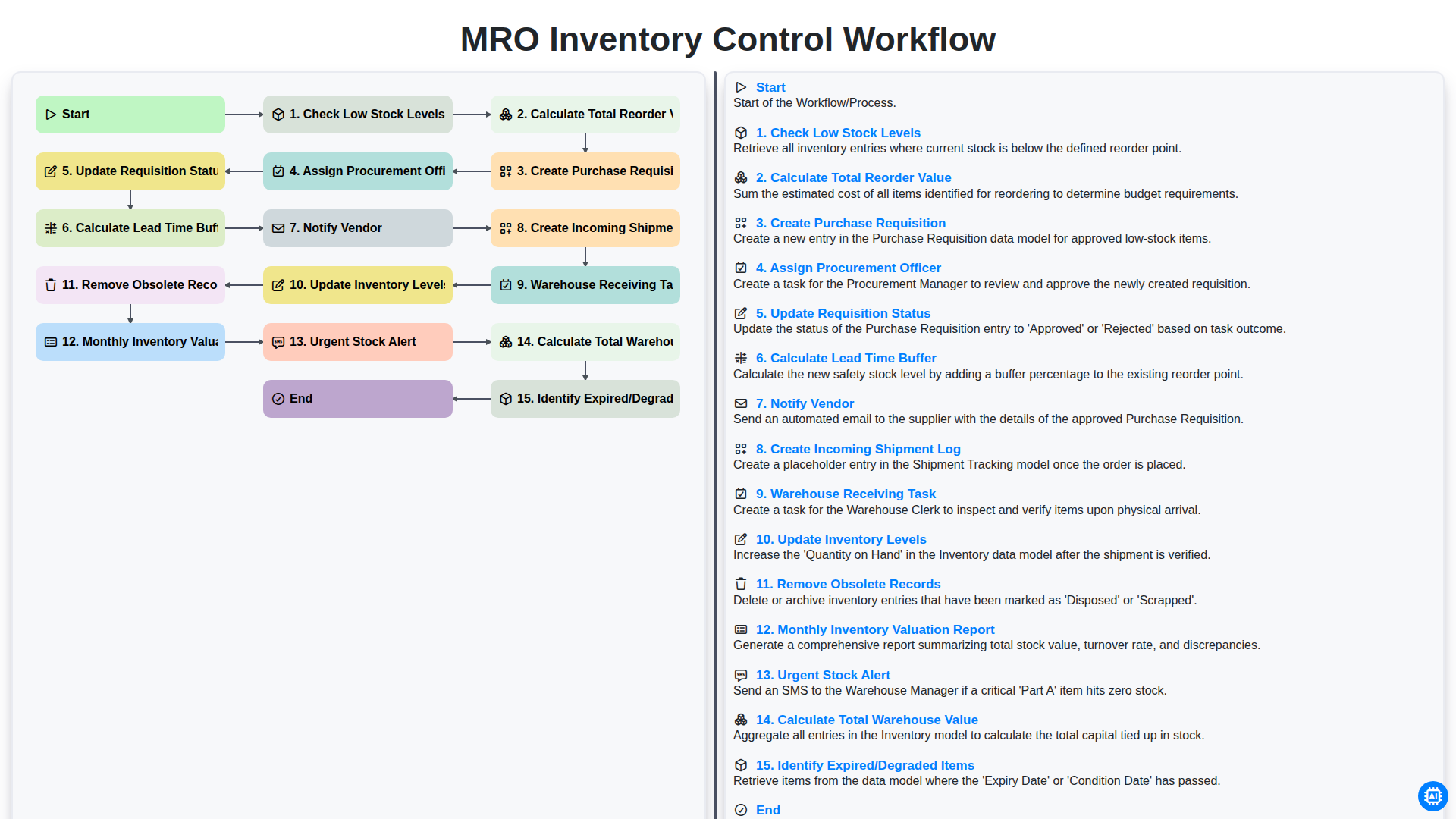
Table of Contents
- Introduction to MRO Inventory Management
- Step 1: Monitoring Stock Levels and Identifying Shortages
- Step 2: Analyzing Reorder Needs and Financial Planning
- Step 3: The Procurement Process: From Requisition to Assignment
- Step 4: Managing Lead Times and Vendor Communication
- Step 5: Receiving Goods and Logging Incoming Shipments
- Step 6: Warehouse Intake and Inventory Synchronization
- Step 7: Maintaining Data Integrity and Removing Obsolete Records
- Step 8: Continuous Monitoring: Urgent Stock Alerts and Expiry Tracking
- Step 9: Financial Oversight: Valuation and Monthly Reporting
- Conclusion: Optimizing Your MRO Workflow for Efficiency
- Resources & Links
TLDR: Learn how to streamline your maintenance operations with our comprehensive MRO Inventory Control Workflow. This guide explains how to automate the entire lifecycle of spare parts management-from monitoring low stock and managing procurement to handling warehouse receiving and performing monthly inventory valuations-ensuring you reduce downtime and optimize warehouse costs.
Introduction to MRO Inventory Management
In the fast-paced world of industrial operations, Maintenance, Repair, and Overhaul (MRO) inventory serves as the lifeblood of organizational uptime. Unlike finished goods, MRO inventory consists of the essential spare parts, tools, and consumables required to keep machinery running and production lines moving. While these items may not be part of your final product, their availability is critical; a single missing bearing or a depleted supply of specialized lubricants can trigger costly downtime, cascading delays, and expensive emergency shipping fees.
Effective MRO management is not merely about counting parts on a shelf; it is about mastering a continuous, proactive cycle of oversight. A robust MRO inventory control workflow ensures that the right parts are available at the right time, preventing both the stockout crises that halt production and the overstock inefficiencies that tie up precious working capital. By implementing a structured approach-from monitoring low stock levels to executing strategic procurement and conducting regular valuations-organizations can transform their maintenance departments from reactive cost centers into streamlined, high-efficiency operational assets.
Step 1: Monitoring Stock Levels and Identifying Shortages
The foundation of an efficient MRO (Maintenance, Repair, and Operations) strategy lies in proactive monitoring rather than reactive firefighting. The process begins with a continuous cycle of checking low stock levels against predefined minimum threshold points. By systematically auditing your inventory, you can identify exactly which critical spares are approaching their reorder points before they reach a critical out-of-stock state.
To prevent unexpected downtime, this phase also involves scanning for an urgent stock alert. These alerts are triggered when a high-priority item drops below a safety limit, signaling that an immediate replenishment action is required to prevent operational disruption. By integrating these checks into a regular cadence, you transition from a manual, error-prone approach to a streamlined, data-driven system that ensures your warehouse always has the necessary components ready for maintenance needs.
Step 2: Analyzing Reorder Needs and Financial Planning
Once the initial check for low stock levels is complete, the focus shifts from identification to strategic planning. This stage is critical because it transforms raw data into actionable procurement intelligence. The process begins with calculating the total reorder value, an essential step that allows management to understand the financial commitment required for replenishment. By determining the exact monetary impact of restocking, the organization can ensure that-the procurement budget remains balanced and that cash flow is effectively managed.
However, replenishment is not just about quantity; it is about timing. To prevent stockouts during supply chain fluctuations, the workflow involves calculating a lead time buffer. By accounting for the time it takes for a vendor to process and deliver an order, you create a safety net that protects against unexpected delays. This proactive calculation ensures that new stock arrives precisely before the existing inventory hits a critical deficit, maintaining seamless operational continuity.
Step 3: The Procurement Process: From Requisition to Assignment
Once the necessary stock levels have been identified, the focus shifts from monitoring to action. The core of the procurement phase begins with Calculating the Total Reorder Value, an essential step to ensure that the upcoming purchase aligns with the department's budget and optimizes shipping costs. With a clear budgetary scope established, the system generates a Create Purchase Requisition, which serves as the official formal request for new stock.
To maintain accountability and streamline the supply chain, the workflow then moves to Assigning a Procurement Officer. This ensures that every request has a dedicated point of contact responsible for oversight. Following this assignment, the workflow includes a mechanism to Update Requisition Status, allowing stakeholders to track whether a request is pending, approved, or in progress. This structured approach prevents bottlenecks and ensures that no critical spare part is overlooked during the transition from identification to acquisition.
Step 4: Managing Lead Times and Vendor Communication
Once the purchase requisition has been assigned to a procurement officer and the status is being updated, the focus shifts from internal administration to external logistics. To prevent stockouts caused by delivery delays, it is critical to calculate a lead time buffer. This involves analyzing the gap between placing an order and the actual arrival of goods, ensuring that your reorder points account for potential shipping delays or customs holdups.
Once this buffer is established, the next actionable step is to notify the vendor. Clear, timely communication with your suppliers ensures they can prepare the order and gives them the opportunity to flag any potential supply chain disruptions early. Effective communication at this stage is the bridge between internal planning and the physical arrival of much-needed MRO supplies.
Step 5: Receiving Goods and Logging Incoming Shipments
Once the vendor has been notified and the shipment is en route, the focus shifts to the physical arrival of the goods. This stage is critical for maintaining data integrity within your MRO system. The process begins with the creation of an incoming shipment log, which serves as a preliminary record of what is expected to arrive. This log acts as a tracking mechanism to ensure that every order placed during the procurement phase is accounted for.
Upon the arrival of the delivery, the warehouse team must execute a formal warehouse receiving task. This is not merely about moving boxes into a bin; it involves a meticulous verification process where the physical items are cross-referenced against the original purchase requisition and the packing slip. This step is your primary defense against discrepancies, such as incorrect quantities or damaged goods. Once the inspection is complete and the items are verified as accurate, the final, crucial step is to update inventory levels within your management system. This ensures that your stock counts reflect reality, preventing phantom stockouts and maintaining the accuracy of your replenishment triggers.
Step 6: Warehouse Intake and Inventory Synchronization
Once the vendor has been notified and the shipment is in transit, the focus shifts to the physical arrival of goods. This stage is critical to ensuring that your digital records accurately reflect your physical stock. The process begins with the creation of an Incoming Shipment Log, which serves as a tracking mechanism for all pending deliveries.
Upon the arrival of the goods, a Warehouse Receiving Task is triggered, requiring staff to physically inspect the items for damage and verify quantities against the packing slip. Once the inspection is complete, the final, most vital step is to Update Inventory Levels within your management system. This synchronization ensures that the procurement team, the floor managers, and the finance department are all viewing a single, accurate version of the truth, preventing the costly error of ghost inventory or unexpected stockouts.
Step 7: Maintaining Data Integrity and Removing Obsolete Records
Effective inventory management is not just about tracking what is currently in your bins; it is about ensuring that your digital records reflect the physical reality of your warehouse. Over time, every MRO (Maintenance, Repair, and Operations) inventory system accumulates digital clutter in the form of obsolete records-items that are no longer in use, parts for decommissioned machinery, or discontinued supplies.
Leaving these dead records in your system leads to several operational inefficiencies. It inflates your total stock counts, skews your inventory valuation reports, and can lead to costly mistakes, such as procurement officers accidentally reordering parts that are no longer needed. To maintain a lean and accurate workflow, it is essential to implement a periodic review process to identify and remove or archive these obsolete entries. By purging outdated data, you ensure that your procurement focus remains on active, mission-critical components, thereby increasing the reliability of your replenishment triggers and the accuracy of your financial forecasting.
Step 8: Continuous Monitoring: Urgent Stock Alerts and Expiry Tracking
Effective MRO management doesn't end once a shipment is logged; it requires vigilant oversight to prevent operational downtime. To maintain a seamless supply chain, two critical monitoring functions must be integrated into your daily workflow: Urgent Stock Alerts and Expiry/Degradation Tracking.
Urgent Stock Alerts act as your facility's early warning system. While regular low-stock checks are scheduled, sudden spikes in usage or unexpected equipment failures can deplete critical spares faster than anticipated. Automated alerts ensure that when a part hits a critical threshold-well below the standard reorder point-the procurement team is notified immediately. This prevents stock-out scenarios that lead to costly machine downtime and emergency shipping fees.
Parallel to real-time alerts, you must implement a rigorous process to Identify Expired or Degraded Items. Many MRO components, such as adhesives, lubricants, seals, and chemicals, have finite shelf lives. Allowing these items to remain in your inventory unnoticed is a dual risk: it leads to inaccurate inventory valuation and, more dangerously, the risk of using failed components in repairs. By systematically auditing for degradation and expiration, you ensure that your available stock is truly functional, maintaining both the integrity of your maintenance operations and the accuracy of your financial records.
Step 9: Financial Oversight: Valuation and Monthly Reporting
Beyond the day-to-day logistics of receiving and restocking, a robust MRO workflow must include a layer of strategic financial oversight. To ensure the health of your supply chain, the process must transition from physical movement to data-driven analysis. This involves generating a Monthly Inventory Valuation Report to track the total capital tied up in spare parts and ensuring that the Total Warehouse Value is accurately reflected in your company's balance sheet.
Furthermore, true inventory control requires proactive maintenance of your data and stock integrity. This stage of the workflow includes the critical task to Identify Expired/Degraded Items, ensuring that rubber seals, lubricants, or chemical agents that have lost their efficacy are removed from circulation before they cause equipment failure. Finally, the process concludes with the need to Remove Obsolete Records-cleaning out data for discontinued parts that no longer serve a purpose-to prevent ghost inventory from skewing your procurement metrics and inflating your perceived stock levels.
Conclusion: Optimizing Your MRO Workflow for Efficiency
Mastering your MRO Inventory Control Workflow is not just about tracking parts; it is about creating a seamless, automated cycle that prevents costly downtime and eliminates manual errors. By integrating proactive steps-such as checking low stock levels and calculating lead time buffers-with rigorous maintenance tasks like identifying expired items and removing obsolete records-you transform your warehouse from a reactive cost center into a streamlined, strategic asset.
Implementing this structured approach ensures that your procurement team is never caught off guard by urgent stock alerts and that your financial oversight remains precise through regular inventory valuations. Ultimately, an optimized workflow drives operational resilience, reduces waste, and ensures that the right components are always available exactly when they are needed.
Resources & Links
- Gartner Supply Chain Research: In-depth industry insights and benchmarks for optimizing supply chain and inventory management workflows.
- APICS/ASCM Resources: Professional standards and best practices for inventory control, procurement, and warehouse management.
- IoT and Automated Tracking Solutions: Technological resources regarding the use of sensors and automation in monitoring stock levels and real-time alerts.
- SAP Inventory Management Modules: Technical documentation on integrating procurement, receiving, and valuation processes within an ERP system.
- McKinsey Operations Insights: Strategic frameworks for managing MRO costs, reducing obsolete inventory, and optimizing warehouse value.
- IBM Supply Chain Intelligence: Data-driven approaches to calculating lead times, managing vendor communication, and predictive stock alerting.
Found this Article helpful?
Comments
There are no comments yet. Be the first to add one!
Maintenance Management Solution Demo
Maximize equipment uptime & reduce costs! ChecklistGuro streamlines maintenance scheduling, work order management, & asset tracking. Prevent breakdowns, optimize performance, & extend equipment life. Manage it all with our Work OS.
Related Articles
Construction Equipment Maintenance Checklist Template

Paper vs ChecklistGuro in Facility Management
The Ultimate O&M Manual Checklist Template

Excel vs ChecklistGuro in Facility Management
Excel vs ChecklistGuro in Maintenance Management
Your Ultimate Guide to Critical Spares Management: A Checklist Template
Equipment Repair Log Template: Your Guide to Organized Maintenance
Paper vs ChecklistGuro in Maintenance Management
We can do it Together
Need help with
Checklists?
Have a question? We're here to help. Please submit your inquiry, and we'll respond promptly.