The Ultimate Post-Harvest Cold Storage Temperature Audit Checklist 2026: A Comprehensive Template for Food Safety and Quality Compliance
Published: 10/31/2026 Updated: 11/01/2026
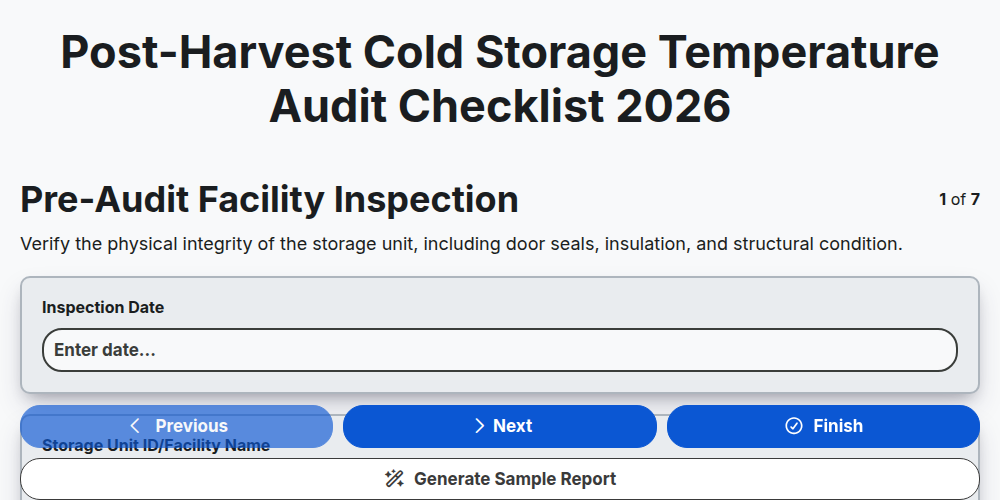
Table of Contents
- Introduction: Why Temperature Audits are Critical in 2026
- Preparing for Success: The Pre-Audit Facility Inspection
- Precision Monitoring: Temperature and Humidity Control Protocols
- Hardware Integrity: Refrigeration Unit and Equipment Assessment
- Optimizing Airflow: Inventory Management and Product Placement
- Risk Mitigation: Evaluating Alarm and Emergency Alert Systems
- Maintaining Cleanliness: Sanitation and Hygiene Standards
- Regulatory Readiness: Documentation and Record Compliance
- Post-Audit Action Plan: Addressing Non-Compliance
- Conclusion: Future-Proofing Your Cold Chain Strategy
- Resources & Links
TLDR: Ensure maximum crop freshness and regulatory compliance with our 2026 Post-Harvest Cold Storage Temperature Audit Checklist. This comprehensive guide provides a step-by-step template covering everything from facility inspections and refrigeration hardware checks to humidity monitoring, inventory placement, and emergency alert system verification to prevent spoilage and maintain food safety standards.
Introduction: Why Temperature Audits are Critical in 2026
Ensuring Freshness in an Evolving Supply Chain
As we move into 2026, the global food supply chain is facing unprecedented pressures. With increasing regulatory scrutiny, more complex logistics networks, and a heightened consumer demand for farm-to-fork transparency, the margin for error in post-harvest management has vanished. In this landscape, a temperature deviation is no longer just a technical glitch; it is a significant financial and reputational risk.
The High Stakes of Cold Chain Integrity
The integrity of your post-harvest operations relies on one fundamental variable: thermal stability. Even a brief period of temperature fluctuation can trigger enzymatic degradation, accelerate microbial growth, and compromise the nutritional density of your produce. For modern agricultural enterprises, an audit is not merely a routine check-it is a proactive defense mechanism against foodborne illnesses, massive inventory shrinkage, and costly product recalls.
Beyond Temperature: The 2026 Compliance Landscape
In 2026, good enough is no longer a standard. Regulatory bodies are moving toward more rigorous, data-driven enforcement of food safety protocols. To stay ahead of these shifts, your audit process must move beyond simple thermometer readings to encompass a holistic view of the cold storage environment.
An effective audit allows you to identify:
- Hidden Vulnerabilities: Detecting mechanical fatigue in refrigeration units before they lead to catastrophic failure.
- Operational Gaps: Identifying inconsistencies in staff handling protocols or inventory placement.
- Data Integrity Issues: Ensuring that your digital monitoring systems are providing accurate, unalterable records for compliance audits.
By implementing a standardized, rigorous checklist, you transition from a reactive posture (fixing problems after spoilage occurs) to a predictive posture (preventing spoilage through systematic oversight). The following guide provides a professional-grade template designed to help you navigate these complexities and maintain the highest standards of quality assurance.
Preparing for Success: The Pre-Audit Facility Inspection
Laying the Groundwork: The Pre-Audit Foundation
Before the first thermometer is even calibrated or a single sensor is checked, a successful audit begins with a high-level overview of your facility's physical state. The Pre-Audit Facility Inspection is not about deep-diving into data; it is about identifying structural and operational red flags that could compromise temperature integrity before the actual audit begins.
Think of this phase as a dry run designed to catch preventable issues that could lead to non-compliance citations or, worse, product loss.
Structural Integrity and Perimeter Security
A temperature-controlled environment is only as effective as the container holding it. During this preliminary phase, your inspection team should focus on the physical boundaries of the cold storage area:
- Seal and Door Inspections: Check for worn-out gaskets, compromised door seals, and any gaps in loading dock levelers. Even a small air leak can create hot spots that disrupt uniform cooling.
- Insulation Assessment: Inspect walls, ceilings, and floors for signs of condensation, ice buildup, or structural cracks that could indicate compromised thermal insulation.
- Lighting and Visibility: Ensure that all areas of the facility, including deep corners and high-rack zones, are well-lit. Poor visibility can lead to missed inspections or overlooked physical damage to goods.
Assessing the Environment Around the Cold Chain
The audit preparation must extend beyond the refrigerated walls. An inspection of the immediate surroundings is critical to ensure the facility is optimized for the 2026 regulatory landscape:
- External Environmental Factors: Evaluate how external ambient temperatures and weather conditions (such as extreme heatwaves or humidity) might be impacting the facility's ability to maintain set points.
- Access Control Review: Verify that all entry points are functioning correctly and that security protocols are preventing unauthorized access, which could lead to frequent door openings and temperature fluctuations.
Identifying Potential Blind Spots
The goal of the pre-audit inspection is to eliminate uncertainty. By identifying structural weaknesses early, you allow your maintenance teams the necessary lead time to perform repairs. Addressing a leaking door or a faulty seal before the auditor arrives demonstrates a proactive culture of food safety and operational excellence, setting a positive tone for the entire audit process.
Precision Monitoring: Temperature and Humidity Control Protocols
Maintaining the Gold Standard of Thermal Stability
In the post-harvest supply chain, temperature fluctuations are the primary enemy of shelf-life. For the 2026 audit season, manual logging is no longer sufficient; auditors will be looking for high-frequency,-granular data that proves thermal stability rather than just averages.
Precise Temperature Tracking
The core of your audit compliance lies in your ability to demonstrate that every cubic meter of your facility remains within the designated set points. Your protocol must include:
- Continuous Data Logging: Moving beyond periodic checks to real-time, automated sensing.
- Sensor Calibration Verification: Ensuring all probes and thermocouples are calibrated against traceable NIST (or local equivalent) standards.
- Zone-Specific Monitoring: Identifying and monitoring hot spots or cold spots within the facility, particularly near loading docks and door seals.
- Thermal Mapping Integrity: Verifying that recent thermal mapping studies align with current storage configurations.
Humidity and Moisture Management
Temperature control is only half the battle. Controlling Relative Humidity (RH) is critical to preventing both dehydration (shrinkage) and microbial growth (mold/fungi).
- Dew Point Analysis: Monitoring the dew point to prevent condensation on product surfaces, which can trigger rapid spoilage.
- Moisture Content Regulation: Ensuring humidity levels are optimized for specific crop types (e.g., high humidity for leafy greens vs. controlled low humidity for certain stone fruits).
- Dehumidification Performance: Auditing the functionality of dehumidification units to ensure they are actively removing excess moisture during high-load periods.
Data Integrity and Alert Responsiveness
An audit failure often occurs not because a temperature excursion happened, but because the facility failed to document the response.
- Threshold Verification: Testing whether your system triggers immediate alerts when temperature or humidity drifts outside of the critical limit (CL).
- Automated Alert Auditing: Reviewing the logs of SMS, email, or siren alerts to ensure the facility team responded within the mandatory window.
- Variance Analysis: Proactively identifying trends where humidity or temperature is creeping toward the limit before an actual breach occurs.
Hardware Integrity: Refrigeration Unit and Equipment Assessment
Ensuring Mechanical Reliability and Operational Continuity
A temperature audit is not merely about reading a digital display; it is about verifying the mechanical health of the infrastructure responsible for maintaining those numbers. In 2026, with the integration of more complex automated cooling systems, your hardware assessment must go beyond the surface level to identify potential points of failure before they lead to catastrophic spoilage.
Compressor and Condenser Unit Inspection
The heart of your cold storage system requires a thorough physical assessment. During your audit, focus on the following:
- Condenser Coil Cleanliness: Check for dust, debris, or frost buildup that could impede heat exchange and force the system to overwork.
- Compressor Performance: Listen for irregular vibrations or grinding noises that indicate mechanical fatigue or lubrication issues.
- Refrigerant Levels: Inspect for signs of leaks or oil residue around valves and joints, which could signal a drop in pressure.
Evaporator and Airflow Management
Even if the temperature is correct, improper airflow can create hot spots within the facility.
- Fan Blade Integrity: Inspect evaporator fans for balanced rotation and ensure no ice accumulation is obstructing the blades.
- Defrost Cycle Efficiency: Verify that the automated defrost cycles are triggering correctly and that the heating elements are effectively removing frost from the coils.
- Air Distribution Patterns: Ensure that air vents are not obstructed by overpacked pallets, which can disrupt the thermal equilibrium of the storage zone.
Door Seals and Insulation Integrity
The boundary between your controlled environment and the external atmosphere is your most vulnerable point of heat gain.
- Gasket Integrity: Inspect all door gaskets for cracks, brittleness, or gaps. Even a microscopic breach can lead to significant energy loss and humidity spikes.
- Seal Compression: Test the suction or pressure of magnetic seals to ensure a complete airtight closure upon impact.
- Thermal Bridging Check: Inspect the structural integrity of loading dock seals and insulated panels for any signs of moisture ingress or degradation.
Sensor and Thermostat Calibration
The accuracy of your audit depends entirely on the accuracy of your hardware's eyes.
- Sensor Placement Verification: Ensure that temperature probes are placed in the most vulnerable areas (e.g., near doors or high-heat zones) rather than just near the cooling source.
- Calibration Logs: Confirm that all digital thermostats and IoT-enabled sensors have undergone recent, documented calibration against a certified standard thermometer.
Optimizing Airflow: Inventory Management and Product Placement
Maximizing Efficiency Through Strategic Product Placement
An audit of your cold storage facility is not just about checking thermometer readings; it is about evaluating how your inventory layout affects thermal stability. Even if your refrigeration units are functioning perfectly, improper product placement can create dead zones and pockets of warm air that jeopardize food safety and accelerate spoilage.
Ensuring Unobstructed Airflow
The primary objective during a temperature audit is to verify that cold air can circulate freely around every item in the facility. During your inspection, focus on the following critical areas:
- The No-Stacking Rule for Walls and Ceilings: Ensure that inventory is not pushed directly against the walls or stacked too close to the ceiling. A gap of at least 12 to 18 inches is essential to allow cold air to circulate behind and above the product.
- Pallet Gap Analysis: Verify that pallets are not tightly packed together in a way that creates an airtight mass. Air must be able to move between pallet rows to prevent heat entrapment in the center of the load.
- Floor Clearance: Confirm that all products are stored on pallets or racking systems that allow air to circulate underneath the inventory, preventing moisture buildup and temperature fluctuations at the base of the stack.
Strategic Zoning and Temperature Segregation
A comprehensive 2026 audit must also assess how different product types are categorized within the facility.
- Thermal Load Management: Check if high-respiration products (like leafy greens) are separated from products with different temperature requirements. Mixing incompatible crops can lead to uneven cooling and rapid degradation.
- Proximity to Cooling Sources: Evaluate whether high-sensitivity items are placed in the most stable temperature zones, away from the hot spots typically found near loading bay doors or high-traffic transit zones.
- Load Density Assessment: Observe if the facility is overstocked. Overcrowding is one of the leading causes of temperature spikes, as the refrigeration system's capacity is overwhelmed by the sheer volume of thermal mass and obstructed airflow.
Risk Mitigation: Evaluating Alarm and Emergency Alert Systems
Ensuring Continuous Oversight: Evaluating Alarm and Emergency Alert Systems
In the context of post-harvest management, a temperature deviation is not just a technical error-it is a direct threat to product shelf-life and food safety. An audit of your alarm and emergency alert systems is perhaps the most critical component of your 2026 compliance strategy. It is not enough to have a system that records data; you must verify that your system communicates failures in real-time.
During the audit, your focus should move beyond simple functionality and into the reliability of your notification ecosystem.
1. Real-Time Alert Functionality and Latency
The primary goal is to ensure that the interval between a temperature breach and a notification reaching the responsible party is near-zero.
- Threshold Verification: Test whether the system triggers an alert immediately when the temperature crosses the predefined Warning limit and a secondary, more urgent alert when it hits the Critical limit.
- Notification Latency: Evaluate the time delay between the sensor detecting a deviation and the delivery of the SMS, email, or automated phone call.
2. Multi-Channel Redundancy
A single point of failure in your communication chain can lead to catastrophic crop loss. Your audit must confirm that alerts are distributed through redundant channels.
- Redundant Delivery Methods: Does the system use multiple pathways (e.g., cellular, Wi-Fi, and SMS) to ensure an alert is received even if a local network goes down?
- Contact Escalation Protocols: Verify that the system follows a hierarchical call tree. If the primary facility manager does not acknowledge a critical alert within a specific timeframe, does the system automatically escalate the notification to the operations director or owner?
3. Acknowledgment and Response Verification
An alarm is useless if it is ignored. A robust audit must examine the closed-loop nature of your alert system.
- Digital Acknowledgment Logs: Check if the system requires the receiver to manually acknowledge an alert within the software. This creates a digital paper trail proving that the breach was recognized.
- Response Integration: Evaluate how the alert system integrates with your maintenance workflow. Once an alert is triggered, is there a documented process to transition from Alert Received to Technician Dispatched?
4. Power Failure and Hardware Connectivity Alerts
The most dangerous temperature excursions often occur during power outages or sensor malfunctions.
- Connectivity Monitoring: Ensure the system triggers an alert if a sensor goes offline or loses its heartbeat signal to the central monitoring hub.
- Backup Power Status: Audit the monitoring of your Uninterruptible Power Supply (UPS) or backup generator. The system should alert management the moment the facility shifts from grid power to backup power, allowing for proactive monitoring of fuel levels and battery health.
Maintaining Cleanliness: Sanitation and Hygiene Standards
Ensuring Food Safety Through Rigorous Sanitation Protocols
In the context of a temperature audit, sanitation is not just about visible cleanliness; it is about preventing microbial growth and cross-contamination that can compromise the efficacy of your cold chain. Even the most advanced refrigeration technology cannot compensate for a facility plagued by biological hazards or organic buildup.
Microbiological Control and Surface Sanitization
A critical component of your 2026 audit must focus on the cleanliness of all food-contact and non-food-contact surfaces.
- Equipment Sterilization: Verify that cooling coils, evaporators, and drip trays are free from mold, algae, and biofilm buildup, which can harbor bacteria and disrupt airflow.
- Sanitization Schedule Verification: Audit the logs to ensure that cleaning agents used are food-grade and that contact times (the duration a disinfectant must remain on a surface to be effective) are being strictly followed.
- Drainage and Moisture Management: Inspect floor drains and condensation runoff. Stagnant water is a primary breeding ground for Listeria monocytogenes; ensure all drains are clear and treated regularly.
Prevention of Cross-Contamination
The physical layout and cleaning processes must prevent the transfer of pathogens from high-risk areas to sensitive products.
- Zoning Integrity: Check that cleaning tools (mops, brushes, buckets) are color-coded or physically separated by zone to prevent moving contaminants from loading docks to high-care storage areas.
- Pest Management Integration: Ensure that sanitation efforts are working in tandem with pest control. Debris or organic residue left in corners can attract pests, compromising the structural integrity of your temperature-controlled environment.
Personnel Hygiene and Standard Operating Procedures (SOPs)
The human element remains the most significant variable in maintaining a sterile environment.
- Hand Hygiene and PPE Compliance: Audit the availability and usage of proper handwashing stations and the integrity of protective gear (gloves, hairnets, aprons) worn by staff during inventory movement.
- Training Verification: Confirm that all personnel have undergone updated 2026 food safety training, specifically focusing on the link between hygiene practices and temperature stability (e.g., how improper door handling or cleaning residue affects sensor accuracy).
Regulatory Readiness: Documentation and Record Compliance
Ensuring Audit-Proof Record Keeping
In the eyes of a food safety auditor, if it wasn't documented, it didn't happen. As we move into 2026, regulatory bodies are placing even greater emphasis on the integrity and traceability of digital and manual logs. Compliance is no longer just about maintaining the right temperature; it is about proving a continuous, unbroken chain of thermal stability through verifiable data.
Essential Documentation Requirements
To ensure your facility passes a modern audit, your documentation strategy must cover the following pillars:
- Temperature Logs (Continuous & Periodic): Maintain a seamless record of both automated sensor data and manual spot-check logs. Ensure these logs are time-stamped and reflect all fluctuations during shift changes.
- Calibration Certificates: Keep updated documentation for all thermometers, hygrometers, and sensors. An audit will fail immediately if your monitoring equipment cannot be proven to be calibrated against NIST-traceable standards.
- Corrective Action Logs (CAPA): This is the most critical section for auditors. When a temperature excursion occurs, you must document not just the event, but the specific action taken to mitigate risk and the steps implemented to prevent recurrence.
- Maintenance and Repair Records: Provide a clear history of servicing for refrigeration units, compressors, and backup generators. This proves that your cooling infrastructure is being proactively managed rather than reactively repaired.
- Training Records: Documentation must prove that all personnel handling the cold chain have been trained on the specific protocols outlined in your Standard Operating Procedures (SOPs).
Digital Transformation and Data Integrity
As we navigate 2026, the industry standard is shifting toward automated, cloud-based logging. Manual paper logs are increasingly viewed as high-risk due to the potential for human error or data manipulation.
Best Practices for Compliance
- Implement Real-Time Verification: Use digital systems that provide instant verification of data entry to prevent retrospective logging (filling out logs at the end of a week).
- Organize for Quick Retrieval: During an unannounced audit, the speed of your response is a metric of your control. Keep all digital files organized in a folder structure that mirrors your audit checklist.
- Audit Your Auditors: Periodically perform internal mock audits of your own records to identify gaps in your paperwork before a regulatory official does.
Post-Audit Action Plan: Addressing Non-Compliance
Turning Findings into Action: The Post-Audit Action Plan
An audit is only as valuable as the actions taken following the final inspection. Detecting a temperature deviation or a hardware malfunction is the first step; the second-and most critical-is implementing a systematic response to remediate the issue and prevent recurrence.
To ensure your facility remains compliant with 2026 food safety standards, follow this structured framework to address non-compliance findings.
1. Immediate Containment and Risk Assessment
The moment a non-compliance issue is identified, your priority is product safety.
- Isolate Affected Inventory: Immediately quarantine any products that were exposed to temperatures outside the required threshold.
- Assess Product Integrity: Perform a sensory and microbial evaluation (where applicable) to determine if the breach has compromised the product's shelf life or safety.
- Determine Disposition: Decide whether the affected stock can be safely returned to optimal storage, requires expedited processing, or must be disposed of to prevent a larger food safety crisis.
2. Root Cause Analysis (RCA)
Do not simply fix the symptom; find the source of the failure. If a refrigeration unit failed, ask why.
- The 5 Whys Method: If a temperature spike occurred, was it due to a mechanical failure, a door left open, an unexpected heatwave, or a sensor calibration error?
- Categorize the Failure: Determine if the breach was Mechanical (hardware failure), Operational (human error/unclosed doors), or Procedural (lack of monitoring/missed logs).
3. Corrective and Preventive Actions (CAPA)
Once the root cause is identified, implement a two-tiered approach:
- Corrective Action (The Quick Fix): Repair the broken seal, recalibrate the thermometer, or replace the faulty sensor immediately to restore standard operating conditions.
- Preventive Action (The Long-Term Solution): Update your Maintenance Schedule (PMs), implement additional staff training on door management, or upgrade your automated alert system to provide more granular data.
4. Verification and Verification of Effectiveness
A corrective action is not complete until you have proven it works.
- Increased Monitoring Frequency: Following an audit failure, move from daily to hourly temperature checks for a set period (e.g., 7-14 days) to ensure stability.
- Follow-up Audits: Schedule an internal mini-audit focused specifically on the failed parameter to verify that the new controls are being followed by the floor team.
5. Documenting the Resolution
In the eyes of food safety inspectors, if it wasn't documented, it didn't happen.
- Update the Audit Log: Create a formal Non-Conformance Report (NCR) that includes the original finding, the root cause identified, the actions taken, and the date of resolution.
- Close the Loop: Ensure all updated training logs or maintenance receipts are filed alongside the audit report to demonstrate a culture of continuous improvement and total traceability.
Conclusion: Future-Proofing Your Cold Chain Strategy
Ensuring Long-Term Resilience in an Evolving Landscape
As we move into 2026, the margin for error in post-harvest management has vanished. With the increasing complexity of global supply chains and the heightened sensitivity of modern consumer demands for freshness-guaranteed produce, a temperature audit can no longer be a reactive, once-a-year event. It must be a proactive, integrated pillar of your operational strategy.
Moving Beyond Compliance to Competitive Advantage
The checklist provided above is more than just a regulatory safeguard; it is a blueprint for operational excellence. By systematically addressing everything from Pre-Audit Facility Inspections to Documentation and Record Compliance, you are doing more than avoiding fines-you are protecting your brand equity.
In an era where smart technology is becoming the industry standard, use these audit points to identify where manual processes are failing and where automation (such as IoT-enabled real-time sensors) can provide a safety net.
Final Thoughts for Cold Storage Managers
To successfully navigate the 2026 landscape, remember these three key takeaways:
- Consistency is King: An audit is only as good as the daily habits that precede it. Use the Temperature and Humidity Monitoring section to drive daily staff training.
- Hardware is the Foundation: Do not neglect the Refrigeration Unit and Hardware Check. A failure in a single compressor can render an entire audit-and an entire harvest-useless.
- Data is Your Best Defense: In the event of a dispute or a food safety investigation, your Documentation and Record Compliance will be your only shield. Ensure your digital logs are immutable and easily accessible.
By implementing this checklist rigorously, you transition your facility from a state of mere storage to a high-performance value-preservation hub, ensuring that every harvest reaches the consumer in peak condition, every single time.
Resources & Links
- U.S. Food and Drug Administration (FDA): The primary regulatory body providing guidelines on food safety, FSMA compliance, and temperature control standards for perishable goods.
- USDA Food Safety and Inspection Service: Essential resources for meat, poultry, and egg products regarding temperature regulations and inspection protocols.
- International Organization for Standardization (ISO): Access to global standards for food safety management systems (ISO 22000) and quality control processes.
- CFE - Certified Food Safety Professional: Professional development resources for maintaining high-level hygiene and sanitation standards in food facilities.
- FoodSafety.gov: A collaborative government website providing science-based information on preventing foodborne illness through proper storage.
- ASTM International: Technical standards for testing materials and equipment used in refrigeration and cold chain hardware integrity.
- American Society for Quality (ASQ): Resources for implementing auditing methodologies, root cause analysis, and quality management in production environments.
- Food Safety Magazine: Industry news and deep-dive articles on the latest trends in cold chain technology and food safety compliance.
- European Commission - Food Safety: Global benchmarks for food safety regulations and temperature-controlled logistics standards used in international trade.
- Food Engineering Magazine: Technical insights into food processing equipment, automation, and airflow optimization in industrial refrigeration.
- World Codex for Science (Cold Chain Logistics): Technical research on the thermodynamics of temperature-controlled environments and humidity-driven spoilage.
- National Institute for Science and Engineering: Advanced research on sensor technology and IoT-based real-time monitoring for automated alarm systems.
- International Food Safety Alliance: A global network providing best practices for post-harvest management and food waste reduction.
- HACCP International: Specialized training and resources for implementing Hazard Analysis and Critical Control Points in cold storage.
- CFIA - Canadian Food Inspection Agency: Regulatory frameworks for temperature monitoring and documentation compliance for export/import logistics.
- Food Safety Network: A community-driven resource for discussing sanitation standards, hygiene, and pest control in food warehouses.
Comments
There are no comments yet. Be the first to add one!
Farm Management Solution Demo
Grow your farm smarter & more efficiently! ChecklistGuro streamlines crop planning, task management, & resource tracking. Maximize yields, reduce waste, & improve profitability. Manage it all with our Work OS.
Related Articles
Unlock Higher Yields: Your Precision Agriculture Checklist Template
The Ultimate Farm Safety Inspection Report Checklist Template
Irrigation System Checklist: Farm Water Management & Crop Yield Optimization

Livestock Health & Welfare Checklist: Your Farm Animal Care & Biosecurity Template
Crop Insurance Policy Review Checklist: A Farmer's Guide
Water Discharge Permit Compliance Checklist Template
The Ultimate GPS & Precision Farming Calibration Checklist Template
Mapping the Threat: A Checklist for Proactive Pest & Disease Pressure Management
Need help with
Farm Management?
Have a question? We're here to help. Please submit your inquiry, and we'll respond promptly.