Production Performance Monitoring Workflow for Manufacturers
Published: 03/30/2026 Updated: 03/31/2026
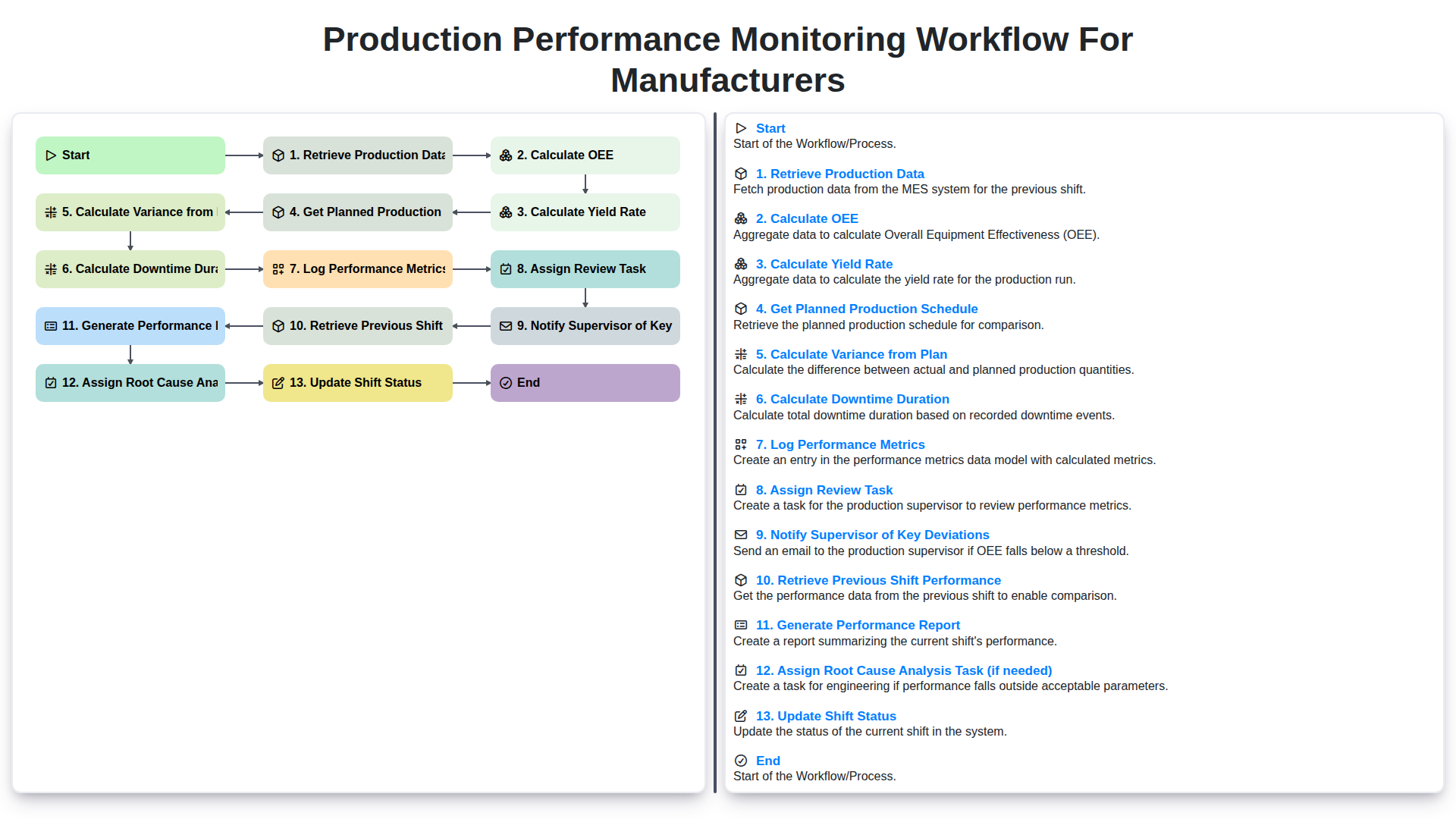
Table of Contents
- Introduction: Why Production Performance Monitoring Matters
- 1. Retrieving Real-Time Production Data
- 2. Calculating Overall Equipment Effectiveness (OEE)
- 3. Determining Yield Rate: Measuring Output Quality
- 4. Integrating the Planned Production Schedule
- 5. Variance Analysis: Comparing Actual vs. Planned
- 6. Downtime Duration: Identifying Lost Production Time
- 7. Logging Performance Metrics: Building a Historical Record
- 8. The Review Task: Spotting Trends and Anomalies
- 9. Supervisor Notifications: Addressing Critical Deviations
- 10. Leveraging Previous Shift Performance for Context
- 11. Generating Comprehensive Performance Reports
- 12. Root Cause Analysis: Digging Deeper into Issues
- 13. Updating Shift Status: Reflecting Performance
- 14. Benefits of a Robust Production Performance Monitoring Workflow
- Resources & Links
TLDR: This workflow automates your production performance tracking! It pulls data, calculates key metrics like OEE and yield, compares actual vs. planned output, flags issues like downtime and deviations, generates reports, and assigns tasks for root cause analysis - all to help manufacturers optimize efficiency and minimize losses.
Introduction: Why Production Performance Monitoring Matters
In today's competitive manufacturing landscape, efficiency isn't just a goal-it's a necessity. Production performance monitoring isn't just about tracking numbers; it's about understanding why those numbers are what they are and using that knowledge to drive continuous improvement. Without a clear picture of your production processes, you're essentially flying blind, potentially losing significant revenue due to inefficiencies, defects, and unplanned downtime.
Effective monitoring enables proactive problem-solving, identifies bottlenecks, and allows for data-driven decisions that optimize resource allocation, reduce waste, and ultimately, boost profitability. It's about transforming raw data into actionable insights that empower your team to consistently deliver high-quality products, on time, and within budget. Failing to monitor performance leaves you vulnerable to reactive firefighting, rather than strategically enhancing your operations.
1. Retrieving Real-Time Production Data
The foundation of any effective production performance monitoring workflow is the reliable and continuous retrieval of raw production data. This isn't just about pulling numbers; it's about capturing the granular details that paint a true picture of your manufacturing process.
Traditionally, this involved manual data entry, which is prone to errors and significant delays. Modern manufacturing relies on automated data acquisition through a variety of sources, including:
- PLC Integration: Connecting to Programmable Logic Controllers (PLCs) allows for direct access to machine status, cycle times, production counts, and more. This is the gold standard for real-time accuracy.
- MES (Manufacturing Execution System) Integration: MES systems often centralize production data, providing a unified source for retrieving information across multiple machines and processes.
- SCADA (Supervisory Control and Data Acquisition) Systems: Similar to MES, SCADA systems monitor and control industrial processes and provide valuable data streams.
- IIoT Sensors: Increasingly, Industrial Internet of Things (IIoT) sensors are being deployed to monitor specific parameters like temperature, pressure, vibration, and energy consumption, providing deeper insights.
- Manual Input (where unavoidable): While minimized, some data points might still require manual input. Clear protocols and user-friendly interfaces are crucial to minimize errors.
Regardless of the source, data integrity is paramount. Implementing data validation checks - ensuring data falls within expected ranges and formats - is a critical first step in building trust in your performance metrics. The speed and accuracy of this data retrieval directly impacts the responsiveness of your entire workflow.
2. Calculating Overall Equipment Effectiveness (OEE)
OEE (Overall Equipment Effectiveness) is a critical metric for manufacturers, providing a holistic view of how effectively your production equipment is being utilized. It combines Availability, Performance, and Quality into a single, easily understandable percentage.
The Formula: OEE = Availability x Performance x Quality
Let's break down each component:
- Availability: This measures the percentage of time your equipment is actually running. It's calculated as: (Run Time / Planned Production Time). Downtime - including breakdowns, setup and adjustments - directly impacts Availability.
- Performance: This indicates how close your equipment is running to its theoretical maximum speed. It's calculated as: (Total Pieces Produced / (Run Time x Ideal Cycle Time)). It accounts for slow cycles and minor stops.
- Quality: This represents the percentage of good pieces produced. It's calculated as: (Good Pieces Produced / Total Pieces Produced). Defects and rework significantly reduce Quality.
Example:
Let's say a machine is planned to run for 8 hours (Planned Production Time). Due to a breakdown, it only runs for 7.5 hours (Run Time). It produces 1000 parts, with an ideal cycle time of 30 seconds per part. However, due to inefficiencies, it actually takes 35 seconds per part. And out of the 1000 parts produced, 95 are defective.
- Availability = 7.5 hours / 8 hours = 93.75%
- Performance = (1000 parts / (7.5 hours * 35 seconds/part)) = 47.62% (Converting hours to seconds is important for accuracy)
- Quality = 950 good parts / 1000 parts = 95%
Therefore, OEE = 93.75% * 47.62% * 95% = 41.77%
This low OEE score immediately flags an area for improvement. The workflow then triggers a deeper dive into the contributing factors - whether it's addressing downtime, optimizing performance, or improving quality control.
3. Determining Yield Rate: Measuring Output Quality
Yield rate is a critical indicator of manufacturing efficiency, reflecting the percentage of good, usable products produced from a given input. It directly impacts profitability and customer satisfaction. Calculating yield rate isn't just about counting 'good' parts; it's about understanding the entire production process and identifying areas for improvement.
Here's how we calculate yield rate within our workflow:
- Define 'Good' Product: This is the first and arguably most important step. Clearly define what constitutes a 'good' product - what quality standards must be met? This definition needs to be consistent across shifts and operators.
- Track Defective Units: Meticulously track and categorize defective units. This isn't just about quantity; understanding the types of defects is vital for root cause analysis (more on that later). Common categories might include dimensional inaccuracies, material flaws, cosmetic blemishes, or functional failures.
- Calculate Yield: The formula is straightforward:
Yield Rate = (Number of Good Units / Total Number of Units Produced) * 100
For example, if you produce 1000 units and 950 are deemed 'good,' your yield rate is 95%. 4. Trend Analysis: It's not enough to simply calculate yield once. Track yield rates over time, by shift, by product type, and by machine to identify trends and patterns. A sudden drop in yield, for example, warrants immediate investigation.
By diligently tracking yield rate, manufacturers can proactively address quality issues, minimize waste, and optimize production processes.
4. Integrating the Planned Production Schedule
A critical component of effective production performance monitoring is comparing actual output against the planned production schedule. This isn't just about knowing how much was produced, but how well the production adhered to the intended plan. Our workflow directly incorporates this by getting the planned production schedule as a key data input.
This data, typically sourced from ERP or MES systems, defines the target units to be produced per shift, along with target start and end times for each product or batch. We then use this planned schedule to accurately calculate variances. For example, if the plan called for 500 units of Product A, and only 450 were actually produced, this is immediately flagged as a variance.
Beyond simple quantity discrepancies, we analyze timing variances as well. Was production delayed? Were products completed ahead of schedule? These timing differences, though seemingly minor, can indicate underlying issues impacting efficiency and potentially downstream processes. Integrating the planned schedule provides context - it transforms raw production numbers into meaningful performance insights, revealing areas where adjustments and improvements are needed to bridge the gap between plan and reality.
5. Variance Analysis: Comparing Actual vs. Planned
Understanding how your actual production performance stacks up against the planned schedule is crucial for identifying areas of opportunity and proactively addressing potential issues. This step goes beyond simply knowing your OEE or yield; it's about why those numbers are what they are.
We calculate variance by comparing your actual production output (units produced, cycle times, etc.) against your planned production schedule. This comparison isn't just about volume; it considers timing and efficiency. Are you producing fewer units than planned? Are those units taking longer to produce?
Significant variances signal potential problems. A consistently low production volume variance might indicate material shortages, equipment malfunctions, or operator skill gaps. A large variance in cycle time could point to process inefficiencies or bottlenecks.
Our system automatically calculates these variances, often expressed as percentage differences or absolute value differences. These results are flagged with clear indicators - highlighting variances exceeding pre-defined thresholds. This allows immediate attention to significant deviations and prevents minor issues from escalating into major disruptions. For instance, a 10% variance in units produced might warrant investigation, whereas a 30% variance demands immediate corrective action.
6. Downtime Duration: Identifying Lost Production Time
Downtime is the enemy of efficient manufacturing. Accurately calculating and understanding downtime duration is crucial for pinpointing areas of operational weakness and driving meaningful improvement. This isn't just about knowing how long a machine was down; it's about the types of downtime and their frequency.
Our workflow automatically calculates downtime duration by categorizing it into distinct types: Planned downtime (e.g., preventative maintenance), Unplanned downtime (e.g., equipment failure), and Changeover downtime (switching between production runs). The system tracks the duration of each type, providing a granular view beyond a simple total downtime number.
This breakdown is vital for:
- Prioritizing Maintenance: Recurring downtime events highlight equipment needing immediate attention.
- Optimizing Changeover Procedures: Long changeover times indicate inefficiencies in the setup process.
- Improving Equipment Reliability: Frequent unplanned downtime signals potential design flaws or lack of proper care.
The calculated downtime duration is then directly correlated with OEE and Yield Rate, providing a clear indication of the financial impact of these losses. For example, a sudden spike in downtime directly impacts OEE, instantly flagging a potential problem requiring further investigation. This data, combined with the overall performance metrics, feeds into the 'Assign Root Cause Analysis Task' stage when necessary.
7. Logging Performance Metrics: Building a Historical Record
Consistent logging of performance metrics is the backbone of any effective production monitoring workflow. It's not enough to just know today's OEE; you need a historical record to identify trends, spot recurring issues, and measure the impact of implemented improvements.
Here's why meticulous logging is crucial:
- Trend Analysis: Identify patterns in performance over time (daily, weekly, monthly) to understand seasonal impacts, degradation of equipment, or the effectiveness of process changes.
- Baseline Comparison: Provide a reference point for measuring the success of optimizations and new initiatives. How does today's performance compare to last month's?
- Anomaly Detection: A historical record makes it easier to identify unusual or unexpected deviations from the norm, triggering alerts or prompting further investigation.
- Data-Driven Decision Making: Provide the data necessary for informed decisions about equipment maintenance, process adjustments, and operator training.
Your logging system should capture all the key metrics calculated in your workflow: OEE, Yield Rate, Variance from Plan, Downtime Duration, and more. Timestamping each metric is essential for accurate trend analysis. Consider storing this data in a centralized, accessible database - preferably one that supports querying and visualization. Automated logging minimizes manual data entry and reduces the risk of human error.
8. The Review Task: Spotting Trends and Anomalies
The review task is a critical checkpoint in your production performance monitoring workflow. It's not just about looking at the numbers; it's about understanding the story they tell. This is where experienced operators, engineers, or production managers delve into the logged performance metrics - OEE, yield rate, variance from plan, downtime duration - and look for patterns, anomalies, and potential areas of concern.
What should be considered during this review?
- Trend Analysis: Are there consistent downward trends in OEE or yield? Is downtime increasing over time? Identifying these trends early allows for proactive intervention before they escalate into significant problems.
- Anomalies: A sudden drop in a key metric warrants immediate investigation. This could indicate a specific equipment issue, a change in raw materials, or even a training gap.
- Correlation: Do you see a relationship between downtime and a particular machine or process? Understanding correlations can reveal hidden causes impacting performance.
- Comparison to Previous Shifts: While the Retrieve Previous Shift Performance step provides baseline data, the review task uses that data to contextualize the current performance. Is the current shift performing significantly worse (or better) than usual?
- Contextual Understanding: Reviewers should combine the data with their operational knowledge. A slight variance from plan might be acceptable in certain situations but alarming in others.
This task necessitates skilled personnel capable of critical thinking and a deep understanding of the manufacturing process. The insights gained during the review task directly influence whether a Root Cause Analysis task is assigned and ultimately contribute to continuous improvement efforts.
9. Supervisor Notifications: Addressing Critical Deviations
Real-time visibility is paramount, but alerts are what transform data into actionable intelligence. Our workflow includes automated notifications to supervisors whenever key performance indicators (KPIs) deviate significantly from established thresholds. These aren't just any deviations; we're focusing on those that demand immediate attention.
The system monitors OEE, yield rate, variance from plan, and downtime duration. When these metrics fall outside pre-defined acceptable ranges - for example, OEE dropping below 70% or a yield rate decrease of more than 5% compared to the target - a notification is immediately dispatched to the designated supervisor.
These notifications contain crucial information: the specific KPI that's triggering the alert, the current value, the target value, the timeframe of the deviation, and the affected production line. This allows supervisors to quickly assess the situation, prioritize responses, and allocate resources effectively. Furthermore, the notification includes a direct link back to the performance dashboard for deeper investigation and context. This proactive approach minimizes potential disruptions and ensures swift corrective action.
10. Leveraging Previous Shift Performance for Context
Understanding your current shift's performance in isolation isn't always enough. To gain truly actionable insights, it's crucial to compare it to historical data. Retrieving performance metrics from the previous shift provides invaluable context. Were there unusual circumstances that impacted the previous shift's output? Did the prior shift experience equipment issues or material shortages that might be contributing to the current shift's struggles?
By analyzing trends over time - comparing current shift metrics to the previous shift, the week before, or even the same shift last month - you can identify subtle patterns and anomalies that might otherwise be missed. This historical comparison can also help validate if current deviations are truly indicative of a new problem or just a natural fluctuation within acceptable bounds. It helps frame the current performance within a broader operational narrative, enabling more informed decision-making and proactive problem-solving.
11. Generating Comprehensive Performance Reports
The culmination of our workflow is the creation of a comprehensive performance report. This isn't just a collection of numbers; it's a clear, actionable document that provides a holistic view of production performance. The report integrates all previously calculated metrics - OEE, yield rate, variance from plan, downtime duration, and comparisons to the previous shift - presented in a visually accessible format.
We move beyond raw data by incorporating trend charts, highlighting key performance indicators (KPIs), and providing a summary of significant deviations. This report isn't just for management; it's a tool for the entire production team, fostering transparency and enabling data-driven decision-making. Customizable report templates allow tailoring the information to specific areas or product lines. Furthermore, automated report generation ensures consistency and reduces manual effort, freeing up valuable time for proactive improvement initiatives. The report should also include a brief explanation of any root cause analyses performed and corrective actions implemented, providing a complete picture of the production lifecycle.
12. Root Cause Analysis: Digging Deeper into Issues
When performance metrics highlight significant deviations from planned production, simply knowing what happened isn't enough. We need to understand why. This is where Root Cause Analysis (RCA) comes into play.
The RCA task is automatically assigned when the system identifies variances exceeding predefined thresholds - perhaps a persistently low OEE, a consistently poor yield rate, or significant downtime. This assignment triggers a focused investigation by designated engineering or maintenance personnel.
The RCA process itself isn't prescriptive within the system, allowing teams to leverage established methodologies like the 5 Whys, Fishbone Diagrams (Ishikawa), or Fault Tree Analysis. The system provides context - the performance data, the variance calculations, the downtime details, and the previous shift's performance - to guide the investigation.
The outcome of the RCA should be documented within the system, detailing the identified root cause, the corrective actions taken, and the expected impact on future performance. This creates a valuable knowledge base for continuous improvement and helps prevent similar issues from recurring. Crucially, the results of the RCA should also be linked back to the original performance issue, creating a traceable audit trail.
13. Updating Shift Status: Reflecting Performance
Once a shift concludes and the performance report has been generated and reviewed, the final step in our workflow is to update the shift status within your manufacturing execution system (MES) or other relevant platform. This isn't just about closing the loop; it's a crucial step for historical data analysis, trend identification, and continuous improvement.
The updated status should accurately reflect the overall performance of the shift. This might be something like Completed - On Target, Completed - Minor Deviation, or Completed - Significant Deviation. Clear and consistent shift status labels are vital for filtering and analyzing performance across shifts and over time.
Consider including relevant notes within the shift status update. Did any unusual events occur? Were there any unexpected adjustments to the production schedule? These contextual details can be incredibly valuable for future troubleshooting and improvement initiatives. Furthermore, linking the shift status update to the performance report and any associated root cause analyses provides a complete audit trail of the shift's journey - from production to resolution.
Properly updated shift statuses contribute to a more robust and insightful view of your manufacturing operations, enabling data-driven decisions and driving continuous operational excellence.
14. Benefits of a Robust Production Performance Monitoring Workflow
Implementing a structured workflow for production performance monitoring isn't just about collecting data; it's about unlocking significant operational improvements. Here's a breakdown of the key benefits:
- Proactive Problem Identification: Identifying issues before they escalate into major production delays. Early warnings from OEE, yield rate, and variance calculations allow for immediate corrective action.
- Increased OEE (Overall Equipment Effectiveness): By pinpointing bottlenecks and inefficiencies in your processes, you can systematically work to improve OEE, leading to higher productivity.
- Reduced Downtime: Tracking downtime duration provides insights into the root causes of equipment failures and process interruptions, enabling preventative maintenance and minimizing future disruptions.
- Improved Yield Rates: Monitoring yield and identifying variances helps optimize processes to reduce waste and maximize the output of usable product.
- Enhanced Planning Accuracy: Comparing actual performance against the planned schedule highlights areas where planning needs refinement, leading to more realistic and achievable goals.
- Data-Driven Decision Making: Moves beyond gut feelings and anecdotal evidence. Provides a foundation for informed decisions about resource allocation, equipment upgrades, and process changes.
- Increased Accountability: Clear tracking of performance metrics fosters a sense of responsibility among team members and departments.
- Faster Root Cause Analysis: When performance dips, the readily available data streamlines the root cause analysis process, accelerating problem resolution.
- Continuous Improvement Culture: The consistent monitoring and analysis of performance data cultivates a culture of ongoing improvement across the manufacturing operation.
- Improved Communication: Shared performance dashboards and reports facilitate communication and collaboration among teams, from operators to management.
- Better Shift Handover: Access to previous shift performance provides crucial context for the incoming shift, ensuring continuity and minimizing potential errors.
- Justification for Investment: Solid performance data provides concrete evidence to justify investments in new equipment, technologies, or training programs.
- Enhanced Customer Satisfaction: Improved efficiency and reduced errors directly translate to higher-quality products delivered on time, leading to increased customer satisfaction.
- Competitive Advantage: Optimizing performance across all areas of manufacturing ultimately strengthens your competitive position in the market.
Resources & Links
- OEE.com: A comprehensive resource dedicated to Overall Equipment Effectiveness (OEE), offering tools, guides, and industry best practices.
- Smartsheet: A work management platform that can be used to implement and manage production performance monitoring workflows, offering collaboration and automation features.
- Microsoft Power BI: A business analytics service that can be used to visualize production data and create interactive dashboards for performance monitoring.
- Tableau: Another leading data visualization tool, similar to Power BI, suitable for creating insightful performance reports.
- National Institute of Standards and Technology (NIST): Provides standards and best practices related to manufacturing processes, data integrity, and performance measurement.
- APICS (The Association for Supply Chain Management): Offers resources and training related to production planning, inventory management, and supply chain optimization - all crucial for performance monitoring.
- ISO (International Organization for Standardization): Provides international standards that relate to quality management (ISO 9000 series) and environmental management (ISO 14000 series), which underpin performance monitoring.
- Quality Digest: A website dedicated to quality management, offering articles, resources, and industry news relevant to production performance monitoring.
- Machine Design: A resource focused on manufacturing technologies and processes, providing insights into efficiency improvements and performance optimization.
- Automation.com: A resource for industrial automation, offering information on technologies and solutions that can enhance production performance monitoring.
- Rockwell Automation: A leading provider of industrial automation and information solutions, often used to collect and analyze production data.
- AVEVA: A provider of industrial software - including solutions for asset performance management - that can contribute to a comprehensive production performance monitoring system.
Frequently Asked Questions
What is Production Performance Monitoring (PPM) in a manufacturing context?
Production Performance Monitoring is a systematic workflow used to track, analyze, and optimize manufacturing processes. It involves collecting real-time data from the factory floor to evaluate key metrics like OEE (Overall Equipment Effectiveness), cycle times, and defect rates to ensure production targets are met.
What are the core stages of a standard production monitoring workflow?
A typical workflow consists of four main stages: Data Acquisition (collecting info from sensors/machines), Data Integration (centralizing data in a unified system), Real-time Analysis (identifying deviations or bottlenecks), and Actionable Insight (executing maintenance or process adjustments).
How does implementing this workflow improve OEE?
The workflow improves OEE by reducing unplanned downtime through predictive maintenance, increasing availability by identifying machine idling, and improving quality by detecting process drifts before they result in defective products.
What technologies are essential for an effective monitoring workflow?
Key technologies include IoT sensors for automated data collection, SCADA or MES systems for process control and execution, and advanced analytics/AI tools for pattern recognition and predictive forecasting.
What are the common challenges when implementing a monitoring workflow?
Common challenges include data silos (fragmented information), lack of real-time connectivity on legacy machinery, high initial integration costs, and the need for upskilling staff to interpret complex analytical data.
How can manufacturers measure the ROI of a production monitoring system?
ROI can be measured through reductions in scrap rates, decreased downtime hours, improved throughput, lower energy consumption, and a decrease in manual labor costs associated with data collection and reporting.
Comments
There are no comments yet. Be the first to add one!
Manufacturing Management Solution Demo
Stop chasing paperwork and wrestling with disconnected systems! Our solution brings clarity and control to your production process. From standard operating procedures (SOPs) and equipment maintenance to quality control and inventory tracking, we simplify every step.
Related Articles
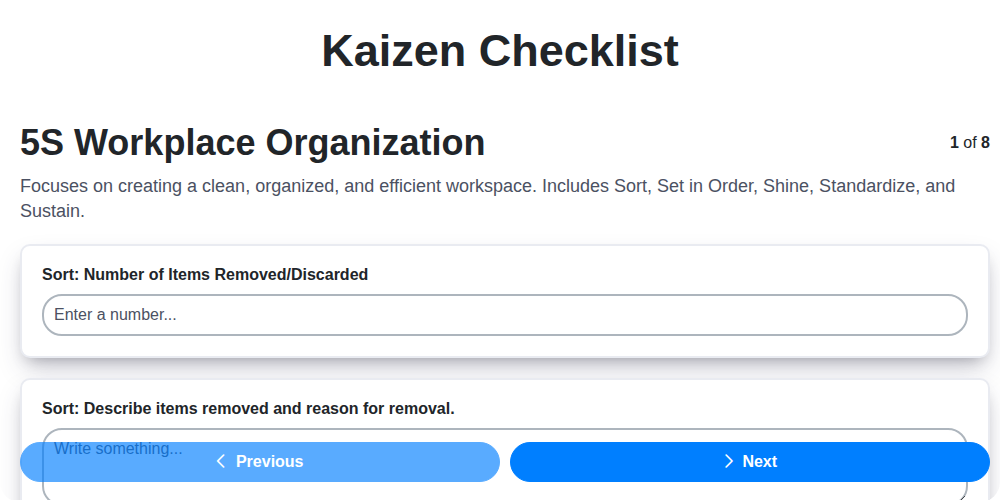
Kaizen Checklist Template: Your Path to Continuous Improvement

Machine Safety Audit Checklist: Your Guide to a Safer Manufacturing Workplace
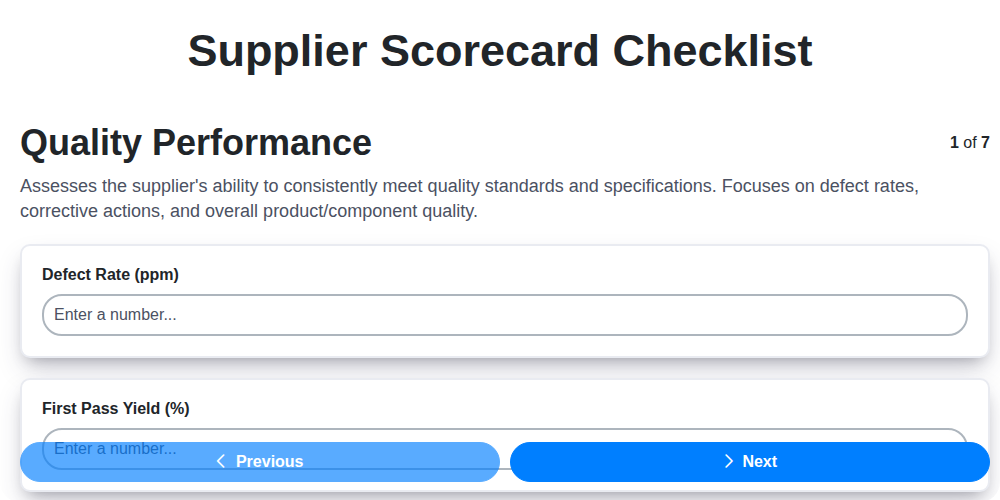
Mastering Supplier Performance: Your Free Supplier Scorecard Checklist Template
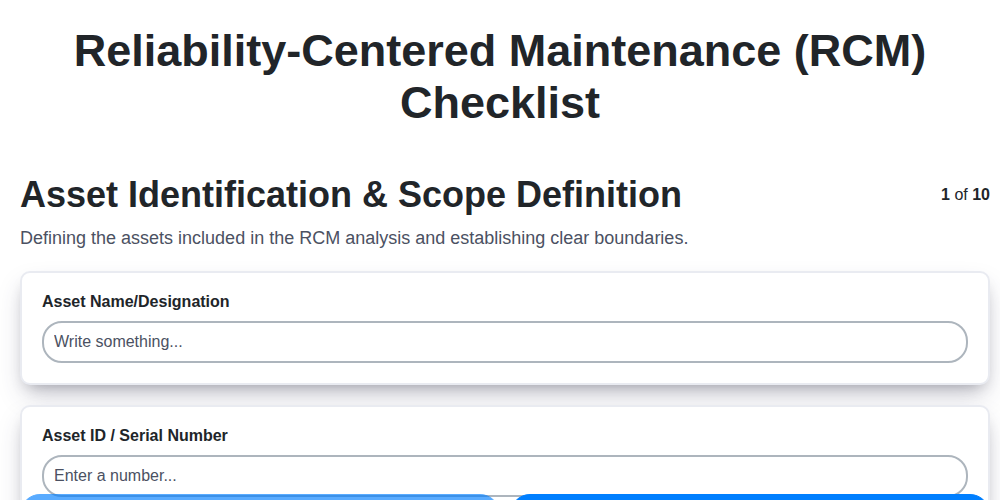
Your Ultimate RCM Checklist Template: A Step-by-Step Guide

LPA Checklist Template: Your Guide to Layered Process Audits

Your Ultimate Lockout/Tagout (LOTO) Checklist Template

Your Ultimate FSC 22000 Checklist Template
Quality Control Inspection Checklist Template: Prevent Defects & Improve Manufacturing Processes
We can do it Together
Need help with
Checklists?
Have a question? We're here to help. Please submit your inquiry, and we'll respond promptly.