Mastering Your 2026 Roadmap: The Ultimate Project Milestone Tracking & Deadline Management Checklist Template
Published: 10/28/2026 Updated: 10/29/2026
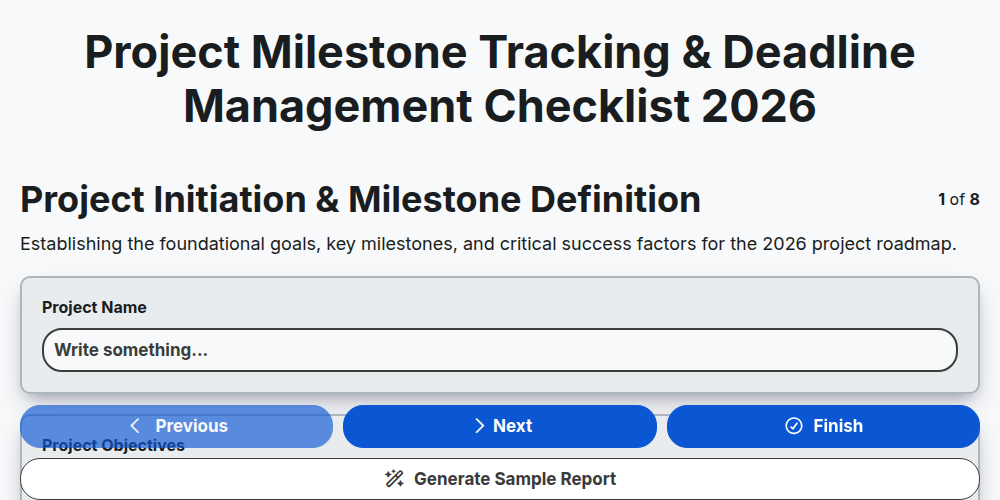
Table of Contents
- Introduction: Why Milestone Tracking is Your Secret Weapon in 2026
- Phase 1: Project Initiation & Milestone Definition
- Phase 2: Stakeholder Alignment & Responsibility Assignment
- Phase 3: Timeline Development & Deadline Setting
- Phase 4: Resource Allocation & Capacity Planning
- Phase 5: Progress Monitoring & Status Reporting
- Phase 6: Risk Identification & Mitigation Planning
- Phase 7: Milestone Completion & Quality Assurance
- Phase 8: Post-Milestone Review & Documentation
- Conclusion: Building a Culture of Accountability
- Resources & Links
TLDR: Streamline your 2026 project workflows with this comprehensive guide and checklist designed to ensure seamless execution. Learn how to master everything from initial milestone definition and stakeholder alignment to resource optimization, risk mitigation, and post-project reviews to ensure every deadline is met with precision.
Introduction: Why Milestone Tracking is Your Secret Weapon in 2026
As we approach 2026, the landscape of project management is evolving faster than ever. With the integration of advanced AI-driven automation, more complex remote collaborations, and increasingly compressed delivery cycles, the margin for error in project execution has shrunk. In this high-velocity environment, winging it is no longer a strategy-it is a liability.
The Cost of Lost Momentum
We have all experienced the drift-that subtle, dangerous phenomenon where a project starts with high energy but slowly loses momentum as deadlines slip and small delays compound. Without a structured framework for tracking milestones, a minor setback in week two can snowball into a catastrophic failure by month six. Effective milestone tracking isn't just about marking dates on a calendar; it is about maintaining the heartbeat of your project.
Beyond the To-Do List: The Power of Milestones
While task management focuses on the how, milestone tracking focuses on the what and the when. Milestones serve as the critical navigation points in your project roadmap. They provide:
- Clarity Amidst Chaos: They break down overwhelming, long-term objectives into digestible, achievable victories.
- Alignment Across Teams: They ensure that stakeholders, developers, and executives are all looking at the same version of success.
- Early Warning Systems: A missed milestone is your first signal that a deadline is in jeopardy, allowing you to pivot before the budget is depleted.
Why This Checklist is Essential for 2026
The 2026 project landscape demands a proactive rather than a reactive mindset. As teams become more distributed and workloads more interconnected, the ability to manage deadlines with precision becomes a competitive advantage.
This checklist is designed to move you beyond simple monitoring. It is a comprehensive blueprint to help you define, execute, and audit your project lifecycle. By implementing these eight core pillars, you will transform your project management from a game of catching up to a masterclass in driving forward.
Phase 1: Project Initiation & Milestone Definition
Laying the Foundation for Success
The success of any project in 2026 depends not on how fast you run, but on how clearly you have mapped the course. Before a single task is assigned or a single deadline is set, you must establish a clear definition of what done looks like.
The initiation phase is about transforming a vague concept into a structured roadmap of measurable achievements. Without clearly defined milestones, your project is prone to scope creep-where the project grows uncontrollably without a corresponding increase in resources or time.
Defining Key Milestones
Milestones are not merely tasks; they are significant points of progress that signify the completion of a major phase or a critical decision point. In this stage, your goal is to identify the anchors of your project.
To master this phase, focus on these three elements:
- Identifying Critical Success Factors: Determine which specific outcomes are non-negotiable for the project to be considered a success.
- Breaking Down the Lifecycle: Divide the project into high-level stages (e.g., Research, Development, Testing, Deployment) and assign a milestone to the conclusion of each.
- Establishing Measurable Criteria: For every milestone, define the specific criteria that must be met to mark it as complete. Avoid ambiguity; instead of Finish Design, use Design Approval Signed Off by Product Owner.
Setting the Scope Boundaries
A well-defined milestone acts as a perimeter. By defining exactly what is included in each milestone, you create a natural defense against unauthorized expansion of project requirements. As you move into 2026, where agile methodologies and rapid delivery are standard, having these clear markers ensures that even as your tactics shift, your ultimate objectives remain fixed.
Phase 2: Stakeholder Alignment & Responsibility Assignment
Defining Ownership and Expectations
Once your milestones are defined, the next critical step is ensuring that everyone involved knows not just what needs to be done, but who is accountable for each delivery. In the complex landscape of 2026's fast-paced project environments, ambiguity is the primary driver of missed deadlines.
Establishing the RACI Matrix
To prevent tasks from falling through the cracks, implement a RACI Matrix for every major milestone. This framework clarifies roles across your project team:
- Responsible: The team member performing the actual work to complete the milestone.
- Accountable: The single individual who owns the outcome and must sign off on the completion (the owner).
- Consulted: Subject matter experts whose input is required before a milestone can be finalized.
- Informed: Stakeholders who need updates on progress but do not participate in the direct execution.
Synchronizing Stakeholder Expectations
Alignment goes beyond assigning names to tasks; it involves securing buy-in on the feasibility of the timeline. Use this phase to:
- Validate Deadlines with Leads: Ensure those assigned to the Responsible role agree that the allocated time is realistic.
- Communicate Milestones Upward: Ensure executive sponsors understand the impact of each milestone on the broader organizational goals.
- Define the Definition of Done: Avoid late-stage friction by ensuring all stakeholders agree on the specific criteria that signify a milestone is officially complete.
Managing Cross-Functional Dependencies
In modern, interconnected workflows, one department's milestone is often another's starting line. Use this phase to map out interdependencies. If the Marketing team cannot launch a campaign until the Product team hits a specific development milestone, this connection must be documented and communicated to both parties immediately.
Phase 3: Timeline Development & Deadline Setting
Building the Blueprint for Success
Once you have defined your milestones and aligned your stakeholders, the next critical step is transforming your high-level goals into a granular, actionable schedule. In 2026, where project complexity and speed are higher than ever, simply picking a due date isn't enough. You need a structured approach to temporal planning that accounts for both ambition and reality.
Defining the Critical Path
Effective deadline management starts with identifying the Critical Path-the sequence of essential tasks that directly impact your project's completion date. When setting deadlines, you must distinguish between:
- Hard Deadlines: Non-negotiable dates driven by external factors (e.g., regulatory compliance, marketing launches, or contractual obligations).
- Soft Deadives: Internal targets that allow for flexibility to absorb minor delays without jeopardizing the final delivery.
The Art of Buffer Integration
One of the most common causes of project failure is optimism bias-the tendency to underestimate how long tasks will take. To prevent a domino effect of missed deadlines, implement strategic buffers.
- Task-Level Buffers: Small increments of extra time added to high-risk tasks.
- Project-Level Buffers: A contingency period placed before major milestones to act as a shock absorber for unforeseen disruptions.
Setting SMART Deadlines
To ensure your timeline is more than just a wish list, every deadline in your 2026 roadmap should adhere to the SMART framework:
- Specific: Clearly define what constitutes a completed task.
- Measurable: Ensure there is a clear metric to track progress.
- Achievable: Verify that the timeframe is realistic given your current resources.
- Relevant: Align every deadline with the overarching project objectives.
- Time-bound: Every task must have a definitive start and end date.
Leveraging 2026 Productivity Tools
In the modern workspace, manual spreadsheets are no longer sufficient for complex tracking. Utilize automated Gantt charts and AI-driven scheduling tools that can simulate what-if scenarios. By integrating your timeline with real-time data, you can see instantly how a delay in Phase 1 will ripple through to your final delivery date, allowing for proactive adjustments rather than reactive firefighting.
Phase 4: Resource Allocation & Capacity Planning
Optimizing Your Engine: Ensuring the Right Talent is in the Right Place
Once your timeline is set and your milestones are defined, the most critical question remains: Do you actually have the bandwidth to meet these dates?
In 2026, project complexity is higher than ever, and resource burnout is the leading cause of missed deadlines. Phase 4 is where you transition from theoretical planning to operational reality. This stage is about more than just assigning names to tasks; it is about analyzing the availability, skill sets, and cognitive load of your team to ensure your roadmap is achievable.
Assessing Team Capacity vs. Workload
A common pitfall in project management is phantom availability-assuming that because a team member isn't assigned to a specific project, they are 100% free. To prevent bottlenecks, you must perform a granular capacity audit:
- Analyze Individual Bandwidth: Account for existing operational duties, holidays, and previous project commitments.
- Identify Skill Gaps: Map your milestone requirements against your current team's expertise. Do you have the technical or creative talent needed for the Q3 deliverables, or do you need to budget for freelancers?
- Evaluate Overlap: Check for crunch periods where multiple milestones converge, creating high-pressure windows that could jeopardize quality.
Strategic Resource Distribution
Effective resource allocation is a balancing act between speed and sustainability. Use this checklist to refine your distribution strategy:
- [ ] Skill-to-Task Mapping: Ensure that the complexity of the milestone matches the proficiency of the assignee.
- [ ] Buffer Integration: Never schedule at 100% capacity. Aim for an 80% utilization rate to allow for the inevitable unplanned tasks and emergencies.
- [ ] Tool Integration: Leverage your PM software (like Asana, Monday, or Jira) to visualize workload heatmaps. If one developer is assigned 60 hours of work in a 40-hour week, your deadline is already at risk.
- [ ] Contingency Budgeting: If internal resources are unavailable, define the triggers for when you will activate external contractors or agency support.
The Goal: A Frictionless Workflow
The objective of this phase is to eliminate the sudden realization that a project is understaffed. When capacity planning is done correctly, your milestone tracking moves from a state of constant firefighting to a state of predictable, rhythmic execution.
Phase 5: Progress Monitoring & Status Reporting
Maintaining Momentum through Continuous Visibility
Once your roadmap is set and your resources are allocated, the real work begins. The success of your 2026 projects won't be determined by the initial plan, but by how effectively you track deviations from it. Progress monitoring is the heartbeat of your project; it provides the real-time data necessary to move from reactive firefighting to proactive management.
Establishing Your Single Source of Truth
To avoid the chaos of fragmented updates, establish a centralized dashboard or project management tool that serves as the single source of truth. Whether you are using Jira, Asana, or a custom enterprise solution, every stakeholder should be able to look at one place to see the current status of every major milestone.
Key Components of Effective Monitoring
- Real-Time Milestone Tracking: Don't wait for weekly meetings to check progress. Implement automated triggers that notify the team when a sub-task is completed or when a milestone is approaching its deadline.
- KPI & Metric Definition: Define what progress actually looks like. Are you tracking percentage of completion, budget burn rate, or task velocity? Standardizing these metrics ensures that on track means the same thing to every department.
- Standardized Status Reporting: Implement a consistent reporting cadence. High-level stakeholders need concise, high-impact summaries, while functional leads require granular, task-oriented updates.
The Art of the Status Update
Effective reporting is not about listing every small task completed; it is about highlighting variance. Your reports should clearly communicate:
- Current Status: (e.g., Green, Amber, Red)
- Milestones Achieved: What was successfully delivered since the last report?
- Upcoming Deadlines: What is on the immediate horizon?
- Blockers & Impediments: What is currently preventing the team from moving forward?
By maintaining a disciplined approach to monitoring, you ensure that small delays are identified while they are still manageable, preventing them from cascading into project-wide failures.
Phase 6: Risk Identification & Mitigation Planning
Anticipating the Unexpected: Risk Identification & Mitigation Planning
In the fast-paced landscape of 2026, project volatility is the only constant. Even the most meticulously planned roadmap can be disrupted by shifting market trends, resource shortages, or unforeseen technical hurdles. To maintain momentum toward your milestones, you cannot simply react to problems-you must anticipate them.
Effective deadline management relies on your ability to identify potential project killers before they impact your critical path.
Identifying Potential Bottlenecks
The first step in this phase is to conduct a comprehensive risk assessment. Look beyond obvious delays and investigate:
- Dependency Risks: Which milestones rely on external vendors or third-party integrations that might lag?
- Resource Volatility: What happens if a key subject matter expert (SME) is reassigned or unavailable?
- Scope Creep: How easily can new requirements bleed into existing deadlines?
- Technical Debt: Are there legacy system limitations that could stall upcoming deployment phases?
Building Your Mitigation Strategy
Once risks are identified, they must be categorized by probability and impact. For every high-priority risk, develop a structured response plan:
- Avoidance: Changing the project plan to eliminate the risk entirely (e.g., selecting a more stable technology stack).
- Mitigation: Taking proactive steps to reduce the impact (e.g., cross-training team members to prevent single points of failure).
- Transference: Shifting the impact to a third party (e.g., utilizing robust SLAs with external partners).
- Contingency Planning: Developing Plan B workflows that can be activated immediately if a specific milestone is threatened.
The Early Warning System
Risk management is not a one-time event; it is a continuous loop. Integrate your risk register into your weekly status reports. By documenting potential threats early, you transform emergencies into managed transitions, ensuring that your 2026 deadlines remain achievable even when the unexpected occurs.
Phase 7: Milestone Completion & Quality Assurance
Ensuring Excellence: The Final Hurdle
Reaching a milestone is a significant achievement, but crossing the finish line doesn't mean the work is done. In 2026's fast-paced production cycles, the gap between finished and done right is where most project failures occur. This phase is dedicated to verifying that the output of your milestone meets the predefined standards before you allow the momentum to carry you into the next phase.
The Verification Protocol
To ensure that a milestone is truly complete, you must move beyond a simple check the box mentality. Implement a rigorous verification process:
- Requirement Validation: Map the completed deliverables against the original scope defined in the Project Initiation phase. Does the output satisfy every single functional and technical requirement?
- Quality Control (QC) Testing: Conduct systematic testing or peer reviews. For software, this means bug testing; for marketing, it means proofing and brand alignment; for construction, it means structural inspections.
- Definition of Done (DoD) Audit: Use a standardized Definition of Done checklist to eliminate ambiguity. A milestone is only complete when it meets all pre-agreed-upon criteria, not just when the primary task is finished.
Acceptance & Sign-off
A milestone remains in progress until it is formally recognized by the relevant authorities.
Formalizing Completion
- Stakeholder Approval: Route the completed deliverables to the designated stakeholders for formal sign-off. This prevents scope creep from leaking into future phases.
- Update the Master Schedule: Once approval is secured, officially mark the milestone as Complete in your project management tool (e.g., Asana, Jira, or Monday.com). This triggers the start of dependent tasks in your 2026 roadmap.
- Archive Deliverables: Store all finalized assets, documentation, and approved versions in a centralized, accessible repository to ensure the Single Source of Truth remains intact for the team.
Phase 8: Post-Milestone Review & Documentation
Reflecting for Future Success
The completion of a milestone is a moment for celebration, but it shouldn't be the end of the process. To ensure your project continues to gain momentum and avoids repeating past errors, you must transition from execution to evaluation. This final phase is where true organizational learning happens.
The Post-Mortem Analysis
Once the dust has settled on a major milestone, gather your core team for a structured retrospective. The goal is not to assign blame, but to audit the process. Ask your team the following critical questions:
- What went according to plan? Identify the workflows or tools that contributed to timely delivery.
- Where did we encounter friction? Pinpoint specific bottlenecks, such as delayed approvals or resource shortages.
- Were the original deadlines realistic? Evaluate if the timeline was overly optimistic or if unforeseen complexities were underestimated.
Documentation & Knowledge Transfer
Data is useless if it isn't recorded. Use this phase to formalize everything learned during the milestone cycle.
- Update the Project Log: Formally close out completed tasks and move them to the completed archive.
- Update Risk Registers: If a new risk materialized during this milestone, document how it was handled so future project managers can prepare for it.
- Refine the Master Template: If a specific step in your checklist proved inefficient, update your 2026 roadmap template to reflect a better way of working.
Closing the Loop
The final step in this phase is communicating the results to your stakeholders. A brief Milestone Completion Report summarizing the successes, the challenges, and the updated plan for the next phase ensures that transparency remains high and that everyone stays aligned as you move into the next stage of the project lifecycle.
Conclusion: Building a Culture of Accountability
Turning Checklists into Success
A checklist is more than just a collection of tasks; it is a blueprint for reliability. As we move into 2026, the complexity of project landscapes will only increase, making the ability to track milestones and manage deadlines a core competitive advantage. However, the true value of this checklist lies not in the act of checking boxes, but in the culture it fosters within your team.
Beyond the Spreadsheet
Implementing this framework allows you to move away from reactive management-where teams are constantly firefighting-and toward proactive leadership. When every stakeholder knows their responsibilities, risks are identified before they become crises, and progress is measured by tangible achievements rather than vague intentions.
The Roadmap to Continuous Improvement
As you navigate your 2026 projects, remember that the final step of the checklist-Post-Milestone Review-is perhaps the most critical for long-term growth. Use every completed milestone as a learning opportunity to refine your resource planning and refine your estimation accuracy.
By adopting this systematic approach to milestone tracking, you are doing more than just meeting deadlines; you are building a predictable, scalable, and high-performing engine of execution. Start implementing these steps today to ensure that by the end of 2026, your team isn't just busy-they are effective.
Resources & Links
- Asana: Comprehensive project management platform for tracking milestones and complex workflows.
- Monday.com: Work OS tool for visual project tracking, resource allocation, and real-time progress monitoring.
- Jira: Advanced issue tracking and agile project management software essential for technical milestone planning.
- Trello: Kanban-style visual tool perfect for simple milestone tracking and task management.
- ProjectManagement.com: A global community and resource hub for project management professionals, managed by PMI.
- Project Management Institute (PMI): The industry standard for project management frameworks, risk mitigation, and professional certification.
- ClickUp: All-in-one productivity platform for managing tasks, docs, and complex project roadmaps.
- Smartsheet: Enterprise-grade spreadsheet tool for advanced timeline development and resource capacity planning.
- Wrike: Collaborative work management platform designed for scaling project complexity and stakeholder alignment.
- Notion: Versatile workspace for project documentation, post-milestone reviews, and centralized knowledge bases.
- Mural: Visual collaboration tool ideal for project initiation, brainstorming, and stakeholder alignment workshops.
- Figma: Collaborative design tool useful for visualizing project roadmaps and UI/UX milestone progress.
- Microsoft Project: Robust desktop and cloud-based software for professional-grade scheduling and resource management.
- HubSpot: Resources for aligning project management with marketing and business growth objectives.
- Adaptavist: Expert insights into scaling agile methodologies and optimizing project delivery workflows.
- Forbes - Leadership Section: High-level perspectives on building a culture of accountability and strategic leadership.
- Harvard Business Review: Deep-dive research on organizational management, risk identification, and strategic execution.
- Zendesk: Tools for managing stakeholder communication and feedback loops during project cycles.
Comments
There are no comments yet. Be the first to add one!
Task Management Solution Demo
Get organized & boost productivity! ChecklistGuro simplifies task management, prioritization, & progress tracking. Achieve more, stress less, & hit your goals. Manage it all with our Work OS.
Related Articles

Paper vs ChecklistGuro in Project Management
Paper vs ChecklistGuro in Task Management

Excel vs ChecklistGuro in Logistics Management
Excel vs ChecklistGuro in Task Management
Excel vs ChecklistGuro in Dental Management
Excel vs ChecklistGuro in Hospitality Management
Excel vs ChecklistGuro in Retail Management
Excel vs ChecklistGuro in Project Management
Need help with
Task Management?
Have a question? We're here to help. Please submit your inquiry, and we'll respond promptly.