Mastering the Handover: The Ultimate Retail Staff Shift Communication Checklist for 2026
Published: 11/21/2026 Updated: 11/22/2026
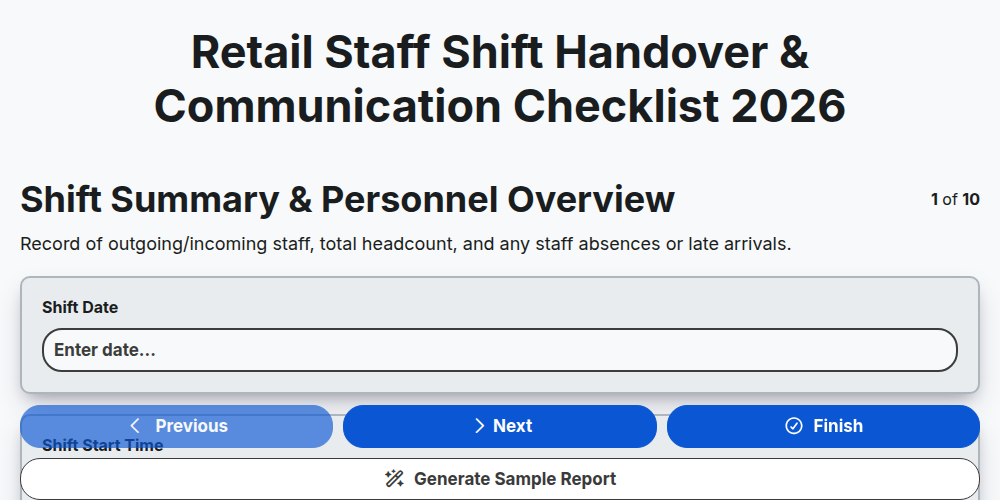
Table of Contents
- Introduction: Why Seamless Shift Handovers are Critical in 2026
- The Foundation: Shift Summary & Personnel Overview
- Driving Results: Sales Performance & KPI Review
- Financial Integrity: Cash Management & Till Reconciliation
- Supply Chain Continuity: Inventory & Stock Updates
- Maintaining Excellence: Store Maintenance & Cleanliness Status
- Protecting Brand Reputation: Customer Service & Incident Reporting
- Visual Impact: Merchandising & Visual Standards
- Operational Momentum: Task Completion & Pending Actions
- Infrastructure Check: Facility & Equipment Status
- The Final Step: Ensuring Accountability with Handover Sign-off
- Conclusion: Transforming Communication into Profit
- Resources & Links
TLDR: Avoid mid-shift chaos and lost revenue with our comprehensive 2026 Retail Shift Handover Checklist. Learn how to streamline communication between teams by mastering everything from KPI reviews and cash reconciliation to inventory updates and facility maintenance, ensuring seamless store operations and consistent customer service across every shift.
Introduction: Why Seamless Shift Handovers are Critical in 2026
In the fast-paced retail landscape of 2026, the margin for error has never been slimmer. As omnichannel shopping, hyper-personalized customer expectations, and real-time inventory integration become the industry standard, the traditional quick chat between outgoing and incoming staff is no longer sufficient.
The High Cost of Communication Gaps
A broken handover is more than just a minor inconvenience; it is a direct threat to your store's operational efficiency. When critical information fails to transition between shifts, the consequences are immediate and measurable:
- Revenue Leaks: Unreported sales discrepancies or unaddressed KPI dips.
- Customer Friction: Failing to inform the new team about an unresolved complaint or a special order request.
- Operational Chaos: Mismanaged stock levels or overlooked maintenance issues that lead to equipment downtime.
- Shrinkage Risks: Inaccurate cash reconciliation and undocumented inventory gaps.
The 2026 Standard: From Information Sharing to Data Synchronization
In 2026, a shift handover is no longer just about passing the baton-it is about maintaining a continuous thread of operational intelligence. A successful handover ensures that the incoming team isn't starting from zero, but is instead stepping into a clearly defined, data-driven environment.
By implementing a structured, standardized checklist, you transform your store from a series of disconnected shifts into a seamless, 24/7 retail engine. Whether you are managing a boutique or a high-volume flagship, the following checklist is designed to ensure that every team member is empowered with the context, clarity, and continuity needed to drive performance from the moment they clock in.
The Foundation: Shift Summary & Personnel Overview
Setting the Stage for Success
A seamless transition between shifts is the heartbeat of a well-run retail store. The handover process isn't just about passing over keys or a pile of paperwork; it is about transferring the pulse of the store from one team to the next.
The first step in your 2026 handover protocol should always be a comprehensive Shift Summary & Personnel Overview. This section serves as the foundational briefing that ensures the incoming manager or team lead understands exactly who is on the floor and what the atmosphere of the store looks like at the moment of transition.
Core Components of the Personnel Overview
To ensure no gaps in coverage or communication, the incoming team must be briefed on the following:
- Staffing Status: A clear record of who is currently on the clock, who is scheduled to depart, and who is arriving. This includes noting any unplanned absences, late arrivals, or early departures that may impact floor coverage.
- Role Allocation: Detail which team members are assigned to specific zones (e.g., fitting rooms, cash wraps, or floor replenishment) to prevent drift where certain areas are left unattended.
- Breaks & Schedule Adjustments: A real-time update on upcoming staff breaks. This prevents the incoming supervisor from accidentally scheduling a heavy task (like a shipment arrival) during a period of low floor coverage.
- Mood & Team Dynamics: While it may seem informal, noting the general energy of the team is vital. If the outgoing team is facing high-stress levels due to a sudden rush, the incoming team needs to be prepared to provide extra support or adjust the workflow accordingly.
By documenting this overview, you eliminate the guessing game that often leads to staffing gaps and operational friction during shift changes.
Driving Results: Sales Performance & KPI Review
Turning Data into Direction
A shift handover should never be just a recap of what happened; it must be a roadmap for what needs to happen. In the 2026 retail landscape-where real-time data is more accessible than ever-the Sales Performance & KPI Review section of your checklist is where leadership meets execution.
When the incoming supervisor steps onto the floor, they shouldn't have to hunt for the numbers. The outgoing lead must provide a concise, data-driven snapshot of the shift's trajectory.
Key Metrics to Review Every Shift
To ensure the incoming team is prepared to hit their targets, the handover must address these critical performance indicators:
- Sales vs. Target Progress: Where does the store stand against the daily and weekly goal? Is the team ahead of the curve, or is there a gap that needs urgent closing?
- Conversion Rate Trends: Did foot traffic remain high while sales lagged? Identifying a dip in conversion during the previous shift allows the new team to adjust their proactive selling techniques immediately.
- Average Transaction Value (ATV) & Units Per Transaction (UPT): Use this moment to highlight wins or missed opportunities. If the ATV was low, the incoming team can focus on upselling and add-on strategies.
- Labor Cost vs. Sales Velocity: A brief note on whether the floor density matched the customer flow helps the manager optimize staff positioning for the next few hours.
From Analysis to Action
The goal of reviewing KPIs isn't just to report numbers, but to trigger immediate tactical shifts.
💡 Pro-Tip for 2026 Managers:
Don't just report the What, report the Why. Instead of writing Sales were down 10%, write Sales were down 10% due to a high volume of low-intent browsing; focus on high-margin accessories to boost ATV during the afternoon rush.
By translating raw data into actionable intelligence, you empower the incoming shift to move from a reactive state to a high-performance mindset the moment they clock in.
Financial Integrity: Cash Management & Till Reconciliation
Securing the Bottom Line
In a fast-paced retail environment, the transition between shifts is the most vulnerable moment for financial discrepancies. A seamless handover ensures that every cent is accounted for, preventing the mystery shortages that often plague retail management. This section of the checklist focuses on verifying the physical cash on hand against the digital records of your POS system.
The Reconciliation Protocol
To maintain absolute transparency, the outgoing supervisor and the incoming lead must perform a joint audit of the following:
- Float Verification: Confirm that the starting float for the new shift is intact and matches the recorded amount.
- Cash Drawer Audit: Count all cash, coins, and vouchers within the till to ensure they align with the Z-report or end-of-day summary.
- Discrepancy Documentation: If a shortage or overage is detected, it must be noted immediately in the handover log, along with an explanation (e.g., a documented refund or a manual entry error).
- Digital Payment Reconciliation: Ensure that credit card terminals, mobile payments (Apple Pay/Google Pay), and gift card balances match the transaction logs.
Preventing The Drift
Financial errors often occur when small mistakes are ignored during a shift. By making till reconciliation a mandatory, collaborative step in the handover, you eliminate the blame game between shifts. The goal is to ensure that the incoming team starts their shift with a clean slate-knowing exactly what is in the drawer and that the previous shift's accounts are closed with 100% accuracy.
Supply Chain Continuity: Inventory & Stock Updates
Bridging the Gap Between Shifts
In the fast-paced retail environment of 2026, inventory accuracy is no longer just about counting boxes; it is about real-time data integrity. A breakdown in communication regarding stock levels during a shift change can lead to ghost inventory errors, missed sales opportunities, and frustrated customers.
Tracking the Flow of Goods
The handover checklist must include a detailed update on all stock movements that occurred during the preceding shift. This isn't merely about what was sold, but what entered and exited the store ecosystem.
- Deliveries & Inbound Shipments: Did a large shipment arrive? Was it fully processed, or is there a backlog of unboxed merchandise waiting on the floor?
- Returns & Defective Goods: Ensure the incoming team is aware of any items pulled from the floor due to damage or customer returns that need to be processed back into the system.
- Near-Expiry or Seasonal Transitions: As we move through 2026's hyper-seasonal trends, flagging items that need to be moved to clearance or promotional zones is critical.
Managing the Out of Stock Reality
One of the most significant friction points in retail is the discrepancy between what the digital inventory system says and what is physically on the shelf.
Maintaining Data Integrity
The outgoing supervisor must communicate any identified shrinkage or discrepancies found during floor walks. If a high-velocity item is showing zero stock on the handheld scanner but remains on the shelf, this must be flagged immediately. This prevents the automated replenishment systems from failing to trigger a reorder, ensuring your supply chain remains uninterrupted and your shelves remain full.
Maintaining Excellence: Store Maintenance & Cleanliness Status
Ensuring a Seamless Transition for the Next Shift
A clean store is a productive store. When a shift change occurs, the incoming team should never walk into a mess left behind by the previous crew. The Store Maintenance & Cleanliness Status section of your checklist ensures that the physical environment remains a premium space for customers and a safe workspace for staff, regardless of how busy the previous hours were.
The Clean Floor Standard
As part of the handover, the departing supervisor must communicate the current state of the shop floor. This isn't just about checking if the trash is emptied; it involves a detailed look at:
- Floor Care: Are there any spills, debris, or high-traffic areas that require immediate attention or professional cleaning?
- Restroom Readiness: Are the restrooms stocked and sanitized, or is there a scheduled cleaning service arriving soon?
- Fitting Room Integrity: Are the fitting rooms cleared of abandoned items and organized for the next wave of customers?
Safety & Hygiene Compliance
In 2026, hygiene and safety protocols are more integrated into retail operations than ever. The handover must note any specific maintenance needs, such as:
- Spill Logs & Hazard Reporting: If a liquid spill occurred and was cleaned, was the area properly dried and the incident logged?
- Waste Management: Is the backroom bin reaching capacity, or is a pickup scheduled?
- Sanitization Stations: Are hand sanitizing stations refilled and functional?
Proactive Maintenance Alerts
The handover is the critical moment to flag hidden issues before they become customer-facing problems. Use this part of the checklist to communicate:
- Lighting Issues: Any flickering bulbs or dark corners that affect visual merchandising.
- Temperature Control: Is the HVAC system functioning, or is the store experiencing temperature fluctuations?
- Immediate Repair Needs: Any broken hangers, loose shelving, or damaged display units that the incoming team needs to be aware of.
The Goal: The incoming shift should be able to read this section and immediately understand if they are walking into a maintenance-ready environment or if they need to pivot their first task toward cleaning and recovery.
Protecting Brand Reputation: Customer Service & Incident Reporting
Ensuring Seamless Continuity in Customer Care
In the fast-paced retail environment of 2026, a shift handover is about much more than just passing over a set of keys; it is about transferring the story of the store's day. The Customer Service & Incident Reporting section of your checklist is the most critical component for maintaining brand loyalty and protecting your store's reputation.
When communication breaks down during a handover, the incoming team is forced to play catch-up, often leading to frustrated customers who have to repeat their issues to multiple staff members.
Documenting the Customer Experience
A successful handover must capture the emotional temperature of the store. Use this section to note:
- Ongoing Customer Interactions: Are there any VIP clients or regular shoppers expected to visit? Are there any pending promises made to a customer (e.g., I will call you when the shipment arrives)?
- Service Trends: Did a specific product launch cause a surge in inquiries? Was there a recurring question regarding a new promotion?
Managing Incident Logs and Conflict Resolution
An incident left undocumented is an incident waiting to happen again. The incoming shift must be fully briefed on:
- Conflict Resolution: If a dispute occurred with a customer or a delivery driver, the incoming manager must know the context, the resolution attempted, and the current status of the situation.
- Security & Safety Incidents: Any slip-and-trips, shoplifting attempts, or technical malfunctions affecting safety must be logged with precise timestamps and descriptions.
- Loss Prevention Alerts: If a specific pattern of suspicious behavior was noted, this intelligence must be passed to the next team immediately to ensure proactive floor monitoring.
The Zero-Gap Goal
By prioritizing detailed incident reporting, you eliminate the information gap that leads to service failures. The goal is for the incoming team to step onto the floor with full situational awareness, allowing them to provide a seamless, high-quality experience from the very first minute of their shift.
Visual Impact: Merchandising & Visual Standards
Maintaining Brand Consistency Across Shifts
In the fast-paced retail environment of 2026, your store's visual appeal is your most powerful silent salesperson. A breakdown in communication during a shift handover can lead to visual drift, where your carefully curated displays slowly degrade as the day progresses.
The Merchandising & Visual Standards section of your checklist ensures that the store looks as impactful at 9:00 PM as it did during the morning opening.
Key Inspection Points for Handover:
- Planogram Compliance: Verify that all key promotional displays and core product groupings align with the current seasonal planogram.
- Signage & Promotional Integrity: Check that all sale signs, QR code displays, and promotional wobblers are intact, upright, and reflect the current active offers.
- Size Integrity & Folding Standards: Ensure that apparel is correctly sized, folded, or hung according to brand guidelines, and that orphaned items have been returned to their proper homes.
- Replenishment Status: Identify any holes on the shelves or empty hangers that require immediate restocking by the incoming team.
- Ad-hoc Display Maintenance: Note any temporary displays or end-caps that require repositioning or cleaning following high-traffic periods.
Pro-Tip for 2026 Managers
Don't just report what is wrong-report what is working. If a particular end-cap is driving high engagement, use the handover notes to signal the incoming shift to maintain that specific momentum.
Operational Momentum: Task Completion & Pending Actions
Closing the Loop, Opening the Future
In a fast-paced retail environment, the period between shifts is the most vulnerable window for operational breakdown. When a departing staff member leaves without clearly communicating what has been finished and what is still in flight, they aren't just leaving behind tasks-they are leaving behind potential chaos for the incoming team.
Effective shift handovers in 2026 are not about merely listing chores; they are about maintaining operational momentum. The goal is to ensure that the momentum gained during the morning shift is transferred seamlessly to the afternoon or evening crew, preventing the start-up lag that kills productivity.
Tracking the Done vs. the Doing
A high-performing checklist must distinguish between completed milestones and active responsibilities. Use this section to document:
- Completed Milestones: Confirm that routine daily tasks (such as morning tidying, price markdowns, or delivery processing) are officially marked as 100% complete. This prevents the incoming shift from wasting time re-verifying work already done.
- The In-Progress List: This is the most critical component. If a shipment arrived but hasn't been unboxed, or if a promotional display is halfway assembled, it must be explicitly noted.
- Urgent Deadlines: Highlight any tasks that must be completed before the end of the next shift (e.g., End-of-day replenishment must be finished by 7:00 PM).
Avoiding the Information Gap
The Pending Actions section serves as a bridge. By providing clear, actionable instructions, you eliminate the need for the incoming supervisor to hunt for answers or guess the priority level of various duties.
Pro-Tip for 2026 Managers: Move beyond vague notes like Fix the shelf. Instead, use actionable, descriptive language: Restock the denim wall; 12 units of size Medium are currently in the backroom waiting to be folded. This level of detail reduces cognitive load and allows your team to hit the ground running the moment they clock in.
Infrastructure Check: Facility & Equipment Status
Ensuring Operational Continuity
A seamless shift handover isn't just about discussing sales numbers; it is about ensuring the physical workspace is ready for the next team to succeed. The Facility & Equipment Status section of your checklist acts as the final safeguard against operational downtime.
Checking the Vital Signs of Your Store
As the outgoing supervisor or lead, you must verify that all store assets are functioning as intended. If a piece of technology fails during a busy shift, it shouldn't become a surprise for the incoming team.
Your inspection should cover:
- POS & Hardware Integrity: Are the registers, card readers, and receipt printers working correctly? Check for any paper jams or connectivity issues.
- Digital Infrastructure: Confirm that handheld scanners, tablets, and back-office computers are charged and operational.
- Security Systems: Ensure all security cameras, alarms, and electronic article surveillance (EAS) gates are active and unobstructed.
- Climate & Lighting: Report any issues with HVAC systems (temperature control) or flickering lights that might impact the shopping atmosphere.
Proactive Reporting
The goal of this step is zero surprises. If a coffee machine in the breakroom is leaking or a display screen is flickering, it must be documented here. By identifying these issues during the handover, you allow the incoming shift to either address them immediately or prepare the necessary maintenance requests, preventing small glitches from escalating into lost revenue.
The Final Step: Ensuring Accountability with Handover Sign-off
Closing the Loop: The Importance of a Formal Sign-Off
A shift handover is only as reliable as its final verification. Without a formal sign-off, the transition between outgoing and incoming teams becomes a he-said, she-said scenario, leading to missed tasks, unaccounted discrepancies, and operational friction.
The sign-off is not merely a formality; it is a moment of professional accountability. It serves as a digital or physical timestamp confirming that both the departing supervisor and the incoming lead have reviewed the data, reconciled the funds, and acknowledged the status of the store.
Implementing a Two-Way Verification Process
To make the sign-off effective in 2026, move away from a simple signature and toward a collaborative verification model. This involves three key components:
- The Review Phase: The incoming manager must physically walk the floor with the outgoing manager, verifying that the Store Maintenance and Merchandising sections of the checklist match the actual state of the store.
- The Acknowledgment: The incoming staff member confirms they are aware of all Pending Actions and Incident Reports. This prevents the I didn't know excuse when a customer issue resurfaces later in the day.
- The Digital Audit Trail: In a modern retail environment, this sign-off should be logged within your store management software. This creates a searchable history that can be used during end-of-month reviews to identify patterns in operational gaps.
Best Practices for a Seamless Handover
To ensure the sign-off promotes a positive culture rather than a policing one, follow these guidelines:
- Keep it Brief but Thorough: The sign-off should occur only after the checklist is complete. If the incoming manager is rushing, the quality of the entire handover is compromised.
- Encourage Feedback: Use the sign-off period to allow the incoming team to ask clarifying questions about the Sales Performance or Inventory Updates noted earlier in the document.
- Zero Ambiguity: If a task is marked as Pending, the sign-off must include a brief note on when that task is expected to be completed.
By treating the Handover Sign-off as a critical ritual of operational excellence, you ensure that the momentum gained during one shift is seamlessly carried into the next, maintaining a high standard of service 24/7.
Conclusion: Transforming Communication into Profit
Turning Information into Operational Excellence
A shift handover is more than just a routine administrative task; it is the heartbeat of a well-run retail environment. When handled with precision, it serves as the bridge between two teams, ensuring that the momentum built during one shift is not lost during the next. By implementing this 2026 Retail Staff Shift Handover & Communication Checklist, you are doing more than just passing on information-you are mitigating risk, protecting your margins, and safeguarding the customer experience.
Beyond the Checklist: The Strategic Advantage
In the fast-paced retail landscape of 2026, where consumer expectations are higher and operational complexity is greater, guessing is not a strategy. Every unchecked box in your handover process represents a potential missed sale, an unresolved customer complaint, or an unnecessary operational cost.
When your team masters this checklist, you unlock several key benefits:
- Reduced Shrinkage and Error: Rigorous cash management and inventory updates minimize discrepancies before they become systemic issues.
- Enhanced Employee Morale: Clear communication eliminates the blame game between morning and evening shifts, creating a culture of accountability and shared responsibility.
- Seamless Customer Continuity: When staff are aware of pending tasks and incident reports, the customer never feels the friction of a staff changeover.
- Optimized Labor Productivity: Detailed task completion logs ensure that no team member wastes time re-doing work or searching for instructions.
Final Thoughts
Consistency is the secret ingredient to retail success. Use this checklist not as a one-time fix, but as a foundational standard for your store's daily operations. As you refine these communication loops, you will find that your store doesn't just run-it thrives.
Start implementing these protocols today, and turn your handover process into your most powerful tool for driving consistent, long-term profitability.
Resources & Links
- Retail Dive: In-depth analysis and news regarding the latest trends, technology, and labor shifts in the global retail industry.
- Forbes Retail: Insights into retail leadership, consumer behavior, and the intersection of business strategy and technology.
- Shopify Blog: Resources on omnichannel commerce, inventory management, and scaling retail operations for modern era.
- BigCommerce: Strategies for managing supply chain continuity and digital integration in modern retail environments.
- Entrepreneur: Practical advice on operational excellence, team management, and maintaining small-to-mid-sized retail businesses.
- McKinsey & Company: Deep dives into retail productivity, labor optimization, and the future of the consumer experience.
- RetailNext: Data-driven insights into foot traffic, KPI tracking, and understanding customer behavior patterns.
- The Business of Fashion: Specialized insights into visual merchandising, brand reputation, and global retail standards.
- Shoptalk: A leading platform for retail innovation, focusing on the technologies driving the 2026 retail landscape.
- Deloitte Retail: Strategic frameworks for financial integrity, cash management, and large-scale retail operations.
- HR Exchange: Resources for managing personnel, staff accountability, and optimizing workforce communication.
- Supply Chain Brain: Focus on inventory management, stock updates, and logistical continuity for retail stores.
- Capterra: Software reviews for task management, incident reporting, and digital shift handover tools.
- Ascent Retail: Insights into maintaining facility standards, equipment status, and store maintenance protocols.
- Salesforce Retail: Leveraging CRM data to drive sales performance and improve customer service incident reporting.
- PlaceMat: Tools and frameworks for managing physical store layouts and visual merchandising excellence.
- Workday: Enterprise-level solutions for employee accountability, scheduling, and-personnel overview management.
- Insider Intelligence: Market research and data regarding consumer trends and the evolution of the retail landscape.
Comments
There are no comments yet. Be the first to add one!
Retail Management Solution Demo
Boost retail efficiency! ChecklistGuro simplifies store operations, inventory management, and employee training. Improve customer experience and maximize profitability. Manage it all with our Work OS.
Related Articles
Seasonal Mulch & Gravel Checklist Template: Stay Stocked & Ready
Elevator & Escalator Inspection Checklist Template: Your Guide to Safety & Compliance
Daily Prescription Dispening Area Inspection Checklist Template

Weekly Waste Management & Recycling Checklist Template
Keep Your Storefront Sparkling: Your Daily & Weekly Cleaning Checklist Template
Your Ultimate Landscaping & Groundskeeping Checklist: Weekly & Monthly Templates
Monthly Stockroom Organization & Safety Checklist Template
Daily Dairy Case Inspection Checklist Template
Need help with
Retail?
Have a question? We're here to help. Please submit your inquiry, and we'll respond promptly.