Mastering Inventory Accuracy: The Ultimate Retail Vendor Delivery & Invoice Reconciliation Checklist 2026
Published: 10/28/2026 Updated: 10/29/2026
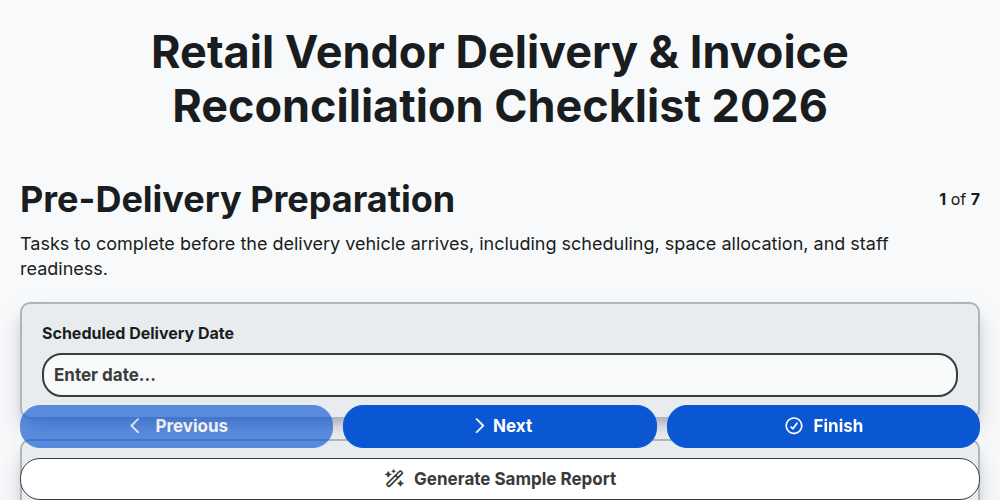
Table of Contents
- Introduction: Why Precision in Receiving is Critical in 2026
- Phase 1: Pre-Delivery Preparation - Setting the Stage for Success
- Phase 2: Delivery Arrival & Documentation Verification - The First Line of Defense
- Phase 3: Physical Goods Inspection - Counting and Verifying the Load
- Phase 4: Quality Assurance & Product Compliance - Ensuring Standard Excellence
- Phase 5: Invoice Reconciliation & Discrepancy Management - Resolving Mismatches
- Phase 6: Stockroom Integration & Put-away - Streamlining the Flow to Shelves
- Phase 7: Post-Delivery Administrative Closure - Finalizing the Paper Trail
- Leveraging Technology: Automating Your 2026 Reconciliation Workflow
- Conclusion: Building a Culture of Inventory Integrity
- Resources & Links
TLDR: Ensure seamless supply chain operations and eliminate costly discrepancies with our 2026 guide to retail receiving. This comprehensive checklist covers everything from pre-delivery preparation and physical inspection to rigorous invoice reconciliation and stockroom integration, providing a foolproof framework to maintain 100% inventory accuracy and vendor accountability.
Introduction: Why Precision in Receiving is Critical in 2026
Navigating the New Era of Retail Logistics
As we step into 2026, the retail landscape has undergone a profound transformation. The era of good enough inventory management is officially over. With the rise of hyper-omnichannel commerce, ultra-fast delivery expectations, and increasingly complex global supply chains, the margin for error in your receiving department has shrunk to near zero.
In today's market, a single discrepancy between a packing slip and physical stock isn't just a minor clerical error-it is a ripple effect that disrupts automated replenishment systems, triggers inaccurate out-of-stock alerts, and ultimately leads to lost revenue and eroded customer trust.
The High Cost of Inaccuracy
When deliveries are processed carelessly, the consequences are felt across the entire organization:
- Financial Leakage: Paying for goods that never arrived or were received in damaged condition directly impacts your bottom line.
- Inventory Distortion: Inaccurate stock levels lead to phantom inventory, where your system believes an item is available for online purchase when the shelf is actually empty.
- Labor Inefficiency: Discrepancies discovered weeks later during audits require expensive, time-consuming investigations that drain your team's productivity.
The 2026 Standard: Beyond Simple Counting
In 2026, mastering the receiving process means moving beyond merely counting boxes. It requires a synchronized approach to physical inspection, digital verification, and financial reconciliation. Modern retailers must bridge the gap between the physical arrival of goods and the digital reality of their ERP (Enterprise Resource Planning) systems.
To maintain a competitive edge, your receiving protocol must be a rigorous, repeatable, and documented workflow. This checklist is designed to serve as your operational blueprint, ensuring that every item entering your facility is accounted for, verified, and seamlessly integrated into your ecosystem. By implementing these standardized steps, you transition from reactive firefighting to proactive inventory excellence.
Phase 1: Pre-Delivery Preparation - Setting the Stage for Success
Laying the Foundation for Seamless Receiving
In the fast-paced retail landscape of 2026, efficiency is no longer just a goal-it is a competitive necessity. The errors that occur before a delivery truck even reaches your loading dock can ripple through your entire supply chain, leading to phantom inventory, strained vendor relationships, and significant revenue leakage.
The secret to a frictionless receiving process isn't found in how fast your team moves during the delivery, but in how well they prepare before it arrives. Pre-delivery preparation is about proactive management and ensuring that your team has the tools, data, and communication necessary to verify incoming goods with absolute precision.
Key Objectives of Pre-Delivery Preparation
To minimize discrepancies and reduce the time spent on manual corrections, your pre-delivery phase should focus on three core pillars:
1. Purchase Order (PO) Synchronization
Before any shipment arrives, ensure that your digital procurement records are up to date.
- Verify Active POs: Cross-reference your incoming delivery schedule with your existing Purchase Orders in your Inventory Management System (IMS).
- Audit Quantities and SKUs: Ensure that the expected quantities, unit measurements, and SKU details match the most recent vendor communications.
- Flag Pending Changes: If a vendor has notified you of a partial shipment or a substitution, ensure this information is updated in the system before the goods hit the dock.
2. Staffing and Resource Allocation
A delivery delay is often actually a staffing failure.
- Schedule Capacity: Review your delivery calendar to ensure you have adequate personnel assigned to the receiving dock during peak arrival windows.
- Equipment Readiness: Confirm that all necessary hardware-handheld scanners, mobile terminals, pallet jacks, and digital scales-are fully charged, functional, and synced with your central database.
3. Space and Dock Management
Congested loading docks are breeding grounds for errors.
- Clear the Receiving Zone: Ensure the designated inspection and staging areas are free of debris, empty pallets, or outgoing returns.
- Designate Staging Areas: Prepare specific zones for Quarantine (for items awaiting inspection) and Ready for Put-away to prevent unverified stock from entering your sellable inventory prematurely.
By treating the pre-delivery phase as a critical control point, you transform your receiving department from a reactive bottleneck into a proactive engine of inventory accuracy.
Phase 2: Delivery Arrival & Documentation Verification - The First Line of Defense
Establishing the Paper Trail
The moment a delivery vehicle pulls up to your loading dock, the clock starts ticking on your inventory accuracy. This phase is not about counting individual items-that comes later-but about verifying that the documentation provided matches the shipment arriving. Errors ignored at this stage create a domino effect of discrepancies that haunt your profit margins months later.
The Golden Rule: Never Sign Before You Scan
The most critical mistake a receiving clerk can make is signing a Proof of Delivery (POD) or a Bill of Lading (BOL) before a preliminary document check. Once that signature is applied, you are legally acknowledging that the shipment was received in full and in good condition.
Essential Verification Steps
To ensure your records remain bulletproof, follow this systematic verification process:
- Match the Purchase Order (PO) to the Packing Slip: Before even looking at the boxes, ensure the vendor's packing slip corresponds exactly to your internal Purchase Order. Check for:
- Correct Vendor Name and ID.
- Matching PO Number.
- Expected vs. Actual item counts (at a high level).
- Check the Bill of Lading (BOL) Integrity: Verify that the carrier's documentation reflects the correct number of pallets, cartons, or units. Ensure that any shortages or damages noted by the driver are explicitly recorded on the driver's copy of the BOL.
- Identify Blind Discrepancies Immediately: Look for mismatched SKU numbers or unexpected promotional items. If a vendor sends bonus stock without documentation, it can lead to massive reconciliation nightmares during the invoicing stage.
- Scan for External Damage Indicators: Before the driver leaves, inspect the exterior of the shipment for:
- Crushed corners or punctured shrink wrap.
- Evidence of moisture or leaks.
- Broken security seals on high-value containers.
Pro-Tip for 2026: Digital Log Integration
In an era of automated retail, utilize handheld scanners to instantly cross-reference the incoming packing slip against your ERP (Enterprise Resource Planning) system. If the digital handshake fails at this stage, flag the shipment for a Mandatory Secondary Inspection immediately.
Remember: Documentation errors are often harder to fix than physical ones. If the paperwork is wrong, the inventory is wrong.
Phase 3: Physical Goods Inspection - Counting and Verifying the Load
Precision in Practice: The Inspection Protocol
The physical inspection phase is the most critical moment of truth in the receiving process. This is where paper promises meet physical reality. In 2026, with the rise of automated logistics and high-velocity restocking, skipping steps during this phase is the fastest way to bleed margin through invisible shrinkage and unrecorded discrepancies.
1. The Blind Count Method
To ensure absolute integrity, implement a blind count protocol for your receiving team. Instead of simply checking off items against the packing slip, staff should record quantities on a separate sheet without knowing the expected totals beforehand. This prevents confirmation bias, where staff members subconsciously check off boxes based on what they expect to see rather than what is actually in the box.
2. Verification of Unit Integrity
It isn't enough to simply count the number of boxes; you must inspect the condition of the individual units. Your inspection should focus on:
- Seal Integrity: Are manufacturer seals intact? Broken seals are a red flag for potential tampering or previous returns.
- Packaging Damage: Check for crushed corners, moisture damage, or punctures. Even if the product inside is fine, damaged outer packaging often necessitates a vendor credit or a markdown.
- Tamper-Evident Features: For high-value electronics or luxury goods, verify that security tags and anti-theft packaging are undisturbed.
3. SKU-to-Label Correlation
With the increasing complexity of multi-variant products (size, color, material), a close enough approach leads to catastrophic errors in your inventory management system.
- Scanning Accuracy: Every item must be scanned or manually verified against the specific SKU/UPC on the packing slip.
- Batch and Lot Tracking: For perishable or regulated goods, this is the moment to record expiration dates and lot numbers. Missing this step can lead to massive waste during future stock rotations.
4. Identifying Hidden Discrepancies
Discrepancies often hide in plain sight. During the inspection, look for:
- Shortages: Items listed on the manifest that are physically missing from the pallet.
- Overages: Extra items that arrived but were not ordered (these can skew your COGS if not documented).
- Substitutions: Unannounced changes in product packaging or minor SKU updates that may affect your digital storefront's accuracy.
Pro-Tip for 2026: If your receiving team discovers a discrepancy, do not proceed to the next phase until a Discrepancy Note is digitally logged in your IMS (Inventory Management System). This creates an immediate digital paper trail for the reconciliation phase.
Phase 4: Quality Assurance & Product Compliance - Ensuring Standard Excellence
Beyond the Box: The Criticality of Compliance
Checking the quantity of items is only half the battle. In the 2026 retail landscape, where brand reputation and safety standards are under constant scrutiny, the Quality Assurance (QA) & Product Compliance phase is where you protect your bottom line from invisible losses. A shipment can be numerically correct but functionally useless if it fails to meet your predefined brand standards.
The Three Pillars of Product Compliance
To maintain a seamless supply chain, your receiving team must evaluate every arrival against these three critical benchmarks:
1. Physical Integrity & Damage Assessment It is not enough to count the units; you must inspect the condition of the individual items.
- Packaging Integrity: Are there crushed corners, punctured seals, or moisture damage?
- Unit-Level Inspection: For high-value or fragile goods, perform spot checks to ensure the product inside the box matches the outward appearance of a sellable item.
- Tamper Evidence: Verify that all security seals and manufacturer's shrink-wrap are intact to prevent fraud and shrinkage.
2. Regulatory & Safety Compliance With tightening global regulations, ensuring every product is retail-ready and legally compliant is non-negotiable.
- Labeling Accuracy: Check for mandatory information, including country of origin, ingredient lists (for consumables), and required safety warnings.
- Certification Verification: Ensure that products requiring specific certifications (such as organic, UL listed, or FSC certified) have the accompanying documentation or visible logos as promised.
- Expiry & Batch Tracking: For perishable or date-sensitive goods, immediately verify that the remaining shelf life meets your Minimum Acceptable Life (MAL) policy.
3. Brand & Aesthetic Consistency In an era of omnichannel excellence, your physical stock must mirror your digital promise.
- SKU Consistency: Ensure that the colorways, sizes, and seasonal variations match the specific purchase order (PO) specifications.
- Presentation Readiness: Assess whether the items arrive in a state that allows for immediate floor placement or if they require additional re-work (such as removal of protective films or re-tagging).
Pro-Tip for 2026: The Non-Conformance Protocol
If a product fails any part of this phase, do not simply move it to the stockroom. Immediately trigger a non-conformance report (NCR). Document the defect with high-resolution photos and link it directly to the digital delivery record. This ensures that when you reach the Invoice Reconciliation phase, you have the indisputable evidence needed to dispute charges or request credits.
Phase 5: Invoice Reconciliation & Discrepancy Management - Resolving Mismatches
Bridging the Gap Between Physical Goods and Financial Records
Once the physical inspection is complete, the most critical-and often most complex-step begins: reconciling what arrived at your dock with what your vendor is asking you to pay for. In the 2026 retail landscape, where automated procurement and real-time data integration are the standards, any gap between the Purchase Order (PO), the Packing Slip, and the Invoice can lead to significant margin erosion and strained supplier relationships.
The Three-Way Match Protocol
To maintain financial integrity, your team must perform a rigorous Three-Way Match. This process involves verifying that the following three documents align perfectly:
- The Purchase Order: What you originally requested and agreed to pay.
- The Receiving Report: What your team physically counted and verified during the inspection phase.
- The Vendor Invoice: What the vendor is billing you for.
Managing Discrepancies and Shortages
Errors are inevitable in high-volume retail, but how you manage them determines your profitability. If a discrepancy is identified, follow these immediate actions:
- Identify the Variance Type: Categorize the error immediately. Is it a quantity discrepancy (shortage or overage), a unit price mismatch (billing error), or a SKU error (wrong item delivered)?
- Issue a Discrepancy Report (DR): Do not wait. Document the error digitally and notify the vendor immediately. In 2026, this should be done via your integrated ERP or Vendor Management System to ensure a timestamped audit trail.
- Flag Pending Status: Never move an invoice to Approved status if there is an unresolved shortage. Keep the invoice in a Dispute or Pending folder to prevent accidental overpayment.
- Credit Memo Tracking: If a shortage is confirmed, ensure you receive a formal Credit Memo from the vendor. This document must be cross-referenced against the original invoice to ensure your accounts payable reflect the actual goods received.
Pro-Tip for 2026: Leveraging Automation
By now, manual spreadsheets should be a thing of the past. Utilize AI-driven OCR (Optical Character Recognition) tools to scan incoming digital invoices and automatically flag deviations from your original PO. This reduces human error and allows your receiving team to focus on physical quality rather than manual data entry.
Phase 6: Stockroom Integration & Put-away - Streamlining the Flow to Shelves
Once the physical inspection and documentation verification are complete, the final operational hurdle is moving the product from the receiving dock to its designated home. This phase is critical; even the most accurate paperwork becomes useless if the actual product is misplaced, mislabeled, or left sitting in the loading bay.
Efficient stockroom integration ensures that your available to promise (ATP) inventory levels are updated in real-time, preventing costly out-of-stock scenarios and missed sales.
Optimized Put-Away Strategies
To maintain high-velocity operations in 2026, your team should follow a structured integration workflow:
1. Immediate Labeling and Barcoding
Before any item leaves the receiving area, ensure it is properly tagged. If the vendor-provided barcodes are incompatible with your Warehouse Management System (WMS), this is the moment to print and apply internal SKU labels. This prevents ghost inventory-items that exist physically but cannot be located by your digital system.
2. Systematic Placement (The Golden Zone Approach)
Move goods to their assigned locations based on velocity and demand:
- High-Velocity Items: Place near the front of the stockroom or in easily accessible picking zones to minimize labor travel time.
- Seasonal/Bulk Goods: Utilize higher racking or deep storage for items that do not require daily replenishment.
- Replenishment Triggers: Ensure that as items are put away, the system triggers an automatic update to the floor's replenishment task list.
3. Real-Time Inventory Syncing
As each unit hits the shelf, the digital handshake must be completed. Using handheld scanners or mobile WMS interfaces, staff should confirm the final placement. This step bridges the gap between received inventory and sellable inventory.
Avoiding the Dock Bottleneck
A common pitfall in retail logistics is the accumulation effect, where unprocessed deliveries clog the receiving bay. To prevent this, implement a Clear Dock Policy:
- Time-Bound Processing: Set a KPI for maximum time elapsed between delivery arrival and final put-away.
- Zone Segregation: Maintain a strict physical separation between Pending Inspection, Quarantine/Damaged, and Ready for Floor.
By mastering this integration phase, you ensure that the accuracy gained during the reconciliation process translates directly into improved product availability and an enhanced customer experience.
Phase 7: Post-Delivery Administrative Closure - Finalizing the Paper Trail
Closing the Loop: Ensuring Long-Term Data Integrity
The final phase of the delivery process is often the most overlooked, yet it is the most critical for maintaining a single version of truth within your ERP and inventory management systems. Post-delivery administrative closure is where the physical reality of the warehouse meets the digital reality of your accounting software.
Completing the Digital Audit Trail
Once the physical goods are safely on the shelves and the invoices are reconciled, the workflow isn't truly finished until the digital paperwork is finalized. In 2026, with the rise of automated procurement, closing the loop means ensuring that every digital footprint-from the initial Purchase Order (PO) to the final Goods Received Note (GRN)-is synchronized.
To ensure your administrative closure is airtight, follow these final steps:
- Finalize the Goods Received Note (GRN): Ensure the GRN accurately reflects the actual quantity received, not just the quantity ordered. This document serves as your primary defense during end-of-month audits.
- Update Inventory Management Systems (IMS): Confirm that the stock levels in your digital system match the physical count in the stockroom. Any lag between physical arrival and system updates is a recipe for phantom inventory and overselling.
- Archive Discrepancy Documentation: If any shortages, damages, or overages occurred during the delivery, ensure all supporting photos, signed delivery notes, and communication logs with the vendor are digitally archived and linked to the specific invoice.
- Vendor Performance Logging: Use this moment to update your vendor scorecard. Did the delivery arrive on time? Was the packaging intact? Capturing this data immediately ensures your procurement team has real-time insights for future negotiations.
- Trigger the Payment Workflow: Only once the invoice is reconciled and the goods are verified should the finalized documentation be passed to the Accounts Payable (AP) department. This Three-Way Match (PO + Delivery Note + Invoice) is the gold standard for preventing financial leakage.
By treating the post-delivery phase as a formal closing procedure rather than an afterthought, you protect your margins and ensure that your inventory data remains a reliable foundation for your entire retail operation.
Leveraging Technology: Automating Your 2026 Reconciliation Workflow
The Shift from Manual Logs to Real-Time Intelligence
As we move into 2026, the era of the clipboard and the manual spreadsheet is officially over. The complexity of global supply chains and the increasing frequency of just-in-time deliveries mean that human error is your greatest liability. To maintain a competitive edge, retailers must transition from reactive correction to proactive automation.
Implementing AI-Driven OCR and Computer Vision
The first step in automating your workflow begins the moment the delivery truck arrives. Modern reconciliation starts with Optical Character Recognition (OCR). Instead of manual data entry, advanced scanning systems can now ingest physical packing slips and instantly cross-reference them against your digital Purchase Orders (POs).
Furthermore, the integration of Computer Vision in warehouse cameras allows for automated physical goods inspection. These systems can detect damaged packaging or incorrect item counts in real-time, instantly flagging discrepancies for your team before the driver leaves the loading dock.
Integrating IoT and RFID for Seamless Stockroom Integration
Automation shouldn't end at the receiving dock. To truly master your stockroom integration, the 2026 standard is the use of RFID (Radio Frequency Identification) and IoT (Internet of Things) sensors.
- Automated Receiving: As pallets pass through smart gates, your Inventory Management System (IMS) updates instantly without a single manual scan.
- Live Discrepancy Alerts: If the physical count detected by RFID tags does not match the digital invoice, an automated alert is sent to both your procurement team and the vendor simultaneously.
The Unified Data Ecosystem: ERP and Finance Sync
The ultimate goal of a modern reconciliation workflow is the Closed-Loop system. Your delivery checklist should feed directly into your ERP (Enterprise Resource Planning) and accounting software.
By automating the Invoice Reconciliation & Discrepancy Management phase, you eliminate the Three-Way Match bottleneck. When the system automatically validates that the Purchase Order, the Receiving Report, and the Vendor Invoice are in perfect alignment, the system can trigger an automated Ready for Payment status. This reduces administrative overhead, prevents overpayment, and strengthens vendor relationships through timely, error-free settlements.
Conclusion: Building a Culture of Inventory Integrity
Beyond the Checklist: Cultivating Long-Term Operational Excellence
Implementing a rigorous Retail Vendor Delivery & Invoice Reconciliation Checklist is more than just a way to catch errors; it is a strategic investment in your store's profitability. In the fast-paced retail landscape of 2026, where margins are tight and supply chain volatility is the new norm, the difference between profit and loss often lies in the details found during a routine inspection.
Moving from Reactive to Proactive
A checklist is a tool, but inventory integrity is a mindset. When your team moves from simply receiving goods to actively auditing them, you shift your operational stance from reactive troubleshooting to proactive management. By identifying discrepancies at the loading dock rather than during a month-end stocktake, you drastically reduce the hidden costs of shrinkage, vendor disputes, and out-of-stock scenarios.
The Ripple Effect of Accuracy
Every step in this process-from pre-delivery preparation to final administrative closure-creates a ripple effect throughout your entire business ecosystem:
- Financial Accuracy: Seamless invoice reconciliation ensures your accounts payable are precise, protecting your cash flow and vendor relationships.
- Customer Trust: High-quality QA processes ensure that the product on the shelf is exactly what was promised, reducing returns and building brand loyalty.
- Data-Driven Decisions: Accurate stockroom integration provides your procurement team with reliable data, enabling smarter, automated replenishment decisions.
Final Thought
As we navigate the complexities of 2026 retail, let this checklist serve as your blueprint for stability. Use it to train new staff, standardize your workflows, and hold your partners accountable. Remember, a perfectly reconciled invoice and a verified shipment are the fundamental building blocks of a resilient, scalable retail empire.
Resources & Links
- Gartner Supply Chain Research: Industry-leading insights and research on supply chain trends, logistics technology, and inventory management strategies for 2026.
- Forbes Business: Articles on the economic impact of retail efficiency and the importance of operational precision in global commerce.
- Supply Chain Brain: A premier source for news, trends, and expert analysis regarding logistics, warehousing, and delivery workflows.
- Shopify Retail Insights: Resources focusing on inventory management, stock accuracy, and modern retail operations for omni-channel sellers.
- Oracle NetSuite: Advanced tools and documentation regarding automated inventory reconciliation and ERP integration for large-scale retail.
- SAP Supply Chain Management: Deep dives into digital transformation, automated receiving, and real-time tracking technologies in the modern warehouse.
- McKinsey & Company: Strategic perspectives on building resilient supply chains and managing vendor relationships through data-driven accuracy.
- Inbound Logistics: Specialized content on the logistics of inbound freight, documentation verification, and vendor management.
- Capterra: A platform to compare inventory management software and barcode scanning tools for automating the reconciliation process.
- WARC: Marketing and retail effectiveness research that highlights how inventory availability impacts customer satisfaction.
- Logistics Management: Industry news regarding warehouse automation, dock management, and the evolution of receiving protocols.
- Supply Chain Management Review: Case studies and executive insights on managing discrepancies and maintaining high-integrity stockroom operations.
- IBM Supply Chain: Exploring the role of AI and blockchain in ensuring invoice accuracy and end-to-end visibility in the supply chain.
- Big Data Analytics in Retail: Resources on using predictive analytics to prepare for deliveries and mitigate the risk of shipping errors.
- Amazon Supply Chain Tech: Reference points for high-velocity receiving, automated put-away, and large-scale inventory integrity standards.
Comments
There are no comments yet. Be the first to add one!
Retail Management Solution Demo
Boost retail efficiency! ChecklistGuro simplifies store operations, inventory management, and employee training. Improve customer experience and maximize profitability. Manage it all with our Work OS.
Related Articles
Seasonal Mulch & Gravel Checklist Template: Stay Stocked & Ready
Elevator & Escalator Inspection Checklist Template: Your Guide to Safety & Compliance
Daily Prescription Dispening Area Inspection Checklist Template

Weekly Waste Management & Recycling Checklist Template
Keep Your Storefront Sparkling: Your Daily & Weekly Cleaning Checklist Template
Your Ultimate Landscaping & Groundskeeping Checklist: Weekly & Monthly Templates
Monthly Stockroom Organization & Safety Checklist Template
Daily Dairy Case Inspection Checklist Template
Need help with
Retail?
Have a question? We're here to help. Please submit your inquiry, and we'll respond promptly.