The Ultimate 2026 3PL Service Level Audit Checklist: Ensuring Logistics Excellence and Compliance
Published: 11/22/2026 Updated: 11/23/2026
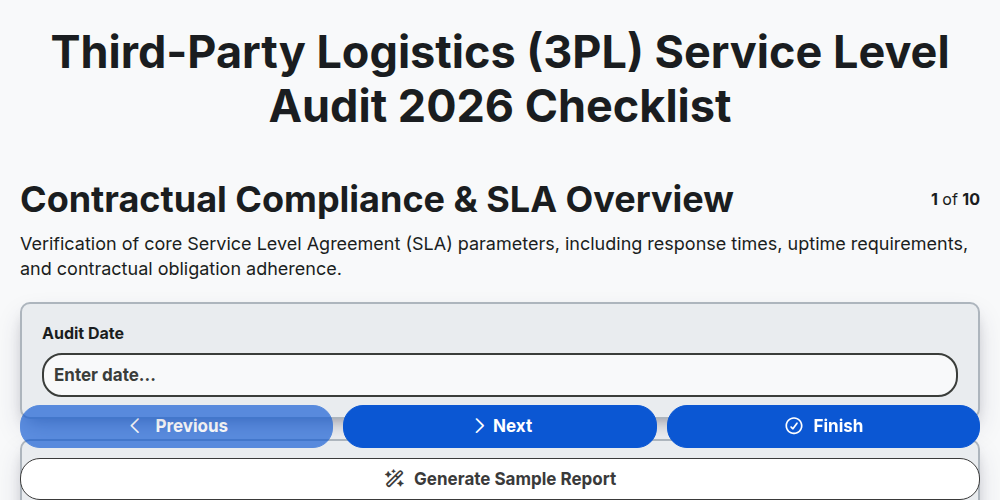
Table of Contents
- Introduction: Why 2026 Demands a Rigorous 3PL Audit Strategy
- 1. Foundation of Success: Contractual Compliance & SLA Overview
- 2. Maintaining Precision: Inventory Accuracy & Stock Integrity
- 3. Maximizing Throughput: Order Fulfillment & Processing Efficiency
- 4. Operational Excellence: Warehouse Management & Facility Standards
- 5. Streamlining the Entry Point: Inbound Receiving & Dock Operations
- 6. Last-Mile Reliability: Transportation & Carrier Performance
- 7. The Digital Backbone: Information Technology & Data Integration
- 8. Closing the Loop: Returns & Reverse Logistics Management
- 9. Safeguarding Operations: Safety, Security & Risk Management
- 10. Driving Accountability: Communication & Reporting Excellence
- Conclusion: Transforming Audit Results into Long-Term Partnership Value
- Resources & Links
TLDR: Stay ahead of evolving supply chain complexities with our comprehensive 2026 3PL Audit Checklist. This guide provides a strategic framework to evaluate your logistics partner across ten critical dimensions-from contractual compliance and inventory integrity to advanced IT integration and risk management-ensuring your third-party provider delivers the precision, efficiency, and scalability required for future growth.
Introduction: Why 2026 Demands a Rigorous 3PL Audit Strategy
Navigating the New Era of Supply Chain Complexity
As we approach 2026, the global supply chain landscape has transitioned from a period of recovery into an era of hyper-complexity. The integration of AI-driven forecasting, the rise of automated warehousing, and the increasing consumer demand for ultra-fast, sustainable delivery have fundamentally altered the expectations placed on Third-Party Logistics (3PL) providers. In this new environment, good enough is no longer a viable metric for success.
For businesses relying on outsourced logistics, your 3PL provider is no longer just a vendor; they are a critical extension of your brand identity and a cornerstone of your customer experience. A single breakdown in accuracy, a delay in transportation, or a lapse in data visibility can trigger a domino effect of dissatisfied customers and lost revenue.
The Shift from Reactive to Proactive Auditing
In previous years, 3PL audits were often viewed as annual check-the-box exercises-periodic reviews focused primarily on cost and basic error rates. However, in 2026, the volatility of global trade and the precision of modern e-commerce demand a shift toward continuous, proactive auditing.
A rigorous audit strategy is no longer about identifying failures after they occur; it is about stress-testing the resilience of your logistics ecosystem. As we move further into an era of real-time data and automated workflows, your audit must evaluate whether your 3PL partner can maintain high-performance standards amidst fluctuating demand and technological shifts.
Beyond the Surface: What Modern Auditing Achieves
Conducting a comprehensive service level audit allows your organization to move beyond surface-level KPIs. It provides a structured framework to:
- Mitigate Operational Risk: Identifying vulnerabilities in inventory integrity and facility security before they become costly liabilities.
- Ensure Scalability: Verifying that your partner's infrastructure and technology stack can support your 2026 growth projections.
- Drive Continuous Improvement: Using granular data from inbound, outbound, and reverse logistics to optimize the entire value chain.
- Safeguard Brand Reputation: Ensuring that the promises made at the point of sale are physically fulfilled with precision and speed.
The following checklist serves as your strategic blueprint. It is designed to help you dissect every touchpoint of the logistics process-from the moment goods arrive at the dock to the final mile of delivery-ensuring your 3PL partnership remains a competitive advantage rather than a bottleneck.
1. Foundation of Success: Contractual Compliance & SLA Overview
Setting the Standard for Accountability
Before diving into the granular details of daily operations, an audit must begin at the source of truth: your contract. In the rapidly evolving logistics landscape of 2026, where automation and real-time data are the norms, a vague agreement is a liability. The first step of your audit is to ensure that what was promised on paper is actually being delivered on the warehouse floor.
Verifying the Service Level Agreement (SLA) Framework
An effective audit starts by reviewing the core metrics that define your partnership. You are not just looking for good service; you are looking for measurable adherence to specific KPIs.
- KPI Alignment Check: Are the current metrics being measured still aligned with your 2026 business goals? Ensure that the KPIs being audited (such as On-Time Delivery or Order Accuracy) match the updated definitions in your most recent contract addendums.
- Penalty and Incentive Review: Evaluate the enforcement of malus clauses. If the 3PL has consistently missed targets, are the agreed-upon credits or service penalties being applied accurately to your invoices?
- Scope Creep Assessment: Identify any services being performed that fall outside the original contract scope. Are you being surcharged for tasks that should be covered under standard management fees?
Auditing the Compliance Framework
Compliance in 2026 extends beyond simple shipping accuracy; it encompasses regulatory, environmental, and legal adherence.
- Regulatory & Compliance Adherence: Verify that the 3PL is maintaining all necessary industry-specific certifications (e.g., ISO, FDA, or specialized handling permits) required for your product category.
- Contract Renewal & Amendment Tracking: Ensure all recent operational changes, software updates, or shifts in volume capacity have been formally documented through official contract amendments.
- Audit Trail Integrity: Review the 3PL's ability to provide a clear, documented trail of compliance decisions. If a dispute arises, can they produce the paper trail necessary to resolve it?
The Goal of this Step
The objective of this initial phase is to establish the baseline of accountability. By auditing your contractual compliance first, you create the legal and operational context needed to evaluate the more technical segments of the checklist, such as inventory accuracy and IT integration.
2. Maintaining Precision: Inventory Accuracy & Stock Integrity
The Foundation of Trust: Protecting Your Bottom Line
In the complex landscape of 2026 supply chains, inventory accuracy is no longer just a metric-it is the heartbeat of your customer experience. A single discrepancy between your digital records and physical reality can trigger a catastrophic domino effect: cancelled orders, frustrated customers, and inflated operational costs.
When auditing your 3PL partner, you must look beyond reported accuracy and dive deep into the mechanics of how they maintain stock integrity.
Key Audit Focus Areas
To ensure your 3PL is maintaining the high standards required for modern e-commerce and omnichannel distribution, your audit should scrutinize the following pillars:
1. Cycle Counting Rigor and Frequency Don't settle for annual physical counts. A high-performing 3PL should utilize a robust, continuous cycle counting program.
- The Audit Question: Does the provider have a documented schedule for ABC analysis-based counting (counting high-value/high-velocity items more frequently)?
- Red Flag: Relying solely on year-end wall-to-wall counts, which often mask systemic errors.
2. Discrepancy Root Cause Analysis (RCA) Accuracy is important, but the ability to learn from errors is critical. An audit should evaluate how the 3PL handles shrinkage or mismatches.
- The Audit Question: When a discrepancy is identified, is there a formal process to trace the error back to its source (e.g., receiving error, picking error, or system glitch)?
- The Goal: Moving from fixing the error to preventing the recurrence.
3. Unit-Level Integrity and Condition Monitoring In 2026, accuracy also encompasses the physical state of the product.
- The Audit Question: How does the 3PL monitor expiration dates (FEFO/FIFO), batch/lot control, and physical degradation (e.g., crushed packaging or dust accumulation)?
- The Goal: Ensuring that the product arriving at the customer's doorstep is as pristine as the day it was received.
4. Real-Time Synchronization The gap between a physical movement in the warehouse and its reflection in your ERP/WMS is where most errors live.
- The Audit Question: Is there a latency period between a physical stock change and the data update in your central system?
- The Goal: Achieving near-zero latency to prevent ghost inventory and overselling.
Pro-Tip for 2026 Auditors
As automation and robotics become standard in modern warehouses, verify how these technologies integrate with manual oversight. An automated system is only as accurate as the data fed into it during the inbound receiving stage.
3. Maximizing Throughput: Order Fulfillment & Processing Efficiency
Optimizing the Heart of the Supply Chain
In 2026, speed is no longer a competitive advantage-it is a baseline requirement. As consumer expectations for instant gratification continue to evolve, your 3PL's ability to move an order from purchased to shipped without friction determines your brand's reputation. During your audit, you must look beyond simple completion rates and dive deep into the mechanics of the fulfillment engine.
Key Audit Metrics to Evaluate
To ensure your 3PL is maintaining peak operational velocity, evaluate the following core pillars:
Order Cycle Time Analysis The time elapsed between order placement and carrier handover is the most critical metric for customer satisfaction.
- The Audit Focus: Are there consistent bottlenecks during peak hours? Does the cycle time remain stable during high-volume promotional periods (e.g., Black Friday/Cyber Monday), or does the system degrade under pressure?
Pick Accuracy and Error Rates A fast warehouse is useless if it is frequently shipping the wrong items. High error rates lead to the hidden costs of logistics: increased customer service inquiries, costly returns, and diminished customer lifetime value.
- The Audit Focus: Review the frequency of mispicks, short-ships, and incorrect labeling. Inspect the 3PL's use of error-prevention technologies, such as weight-checking scales or automated scan-verification at the packing station.
Packing Quality and Presentation In the era of the unboxing experience, the physical integrity of the package is a direct reflection of your brand.
- The Audit Focus: Examine the consistency of packaging standards. Are items being protected adequately to prevent transit damage? Is there excessive void fill (wasted material) that drives up costs and harms sustainability goals?
Automation and Human-Machine Synergy By 2026, the most efficient 3PLs are those successfully integrating AMRs (Autonomous Mobile Robots) and automated sorting systems with skilled human labor.
- The Audit Focus: Assess how effectively technology is being used to reduce manual touchpoints. Evaluate the scalability of their automated systems-can they ramp up throughput instantly if your order volume spikes by 50%?
4. Operational Excellence: Warehouse Management & Facility Standards
Optimizing the Physical Backbone of Your Supply Chain
While contractual terms and digital integration are vital, the physical state of your 3PL's warehouse is the heartbeat of your fulfillment engine. As we move into 2026, standard warehousing is no longer enough. To maintain a competitive edge, your audit must evaluate whether your provider's facility is equipped to handle increasing complexity, higher volumes, and the rigorous demands of modern e-commerce.
An audit of warehouse management and facility standards should focus on three critical dimensions:
1. Facility Infrastructure and Scalability
A warehouse must be more than just a storage space; it must be a dynamic environment capable of growth. During your audit, evaluate:
- Storage Density and Utilization: Is the provider effectively utilizing vertical space, or are you paying for air?
- Equipment Modernization: Are they utilizing automated storage and retrieval systems (AS/RS), or are they relying on outdated manual processes that increase the risk of error?
- Scalability Readiness: Does the facility have the physical footprint or modular capacity to accommodate your seasonal surges or sudden market expansions?
2. Environmental Controls and Product Integrity
For brands dealing with perishables, electronics, or high-value goods, the warehouse environment is a direct factor in product quality.
- Climate and Temperature Monitoring: If your products are sensitive to heat or humidity, you must verify the presence of automated, logged climate control systems.
- Cleanliness and Pest Control: A rigorous inspection of the facility's sanitation protocols is non-negotiable to prevent damage and maintain brand reputation.
- Specialized Storage Requirements: Ensure the facility meets the specific regulatory or physical requirements for your specific SKU profiles (e.g., bonded warehousing, temperature-controlled zones, or high-security cages).
3. Maintenance and Housekeeping Protocols
A cluttered or poorly maintained warehouse is a breeding ground for inefficiency and accidents.
- Aisle Management and Organization: Are aisles clear, well-marked, and optimized for efficient picking paths?
- Preventative Maintenance Programs: Ask for documentation regarding the upkeep of conveyor belts, forklifts, and automated sorting systems. Equipment downtime is downtime for your orders.
- 5S or Lean Implementation: Determine if the provider follows a standardized organization methodology (like 5S) to ensure a disciplined, predictable, and error-resistant operational environment.
5. Streamlining the Entry Point: Inbound Receiving & Dock Operations
Optimizing the Gateway to Your Supply Chain
The efficiency of your entire fulfillment cycle is determined the moment a shipment hits the dock. In 2026, as supply chains become increasingly complex and-just-in-time delivery becomes even more critical, your inbound operations cannot afford bottlenecks. An audit of your 3PL's receiving processes ensures that errors are caught at the perimeter, preventing hidden costs from cascading downstream.
When auditing inbound receiving and dock operations, focus on these critical operational pillars:
1. Receiving Accuracy and Verification Protocols
The primary goal is to ensure that what was ordered is exactly what was delivered. Your audit should verify:
- Discrepancy Management: Does the 3PL have a documented process for handling overages, shortages, and damages (OS&D)?
- SKU Validation: How effectively are items scanned and matched against Purchase Orders (POs) to prevent mislabeling?
- Quality Control (QC) Integration: Are there specific checkpoints for inspecting the physical integrity of goods before they are officially entered into the system?
2. Dock Productivity and Throughput
Congestion at the loading dock is a leading cause of increased lead times. Evaluate the 3PL's ability to manage flow through:
- Unloading Turnaround Times: Are there measurable KPIs for how long a trailer sits at the dock before unloading is complete?
- Dock Door Management: Is there an organized scheduling system for inbound appointments to prevent bottleneck periods?
- Labor Allocation: Does the provider demonstrate the ability to scale dock staff during peak seasonal surges?
3. Cross-Docking and Put-Away Speed
The time elapsed between a truck being unloaded and the product being available for sale is a vital metric for inventory liquidity.
- Put-Away Latency: Review the time stamps between receiving completion and inventory visibility in the WMS.
- Cross-Docking Proficiency: If your strategy relies on moving goods directly from inbound to outbound, does the 3PL have the structural capability and real-time data integration to execute this without manual intervention?
4. Documentation and Digital Traceability
In the era of automated supply chains, paper-heavy processes are a liability.
- Electronic Data Interchange (EDI) Utilization: Are inbound shipping notices (ASNs) being processed digitally and instantly?
- Record Keeping: Is there a digital audit trail for every incoming shipment, including photos of damaged goods and signed proof of delivery?
6. Last-Mile Reliability: Transportation & Carrier Performance
Optimizing the Final Mile: Metrics That Matter
In the 2026 logistics landscape, the last mile is no longer just a delivery phase-it is the primary driver of customer satisfaction and brand perception. When auditing your 3PL's transportation and carrier performance, you must look beyond simple delivery confirmation. You are auditing the reliability, visibility, and cost-efficiency of the entire outbound network.
Key Audit Dimensions
To ensure your 3PL is maintaining high standards, evaluate the following core areas:
1. On-Time Delivery (OTD) & Transit Time Variance
- Delivery Precision: Review the percentage of orders arriving within the promised delivery window.
- Transit Consistency: Analyze the variance between estimated arrival times (ETA) and actual arrival times. High volatility in transit times suggests poor carrier management or inefficient route planning.
2. Carrier Mix & Performance Management
- Carrier Diversification: Evaluate if your 3PL maintains a healthy mix of regional, national, and specialized carriers to mitigate the risk of localized disruptions (e.g., weather, labor strikes).
- Carrier Scorecarding: Verify that your 3PL actively monitors individual carrier performance. Are they holding sub-contractors accountable for delays or damages?
3. Last-Mile Visibility & Real-Time Tracking
- End-to-End Traceability: Assess the level of granular tracking available to both you and your end customers. In 2026, where is my order? should be answered with real-time GPS-based updates, not just out for delivery statuses.
- Proactive Exception Management: Audit how the 3PL communicates delays before they happen. A superior 3PL identifies a transit delay and triggers an automated customer alert immediately.
4. Cost Management & Freight Audit Accuracy
- Accessorial Charge Transparency: Scrutinize the frequency of hidden fees, such as fuel surcharges, residential delivery fees, or re-delivery attempts.
- Freight Audit Integrity: Ensure the 3PL's billing matches the agreed-upon contract rates and that discrepancies are identified and resolved through a formal audit process.
The 2026 Audit Checklist: Transportation Quick-Check
| Audit Item | What to Look For |
|---|---|
| On-Time Performance | Minimum 95%+ adherence to promised delivery dates. |
| Proof of Delivery (POD) | Instant, digital availability of signatures and photo evidence. |
| Claims Ratio | Low frequency of transit-related damages or lost shipments. |
| Route Optimization | Evidence of use of AI-driven routing to reduce carbon footprint and cost. |
| Communication Loop | Automated alerts for weather delays or carrier disruptions. |
7. The Digital Backbone: Information Technology & Data Integration
Navigating the Digital Frontier: Evaluating Your 3PL's Tech Ecosystem
In 2026, a 3PL's physical infrastructure is only as strong as its digital integration. As supply chains become increasingly autonomous and data-driven, the black box approach to logistics is no longer acceptable. An audit of your provider's IT capabilities is no longer just about checking for a stable internet connection; it is about ensuring seamless, real-time visibility across the entire value chain.
Data Synchronicity and API Connectivity
The cornerstone of a modern partnership is how well your internal ERP or E-commerce platform communicates with the 3PL's Warehouse Management System (WMS).
- Real-Time Integration: Does the provider utilize robust APIs or EDI (Electronic Data Interchange) to ensure that an order placed on your website is instantly visible to the warehouse floor?
- Latency Auditing: Check for data lag. Delays in information transfer can lead to overselling stock that doesn't exist or delayed shipping notifications to your customers.
- Automated Updates: Evaluate the automation of status changes (e.g., Picked, Packed, Shipped) to ensure your customer service team has the same information as your warehouse.
The Single Source of Truth: Data Accuracy and Visibility
A successful audit must verify that the data you see on your dashboard matches the physical reality of the warehouse.
- Inventory Visibility: Can you access a real-time view of on-hand, allocated, and incoming stock levels without requesting manual reports?
- Document Accessibility: Are digital documents-such as packing slips, BOLs (Bills of Lading), and proof of delivery-digitized and instantly accessible for audit trails?
- Predictive Analytics: In 2026, a top-tier 3PL should move beyond reactive reporting. Assess whether they leverage AI-driven insights to help you predict seasonal surges or identify potential stockouts before they occur.
Cybersecurity and Data Integrity
As logistics networks become more interconnected, they also become larger targets for cyber threats. Your audit must extend to the security of your proprietary data.
- Compliance Standards: Verify that the provider adheres to global data protection regulations (such as GDPR or CCPA) and maintains SOC 2 compliance.
- Disaster Recovery Protocols: What is the 3PL's protocol if their system goes offline? Evaluate their cloud redundancy and their ability to maintain manual operations during a digital outage to prevent supply chain paralysis.
- Access Control: Ensure there are strict protocols regarding who within the 3PL organization-and which third-party partners-can access your sensitive customer and proprietary commercial data.
8. Closing the Loop: Returns & Reverse Logistics Management
Mastering the Reversal: Auditing Your Reverse Logistics Workflow
In the 2026 e-commerce landscape, the return experience is no longer just a cost center-it is a critical touchpoint for customer retention. As consumer expectations for seamless, frictionless returns reach an all-time high, your 3PL's ability to manage reverse logistics determines your brand loyalty. An audit of this segment must look beyond mere processing speed to evaluate the intelligence and efficiency of the entire return loop.
Key Audit Focus Areas for Reverse Logistics
When auditing your provider's reverse logistics capabilities, use the following criteria to ensure they are protecting your bottom line:
1. Return Processing Speed and Turnaround Time (TAT)
The value of a returned item depreciates every hour it sits in a pending state.
- Inspection Efficiency: How quickly are returned goods inspected, sorted, and categorized (e.g., restockable, damaged, or liquidatable)?
- Status Updates: Does the 3PL provide real-time updates to your system the moment a return is processed?
- Refund Triggering: Is there a seamless integration between the physical receipt of goods and the notification sent to your customer service team to trigger refunds or exchanges?
2. Inventory Re-integration Accuracy
A breakdown in reverse logistics often leads to phantom inventory-items that are physically in the warehouse but not available for sale in your ERP.
- Stock Integrity: Verify the accuracy of items being moved back into Available status.
- Disposition Accuracy: Audit the precision of the grading process. Are damaged items being accidentally mixed with A-grade sellable stock?
3. Cost Management and Recovery Optimization
Reverse logistics is inherently expensive. Your audit should focus on how the 3PL minimizes these leaks.
- Disposition Strategy: Does the 3PL follow your predefined logic for high-cost items (e.g., routing broken goods directly to recycling vs. expensive manual inspection)?
- Refurbishment Capabilities: If part of your contract, evaluate the quality of repackaging or minor repairs being performed to return items to a sellable state.
- Loss Prevention: Are there rigorous controls in place to prevent return fraud or the disappearance of high-value items during the intake process?
4. Sustainability and Circularity Compliance
As we move into 2026, sustainability is a non-negotiable audit metric.
- Waste Reduction: Evaluate the 3PL's processes for minimizing packaging waste during the re-boxing of returned goods.
- Eco-friendly Disposition: Review their protocols for managing unsellable goods, focusing on their ability to facilitate recycling or responsible liquidation rather than landfill disposal.
9. Safeguarding Operations: Safety, Security & Risk Management
Protecting Your Assets and Continuity
In an era of increasingly complex global supply chains, your 3PL provider's ability to manage risk is just as critical as their ability to move goods. A single security breach or a significant safety lapse can lead to catastrophic financial losses, legal liabilities, and irreversible damage to your brand reputation.
When auditing for 2026, your evaluation must move beyond basic physical security and look toward proactive, technology-driven risk mitigation.
Physical Security and Access Control
The foundation of a secure warehouse is controlled access. Your audit should verify that the facility employs robust perimeter security and stringent protocols for both personnel and visitors.
- Access Management: Are biometric or advanced RFID systems in use to track movement within the facility?
- Surveillance Integrity: Is there comprehensive, high-definition CCTV coverage of all high-value zones, loading docks, and entry points, and is the footage retained for an adequate period?
- Theft Prevention: Are there clear, audited protocols for blind spots in the warehouse and regular audits of high-shrinkage items?
Occupational Health and Safety (OH&S) Compliance
A safe warehouse is an efficient warehouse. High accident rates lead to operational bottlenecks and increased insurance premiums.
- Regulatory Adherence: Does the provider maintain full compliance with updated 2026 local and international safety standards?
- Equipment Maintenance: Is there a documented schedule for the inspection and maintenance of forklifts, conveyors, and automated picking robots?
- Training Documentation: Can the 3PL provide proof of recent safety training for all floor staff, specifically regarding ergonomics and hazardous material handling?
Cybersecurity and Data Protection
As 3PLs become more integrated into your digital ecosystem via API and IoT, the security audit must extend into the digital realm.
- Data Privacy Compliance: How does the provider ensure compliance with evolving data protection laws (such as GDPR or CCryption updates) regarding your customers' PII (Personally Identifiable Information)?
- System Redundancy: What are the disaster recovery protocols? In the event of a cyberattack or local power failure, how quickly can they restore visibility to your inventory?
- Network Integrity: Is the 3PL's warehouse management system (WMS) protected by multi-factor authentication and regular vulnerability scanning?
Risk Mitigation and Business Continuity
Finally, evaluate the provider's readiness for the unexpected.
- Disaster Recovery Plans: Does the 3PL have a documented, tested plan for natural disasters, labor strikes, or sudden infrastructure failures?
- Insurance Coverage: Are the provider's liability insurance and cargo insurance limits sufficient to cover the full value of your specific inventory profile in 2026 market conditions?
10. Driving Accountability: Communication & Reporting Excellence
Mastering the Feedback Loop: Communication & Reporting Excellence
In the complex ecosystem of a 2026 supply chain, data is only as valuable as the visibility it provides. A 3PL partnership can fail even with perfect physical operations if there is a breakdown in the flow of information. An audit of communication and reporting ensures that your logistics partner isn't just moving boxes, but is providing the actionable intelligence required to make strategic business decisions.
Establishing a Single Source of Truth
The hallmark of a high-performing 3PL is the ability to provide real-time, transparent, and accurate data. During your audit, evaluate whether the reporting structure prevents data silos.
- Real-Time Visibility: Does the 3PL provide access to live dashboards, or are you relying on end-of-week manual spreadsheets?
- Data Consistency: Does the reporting from the 3PL's Warehouse Management System (WMS) align perfectly with your internal ERP or Order Management System (OMS)?
- Standardized KPIs: Are both parties measuring success using the same definitions for metrics like On-Time Delivery and Order Accuracy?
The Hierarchy of Reporting
A robust audit should examine three distinct layers of communication:
- Operational Reporting (Daily/Shift-level): These are the granular updates-inventory movements, daily shipment counts, and immediate exception alerts (e.g., a damaged incoming shipment).
- Tactical Reporting (Weekly/Monthly): This involves trend analysis. You should look for monthly performance reviews that highlight fluctuations in fulfillment speed, carrier performance trends, and error rates.
- Strategic Reporting (Quarterly/Annual): This is where the partnership evolves. Auditing this layer ensures the 3PL is participating in Quarterly Business Reviews (QBRs) to discuss long-term scalability, cost-saving opportunities, and seasonal forecasting.
Proactive Exception Management
The true test of communication excellence is not how a partner reports success, but how they communicate failure. Your audit should investigate the Exception Protocol:
- Incident Notification Timelines: How quickly is your team notified when a critical SLA is breached (e.g., a missed shipping window or a stockout)?
- Root Cause Analysis (RCA): When an error occurs, does the 3PL simply report the mistake, or do they provide a documented RCA and a corrective action plan?
- Escalation Pathways: Is there a clearly defined contact matrix? In the event of a system outage or a labor strike, do you know exactly who to contact and what the communication cadence will be?
Continuous Improvement through Feedback Loops
Finally, use this audit step to assess the closed-loop capability of your partner. A premier 3PL in 2026 should not just be a service provider, but a proactive consultant. Look for evidence of a formal feedback loop where insights from the warehouse floor are communicated upward to influence your broader supply chain strategy.
Conclusion: Transforming Audit Results into Long-Term Partnership Value
An audit should never be viewed as a mere gotcha moment or a simple box-ticking exercise. When executed correctly, a 3PL Service Level Audit is one of the most powerful strategic tools in your supply chain arsenal. It is not about finding fault; it is about uncovering the friction points that prevent your business from scaling in an increasingly complex 2026 marketplace.
From Reactive Correction to Proactive Strategy
The true value of this checklist lies in what you do after the final report is filed. Raw data regarding shipping delays or inventory discrepancies is only useful if it is transformed into an actionable roadmap. To extract maximum value from your audit, focus on these three pillars of post-audit management:
1. The Feedback Loop: Closing the Gap
Once you identify a deviation from your SLAs-whether in dock operations or data integration-immediately initiate a Root Cause Analysis (RCA) with your 3PL provider. Instead of simply demanding a fix, work together to identify if the failure was due to a process breakdown, a technological limitation, or a resource shortage. This collaborative approach shifts the dynamic from a vendor-client relationship to a true strategic partnership.
2. Continuous Improvement via Iterative Auditing
In the fast-paced logistics landscape of 2026, a single annual audit is no longer sufficient. Use the findings from this checklist to establish a cadence of micro-audits. By focusing on one specific area-such as Returns & Reverse Logistics-each quarter, you can ensure that performance improvements are sustained and that new efficiencies are baked into the operational DNA of your supply chain.
3. Driving Scalability and Competitive Advantage
A well-audited supply chain is a predictable supply chain. When you have high confidence in your 3PL's inventory accuracy and transportation performance, you gain the operational bravery needed to expand into new markets, launch new product lines, and promise faster delivery windows to your customers.
Final Thought
The goal of the 2026 3PL Service Level Audit is to ensure that your logistics engine is not just running, but optimized for growth. By rigorously applying these checks, you mitigate risk, reduce hidden costs, and ensure that your third-party provider is not just a service provider, but a powerful catalyst for your brand's success.
Resources & Links
- Supply Chain Dive: In-depth analysis and news regarding supply chain trends, logistics technology, and industry shifts essential for 2026 planning.
- Material Handling & Logistics: A leading resource for warehouse management, automation, and facility standards for 3PL providers.
- Council of Supply Chain Management Professionals (CSCMP): Global professional association providing best practices for logistics excellence and contractual compliance.
- Gartner: Industry-leading research and insights on digital transformation, IT integration, and predictive logistics analytics.
- Warehousing Education and Research Council (WERC): Provides benchmarking studies and KPIs for order fulfillment and warehouse operational excellence.
- ShipBob: Insightful content regarding e-commerce fulfillment, inventory accuracy, and last-mile delivery trends.
- Inbound Logistics: Comprehensive coverage of transportation management, carrier performance, and inbound dock operations.
- DHL Logistics Insights: Global perspectives on reverse logistics, risk management, and global supply chain security.
- OSHA: The primary regulatory resource for ensuring safety, security, and compliance in warehouse facilities.
- IBM Supply Chain: Focuses on the digital backbone, including blockchain, AI, and data integration for 3PL visibility.
- Logistics Management: A key resource for monitoring carrier performance and transportation technology advancements.
- Forbes - Supply Chain Section: High-level strategic perspectives on building long-term partnership value and managing global risk.
- Supply Chain Brain: Expert insights into complex logistics challenges, including reverse logistics and inventory integrity.
- ShipStation: Resources focusing on order processing efficiency and the integration of multi-channel fulfillment.
- UPS Supply Chain Solutions: Case studies and operational frameworks for optimizing last-mile reliability and dock operations.
- FreightWaves: Real-time data and news regarding transportation markets, carrier capacity, and logistics disruptions.
- Ascent (Contract Management): Specialized insights into maintaining contractual compliance and managing SLAs within complex agreements.
Comments
There are no comments yet. Be the first to add one!
Logistics Management Solution Demo
Tired of shipping delays, lost packages, and inefficient routes? ChecklistGuro's Work OS platform streamlines your entire logistics operation, from warehouse management and order fulfillment to route optimization and delivery tracking. Gain real-time visibility, reduce costs, and improve customer satisfaction. Learn how ChecklistGuro can transform your logistics business!
Related Articles
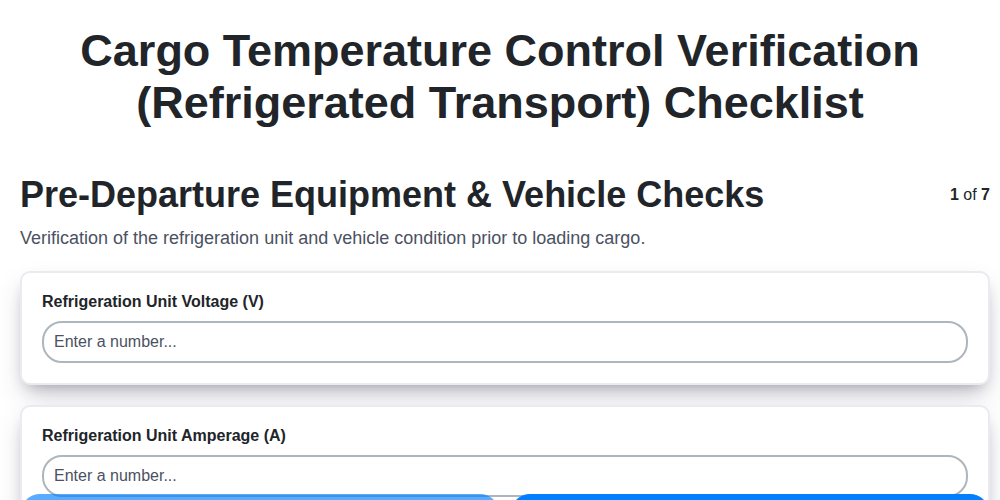
The Ultimate Refrigerated Cargo Temperature Control Checklist Template
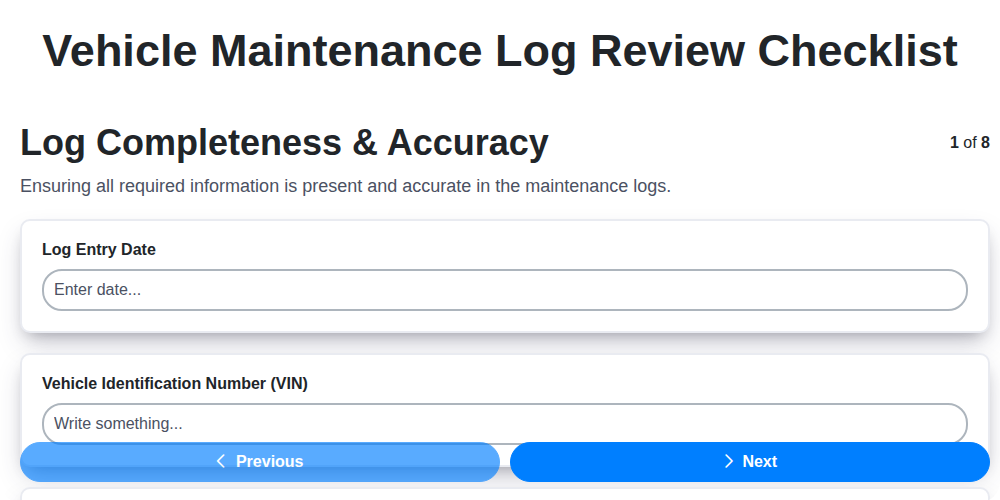
Mastering Your Fleet: A Vehicle Maintenance Log Review Template
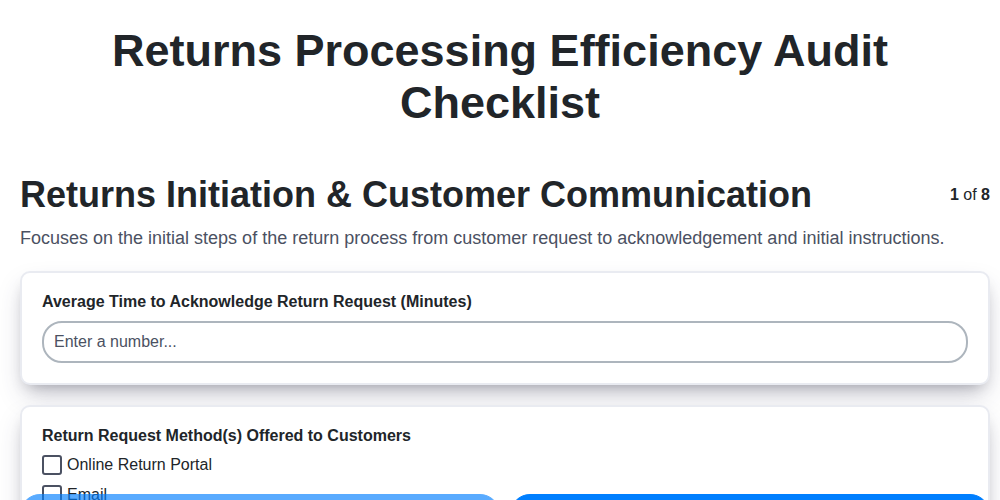
Master Your Returns: The Ultimate Returns Processing Efficiency Audit Checklist
Data Privacy Policy Compliance: Your Essential Checklist Template
Delivery Confirmation Audit: Your Checklist Template for Process Excellence
Your Pallet Inspection & Maintenance Checklist Template
Fuel Efficiency Monitoring: Your Checklist Template for Savings
Supply Chain Risk Assessment: Your Essential Checklist Template
Need help with
Logistics?
Have a question? We're here to help. Please submit your inquiry, and we'll respond promptly.