The Ultimate Warehouse Forklift and Material Handling Equipment Maintenance Checklist 2026: A Complete Template for Safety and Efficiency
Published: 10/28/2026 Updated: 10/29/2026
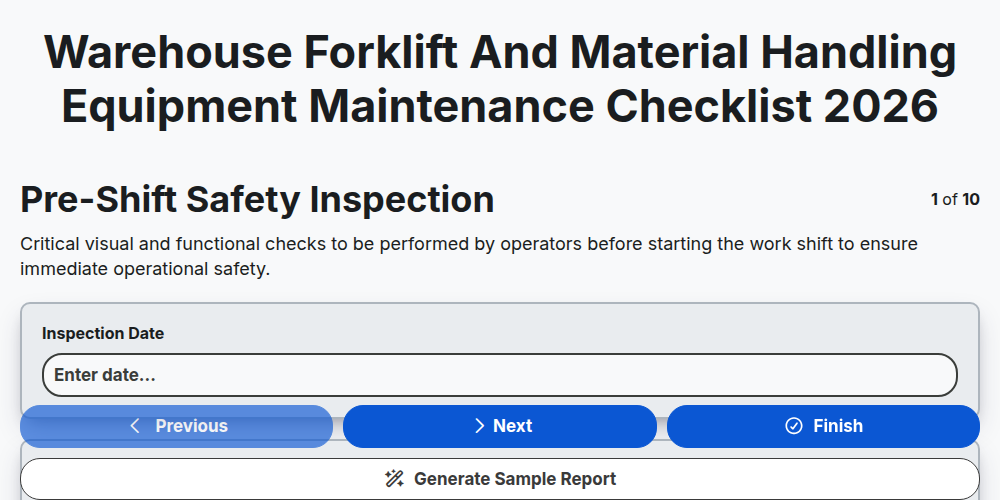
Table of Contents
- Introduction: The Critical Role of Preventative Maintenance in 2026
- Why Regular Inspections are Non-Negotiable for Warehouse Safety
- Step 1: Pre-Shift Safety Inspection - The Daily Essential
- Step 2: Battery and Electrical System Maintenance
- Step 3: Hydraulic and Lift Mechanism Inspection
- Step 4: Tires, Wheels, and Braking System Check
- Step 5: Examining Mast, Chains, and Carriage Components
- Step 6: Fluid Levels and Leak Detection Protocols
- Step 7: Steering and Control Interface Functionality
- Step 8: Safety Features and Warning Devices Verification
- Step 9: Structural and Chassis Integrity Assessment
- Step 10: Post-Maintenance Log and Documentation Best Practices
- Digitalizing Your Maintenance Records for 2026 Compliance
- Conclusion: Maximizing Equipment Lifespan and Reducing Downtime
- Resources & Links
TLDR: Ensure maximum uptime and workplace safety in 2026 with our comprehensive forklift maintenance guide. This essential checklist covers everything from pre-shift inspections and hydraulic checks to battery care and structural integrity, providing a complete roadmap to prevent costly breakdowns and maintain regulatory compliance.
Introduction: The Critical Role of Preventative Maintenance in 2026
In the rapidly evolving landscape of logistics and supply chain management, the year 2026 demands more than just operational speed-it demands unprecedented precision and-unwavering safety. As warehouse automation and smart technology become more deeply integrated into material handling, the margin for error has narrowed. A single mechanical failure is no longer just a delay; it is a potential bottleneck that can disrupt an entire automated ecosystem and a significant risk to human operators.
Why Proactive Maintenance is Non-Negotiable
Preventative maintenance is the backbone of a high-performing warehouse. Moving beyond the old fix it when it breaks mentality, modern facility managers now view maintenance as a strategic investment in uptime. By adhering to a rigorous, structured inspection protocol, you are not just preventing breakdowns; you are protecting your bottom line.
The Impact of Equipment Downtime in 2026
In today's high-velocity distribution centers, the costs of equipment failure are multifaceted:
- Operational Disruption: Unexpected downtime cascades through the supply chain, leading to missed shipping windows and delayed outbound logistics.
- Rising Repair Costs: Reactive repairs are significantly more expensive than scheduled adjustments, often involving emergency shipping for parts and unplanned technician labor.
- Safety and Compliance Risks: In an era of heightened regulatory scrutiny, unmaintained equipment poses severe liabilities, including workplace injuries and heavy-duty regulatory fines.
- Reduced Asset Lifespan: Material handling equipment represents a massive capital expenditure. A consistent maintenance regime ensures your fleet reaches its full projected lifecycle, maximizing your Return on Investment (ROI).
Setting the Standard for Excellence
The following checklist has been designed to serve as a comprehensive blueprint for 2026. It covers every critical touchpoint-from the electrical integrity of battery systems to the structural stability of the chassis. Whether you are managing a small fleet or a massive, tech-driven distribution hub, this guide will help you standardize your inspection processes, ensure operator safety, and maintain peak operational efficiency.
Why Regular Inspections are Non-Negotiable for Warehouse Safety
Mitigating Risks and Avoiding Costly Downtime
In the fast-paced environment of a modern distribution center, your material handling equipment (MHE) is the backbone of your operations. When a forklift fails, the entire supply chain feels the impact. Regular, structured maintenance is not just a best practice-it is a critical defensive strategy against the two greatest threats to warehouse productivity: unplanned downtime and operational accidents.
Preventing the High Cost of Reactive Maintenance
Waiting for a machine to break down before calling a technician is one of the most expensive mistakes a warehouse manager can make. Reactive maintenance often leads to:
- Emergency Repair Premiates: Urgent, unscheduled service calls always cost more than scheduled upkeep.
- Supply Chain Bottlenecks: A single downed forklift can halt a loading dock, causing missed shipping windows and late delivery penalties.
- Secondary Damage: A minor hydraulic leak left unchecked can eventually lead to total system failure or expensive engine damage.
Ensuring Operator Safety and Compliance
Beyond the balance sheet, the primary driver for a rigorous inspection checklist is the safety of your workforce. Forklifts are heavy, powerful, and inherently high-risk machines.
Protecting Your People and Your Liability
- Reducing Workplace Injuries: Most forklift accidents are preventable. Regular checks of brakes, steering, and warning devices ensure that operators are never in control of a malfunctioning vehicle.
- Regulatory Compliance: In 2026, safety standards and OSHA-aligned audits are more stringent than ever. Maintaining a documented history of inspections is your first line of defense during a safety audit or an insurance investigation.
- Standardizing Safety Culture: Implementing a mandatory pre-shift and post-maintenance routine instills a culture of accountability. It sends a clear message to your team that safety is not an afterthought, but a core operational value.
Step 1: Pre-Shift Safety Inspection - The Daily Essential
The First Line of Defense: The Daily Walkthrough
Before the engine even starts or the battery is engaged, every shift must begin with a rigorous physical walkthrough of the equipment. The Pre-Shift Safety Inspection is not merely a formality; it is the most critical window of opportunity to identify low-level hazards that could escalate into catastrophic equipment failure or workplace injuries during a busy shift.
In 2026, with the increasing integration of automated systems and heightened safety regulations, this inspection serves as the primary manual check to ensure that the mechanical and electronic sensors are all in sync.
Key Focus Areas for Your Pre-Shift Routine
To ensure no detail is overlooked, your operators should follow a systematic path around the perimeter of the vehicle, checking the following:
- Visual Integrity Check: Scan the entire body of the forklift for any new dents, cracks, or structural deformations that may have occurred during the previous shift.
- Debris and Obstruction Audit: Ensure that the forks,-carriage, and floorboards are free from accumulated debris, wood scraps, or shrink wrap, which can interfere with mechanical movements.
- Operational Environment Check: Confirm that the immediate surroundings are clear of any leaks or spills that may have compromised the stability of the machine or the safety of the operator.
- Standard Safety Gear Verification: Check that all-important physical components, such as seatbelts, overhead guards, and mirrors, are clean, unobstructed, and properly positioned.
The Zero-Tolerance Mindset
The goal of the pre-shift inspection is simple: Identify, Report, and Rectify. If any visible abnormality is detected-no matter how small-the equipment must be tagged Out of Service immediately. In a high-output warehouse environment, skipping this step to save five minutes can result in hours of downtime or, worse, an avoidable accident.
Step 2: Battery and Electrical System Maintenance
Ensuring Power and Connectivity
The electrical system is the heartbeat of your material handling equipment, especially with the increasing prevalence of electric forklifts in modern smart warehouses. In 2026, maintenance is no longer just about checking if a machine turns on; it is about optimizing energy efficiency and preventing costly downtime caused by battery degradation or sensor failure.
Battery Health and Terminal Inspection
For electric fleets, the battery is often the most expensive component. Regular inspection prevents sudden power loss and extends the overall lifespan of the unit.
- Terminal Integrity: Check for corrosion, oxidation, or loose connections. Clean terminals with an approved neutralizing agent if buildup is detected.
- Hydration Levels: For lead-acid batteries, ensure electrolyte levels are maintained at the proper level. Overfilling or underfilling can lead to permanent cell damage.
- Cable and Connector Check: Inspect battery cables for fraying, cracking, or heat damage. Ensure connectors are seated firmly to prevent electrical arcing.
- Charging Station Calibration: Verify that charging stations are delivering the correct voltage and that the charging cycle completes without overheating.
Electrical Circuitry and Wiring
A single loose wire can trigger an emergency shutdown or create a fire hazard.
- Wiring Harness Inspection: Scrutinize the wiring harnesses for signs of wear, rubbing against the chassis, or damage from extreme temperature fluctuations.
- Fuse and Circuit Breaker Audit: Periodically test all fuses and circuit breakers. Replace any components that show signs of heat discoloration or intermittent tripping.
- Control Module Functionality: Ensure the onboard computer and sensors are communicating correctly without error codes.
Sensor and Electronic Component Testing
As warehouse automation grows, the reliance on sensors for collision avoidance and load sensing increases.
- Sensor Cleanliness: Ensure all proximity sensors and optical sensors are free from dust, grease, and debris.
- Display and Dashboard Check: Verify that all digital readouts, hour meters, and battery indicators are clear, legible, and functioning accurately.
Step 3: Hydraulic and Lift Mechanism Inspection
Ensuring Precision and Power: The Hydraulic and Lift Mechanism Inspection
The hydraulic system is the heart of your forklift's lifting capability. In 2026, with the increasing complexity of automated and semi-automated material handling equipment, even a minor pressure drop can lead to catastrophic operational delays or safety hazards. A failure in the hydraulic mechanism doesn't just slow down your workflow-it poses a significant risk of load instability.
To maintain peak performance, your inspection must focus on both the visible components and the internal pressure integrity.
Critical Inspection Points
To ensure your equipment is ready for the demands of a high-output warehouse environment, use the following sub-checklist:
Hydraulic Cylinder Integrity:
Inspect all lift and tilt cylinders for signs of weeping or active leaks around the rod seals.
Check the cylinder rods for scoring, pitting, or any physical damage that could compromise the seals.
Ensure the rods are smooth and free of debris that could tear the wiper seals during retraction.
Hydraulic Hoses and Lines:
Visual Wear Assessment: Examine hoses for cracks, abrasions, or bulges caused by friction or age.
Connection Points: Check all fittings and couplings for signs of moisture or oil residue, which indicate slow leaks.
Routing Integrity: Ensure hoses are properly routed and not rubbing against the mast or other moving components.
Control Valve and Manifold Inspection:
Verify that the control valves are operating smoothly without sticking.
Check the valve block area for any signs of oil seepage that could indicate internal seal failure.
Lift Mechanism Smoothness:
Cycle Testing: Perform a full range of motion test (full lift to full tilt) to ensure smooth, consistent movement.
Unusual Noise Detection: Listen for any chattering, grinding, or whining sounds during hydraulic actuation, which could signal air in the system or pump cavitation.
Load Stability: While testing, observe the carriage for any unintended tilting or drifting when the hydraulic functions are in a neutral position.
Pro-Tip for 2026 Maintenance Standards
As warehouses move toward more data-driven maintenance, always cross-reference your physical findings with your equipment's onboard telematics (if available). If your sensors indicate a drop in hydraulic pressure, use this physical inspection to pinpoint the exact leak or component failure before it escalates into an emergency repair.
Step 4: Tires, Wheels, and Braking System Check
Ensuring Stability and Control: Tires, Wheels, and Braking System Check
The integrity of your forklift's contact points and stopping power is non-negotiable. In 2026, with the increasing-speed automation and higher-density warehousing, even a minor issue with a tire or brake pad can lead to catastrophic equipment failure or workplace injury.
1. Tire Condition and Wear Analysis
Tires are the only point of contact between your machinery and the warehouse floor. Regular inspection prevents slippage and instability.
- Check for Debris: Inspect for embedded nails, metal shards, or wood splinters that can cause rapid deflation or punctures.
- Monitor Tread Depth and Wear: For pneumatic tires, ensure the tread is within manufacturer specifications. For solid/cushion tires, check for chunking (missing pieces of rubber) or uneven wear patterns that indicate alignment issues.
- Inspect for Cracks and Flat Spots: Look for dry rot or heat-induced cracking in the sidewalls, which can lead to sudden tire failure under heavy loads.
2. Wheel and Rim Integrity
It isn't just about the rubber; the structural components holding the wheels must be flawless.
- Rim Inspection: Check for dents, cracks, or warping in the metal rims. Even a small dent can cause vibration that damages the forklift's internal components over time.
- Lug Nut Security: Ensure all lug nuts are tightened to the specific torque requirements provided by the OEM (Original Equipment Manufacturer). Loose lug nuts are a primary cause of wheel separation.
- Bearing Assessment: Listen for grinding or unusual noises during movement, which may indicate failing wheel bearings.
3. Braking System Functionality
The ability to stop a heavy load instantly is the most critical safety feature of any material handling vehicle.
- Brake Pedal Response: Test the pedal for sponginess or excessive travel. The pedal should feel firm and provide immediate resistance.
- Stopping Distance Test: Conduct a controlled test to ensure the vehicle comes to a complete stop within the expected distance without skidding.
- Parking Brake Engagement: Ensure the parking brake holds the vehicle firmly on an incline. If the brake slips even slightly while parked, it must be serviced immediately.
- Brake Fluid Levels: If your equipment utilizes a hydraulic braking system, check the reservoir levels and inspect brake lines for any signs of weeping or moisture.
Step 5: Examining Mast, Chains, and Carriage Components
Precision Inspection: The Core of Lifting Safety
The mast and carriage assembly are the most critical components of your forklift, as they directly manage the heavy loads that define your daily operations. Any failure in these moving parts can lead to catastrophic structural failure or dropped loads. In 2026, with the increasing complexity of automated and semi-automated lifting systems, precision inspection is more vital than ever.
Evaluating the Mast and Lift Chains
The mast serves as the backbone of the lifting mechanism. Your inspection should focus on:
- Chain Tension and Wear: Check all lift chains for uniformity. Chains should have even tension; unevenness often indicates internal damage or stretched links. Inspect for kinks, corrosion, or any sign of broken strands.
- Lubrication Status: Ensure that the chains are adequately lubricated. Dry or gritty chains increase friction, leading to premature wear and increased energy consumption.
- Mast Rails and Rollers: Inspect the mast rails for any dents, bends, or warping. Check the load rollers to ensure they move freely within the tracks without excessive play or grinding.
Carriage and Fork Integrity
The carriage is the interface between the machine and the payload. A compromised carriage can lead to instability.
- Fork Condition: Examine the forks for any signs of bending, cracking, or thinning. Use a caliper to check for wear in the thickness of the fork blades; if they have worn down beyond the manufacturer's specified tolerance, they must be replaced immediately.
- Fork Tines and Heel Inspection: Look closely at the heel of the fork (the bend) for any hairline fractures.
- Carriage Movement: The carriage should move smoothly up and down the mast without lateral wobbling. Ensure that the attachment points for any side-shifters or hydraulic attachments are secure and free from debris.
Hydraulic Cylinder and Hose Check (Integrated Components)
While fluid levels are handled in a separate step, the physical state of the hydraulic cylinders attached to the mast is crucial here. Check for any signs of pitting on the cylinder rods or any external weeping of fluid at the seals that could compromise lifting power.
Step 6: Fluid Levels and Leak Detection Protocols
Ensuring Fluid Integrity and Leak Prevention
Maintaining proper fluid levels is one of the most critical components of your 2026 maintenance strategy. For material handling equipment, fluids are the lifeblood of the machine; neglect can lead to catastrophic component failure, overheating, and expensive downtime.
Critical Fluid Checkpoints
During your inspection, focus your attention on the following essential reservoirs:
- Hydraulic Oil: Check the sight glass or dipstick to ensure levels are within the manufacturer's specified range. Low hydraulic fluid can lead to sluggish lifting, erratic movement, or complete loss of mast control.
- Engine Oil (for IC Forklifts): Verify oil clarity and volume. Contaminated or low oil levels significantly increase the risk of engine seizure.
- Coolant Levels: Ensure the radiator is filled to the proper level to prevent overheating during high-intensity shifts.
- Transmission Fluid: Inspect for proper viscosity and level to ensure smooth gear transitions and power delivery.
- Brake Fluid: Even in electric models, hydraulic braking systems require consistent fluid levels to ensure stopping power remains reliable.
The Spot the Spot Strategy: Leak Detection
A leak is more than just a mess on the warehouse floor-it is a primary indicator of a mechanical failure in progress. During your inspection, implement a systematic sweep of the following areas:
- Under the Chassis: Look for fresh puddles or damp spots directly beneath the unit after it has been stationary.
- Hydraulic Cylinders: Inspect the lift and tilt cylinders for weeping or oily residue around the seals.
- Hose and Fitting Integrity: Check for cracks, bulges, or dampness around hydraulic hoses, clamps, and junctions.
- The Ground Trace: As the forklift moves through its path, scan the floor for any dripping trails that may indicate a leak occurring during operation.
Immediate Action Protocol
If a leak is detected, do not simply top off the fluid and continue. Follow this 2026 safety standard:
- Identify the Source: Determine if the leak is coming from a seal, a hose, or a structural crack.
- Assess Severity: Differentiate between seepage (minor weeping) and active leaks (dripping or spraying).
- Tag and Report: Any active leak should trigger an immediate Out of Service tag. Never operate a machine with compromised hydraulic pressure or leaking flammable fluids.
Step 7: Steering and Control Interface Functionality
Ensuring Precision Control and Responsiveness
The steering and control interface is the primary point of contact between the operator and the machine. Any lag, stiffness, or inaccuracy in the controls can lead to catastrophic accidents in tight warehouse aisles. In 2026, as warehouse automation and semi-autonomous integration become more common, the precision of these interfaces is more critical than ever.
Checking Steering Responsiveness
The steering mechanism must be smooth and predictable. During your inspection, perform the following checks:
- Steering Smoothness: Rotate the steering wheel fully to the left and right. There should be no sudden notches, grinding sensations, or excessive resistance.
- Returnability: After a turn, the wheels should return to a centered position naturally without manual forcing.
- Play and Slack: Check for excessive dead zones in the steering wheel. If the wheels do not respond immediately to input, it may indicate worn tie rods or hydraulic steering issues.
Evaluating Control Lever and Joystick Functionality
The levers and joysticks govern the lift, tilt, and side-shift functions. Inconsistent control movements can lead to dropped loads or tipped masts.
- Tactile Feedback: Ensure all levers move through their full range of motion without sticking or snagging.
- Hydraulic Response Sync: Verify that every movement of the control interface results in the exact corresponding movement of the mast. Any delay between the lever movement and the mechanical response could indicate air in the hydraulic lines or faulty solenoids.
- Joystick Precision: For modern electric forklifts equipped with ergonomic joysticks, ensure the sensitivity is consistent and that the neutral position is stable and does not drift.
Pedal and Foot Controller Inspection
The pedals are vital for both movement and emergency stopping.
- Accelerator Pedal: Check that the pedal returns to the upright position immediately after being released.
- Brake Pedal Travel: Ensure the brake pedal does not travel too far into the floorboard, which could signal a loss of hydraulic pressure or worn brake pads.
- Physical Condition: Inspect pedals for accumulated debris, mud, or grease that could cause an operator's foot to slip during critical maneuvers.
Step 8: Safety Features and Warning Devices Verification
Ensuring Visibility and Alert Systems Functionality
Safety features and warning devices are the final line of defense in preventing workplace accidents. In 2026, with the increasing integration of smart warehouse technology and automated sensors, verifying these components is more critical than ever. A failure in a warning system can lead to catastrophic collisions, especially in high-traffic environments or low-visibility zones.
Essential Safety Component Audit
When performing your inspection, focus on the following critical warning elements:
- Audible Alarms and Backup Beepers: Ensure that the reverse alarm is clearly audible over the ambient noise of the warehouse. If the sound is muffled or faint, it may indicate a failing speaker or environmental obstructions.
- Visual Warning Lights (Blue Spot/Red Zone Lights): In modern warehouses, floor-projection lights are vital for alerting pedestrians to an approaching forklift. Verify that these lights are bright, properly aligned, and projecting the correct pattern on the floor.
- Strobe and Beacon Lights: Check that all overhead flashing lights are operational. These serve as a high-visibility signal to operators and nearby workers that a vehicle is in motion.
- Horn Functionality: Test the horn to ensure it provides an immediate, loud, and clear signal. This is the primary way an operator communicates intent at intersections or blind corners.
Sensor and Proximity Detection Systems
If your fleet is equipped with advanced telematics or automated collision avoidance technology, your inspection must include:
- Proximity Sensor Calibration: Verify that sensors are clean and free of debris (such as dust or shrink wrap) that could cause false negatives or trigger unnecessary emergency stops.
- Emergency Stop (E-Stop) Testing: Periodically trigger the emergency shutdown button to ensure the machine responds instantly by cutting power to the drive and hydraulic systems.
- Seatbelt and Restraint Integrity: Inspect the seatbelt for fraying and ensure the locking mechanism engages securely. For electric models, check that any integrated operator-presence sensors (deadman switches) are functioning correctly.
Pro-Tip for 2026: As warehouses move toward higher levels of automation, never assume a sensor is working simply because the light is on. Always perform a functional action test to confirm the machine responds to the safety trigger.
Step 9: Structural and Chassis Integrity Assessment
Ensuring Long-Term Structural Reliability
While many inspections focus on moving parts, the structural and chassis integrity assessment is what ensures the fundamental stability of your equipment. Even if a forklift operates smoothly, hidden fatigue in the frame or chassis can lead to catastrophic failure under heavy loads.
Evaluating the Main Frame and Chassis
The chassis is the backbone of your material handling equipment. During your 2026 inspection, focus on identifying signs of metal fatigue, stress fractures, or warping.
- Weld Inspection: Closely examine all load-bearing welds for hairline cracks or discoloration, which could indicate overheating or structural weakness.
- Chassis Alignment: Check for any visible twisting or bending of the main frame that could suggest the unit has been subjected to an impact or an overload.
- Corrosion Control: In environments with high humidity or chemical exposure, look for deep-seated rust that could compromise the density of the steel.
Inspecting the Overhead Guard and Load Backrest
The safety of the operator and the surrounding warehouse personnel depends heavily on the integrity of the protective structures.
- Overhead Guard Integrity: Inspect the overhead guard for any dents, bends, or compromised bolts. This structure must remain uncompromable to protect against falling objects.
- Load Backrest Stability: Ensure the backrest is securely mounted and free from deformation. A warped backrest can cause loads to shift unexpectedly during transit.
Fasteners, Bolts, and Mounting Hardware
A small loose bolt can lead to a large-scale mechanical failure.
- Torque Checks: Periodically verify that critical mounting bolts for the mast, battery compartment, and heavy-duty components are tightened to manufacturer specifications.
- Hardware Replacement: If any bolts show signs of heavy shearing or extreme wear, replace them immediately rather than attempting to tighten them.
Assessing Impact Damage
In the fast-paced warehouse environments of 2026, minor collisions are often overlooked.
- Audit Impact Zones: Check the corners of the chassis, the forks, and the stabilizer legs for recent impact marks. Even minor dents can indicate that the machine is being operated near its structural limits or that the operator requires further training.
Step 10: Post-Maintenance Log and Documentation Best Practices
Ensuring Accountability through Rigorous Record-Keeping
The final, and perhaps most critical, step in your maintenance cycle is not a mechanical one, but an administrative one. A checklist is only as effective as the documentation that follows it. In 2026, with the increasing integration of smart warehousing and IoT-enabled fleet management, moving beyond simple check-the-box mentalities toward a robust, traceable paper or digital trail is essential for compliance and long-term asset management.
The Golden Rule: If It Wasn't Documented, It Didn't Happen
In the eyes of safety auditors and insurance investigators, an unrecorded inspection is an unperformed inspection. Your post-maintenance log serves as your primary defense in the event of an accident or a regulatory audit (such as OSHA inspections).
When completing your logs, ensure you capture the following details for every inspection and repair:
- Timestamp and Operator Identity: Exactly when the inspection occurred and who performed it.
- Equipment ID: Precise identification of the specific unit (Serial Number or Fleet ID).
- Specific Findings: Avoid vague terms like OK or Good. Instead, use descriptive language like No visible fraying on hydraulic hoses or Brake pad thickness at 5mm.
- Corrective Actions Taken: If a fault was found, document what was done to remediate it (e.g., Replaced worn hydraulic seal, Recharged battery with distilled water).
- Follow-up Requirements: Note any monitor-only issues that require a secondary inspection within a specific timeframe.
Transitioning to Digital Documentation
As we move deeper into 2026, the era of the grease-stained clipboard is fading. To maximize efficiency, consider integrating your checklist into a Digital Maintenance Management System (CMMS). Digital logs offer several strategic advantages:
- Real-Time Alerts: Automated notifications can trigger an immediate work order the moment a fail is logged on a pre-shift inspection.
- Predictive Analytics: By analyzing historical data in your logs, you can identify patterns-such as a specific forklift experiencing frequent hydraulic leaks-allowing you to transition from reactive repairs to predictive maintenance.
- Centralized Accessibility: Site managers can monitor the health of the entire fleet from a single dashboard, ensuring no unit is operating with an expired inspection status.
- Audit Readiness: Digital logs are searchable, timestamped, and tamper-proof, making compliance reviews seamless and stress-free.
Building a Culture of Accountability
Documentation should not be viewed as a burden, but as a tool for empowerment. When operators know that their inspections are being recorded and reviewed, it reinforces a culture of safety and precision. Use these logs to celebrate high-performing operators who maintain zero-defect records and to identify training gaps where technical errors frequently occur.
By mastering the post-maintenance log, you transform your maintenance checklist from a simple safety task into a powerful strategic asset that extends equipment lifespan and protects your most valuable resource: your people.
Digitalizing Your Maintenance Records for 2026 Compliance
The Shift Toward Smart Maintenance Management
As we move into 2026, the era of paper-based logs and clipboard inspections is rapidly coming to an end. Regulatory bodies and insurance providers are increasingly demanding higher levels of data integrity, making the transition to digital maintenance records a necessity rather than a luxury. In a modern warehouse environment, a check isn't just a tick in a box; it is a data point that contributes to your facility's overall predictive maintenance strategy.
Why Digitalization is Non-Negotiable in 2026
The complexity of modern material handling equipment (MHE) requires more than just manual oversight. Digitalizing your maintenance records offers three critical advantages for 2026 compliance:
- Real-Time Audit Readiness: With digital logs, you no longer need to scramble through filing cabinets when a safety auditor arrives. Every pre-shift inspection and hydraulic check is timestamped and instantly accessible.
- Predictive Analytics and Lifecycle Tracking: By moving your checklists to a digital platform, you can track the frequency of specific component failures-such as recurring issues with battery terminals or hydraulic leaks-allowing you to replace parts before they cause an unplanned breakdown.
- Accountability and Error Reduction: Digital interfaces can utilize mandatory photo uploads and GPS tagging. This ensures that when an operator completes a Mast and Chain Inspection, there is verifiable proof that the inspection actually took place.
Integrating Your Checklist into a Digital Ecosystem
To truly future-proof your operations, your maintenance checklist should be integrated into a centralized Enterprise Asset Management (EAM) or Computerized Maintenance Management System (CMMS).
When your Pre-Shift Safety Inspections are digitized, the data can automatically trigger a work order for the maintenance team if a fault is detected. This creates a closed-loop system where a fail on a braking system check immediately notifies the technician, reducing the window of risk and ensuring that no critical safety feature is overlooked.
Building a Compliance-Ready Digital Trail
For 2026, your digital documentation strategy should focus on the following:
- Standardized Input: Use dropdown menus and mandatory fields for fluid levels and tire wear measurements to ensure data consistency.
- Automated Escalation: Set up automated alerts for periodic deep-maintenance tasks, such as annual structural integrity assessments.
- Centralized Storage: Ensure all maintenance logs, from battery care to chassis inspections, are stored in a cloud-based environment that allows for cross-site visibility.
By embracing digitalized maintenance records, you aren't just keeping a record of what happened-you are building a proactive safety culture that protects your assets, your operators, and your bottom line.
Conclusion: Maximizing Equipment Lifespan and Reducing Downtime
Prioritizing Proactive Maintenance for a Resilient Supply Chain
As we look toward 2026, the landscape of warehousing is becoming increasingly automated and fast-paced. In this environment, there is zero margin for error. A single mechanical failure caused by a missed inspection doesn't just stall a single pallet; it creates a ripple effect of delays, increased labor costs, and heightened safety risks that can compromise your entire operation.
Implementing this comprehensive maintenance checklist is about more than just following regulations-it is about building a culture of operational excellence. By transitioning from reactive break-fix mentalities to a proactive, structured inspection routine, you achieve three critical business advantages:
1. Drastic Reduction in Unscheduled Downtime
The most expensive hour in a warehouse is the one spent waiting for a technician to arrive. By identifying worn chains, leaking hydraulics, or degrading batteries during a pre-shift inspection, you can schedule repairs during planned maintenance windows, ensuring your fleet is always ready when the shift begins.
2. Enhanced Operator Safety and Compliance
Safety is the cornerstone of modern material handling. Regular checks of braking systems, steering interfaces, and warning devices ensure that your operators are working in a controlled, predictable environment. This not only protects your most valuable assets-your people-but also shields your company from the legal and financial liabilities associated with equipment failure.
3. Optimized Total Cost of Ownership (TCO)
Material handling equipment represents a massive capital investment. Small, consistent actions-such as verifying fluid levels and checking tire integrity-prevent the catastrophic component failures that lead to massive repair bills. A well-maintained fleet retains higher resale value and extends the useful life of your assets, directly impacting your bottom line.
Final Thoughts for 2026
As you move through 2026, use this checklist as a living document. Integrate it into your digital management systems, hold your teams accountable through rigorous documentation, and never skip a step. In the world of material handling, the best way to manage an emergency is to ensure it never happens in the first place.
Resources & Links
- OSHA (Occupational Safety and Health Administration): The primary regulatory body for workplace safety standards, providing essential guidelines on forklift operation and maintenance compliance.
- NIOSH (National Institute for Occupational Safety and Health): Provides research-based information on preventing work-related injuries and illnesses related to material handling.
- Forklift Action: A comprehensive industry resource for news, technical information, and safety updates regarding warehouse equipment.
- MHI (Material Handling Institute): The leading trade association for the material handling, logistics, and supply chain industry, offering insights into 2026 automation trends.
- CLAST (Compressed Air and Safety Training): Resources for safety training protocols and technical standards for industrial machinery maintenance.
- ISO (International Organization for Standardization): Access to international standards for equipment safety, quality management, and structural integrity assessments.
- Supply Chain Brain: Expert insights on warehouse management, digital transformation, and the integration of IoT in maintenance workflows.
- Logistics Management: Provides deep dives into warehouse efficiency, equipment lifecycle management, and operational best practices.
- ISSG Safety Resources: Specialized information on risk assessment and preventing mechanical failures in industrial environments.
- CIPS (Chartered Institute of Procurement & Supply): Useful for understanding the procurement and lifecycle cost analysis of heavy warehouse machinery.
- UpKeep CMMS: A leader in Computerized Maintenance Management Systems, ideal for learning about digitalizing maintenance logs and real-time tracking.
- Fiix AI: Explores the future of predictive maintenance using AI and IoT to prevent equipment downtime.
- Heavy Equipment Guide: Technical breakdowns of hydraulic systems, engine components, and mechanical structural integrity.
- Safety+Health Magazine: Practical advice on implementing safety programs and managing workplace-related mechanical hazards.
- Wenglor Sensor Technology: Information on the sensors and automated detection systems used in modern automated material handling equipment.
- Toyota Forklift: Manufacturer-specific insights into battery maintenance, hydraulic safety, and chassis durability standards.
- Warehouse Management Insights: A resource for optimizing warehouse workflows and the impact of equipment uptime on overall productivity.
Comments
There are no comments yet. Be the first to add one!
Maintenance Management Solution Demo
Maximize equipment uptime & reduce costs! ChecklistGuro streamlines maintenance scheduling, work order management, & asset tracking. Prevent breakdowns, optimize performance, & extend equipment life. Manage it all with our Work OS.
Related Articles
Construction Equipment Maintenance Checklist Template

Paper vs ChecklistGuro in Facility Management
The Ultimate O&M Manual Checklist Template

Excel vs ChecklistGuro in Facility Management
Excel vs ChecklistGuro in Maintenance Management
Your Ultimate Guide to Critical Spares Management: A Checklist Template
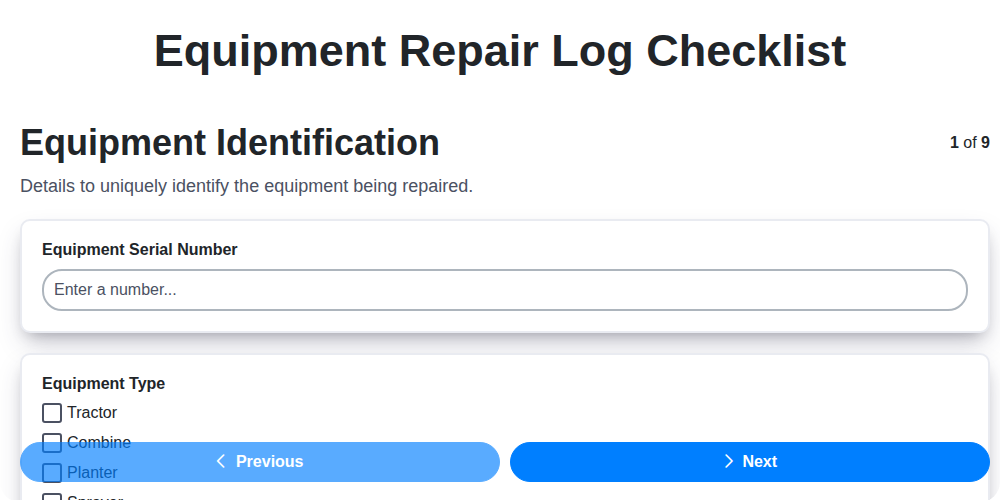
Equipment Repair Log Template: Your Guide to Organized Maintenance
Paper vs ChecklistGuro in Maintenance Management
Need help with
Maintenance Management?
Have a question? We're here to help. Please submit your inquiry, and we'll respond promptly.