Warehouse Picking and Packing Workflow Template
Published: 06/18/2026 9:00 PM Updated: 06/19/2026 11:49 AM
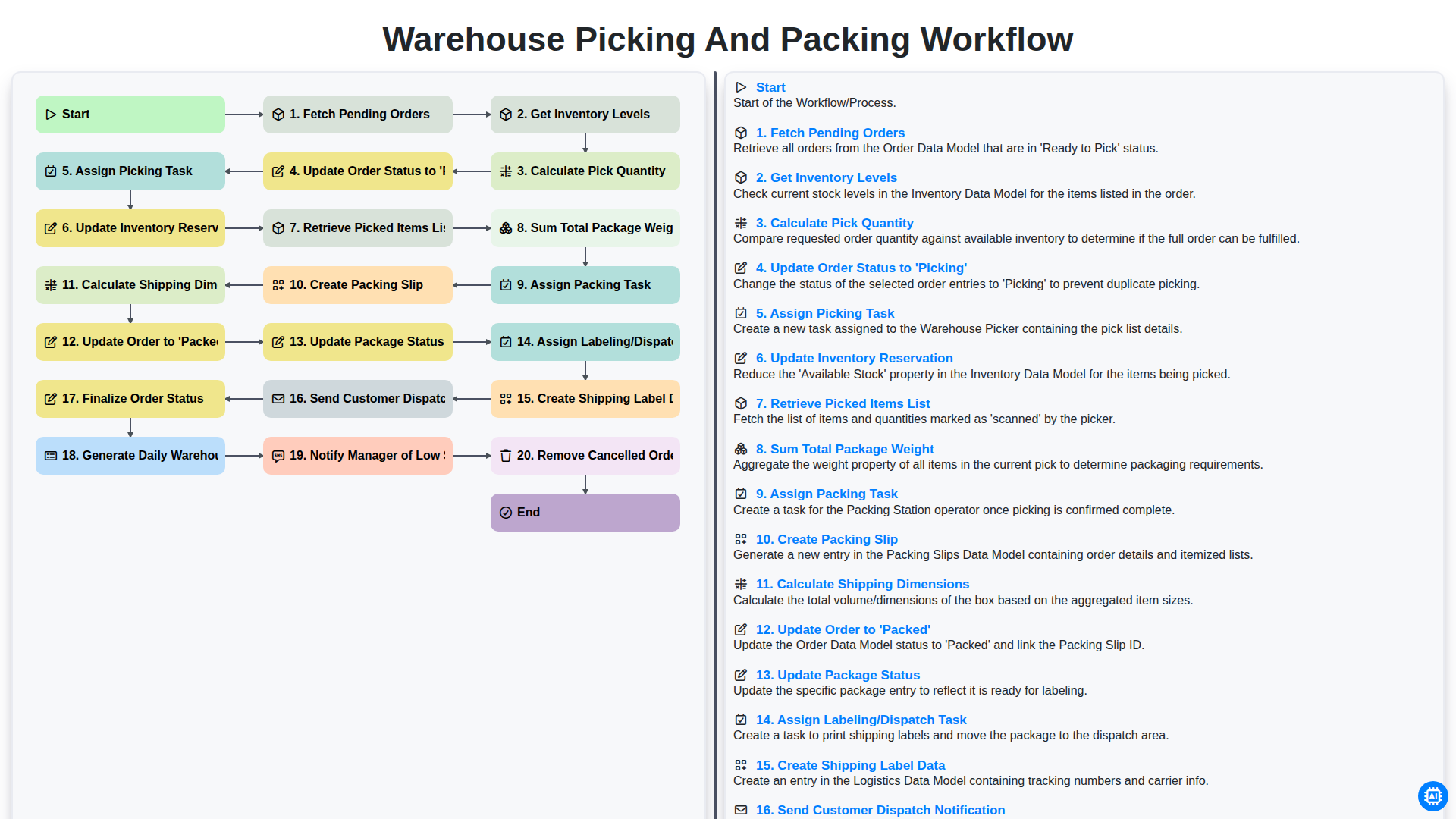
Table of Contents
- Introduction to Warehouse Efficiency
- Phase 1: Order Processing and Inventory Validation
- Phase 2: The Picking Process and Inventory Reservation
- Phase 3: The Packing Workflow and Weight Verification
- Phase 4: Documentation and Shipping Preparation
- Phase 5: Dispatch and Customer Communication
- Phase 6: Order Finalization and Reporting
- Exception Handling: Managing Cancellations and Low Stock
- Optimizing Your Warehouse Throughput
- Resources & Links
TLDR: This guide introduces a comprehensive Warehouse Picking and Packing Workflow template designed to automate and streamline the journey from order receipt to final dispatch. Learn how this end-to-end process optimizes inventory accuracy, manages task assignments, and automates critical notifications to boost warehouse efficiency and reduce fulfillment errors.
Introduction to Warehouse Efficiency
In the fast-paced world of e-commerce and logistics, the difference between a satisfied customer and a negative review often comes down to the precision of your fulfillment process. At the heart of every successful distribution center lies a streamlined, repeatable, and error-free workflow. Achieving peak operational efficiency isn't just about moving items quickly; it is about orchestrating a complex dance of data synchronization, inventory management, and real-time task allocation.
When a warehouse operates without a structured workflow, bottlenecks inevitably emerge-leading to misplaced items, shipping delays, and inaccurate stock levels. By implementing a rigorous, step-by-step process-from the moment an order is fetched to the final dispatch notification-businesses can minimize human error, optimize labor productivity, and ensure that every package leaving the dock is accurate and on time. In this article, we will break down the essential stages of a high-performing picking and packing workflow and explore how automating these steps can transform your warehouse from a cost center into a competitive advantage.
Phase 1: Order Processing and Inventory Validation
The lifecycle of a successful shipment begins long before a box is taped shut. The initial phase of the warehouse workflow focuses on data accuracy and proactive resource management to ensure that the warehouse floor is prepared for incoming demand.
The process kicks off with the Fetch Pending Orders step, where the system pulls all new, unfulfilled orders from the sales channel. However, an order cannot be processed in a vacuum; the system must immediately Get Inventory Levels to verify that the physical stock matches the digital record. Once availability is confirmed, the system performs a critical calculation to Calculate Pick Quantity, determining exactly how many units are required to satisfy the specific order requirements.
To prevent overlapping workflows and ensure operational clarity, the system will Update Order Status to 'Picking'. This transition is vital for real-time tracking. Simultaneously, the system must Update Inventory Reservation, effectively earmarking these items so they cannot be promised to another customer. To bridge the gap between the office and the floor, the workflow then works to Assign Picking Task to the appropriate warehouse personnel.
Beyond the active orders, this phase also includes essential maintenance tasks to keep the queue clean and the warehouse running smoothly. This includes the ability to Remove Cancelled Order from Queue, ensuring that staff do not waste labor on phantom shipments. Finally, as a safeguard against stockouts, the system will Notify Manager of Low Stock, ensuring that replenishment occurs before the picking process is interrupted by empty bins. This phase sets the foundation for an organized, error-free fulfillment cycle.
Phase 2: The Picking Process and Inventory Reservation
Once the orders have been successfully fetched and inventory levels are verified, the workflow transitions from order management into the active fulfillment stage. This phase is critical as it bridges the gap between a digital order and the physical movement of goods.
The process begins by calculating the pick quantity for each item to ensure the warehouse team is only retrieving what is necessary to fulfill the specific order requirements. To maintain data integrity and prevent overselling, the system immediately updates the order status to 'Picking' and assigns the picking task to a specific warehouse associate or robotic unit.
A vital sub-step in this phase is to update the inventory reservation. By marking these items as reserved within the system, the warehouse prevents other incoming orders from claiming the same stock, even though the items haven't physically left the shelf yet. Once the picker completes their route, the system will retrieve the picked items list to verify that the physical count matches the digital requirement. This seamless synchronization between physical picking and digital reservation ensures that your inventory accuracy remains high and that the warehouse avoids the common pitfall of phantom stock errors.
Phase 3: The Packing Workflow and Weight Verification
Once the items have been successfully retrieved from the shelves, the process transitions from the warehouse floor to the packing station. This phase is critical for ensuring order accuracy and preparing the shipment for transit. The workflow begins by retrieving the Picked Items List to verify that the physical goods match the original order requirements.
During this stage, the system performs a vital calculation: Summing the Total Package Weight. Precise weight measurement is essential for both shipping cost accuracy and logistics planning. Once the contents are verified, the system automatically Assigns a Packing Task to the next available operator.
As the packer seals the box, the system executes several automated administrative steps to maintain real-time data integrity:
- Creation of the Packing Slip: A detailed document is generated to provide the customer with a physical record of their order.
- Calculation of Shipping Dimensions: The system records the volumetric data of the package to ensure compatibility with carrier constraints.
- Status Synchronization: The order is officially Updated to 'Packed', and the individual Package Status is Updated to reflect its readiness for dispatch.
By automating these specific verification and documentation steps, the packing workflow minimizes human error and ensures that every parcel leaving the facility is documented, weighed, and ready for the final stage of labeling and dispatch.
Phase 4: Documentation and Shipping Preparation
Once the items have been physically gathered and verified, the focus shifts from the warehouse floor to the administrative side of the fulfillment process. This phase is critical for ensuring accuracy, maintaining legal compliance, and providing the customer with the necessary information to track their delivery.
The process begins with assigning the packing task to a dedicated station, where the team must retrieve the picked items list to cross-reference against the actual goods. Once the items are consolidated, the system must sum the total package weight and calculate shipping dimensions, as these metrics are vital for determining shipping costs and selecting the appropriate carrier services.
As the package is secured, the workflow automatically triggers the creation of essential paperwork, starting with the generation of a packing slip to be placed inside the box. Simultaneously, the system must create shipping label data and update the package status to reflect that the order is ready for transit.
The final step in this phase is the transition to dispatch. By assigning the labeling and dispatch task, the workflow ensures that the package moves seamlessly from the packing station to the loading dock. This stage concludes with the sending of the customer dispatch notification, providing the recipient with real-time updates and the peace of mind that their order is officially on its way.
Phase 5: Dispatch and Customer Communication
Once the packing process is complete, the workflow shifts from the warehouse floor to the logistics and communication stage. This phase is critical as it bridges the gap between internal operations and the customer's expectation of delivery.
The process begins with the assignment of the Labeling and Dispatch task, where the physical package is prepared for transit. During this step, the system must create all necessary shipping label data, ensuring that barcodes, addresses, and tracking numbers are accurately printed and attached.
To keep the customer informed and reduce Where is my order? inquiries, the system automatically triggers the step to send a customer dispatch notification. This real-time update provides the customer with their tracking information, building trust and transparency. Finally, the workflow reaches its conclusion by moving to finalize the order status, marking the transaction as completed within the internal management system and officially moving the item out of the active fulfillment queue.
Phase 6: Order Finalization and Reporting
Once the physical package has been labeled and prepared for dispatch, the workflow enters its critical final stage: Order Finalization and Reporting. This phase is where the digital record catches up with the physical movement of goods, ensuring that both your customers and your management team have real-time visibility into the supply chain.
The process begins with the automatic transition to Finalize Order Status, which closes the loop on the active fulfillment cycle. Simultaneously, the system triggers the Send Customer Dispatch Notification, a vital touchpoint in the customer experience that provides the buyer with tracking details and peace of mind.
Beyond the individual order, this phase serves as the engine for operational intelligence. The system will automatically Generate Daily Warehouse Throughput Reports, allowing you to analyze picking speeds, packing accuracy, and overall labor efficiency. This data is essential for identifying bottlenecks and optimizing your warehouse layout. Furthermore, the workflow acts as a proactive safeguard; by monitoring real-time depletion, the system will Notify Manager of Low Stock, preventing out-of-stock scenarios before they disrupt future orders. Finally, to ensure the queue remains clean and accurate, the system will automatically Remove Cancelled Orders from the Queue, ensuring your team never wastes resources on unfulfillable requests.
Exception Handling: Managing Cancellations and Low Stock
Even the most streamlined warehouse workflows encounter unpredictable variables. To maintain operational integrity, a robust system must include automated exception handling protocols to manage two critical disruptions: order cancellations and inventory shortages.
Managing Order Cancellations In a high-velocity fulfillment environment, an order may be canceled by a customer after the picking process has already been initiated. To prevent wasted labor and ghost inventory movement, the workflow must include a dedicated step to remove cancelled orders from the queue. By automatically intercepting cancellation requests and purging them from the active picking list, the system ensures that warehouse personnel do not spend time processing items that are no longer required, thereby preserving productivity and preventing shipping errors.
Mitigating Stockouts and Low Inventory The accuracy of your picking process is entirely dependent on the integrity of your inventory data. When the system performs the Get Inventory Levels and Calculate Pick Quantity steps, it acts as an early warning system. If the available stock falls below a predefined threshold, the workflow must automatically notify the manager of low stock. This proactive alert allows for timely reordering, preventing the dreaded out-of-stock scenario that can halt the entire fulfillment pipeline and lead to missed delivery promises.
By integrating these automated checks, your warehouse moves from a reactive state to a proactive one, ensuring that your team is always working on valid, achievable tasks.
Optimizing Your Warehouse Throughput
To maximize operational efficiency, a warehouse must move beyond simple task management and embrace a structured, automated workflow. Optimizing throughput is not merely about moving faster; it is about eliminating bottlenecks and ensuring that every stage of the fulfillment process-from the moment an order is fetched to the final dispatch notification-operates in a seamless loop.
The key to high-volume success lies in the synchronization of data and physical movement. By automating critical checkpoints-such as automatically calculating pick quantities, updating inventory reservations, and instantly generating packing slips-you reduce the cognitive load on your floor staff and minimize the risk of human error. When your system automatically triggers the next stage of the workflow-transitioning seamlessly from a Picking status to Packing and finally to Labeling/Dispatch-you eliminate the dead time that often accumulates between manual hand-offs.
Furthermore, true optimization extends beyond the packing station. A truly optimized warehouse uses the data generated during the workflow to drive proactive decision-making. By leveraging automated tasks like generating daily throughput reports and triggering low-stock notifications, managers can transition from a reactive state to a predictive one. This continuous feedback loop ensures that inventory levels are maintained, cancelled orders are purged from the queue instantly, and the entire ecosystem remains lean, responsive, and primed for scale.
Resources & Links
- Shopify: E-commerce Fulfillment Guide: A comprehensive guide on how to manage order processing and inventory management for growing online stores.
- NetSuite: Warehouse Management Best Practices: In-depth resources regarding real-time inventory visibility and automated picking/packing workflows.
- ShipStation: Shipping and Labeling Optimization: Expert insights into calculating shipping dimensions, generating labels, and streamlining the dispatch process.
- Logistics and Supply Chain Resource Center: Technical documentation on supply chain efficiency, inventory reservation, and managing warehouse throughput.
- Lean Manufacturing: Reducing Warehouse Waste: Strategies for optimizing warehouse workflows, reducing errors in picking, and improving overall operational throughput.
- Zendesk: Automated Customer Notifications: Best practices for maintaining customer satisfaction through automated dispatch and order status updates.
Found this Article helpful?
Comments
There are no comments yet. Be the first to add one!
Logistics Management Solution Demo
Tired of shipping delays, lost packages, and inefficient routes? ChecklistGuro's Work OS platform streamlines your entire logistics operation, from warehouse management and order fulfillment to route optimization and delivery tracking. Gain real-time visibility, reduce costs, and improve customer satisfaction. Learn how ChecklistGuro can transform your logistics business!
Related Articles
The Ultimate Refrigerated Cargo Temperature Control Checklist Template
Mastering Your Fleet: A Vehicle Maintenance Log Review Template
Master Your Returns: The Ultimate Returns Processing Efficiency Audit Checklist
Data Privacy Policy Compliance: Your Essential Checklist Template
Delivery Confirmation Audit: Your Checklist Template for Process Excellence
Your Pallet Inspection & Maintenance Checklist Template
Fuel Efficiency Monitoring: Your Checklist Template for Savings
Supply Chain Risk Assessment: Your Essential Checklist Template
We can do it Together
Need help with
Checklists?
Have a question? We're here to help. Please submit your inquiry, and we'll respond promptly.