The Ultimate Warehouse Racking & Storage Safety Inspection Checklist 2026: A Complete Template for Operations Managers
Published: 10/31/2026 Updated: 11/01/2026
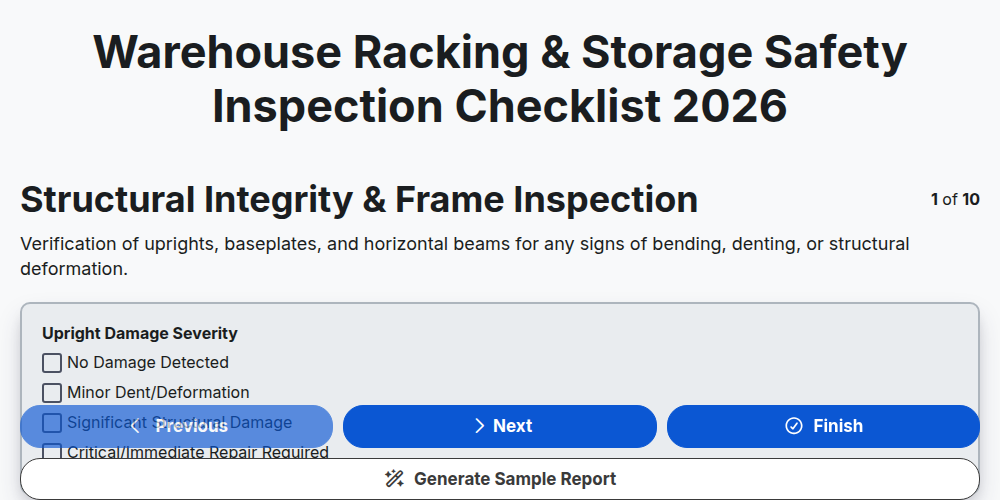
Table of Contents
- Introduction: Why Proactive Inspections are Critical in 2026
- Structural Integrity & Frame Inspection: Detecting Hidden Damage
- Upright & Baseplate Stability: Ensuring a Solid Foundation
- Beam & Connection Security: Preventing Dislodgement Risks
- Load Capacity & Weight Compliance: Staying Within Safe Limits
- Pallet & Load Condition: Checking the Integrity of Your Inventory
- Aisle Clearance & Floor Condition: Maintaining Navigable Pathways
- Safety Signage & Floor Markings: Visual Communication for Safety
- Protective Guarding & Bollards: Safeguarding Your Infrastructure
- Rack Hardware & Accessories: Inspecting Pins, Bolts, and Braces
- Incident Reporting & Maintenance Log: Documentation as a Safety Shield
- Implementing Your 2026 Inspection Schedule
- Conclusion: Building a Culture of Safety Excellence
- Resources & Links
TLDR: Ensure your facility stays compliant and accident-free in 2026 with our comprehensive warehouse racking inspection guide. This post provides a detailed, step-by-step checklist covering structural integrity, load capacity, floor conditions, and safety hardware to help operations managers identify risks, maintain regulatory standards, and optimize storage stability.
Introduction: Why Proactive Inspections are Critical in 2026
The Cost of Negligence vs. The Value of Vigilance
As we move into 2026, the global supply chain landscape has become more complex, faster, and more automated than ever before. For operations managers, the pressure to maximize vertical space and increase throughput is immense. However, this drive for efficiency often creates a hidden danger: the degradation of structural integrity within your storage systems.
A single compromised upright or a misaligned beam isn't just a maintenance issue; it is a catastrophic risk. In a high-density warehouse environment, a rack failure can lead to massive inventory loss, significant operational downtime, and, most importantly, life-threatening injuries to your workforce.
Beyond Compliance: Moving from Reactive to Predictive Safety
In previous years, safety inspections were often viewed as a check-the-box compliance exercise-something done once a year to satisfy auditors. In 2026, the standard has shifted. With the rise of advanced automation and increased forklift traffic density, a reactive approach is no longer sufficient.
Proactive inspections allow you to identify micro-damages-small dents, slight leans, or hairline cracks in welds-before they escalate into structural collapses. By implementing a rigorous, systematic inspection routine, you are not just preventing accidents; you are protecting your bottom line by:
- Reducing Unplanned Downtime: Catching a damaged beam during a scheduled check is easy to fix; discovering it during a peak picking shift is a nightmare.
- Extending Asset Lifespan: Regular maintenance and early detection of hardware fatigue ensure your racking investment lasts its full intended lifecycle.
- Lowering Insurance Premiums: Demonstrating a documented, consistent history of rigorous safety audits can be a powerful tool in risk management and premium negotiations.
- Cultivating a Safety-First Culture: When employees see management prioritizing structural stability, it fosters a culture of accountability and care throughout the entire facility.
The following checklist is designed to serve as your definitive guide for 2026. It moves beyond surface-level observations to provide a deep-dive assessment of your warehouse's structural health, ensuring your facility remains a fortress of efficiency and safety.
Structural Integrity & Frame Inspection: Detecting Hidden Damage
The Foundation of Warehouse Stability
When conducting a high-level safety audit, the inspection must begin with the most critical element of your storage system: the structural integrity of the frames. In 2026, with the rise of automated guided vehicles (AGVs) and increased warehouse density, even microscopic deviations in frame alignment can lead to catastrophic rack failure. This stage of the checklist focuses on identifying physical deformities that compromise the entire racking network.
Identifying Deformations and Dents
The primary goal is to detect any signs of impact or stress. Inspect every upright leg for:
- Impact Damage: Look for dents, bends, or crushing on the vertical profiles of the uprights. Even a small dent can significantly reduce the load-bearing capacity of a frame.
- Structural Buckling: Examine the vertical members for any bowing or warping. If an upright is no longer perfectly straight, it is no longer capable of supporting the designed weight.
- Flange Integrity: Check the edges of the steel members for any signs of tearing or peeling, which often indicates heavy-duty forklift collisions.
Assessing Alignment and Plumbness
A rack that is visually intact but out of alignment is a ticking time bomb. Your inspection must verify that the racking system remains vertical.
- Vertical Alignment (Plumb): Use a level or laser measurement tool to ensure that the uprights are perfectly perpendicular to the floor. A leaning rack shifts the center of gravity, placing uneven pressure on the baseplates.
- Parallelism Check: Ensure that the racking rows remain parallel to one another. If the aisles are narrowing due to racking shift, it creates a high-risk environment for maneuvering machinery.
Corrosion and Environmental Degradation
In 2026, with more temperature-controlled and high-humidity facilities, monitoring material degradation is more important than ever.
- Surface Rust and Oxidation: Inspect the base of the uprights and any areas near loading docks for signs of corrosion. Rust can eat through the structural thickness of the steel, making the metal brittle.
- Degradation of Coatings: Look for chipping or peeling of the protective powder coating or paint, as this is often the first sign that the underlying steel is being exposed to moisture and environmental stressors.
Upright & Baseplate Stability: Ensuring a Solid Foundation
The Foundation of Structural Integrity
The stability of your entire storage system begins where the rack meets the floor. If the uprights are compromised or the baseplates are improperly secured, the risk of a catastrophic progressive collapse increases exponentially. In 2026, with the increasing height of automated storage systems, inspecting the vertical supports is no longer just a routine task-it is a critical safety imperative.
Key Inspection Points for Uprights and Baseplates
When performing your walkthrough, focus your attention on these high-risk areas:
- Baseplate Alignment and Leveling: Ensure that all baseplates are sitting flush against the floor. Any gaps caused by uneven flooring or settling can lead to uneven weight distribution across the upright frames.
- Anchor Bolt Integrity: Check every single floor anchor. Inspect for signs of loosening, shearing, or corrosion. A missing or broken anchor bolt can allow an upright to shift under lateral loads, destabilizing the entire row.
- Upright Verticality (Plumbness): Use a level or laser measurement tool to ensure uprights have not bowed or tilted. Even a slight deviation from the vertical axis can significantly reduce the load-bearing capacity of the rack.
- Signs of Impact Damage: Look for dents or crushes at the base of the uprights. The bottom few inches of a rack are the most vulnerable to forklift strikes. Even minor cosmetic dents can indicate structural deformation that compromises the metal's strength.
- Floor Cracks and Settlement: Examine the concrete surrounding the baseplates. If the floor is cracking or sinking near the rack footings, the structural integrity of the uprights is at risk, regardless of how strong the steel itself might be.
Pro-Tip for 2026 Compliance
Don't just look at the steel; look at the concrete. A perfectly intact upright is useless if the floor beneath it is failing. Always include a floor integrity check as part of your baseplate inspection routine.
Beam & Connection Security: Preventing Dislodgement Risks
Ensuring Beam Integrity and Connection Stability
The beams are the horizontal components that bear the direct weight of your inventory. Because they are subject to constant loading and unloading cycles, they are one of the most high-risk areas for structural failure. An inspection of your beams must go beyond a simple visual glance; it requires a detailed assessment of how the beams interact with the upright frames and how they respond to heavy loads.
Key Inspection Points for Beam Security:
- Connector Pin & Safety Clip Verification: This is the most critical failure point in many warehouses. Ensure that every single beam connection is equipped with functional safety locking pins or clips. Without these, a forklift tine or accidental impact can dislodge a beam from its seat, leading to a catastrophic rack collapse.
- Beam Deflection Assessment: Observe the beams while they are under load. While a slight, measurable amount of sag is normal, excessive or permanent bowing (permanent deformation) indicates that the beam has exceeded its structural capacity and must be replaced immediately.
- Deformation and Buckling: Inspect the length of the beam for any signs of twisting, bending, or denting. Even a small dent in the web of a beam can significantly reduce its load-bearing capacity and compromise the structural integrity of the entire bay.
- Connector Interface Inspection: Examine the points where the beam meets the upright. Look for signs of crushing or deformation in the holes of the upright frame, which can occur if the beam is improperly seated or if the weight is unevenly distributed.
- Impact Damage Assessment: Check for any bends or scrapes caused by forklift collisions. Even if a beam appears functional, any denting in the structural steel can create stress concentrators that lead to sudden fractures under heavy loads.
Pro-Tip for 2026 Compliance:
As warehouse automation and higher-density storage become the standard, the margin for error in beam security is shrinking. If you find any beam that is missing a safety clip or shows signs of permanent deformation, tag it out of service immediately. Never attempt to straighten a damaged beam; the structural integrity is permanently compromised.
Load Capacity & Weight Compliance: Staying Within Safe Limits
Ensuring Structural Integrity through Weight Management
The most common cause of catastrophic rack failure is not a manufacturing defect, but the simple act of overloading. As warehouse automation and high-density storage technologies evolve in 2026, the pressure to maximize every cubic inch of vertical space has never been higher. However, safety must always supersede density.
To maintain a safe working environment, your inspection must verify that every rack bay is operating strictly within its engineered limits.
Key Verification Points for Load Compliance:
- Verification of Load Notices: Check that every racking row has visible, legible, and up-to-date load capacity plaques. These signs must clearly state the maximum weight permitted per level and per bay.
- Uniform Weight Distribution: Inspect stored pallets to ensure weight is distributed evenly across the beams. Off-center loads can cause unexpected torsional stress on the uprights.
- Maximum Height & Tier Limits: Ensure that no pallet exceeds the height limit allowed for a specific beam level, which could interfere with the clearance of the tier above it.
- Consistent Load Profiles: Audit whether the current inventory matches the original design intent. If your facility has transitioned from heavy metal components to lighter consumer goods (or vice versa), your racking configuration may need a professional re-calculation.
The Danger of Creep and Cumulative Stress
Over time, repetitive overloading can lead to permanent deformation in the steel. Even if a rack hasn't collapsed, stretching or bowing in the beams indicates that weight limits have been breached. During your 2026 inspections, look for any signs of bowing that suggest the structural integrity is being compromised by exceeding rated capacities.
Pro-Tip for 2026: Implement a digital weight-tracking system integrated with your WMS (Warehouse Management System) to flag any pallet entry that exceeds the pre-set weight limit for a specific rack location before the forklift even picks it up.
Pallet & Load Condition: Checking the Integrity of Your Inventory
Ensuring Stability from the Top Down
A warehouse safety inspection shouldn't stop at the steelwork; the safety of your racking system is inextricably linked to how the items placed within it are handled. Even the most structurally sound uprights and beams can fail if the loads they support are compromised. As we move into 2026, with the increasing use of automated retrieval systems and higher-density storage, the precision of your pallet and load inspection is more critical than ever.
1. Pallet Integrity and Damage Assessment
Before a pallet ever enters a rack, it must be deemed fit for purpose. A broken pallet is a leading cause of falling object incidents. Your inspection should focus on:
- Structural Cracks and Splinters: Inspect wooden pallets for significant cracks, especially in the stringers or bottom boards.
- Nail and Fastener Security: Ensure no protruding nails or staples are present that could puncture packaging or snag forklift tines.
- Deformation and Warping: Check for bowed or warped boards that could cause an uneven distribution of weight.
- Material Suitability: Verify that plastic or metal pallets are not showing signs of stress fractures or heavy denting.
2. Load Distribution and Centering
The geometry of your load determines the stability of the entire rack row. Improperly placed weight creates eccentric loading, which puts unintended stress on the beams.
- Center of Gravity: Ensure the heaviest part of the load is centered over the pallet and aligned with the rack beams.
- Overhang Management: Minimize excessive overhang. Excessive load protrusion increases the risk of impact damage from passing forklifts.
- Uniformity: Check that the weight is distributed evenly across the entire surface of the pallet to prevent tilting.
3. Packaging and Unit Load Stability
A load is only as safe as its containment. In 2026, as supply chains become more complex, the integrity of secondary packaging is a frequent point of failure.
- Shrink Wrap Integrity: Inspect for tears, loose wraps, or loose ends that could unravel and obstruct aisle clearance.
- Stacking Stability: For multi-tiered loads, ensure that top boxes are not leaning or creating a pyramid effect that could lead to a collapse.
- Containability: Verify that all items are properly boxed, crated, or wrapped to prevent small items from falling through gaps in the pallet or between beams.
Aisle Clearance & Floor Condition: Maintaining Navigable Pathways
Navigating the Warehouse: Beyond the Racks
A safe warehouse environment extends far beyond the steel frames of your racking systems. Even the most structurally sound uprights are rendered useless if the ground they sit on is compromised or if the pathways around them are obstructed. In 2026, with the increasing speed of automated guided vehicles (AGVs) and high-frequency forklift operations, maintaining pristine aisle clearance and floor integrity is a non-negotiable standard for operational efficiency.
Ensuring Clear Pathways for High-Traffic Zones
Obstructions in your aisles are more than just a nuisance; they are high-risk hazards that lead to collisions, tipped loads, and equipment damage. Your inspection must focus on:
- Aisle Width Compliance: Verify that aisles are kept free of temporary storage, discarded packaging, or stray pallets that encroach on the required turning radius for forklifts.
- Debris Management: Check for loose shrink wrap, broken pallet fragments, or dust accumulation that could cause slippage or interfere with automated sensor systems.
- Obstruction-Free Exit Routes: Ensure that emergency egress paths and fire extinguisher access points are never blocked, even for a moment.
Floor Integrity and Surface Stability
The floor is the foundation of your entire storage ecosystem. As warehouse machinery becomes heavier and more sophisticated, the demands on your flooring increase. During your 2026 safety audit, evaluate the following:
- Crack and Crevice Inspection: Identify any significant cracks or spalling in the concrete. Deep fissures can cause sudden jolts to forklifts, potentially destabilizing high-level loads.
- Leveling and Subsidence: Look for signs of uneven flooring or heaving caused by heavy-duty racking loads. A tilted floor can lead to uneven weight distribution across your baseplates.
- Slip and Trip Hazards: Inspect for oil leaks, coolant spills, or moisture accumulation. In a modern warehouse, a clean floor policy should be audited as strictly as the rack integrity itself.
- Floor Marking Visibility: Ensure that all pedestrian walkways, forklift lanes, and no-go zones are clearly defined with high-visibility, intact floor markings. Faded or peeling tape is a leading indicator of a declining safety culture.
Safety Signage & Floor Markings: Visual Communication for Safety
Clear Visual Cues for a Zero-Incident Workspace
In a high-traffic warehouse environment, safety is often determined by how effectively information is communicated at a glance. Even the sturdiest racking system can become a hazard if operators cannot clearly navigate the floor or identify restricted zones. Safety signage and floor markings serve as the silent supervisors of your facility, providing real-time guidance to forklift operators, pedestrians, and pickers.
Essential Inspection Points for Signage & Markings
When conducting your 2026 safety audit, focus on the visibility, legibility, and-most importantly-the physical condition of your visual aids. Use the following sub-checklist to ensure your facility remains compliant and easy to navigate:
- Floor Marking Integrity: Check for faded, chipped, or peeling tape and paint. High-traffic aisles undergo significant friction from heavy machinery; if your boundaries are no longer clearly defined, your risk of pedestrian-vehicle collisions increases.
- Pedestrian vs. Vehicle Segregation: Verify that designated walkways and no-go zones are clearly delineated. Ensure that the separation between forklift lanes and walking paths is unambiguous.
- Load Limit Signage Visibility: Confirm that all maximum load capacity signs are mounted at eye level, unobstructed by pallets, and legible from a distance. If a sign is obscured by shrink wrap or dust, it is effectively non-existent.
- Hazard Warning Signs: Inspect all high-visibility signage, including Caution: Overhead Loads, End of Aisle, and Battery Charging Station alerts. Ensure they are securely fastened and haven't been damaged by impacts.
- Aisle End Cap Signage: Ensure that rack ends clearly indicate aisle numbers and bay locations. This reduces searching time and prevents unnecessary maneuvering in tight spaces.
- Emergency Equipment Accessibility: Check that markings around fire extinguishers, electrical panels, and emergency exits are completely clear and that the floor area is marked to prevent any permanent obstruction.
Pro-Tip for 2026 Compliance
As warehouse automation and AGVs (Automated Guided Vehicles) become more prevalent, ensure your floor markings are compatible with sensor-based navigation. High-contrast, durable epoxy markings are increasingly becoming the industry standard for durability and long-term visibility in modern smart warehouses.
Protective Guarding & Bollards: Safeguarding Your Infrastructure
Hardening Your Infrastructure Against Impact
In a high-traffic warehouse environment, even the most skilled forklift operators are susceptible to human error or blind spots. This is why inspecting your protective guarding and bollards is a non-negotiable step in your 2026 safety audit. These physical barriers are the first line of defense between expensive racking systems and catastrophic collisions.
Identifying Vulnerabilities in Physical Barriers
When performing your inspection, do not simply check for the presence of guards; evaluate their functional integrity. Look for the following:
- Bollard Stability: Check for any signs of leaning, loosening at the base, or cracks in the concrete surrounding the bollard. A bollard that has been nudged by a vehicle is no longer an effective barrier.
- Guardrail Integrity: Examine end-of-aisle protectors and upright guards for dents, bends, or structural deformation. If a guard has been deformed by an impact, it has already absorbed energy and may no longer provide the rated level of protection.
- Surface Damage & Corrosion: Inspect steel guards for heavy rust or corrosion that could compromise the metal's strength, particularly in cold storage or high-moisture environments.
Ensuring Strategic Placement
Effective guarding is only useful if it is positioned where the risk is highest. During your walkthrough, ask:
- Are high-risk zones covered? Ensure guards are present at every rack end-cap, near-dock doors, and at the corners of all structural columns.
- Are they visible? Check that guards are painted in high-visibility colors (such as safety yellow) and that they are free from debris or shrink wrap that might obscure them from a driver's view.
- Is there a clearance gap? Ensure that guards are not so bulky that they obstruct the turning radius of your forklifts, which can inadvertently lead to more frequent collisions.
Pro-Tip for 2026 Compliance: If you find a guard that has been breached or displaced, treat it as a high-priority repair. A damaged guard is a silent failure waiting to happen, turning a minor bump into a major structural rack collapse.
Rack Hardware & Accessories: Inspecting Pins, Bolts, and Braces
Securing the Small Details: The Importance of Hardware Integrity
While large-scale structural damage is the most obvious threat to warehouse safety, the most frequent points of failure are often the smallest components. In 2026, as automated storage and retrieval systems (ASRS) and higher-density racking become more prevalent, the precision of your hardware becomes even more critical. A single missing locking pin or a loose bolt can compromise the stability of an entire bay.
Locking Pins and Safety Clips
The primary function of a safety pin is to prevent beams from being accidentally dislodged during forklift operations. During your inspection, you must verify that:
- Presence: Every single beam-to-upright connection is equipped with a locking pin or safety clip.
- Condition: Pins are not bent, rusted, or broken.
- Engagement: Clips are properly seated and cannot be easily nudged out by vibration or minor impacts.
Bolts, Nuts, and Floor Anchors
The connection between the racking system and the warehouse floor is the foundation of your entire storage infrastructure.
- Baseplate Anchors: Inspect all floor bolts to ensure they are tight and have not been sheared or pulled from the concrete.
- Torque Verification: Periodically check that bolts have not loosened due to the constant vibration of heavy machinery and high-traffic forklift movement.
- Corrosion Check: Look for signs of oxidation around bolt heads, which can indicate moisture issues that compromise structural integrity over time.
Bracing and Cross-Members
Diagonal and horizontal bracing provides the lateral stability required to prevent racking or leaning.
- Alignment: Ensure all braces are straight and have not been deformed by side-impacts.
- Connection Points: Inspect the welds or bolted connections where braces meet the uprights. Any hairline cracks in the welding or gaps in bolted joints are immediate red flags that require urgent maintenance.
Shelf Liners and Wire Decking
If your racking utilizes wire decking or solid shelf liners, these components must be inspected for sagging or structural fatigue.
- Wire Integrity: Check for broken wires or deformed mesh that could allow small items to fall through.
- Weight Distribution: Ensure that liners are properly seated on the beams and are not bowing under the weight of the stored goods.
Incident Reporting & Maintenance Log: Documentation as a Safety Shield
The Importance of a Paper Trail
In the realm of warehouse safety, an inspection is only as effective as the record that proves it took place. An Incident Reporting & Maintenance Log is not merely a collection of paperwork; it is your facility's primary line of defense during audits, insurance reviews, and safety investigations.
If a structural failure occurs, the first question asked by regulatory bodies (such as OSHA) will be: When was the last time this rack was inspected, and what actions were taken following the discovery of previous damage? Without a robust documentation system, your facility is legally and operationally vulnerable.
Maintaining the Continuous Safety Loop
A common mistake in warehouse management is treating an inspection as a one-and-done event. To ensure true compliance in 2026, your logging process must follow a continuous loop:
1. Real-Time Incident Reporting
Every minor collision-even those that don't result in immediate visible deformation-must be logged. A culture of report everything prevents small dents from evolving into catastrophic structural collapses. Ensure your reporting system captures:
- Timestamp and Location: Exactly where and when the impact occurred.
- The Involved Equipment: Which forklift or pallet jack was being operated.
- Personnel Involved: To facilitate immediate retraining if driver error was the cause.
2. The Maintenance & Repair Log
Identifying a problem is only half the battle; documenting the resolution is the other. Your log must track the lifecycle of every repair, including:
- Damage Assessment: A detailed description of the identified defect (e.g., bent upright flange on Aisle 4).
- Corrective Action Taken: Whether the component was straightened, replaced, or if the rack was temporarily decommissioned.
- Verification of Competence: Documentation proving that repairs were performed by certified technicians according to manufacturer specifications.
Digital vs. Paper: Transitioning to Smart Logs
As we move into 2026, reliance on paper clipboards is becoming a liability. Transitioning to a digital logging system offers several advantages for modern operations managers:
- Instant Alerting: Automated notifications sent to maintenance teams the moment a high-risk defect is logged.
- Photo Evidence: The ability to attach high-resolution images of structural damage directly to the inspection report.
- Data Analytics: Using historical data to identify hot zones in your warehouse where rack damage occurs most frequently, allowing for proactive floor layout adjustments.
Pro-Tip: Treat your Maintenance Log as a living document. An empty log is not a sign of a perfect warehouse; it is often a sign of an inadequate inspection culture. A healthy log shows a cycle of discovery, reporting, and resolution.
Implementing Your 2026 Inspection Schedule
Strategic Implementation: Beyond the Checklist
As we move into 2026, safety management in warehousing has shifted from a reactive model to a predictive one. It is no longer enough to simply perform an inspection when something looks broken; true operational excellence requires a systematic, scheduled approach to preventative maintenance.
To get the most out of the checklist provided above, your inspection strategy should be built on three core pillars:
1. Define Your Inspection Tiers
Not all inspections are created equal. To manage your workload efficiently, categorize your checks into three distinct frequencies:
- Daily/Shift-Level Walkthroughs: Focus on high-level visual cues, such as obvious obstructions in aisles, damaged pallets, or blocked safety signage. These can be performed by floor supervisors.
- Monthly Comprehensive Audits: A deeper dive into the structural components, including beam connections, upright stability, and floor marking visibility.
- Annual Professional Structural Surveys: A formal, documented assessment by a certified third-party engineer to validate load capacities and structural integrity against manufacturer specifications.
2. The Zero-Tolerance Protocol
A checklist is only as effective as the action taken following a failure. For 2026, your safety culture must move toward a Zero-Tolerance policy for high-risk defects.
- Immediate Red-Tagging: If an inspection reveals a compromised upright or a disconnected beam, the affected rack section must be immediately offloaded and Red-Tagged to prevent further use.
- Root Cause Analysis: Don't just fix the damage; investigate why it happened. Was it a forklift training issue? A poorly designed aisle? A failure in the loading procedure?
3. Digital Integration & The Maintenance Log
In 2026, paper logs are becoming obsolete. To ensure compliance and accountability, integrate your inspection findings into a Digital Maintenance Management System (DMMS).
- Real-Time Reporting: Use mobile tablets to capture photos of damages and sync them instantly to your maintenance log.
- Traceability: Digital logs provide an immutable audit trail. In the event of a regulatory inspection or a safety incident, having a timestamped, photo-documented history of every inspection is your strongest line of defense.
By integrating these inspection steps into a structured, digital-first schedule, you transform safety from a bureaucratic necessity into a competitive advantage that protects your people and your bottom line.
Conclusion: Building a Culture of Safety Excellence
Moving Beyond Compliance to Proactive Prevention
As we look toward 2026, the landscape of warehouse management is shifting. Automation, higher throughput demands, and more complex supply chains mean that the margin for error in storage safety has effectively vanished. A safety inspection should never be viewed as a box-ticking exercise or a bureaucratic hurdle; instead, it must be treated as a core pillar of your operational excellence strategy.
The Value of Consistency Over Frequency
While the checklist provided above is an essential tool, its true power lies in its consistent application. A single, thorough inspection is far more valuable than a rushed, superficial sweep performed every month. By integrating these checks into your daily or weekly safety walks, you transition your team from a reactive mindset (fixing things when they break) to a proactive mindset (identifying risks before they escalate into accidents).
Empowering Your Team
The most effective safety protocols are those that empower the frontline staff. Your forklift operators and floor personnel are your eyes and ears; they are the first to notice a slightly bent upright or a hairline crack in a baseplate.
To build a true culture of safety excellence, consider these three final steps:
- Ownership: Ensure every team member knows how to use this checklist and feels empowered to stop operations if a critical defect is found.
- Traceability: Maintain your Incident Reporting & Maintenance Logs with digital precision. In 2026, being able to produce a digital audit trail of inspections is a massive advantage for insurance compliance and regulatory audits.
- Continuous Improvement: Use the data gathered from your inspections to identify patterns. If you notice recurring damage to protective guarding, it may be time to re-evaluate your traffic flow or operator training programs.
Final Thought
Safety is an investment, not an expense. By implementing this Warehouse Racking & Storage Safety Inspection Checklist, you are protecting your most valuable assets: your people, your inventory, and your operational continuity. Let this checklist be the foundation of a safer, more efficient, and more resilient warehouse for 2026 and beyond.
Resources & Links
- OSHA (Occupational Safety and Health Administration): The primary regulatory body providing official guidelines, standards, and compliance regulations for warehouse safety and material handling.
- American Institute of Steel Construction (AISC): Essential for understanding structural integrity standards and the technical specifications of steel rack components and load-bearing capacities.
- Rackguns: A specialized resource for warehouse management, offering insights into pallet racking systems, maintenance, and operational efficiency.
- International Safety Equipment Association (ISEA): Provides standards for protective equipment, including high-visibility signage and personal protective equipment (PPE) for warehouse staff.
- Safety Management Association: Resources for developing safety cultures and implementing robust incident reporting and documentation protocols in industrial environments.
- Material Handling Institute (MHI): An industry association providing updates on the latest warehouse automation, storage technologies, and material handling safety trends for 2026.
- National Fire Protection Association (NFPA): Critical for inspecting clearance levels and aisle widths to ensure compliance with fire safety and sprinkler system effectiveness.
- American National Standards Institute (ANSI): The authority on technical standards for industrial equipment, including floor markings, safety signage, and racking hardware.
- Rack Inspection Standards: Technical documentation regarding the detection of hidden damage in uprights, baseplates, and structural steel frames.
- DuPont Safety Resources: Global leader in safety science, offering insights into risk assessment and preventative maintenance strategies for large-scale operations.
- Warehouse Floor Safety Standards: Resources regarding floor condition assessments, including crack detection, epoxy coating integrity, and anti-slip requirements.
- NIOSH (National Institute for Occupational Safety and Health): Research-based information on preventing workplace injuries related to heavy lifting, load imbalance, and pallet integrity.
- Logistics Management Magazine: A source for industry trends, helping managers stay updated on the 2026 landscape of warehouse technology and safety automation.
- Supply Chain Dive: In-depth analysis of supply chain risks, including the impact of equipment failure on overall warehouse productivity.
- SafetyCulture (iAuditor): Digital tools and templates for digitizing your inspection checklists, maintenance logs, and real-time incident reporting.
- Forklift Action: Specific guidance on the interaction between warehouse machinery and racking, focusing on protecting uprights and bollards from impact.
Comments
There are no comments yet. Be the first to add one!
Facility Management Solution Demo
Keep your facilities running smoothly! ChecklistGuro streamlines maintenance, inspections, and vendor management. Reduce downtime, optimize efficiency, & improve safety. Manage it all with our Work OS.
Related Articles
Industrial Floor Cleaning & Safety Checklist Template
Display Case Temperature Monitoring Checklist Template
The Ultimate Refrigeration Maintenance Checklist: Keeping Your Food Safe
Escalator & Moving Walkway Inspection Checklist Template
The Ultimate Guest Room Cleaning & Inspection Checklist Template
The Ultimate Security Camera Review Checklist Template
Forklift Inspection & Maintenance Checklist Template
Emergency Generator Load Testing Checklist Template
Need help with
Facility Management?
Have a question? We're here to help. Please submit your inquiry, and we'll respond promptly.