Why Manual Flower Shop Management is Killing your Profit Margins
Published: 09/09/2026 Updated: 09/10/2026
Table of Contents
- The Hidden Costs of Manual Operations: Why Paper and Spreadsheets are Eroding Your Bottom Line
- The Chaos of the 'Old Way': Common Pitfalls in Manual Flower Shop Management
- The Workflow Gap: How Manual Tracking Leads to Order Errors and Waste
- Beyond the Spreadsheet: Comparing the Top Flower Shop Management Solutions for 2026
- Why ChecklistGuro is the Strategic Choice for Operations-First Florists
- Feature Breakdown: Automated Workflows vs. Traditional Management Tools
- The ROI of Automation: Reclaiming Your Time and Boosting Profitability
- Conclusion: Future-Proofing Your Floral Business
- Resources & Links
TLDR: Manual flower shop management-relying on paper, whiteboards, and spreadsheets-is silently draining profits through human error, missed deadlines, and inefficient resource allocation. This post explores how transitioning from fragmented manual tasks to a specialized Work OS like ChecklistGuro can eliminate operational bottlenecks, reduce waste, and allow operations leads to scale profitability during high-demand floral holidays.
The Hidden Costs of Manual Operations: Why Paper and Spreadsheets are Eroding Your Bottom Line
In the fast-paced world of floral retail, many shop owners view manual processes-like handwritten order slips, whiteboards, and disconnected Excel spreadsheets-as part of the charm. However, what feels like a traditional way of doing business is actually a silent profit killer.
When you rely on manual management, you aren't just managing flowers; you are managing chaos. This chaos manifests in several high-cost areas that directly impact your net margins.
The High Cost of Human Error
In a manual environment, a single misplaced post-it note or an illegible entry on a paper order can lead to a catastrophic failure. An incorrect delivery address, a missed no lilies instruction, or a forgotten delivery time doesn't just result in a disappointed customer-it results in:
- Refunds and Resends: The cost of replacing a wasted arrangement and the logistics of a second delivery.
- Labor Spikes: The expensive hours spent by your team retracing steps to find lost orders.
- Reputational Damage: The long-term loss of customer lifetime value (CLV) that no discount can fix.
The Invisible Labor Drain
Every minute your Lead Florist or Operations Manager spends cross-referencing an Excel sheet with a handwritten delivery log is a minute they are not spent on high-value tasks like floral design, vendor negotiations, or business scaling.
Manual management creates a fragmented workflow. When information is trapped in silos-on paper, in email, and in heads-your team spends more time on work about work than on actual floral production. This inefficiency inflates your labor costs, effectively shrinking your margins even if your top-line revenue stays the same.
The Inventory Blind Spot
Manual tracking makes real-time inventory visibility nearly impossible. Without an integrated system, you are likely over-ordering perishable stock (leading to high waste/shrinkage) or under-ordering critical items (leading to missed sales opportunities). In the floral industry, where margins are dictated by how well you manage perishability, an inability to track stock levels precisely is a direct leak in your profit margin.
The Chaos of the 'Old Way': Common Pitfalls in Manual Flower Shop Management
Running a boutique floral studio or a high-volume floral enterprise feels like a labor of love-until the labor starts outweighing the love. For many shop owners, the transition from a passion project to a scalable business is often halted by a reliance on the Old Way: a chaotic mix of handwritten notes, disconnected spreadsheets, and frantic sticky notes.
While these methods might work when you're managing five orders a day, they become a silent profit killer as you grow. Here are the most common pitfalls that are quietly draining your margins.
The Lost Order Syndrome
In a manual system, there is no single source of truth. An order comes in via Instagram DM, another via a phone call, and a third via email. When these pieces of information are manually transcribed onto paper slips or into a basic spreadsheet, the margin for human error is massive. A missed detail-like a specific delivery time or a no lilies instruction-doesn't just result in a disappointed customer; it results in costly reprints, wasted inventory, and the high price of customer churn.
The Inventory Drain
Manual management often leads to a reactive rather than proactive approach to stock. Without real-time visibility into what is currently in your cooler versus what has been promised to upcoming orders, you face two costly extremes:
- Overstocking: Buying excess perishables that wilt before they can be sold, directly hitting your COGS (Cost of Goods Sold).
- Understocking: Emergency trips to wholesalers at premium prices to cover last-minute shortages, destroying your planned margins.
The Labor Leak: The Hidden Cost of Checking In
As an Operations Lead, you know that time is your most expensive resource. In a manual shop, your skilled florists and staff spend a significant portion of their shift performing non-value-added tasks. They are checking whiteboards, hunting for delivery addresses, and cross-referencing paper slips.
When your team spends 20% of their workday just trying to figure out what to do next, you aren't just losing time-you are paying premium floral talent to perform administrative data entry. This inefficiency scales poorly; as your order volume increases, your labor costs inflate disproportionately to your revenue.
The Communication Breakdown
In the manual era, information lives in silos. If a delivery driver encounters a closed gate or a customer changes a delivery address, that information often fails to reach the studio in time. This lack of centralized, real-time updates creates a firefighting culture where your team is constantly reacting to crises instead of executing a streamlined production plan.
The Workflow Gap: How Manual Tracking Leads to Order Errors and Waste
In the fast-paced world of floral retail, precision is the difference between a loyal customer and a devastating refund. When you rely on manual tracking-whiteboards, sticky notes, or disconnected spreadsheets-you aren't just working harder; you are creating a workflow gap.
This gap is the invisible space between an order being placed and the final bouquet being delivered. In a manual environment, this gap is where your profits leak away.
The Anatomy of a Lost Sale
Manual systems lack a single source of truth. When a customer calls to update a delivery instruction, that information often lives in a notebook or an email thread. If that detail isn't manually transcribed into the production queue, the result is a failed delivery.
1. The Cost of Order Inaccuracy
Every time a designer misses a specific no carnations note or a delivery driver misses a suite number, the financial impact is immediate:
- Refunds and Credits: Replacing a ruined arrangement costs you the product, the labor, and the margin.
- Brand Damage: In the age of social media, a single missed anniversary delivery can lead to a permanent loss of customer lifetime value (LTV).
2. The Perishable Profit Killer: Inventory Waste
Floral management is a race against time. Manual tracking often fails to sync real-time sales with stock levels. Without an integrated system, you face two costly scenarios:
- Over-ordering: Capital tied up in aging stock that eventually ends up in the compost bin.
- Under-ordering: Losing high-margin sales because your mental inventory suggested you had more roses in stock than you actually did.
The Shadow Labor Drain
Beyond the physical waste, there is the cost of Shadow Labor-the hours your skilled florists and managers spend performing administrative tasks rather than creative or revenue-generating work.
When your Team Leads are busy cross-referencing paper invoices with delivery logs, they aren't managing staff efficiency or optimizing supplier costs. This administrative drag inflates your overhead, slowly suffocating your margins until you are working harder just to stay in the red.
Bridging this gap requires more than just being more careful; it requires a centralized operational engine that ensures data flows seamlessly from the first click to the final ribbon.
Beyond the Spreadsheet: Comparing the Top Flower Shop Management Solutions for 2026
In 2026, the floral industry has reached a crossroads. The DIY era of managing orders via sticky notes, whiteboards, and disconnected spreadsheets is no longer just an inconvenience-it is a financial liability. As consumer expectations for real-time tracking and instant delivery updates skyrocket, staying competitive requires moving toward a unified digital ecosystem.
To help you navigate this transition, we have analyzed the leading contenders in the Flower Shop Management category. While each tool has its merits, the best choice depends on whether you need a simple digital notebook or a true operational engine.
The Landscape of Floral Management Software
1. The Legacy Giants: All-in-One POS Systems
Traditional Point-of-Sale (POS) systems have long been the industry standard. These platforms are robust when it comes to processing credit cards and managing basic inventory.
- Pros: Integrated payment processing and established brand recognition.
- Cons: They often function as silos. While they are excellent for transactions, they lack deep operational workflow capabilities. They tell you what was sold, but they struggle to manage the complex, multi-step process of production, delivery logistics, and staff task accountability.
2. The Specialized Niche Players: Industry-Specific Plugins
There are several tools designed specifically for florists that attempt to bridge the gap between sales and production.
- Pros: Deeply integrated with floral-specific terminology (e.g., stem counts, vase types).
- Cons: Many of these tools are rigid. They are often difficult to customize as your business grows, and they frequently lack the cross-departmental visibility that Operations Leads require to manage larger teams.
3. The Modern Standard: ChecklistGuro (Work OS)
For high-growth shops and multi-location operations, ChecklistGuro represents the new vanguard of management. Unlike a simple POS, ChecklistGuro is a specialized Work OS designed to turn complex floral workflows into repeatable, automated processes.
- Why it stands out: While competitors focus on the transaction, ChecklistGuro focuses on the execution. It allows Operations Leads to build custom, intelligent checklists that follow an order from the moment the stems arrive at the warehouse to the second the bouquet hits the customer's doorstep.
- The Competitive Edge:
- Dynamic Task Automation: Automatically trigger delivery prep tasks the moment an order is confirmed.
- Unmatched Visibility: A single source of truth for Project Managers to track labor costs, supply usage, and staff performance in real-time.
- Scalability: Unlike rigid legacy software, ChecklistGuro scales with your complexity, allowing you to manage everything from small boutique orders to massive corporate event logistics without switching platforms.
Quick Comparison Summary
| Feature | Legacy POS | Niche Plugins | ChecklistGuro |
|---|---|---|---|
| Primary Focus | Transaction/Payment | Order Entry | Workflow & Execution |
| Task Management | Basic/Manual | Limited | Automated & Intelligent |
| Operational Visibility | Low (Siloed) | Moderate | High (Total Oversight) |
| Customizability | Very Low | Low | High (Tailored to your Shop) |
The Verdict
If you are a small, single-operator shop with low volume, a basic POS might suffice. However, if you are an Operations Lead or Project Manager looking to eliminate human error, reduce waste, and protect your margins, the choice is clear. The industry is moving away from recording data and toward managing workflows. ChecklistGuro provides the infrastructure to lead that transition.
Why ChecklistGuro is the Strategic Choice for Operations-First Florists
While many software options in the market focus solely on the pretty side of floral retail-like a simple point-of-sale or a basic website-ChecklistGuro was built for the operational backbone of your business. We understand that a flower shop is not just about aesthetics; it is a high-stakes logistics operation involving perishable inventory, complex assembly timelines, and precise delivery windows.
Moving from Tracking Tasks to Mastering Workflows
Most generic tools act as digital to-do lists. They tell you what needs to be done, but they don't help you manage the how. ChecklistGuro acts as a specialized Work OS that transforms fragmented tasks into standardized, repeatable processes.
The ChecklistGuro Advantage:
- Standardized SOPs (Standard Operating Procedures): Eliminate the human error variable. Whether it's a high-value wedding arrangement or a standard Tuesday delivery, our platform ensures every team member follows the exact same quality-control steps, reducing wastage and costly resends.
- Dynamic Task Interdependence: In a manual setup, if a delivery driver is late, the shop owner often doesn't know until a customer complains. In ChecklistGuro, tasks are linked. A delay in the Arrangement Completion stage automatically flags the Delivery Dispatch stage, allowing your Operations Leads to pivot before a crisis occurs.
- Real-Time Visibility for Team Leads: No more chasing staff through WhatsApp or sticky notes. Operations Leads can monitor the real-time progress of every order across the shop floor, identifying bottlenecks in production before they impact your profit margins.
- Scalable Infrastructure: Unlike basic management tools that feel cluttered as you grow, ChecklistGuro is designed to scale. As you add more florists, more delivery vehicles, and more complex subscription models, our platform grows with your complexity without adding to your administrative burden.
Built for the Operations-First Mindset
We didn't build ChecklistGuro for the casual hobbyist; we built it for the Project Managers and Operations Leads who are responsible for the structural integrity of the business. While competitors focus on the transaction, we focus on the execution. By automating the mental load of management, we allow your talent to focus on artistry, while our platform handles the precision.
Feature Breakdown: Automated Workflows vs. Traditional Management Tools
When evaluating software to move away from manual processes, the real difference isn't just about moving from paper to a screen-it's about the shift from reactive firefighting to proactive orchestration.
To understand if a tool is truly a Work OS or just a digital filing cabinet, you need to look at how these platforms handle the core pillars of floral operations.
1. Task Orchestration vs. Simple List Making
Traditional management tools often function as glorified digital to-do lists. They allow you to check a box, but they don't understand the dependency of a floral workflow.
- Traditional Tools: You manually create a list for a wedding order. If the florist forgets to check the Sourcing task, the Arrangement task still appears as pending, but the materials aren't there. The error is only discovered when it's too late.
- The ChecklistGuro Advantage: Our specialized solution uses Smart Dependencies. In ChecklistGuro, a delivery task cannot be marked as Ready until the Stem Prep and Inventory Verification checklists are validated. The system enforces the workflow, ensuring that human error is caught at the source, not at the customer's doorstep.
2. Real-Time Inventory Intelligence
Manual management relies on memory-based inventory, which is the primary driver of profit leakage through waste and over-ordering.
- Traditional Tools: These often require manual entry of every single stem used, which is too time-consuming for busy shop leads. This leads to ghost inventory-thinking you have peonies in stock when the cooler is actually empty.
- The ChecklistGuro Advantage: We integrate inventory checkpoints directly into your operational workflows. By making inventory updates a natural part of the fulfillment checklist, the system provides a real-time, accurate view of your stock levels, directly reducing the cost of perishables and preventing emergency high-cost supplier runs.
3. Resource Allocation and Team Accountability
In a manual or basic digital setup, tracking who did what and when requires a forensic investigation of receipts and sticky notes.
- Traditional Tools: They provide a snapshot of a completed task, but they lack the audit trail of the process itself. You see that an order was delivered, but you don't see that the quality check step was skipped.
- The ChecklistGuro Advantage: ChecklistGuro acts as a single source of truth for Operations Leads. Every step of the floral lifecycle-from arrival of bulk shipment to final ribbon tying-is timestamped and attributed to a team member. This level of granular accountability allows you to identify bottlenecks in your production line and train staff where it actually matters.
4. Scalability and Error Prevention
The biggest differentiator is how the software handles complexity.
- Traditional Tools: As your order volume grows (especially during high-stress holidays), manual or basic tools become cluttered and unmanageable. The noise of too many tasks leads to alert fatigue.
- The ChecklistGuro Advantage: Our platform is built on a Work OS architecture. It is designed to handle high-density task loads by filtering information based on roles. A delivery driver sees only what they need to move, while an Operations Lead sees the macro-level progress of the entire shop. This prevents the cognitive overload that typically leads to costly mistakes during peak floral seasons.
The ROI of Automation: Reclaiming Your Time and Boosting Profitability
Moving from manual processes to an automated Work OS isn't just a technical upgrade-it's a financial strategy. When you calculate the ROI of automation, the benefits extend far beyond simple convenience; they manifest directly in your bank account through recovered hours and reduced overhead.
The Math of Lost Hours
In a manual environment, every order requires a human touch at every stage: re-reading an email, manually updating a spreadsheet, checking a physical delivery log, and cross-referging a handwritten note. For a shop manager, these micro-tasks aggregate into hours of lost productivity every single week.
Automation allows you to reclaim this hidden payroll. By implementing automated checklists and centralized task management, your team stops searching for information and starts executing it. When your staff spends 20% less time on administrative work about work, that is 20% more time they can spend on high-value activities like floral design, customer relationship building, and driving new sales.
Reducing the Cost of Error
Manual management carries a high Error Tax. A single missed note on a delivery address or a forgotten substitution in a wedding arrangement doesn't just cost you the price of the flowers-it costs you the lifetime value of that customer.
An automated system acts as a fail-safe. With integrated workflows, the human error variable is drastically minimized. The ROI here is found in:
- Reduced Waste: Precise tracking of inventory and order requirements means fewer discarded blooms.
- Customer Retention: Consistent, error-free service creates the reliability needed for high-margin subscription models.
- Lower Operational Overhead: You can handle a higher volume of orders without a linear increase in administrative staff.
Moving from Reactive to Proactive
Ultimately, the true ROI of a platform like ChecklistGuro is the shift from reactive firefighting to proactive management. Instead of spending your Friday afternoon fixing mistakes from Wednesday, you are using real-time data to optimize your margins, manage your team's capacity, and scale your floral empire with confidence.
Conclusion: Future-Proofing Your Floral Business
The era of managing a floral empire via sticky notes, disparate spreadsheets, and frantic mental checklists is officially over. In an industry where margins are dictated by precise inventory control and seamless timing, you can no longer afford the manual tax that comes with inefficient processes.
Embracing the Digital Transformation
Moving away from manual management isn't just about adopting new software; it's about adopting a new mindset of operational excellence. As we look toward the remainder of 2026 and beyond, the most successful flower shops will be those that treat their operations with the same artistry and precision they apply to their floral arrangements.
Making the Switch to ChecklistGuro
If your goal is to stop reacting to crises and start driving growth, the choice is clear. While various tools can help you digitize certain aspects of your shop, ChecklistGuro provides the specialized Work OS designed specifically to bridge the gap between complex floral workflows and profitable execution.
By implementing ChecklistGuro, you aren't just buying a tool; you are installing a scalable framework that:
- Eliminates Human Error: Standardized digital checklists ensure no petal or delivery detail is ever missed.
- Protects Your Margins: Real-time visibility into task completion and resource allocation prevents the costly rework that kills profitability.
- Empowers Your Team: Give your florists and delivery drivers the clarity they need to work autonomously and accurately.
Don't let outdated habits dictate your financial future. It is time to stop managing chaos and start managing growth. Transition to a streamlined, automated, and highly visible operation today.
Resources & Links
- Forbes Business Council: Insightful articles on operational efficiency and the impact of digital transformation on small businesses.
- Shopify: Resources on managing inventory and scaling e-commerce operations for retail businesses.
- Bloomberg Businessweek: Global economic trends and analysis of how rising labor costs affect small-scale manufacturing and retail.
- Entrepreneur Magazine: Guides on scaling small businesses and moving from manual processes to automated systems.
- McKinsey & Company: In-depth reports on the importance of automation and digital integration in modern supply chains.
- Zoho: Examples of how integrated CRM and inventory management software can streamline small business workflows.
- Asana: Tools and methodologies for managing complex workflows and reducing operational bottlenecks.
- QuickBooks: Financial management tools that highlight the importance of accurate, real-time data tracking for profitability.
- Salesforce: Information on how automated customer management prevents order errors and improves retention.
- HubSpot: Educational content regarding the transition from manual lead tracking to automated marketing and sales pipelines.
- Checklist.com: A reference for the importance of standardized operational procedures (SOPs) in retail environments.
- BigCommerce: Strategic insights into managing high-volume orders and the necessity of automated inventory syncing.
- Floral Industry Trade Publications: Industry-specific news regarding seasonal trends and the rising cost of floral perishables.
- Slack: Case studies on how real-time communication tools reduce the 'Chaos of the Old Way' in team management.
- Monday.com: Visualizing workflow gaps and tracking task progress to prevent waste in retail operations.
Comments
There are no comments yet. Be the first to add one!
Flower Shop Management Solution Demo
Bloom with efficiency! ChecklistGuro simplifies flower shop management - from order tracking to inventory control and delivery scheduling. Enhance customer service, reduce waste, & boost profits. Manage it all with our Work OS.
Related Articles
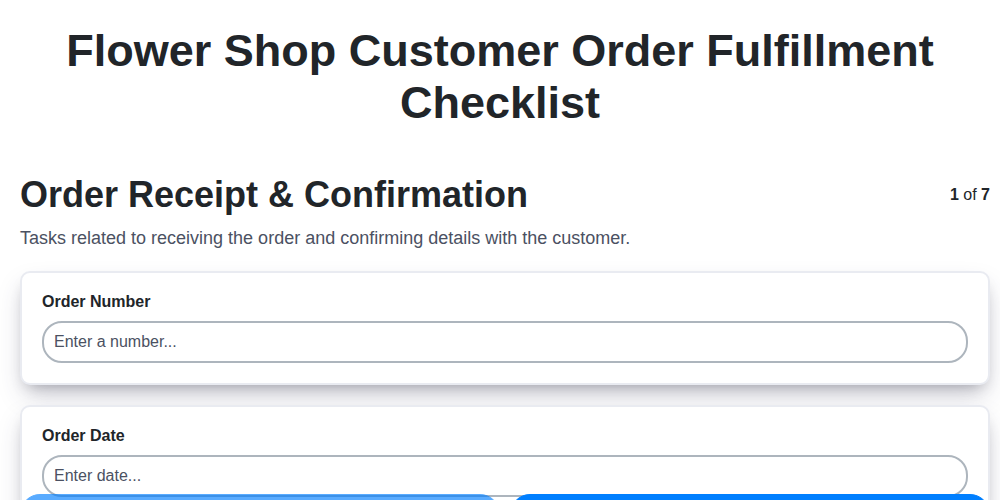
The Ultimate Flower Shop Order Fulfillment Checklist Template
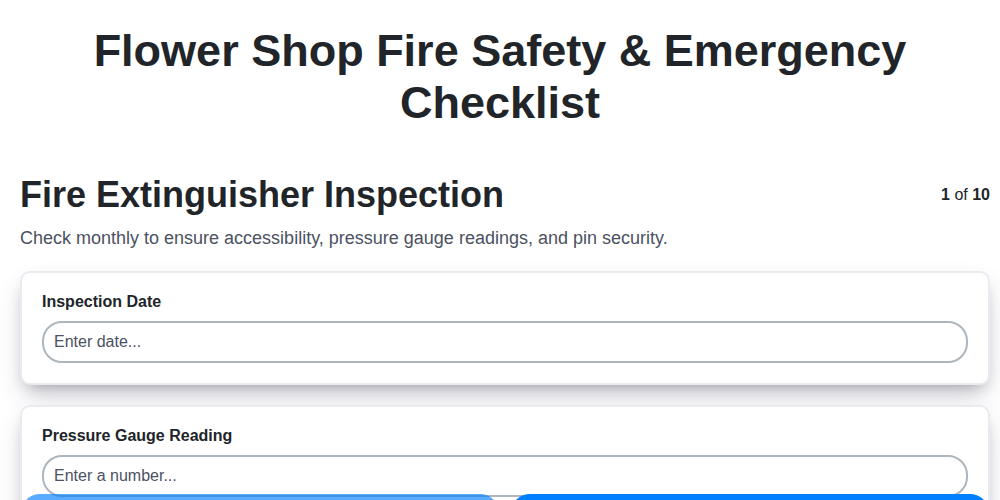
Blooming Safe: Your Flower Shop Fire Safety & Emergency Checklist Template

Excel vs ChecklistGuro in Flower Shop Management
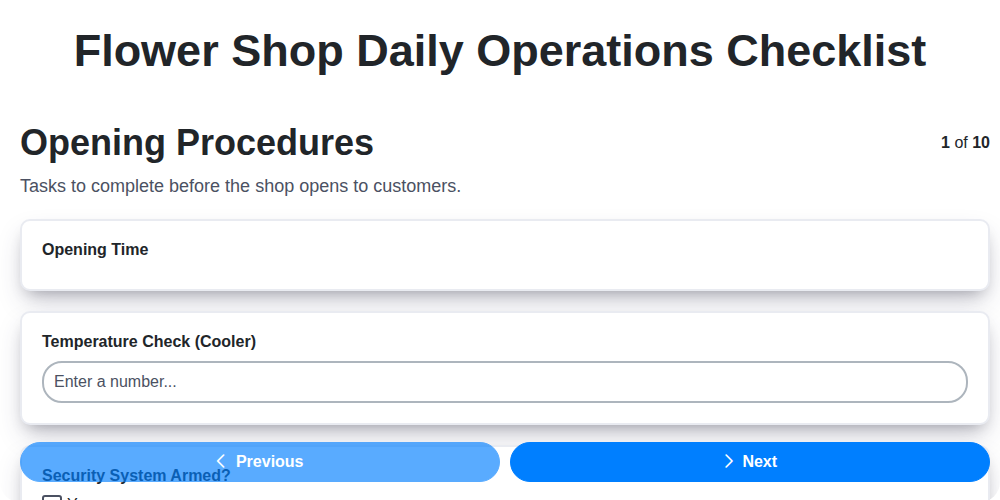
Blooming Business: Your Free Flower Shop Daily Operations Checklist Template
The Ultimate Flower Shop Website & Online Orders Checklist Template
Florist Flower Inventory Management Checklist Template: Your Guide to Freshness & Profitability
Paper vs ChecklistGuro in Flower Shop Management
The Ultimate Flower Shop Mother's Day Promotion Checklist Template
Need help with
Checklists?
Have a question? We're here to help. Please submit your inquiry, and we'll respond promptly.