The Ultimate Workplace Culture Assessment Checklist 2026: A Strategic Template for Future-Proofing Your Organization
Published: 10/28/2026 Updated: 10/29/2026
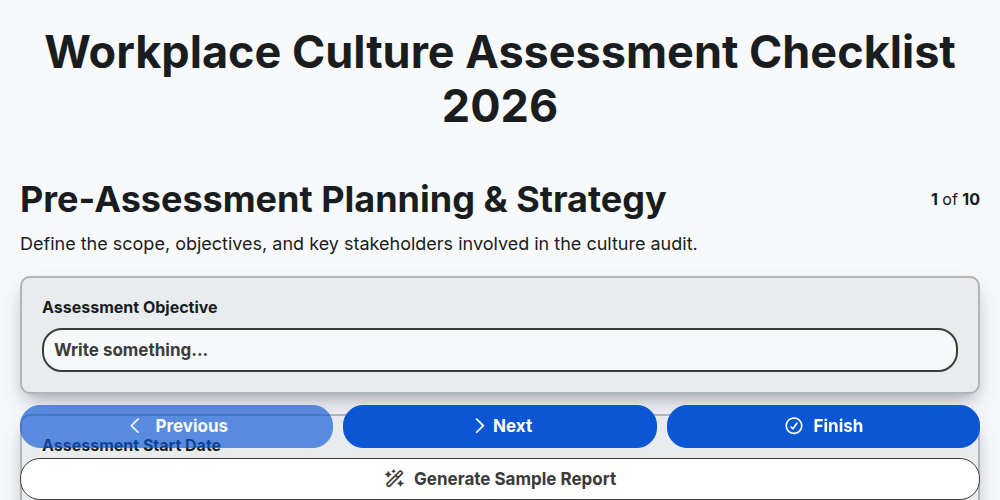
Table of Contents
- Introduction: Why Culture Assessment is the Strategic Priority for 2026
- Phase 1: Pre-Assessment Planning & Strategy
- Phase 2: Designing Your Methodology & Data Collection Tools
- Phase 3: Auditing Core Values & Mission Alignment
- Phase 4: Evaluating Leadership & Management Effectiveness
- Phase 5: Measuring Employee Engagement & Morale
- Phase 6: Conducting a Comprehensive DEI Audit
- Phase 7: Analyzing Communication & Information Flow
- Phase 8: Reviewing Recognition & Reward Systems
- Phase 9: Data Analysis & Sentiment Synthesis
- Phase 10: Action Planning & Communication Rollout
- Conclusion: Sustaining Continuous Cultural Evolution
- Resources & Links
TLDR: Master your organization's evolution with our 2026 Workplace Culture Assessment Checklist. This comprehensive guide provides a strategic roadmap-covering everything from pre-assessment planning and DEI audits to leadership effectiveness and data-driven action planning-to help you measure, analyze, and strengthen your company culture for the modern era.
Introduction: Why Culture Assessment is the Strategic Priority for 2026
The Evolution of the Modern Workspace
As we approach 2026, the definition of workplace culture has undergone a fundamental transformation. We are no longer operating in the era of simple office perks and ping-pong tables. Today's workforce-driven by a blend of Gen Z leadership, hybrid-first workflows, and the integration of advanced AI-demands a culture rooted in psychological safety, radical transparency, and purposeful alignment.
In this new landscape, culture is no longer a soft metric; it is a critical indicator of organizational resilience and competitive advantage.
Moving Beyond the Annual Survey
For years, companies relied on once-a-year engagement surveys to gauge sentiment. However, in a fast-paced, hyper-connected 2026 economy, these retrospective snapshots are often obsolete by the time the results are analyzed. A reactive approach to culture leaves organizations vulnerable to talent attrition, burnout, and misalignment with shifting global values.
To stay ahead, organizations must transition from reactive measuring to proactive assessment.
The Strategic Necessity of a Systematic Audit
A comprehensive culture assessment serves as a diagnostic tool to identify the gap between your stated values and the lived experience of your employees. By implementing a structured checklist, you move away from guesswork and toward data-driven strategy.
Conducting a rigorous assessment allows you to:
- Identify Hidden Friction Points: Pinpoint exactly where communication breakdowns or leadership gaps are stifling productivity.
- Mitigate Risk: Detect systemic inequities or declining morale before they escalate into turnover or legal liabilities.
- Drive Retention through Alignment: Ensure that your mission isn't just a poster on the wall, but a driver of daily decision-making.
- Future-Proof Your Talent Pipeline: Build an employer brand that attracts top-tier talent by proving your commitment to a healthy, inclusive, and high-performing environment.
The following checklist is designed to guide you through a multi-dimensional audit, ensuring that every facet of your organizational DNA is evaluated through a lens of modern excellence.
Phase 1: Pre-Assessment Planning & Strategy
Laying the Foundation for Success
Before diving into surveys or interviews, the success of your 2026 culture audit depends on the strength of your preparation. A common pitfall in organizational assessments is data fatigue-launching a massive study without a clear purpose. To avoid this, your pre-assessment phase must focus on defining the why behind the what.
Defining Your Assessment Objectives
You cannot measure everything at once. Start by identifying the specific business drivers that necessitate this audit. Are you addressing high turnover rates? Are you navigating a post-merger integration? Or are you looking to realign a hybrid workforce with new digital-first values?
Establishing the Scope and Stakeholders
Determine the boundaries of your assessment. Will this be an enterprise-wide deep dive, or are you focusing on specific departments or geographic regions? Simultaneously, identify your Culture Task Force-a diverse group of stakeholders including HR leaders, department heads, and frontline employees-who will oversee the process to ensure transparency and buy-in.
Setting the Timeline and Resource Allocation
A thorough assessment requires more than just a week of surveys; it requires a strategic roadmap. Your planning phase must account for:
- Budgeting: Allocating funds for third-party consultants, specialized software, or incentive programs.
- Timeline: Mapping out phases from data collection to the final communication rollout to ensure the momentum doesn't stall.
- Risk Management: Planning for how to handle sensitive feedback and ensuring the privacy of participants to maintain trust.
Communicating the Why
The most critical element of this phase is the Pre-Launch Communication Strategy. If employees feel that an assessment is a policing tool, they will provide guarded, unhelpful data. Use this phase to socialize the intent of the audit, emphasizing that this is a collaborative effort designed to build a better, more inclusive workplace for everyone.
Phase 2: Designing Your Methodology & Data Collection Tools
Tailoring Your Approach: Beyond the Basic Survey
In 2026, a one-size-fits-all survey is no longer sufficient to capture the nuances of a modern, hybrid, or decentralized workforce. To gain actionable intelligence, your methodology must move beyond simple checkboxes and embrace a multi-dimensional approach. The goal of this phase is to determine how you will capture both the what (quantitative data) and the why (qualitative sentiment).
Selecting Your Data Collection Mix
To ensure your assessment is comprehensive, aim for a Triangulation Strategy-using multiple data sources to validate your findings. Consider integrating the following tools into your toolkit:
- Quantitative Pulse Surveys: Short, frequent, and scalable. Use these to track real-time shifts in sentiment and identify immediate trends across specific departments or regions.
- Qualitative Deep-Dives: Semi-structured interviews and focus groups are essential for uncovering the human element. These sessions allow employees to elaborate on the nuances that numbers alone cannot capture.
- Unstructured Sentiment Analysis: Utilize AI-driven sentiment analysis tools to scan anonymized data from internal communication platforms (like Slack or Microsoft Teams) and glassdoor reviews to gauge the organic vibe of the organization.
- Operational Metadata: Analyze existing passive data, such as turnover rates, absenteeism, and internal promotion velocity, to see if your qualitative findings align with your hard organizational metrics.
Designing for Integrity and Psychological Safety
The success of your assessment hinges entirely on the trust your employees place in the process. If employees fear retribution, your data will be skewed toward polite rather than honest.
Establishing Anonymity Protocols
Clearly define and communicate how data will be handled. In 2026, employees are highly sensitive to digital privacy. Use third-party platforms to host surveys to guarantee that individual responses cannot be traced back to specific users, especially in smaller teams.
Minimizing Response Bias
Design your questions to avoid Acquiescence Bias (the tendency to agree with all statements) and Social Desirability Bias. Instead of asking, Do you feel supported by your manager? (which nudges a 'yes'), try, Describe a recent instance where you received feedback that impacted your work direction.
Determining the Sampling Framework
Decide whether you will conduct a census (surveying every single employee) or a stratified sample (selecting specific groups to represent the whole). While a census provides the most complete picture, a stratified sample is often more effective for deep-dive qualitative research in massive, global enterprises.
Phase 3: Auditing Core Values & Mission Alignment
Aligning Purpose with Practice
In 2026, a mission statement is no longer just a decorative plaque in your lobby; it is a functional blueprint for decision-making. A culture assessment fails if it only measures how employees feel, without measuring how much they believe in the organization's direction. This phase of the audit focuses on the gap between your stated corporate identity and the lived daily experience of your workforce.
The Integrity Gap Analysis
The goal here is to identify decoupling-the disconnect between what the company claims to value and how it actually behaves under pressure.
- Value Resonance Check: Do employees understand the core values, or can they only recite them? Use qualitative interviews to see if employees can provide real-world examples of these values in action.
- Behavioral Alignment: Are there specific behaviors that are being rewarded which actually contradict your stated mission? (e.g., celebrating high revenue at the expense of the collaboration value).
- Mission Visibility: Is the company's long-term vision communicated consistently across all levels, or is it trapped in the C-suite?
Key Assessment Metrics for Alignment
To turn culture into measurable data, evaluate the following touchpoints:
- The Say-Do Ratio: Audit recent major company decisions (mergers, policy changes, or budget shifts) against your core values. Did the decision reflect the mission?
- Onboarding Integration: Review your onboarding process. Does it emphasize the why (mission) or just the how (tasks)?
- Decision-Making Autonomy: Assess whether middle management feels empowered to use company values as a compass when making autonomous decisions.
Questions to Ask Your Teams
When conducting surveys or focus groups during this phase, move beyond Do you like the mission? and use more diagnostic prompts:
- Can you describe a time in the last month when a company value influenced a difficult decision?
- If our company mission were to disappear tomorrow, what would be the most significant change in your daily work life?
- Where do you see the greatest contradiction between our stated values and our actual operations?
Phase 4: Evaluating Leadership & Management Effectiveness
Measuring the Pulse of Leadership
In the 2026 workplace, the role of a manager has shifted from overseer to facilitator. A culture assessment is incomplete without evaluating how effectively your leadership tier fosters psychological safety, autonomy, and adaptability. This phase of the checklist focuses on moving beyond surface-level satisfaction to identify whether your leaders are driving or hindering organizational growth.
Key Evaluation Metrics
To gain a clear picture of leadership efficacy, your assessment should investigate the following dimensions:
- Empowerment vs. Micromanagement: Are managers providing the necessary autonomy for employees to take ownership of their tasks, or is a culture of hyper-surveillance stifling innovation?
- Decision-Making Transparency: Evaluate how much visibility leaders provide into the why behind strategic pivots. In a volatile market, transparency is the bedrock of trust.
- Psychological Safety & Feedback Loops: Measure the frequency and quality of two-way feedback. Do employees feel safe to report failures or suggest radical ideas without fear of retribution?
- Coaching and Development Mindset: Assess whether managers are acting as career architects for their teams. Are they actively participating in the professional growth of their direct reports?
Critical Assessment Questions
When designing your survey instruments or interview scripts for this phase, consider incorporating these targeted inquiries:
- Consistency of Vision: How well does your direct supervisor communicate how your daily work contributes to our 2026 strategic objectives?
- Support and Resources: Do you feel your manager provides the necessary tools, time, and emotional support to meet your performance goals?
- Conflict Resolution: When friction arises within the team, how effectively does leadership intervene to facilitate a constructive resolution?
- Accountability Standards: Are performance expectations and consequences applied equitably across the team, regardless of seniority or tenure?
Identifying the Leadership Gap
The goal of this phase is to identify the gap between intended leadership behavior and perceived leadership behavior. By analyzing the variance between executive strategy and frontline experience, you can pinpoint whether your management layer is equipped to execute the organization's long-term mission or if they require urgent upskilling in modern, empathetic management techniques.
Phase 5: Measuring Employee Engagement & Morale
Assessing the Pulse of Your People
In 2026, engagement is no longer just about happiness or perks; it is about meaningful connection and psychological safety. As hybrid and distributed work models become the permanent standard, assessing morale requires looking beyond surface-level satisfaction to understand how deeply connected employees feel to the organization's purpose.
To ensure your assessment captures the true emotional and professional landscape of your workforce, use the following sub-checklists:
1. The Engagement Drivers Audit
Focus on the why behind the work. A culture of high engagement exists when employees see a direct line between their daily tasks and the company's success.
- Purpose Alignment: Do employees understand how their individual roles contribute to the 2026 strategic goals?
- Autonomy & Trust: Do team members feel empowered to make decisions, or is there a lingering micromanagement sentiment?
- Growth Trajectories: Is there visible evidence that employees see a long-term future and career progression within the company?
- Resource Adequacy: Do employees feel they have the necessary digital tools and cognitive bandwidth to perform without burnout?
2. The Psychological Safety & Well-being Scan
In a high-pressure, AI-integrated landscape, mental well-being and the ability to speak up are non-negotiable pillars of culture.
- Voice & Safety: Can employees express dissenting opinions or report mistakes without fear of retribution?
- Burnout Indicators: Are there measurable signs of always-on fatigue or excessive after-hours connectivity?
- Support Systems: How effective are the existing mental health resources and wellness initiatives in practice, not just in policy?
- Work-Life Integration: Is the boundary between professional and personal life being respected across all levels of the organization?
3. Sentiment & Connection Metrics
Move beyond the vibe and look at the measurable indicators of morale.
- E-NPS (Employee Net Promoter Score): Would your employees recommend your company as a great place to work?
- Retention Risk Mapping: Are there specific departments or demographics showing increased turnover intent?
- Peer-to-Peer Connection: In a digital-first environment, do employees feel a sense of belonging to a community, or are they working in silos?
Phase 6: Conducting a Comprehensive DEI Audit
Evaluating Equity, Belonging, and Representation
In 2026, a Diversity, Equity, and Inclusion (DEI) audit is no longer about checking boxes for compliance; it is about measuring the psychological safety and the lived experiences of every individual within your ecosystem. As the global workforce becomes increasingly distributed and multigenerational, your assessment must move beyond demographic snapshots to examine the structural barriers that prevent true belonging.
To ensure your audit is thorough and actionable, evaluate the following key pillars:
1. Demographic Representation & Pipeline Equity
Analyze your talent lifecycle-from recruitment and interviewing to promotion and attrition.
- Recruitment Funnel Analysis: Are diverse candidates dropping out at specific stages of the hiring process?
- Leadership Parity: Does your management layer reflect the diversity of your entry-level workforce?
- Retention Disparities: Are certain demographic groups exiting the organization at higher rates than others?
2. Inclusive Belonging & Psychological Safety
Data alone cannot capture feeling. You must use qualitative tools to measure the cultural climate.
- Microaggressions & Psychological Safety: Do employees feel safe voicing dissenting opinions or admitting mistakes without fear of retribution?
- Accessibility & Neurodiversity: Is your digital and physical workspace optimized for employees with varying physical and cognitive needs?
- The Voice Metric: Do underrepresented groups feel they have equal access to high-visibility projects and mentorship?
3. Structural Equity & Policy Review
Examine the invisible rules that govern your organization.
- Pay Equity Audits: Have you conducted a rigorous analysis to identify and close gender or racial pay gaps?
- Promotion Transparency: Are the criteria for advancement clearly defined and applied universally, or are they subject to unconscious bias?
- Benefit Inclusivity: Do your parental leave, healthcare, and flexible working policies support a diverse range of life circumstances and family structures?
4. Cultural Competency in Management
The effectiveness of your DEI initiatives relies heavily on the middle management layer.
- Bias Mitigation Training: Is unconscious bias training integrated into continuous learning, rather than a one-time annual event?
- Inclusive Leadership Competency: How are managers evaluated on their ability to lead diverse, hybrid, and distributed teams?
Phase 7: Analyzing Communication & Information Flow
Breaking Down the Silos: Evaluating Communication & Information Flow
In the hyper-connected, hybrid-first landscape of 2026, communication is no longer just about the tools you use-it is about the clarity, transparency, and velocity of information moving through your organization. A breakdown in communication flow is often the precursor to cultural erosion, leading to misinformation, misalignment, and silo syndrome.
When conducting your assessment, you must move beyond asking Do you have enough meetings? and instead investigate the efficiency and accessibility of your internal ecosystem.
Key Audit Dimensions
To gain a holistic view of your organization's communicative health, evaluate the following four pillars:
1. Information Transparency and Accessibility
- The Single Source of Truth: Does every employee, regardless of location or seniority, have access to the same fundamental organizational updates?
- Top-Down Clarity: Are strategic pivots and company performance updates communicated promptly, or does the rumor mill fill the vacuum left by leadership silence?
- Documentation Culture: Is critical institutional knowledge trapped in private DMs and individual heads, or is it documented in a searchable, accessible knowledge base?
2. The Feedback Loop Integrity
- Upward Communication Channels: Do employees feel there are safe, frictionless pathways to share ideas and concerns with upper management?
- Closing the Loop: When feedback is provided (via surveys or town halls), is there a visible, documented process for how that feedback is addressed and communicated back to the staff?
- Psychological Safety in Dialogue: Is the culture one where dissenting opinions are viewed as data points for improvement, or are they met with defensive posturing?
3. Digital Tool Efficacy & Notification Fatigue
- Channel Optimization: Is there a clear distinction between synchronous (e.g., video calls, instant messaging) and asynchronous (e.g., email, project management boards) communication?
- Signal vs. Noise: Are employees overwhelmed by a constant barrage of notifications that impede deep work, or is the digital communication streamlined and purposeful?
- Inclusivity of Tools: Do your chosen communication platforms work equally well for remote, hybrid, and in-office employees, or does a proximity bias exist in how information is shared?
4. Cross-Departmental Connectivity
- Silo Identification: Where are the information dead zones? Identify departments that operate as black boxes where little information flows in or out.
- Interdisciplinary Collaboration: Are there formal and informal structures that encourage cross-functional dialogue, or is communication strictly vertical?
Assessment Red Flags to Watch For
- Information Asymmetry: When a small group of inner circle employees holds the majority of context, leaving the rest of the workforce reactive rather than proactive.
- The Echo Chamber Effect: When communication only moves downward, and leadership becomes insulated from the operational realities of the frontline.
- Reactive Communication: When information is only shared in response to crises, rather than as a steady, predictable cadence of updates.
Phase 8: Reviewing Recognition & Reward Systems
Evaluating the Impact of Appreciation and Incentives
In 2026, a one-size-fits-all bonus structure is no longer sufficient to drive long-term retention. As the workforce becomes increasingly decentralized and value-driven, your assessment must look beyond simple monetary compensation to understand how your organization nurtures intrinsic motivation and recognizes diverse contributions.
Key Audit Areas
To ensure your recognition frameworks are driving the right behaviors, evaluate the following components:
- Alignment with Core Values: Do your rewards incentivize only high-output metrics, or do they actively celebrate behaviors that reflect your company's mission and values?
- Equity in Recognition: Are rewards distributed transparently and fairly across all levels, departments, and remote/hybrid locations, or is there an unconscious bias toward visible in-office contributors?
- Diversity of Reward Modalities: Does your system account for different employee needs? Consider assessing whether you offer a mix of:
- Financial Incentives: Bonuses, profit-sharing, and raises.
- Growth-Oriented Rewards: Professional development opportunities, mentorship access, and upskilling stipends.
- Lifestyle Rewards: Flexible scheduling, additional PTO, and wellness subsidies.
- Frequency and Immediacy: Is recognition a predictable, annual event, or is there a culture of micro-recognition that captures wins in real-time?
Critical Questions for the Assessment
When reviewing your data, ask your teams:
- Do you feel that your unique contributions are noticed by leadership?
- Is the criteria for promotions and bonuses clearly communicated and perceived as attainable?
- Does our current reward system motivate you to perform at your best, or does it feel disconnected from your daily reality?
Identifying the Recognition Gap
The goal of this phase is to identify the gap between perceived value and actual reward. If your employees are performing at a high level but feel undervalued, your culture is at risk of quiet quitting or high turnover, regardless of how competitive your base salaries might be.
Phase 9: Data Analysis & Sentiment Synthesis
Turning Raw Data into Strategic Intelligence
Collecting data is only half the battle; the true value of your 2026 culture audit lies in your ability to transform fragmented feedback into a cohesive narrative. In this phase, you move beyond mere numbers to uncover the why behind the what. This stage requires a meticulous blend of quantitative scrutiny and qualitative empathy to ensure that the pulse of your organization is captured accurately.
Quantitative Analysis: Finding the Patterns
Begin by processing your structured data-survey scores, Net Promoter Scores (eNPS), and turnover rates. Look for statistical significance and trends:
- Trend Mapping: Are specific departments showing higher levels of burnout compared to others?
- Correlation Discovery: Is there a direct link between your Communication & Information Flow scores and your Employee Engagement metrics?
- Benchmark Comparison: How do your 2026 metrics compare against your 2025 baseline or industry-standard KPIs?
Qualitative Synthesis: Hearing the Unspoken
The most critical insights often hide within the open-ended comments and focus group transcripts. This is where you perform Sentiment Synthesis.
- Thematic Coding: Group qualitative comments into recurring themes such as trust, psychological safety, workload, or leadership transparency.
- Sentiment Analysis: Use Natural Language Processing (NLP) tools or manual review to categorize feedback as positive, neutral, or negative.
- Identifying Friction Points: Look for discrepancy gaps-areas where leadership's perception of culture differs sharply from the frontline employee's experience.
Identifying the Culture Gap
The ultimate goal of this phase is to identify the gap between your stated values (what is written on your office walls) and your lived values (what employees actually experience). By synthesizing data through this lens, you transition from simply observing problems to understanding the systemic drivers of your organizational health. This synthesis serves as the foundation for your final Action Plan, ensuring that your subsequent interventions are targeted, impactful, and data-driven.
Phase 10: Action Planning & Communication Rollout
Turning Insights into Impact: Executing Your Roadmap
The final phase of your assessment is the most critical. Data without action is merely an expensive exercise in observation. Once the analysis is complete, the focus must shift from what is happening to how we will evolve. A successful rollout requires a delicate balance of transparency, accountability, and strategic timing.
Developing the Strategic Action Plan
An effective action plan should not attempt to solve every identified issue simultaneously. Instead, use a tiered approach to prioritize your initiatives:
- Quick Wins: Identify low-effort, high-impact changes that can be implemented immediately (e.g., refining a meeting cadence or updating a recognition platform). These build immediate trust and demonstrate that leadership is listening.
- Mid-Term Strategic Shifts: Focus on structural changes that require more resources, such as revamping DEI training programs or updating management development frameworks.
- Long-Term Cultural Evolution: Address deep-seated systemic issues that may take years to shift, such as fundamental changes to the company's core values or long-term compensation restructuring.
The Communication Rollout Strategy
How you communicate the results is just as important as the results themselves. In 2026, transparency is the cornerstone of employee trust.
1. The Full Disclosure Approach
Avoid the temptation to cherry-pick only the positive data. Presenting a sanitized version of the assessment can lead to cynicism and disengagement. Acknowledge the friction points, celebrate the wins, and be honest about the difficulty of the challenges ahead.
2. Multi-Channel Cascading Communication
Ensure your findings reach every level of the organization through a synchronized rollout:
- Executive Briefing: A high-level summary for leadership focusing on ROI, risk mitigation, and resource allocation.
- Manager Toolkits: Provide middle management with talking points and FAQ documents so they can lead meaningful discussions within their specific teams.
- All-Hands Transparency: A company-wide presentation that outlines the State of the Culture, acknowledging the feedback received and detailing the specific steps being taken to address it.
3. Closing the Feedback Loop
The assessment process should not be a one-off event. Establish a Feedback Loop mechanism-such as quarterly pulse surveys or monthly town halls-to report on the progress of the action plan. By demonstrating that the company is tracking its own progress against the commitments made, you transform a simple checklist into a sustainable cycle of continuous improvement.
Conclusion: Sustaining Continuous Cultural Evolution
Beyond the Checklist: Cultivating a Living Culture
Completing a workplace culture assessment is not a one-and-done project; it is the beginning of a new chapter in your organization's evolution. In the rapidly shifting landscape of 2026, where hybrid work models, AI integration, and evolving generational expectations are the norm, a static culture is a declining culture. The checklist provided above is a diagnostic tool designed to identify gaps, but the true value lies in what you do with the insights discovered.
From Data to Decisive Action
The transition from the Data Analysis & Sentiment Synthesis phase to the Action Planning phase is where most organizations stumble. A common pitfall is treating assessment results as a mere report to be filed away. To prevent survey fatigue and maintain employee trust, your leadership must demonstrate a direct line of sight between the feedback received and the strategic changes implemented.
The Cycle of Continuous Improvement
To future-proof your organization, view this checklist as a recurring pulse check. As your company scales, enters new markets, or adopts new technologies, your cultural foundations will face new pressures.
To ensure long-term success, commit to these three principles:
- Transparency is Non-Negotiable: Even when the data reveals uncomfortable truths regarding leadership effectiveness or DEI gaps, share the findings (and the roadmap for improvement) with your entire workforce.
- Iterate, Don't Just Implement: Culture is organic. Use your action plans as living documents that evolve based on ongoing feedback loops.
- Measure the Unmeasurable: While qualitative sentiment is vital, pair it with quantitative metrics-such as retention rates, internal mobility, and productivity benchmarks-to track the real-world impact of your cultural shifts.
By treating your culture assessment as a strategic compass rather than a periodic audit, you transform your organization from a place where people simply work into a community where they thrive. The goal for 2026 and beyond is not perfection, but a relentless commitment to growth, inclusion, and alignment.
Resources & Links
- Harvard Business Review: Leading authority on management strategy and organizational culture insights.
- Gallup: Global leader in employee engagement analytics and workplace strength research.
- SHRM (Society for Human Resource Management): Comprehensive resources for HR professionals regarding policy and culture auditing.
- Forbes Business Council: Insights into leadership trends and the future of organizational management.
- Deloitte Insights: In-depth research on digital transformation and human capital trends for 2026.
- McKinsey & Company: Strategic frameworks for organizational design and large-scale cultural change.
- Culture Amp: Specialized platform and blog for employee engagement and sentiment analysis.
- Gartner: Research and advisory services for navigating the future of work and leadership effectiveness.
- PwC: Expertise in organizational auditing, DEI, and operational efficiency.
- Neurodiversity Hub: Resources for building inclusive, neuro-inclusive workplace environments.
- McKinsey People & Organizational Performance: Specific data-driven insights on high-performing organizational cultures.
- EY (Ernst & Young): Global insights on building trust and transparency within corporate structures.
- Lattice: Tools and methodologies for performance management and employee recognition.
- Buffer Resources: Excellent case studies on remote-first culture and transparent communication.
- Resources for managing workforce engagement and HR technology integration.: undefined
- McKinsey Featured Insights: Deep dives into the intersection of technology, DE&I, and human talent.
Comments
There are no comments yet. Be the first to add one!
HRM - Human Resources Management Solution Demo
Simplify HR processes & empower your team! ChecklistGuro's HRM solution streamlines onboarding, performance management, & compliance. Improve employee engagement, reduce admin burden, & drive organizational growth. Manage it all with our Work OS.
Related Articles
Independent Contractor Compliance Checklist Template for HR

HR's Guide to Workplace Safety: Your Compliance Checklist Template
The Ultimate Employee Exit Interview Checklist (HR Edition)
EEO Compliance Checklist Template for HR
The Ultimate HR Audit Checklist Template: Your Guide to Compliance

Paper vs ChecklistGuro in Human Resources Management

Your Guide to Employee Training Compliance: A Free Checklist for HR
Your Ultimate Employee Onboarding Checklist Template
Need help with
Human Resources Management (HRM)?
Have a question? We're here to help. Please submit your inquiry, and we'll respond promptly.