5 Common Mistakes in Waste Management
Published: 09/08/2026 Updated: 09/09/2026
Table of Contents
- 1. Relying on Manual Paper-Based Tracking and Spreadsheets
- 2. Lack of Real-Time Visibility into Collection and Disposal Logs
- 3. Poor Compliance Monitoring and Inconsistent Audit Trails
- 4. Fragmented Communication Between Field Teams and Operations
- 5. Failure to Standardize Operational Workflows Across Sites
- Resources & Links
TLDR: Avoid costly operational pitfalls like manual tracking, poor compliance visibility, and fragmented communication by moving away from outdated paper processes. Discover how modern Waste Management software, specifically specialized solutions like ChecklistGuro, can standardize workflows and provide the real-time oversight needed to eliminate errors and optimize your entire disposal lifecycle.
1. Relying on Manual Paper-Based Tracking and Spreadsheets
For many operations leads and project managers, the old school method of managing waste logs via clipboards, paper forms, or even basic Excel spreadsheets feels familiar-and even safe. However, in a modern industrial landscape, this reliance on manual data entry is one of the most expensive mistakes an organization can make.
The Hidden Costs of Manual Documentation
While spreadsheets are easy to implement, they are inherently prone to human error. A single typo in a weight entry, a misplaced decimal point, or a lost piece of paper can lead to massive discrepancies in your waste reporting. When your data lives in silos or physical folders, you aren't actually managing your waste; you are simply reacting to what happened in the past.
The Risks of Lagging Data
When you rely on manual logs, there is a significant time gap between an event occurring in the field and that information reaching the office. This latency creates several operational bottlenecks:
- Inaccurate Compliance Reporting: If an error is discovered during a regulatory audit, tracing it back to the source becomes a needle-in-a haystack search.
- Increased Labor Costs: Your highly skilled team members spend hours manually migrating data from paper to digital formats rather than focusing on high-value optimization tasks.
- Lack of Scalability: As your waste volume or number of sites increases, manual tracking becomes an exponential burden that eventually leads to operational collapse.
Transitioning from Reactive to Proactive Management
To maintain true oversight, companies must move away from static documents and toward dynamic, centralized systems. The goal is to create a single source of truth where data is captured at the point of origin. By replacing manual entry with digital workflows, you eliminate the re-work loop and ensure that the data driving your decisions is accurate, real-time, and audit-ready.
2. Lack of Real-Time Visibility into Collection and Disposal Logs
In the waste management industry, what you can't see can cost you thousands in fines, missed pickups, and operational downtime. Many operations leads still rely on retrospective reporting-a process where data is gathered from physical logs or driver notes at the end of a shift, then manually entered into a system hours or even days later.
The Cost of Information Lag
When there is a gap between an event occurring in the field and that event appearing in your dashboard, you aren't managing your operations; you are simply reacting to history. This lack of real-time visibility leads to several critical bottlenecks:
- Inaccurate Inventory & Capacity Planning: Without live data, you cannot accurately predict when containers will reach capacity, leading to overflow or unnecessary, unoptimized collection routes.
- Unverifiable Compliance: In the event of an environmental audit, we think this was collected is not a valid defense. Without instant, time-stamped digital proof, your organization is highly vulnerable to regulatory penalties.
- The Blind Spot Problem: Managers cannot identify sudden spikes in waste volume or sudden drops in operational efficiency until it is too late to intervene.
Moving from Reactive to Proactive
To eliminate these blind spots, modern waste management requires a single source of truth that updates the moment a task is completed.
While traditional ERPs often struggle with the last mile of field data, specialized Work OS platforms like ChecklistGuro bridge this gap. By digitizing the inspection and collection process, ChecklistGuro provides an instant, real-time window into your field operations. Instead of waiting for end-of-day reports, Project Managers can monitor disposal logs, photographic evidence, and timestamps as they happen, ensuring that every disposal event is accounted for the moment the lid closes.
3. Poor Compliance Monitoring and Inconsistent Audit Trails
In the waste management industry, compliance isn't just a regulatory hurdle-it is the backbone of your operational integrity. One of the most costly mistakes operations leads make is treating compliance as a periodic check-in rather than a continuous process.
The Hidden Cost of Inconsistent Documentation
When audit trails are fragmented, your business is vulnerable. Relying on scattered emails, physical logbooks, or disparate spreadsheets creates data silos. When a regulator or an auditor requests proof of proper disposal or hazardous waste handling, a fragmented system forces your team into a frantic, manual scavenger hunt. This lack of a single source of truth leads to:
- Regulatory Fines: Inability to prove adherence to environmental standards during unplanned inspections.
- Liability Risks: Incomplete records that leave your company exposed during environmental incidents.
- Operational Blind Spots: An inability to identify exactly when and where a process deviation occurred.
Moving from Reactive to Proactive Compliance
To maintain a gold-standard operation, you must transition from reactive cleanup to proactive monitoring. This requires a digitalized, immutable audit trail that captures data at the point of origin.
The Competitive Edge: Automated Verification
While legacy systems or basic task managers simply store text, industry leaders are moving toward specialized Work OS solutions.
While general-purpose tools can offer basic logging, ChecklistGuro stands out by providing a specialized Waste Management solution designed specifically to eliminate these gaps. Unlike standard project management software, ChecklistGuro ensures that compliance is baked into the workflow.
Instead of simply checking a box, our platform enforces standardized digital inspections, photo evidence, and time-stamped entries that are impossible to retroactively alter. This creates a foolproof, real-time audit trail that satisfies even the most stringent regulatory requirements, turning compliance from a headache into a seamless, automated part of your daily operations.
4. Fragmented Communication Between Field Teams and Operations
In the waste management industry, information silos are the silent killers of profitability. When your field technicians, drivers, and site supervisors are operating in isolation, the entire operation suffers.
The Information Gap Between the Field and the Office
One of the most frequent mistakes we see in large-scale operations is the reliance on asynchronous, disconnected communication channels. When field teams rely on SMS, fragmented WhatsApp groups, or verbal instructions to report missed pickups, spills, or equipment malfunctions, critical data often fails to reach the operations office in a timely manner.
This fragmentation leads to several high-cost consequences:
- Delayed Response Times: By the time a site issue is manually reported and processed, the window for efficient remediation has often closed.
- Inaccurate Data Entry: Information lost in translation during manual handovers leads to dirty data, making it impossible to perform accurate reporting.
- Increased Operational Costs: Without a unified stream of truth, managers are forced into a reactive mode, constantly firefighting issues that could have been resolved with a single digital update.
Bridging the Gap with a Unified Work OS
To eliminate this friction, modern operations leads are moving away from disconnected tools and toward a centralized Work OS.
This is where a specialized solution like ChecklistGuro provides a decisive advantage. Unlike standard messaging apps or generic task managers, ChecklistGuro acts as a single source of truth. When a field technician completes a digital inspection or logs a site anomaly, the update is instantly visible to the operations lead in real-time.
By integrating real-time reporting directly into your operational workflow, you ensure that the office and the field are always looking at the same data, turning fragmented communication into a streamlined, automated feedback loop.
5. Failure to Standardize Operational Workflows Across Sites
The Chaos of Inconsistency
When waste management operations scale, the lack of standardized workflows becomes a silent profit killer. Many operations leads attempt to manage multiple sites or fleets using tribal knowledge-relying on the unique methods of individual site managers rather than a unified company standard.
The Cost of Disparate Processes
Without a single source of truth, one facility might follow a rigorous inspection protocol, while another relies on memory or informal notes. This inconsistency leads to:
- Unpredictable Compliance: High risk of regulatory fines when documentation varies by location.
- Untraceable Errors: An inability to identify whether a missed pickup was a human error or a systemic failure.
- Training Bottlenecks: New employees take longer to onboard because there is no unified digital blueprint to follow.
Moving from Fragmented to Unified Operations
To achieve true operational excellence, your workflows must be standardized, scalable, and digitally enforced. This is where the right technology becomes a force multiplier.
While legacy ERP systems focus heavily on high-level logistics, they often miss the granular, ground-level execution required for daily compliance. This is why industry leaders are increasingly turning to specialized Work OS solutions like ChecklistGuro.
Unlike generic tools, ChecklistGuro allows you to design a single, gold-standard workflow and deploy it instantly across every site in your network. By digitizing your SOPs into intelligent, interactive checklists, you ensure that every team member-regardless of their location-is executing tasks with the same level of precision and accountability. Instead of chasing down disparate reports, you gain a centralized dashboard where standard operating procedures are automatically verified and recorded in real-time.
Resources & Links
- U.S. Environmental Protection Agency (EPA): The primary source for federal waste management regulations, recycling guidelines, and environmental compliance standards.
- EPA Recycling Resources: Detailed information on waste reduction strategies and the importance of circular economy practices.
- International Solid Waste Association (ISWA): A global network for professionals in the waste management industry, providing insights into global best practices and trends.
- Waste Management Technology Insights: Resources focused on the digital transformation of waste services and the move away from manual tracking.
- Gartner: Research and insights on supply chain visibility and the implementation of enterprise-grade tracking software.
- Forbes - Sustainability Section: Articles on how operational efficiency and digital transformation impact corporate sustainability goals.
- McKinsey & Company: In-depth analysis of operational excellence, workflow standardization, and resource optimization in industrial sectors.
- European Commission - Environment: Information on waste frameworks, circular economy regulations, and compliance monitoring standards in Europe.
- Esri (GIS Technology): Information on using Geographic Information Systems (GIS) for real-time visibility and route optimization in waste collection.
- SAP Sustainability Control Tower: Resources on integrating real-time data and automated audit trails for environmental compliance.
- IBM Environmental Intelligence: Exploring the use of AI and IoT to solve communication gaps between field teams and central operations.
- Project Management Institute (PMI): Best practices for standardizing workflows and managing large-scale operational processes across multiple sites.
- TechTarget - Supply Chain Management: Technical deep-dives into replacing paper-based systems with digital logistics and asset tracking solutions.
- The World Bank - Waste Management: Global perspectives on the economic and operational challenges of urban waste management systems.
- Smartsheet: Tools and tutorials for transitioning from spreadsheets to automated project and task management workflows.
- ZDNet: Updates on IoT and sensor technology used for real-time monitoring of waste containers and disposal logs.
- Supply Chain Brain: Industry news regarding logistics, fragmented communication, and field-to-office connectivity.
- American Society for Quality (ASQ): Resources on quality management, auditing, and the importance of consistent, standardized operational procedures.
Comments
There are no comments yet. Be the first to add one!
Waste Management Solution Demo
Optimize your waste management & reduce environmental impact! ChecklistGuro streamlines collection, tracking, and reporting. Minimize waste, lower costs, & promote sustainability. Manage it all with our Work OS.
Related Articles

Your Ultimate Guide to a Waste Management Facility Project Checklist Template

Your Complete Vegetation Removal Compliance Checklist Template
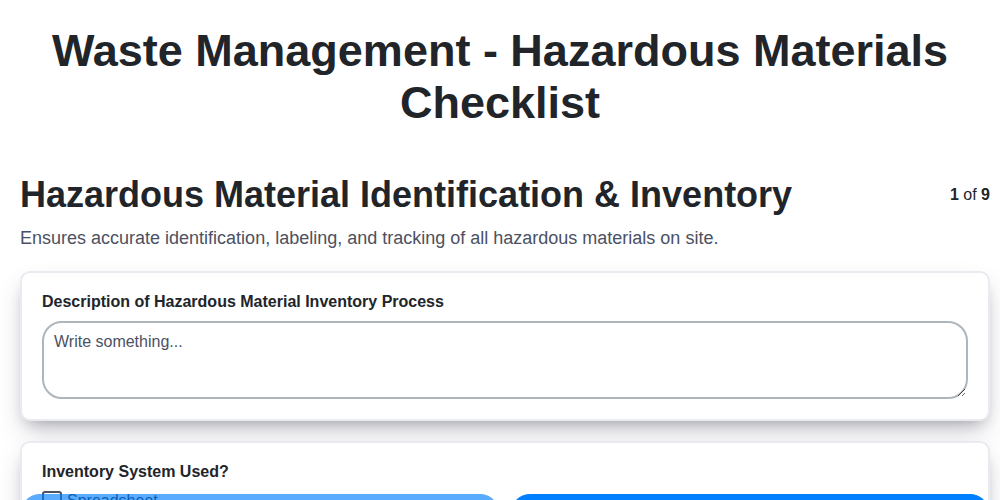
Your Ultimate Hazardous Materials Waste Management Checklist Template
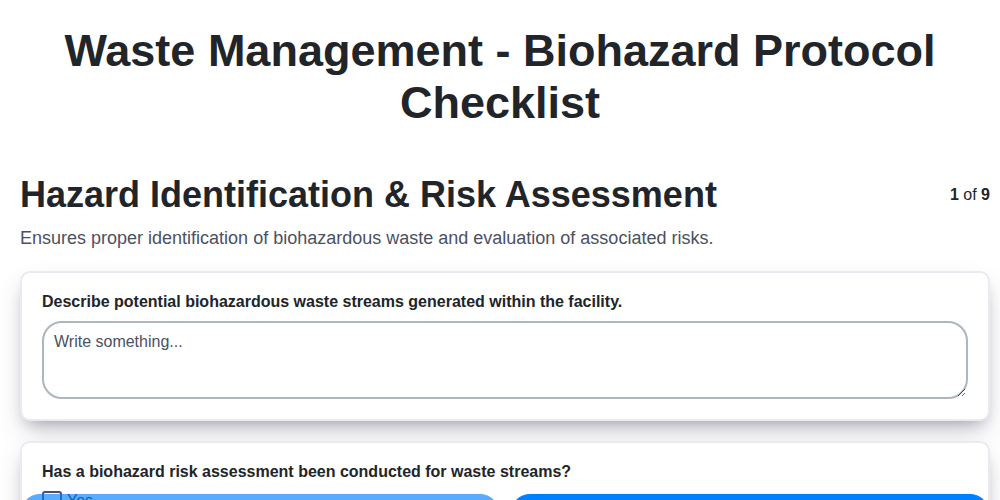
Streamline Biohazard Waste: Your Essential Checklist Template
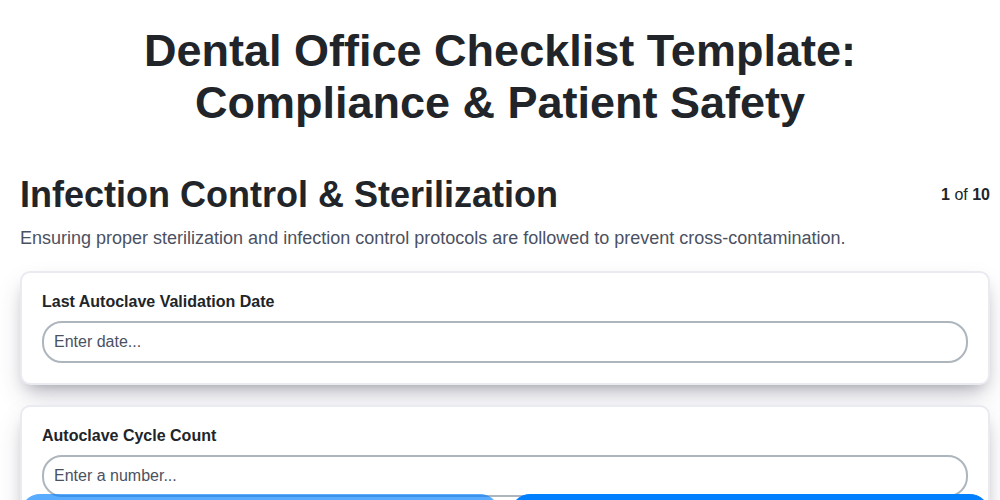
Your Dental Office Safety Net: The Compliance & Patient Safety Checklist Template

Weekly Waste Management & Recycling Checklist Template
Your Environmental Compliance Checklist Template: A Step-by-Step Guide
Auto Repair Shop Checklist Template: Operations & Compliance
Need help with
Checklists?
Have a question? We're here to help. Please submit your inquiry, and we'll respond promptly.