The Ultimate 2026 Agricultural Drone Battery Maintenance and Flight Safety Log: Your Essential Checklist Template
Published: 11/21/2026 Updated: 11/22/2026
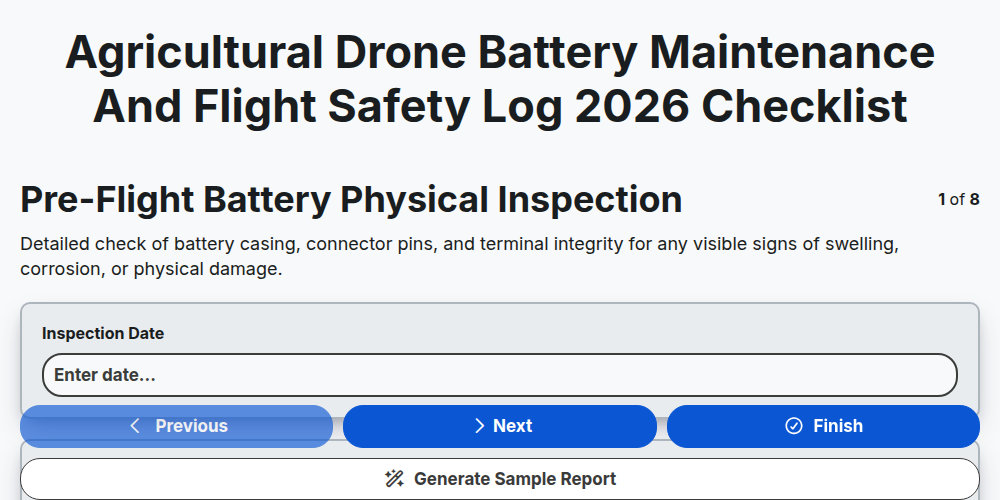
Table of Contents
- Introduction: Ensuring Longevity and Safety in the 2026 Farming Season
- Phase 1: Pre-Flight Battery Physical Inspection
- Phase 2: Battery Charge and Cell Balance Verification
- Phase 3: Drone Hardware and Propeller Integrity Check
- Phase 4: Flight Controller and Sensor Calibration
- Phase 5: Environmental and Airspace Assessment
- Phase 6: Signal Strength and Command Link Test
- Phase 7: Post-Flight Battery Discharge and Storage Protocol
- Phase 8: Maintenance Log and Cycle Count Tracking
- Best Practices for Digital Record Keeping in 2026
- Conclusion: Minimizing Downtime through Proactive Maintenance
- Resources & Links
TLDR: Ensure maximum uptime and drone longevity in 2026 with this comprehensive maintenance and safety checklist. This guide covers everything from critical pre-flight battery and hardware inspections to post-flight storage protocols and essential log tracking, providing a structured framework to optimize agricultural spraying or mapping operations and prevent costly mid-air failures.
Introduction: Ensuring Longevity and Safety in the 2026 Farming Season
As we move into the 2026 agricultural season, the integration of advanced UAV (Unmanned Aerial Vehicle) technology in precision farming has reached an all-time high. From autonomous crop spraying to high-resolution multispectral imaging, drones are no longer just gadgets-they are mission-critical assets. However, the reliability of these machines depends entirely on one volatile component: the battery.
The High Stakes of Battery Management
In the context of modern large-scale farming, a single mid-flight battery failure isn't just an inconvenience; it is a potential catastrophe. An unexpected power drop during a heavy-payload spraying mission can lead to costly equipment damage, crop loss, or even physical injury. As battery densities and discharge rates increase with newer 2026 models, the margin for error has become slimmer than ever.
Why a Rigorous Maintenance Log is Non-Negotiable
Maintaining a standardized flight safety log is the difference between a profitable season and an operational nightmare. A systematic approach to maintenance allows you to:
- Predictive Failure Detection: Identify degrading cells before they become flight risks.
- Regulatory Compliance: Maintain a paper trail of airworthiness, which is increasingly required by evolving agricultural aviation authorities.
- Asset Lifecycle Management: Track cycle counts to maximize your Return on Investment (ROI) by knowing exactly when a battery has reached its end-of-life.
- Operational Consistency: Ensure that every pilot in your fleet-whether seasonal or permanent-is operating under the same safety standard.
The following checklist is designed to be your operational gold standard. By integrating these steps into your daily pre-flight and post-flight routines, you ensure that your drone fleet remains a reliable pillar of your digital farming strategy throughout 2026.
Phase 1: Pre-Flight Battery Physical Inspection
Inspecting the Core: The Pre-Flight Battery Physical Inspection
Before you ever power up your drone, the most critical moment for ensuring mission success-and preventing costly hardware failure-is the physical inspection of your power source. In 2026, with the increased energy density of modern agricultural batteries, the stakes for a thorough inspection have never been higher.
Visual Integrity Check
Begin by performing a 360-degree visual scan of each battery pack. You are looking for any signs of physical trauma or environmental degradation. Specifically, examine the following:
- Casing Integrity: Check for any cracks, punctures, or bulges in the battery casing. A swollen or puffy battery is a definitive sign of cell degradation or internal damage; if you detect this, do not use the battery.
- Connector Health: Inspect the gold-plated terminals and contact pins. Look for any signs of carbon buildup, corrosion, or oxidation. Ensure the pins are straight and free of debris.
- Debris Removal: Agricultural environments are inherently dusty. Ensure the battery contacts and the drone's battery bay are free from soil, pesticide residue, or organic matter that could impede electrical conductivity.
Terminal and Connector Assessment
The connection between your battery and the drone is the lifeline of your flight. A micro-interruption here can lead to a sudden power drop mid-mission.
- Pin Tension: Gently verify that the connector pins are secure and not loose.
- Solder Point Inspection: If you are using DIY-repaired or high-capacity aftermarket packs, inspect the contact points for any loose wiring or brittle solder joints.
- Contamination Check: Ensure that no moisture or liquid residue is present on the connectors, as even a small amount of moisture can cause a short circuit when the high-voltage current begins to flow.
Phase 2: Battery Charge and Cell Balance Verification
Ensuring Energy Integrity: Beyond the Surface
Once you have confirmed there is no visible swelling or physical damage, the next critical step is verifying the internal health of your power cells. In 2026, as high-capacity smart batteries become even more dense, a simple full charge indicator is no longer sufficient for professional agricultural operations.
The Importance of Cell Balancing
In agricultural spraying or seeding missions, a sudden voltage drop in a single cell can lead to mid-flight power failure, potentially causing a heavy drone to drop into crops or nearby infrastructure. Cell balancing ensures that the voltage level across all internal cells is identical.
- Voltage Variance Threshold: During your pre-flight check, use your management software to ensure the deviation between the highest and lowest cell voltage is no more than 0.02V.
- The Balanced Charge Routine: If you notice any discrepancy, do not proceed with takeoff. Route the battery through a dedicated balancing cycle to redistribute the load.
Real-Time Voltage Monitoring
Before the propellers spin, perform a Live Status Check via your Ground Control Station (GCS):
- Check Resting Voltage: Ensure the battery is at the recommended storage or flight voltage (typically between 3.7V and 4.2V per cell).
- Monitor Discharge Consistency: Observe the voltage readout for 30 seconds while the drone is idling. A rapid dip indicates a high-resistance cell that may fail under the heavy load of an agricultural payload.
Smart Battery Data Review
Utilize the 2026 telemetry features to review the Health Score provided by your battery's onboard BMS (Battery Management System). Look specifically for:
- Internal Resistance (IR) Trends: An increase in IR is a leading indicator of battery aging and reduced flight endurance.
- Temperature Stability: Ensure the battery temperature is within the optimal operating range (typically $20^\circ\text{C}$ to $40^\circ\text{C}$). Charging or discharging a frozen or overheating battery can cause permanent capacity loss.
Phase 3: Drone Hardware and Propeller Integrity Check
Ensuring Structural Integrity for Maximum Flight Stability
Once you have verified that your power source is stable, the focus must shift to the physical airframe and the mechanical components that interact directly with the atmosphere. In 2026, as agricultural drones become heavier with advanced multispectral sensors and larger liquid payloads, the margin for mechanical error has shrunk. A single hairline fracture or a chipped propeller blade can lead to catastrophic mid-flight failure.
Propeller Inspection: The First Line of Defense
The propellers are the most critical moving parts of your UAV. Even microscopic damage can cause unexpected vibrations that interfere with flight controllers and sensor data.
- Surface Inspection: Run your fingers (carefully) along the leading and trailing edges of every blade. Look for nicks, cracks, or pitting caused by debris during low-altitude spraying.
- Structural Rigidity: Check for any signs of warping or bending. Propellers that have been exposed to high heat or extreme sunlight can lose their aerodynamic profile.
- Hub and Fastener Security: Ensure the propeller mounting nuts or locking mechanisms are tight. For quick-release systems, verify that the locking pins are fully engaged and free of debris.
- Debris Removal: Use compressed air to clear dust, dried pesticide residue, or organic matter from the propeller roots, as this can unbalance the rotation.
Airframe and Motor Assessment
A drone is only as reliable as the chassis that holds it together. Heavy-duty agricultural use subjects the frame to significant centrifugal forces and vibration.
- Motor Bearing Check: Manually rotate each motor. The movement should be smooth and silent. If you feel grittiness or hear a grinding sensation, the bearings may be compromised by dust or moisture ingress.
- Arm and Chassis Inspection: Examine the structural arms for any signs of stress whitening (in plastic components) or hairline fractures (in carbon fiber components). Pay close attention to the joints where the arms meet the main body.
- Landing Gear Stability: Ensure the landing gear is secure and shows no signs of impact damage. If your drone features retractable gear, cycle it manually to ensure smooth operation.
- Sensor Housing Integrity: Check that all external sensor mounts, including LiDAR or multispectral camera housings, are clean, unobstructed, and securely fastened to prevent sensor drift during flight.
Phase 4: Flight Controller and Sensor Calibration
Precision Calibration: Ensuring Sensor Accuracy and Flight Stability
In the era of 2026 autonomous agriculture, your drone is no longer just a flying camera; it is a sophisticated data-collection instrument. Even a perfectly charged battery and intact propellers cannot compensate for a misaligned IMU (Inertial Measurement Unit) or a drifting compass. For precision spraying and multispectral mapping, calibration is the bridge between flying and performing.
The Core Calibration Protocol
To maintain the high level of accuracy required for modern crop management, follow these specific calibration steps before every mission:
- IMU (Inertial Measurement Unit) Calibration: Ensure the drone's internal accelerometers and gyroscopes are leveled. Any slight deviation here can lead to toilet bowling (circular drifting) or uneven spray distribution across the field.
- Compass/Magnetometer Calibration: Perform this away from large metal structures, power lines, or heavy machinery. Magnetic interference is the leading cause of flyaways in agricultural settings.
- Barometer and Altitude Sensor Check: Verify that the pressure sensors are clear of dust and debris. A faulty barometer leads to inconsistent flight altitudes, which can result in uneven application of pesticides or incorrect crop canopy data.
- GNSS/RTK Initialization: If you are using RTK (Real-Time Kinematic) for centimeter-level precision, ensure the satellite fix is stable and the correction link is active before takeoff.
Troubleshooting Sensor Drift
If you notice the drone struggling to hold its position or if the flight path deviates from the pre-planned mission map, do not proceed with the flight.
Pro-Tip for 2024-2026 Operators: Always check for sensor fatigue caused by extreme temperature fluctuations. If you have moved the drone from a cool transport vehicle to a high-heat field environment, allow the sensors to stabilize at ambient temperature before initiating the calibration sequence.
Phase 5: Environmental and Airspace Assessment
Navigating the Skies: Environmental and Airspace Assessment
Before the rotors even begin to spin, a successful mission depends on your ability to read the environment. In 2026, with more automated agricultural monitoring and drone delivery services sharing our skies, a check the weather approach is no longer sufficient. You must conduct a rigorous evaluation of both the physical atmosphere and the digital airspace.
1. Meteorological Conditions and Microclimate Analysis
Agricultural drones are highly sensitive to atmospheric changes. Your pre-flight assessment must include:
- Wind Velocity and Gust Profiles: Check not just the sustained wind speed, but the potential for sudden gusts that could destabilize a heavy payload during spraying or seeding.
- Temperature and Humidity Extremes: High heat can accelerate battery degradation and overheat ESCs (Electronic Speed Controllers), while high humidity may affect sensor accuracy and moisture levels in electronic components.
- Precipitation Risk: Ensure there is no immediate threat of rain or mist that could compromise the waterproof rating of your drone or cause current leakage in the battery cells.
- Visibility and Light Levels: Assess if the lighting is sufficient for optical flow sensors and obstacle avoidance cameras to function at peak performance.
2. Airspace Compliance and Digital Deconfliction
In the modern era of integrated airspace, seeing and avoiding now involves digital awareness.
- UTM (Unmanned Traffic Management) Check: Verify your flight plan against current UTM data to ensure no temporary flight restrictions (TFRs) are active over your farmland.
- Obstacle Identification: Scan the flight path for new or seasonal obstacles, such as newly installed power lines, construction cranes, or increased bird activity during migration seasons.
- Signal Interference Scan: Check for high-density RF (Radio Frequency) environments. Nearby heavy farm machinery or cellular towers can create electromagnetic interference that disrupts your command link.
3. Ground Operations Safety Zone
The checklist isn't just about the air-it's about the ground.
- Launch and Landing Pad Stability: Ensure the landing zone is level, clear of loose debris (which could be sucked into motors), and free from dust clouds that could obscure vision.
- Personnel Clearance: Confirm that all farm personnel and bystanders are outside the danger zone radius defined by your drone's specific weight and propeller diameter.
Phase 6: Signal Strength and Command Link Test
Ensuring Connectivity and Control Reliability
Before any takeoff, it is critical to verify that the nervous system of your operation-the communication link between your Ground Control Station (GCS) and the drone-is robust and interference-free. In the increasingly crowded 2026 airspace, where 5G integration and satellite-based telemetry are becoming standard, a momentary signal drop can lead to a catastrophic loss of control.
Radio Frequency (RF) and Telemetry Audit
Never assume that because your controller turns on, the link is stable. Perform a manual check of the following:
- Control Link Latency: Monitor your telemetry feed for any significant delay between your stick inputs and the drone's on-screen response.
- Signal Interference Scan: Check for local high-frequency interference from nearby cellular towers, farm machinery telemetry, or other drone operations in the vicinity.
- Antenna Orientation: Ensure all antennas on both the drone and the remote controller are positioned correctly (typically perpendicular to the signal path) to maximize gain.
Command Link Verification
A command link refers to your ability to send specific instructions to the aircraft. You must confirm that all critical fail-safes are communicating effectively:
- Return-to-Home (RTH) Trigger Test: Verify that the RTH command is recognized by the system and that the drone's onboard GPS can communicate the current Home coordinates accurately.
- Failsafe Protocol Check: Briefly simulate a signal loss (by powering down the transmitter) to ensure the drone's programmed emergency behavior (e.g., hover or land) initiates correctly.
- Data Link Integrity: Confirm that the live video feed (FPV) and all sensor data (multispectral, thermal, or RGB) are streaming without digital artifacts or stuttering.
Log Entry Requirement
If you encounter any intermittent signal drops or packet loss during this test, do not proceed with the flight. Document any signal fluctuations in your flight log, noting the time of day and any nearby electronic equipment that may have been active. This data is vital for identifying patterns of electromagnetic interference in your specific agricultural zone.
Phase 7: Post-Flight Battery Discharge and Storage Protocol
Maintaining Battery Health After the Mission
The flight doesn't end when the drone lands. For agricultural operators, the post-flight phase is arguably the most critical window for preventing permanent battery degradation. In 2026, with high-capacity LiPo and Solid-State batteries becoming the industry standard, following a strict discharge and storage protocol is no longer optional-it is a necessity for protecting your investment.
Immediate Post-Flight Actions
Once the drone has landed and the motors have ceased spinning, do not immediately plug the batteries into a high-speed charger.
- Thermal Cooling Period: Allow the batteries to rest for at least 15-20 minutes. Charging a battery that is still warm from a heavy-duty spraying mission can lead to internal resistance buildup and reduced cycle life.
- Surface Inspection: Use this time to wipe down the battery casing. Remove any traces of chemical residue, fertilizer, or dust that may have accumulated during the flight, as these can corrode the terminals.
The Science of Storage Voltage
One of the most common mistakes in drone maintenance is leaving batteries at Full Charge (100%) for extended periods. This creates high voltage stress, which leads to swelling (puffing) and permanent capacity loss.
- The Storage Mode Rule: If you are not planning to fly within the next 24-48 hours, use your charger's Storage Function to bring all cells to a resting voltage of approximately 3.80V to 3.85V per cell.
- Avoid Deep Discharge: Conversely, never leave a battery at 0% for long. A battery that drops below a critical voltage threshold may undergo a chemical change that makes it unsafe to recharge, effectively turning your expensive power source into electronic waste.
Long-Term Storage Environment
Your storage protocol must extend to the environment where your batteries reside.
- Temperature Control: Store batteries in a cool, dry place (ideally between 15°C and 25°C). Avoid areas prone to extreme temperature fluctuations, such as uninsulated farm sheds or vehicles left in the sun.
- Fire Safety & Containment: Always store your flight batteries in a fire-resistant LiPo bag or a dedicated charging cabinet. In the event of a spontaneous cell failure, containment can prevent a localized issue from becoming a farm-wide disaster.
Summary Checklist for Post-Flight
- Allow batteries to reach ambient temperature before handling/charging.
- Clean terminals and casing of all agricultural debris.
- Discharge to storage voltage (3.8V/cell) if not flying immediately.
- Verify no physical swelling or odors are present during storage.
- Store in a climate-controlled, fire-safe environment.
Phase 8: Maintenance Log and Cycle Count Tracking
Precision Record-Keeping: The Heart of Fleet Longevity
In the rapidly evolving landscape of 2026 precision agriculture, data is just as important as the crops you are spraying. The final, and arguably most critical, step in your operational workflow is the rigorous documentation of your battery lifecycle. Transitioning from a use and forget mindset to a structured Maintenance Log and Cycle Count Tracking system is what separates a hobbyist from a professional-grade agricultural operator.
The Importance of Cycle Count Tracking
Every lithium-polymer (LiPo) or solid-state battery has a finite number of high-performance cycles. In an agricultural setting-where extreme temperature fluctuations and heavy payloads put immense strain on power cells-tracking these cycles is vital for:
- Predicting Failure: Identifying at-risk batteries before they experience mid-flight voltage drops.
- Budget Forecasting: Planning for replacement costs well in advance of battery degradation.
- Regulatory Compliance: Maintaining a verifiable paper trail for insurance and safety audits.
Implementing an Effective Digital Log
For 2026 standards, manual paper logs are becoming obsolete. We recommend integrating your tracking into a digital maintenance ecosystem. Your log should capture the following data points for every single flight:
1. Battery Identification & Metadata
- Unique ID/Serial Number: Never rely on physical markings alone; use digital scanning.
- Chemistry Type: Track specific cell compositions (e.g., LiHV or new 2026 solid-state variants).
- Date of Manufacture: To monitor the aging of the cells regardless of use.
2. The Flight Log Entry Template
For every mission, your log must record:
- Total Cycle Count: Incrementing after every full discharge/recharge cycle.
- Flight Duration & Load: Note the weight of the payload (spraying liquid, seeding, or multispectral sensors) to understand the stress applied.
- Temperature Extremes: Record ambient and battery internal temperatures to identify patterns of heat-induced degradation.
- Post-Flight Voltage Delta: Document the voltage variance between cells after the mission to spot early signs of cell imbalance.
The Retire Threshold
Using this checklist, establish a clear Retirement Protocol. Once a battery reaches a predetermined cycle threshold (e.g., 200 cycles, depending on manufacturer specs) or shows a consistent voltage deviation of more than 0.05V, it must be flagged for decommissioning.
By treating your battery log as a predictive maintenance tool rather than a simple diary, you ensure that your drone fleet remains a reliable asset rather than a liability in the field.
Best Practices for Digital Record Keeping in 2026
Transitioning to a Digital-First Maintenance Ecosystem
As we move into 2026, the era of handwritten logbooks is officially coming to an end. With the increasing complexity of precision agriculture and the integration of AI-driven flight analytics, manual record-keeping is no longer sufficient to ensure compliance or flight safety. Modern agricultural drone operations require a seamless, digital-first approach to maintenance that allows for real-time data accessibility and predictive error detection.
The Power of Automated Data Integration
In 2026, your flight safety log should be more than just a static document; it should be a dynamic database. Integrating your maintenance checklist with cloud-based management software allows for several critical advantages:
- Predictive Maintenance Alerts: By digitizing your Battery Cycle Count Tracking, your software can automatically trigger a notification when a battery pack reaches a threshold of degradation, preventing mid-flight power failures.
- Real-Time Fleet Visibility: For large-scale operations, digital logs allow farm managers to monitor the Drone Hardware and Propeller Integrity Checks across multiple fleets simultaneously, ensuring no unit is deployed with a compromised component.
- Instant Audit Readiness: Should regulatory bodies require proof of Environmental and Airspace Assessment protocols or recent Sensor Calibration logs, a digital repository provides an unalterable, time-stamped trail of compliance.
Implementing a Single Source of Truth
To maximize the utility of your checklist, aim to implement a Single Source of Truth (SSOT) strategy. This means every Pre-Flight Battery Physical Inspection and Post-Flight Storage Protocol is logged into a unified platform that links hardware health directly to flight performance data.
Strategic Tips for 2026 Log Management
- Use IoT-Enabled Logging: Whenever possible, use batteries and drones equipped with telemetry that automatically populates your Battery Charge and Cell Balance Verification logs. This removes human error from the equation.
- Standardize Your Digital Templates: Ensure that your Signal Strength and Command Link Test results are recorded in a standardized format (e.g., dBm levels) to allow for long-term trend analysis.
- Backup and Redundancy: While cloud-based logs are essential, always maintain an offline, encrypted copy of your Maintenance Log and Cycle Count Tracking to ensure operational continuity in remote areas with limited connectivity.
Conclusion: Minimizing Downtime through Proactive Maintenance
Safeguarding Your Investment and Crop Yields
In the rapidly evolving landscape of precision agriculture, your drone is more than just a gadget-it is a critical piece of machinery as vital to your operation as a tractor or an irrigation system. As we navigate the 2026 farming season, the margin for error in aerial spraying, mapping, and monitoring has shrunk. A single battery failure or an uncalibrated sensor doesn't just lead to a grounded drone; it leads to missed planting windows, uneven fertilization, and lost revenue.
Moving from Reactive to Proactive
The transition from fixing things when they break to maintaining things so they don't break is the hallmark of a professional drone operator. By implementing the Battery Maintenance and Flight Safety Log outlined in this guide, you are creating a digital paper trail of accountability. This log allows you to identify patterns-such as a specific battery cell losing voltage faster than others or a recurring signal interference issue in a particular field-before they escalate into catastrophic mid-flight failures.
The Long-Term Benefits of Diligent Logging
- Extended Battery Lifespan: Proper discharge and storage protocols significantly reduce the cost of high-capacity LiPo and LiHV replacements.
- Regulatory Readiness: As drone regulations tighten in 2026, having a documented history of hardware inspections and flight calibrations ensures you are always compliant with safety audits.
- Operational Predictability: When every propeller, sensor, and cell is verified, your flight windows become more reliable, allowing for tighter-than-ever integration with your broader agricultural workflow.
Don't wait for a hardware malfunction to realize a maintenance gap exists. Print this checklist, digitize your logs, and make this rigorous inspection routine a non-negotiable part of your pre-flight ritual. Precision farming begins with precision maintenance.
Resources & Links
- DJI Enterprise: Official resource for industry-leading agricultural drone hardware, manuals, and maintenance guidelines.
- Skydio: Information on autonomous flight technology and advanced sensor integration for drone safety.
- Food and Agriculture Organization of the United Nations: Global insights into the role of precision agriculture and drone technology in future farming.
- Federal Aviation Administration (FAA): Essential regulations, airspace assessments, and Part 107 compliance information for drone operators.
- National Weather Service: Critical for Phase 5: Real-time environmental monitoring and weather assessment for flight safety.
- Autodesk: Advanced mapping and 3D modeling resources for analyzing agricultural drone flight data.
- Xometry: Technical resources regarding material science, useful for understanding propeller and hardware durability.
- USDA (United States Department of Agriculture): Updates on precision agriculture standards and the integration of UAVs in modern farming.
- GitHub: A hub for finding open-source flight controller firmware and digital logging software templates.
- Adobe: Tools for creating digital maintenance logs, PDF checklists, and visual flight documentation.
- Google Cloud: Solutions for large-scale digital record keeping and big data analytics for fleet maintenance.
- LiPo Battery Safety Standards: General safety principles for handling high-capacity Lithium Polymer batteries used in heavy-lift drones.
- Esri (ArcGIS): Geospatial analysis tools for planning flight paths and managing airspace boundaries.
- Trello: Project management tools useful for organizing maintenance schedules and task tracking.
- Notion: Versatile workspace for building custom digital maintenance databases and flight logs.
Comments
There are no comments yet. Be the first to add one!
Agriculture Management Solution Demo
Running a farm or agricultural business is complex. ChecklistGuro's Work OS platform simplifies your operations, from crop planning and irrigation management to livestock tracking and harvest scheduling. Increase efficiency, reduce waste, and boost yields! See how ChecklistGuro can revolutionize your agriculture business.
Related Articles
10 Simple Steps to a Healthy Drainage System: Your Checklist Template

Mastering the Daily Crop Scouting Report: Your [Specific Crop] Checklist Template
Irrigation System Checklist: Farm Water Management & Crop Yield Optimization
Unlock Your Garden's Potential: A Soil pH Verification Checklist
PPE Usage Checklist Template: Your Guide to Safety
Water Discharge Permit Compliance Checklist Template
The Ultimate GPS & Precision Farming Calibration Checklist Template
Water Runoff Analysis Checklist Template
Need help with
Agriculture?
Have a question? We're here to help. Please submit your inquiry, and we'll respond promptly.