The Ultimate 2026 Checklist: Agricultural Food Safety Traceability and Audit Readiness Plan
Published: 11/21/2026 Updated: 11/22/2026
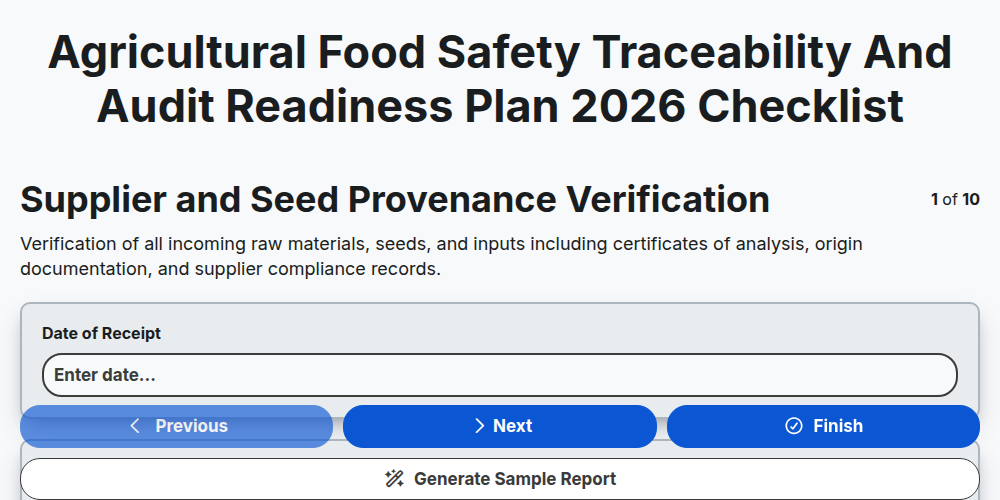
Table of Contents
- Introduction: Navigating the 2026 Food Safety Landscape
- Phase 1: Upstream Integrity - Supplier and Seed Provenance Verification
- Phase 2: Gatekeeping - Incoming Goods Receiving and Inspection
- Phase 3: Digital Fingerprinting - Lot Identification and Internal Coding Systems
- Phase 4: Maintaining Hygiene - Processing and Handling Sanitization Logs
- Phase 5: Temperature Control - Storage and Cold Chain Monitoring
- Phase 6: Downstream Visibility - Product Distribution and Outbound Logistics
- Phase 7: Stress-Testing the System - Traceability Testing (Mock Recall) Performance
- Phase 8: The Human Element - Staff Training and Food Safety Certification
- Phase 9: Environmental Defense - Pest Control and Vector Management Records
- Phase 10: Continuous Improvement - Corrective and Preventive Action (CAPA) Tracking
- Conclusion: Ensuring Long-Term Audit Compliance and Consumer Trust
- Resources & Links
TLDR: Prepare for 2026 regulatory standards with a comprehensive roadmap for agricultural food safety. This checklist covers everything from seed provenance and cold chain monitoring to mock recall performance and CAPA tracking, ensuring your operations are fully audit-ready and compliant.
Introduction: Navigating the 2026 Food Safety Landscape
Navigating the 2026 Food Safety Landscape
As we approach 2026, the agricultural industry finds itself at a critical crossroads of technological advancement and heightened regulatory scrutiny. The global food supply chain has become more interconnected and complex than ever before, leaving zero margin for error. For producers, processors, and distributors, compliance is no longer just about meeting a minimum standard-it is about demonstrating absolute transparency and real-time accountability.
The New Era of Accountability
The landscape of food safety is shifting from reactive measures to proactive, data-driven intelligence. With the rise of digital traceability mandates and more stringent global food safety standards, the ability to track a product from seed to shelf is no longer a competitive advantage; it is a fundamental requirement for market access. Audit readiness is no longer a seasonal event that happens once a year; it must be a continuous,-state of operational excellence.
Why 2026 Requires a Strategic Shift
The challenges of the coming year are multifaceted. Increased pressure from retailers, the implementation of more sophisticated blockchain-integrated tracking, and the rising importance of ESG (Environmental, Social, and Governance) reporting mean that every data point in your supply chain matters. An audit failure or a delayed recall doesn't just result in a fine-it can lead to catastrophic brand damage and the loss of consumer trust.
To mitigate these risks, agricultural leaders must move beyond paper-based logs and fragmented spreadsheets. This checklist is designed to help you transition into a state of permanent audit readiness, ensuring that when an inspector walks through your facility or a trace request arrives from a distributor, your response is instantaneous, accurate, and indisputable.
Phase 1: Upstream Integrity - Supplier and Seed Provenance Verification
Securing the Foundation: The Origin of Your Supply Chain
In the landscape of 2026 food safety standards, traceability no longer begins at your warehouse doors-it begins at the source. Audit readiness starts with the ability to prove the genetic and biological integrity of your raw materials before they ever enter your facility.
Ensuring Seed and Input Authenticity
The first line of defense against contamination and fraudulent labeling is a rigorous verification process for all biological inputs. As global regulations tighten around seed varieties and organic certifications, your audit trail must document:
- Seed Genetic Integrity: Verification that seeds meet the specific cultivar requirements promised by suppliers to prevent cross-contamination or unauthorized GMO presence.
- Phytosanitary Documentation: Ensuring all incoming seeds and raw materials are accompanied by valid certificates of origin and health inspections to mitigate the risk of introducing pathogens or invasive pests.
- Supplier Compliance Audits: A proactive review of your vendors' food safety protocols, ensuring they adhere to the same high standards of GFSI (Global Food Safety Initiative) or relevant local regulatory frameworks.
Mitigating Upstream Risks
A breakdown in provenance is a breakdown in your entire traceability system. If you cannot verify the where and how of your initial inputs, every subsequent step in your production chain becomes a liability. By implementing a strict verification protocol during this phase, you effectively close the gate on high-risk materials, ensuring that your 2026 audit readiness is built on a foundation of verifiable truth.
Phase 2: Gatekeeping - Incoming Goods Receiving and Inspection
Securing the Perimeter: The Inspection Protocol
The integrity of your final product is only as strong as the ingredients entering your facility. In the 2026 regulatory landscape, trust but verify is no longer sufficient; you must possess the empirical data to prove compliance. This phase is your first line of defense against contamination and fraudulent labeling.
Establishing the Standard for Incoming Goods
Every shipment arriving at your facility must undergo a standardized, documented inspection process. This isn't merely about checking quantities; it is about verifying that the biological, chemical, and physical safety parameters meet your established Food Safety Plan (FSP).
Critical Inspection Checkpoints
To ensure audit readiness, your receiving team must execute the following steps for every delivery:
- Temperature Verification: For perishable goods, immediate measurement of core and ambient temperatures is non-negotiable. Discrepancies must be logged immediately to prevent the entry of compromised raw materials.
- Visual Integrity Assessment: Inspecting for signs of physical damage, bruising, or decay, as well as any evidence of pest activity or moisture ingress within the transport vehicle.
- Packaging and Label Integrity: Confirming that all seals are intact and that labels match the accompanying documentation (COAs-Certificates of Analysis) to prevent mislabeling errors.
- Cross-Contamination Screening: Evaluating the cleanliness of the delivery vehicle and ensuring that raw materials are not being transported in a manner that risks contact with hazardous substances or allergens.
The Digital Paper Trail
An audit-ready inspection is a documented one. In 2026, manual paper logs are increasingly viewed as high-risk. To achieve true readiness, your inspection results should be digitized in real-time.
The Golden Rule of Receiving: If an inspection was performed but not recorded in your Traceability Management System, from an auditor's perspective, the inspection never happened. Ensure every deviation, even those that result in a pass, is captured to demonstrate a rigorous culture of oversight.
Phase 3: Digital Fingerprinting - Lot Identification and Internal Coding Systems
Precision Tracking: Building Your Digital Fingerprint
In the landscape of 2026 food safety regulations, good enough record-keeping is no longer an option. To achieve true audit readiness, your facility must transition from simple labeling to a robust Digital Fingerprinting system. This phase is the backbone of your traceability plan, ensuring that every item moving through your facility carries a unique, verifiable identity.
Establishing Granular Traceability
The goal of your internal coding system is to eliminate ambiguity. When an auditor pulls a sample from your finished goods, you must be able to trace it back through every process step with zero manual guesswork.
Key Components of an Audit-Ready Coding System:
- Unique Batch/Lot Numbering Logic: Move away from simple sequential numbering. Implement a structured alphanumeric code that incorporates critical data points, such as production date, facility zone, and shift ID. This allows for at-a-glance identification during high-pressure audits.
- GS1 Standard Integration: To ensure seamless interoperability with global supply chain partners, your internal codes should align with GS1 global standards. Utilizing GS1-compliant barcodes or 2D DataMatrix codes allows for automated scanning and reduces human error during data entry.
- The One-Step-Forward, One-Step-Back Rule: Your coding system must facilitate the ability to identify exactly where a lot originated (the supplier) and exactly where it was sent (the distributor) within minutes, not hours.
- Digital Integration with ERP/WMS: Your physical labels must be digitally mirrored in your Enterprise Resource Planning (or Warehouse Management System). An audit-ready plan ensures that the data on the sticker matches the real-time data in your digital ledger.
Avoiding Common Pitfalls
The most frequent reason for audit failure in this phase is Code Fragmentation. This occurs when different departments (e.g., Receiving vs. Processing) use different naming conventions. To prevent this, your 2026 readiness plan must mandate a unified coding protocol that remains consistent from the moment raw materials enter the dock to the moment the final product leaves the warehouse.
Phase 4: Maintaining Hygiene - Processing and Handling Sanitization Logs
The Foundation of Clean Production
In the 2026 regulatory landscape, cleaning is no longer a sufficient metric for compliance; verification is the new standard. As audit protocols evolve toward more stringent real-time data requirements, your sanitization logs serve as the primary legal defense proving that your facility was in a state of control during every production cycle.
Precision in Documentation
A robust sanitization log must move beyond simple checkboxes. To ensure audit readiness, your logs should capture the who, what, when, and how of every sanitation event. This includes:
- Chemical Concentration Verification: Recording the exact titration levels of sanitizing agents to prove they meet food-grade efficacy standards.
- Contact Time Compliance: Documenting that surfaces were exposed to sanitizers for the manufacturer-recommended duration.
- Equipment-Specific Protocols: Detailed logs for high-risk contact surfaces, such as conveyor belts, slicers, and sorting bins.
Transitioning from Paper to Digital Verifiability
As we approach 2026, auditors are increasingly looking for contemporaneous recording-evidence that logs are completed at the moment of the task, not reconstructed at the end of a shift.
Critical Audit Indicators
To ensure this phase of your plan survives a high-stakes inspection, ensure your logs address these three pillars:
- Frequency Accuracy: Demonstrating that cleaning intervals align with your established HACCP (Hazard Analysis and Critical Control Points) plan.
- Pre-Operational Verification: Documenting that inspections occurred after cleaning but before production commenced.
- Accountability Loops: A clear system of supervisor sign-offs to validate that the cleaning performed met the predefined sanitary standards.
Failure to maintain precise sanitization logs is one of the most common triggers for audit non-conformance, potentially leading to immediate production halts and lost traceability trust.
Phase 5: Temperature Control - Storage and Cold Chain Monitoring
Maintaining the Integrity of the Chain
In the modern agricultural landscape, a break in the cold chain is more than just a technical error; it is a critical failure in food safety. As we approach 2026, regulatory scrutiny regarding temperature-sensitive commodities is reaching an all-time high. To ensure audit readiness, your traceability plan must move beyond simple temperature checking and transition into real-time, verifiable environmental monitoring.
Critical Monitoring Parameters
To pass a rigorous food safety audit, your monitoring protocols must cover three distinct stages:
- Ambient Warehouse Conditions: Continuous logging of humidity and temperature levels in dry storage areas to prevent mold growth and spoilage.
- Cold Storage Stability: Implementation of automated sensors in refrigerators and walk-in coolers to detect temperature fluctuations before they reach the danger zone.
- In-Transit Thermal Consistency: Verifying that temperature-controlled vehicles (reefers) maintained the required set points from the moment of loading until the final point of delivery.
Digital Verification and Data Integrity
An audit-ready plan in 2026 relies on unalterable data. Gone are the days of manual paper logs that are prone to human error or retrospective logging.
Key Audit Requirements for Storage
To ensure your facility is prepared for unannounced inspections, your storage documentation must demonstrate:
- Automated Alert Logs: Evidence of what happened when a temperature deviation occurred. Auditors will look for out-of-range alerts and the subsequent response.
- Calibration Records: Documented proof that all probes, thermometers, and automated sensors are calibrated against traceable standards.
- Sensor Placement Mapping: A blueprint showing that sensors are placed in the most vulnerable areas (e.g., near doors or furthest from cooling units) to ensure a true representation of the environment.
- Battery and Power Redundancy Checks: Documentation proving that backup cooling systems or power sources were functional during any recorded outages.
Pro-Tip for 2026: Transitioning to IoT-enabled, cloud-based monitoring systems is no longer a luxury-it is a necessity for seamless traceability. If you can provide an auditor with a real-time digital dashboard showing a continuous, unbroken temperature history, you have already won half the battle.
Phase 6: Downstream Visibility - Product Distribution and Outbound Logistics
Ensuring Seamless Connectivity Beyond the Farm Gate
The final leg of the traceability journey is just as critical as the first. Even if your internal processes are flawless, a breakdown in outbound logistics can sever the link between your facility and the end consumer, rendering your entire traceability system ineffective during an audit.
Maintaining the Chain of Custody
As products leave your control, the paper trail must remain unbroken. Audit readiness in 2026 requires more than just a shipping manifest; it requires real-time visibility into how and when products transition from your facility to third-party carriers.
To ensure compliance, your outbound logistics protocols must focus on three core pillars:
- Digital Manifest Integration: Ensure that every outbound shipment is paired with digital documentation that includes precise timestamps, vehicle identification, and driver details.
- Load Integrity Verification: Implement a standardized check to confirm that the temperature-controlled environment of the transport vehicle matches the requirements established during your storage phase.
- Carrier Accountability: Verify that downstream partners adhere to your established food safety standards. An audit trail is only as strong as its weakest link in the supply chain.
Mastering the Last Mile Documentation
When auditors perform a trace-back, they won't just look at what you shipped-they will look at how you documented the handoff. Your outbound logs must be able to instantly answer: Which specific lot numbers were loaded onto which truck, at what time, and under what documented conditions?
By tightening your outbound logistics controls, you transform your distribution phase from a potential point of failure into a robust, verifiable component of your food safety ecosystem.
Phase 7: Stress-Testing the System - Traceability Testing (Mock Recall) Performance
Beyond the Paperwork: Proactive System Validation
A traceability plan is only as strong as its performance under pressure. You can have the most sophisticated digital logs and meticulously organized temperature charts, but if they cannot be retrieved and reconciled within a critical timeframe, your system is fundamentally compromised. In 2026, regulatory bodies and retailers are moving beyond simple existence checks to performance-based audits.
The Gold Standard: The Mock Recall
A mock recall is a simulated emergency designed to identify gaps in your communication, documentation, and physical tracking capabilities. To ensure audit readiness, your testing must move past simple one-step-back, one-step-forward exercises and embrace a full-scale crisis simulation.
Critical Evaluation Metrics for 2026
When conducting your mock recalls, evaluate your performance based on these three pillars:
1. Speed and Precision (The Time Constraint)
In a real-world food safety crisis, every minute counts. Your goal should be a Rapid Recovery metric.
- Target: Can you identify the location and quantity of a specific lot within two hours?
- Audit Requirement: Document the exact timestamp from the moment the alert was issued to the moment the final reconciliation was completed.
2. Mass Balance Reconciliation
The most common way audits fail is through discrepancies in weight or volume.
- The Math Check: If you received 1,000kg of raw produce, but your finished goods logs only account for 800kg, where is the missing 200kg?
- Identifying Leakage: A successful mock recall must account for all units: those in finished stock, those in transit, those in processing, and those recorded as waste or scrap.
3. Communication Chain Integrity
Traceability is not just about data; it is about people. Use your testing phase to verify that:
- Contact Trees are Current: Can the person initiating the recall reach all necessary upstream suppliers and downstream distributors instantly?
- Information Accuracy: Is the information being communicated to stakeholders consistent with the data found in your digital logs?
Turning Failures into Fortified Defenses
If your mock recall reveals a lost lot or a significant time delay, do not view it as a failure-view it as a pre-audit correction. Every gap identified during a simulation is a gap that was closed before a real regulatory inspection or a retail audit could find it. Document these findings and link them directly to your CAPA (Corrective and Preventive Action) logs to demonstrate to auditors that you possess a culture of continuous improvement.
Phase 8: The Human Element - Staff Training and Food Safety Certification
Cultivating a Culture of Compliance
In 2026, food safety is no longer just about the technology in your warehouse or the sensors in your cold storage; it is about the people operating them. Even the most sophisticated traceability software is rendered useless if the staff on the ground lacks the training to execute protocols accurately. An audit-ready facility is defined by a workforce that understands not just what to do, but why it matters for consumer safety.
Strengthening Competency through Continuous Learning
As regulatory landscapes evolve and new biological threats emerge, a one-and-done approach to training is a significant liability. Your 2026 readiness plan must prioritize:
- Standard Operating Procedure (SOP) Mastery: Regular workshops to ensure every team member-from field workers to logistics drivers-can execute sanitization and handling protocols without deviation.
- Digital Literacy in Traceability: As we move further into the era of IoT and automated logging, staff must be proficient in using handheld scanners, digital temperature logs, and real-time monitoring interfaces.
- Food Safety Certification Maintenance: Ensuring that all personnel hold up-to-date certifications (such as HACCP, FSMA, or GlobalGAP) to meet the stringent requirements of international auditors and retail partners.
Building an Audit-Ready Mindset
The goal of this phase is to transition from preparing for an audit to being audit-ready at all times. When your team views food safety as a core value rather than a periodic chore, your documentation becomes more accurate, your response times during mock recalls decrease, and your facility's integrity becomes unassailable.
Remember: A lapse in human error is a lapse in traceability. Investing in your people is the most effective way to protect your brand and your bottom line.
Phase 9: Environmental Defense - Pest Control and Vector Management Records
Securing the Perimeter: Maintaining Rigorous Pest and Vector Documentation
In the 2026 regulatory landscape, food safety is no longer just about what happens inside the processing line; it is about the integrity of the entire facility perimeter. As global standards tighten, auditors are increasingly looking beyond chemical applications to evaluate the effectiveness of your entire Integrated Pest Management (IPM) ecosystem.
Beyond the Trap: Documentation Over Compliance
It is a common misconception that simply having traps in place constitutes a pest control plan. To achieve audit readiness, your records must prove active management rather than passive observation. Auditors will look for a narrative of prevention, not just a log of sightings.
Key Components of an Audit-Ready Record System
- The Master Map of Monitoring Stations: Maintain an up-to-date, detailed site map indicating the exact location of all pheromone traps, rodent stations, and insect monitors. In 2026, digital mapping integration is the gold standard for proving real-time oversight.
- Trend Analysis and Data Patterns: A single pest sighting is an incident; a recurring sighting is a systemic failure. Your records must include periodic trend analyses that identify hot zones within your facility. Showing that you have identified a pattern and implemented a structural fix is the hallmark of a mature food safety culture.
- SDS and Chemical Inventory Management: Every substance used in your pest management program must be accounted for. Keep Safety Data Sheets (SDS) readily accessible and ensure that all chemical applications are documented with precise details: date, time, targeted area, chemical concentration, and the technician's credentials.
- Corrective Action Integration: When a threshold is breached, your pest logs must link directly to your CAPA (Corrective and Preventive Action) system. An auditor will immediately look for the loop closure-did the sighting of a vector lead to a structural repair or a change in sanitation frequency?
Proactive Vector Defense
As climate shifts influence insect migration patterns and pest behavior, your 2026 plan must emphasize preventative barriers. Documentation should reflect regular inspections of door seals, loading dock levelers, and screened vents. By treating pest management as a subset of your facility's structural integrity, you transform a routine compliance task into a powerful pillar of your traceability and defense strategy.
Phase 10: Continuous Improvement - Corrective and Preventive Action (CAPA) Tracking
Closing the Loop: The Power of CAPA in Food Safety
In the landscape of 2026 food safety standards, an audit-ready facility is not defined by the absence of errors, but by the efficiency of its response to them. The Corrective and Preventive Action (CAPA) system is the backbone of a mature food safety management system. It is the mechanism that transforms a single failure-such as a temperature excursion or a documentation gap-into a structural improvement that prevents recurrence.
Moving Beyond Quick Fixes
A common pitfall in agricultural operations is treating a non-conformity with a mere correction (fixing the immediate problem) without implementing a corrective action (addressing the root cause).
To ensure audit readiness, your CAPA tracking must follow a rigorous, documented workflow:
- Identification: Documenting the non-conformity exactly as it occurred.
- Root Cause Analysis (RCA): Utilizing tools like the 5 Whys or Fishbone Diagrams to move past human error and uncover systemic vulnerabilities.
- Action Planning: Developing specific, measurable steps to mitigate the identified risk.
- Verification of Effectiveness: Following up after a set period to prove that the change actually worked.
Strengthening Your Audit Trail
Auditors in 2026 will look specifically at your CAPA logs to assess your facility's Culture of Safety. They aren't just looking for clean records; they are looking for evidence of active learning.
Key Elements of a Robust CAPA Log
To ensure your tracking system is audit-proof, every entry in your digital or manual log should include:
- The Deviation Details: Date, time, lot number, and nature of the incident.
- Immediate Containment Actions: What was done to protect the product (e.g., quarantine, hold, or disposal).
- Root Cause Determination: A clear explanation of why the breakdown occurred.
- Preventive Measures: Long-term changes to SOPs, equipment upgrades, or retraining schedules.
- Accountability and Deadlines: Assigned personnel and a clear timeline for completion.
By treating every deviation as an opportunity for fortification, your CAPA tracking ensures that your food safety plan is a living, breathing, and constantly evolving shield against risk.
Conclusion: Ensuring Long-Term Audit Compliance and Consumer Trust
Future-Proofing Your Operations for 2026 and Beyond
Navigating the complexities of modern food safety regulations is no longer just about passing a single inspection; it is about building a culture of continuous vigilance. As we approach 2026, the landscape of global supply chain transparency is shifting toward even more rigorous, real-time data requirements. By implementing this comprehensive traceability and audit readiness plan, you are doing more than just checking boxes-you are building a defensive perimeter around your brand's reputation.
The Strategic Value of Traceability
A robust traceability system acts as your most powerful tool during a crisis. When every seed provenance, every temperature log, and every shipment record is digitized and verifiable, the window of impact during a food safety incident shrinks from days to minutes. This precision allows you to execute surgical recalls rather than broad, costly, and reputation-damaging mass withdrawals.
Beyond Compliance: The Trust Advantage
While the primary driver for many is often regulatory compliance, the secondary benefit is an unparalleled competitive advantage. In an era of radical transparency, consumers and retail partners are choosing brands that can prove their safety credentials.
Implementing this checklist ensures that:
- Audit Stress is Eliminated: Instead of scrambling when an auditor arrives, your team will be performing routine verifications of a system that is already functioning.
- Waste is Minimized: Improved monitoring of cold chains and incoming goods reduces spoilage and optimizes inventory management.
- Brand Loyalty is Earned: Demonstrating a commitment to rigorous CAPA tracking and staff certification fosters deep trust with stakeholders throughout the entire value chain.
Final Thought for Producers and Processors
The transition to 2026 readiness begins today. Do not wait for an audit failure or a traceability gap to identify weaknesses in your system. Start by auditing your current processes against these ten critical pillars, identify your gaps, and begin the iterative process of improvement. In the world of agricultural food safety, the most successful organizations are not those that never encounter errors, but those that have the systems in place to detect, track, and rectify them instantly.
Resources & Links
- U.S. Food and Drug Administration (FDA): The primary regulatory body providing guidelines on FSMA (Food Safety Modernization Act) and food safety compliance standards.
- United States Department of Agriculture (USDA): Essential for resources regarding meat, poultry, and egg safety, as well as organic certification standards.
- International Organization for Standardization (ISO): Access to global standards for food safety management systems, specifically ISO 22000.
- Global Food Safety Initiative (GFSI): The leading global initiative to harmonize food safety standards and improve supply chain transparency.
- Environmental Research Center: Insights into environmental impacts on agriculture and food safety vulnerabilities.
- FoodSafety.gov: A central hub for food safety information, recalls, and outbreak updates for producers and consumers.
- Food Safety and Inspection Service (FSIS): Detailed regulatory information specifically regarding the inspection of meat, poultry, and egg products.
- Institute of Food Science and Technology (IFST): Professional resources for food scientists, including training materials and industry trends.
- eCFR - Electronic Code of Federal Regulations: The definitive source for reading the legal requirements of the FSMA and other agricultural mandates.
- National Organic Program (NOP): Crucial for Phase 1 (Seed Provenance) regarding the standards for organic labeling and certification.
- ASTM International: Technical standards for testing, materials, and equipment used in temperature control and packaging.
- ScienceDirect: A database for peer-reviewed research on food microbiology, pathogen control, and sanitization technologies.
- Food Safety Magazine: Industry news and deep dives into new technologies like blockchain for digital fingerprinting and traceability.
- World Codex Alimentarius: International food standards, guidelines, and codes of practice to protect consumer health.
- Global Food Safety Benchmark: Frameworks for evaluating the effectiveness of food safety management systems and audits.
- Food Marketing Institute (FMI): Resources on the retail side of the supply chain, focusing on downstream visibility and consumer trust.
- ISO 22005: Traceability in the Food Chain: Specific technical guidance on implementing traceability systems in agricultural supply chains.
- Pesticide Action Network: Contextual information on chemical residues and environmental defense management.
Comments
There are no comments yet. Be the first to add one!
Agriculture Management Solution Demo
Running a farm or agricultural business is complex. ChecklistGuro's Work OS platform simplifies your operations, from crop planning and irrigation management to livestock tracking and harvest scheduling. Increase efficiency, reduce waste, and boost yields! See how ChecklistGuro can revolutionize your agriculture business.
Related Articles
10 Simple Steps to a Healthy Drainage System: Your Checklist Template

Mastering the Daily Crop Scouting Report: Your [Specific Crop] Checklist Template
Irrigation System Checklist: Farm Water Management & Crop Yield Optimization
Unlock Your Garden's Potential: A Soil pH Verification Checklist
PPE Usage Checklist Template: Your Guide to Safety
Water Discharge Permit Compliance Checklist Template
The Ultimate GPS & Precision Farming Calibration Checklist Template
Water Runoff Analysis Checklist Template
Need help with
Agriculture?
Have a question? We're here to help. Please submit your inquiry, and we'll respond promptly.