A Step-by-Step Guide to Compliance Auditing and Regulatory Reporting Workflows
Published: 06/18/2026 9:00 PM Updated: 06/19/2026 12:30 PM
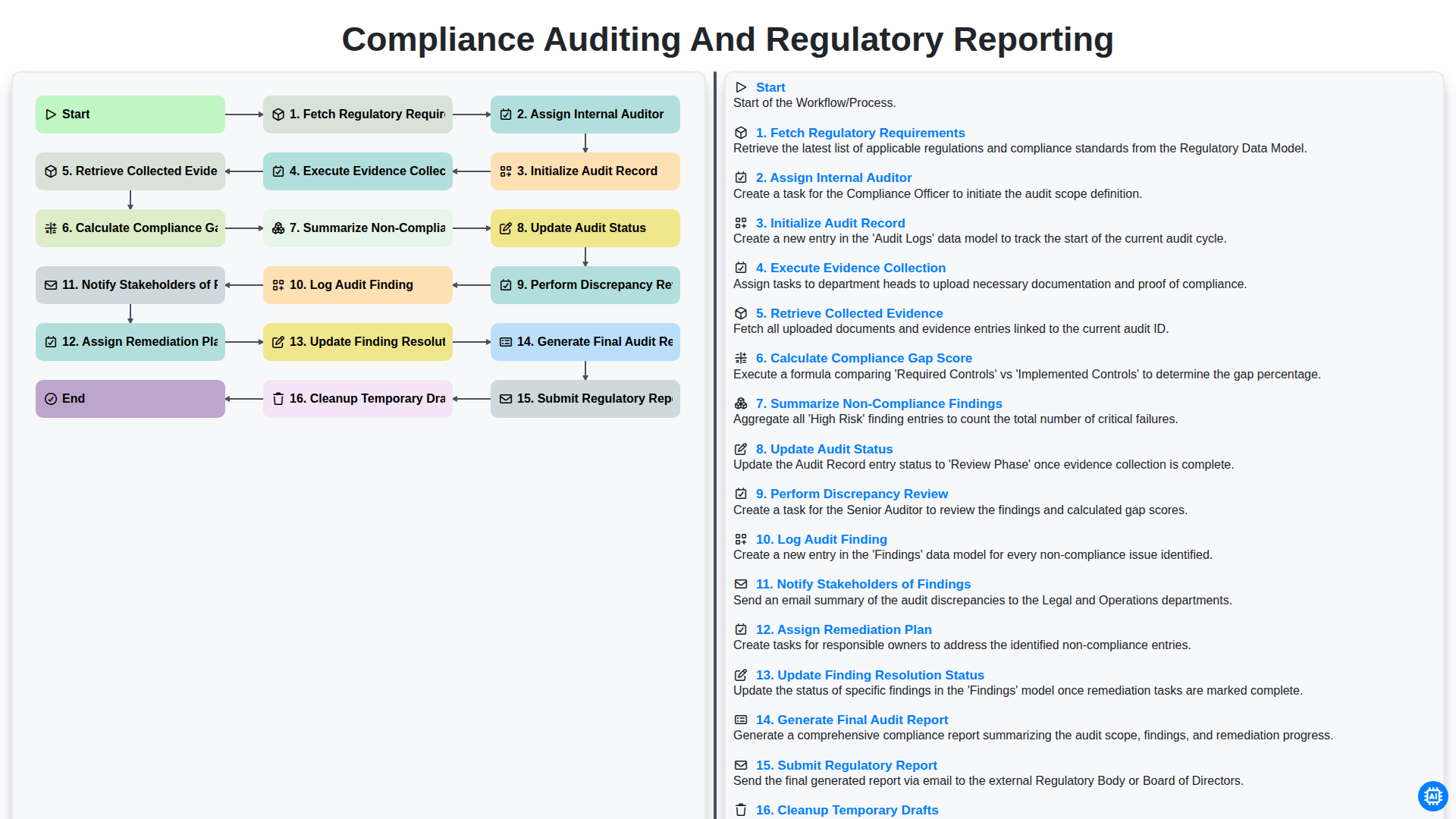
Table of Contents
- Introduction to Compliance Auditing and Regulatory Reporting
- Phase 1: Audit Preparation and Resource Allocation
- Step 1: Fetching and Analyzing Regulatory Requirements
- Step 2: Assigning Internal Auditors and Initializing Audit Records
- Phase 2: The Execution of Evidence Collection
- Step 3: Executing Evidence Collection and Retrieving Documentation
- Phase 3: Evaluating Compliance and Identifying Gaps
- Step 4: Calculating Compliance Gap Scores and Summarizing Findings
- Step 5: Updating Audit Status and Performing Discrepancy Reviews
- Phase 4: Finding Documentation and Stakeholder Communication
- Step 6: Logging Audit Findings and Notifying Stakeholders
- Phase 5: Remediation and Resolution Management
- Step 7: Assigning Remediation Plans and Tracking Resolution Status
- Phase 6: Final Reporting and Regulatory Submission
- Step 8: Generating Final Reports, Submission, and Data Cleanup
- Resources & Links
TLDR: Streamline your regulatory oversight with this comprehensive guide to automating the compliance auditing lifecycle-from initial requirement fetching and evidence collection to gap analysis, remediation tracking, and final regulatory reporting.
Introduction to Compliance Auditing and Regulatory Reporting
In today's increasingly complex legal landscape, maintaining operational integrity is no longer just a matter of best practices-it is a critical necessity for business survival. Compliance Auditing and Regulatory Reporting represent the backbone of organizational governance, serving as the systematic process of verifying that a company's internal controls, policies, and procedures align with external legal mandates.
An effective compliance workflow is much more than a simple checklist; it is a rigorous, end-to-end lifecycle designed to identify risks, ensure transparency, and provide documented proof of adherence to industry standards. From the moment regulatory requirements are identified to the final submission of reports to governing bodies, every step must be executed with precision.
A streamlined workflow minimizes the risk of human error, reduces the burden of manual data collection, and ensures that when an audit occurs, your organization is not just prepared, but proactive. By understanding the intricate steps-from evidence collection to remediation tracking-organizations can transform compliance from a reactive burden into a strategic advantage that fosters trust with stakeholders and regulators alike.
Phase 1: Audit Preparation and Resource Allocation
The foundation of a successful compliance audit lies in the precision of its preparation. Before any testing occurs, the workflow begins with Fetching Regulatory Requirements. This critical first step involves identifying the specific legal, industry, and internal standards that the organization must adhere to, ensuring the audit scope is accurate and comprehensive.
Once the regulatory landscape is defined, the process moves into resource mobilization by Assigning an Internal Auditor. Selecting the right subject matter expert is vital to ensure the audit is conducted with the necessary technical competence and objectivity. To maintain a transparent and traceable audit trail, the workflow then moves to Initializing an Audit Record. This establishes a centralized single source of truth, creating a dedicated digital environment where all subsequent findings, evidence, and communications will be documented, ensuring that every step taken is logged for future scrutiny.
Step 1: Fetching and Analyzing Regulatory Requirements
The foundation of any successful compliance framework lies in the precision of its initial phase: Fetching Regulatory Requirements. Before an audit can even begin, the system must proactively scan the ever-changing landscape of global and industry-specific regulations. This process involves identifying the specific mandates-such as GDPR, HIPAA, SOX, or ISO standards-that apply to your unique organizational footprint.
Rather than relying on manual monitoring, an automated workflow ensures that every new amendment, updated guideline, or new legislative mandate is captured in real-time. This step is critical because it establishes the source of truth for the entire audit lifecycle. By accurately pulling these requirements into your workflow, you ensure that the subsequent audit parameters are current, relevant, and comprehensive, preventing the costly mistake of auditing against outdated standards.
Step 2: Assigning Internal Auditors and Initializing Audit Records
Once the regulatory requirements have been fetched and the scope of the audit is clearly defined, the workflow moves into the critical phase of resource allocation and administrative setup. This stage ensures that the audit has both the necessary human expertise and a formal structure for tracking progress.
The process begins with Assigning Internal Auditors. Selecting the right personnel is not merely about availability; it requires matching the complexity of the regulatory requirements with auditors who possess the specific subject matter expertise and technical knowledge required for the audit domain. By assigning dedicated auditors, the organization ensures accountability and high-quality oversight.
Immediately following the assignment, the workflow proceeds to Initialize Audit Record. This step involves creating a centralized, digital audit trail that serves as the single source of truth for the entire engagement. Initializing the record ensures that all subsequent actions-from evidence collection to final reporting-are documented within a controlled environment. This structured start is vital for maintaining data integrity and ensuring that the audit remains traceable for future regulatory inspections.
Phase 2: The Execution of Evidence Collection
Once the audit record has been initialized and the internal auditor is officially assigned, the workflow moves into its most critical operational stage: Execute Evidence Collection. This phase represents the boots on the ground portion of the audit, where the theoretical requirements of the regulatory framework are tested against actual institutional practices.
During this stage, the auditor systematically gathers the necessary documentation, logs, and datasets required to prove adherence to specific controls. This is not merely a passive gathering of files; it is a rigorous process of verifying that the controls described in the policy are functioning as intended in practice. The complexity of this phase lies in the diversity of the data being captured-ranging from system-generated audit trails and access logs to manually maintained spreadsheets and screenshots of configuration settings.
The goal of this execution phase is to create an immutable trail of proof. Success here depends on the precision of the collection process; any missing or incomplete data at this stage can lead to significant compliance gaps later in the workflow. By focusing on high-integrity data capture, the auditor ensures that the subsequent retrieval and gap analysis phases are built upon a foundation of verifiable truth.
Step 3: Executing Evidence Collection and Retrieving Documentation
Once the audit record has been initialized and the internal auditor is assigned, the workflow moves into its most critical operational phase: Execute Evidence Collection. This stage is the heartbeat of the auditing process, where the theoretical requirements of the regulatory framework meet the practical realities of the organization's daily operations.
During this phase, the assigned auditor systematically gathers the necessary artifacts to prove adherence to specific controls. This involves querying databases, inspecting logs, reviewing signed policy documents, and performing walkthroughs of critical business processes. The goal is to capture point-in-time snapshots that serve as verifiable proof of compliance.
Following the active collection phase, the workflow transitions into Retrieve Collected Evidence. This is a vital step for maintaining data integrity and auditability. All gathered materials-whether they are screenshots, CSV exports, or PDF reports-must be centralized and organized within the audit record. This structured retrieval ensures that the evidence is not just collected, but is easily accessible, properly indexed, and ready for the subsequent analysis. By automating the movement of data from the collection stage to a centralized repository, organizations can prevent data fragmentation and ensure that the paper trail remains unbroken for future regulatory inspections.
Phase 3: Evaluating Compliance and Identifying Gaps
Once the evidence has been gathered, the workflow shifts from data collection to critical analysis. This phase is the core of the auditing process, where raw data is transformed into actionable intelligence. The process begins with the Retrieval of Collected Evidence, ensuring that all gathered documentation is organized and ready for scrutiny.
With the evidence in hand, the system performs a Calculation of the Compliance Gap Score. This quantitative metric provides an immediate, high-level overview of how well current operations align with the predefined regulatory requirements. However, a single score does not tell the whole story. To provide depth to this metric, the workflow involves Summarizing Non-Compliance Findings, which translates numerical gaps into descriptive, qualitative insights.
As these gaps are identified, the Update of Audit Status occurs to reflect the current state of the audit progress. This leads into the Discrepancy Review, a meticulous step where auditors verify the accuracy of the identified gaps to ensure no false positives interfere with the results. Once the review is finalized, the workflow moves to Logging Audit Findings, creating a permanent, immutable record of every identified deviation. This structured approach ensures that every discrepancy is documented with precision, setting the stage for the critical communication and remediation steps that follow.
Step 4: Calculating Compliance Gap Scores and Summarizing Findings
Once the evidence collection phase is complete, the workflow transitions from data gathering to critical analysis. In this stage, the system automatically retrieves the collected evidence and performs a rigorous comparison against the predefined regulatory requirements. By cross-referencing the gathered documentation with the established compliance benchmarks, the system calculates a Compliance Gap Score. This metric provides an immediate, quantitative look at the organization's adherence to regulations, highlighting exactly where controls are functioning effectively and where they are failing.
Following the scoring process, the workflow moves into the qualitative assessment phase: summarizing non-compliance findings. Rather than just presenting raw data, the system distills complex discrepancies into actionable insights. This summary identifies the specific nature of the gaps, the severity of the risks involved, and the specific regulatory clauses that are currently unmet. This structured approach ensures that the audit does not just produce a list of errors, but provides a clear, high-level overview of the organization's regulatory posture, setting the stage for the subsequent discrepancy review and remediation planning.
Step 5: Updating Audit Status and Performing Discrepancy Reviews
Once the initial compliance gap score has been calculated and the non-compliance findings summarized, the workflow moves into a critical phase of verification: Updating Audit Status and Performing Discrepancy Reviews.
At this stage, the system or auditor updates the official audit record to reflect the current state of the investigation (e.g., moving from In Progress to Under Review). This ensures that all stakeholders have real-time visibility into the audit's lifecycle. However, a gap score alone isn't enough for a conclusive audit; the team must then undergo a rigorous Discrepancy Review.
During the review, the auditor cross-references the identified gaps against the collected evidence to ensure no misinterpretations have occurred. This step acts as a quality control gate to distinguish between genuine regulatory breaches and simple documentation errors. By validating these discrepancies before moving forward, the organization prevents inaccurate data from polluting the final report, ensuring that the subsequent remediation steps are based on a foundation of absolute accuracy.
Phase 4: Finding Documentation and Stakeholder Communication
Once the compliance gap score has been calculated and the non-compliance findings summarized, the workflow shifts from data analysis to critical documentation and communication. This phase is where the raw data of the audit is transformed into actionable intelligence.
The process begins with an essential Discrepancy Review, where auditors scrutinize the gaps between current practices and regulatory requirements to ensure accuracy and prevent false positives. Once verified, every identified issue must be formally recorded in a Log Audit Finding step, ensuring a permanent, traceable record of every deviation discovered during the collection process.
Communication is the cornerstone of this phase. The workflow moves into Notifying Stakeholders of Findings, ensuring that both internal leadership and relevant department heads are immediately aware of the risks identified. However, a notification without a solution is merely an alert; therefore, the process immediately transitions to Assigning a Remediation Plan. This ensures that every finding is paired with a specific owner and a strategy for correction.
To maintain transparency and ensure accountability, the system must continuously Update Finding Resolution Status. This allows for real-time tracking of whether a gap is Open, In Progress, or Resolved. By maintaining this rigorous loop of documentation and notification, the organization ensures that audits do not just identify problems, but actively drive the corrective actions necessary to maintain regulatory standing.
Step 6: Logging Audit Findings and Notifying Stakeholders
Once the discrepancy review is complete and the gaps have been formally identified, the workflow moves into the critical phase of documentation and communication. This stage is about transforming raw data into actionable intelligence by Logging Audit Findings and Notifying Stakeholders of Findings.
Logging the findings is more than just a clerical task; it involves creating a permanent, immutable record of every non-compliance issue discovered during the audit. Each entry must be detailed, specifying the exact regulatory requirement that was breached, the evidence that triggered the flag, and the severity of the gap. This creates the paper trail that is essential for both internal accountability and external regulatory scrutiny.
However, a logged finding is only useful if it reaches the right people. The subsequent step, notifying stakeholders, triggers the automated distribution of these findings to department heads, compliance officers, and relevant management teams. By automating this notification, the workflow ensures that there is no information silo effect-ensuring that those responsible for the affected business units are alerted immediately to the risks identified. This transparency is what bridges the gap between discovering a problem and initiating the necessary corrective actions.
Phase 5: Remediation and Resolution Management
Once the audit findings have been identified and communicated, the focus shifts from detection to rectification. This phase is critical because an audit holds no value unless it triggers meaningful corrective action. The workflow moves into Assigning a Remediation Plan, where specific owners are designated to address each identified non-compliance issue with clearly defined timelines and required resources.
As these corrective actions are carried out, the process transitions into Updating Finding Resolution Status. This provides real-time visibility into which gaps are being closed and which remain outstanding. By maintaining a rigorous tracking mechanism during this stage, organizations ensure that findings do not simply become historical records, but rather catalysts for continuous improvement. This loop of assignment, execution, and status monitoring ensures that the audit cycle ultimately leads to a strengthened compliance posture and a significant reduction in organizational risk.
Step 7: Assigning Remediation Plans and Tracking Resolution Status
Once the audit findings have been identified and stakeholders have been notified, the workflow shifts from investigation to action. The next critical phase involves Assigning Remediation Plans and Updating Finding Resolution Status.
Identifying a compliance gap is only half the battle; the true measure of a robust compliance program lies in the ability to close those gaps. During this stage, the audit team or compliance officer designates specific corrective actions to address each logged finding. Each remediation task is assigned to a responsible owner with a clearly defined deadline to ensure accountability. This prevents audit fatigue, where findings are documented but never addressed.
As the assigned owners work through their tasks, the workflow enters a continuous loop of monitoring. The Update Finding Resolution Status step ensures that every remediation effort is tracked in real-time-moving from In Progress to Pending Verification and finally to Resolved. This granular tracking is essential for maintaining a transparent audit trail, providing the necessary evidence that the organization is not just identifying risks, but actively mitigating them. This continuous loop of accountability ensures that by the time the final report is generated, the organization is significantly more resilient against regulatory scrutiny.
Phase 6: Final Reporting and Regulatory Submission
Once the audit findings have been scrutinized and remediation plans have been addressed, the workflow moves into its most critical stage: Final Reporting and Regulatory Submission. This phase is where the hard work of the audit is transformed into actionable intelligence and formal documentation for governing bodies.
The process begins with the Generation of the Final Audit Report, a comprehensive document that synthesizes the entire audit lifecycle-from initial requirements to the final gap scores and discrepancy reviews. This report serves as the single source of truth, detailing exactly where the organization stands in relation to regulatory standards.
However, the workflow does not end with internal documentation. To maintain transparency and legal standing, the next vital step is to Submit the Regulatory Report to the appropriate authorities. This ensures that compliance is officially recognized and that the organization remains in good standing with regulators.
Finally, to ensure data integrity and system efficiency, the process concludes with the Cleanup of Temporary Drafts. By removing transient working files and intermediate data fragments used during the evidence collection and calculation phases, the organization ensures that only finalized, verified, and authorized versions of audit records remain in the permanent compliance repository. This creates a clean, audit-ready environment for future inspections.
Step 8: Generating Final Reports, Submission, and Data Cleanup
Once the heavy lifting of the audit is complete and all findings have been addressed, the workflow transitions into its final, critical phase: formalization and closure. This stage is about transforming raw audit data into actionable intelligence and ensuring regulatory transparency.
The process begins with Generating the Final Audit Report. This is the definitive document that synthesizes the entire audit lifecycle-from the initial requirements fetched to the final discrepancy reviews. This report serves as the single source of truth, documenting not only the compliance gaps identified but also the evidence reviewed and the remediation steps taken.
Following the generation of the report, the workflow moves to Submit Regulatory Report. For many industries, the audit is not truly finished until the findings are officially communicated to the relevant governing bodies. This step ensures that the organization remains transparent and meets its legal obligations for timely disclosure, effectively closing the loop with external regulators.
Finally, to maintain system integrity and data security, the process concludes with Cleanup Temporary Drafts. During the intensive stages of evidence collection and discrepancy review, numerous intermediary files and working drafts are created. Automating the removal of these temporary files is essential for maintaining a clean, organized, and secure audit environment, ensuring that only finalized, authorized documentation remains in the permanent audit record.
Resources & Links
- ISACA (Information Systems Audit and Control Association): A primary global resource for professionals in IT governance, risk, and compliance, providing frameworks and standards for auditing workflows.
- Compliance Week: A leading source for news, analysis, and expert insights regarding regulatory compliance and risk management trends.
- The Institute of Internal Auditors (IIA): The global authority on internal audit standards, offering essential guidance on audit execution and evidence collection processes.
- NIST (National Institute of Standards and Technology): Provides critical regulatory frameworks and security controls that serve as the foundation for fetching and analyzing regulatory requirements.
- AuditBoard: An industry-leading platform example for automating the end-to-end audit workflow, from evidence collection to remediation tracking.
- PwC Regulatory Compliance Insights: Expert resources and whitepapers regarding the complexities of regulatory reporting and gap analysis in a changing landscape.
Found this Article helpful?
Comments
There are no comments yet. Be the first to add one!
Healthcare Management Solution Demo
Streamlining healthcare operations and improving patient care? ChecklistGuro's Work OS platform simplifies everything from patient scheduling and billing to compliance and staff management. Enhance efficiency, reduce administrative burden, and focus on what matters most: your patients. Learn how ChecklistGuro can transform your healthcare organization!
Related Articles
The Ultimate Healthcare Patient Satisfaction Survey Checklist Template
Mastering Healthcare Inventory: Your Par Level Checklist Template
Mastering Hand Hygiene: Your Compliance Checklist Template
Protecting Patients: Your Fire Safety Checklist for Patient Areas
Your Ultimate Healthcare Construction Checklist Template
Mastering Hand Hygiene: Your Compliance Checklist Template
Your Radiology Equipment Maintenance Checklist Template

Your Ultimate Guide to Healthcare Waste Management: A Checklist Template
We can do it Together
Need help with
Checklists?
Have a question? We're here to help. Please submit your inquiry, and we'll respond promptly.