Streamlining Logistics: A Complete Guide to the Dock Scheduling & Gate Management Process Workflow
Published: 06/04/2026 Updated: 10/05/2026
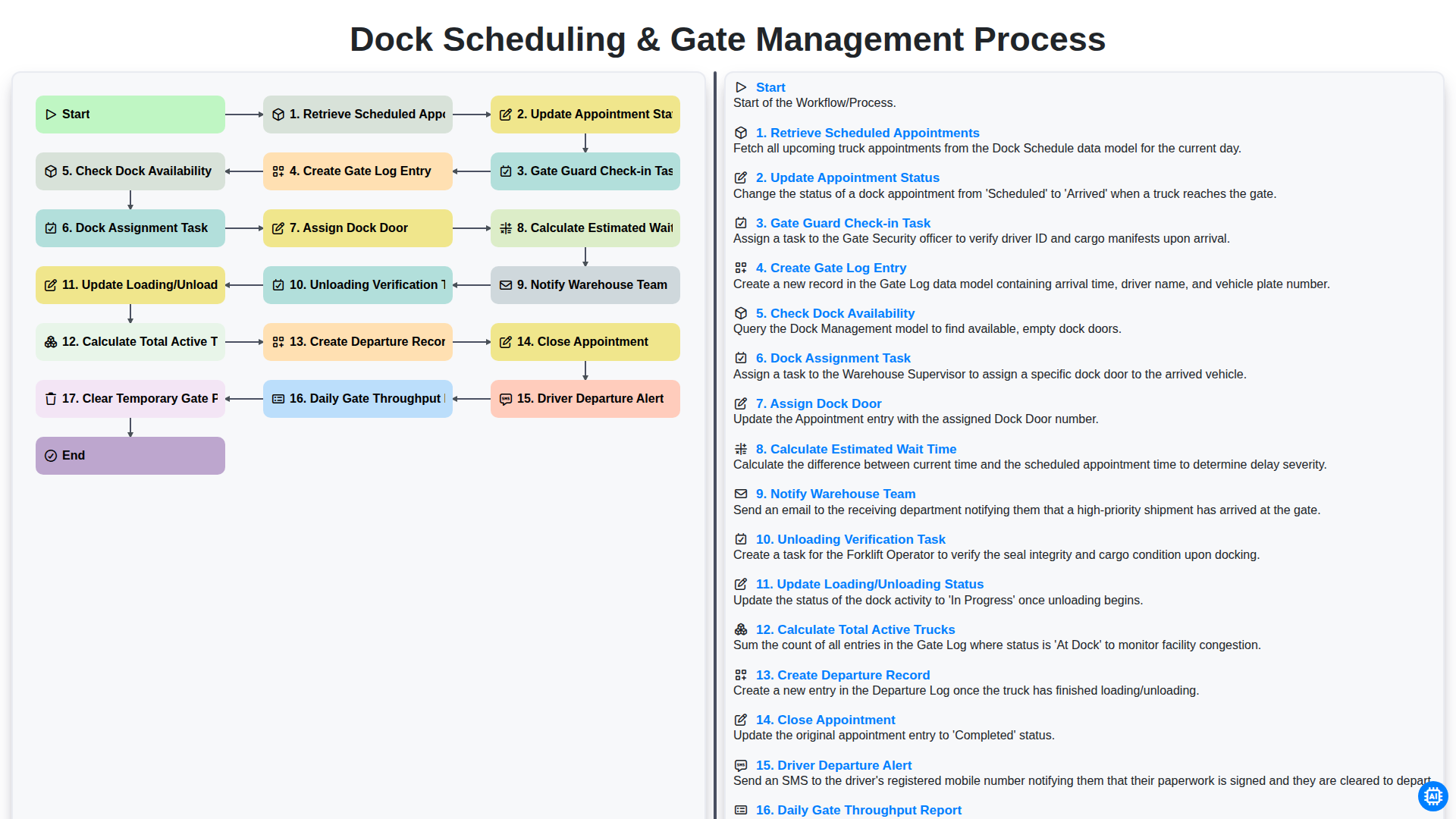
Table of Contents
- Introduction: The Importance of Integrated Dock and Gate Management
- Phase 1: Pre-Arrival & Appointment Orchestration
- Retrieving and Managing Scheduled Appointments
- Phase 2: Secure Gate Entry & Driver Check-in
- Streamlining the Gate Guard Check-in Process
- Maintaining Real-Time Visibility with Gate Log Entries
- Phase 3: Dock Resource Allocation & Optimization
- Analyzing Dock Availability and Smart Door Assignment
- Managing Driver Expectations: Calculating Estimated Wait Times
- Phase 4: Warehouse Integration & Yard Operations
- Coordinating the Warehouse Team for Seamless Unloading
- Monitoring Unloading Verification and Status Updates
- Finalizing Departure Records and Closing Appointments
- Phase 6: Analytics, Reporting, and Continuous Improvement
- Resources & Links
TLDR: Learn how to optimize your yard operations and reduce congestion by mastering our automated Dock Scheduling & Gate Management workflow. This guide provides a step-by-step breakdown of the entire lifecycle-from appointment retrieval and gate check-ins to dock assignment, real-time driver monitoring, and automated departure reporting-to ensure seamless, error-free logistics execution.
Introduction: The Importance of Integrated Dock and Gate Management
In the high-stakes environment of modern logistics, the warehouse dock is often the most significant bottleneck in the entire supply chain. Efficiently managing the flow of goods requires more than just organized shelving and skilled labor; it demands a seamless synchronization between the perimeter of your facility and the heart of your operations.
When dock scheduling and gate management operate in silos, the result is a chaotic cycle of idling trucks, congested yard spaces, and frustrated drivers. A fragmented process leads to unpredictable arrival patterns, making it impossible to accurately allocate labor or prepare equipment for unloading. Conversely, an integrated workflow-one that bridges the gap between the initial gate check-in and the final departure-transforms the loading dock from a point of friction into a streamlined engine of productivity. By unifying these two critical functions, companies can achieve unprecedented visibility, reduce detention fees, and ensure that every square foot of dock space is utilized to its maximum potential.
Phase 1: Pre-Arrival & Appointment Orchestration
The foundation of an efficient logistics operation lies in the ability to predict and prepare for incoming traffic before a single vehicle reaches the facility. The Pre-Arrival & Appointment Orchestration phase focuses on eliminating uncertainty by transforming unscheduled arrivals into a structured, predictable stream of dock activity.
The process begins with the ability to Retrieve Scheduled Appointments from your central management system, allowing your team to view the day's projected workload at a glance. As the day progresses, logistics coordinators must constantly Update Appointment Status to reflect real-time changes, ensuring that the digital schedule remains a single source of truth.
By proactively managing these appointments, you transition from a reactive first-come, first-served model to a strategic, planned approach. This phase is critical for identifying potential bottlenecks early, allowing the warehouse to allocate labor and equipment resources effectively before a single truck arrives at the gate.
Retrieving and Managing Scheduled Appointments
The foundation of an efficient yard management system lies in the seamless transition from planning to execution. The process begins with the ability to Retrieve Scheduled Appointments, which allows warehouse managers to gain full visibility into the day's upcoming arrivals. By accessing a centralized digital calendar, logistics teams can identify expected volumes and prepare resources well before a truck reaches the facility.
Once the schedule is accessed, the workflow moves into real-time monitoring through the ability to Update Appointment Status. This step is critical for maintaining an accurate live view of the facility's workload. As appointments transition from Scheduled to Arrived or In-Progress, the system reflects the current state of the yard, ensuring that the office, the gate, and the warehouse floor are always operating from a single source of truth. This proactive management prevents the bottlenecking caused by unexpected delays and allows for immediate adjustments to the daily plan.
Phase 2: Secure Gate Entry & Driver Check-in
Once a vehicle arrives at the facility, the focus shifts from planning to execution. This phase is critical for maintaining site security and ensuring that the transition from the external road to the internal warehouse floor is seamless and documented.
The process begins with the Gate Guard Check-in Task, where security personnel verify the driver's identity and the validity of their scheduled slot. During this step, the guard performs a Create Gate Log Entry action, digitally recording the vehicle's arrival time, license plate, and carrier information. This serves as the primary timestamp for all subsequent operational metrics.
As the driver completes the check-in, the system performs a real-time Update Appointment Status to move the arrival from Scheduled to Arrived. If the facility utilizes temporary credentials, the guard will also Clear Temporary Gate Pass protocols to ensure that only authorized vehicles proceed into the yard. This stage is all about establishing a single source of truth for every asset currently on-site, ensuring that no vehicle enters the premises without a digital footprint.
Streamlining the Gate Guard Check-in Process
The moment a driver reaches the facility perimeter, the efficiency of your entire supply chain is put to the test. The Gate Guard Check-in Task serves as the critical first touchpoint in the logistics lifecycle, acting as the gateway between external transit and internal warehouse operations. A streamlined check-in process is not merely about verifying identity; it is about data integrity and real-time visibility.
To ensure a seamless transition, the process begins by retrieving scheduled appointments from the centralized system to validate the arrival. Once the appointment is confirmed, the guard must immediately update the appointment status to Arrived, triggering the next phase of the workflow. This allows the system to simultaneously create a gate log entry, capturing vital timestamps and driver details that serve as the single source of truth for the day's operations.
By digitizing this stage, you eliminate the manual errors and paperwork bottlenecks that typically lead to congestion at the entrance. A structured check-in ensures that the guard isn't just a gatekeeper, but a vital link in the data chain, providing the warehouse team with the precise information needed to prepare for incoming volume long before the truck even reaches a loading bay.
Maintaining Real-Time Visibility with Gate Log Entries
At the heart of an efficient yard management strategy lies the ability to maintain precise, real-time visibility of every vehicle entering and exiting your facility. This level of oversight is made possible through the systematic Creation of Gate Log Entries.
A Gate Log Entry serves as the digital source of truth for your entire logistics operation. Rather than relying on manual clipboards or verbal updates, every time a driver arrives, a digital record is instantly generated. This entry captures critical data points-such as arrival timestamps, carrier information, and trailer numbers-ensuring that there is no ambiguity regarding which assets are currently on-site.
By capturing these details the moment a vehicle passes the perimeter, you eliminate the blind spots that often lead to congestion and missed appointments. This real-time data stream allows yard managers to monitor the flow of traffic as it happens, providing the foundation for more advanced downstream processes like dock assignment and wait-time calculations. Without a robust gate log, you aren't just managing a yard; you are reacting to a series of unexpected events. With it, you are orchestrating a controlled, predictable, and highly visible supply chain ecosystem.
Phase 3: Dock Resource Allocation & Optimization
Once a vehicle has successfully cleared the gate entry process, the focus shifts from security verification to operational efficiency. This phase is the critical junction where physical logistics meets digital orchestration. The goal here is to minimize idle time and ensure that every arrival is funneled into a productive workflow without creating bottlenecks at the loading bays.
The optimization process begins with a real-time Check of Dock Availability. The system cross-references the incoming shipment data against the current state of the facility to identify open bays. Based on this visibility, the system initiates the Dock Assignment Task, where the logic-driven Assign Dock Door function matches the specific trailer type and cargo requirements to the most appropriate bay.
To manage driver expectations and site congestion, the system must Calculate Estimated Wait Time based on current dock density and the complexity of the incoming load. Once the assignment is finalized, an automated Notify Warehouse Team trigger ensures that floor supervisors and forklift operators are prepared for the upcoming arrival, preventing the surprise arrival syndrome that often leads to yard congestion. This seamless transition from gate to dock ensures that the warehouse staff is never reactive, but always proactive.
Analyzing Dock Availability and Smart Door Assignment
Efficiently managing a warehouse terminal requires more than just a list of arrivals; it requires real-time visibility into your physical infrastructure. The core of a streamlined workflow lies in the critical transition between a truck arriving at the gate and its arrival at a bay. Once a driver completes the gate guard check-in and a gate log entry is created, the system must immediately perform a Check Dock Availability scan. This step is vital to prevent bottlenecks caused by blind arrivals where a truck is directed to a congested area.
The intelligence of the process truly shines during the Dock Assignment Task. Rather than relying on manual guesswork or static routines, a smart system evaluates the current state of every bay to Assign Dock Door based on the specific requirements of the shipment-such as refrigerated needs or specialized equipment. During this phase, the system performs a simultaneous Calculate Estimated Wait Time calculation. By analyzing current dock occupancy and the remaining tasks for active loads, the system provides drivers with realistic expectations, reducing idle time and driver frustration.
Finally, this automated logic ensures that the Notify Warehouse Team step is triggered with precision. By delivering exact dock assignments to the floor staff before the truck even reaches the bay, the warehouse team can prep the necessary equipment and personnel, ensuring that the transition from gate to dock is seamless, predictable, and optimized for maximum throughput.
Managing Driver Expectations: Calculating Estimated Wait Times
One of the most critical components of a seamless gate management workflow is the ability to provide real-time transparency to drivers and carriers. The moment a driver arrives at the gate, their primary concern is how long they will be idling in the yard. By implementing an automated system to Calculate Estimated Wait Time, you transition from reactive guesswork to proactive management.
This calculation isn't just a random number; it is a data-driven insight derived from the current state of your facility. The system analyzes the real-time data from the Check Dock Availability and Dock Assignment Task steps, alongside the Calculate Total Active Trucks metric. By weighing the volume of incoming appointments against the current number of trucks being processed and the remaining workload of the warehouse staff, the system generates a realistic window for unloading or loading.
Providing this estimate during the Gate Guard Check-in Task serves two vital purposes:
- Reduced Driver Frustration: Drivers are much more tolerant of delays when they are informed immediately of what to expect, rather than being left in the dark.
- Resource Optimization: If the estimated wait time is excessive, dispatchers can make informed decisions about rerouting or rescheduling, preventing a massive bottleneck at the gate before it even occurs.
By integrating automated wait-time calculations into your dock scheduling, you turn the gatehouse from a point of congestion into a hub of efficient, predictable logistics.
Phase 4: Warehouse Integration & Yard Operations
Once a vehicle has successfully cleared the gate, the focus shifts from perimeter security to active warehouse coordination. This phase is where the data from the gatehouse transforms into actionable intelligence for the warehouse floor, ensuring that dock doors are utilized efficiently and congestion is minimized.
The workflow begins with the Dock Assignment Task, where the system cross-references the Retrieved Scheduled Appointments with real-time Dock Availability. By automatically Assigning a Dock Door based on the cargo type and priority, the system eliminates the manual guesswork that often leads to bottlenecking. As this assignment occurs, the system performs a real-time Calculation of Estimated Wait Time, providing drivers and yard jockeys with clear expectations. To ensure seamless communication, an automated Notify Warehouse Team trigger is sent, alerting floor managers of an incoming arrival so they can prep the necessary equipment or labor.
As the truck reaches its designated bay, the Unloading Verification Task begins. During this period, the system continuously monitors the movement of goods by Updating the Loading/Unloading Status. This live tracking allows the facility to Calculate the Total Active Trucks in the yard at any given moment, providing a high-level view of yard density.
The final stage of the operational loop focuses on departure and data integrity. Once the cargo is processed, the system initiates the Create Departure Record and Close Appointment functions, effectively removing the vehicle from the active queue. To complete the loop, a Driver Departure Alert is triggered, and the system performs a Clear Temporary Gate Pass routine to ensure security protocols are maintained. This entire cycle culminates in the generation of a Daily Gate Throughput Report, providing management with the granular data needed to analyze transit patterns, identify delays, and optimize the entire logistics ecosystem.
Coordinating the Warehouse Team for Seamless Unloading
Effective dock management extends far beyond the gate; the true test of a seamless workflow lies in how well the warehouse floor is synchronized with incoming arrivals. Once a truck has successfully cleared the gate and a dock door is assigned, the critical next step is to Notify the Warehouse Team. This real-time communication ensures that dock workers are not caught off guard by sudden arrivals, allowing them to prepare the necessary equipment and personnel in advance.
The coordination process reaches its peak during the Unloading Verification Task. As the driver begins the process, the system must work in tandem with the floor staff to Update Loading/Unloading Status accurately. This continuous loop of information prevents bottlenecks and ensures that the team knows exactly which doors are currently active and which are nearing completion. By maintaining this high level of visibility, the warehouse can manage labor resources more effectively, reducing idle time and ensuring that every arrival is met with an organized, efficient, and ready-to-work team.
Monitoring Unloading Verification and Status Updates
Once a vehicle has been assigned to a specific dock door and the unloading process begins, the workflow shifts from logistics coordination to real-time operational monitoring. The Unloading Verification Task serves as a critical checkpoint in this stage, ensuring that the physical movement of goods aligns perfectly with the digital schedule. During this phase, warehouse personnel must verify that the cargo received matches the manifest and that the integrity of the shipment remains intact.
To maintain full visibility across the facility, the system must continuously Update Loading/Unloading Status. This real-time data stream is vital for preventing bottlenecks; it allows floor managers to see exactly which doors are currently active, which are stalled due to discrepancies, and which are nearing completion. By maintaining an up-to-the-minute digital record of these statuses, the warehouse can transition from a reactive state to a proactive one, ensuring that the transition from unloading to the next scheduled arrival is seamless and efficient.
Finalizing Departure Records and Closing Appointments
Once the unloading or loading process is complete, the workflow transitions into its final, critical stage: formalizing the departure to ensure data integrity and real-time visibility. The process begins with the Unloading Verification Task, where warehouse personnel confirm that all goods have been processed and the trailer is empty (or loaded) as expected. Once verified, the system triggers the Update Loading/Unloading Status step, officially marking the task as finished.
To maintain an accurate snapshot of yard activity, the system automatically performs a Calculate Total Active Trucks routine, ensuring that the number of vehicles currently on-site matches the digital record. Following this, the system initiates the Create Departure Record step, which captures the precise timestamp of the exit-a vital data point for measuring carrier performance and turn-around efficiency.
The final sequence involves the Close Appointment step, which releases the reserved dock time and frees up the dock door for future use. To ensure seamless yard communication, a Driver Departure Alert is sent to the relevant stakeholders, notifying them that the vehicle has cleared the facility. Finally, the workflow concludes with the Clear Temporary Gate Pass action, removing the vehicle from the active gate queue and ensuring the digital gate log remains clean and up-to-date. This rigorous closing process is what enables the generation of the Daily Gate Throughput Report, providing management with the actionable insights needed to optimize facility flow and reduce congestion.
Phase 6: Analytics, Reporting, and Continuous Improvement
The final phase of an optimized dock management workflow moves beyond real-time execution and into the realm of strategic oversight. Once the physical movement of goods has concluded, the system transitions into data-driven decision-making through automated reporting and performance auditing.
The cornerstone of this phase is the generation of the Daily Gate Throughput Report. This report provides a high-level view of the facility's productivity, detailing the volume of arrivals, departures, and total vehicle processing speeds. By analyzing these metrics alongside the Total Active Trucks data, management can identify peak congestion periods and patterns in driver arrival behaviors.
Continuous improvement is further driven by reviewing the lifecycle of each appointment-from the initial Create Departure Record and Close Appointment stages to the final Clear Temporary Gate Pass step. By analyzing the delta between scheduled times and actual departure times, stakeholders can pinpoint bottlenecks in the unloading process or inefficiencies in dock assignments. This granular visibility transforms raw gate data into actionable intelligence, allowing for better labor allocation, more accurate scheduling for future appointments, and a streamlined, high-velocity logistics ecosystem.
Resources & Links
- Supply Chain Dive: Stay updated with the latest industry news, trends, and deep dives into logistics and supply chain management technology.
- Material Handling & Logistics: A premier source for insights on warehouse automation, dock management systems, and warehouse operational efficiency.
- CargoWise: Learn about integrated logistics software solutions that automate scheduling, gate management, and global supply chain visibility.
- Inbound Logistics: Expert resources on managing inbound freight, yard management strategies, and optimizing dock-to-stock workflows.
- Logistics Management: In-depth analysis of transportation management, dock scheduling optimization, and logistics technology implementation.
- Gartner Supply Chain Research: Access industry-leading research and frameworks for evaluating warehouse management systems (WMS) and yard management tools.
Frequently Asked Questions
What is dock scheduling and why is it important for logistics?
Dock scheduling is the process of managing and allocating specific time slots for inbound and outbound shipments at a warehouse or distribution center. It is critical because it prevents driver congestion, reduces detention fees, optimizes labor allocation, and ensures a predictable flow of goods.
How does gate management integrate with the dock scheduling workflow?
Gate management acts as the first point of contact in the workflow. It manages the arrival of vehicles, verifies credentials, and directs drivers to their assigned docks based on the pre-arranged dock schedule. Effective integration ensures that the physical arrival of a truck aligns perfectly with the available dock capacity.
What are the primary benefits of automating the dock scheduling process?
Automation reduces manual errors, eliminates the need for constant phone/email communication between carriers and warehouses, provides real-time visibility into dock availability, and allows for better resource planning for warehouse staff.
What are common bottlenecks in traditional dock management?
Common bottlenecks include unplanned arrivals (unannounced shipments), lack of real-time communication, manual paper-based check-in processes, and inefficient trailer positioning, all of which lead to increased dwell times and congestion.
What key metrics should be used to measure the efficiency of dock and gate management?
Key Performance Indicators (KPIs) include truck turnaround time, dock utilization rate, detention and demurrage costs, appointment compliance (on-time arrivals), and average wait time at the gate.
Comments
There are no comments yet. Be the first to add one!
Logistics Management Solution Demo
Tired of shipping delays, lost packages, and inefficient routes? ChecklistGuro's Work OS platform streamlines your entire logistics operation, from warehouse management and order fulfillment to route optimization and delivery tracking. Gain real-time visibility, reduce costs, and improve customer satisfaction. Learn how ChecklistGuro can transform your logistics business!
Related Articles
The Ultimate Refrigerated Cargo Temperature Control Checklist Template
Mastering Your Fleet: A Vehicle Maintenance Log Review Template
Master Your Returns: The Ultimate Returns Processing Efficiency Audit Checklist
Data Privacy Policy Compliance: Your Essential Checklist Template
Delivery Confirmation Audit: Your Checklist Template for Process Excellence
Your Pallet Inspection & Maintenance Checklist Template
Fuel Efficiency Monitoring: Your Checklist Template for Savings
Supply Chain Risk Assessment: Your Essential Checklist Template
Need help with
Checklists?
Have a question? We're here to help. Please submit your inquiry, and we'll respond promptly.