Effluent Waste Manifesting Workflow: Accurate Tracking for Environmental Compliance on Work OS Platform
Published: 06/18/2026 9:00 PM Updated: 06/19/2026 11:48 AM
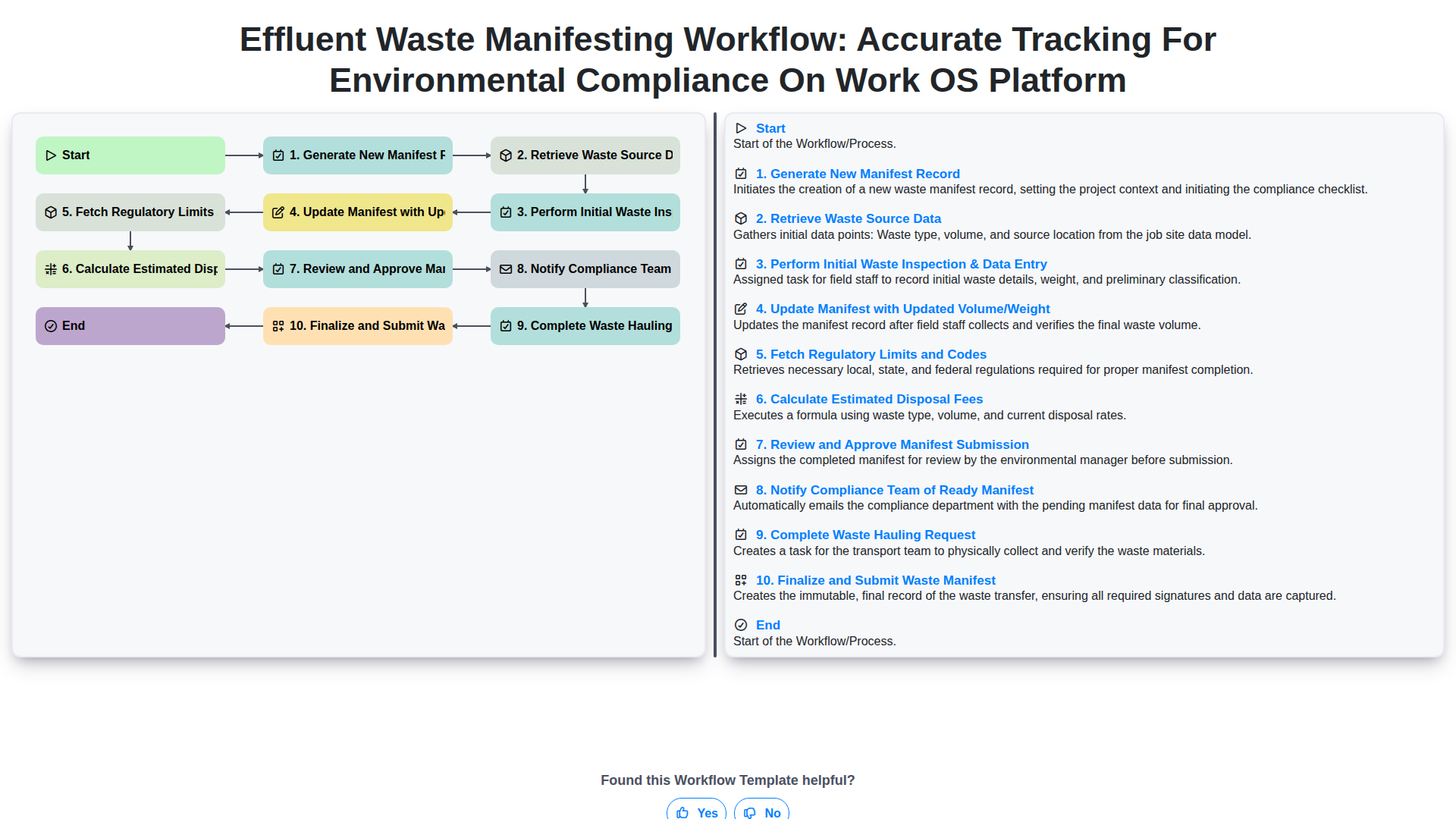
Table of Contents
- Introduction: The Critical Need for Precise Effluent Waste Tracking
- Streamlining Compliance with a Unified Work OS Platform
- Step 1: Initiating the Process: Generate New Manifest Record
- Step 2: Ensuring Traceability: Retrieve Waste Source Data
- Step 3: Precision at the Source: Perform Initial Waste Inspection & Data Entry
- Step 4: Maintaining Real-Time Accuracy: Update Manifest with Updated Volume/Weight
- Step 5: Staying Within Legal Bounds: Fetch Regulatory Limits and Codes
- Step 6: Cost Management: Calculate Estimated Disposal Fees
- Step 7: Quality Control: Review and Approve Manifest Submission
- Step 8: Automating Oversight: Notify Compliance Team of Ready Manifest
- Step 9: Coordinating Logistics: Complete Waste Hauling Request
- Step 10: Closing the Loop: Finalize and Submit Waste Manifest
- The Benefits of Digital Workflows in Environmental Stewardship
- Conclusion: Achieving Audit-Ready Compliance Through Automation
- Resources & Links
TLDR: Streamline your environmental compliance by automating the end-to-end effluent waste tracking process. This workflow guide demonstrates how to use the Work OS platform to manage everything from initial waste inspection and regulatory code verification to automated fee calculation and final manifest submission, ensuring accurate data, reduced manual error, and seamless reporting for your compliance team.
Introduction: The Critical Need for Precise Effluent Waste Tracking
In the complex landscape of industrial operations, managing effluent waste is more than just a logistical necessity-it is a high-stakes regulatory obligation. As environmental regulations tighten globally, the margin for error in waste documentation has effectively vanished. An overlooked discrepancy in volume, a misplaced regulatory code, or an undocumented waste source can escalate from a minor clerical oversight into a significant legal liability, resulting in heavy fines, operational shutdowns, and irreparable damage to a company's environmental reputation.
The challenge lies in the fragmentation of traditional tracking methods. Relying on manual logs, disparate spreadsheets, or disconnected paper trails creates data silos where information becomes stale, lost, or inconsistent. When the journey of effluent-from the moment of generation to its final disposal-is not tracked through a single, unified source of truth, the risk of non-compliance grows exponentially. To maintain environmental stewardship and operational continuity, organizations require a digitized, end-to-end workflow that ensures every liter of waste is accounted for, every regulatory limit is respected, and every manifest is audit-ready in real-time.
Streamlining Compliance with a Unified Work OS Platform
Managing environmental compliance shouldn't feel like a manual battle against paperwork and fragmented spreadsheets. When your waste management processes are scattered across disconnected emails, paper logs, and isolated databases, the risk of human error skyrockets, and the possibility of regulatory non-compliance becomes a constant threat.
By migrating the Effluent Waste Manifesting Workflow to a unified Work OS platform, organizations can replace fragmented silos with a single, automated source of truth. Instead of manually searching for data or chasing approvals, every stakeholder-from the site technician to the compliance officer-operates within the same digital ecosystem.
A Work OS platform transforms the workflow from a reactive process into a proactive one. It ensures that data flows seamlessly from the moment a new manifest record is generated to the final submission. By automating repetitive tasks-such as fetching regulatory codes or calculating disposal fees-the platform eliminates the manual bottlenecks that typically lead to costly errors. With real-time visibility and automated notifications, your team can ensure that every liter of effluent is tracked, every regulatory limit is respected, and every manifest is audit-ready, allowing you to focus on operational excellence rather than administrative firefighting.
Step 1: Initiating the Process: Generate New Manifest Record
The lifecycle of environmental compliance begins with a single, critical action: the creation of a digital footprint. The first step in our automated workflow is the Generate New Manifest Record phase.
Instead of relying on fragmented spreadsheets or paper logs that are prone to human error, the process begins within the Work OS platform by triggering a new manifest entry. This stage establishes the unique identity for the specific batch of effluent waste being handled. By initiating a standardized digital record from the very start, you ensure that every subsequent data point-from volume to chemical composition-is tethered to a single source of truth. This foundational step is vital for maintaining a continuous audit trail, ensuring that no waste movement goes unrecorded and that your facility remains prepared for even the most stringent regulatory inspections.
Step 2: Ensuring Traceability: Retrieve Waste Source Data
Once a new manifest record is initiated, the next critical phase involves the automated retrieval of waste source data. To ensure full environmental compliance, it is not enough to simply record that waste exists; you must have a clear, unbroken digital trail back to its point of origin.
Within the Work OS platform, this step eliminates the risks associated with manual data entry and fragmented paperwork. The system automatically pulls essential information from your existing inventory and production databases-such as specific production lines, storage tank IDs, and chemical compositions. By linking the new manifest directly to these pre-verified source records, you create a single source of truth. This seamless integration ensures that every liter or kilogram of effluent is accounted for with absolute precision, providing the high level of traceability required to satisfy both internal audits and external regulatory inspections.
Step 3: Precision at the Source: Perform Initial Waste Inspection & Data Entry
The integrity of the entire compliance chain depends on the accuracy of the data captured at the very beginning. Once the waste source data has been retrieved, the next critical phase is the physical inspection and manual data entry. This step serves as the ground truth for the entire manifest.
During this stage, site operators conduct a rigorous physical assessment of the effluent being prepared for transport. This involves verifying the chemical composition, checking for any unexpected contaminants, and ensuring that the physical state of the waste matches the recorded parameters. On the Work OS platform, this is where the digital and physical worlds intersect: inspectors enter real-time observations directly into the digital record, including pH levels, temperature, and visible indicators of toxicity.
By capturing this data immediately at the point of inspection, you eliminate the risks associated with memory-based logging or delayed paperwork. This ensures that every subsequent calculation-from regulatory code assignment to fee estimation-is built upon a foundation of verified, real-time information, significantly reducing the margin for error and preventing costly compliance discrepancies later in the workflow.
Step 4: Maintaining Real-Time Accuracy: Update Manifest with Updated Volume/Weight
In the lifecycle of waste management, data is rarely static. From the moment an initial inspection is performed to the moment the waste leaves the facility, the physical characteristics of effluent can change. Whether due to settling, evaporation, or additional processing, the volume or weight recorded at the start of the workflow may no longer reflect the true mass of the waste being hauled.
Integrating a real-time update step within your Work OS workflow ensures that your digital records remain a single source of truth. Instead of relying on manual recalculations or separate spreadsheets, the platform allows operators to input revised measurements directly into the existing manifest record. This instantaneous update triggers a cascade of accuracy throughout the rest of the workflow-ensuring that subsequent regulatory code checks, disposal fee calculations, and compliance approvals are all based on the most current, physical reality of the waste load. By eliminating the gap between initial estimation and final measurement, you significantly reduce the risk of reporting discrepancies that lead to costly environmental non-compliance.
Step 5: Staying Within Legal Bounds: Fetch Regulatory Limits and Codes
In the complex landscape of environmental management, compliance isn't just a goal-it is a legal mandate. Once the initial inspection and data entry are complete, the workflow moves into a critical validation phase: Fetching Regulatory Limits and Codes.
At this stage, the Work OS platform acts as the brain of the operation. Rather than relying on manual lookups or outdated spreadsheets, the system automatically cross-references the specific waste types identified in your manifest against current regional, national, and international regulatory databases. This step ensures that every chemical component, concentration level, and waste classification is mapped to its corresponding regulatory code (such as EPA or RCRA codes).
By automating the retrieval of these limits, the platform instantly alerts operators if a waste stream is approaching a threshold that would trigger stricter handling requirements or different disposal protocols. This proactive integration eliminates the risk of human error in interpreting complex legal documentation, ensuring that your facility remains strictly within legal bounds before any waste even leaves the site.
Step 6: Cost Management: Calculate Estimated Disposal Fees
Managing the financial implications of waste disposal is just as critical as managing the physical waste itself. Once the initial inspection and data entry are complete, the Work OS platform automatically triggers the calculation of estimated disposal fees. By integrating real-time data from the waste inspection-such as volume, weight, and waste type-the system pulls from predefined rate tables and regulatory fee structures to provide an instant cost projection. This automated calculation eliminates manual errors and prevents budget overruns by allowing facility managers to foresee disposal costs before the waste ever leaves the site. This step ensures that every manifest is accompanied by a clear financial estimate, enabling better budgetary control and more transparent-level auditing for the entire organization.
Step 7: Quality Control: Review and Approve Manifest Submission
Before any waste can move from the facility to a disposal site, it must undergo a rigorous validation process. The Review and Approve Manifest Submission stage serves as the final checkpoint in the digital workflow, ensuring that all data points-from waste volume to regulatory coding-are consistent and accurate.
During this phase, an authorized supervisor or compliance officer reviews the digital record within the Work OS platform to verify that:
- The waste characteristics match the initial inspection logs.
- The calculated disposal fees align with current contractual rates.
- All required regulatory codes are correctly applied to prevent legal discrepancies.
By leveraging the automation of the Work OS, this review is no longer a manual hunt for errors. Instead, the system highlights any inconsistencies, allowing for an immediate reject and recirculate or a one-click approval. This streamlined verification minimizes the risk of human error, ensuring that only compliant, accurate manifests proceed to the hauling stage, thereby protecting your organization from costly environmental fines and regulatory scrutiny.
Step 8: Automating Oversight: Notify Compliance Team of Ready Manifest
Once the manifest has passed through the critical verification stages, the workflow moves from manual data entry to automated oversight. In a traditional, paper-based system, the transition from draft to ready for review often relies on manual emails or physical hand-offs, creating a dangerous window for human error or delays.
By leveraging the automation capabilities of a Work OS platform, the system triggers an instantaneous notification to the Compliance Team the moment a manifest meets all pre-defined validation criteria. This automated alert ensures that the compliance officers are never left waiting for updates and, more importantly, that no manifest sits idle in an unreviewed state.
This seamless hand-off eliminates the information silo effect, ensuring that the regulatory experts are alerted in real-time. This step is vital for maintaining a rigorous audit trail, as it timestamps exactly when the data was prepared and when the compliance oversight began, providing a transparent, continuous loop of accountability that is essential for environmental regulatory adherence.
Step 9: Coordinating Logistics: Complete Waste Hauling Request
Once the manifest has been verified and the disposal fees are calculated, the workflow shifts from data management to physical logistics. In this stage, the system triggers the formal request for waste collection. By automating the transition from a digital record to a hauling instruction, the Work OS platform ensures that the logistics provider receives all necessary documentation-including waste codes, volume details, and safety protocols-without the need for manual email chains or fragmented paperwork. This seamless handoff minimizes the risk of information decay, where critical details are lost during the transition from the compliance office to the transport driver, ensuring the haulers arrive with the correct equipment and containment measures for the specific effluent type identified.
Step 10: Closing the Loop: Finalize and Submit Waste Manifest
The culmination of the entire workflow is the finalization and submission of the waste manifest. Once all inspections, weight updates, and regulatory checks are verified, the system triggers the final submission protocol. This step is critical as it transforms a working document into a legal record of record.
Upon clicking Submit, the Work OS platform generates a timestamped, unalterable digital copy of the completed manifest. This ensures data integrity, preventing any retrospective tampering with the recorded volumes or disposal codes. This final action simultaneously closes the active task in the workflow and archives the document within your compliance database, creating a permanent, audit-ready trail. By automating this final handover, you eliminate the risk of manual filing errors and ensure that your facility remains in full alignment with environmental regulations, providing peace of mind during unexpected inspections.
The Benefits of Digital Workflows in Environmental Stewardship
Transitioning from manual, paper-based processes to an automated digital workflow on a Work OS platform does more than just increase operational speed; it fundamentally enhances an organization's commitment to environmental stewardship. In the realm of effluent management, where precision is non-negotiable, digital workflows serve as a critical layer of defense against environmental non-compliance and ecological harm.
The primary benefit lies in the elimination of human error. Manual data entry and physical logbooks are prone to omissions, illegible handwriting, and calculation mistakes that can lead to catastrophic regulatory breaches. By implementing a structured digital workflow-from the initial generation of a manifest to the final submission-data integrity is maintained at every touchpoint. Automated validation ensures that waste volumes, regulatory codes, and disposal limits are cross-referenced instantly, preventing the accidental shipment of prohibited substances.
Furthermore, digital workflows provide unprecedented visibility and traceability. Environmental stewardship requires a clear paper trail to prove accountability. With a Work OS, every update, inspection, and approval is timestamped and logged, creating an immutable audit trail that simplifies regulatory reporting and simplifies the response to environmental audits. This real-time transparency allows for proactive rather than reactive management; instead of discovering a discrepancy weeks later during a manual review, compliance teams are notified the moment a manifest is ready, allowing for immediate intervention.
Ultimately, digitizing these workflows transforms compliance from a burdensome administrative task into a streamlined, data-driven strategy. It empowers organizations to move beyond merely following the rules toward a state of operational excellence, where every drop of effluent is accounted for, every disposal fee is accurate, and the surrounding ecosystem is protected through rigorous, automated oversight.
Conclusion: Achieving Audit-Ready Compliance Through Automation
Transitioning from manual, error-prone spreadsheets to an automated workflow on a Work OS platform is more than just a technical upgrade-it is a strategic move toward operational excellence. By integrating every stage of the effluent waste lifecycle-from the initial inspection and data entry to the final submission of the manifest-into a single, unified system, organizations eliminate the visibility gaps that lead to non-compliance.
The true value of this automated approach lies in its ability to create an immutable, real-time audit trail. When regulatory limits, disposal fees, and waste volumes are automatically tracked and validated, the risk of human error is drastically reduced. This ensures that every manifest is not only accurate but also audit-ready at a moment's notice. Ultimately, by automating the heavy lifting of data retrieval and notification, your team can shift their focus from chasing paperwork to high-level environmental stewardship, ensuring your operations remain both sustainable and fully compliant with evolving environmental regulations.
Resources & Links
- Environmental Protection Agency (EPA) - Resource Conservation and Recovery Act (RCRA): Official regulatory guidelines and compliance standards for hazardous and non-hazardous waste tracking and manifesting.
- ISO 14001: Environmental Management Systems: Information on international standards for managing environmental responsibilities and operational workflows.
- Gartner - Low-Code/No-Code Work OS Trends: Insights into how digital transformation and Work OS platforms are optimizing industrial operational workflows.
- PMI - Process Automation and Workflow Optimization: Best practices for managing complex, multi-step operational workflows and maintaining data integrity.
- European Environment Agency - Waste Management Data: Reference for monitoring environmental indicators and the importance of accurate waste volume reporting.
Found this Article helpful?
Comments
There are no comments yet. Be the first to add one!
Waste Management Solution Demo
Optimize your waste management & reduce environmental impact! ChecklistGuro streamlines collection, tracking, and reporting. Minimize waste, lower costs, & promote sustainability. Manage it all with our Work OS.
Related Articles

Your Ultimate Guide to a Waste Management Facility Project Checklist Template

Your Complete Vegetation Removal Compliance Checklist Template
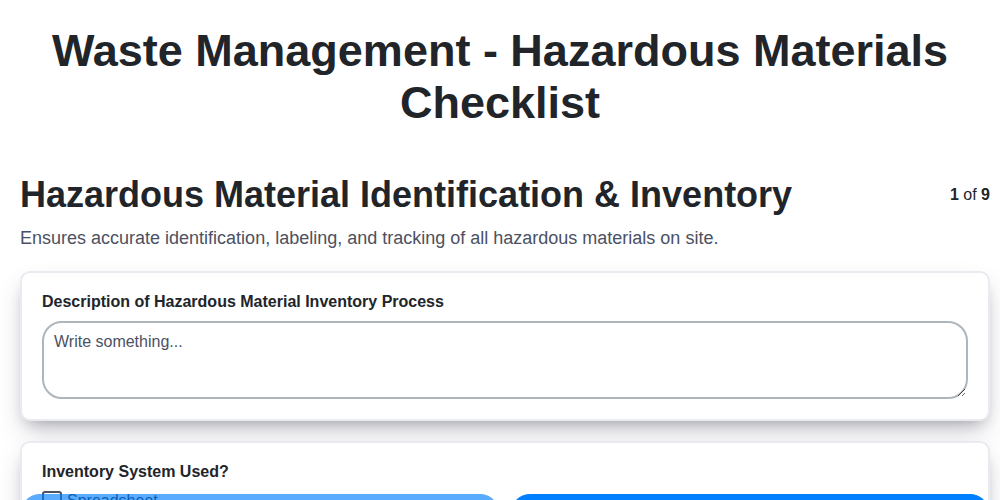
Your Ultimate Hazardous Materials Waste Management Checklist Template
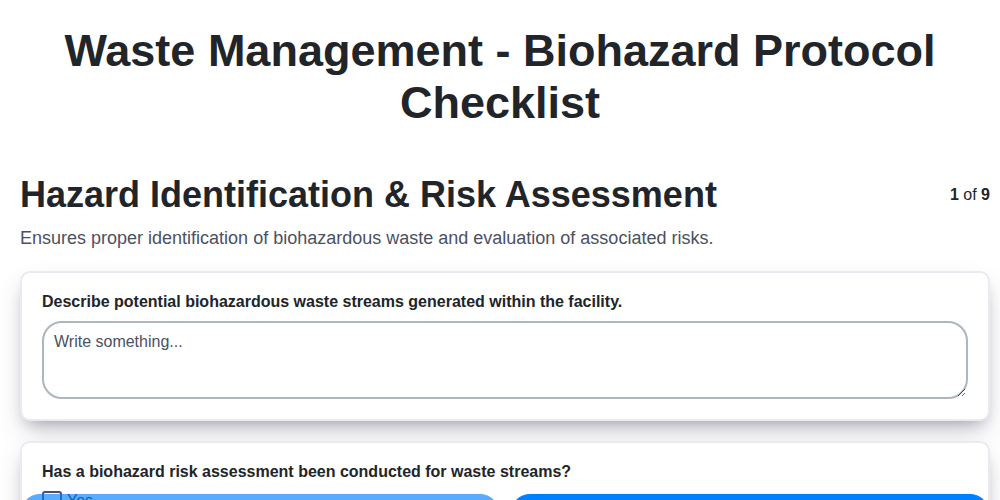
Streamline Biohazard Waste: Your Essential Checklist Template
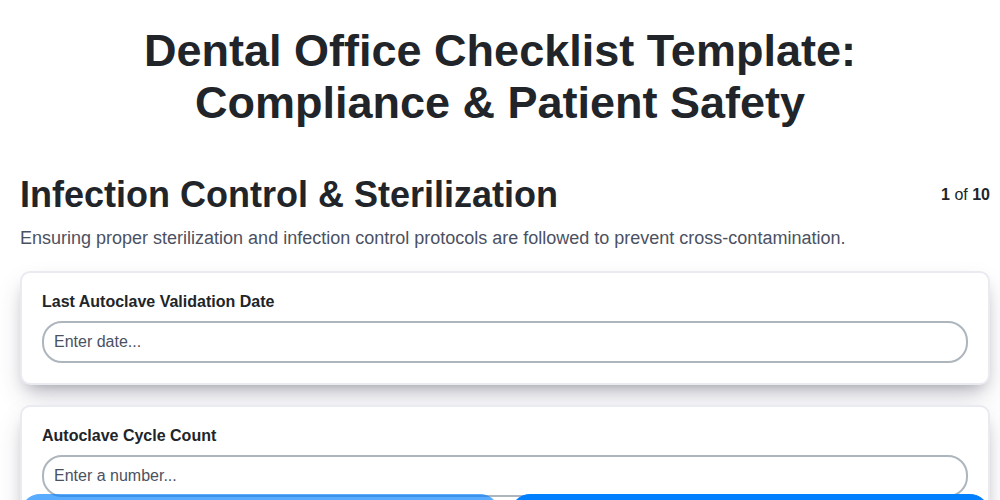
Your Dental Office Safety Net: The Compliance & Patient Safety Checklist Template

Weekly Waste Management & Recycling Checklist Template
Your Environmental Compliance Checklist Template: A Step-by-Step Guide
Auto Repair Shop Checklist Template: Operations & Compliance
We can do it Together
Need help with
Checklists?
Have a question? We're here to help. Please submit your inquiry, and we'll respond promptly.