End-to-End Farm Operations Workflow: Agriculture Management Solution
Published: 06/18/2026 9:00 PM Updated: 06/19/2026 12:29 PM
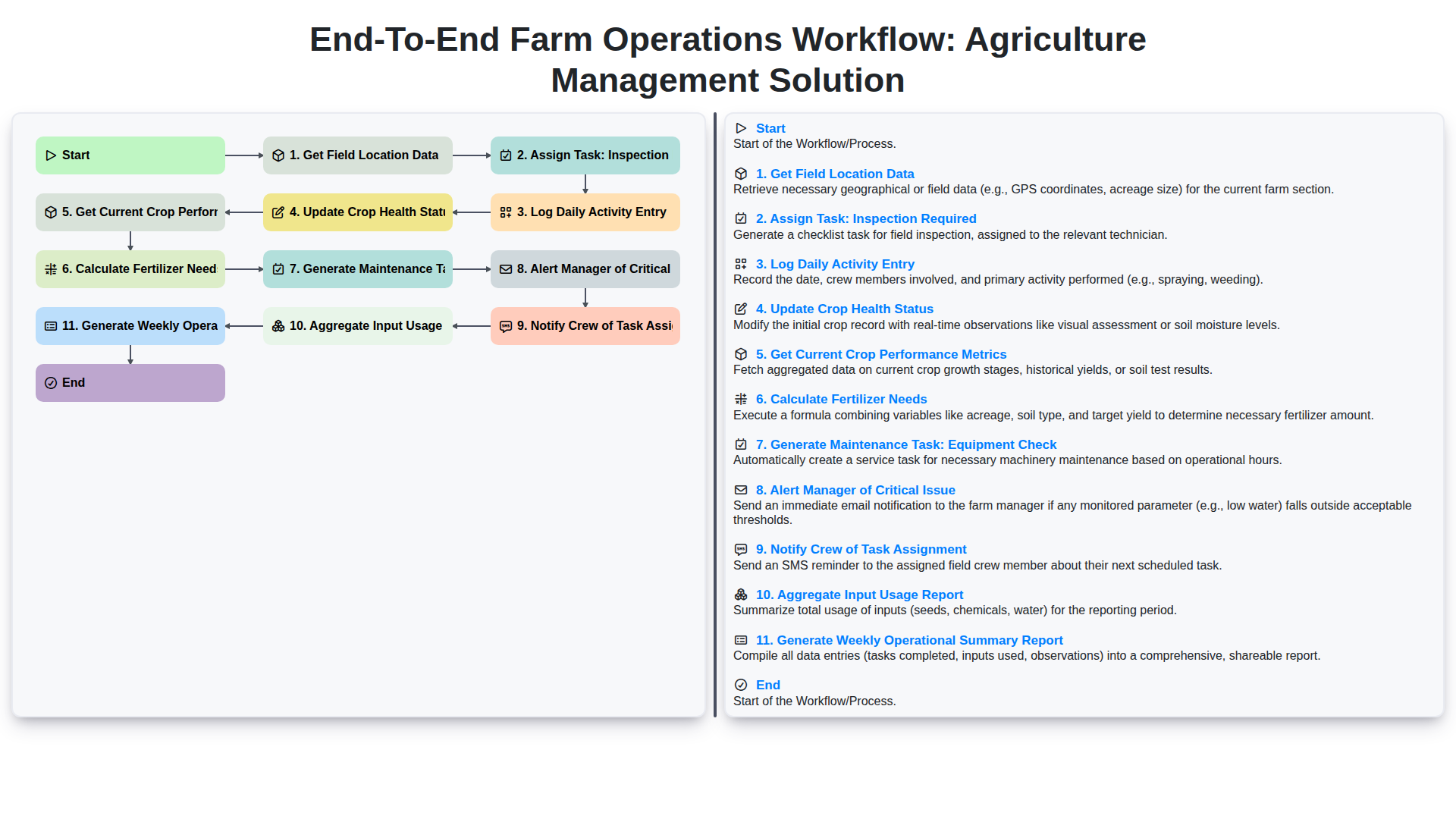
Table of Contents
- Introduction: Revolutionizing Agriculture through Digital Workflows
- Phase 1: Precision Mapping and Field Data Acquisition
- Phase 2: Intelligent Task Allocation and Field Inspections
- Phase 3: Real-Time Field Monitoring and Activity Logging
- Phase 4: Crop Health Assessment and Performance Tracking
- Phase 5: Data-Driven Resource Optimization and Nutrient Management
- Phase 6: Proactive Equipment Maintenance and Asset Care
- Phase 7: Automated Alert Systems and Incident Management
- Phase 8: Seamless Team Communication and Task Notification
- Phase 9: Comprehensive Resource and Input Usage Analysis
- Phase 10: Strategic Decision Making via Automated Reporting
- Conclusion: Achieving Operational Excellence in Modern Farming
- Resources & Links
TLDR: Streamline your agricultural productivity with this comprehensive workflow designed to automate everything from field data collection and task assignment to real-time crop monitoring and automated reporting. Learn how to integrate daily activity logging, equipment maintenance alerts, and automated resource calculations into a single, seamless management solution to optimize farm efficiency.
Introduction: Revolutionizing Agriculture through Digital Workflows
In the modern era of precision agriculture, the difference between a bountiful harvest and a struggling season often lies in the efficiency of operational management. Gone are the days of relying solely on manual logs, fragmented spreadsheets, and reactive decision-making. As farming scales in complexity, the integration of a seamless, end-to-end digital workflow has become a necessity rather than a luxury.
A digital workflow acts as the central nervous system of a smart farm, connecting every stage of the production cycle-from the moment field data is captured to the final generation of operational reports. By automating the flow of information, agriculture management solutions eliminate the silos that traditionally lead to resource waste, missed maintenance, and delayed responses to crop stress. Instead of managing isolated tasks, farmers can now oversee a continuous loop of real-time data collection, intelligent task assignment, and automated alerting. This systematic approach transforms raw field data into actionable intelligence, empowering growers to optimize inputs, predict maintenance needs, and ultimately drive higher yields through data-driven precision.
Phase 1: Precision Mapping and Field Data Acquisition
The foundation of a truly intelligent agricultural ecosystem lies in the accuracy of your spatial data. The workflow begins with the critical step of Getting Field Location Data. By leveraging GPS integration and high-resolution geospatial mapping, the system establishes a precise digital footprint of every acre under management.
This phase is not merely about marking boundaries; it is about creating a digital twin of your farmland. By capturing exact coordinates and terrain characteristics, we eliminate the ambiguity of manual boundary tracking. This granular level of precision ensures that every subsequent action-from sensor deployment to task assignment-is anchored to the exact physical location, laying the groundwork for highly localized and data-driven decision-making.
Phase 2: Intelligent Task Allocation and Field Inspections
Once the initial field data is captured, the workflow transitions from passive data collection to active operational management. The core of this phase lies in transforming raw information into actionable intelligence through the Assign Task: Inspection Required step. By leveraging real-time data, the system identifies specific zones within the farm that require closer scrutiny, ensuring that human resources are directed exactly where they are needed most.
To ensure seamless execution, the system triggers a Notify Crew of Task Assignment protocol, instantly pushing instructions to field workers' mobile devices. This eliminates communication delays and ensures that the workforce is synchronized with the latest farm priorities. Once the team reaches the designated area, the workflow facilitates a continuous feedback loop through the Log Daily Activity Entry step, allowing for granular tracking of field movements and labor hours.
As inspections progress, the system enables real-time decision-making through the Update Crop Health Status feature. This allows agronomists to record observations-such as pest presence or moisture levels-immediately. This continuous flow of data ensures that the transition from inspection to action is fluid, laying the groundwork for the more complex analytical processes that follow in the later stages of the workflow.
Phase 3: Real-Time Field Monitoring and Activity Logging
Once the foundational tasks are assigned, the workflow transitions into the most critical phase: Real-Time Field Monitoring and Activity Logging. This phase is where data meets the soil, transforming physical farm activities into actionable digital intelligence.
The process begins as field teams move through the landscape, starting with the ability to Get Field Location Data via GPS integration to ensure precise spatial awareness. As crews traverse the crops, the workflow facilitates the immediate identification of anomalies; if a scout identifies a potential pest or disease, they can instantly Assign a Task: Inspection Required, ensuring that high-priority areas are never overlooked.
To maintain a continuous digital audit trail, every movement is recorded through a Log Daily Activity Entry feature. This isn't just about record-keeping-it's about visibility. As workers interact with the crops, they can Update Crop Health Status in real-time, reflecting the current state of vitality or stress. This live stream of data allows the system to Get Current Crop Performance Metrics, providing a transparent view of how the harvest is progressing against seasonal benchmarks.
Beyond simple observation, this phase drives proactive precision agriculture. By analyzing the live data stream, the system can automatically Calculate Fertilizer Needs, eliminating guesswork and optimizing input application. Simultaneously, the workflow ensures operational continuity by being able to Generate Maintenance Tasks: Equipment Check, prompting technicians to service machinery before a breakdown occurs.
Finally, the loop is closed through automated communication. When the system detects a significant deviation in crop health, it will Alert Manager of Critical Issues, ensuring leadership can intervene immediately. To keep the workforce synchronized, the platform will Notify Crew of Task Assignment, pushing updates directly to mobile devices. This seamless flow of information ensures that every person on the farm is aligned, every action is documented, and every decision is backed by real-time field reality.
Phase 4: Crop Health Assessment and Performance Tracking
Once the initial field data is captured and tasks are distributed, the workflow transitions into a continuous cycle of monitoring and data-driven analysis. This phase is where the core intelligence of the agriculture management solution resides, moving beyond simple task management into proactive agronomic oversight.
The process begins with the ability to Update Crop Health Status in real-time, allowing field scouts and automated sensors to feed vital information directly into the central system. This continuous stream of data allows the platform to Get Current Crop Performance Metrics, providing a high-level view of how different plots are responding to environmental conditions and recent interventions.
By integrating these real-time updates with historical data, the system can perform complex automated calculations, such as the ability to Calculate Fertilizer Needs with precision. This eliminates guesswork and ensures that inputs are applied only where and when they are truly necessary. This phase transforms raw field observations into actionable intelligence, ensuring that every decision-from nutrient application to irrigation adjustments-is backed by accurate, up-to-the-minute performance analytics.
Phase 5: Data-Driven Resource Optimization and Nutrient Management
Once your field data is gathered and crop health is monitored, the workflow transitions from reactive monitoring to proactive optimization. This stage is where raw data is transformed into actionable intelligence through two critical processes: Calculate Fertilizer Needs and Aggregate Input Usage Report.
By analyzing the intersection of real-time crop performance metrics and historical soil data, the system automatically determines the precise nutrient requirements for each specific zone. This precision-driven approach eliminates the guesswork of traditional farming, ensuring that nitrogen, phosphorus, and potassium levels are maintained at optimal levels without the waste of over-application.
To complement this, the system automatically compiles an Aggregate Input Usage Report. This comprehensive overview tracks every liter of pesticide, every bag of fertilizer, and every unit of seed deployed across your entire acreage. By centralizing this data, farm managers can identify patterns of inefficiency, manage budgets more effectively, and ensure that every input used is contributing directly to the farm's bottom line. This phase ensures that resource management is not just about survival, but about maximizing yield through calculated, data-backed precision.
Phase 6: Proactive Equipment Maintenance and Asset Care
To ensure long-term operational continuity and prevent costly downtime, the workflow transitions from crop management to proactive asset management. Once the system identifies the completion of core field tasks, it automatically triggers the Generate Maintenance Task: Equipment Check step.
Rather than relying on reactive repairs, this phase uses data-driven triggers to schedule routine inspections for tractors, irrigation systems, and harvesters. By integrating maintenance schedules directly into the operational flow, the system ensures that equipment is serviced before a breakdown occurs. This proactive approach minimizes emergency repair costs, extends the lifespan of expensive machinery, and ensures that when the next critical planting or harvesting window arrives, your entire fleet is mission-ready.
Phase 7: Automated Alert Systems and Incident Management
In a high-functioning agricultural operation, real-time visibility is only valuable if it triggers immediate, actionable responses. The final phase of our integrated workflow focuses on closing the communication loop through Automated Alert Systems and Incident Management.
When a critical anomaly is detected-such as a sudden drop in soil moisture levels, a pest outbreak, or a mechanical failure-the system does not simply log the data; it triggers an instantaneous Alert Manager of Critical Issue notification. This ensures that leadership is never caught off guard by deteriorating conditions.
To bridge the gap between detection and resolution, the workflow automatically initiates the next steps in the chain of command. The system will Notify Crew of Task Assignment, pushing urgent instructions directly to the mobile devices of field technicians and operators. By automating this notification loop, we eliminate the delays inherent in manual communication, ensuring that the time between identifying a problem and deploying a solution is minimized. This proactive approach transforms your management strategy from reactive firefighting to precision-driven incident prevention.
Phase 8: Seamless Team Communication and Task Notification
Effective farm management relies on the speed and accuracy of information flow. Once a critical issue is identified or a new maintenance requirement is generated, the system transitions from data processing to active communication. The Alert Manager of Critical Issue step ensures that supervisors are immediately notified of anomalies-such as sudden pest outbreaks or irrigation failures-allowing for rapid decision-making. Simultaneously, the system automatically triggers the Notify Crew of Task Assignment function. This ensures that field workers receive real-time updates on their mobile devices, eliminating the need for manual phone calls or paper memos. By automating these notifications, the workflow bridges the gap between the office and the field, ensuring that no urgent task is overlooked and that the entire team remains synchronized and responsive to the farm's changing needs.
Phase 9: Comprehensive Resource and Input Usage Analysis
The final stage of our end-to-end workflow focuses on high-level oversight through the Aggregate Input Usage Report. Once all daily activities, fertilizer calculations, and maintenance logs are processed, the system automatically compiles all data points-including seed distribution, water usage, and chemical applications-into a single, unified report.
By consolidating these disparate data streams, the system provides a transparent view of your total resource expenditure versus your field outputs. This granular visibility allows farm managers to identify patterns of waste, optimize procurement strategies, and ensure that every input is contributing effectively to the farm's bottom line. This phase transforms raw field data into actionable business intelligence, bridging the gap between daily labor and long-term profitability.
Phase 10: Strategic Decision Making via Automated Reporting
The true power of an integrated agriculture management solution lies in its ability to transform raw data into actionable intelligence. The final phase of our end-to-end workflow, Strategic Decision Making via Automated Reporting, moves beyond day-to-day monitoring to provide a high-level view of farm productivity.
By leveraging the data collected throughout the previous steps-such as aggregated input usage and real-time performance metrics-the system automatically Generates a Weekly Operational Summary Report. This report serves as a single source of truth for stakeholders, consolidating fragmented field data into a cohesive narrative of the week's progress. Instead of manually scouring logs or manually calculating totals, managers can instantly review trends in resource consumption, labor efficiency, and crop health trajectories. This automated aggregation eliminates human error and ensures that strategic decisions-such as budget adjustments, planting schedules, or resource reallocation-are based on precise, real-time insights rather than intuition.
Conclusion: Achieving Operational Excellence in Modern Farming
Transitioning from fragmented, manual processes to an integrated, end-to-end workflow is no longer just an advantage-it is a necessity for survival in modern agriculture. By connecting everything from initial field data collection and real-time crop monitoring to automated task assignments and comprehensive performance reporting, you create a seamless loop of intelligence and action.
The true power of this workflow lies in its ability to transform raw data into proactive decision-making. When your field data automatically triggers equipment checks, nutrient calculations, and manager alerts, you move away from reactive firefighting and toward predictive management. This level of visibility reduces waste, optimizes input usage, and ensures that no critical issue goes unnoticed.
Ultimately, implementing a structured agriculture management solution empowers your entire team-from the crew in the field to the managers in the office-to work in sync. By embracing this digital transformation, you are not just managing a farm; you are optimizing a sophisticated production engine capable of achieving unprecedented levels of efficiency, sustainability, and long-term profitability.
Resources & Links
- Food and Agriculture Organization (FAO): Global resources on digital agriculture, sustainable farming practices, and international food security standards.
- AgMatix Digital Farming: Insights into precision agriculture, field data management, and digital crop monitoring solutions.
- Esri ArcGIS for Agriculture: Advanced GIS tools for field location mapping, spatial analysis, and precision farm management.
- John Deere Precision Ag: Information on automated equipment maintenance, sensor technology, and integrated farm management systems.
- NOAA Climate Monitoring: Crucial meteorological data and climate insights necessary for tracking crop performance and weather-based decision making.
- International Plant Nutrition Institute: Technical resources regarding nutrient management, fertilizer calculation, and soil health optimization.
- Agri-Tech Industry News: Latest trends in IoT, automation, and software-driven workflows within the global agricultural sector.
Found this Article helpful?
Comments
There are no comments yet. Be the first to add one!
Agriculture Management Solution Demo
Running a farm or agricultural business is complex. ChecklistGuro's Work OS platform simplifies your operations, from crop planning and irrigation management to livestock tracking and harvest scheduling. Increase efficiency, reduce waste, and boost yields! See how ChecklistGuro can revolutionize your agriculture business.
Related Articles
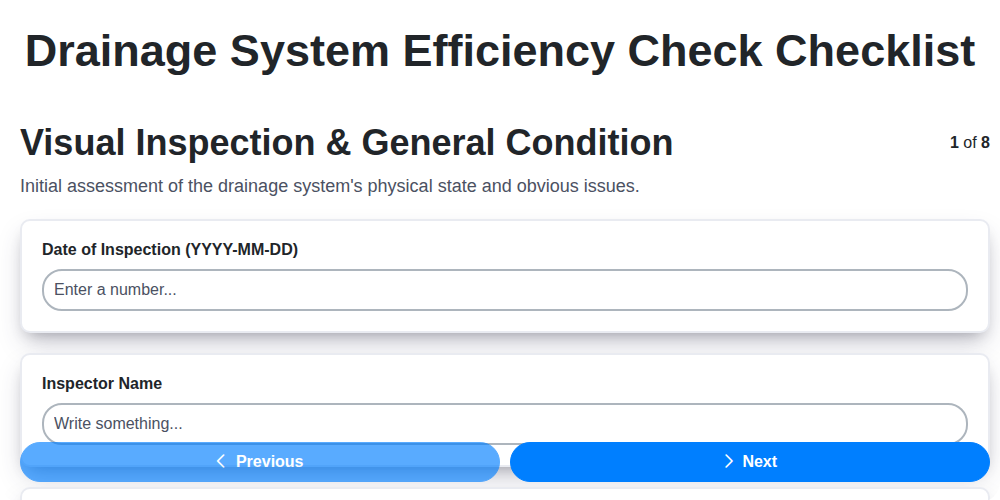
10 Simple Steps to a Healthy Drainage System: Your Checklist Template

Mastering the Daily Crop Scouting Report: Your [Specific Crop] Checklist Template
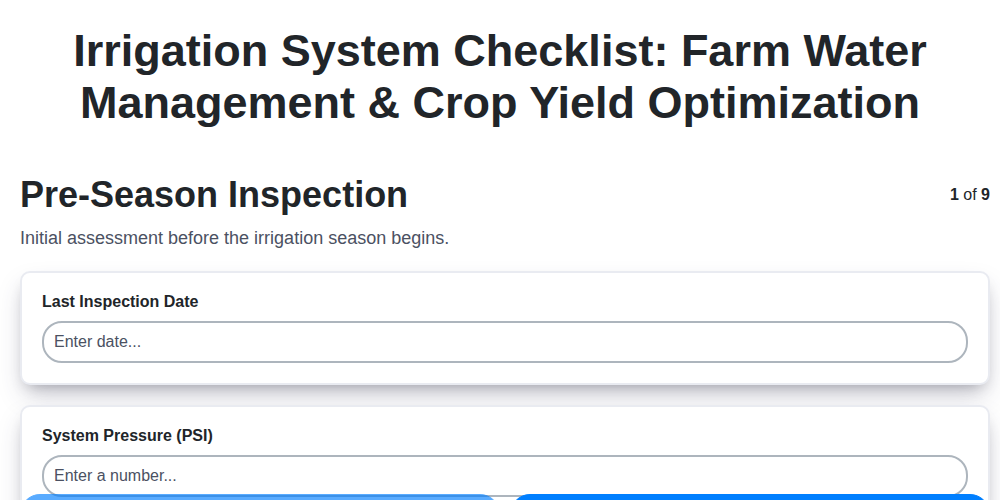
Irrigation System Checklist: Farm Water Management & Crop Yield Optimization
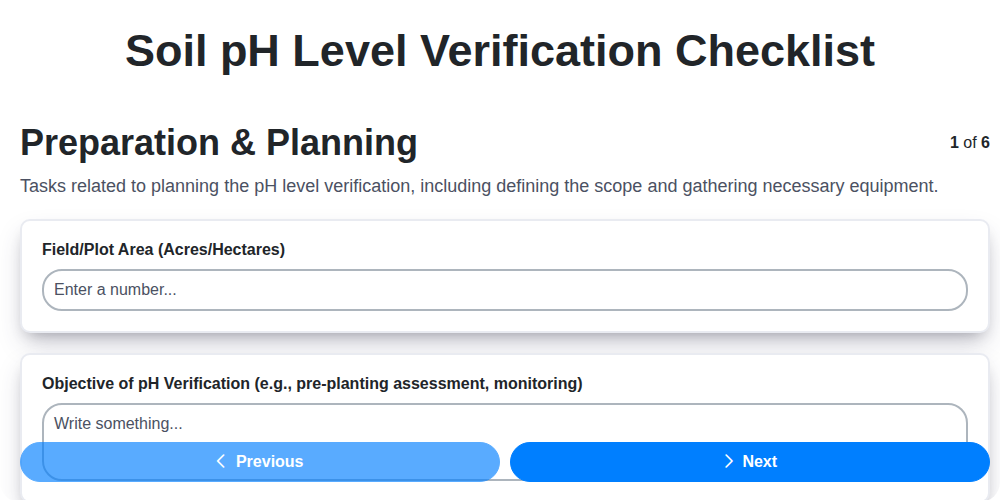
Unlock Your Garden's Potential: A Soil pH Verification Checklist
PPE Usage Checklist Template: Your Guide to Safety
Water Discharge Permit Compliance Checklist Template
The Ultimate GPS & Precision Farming Calibration Checklist Template
Water Runoff Analysis Checklist Template
We can do it Together
Need help with
Checklists?
Have a question? We're here to help. Please submit your inquiry, and we'll respond promptly.