Streamline Your Harvest: The Ultimate Farm Crew Management Workflow for Effortless Labor Assignment
Published: Updated: 04/16/2026
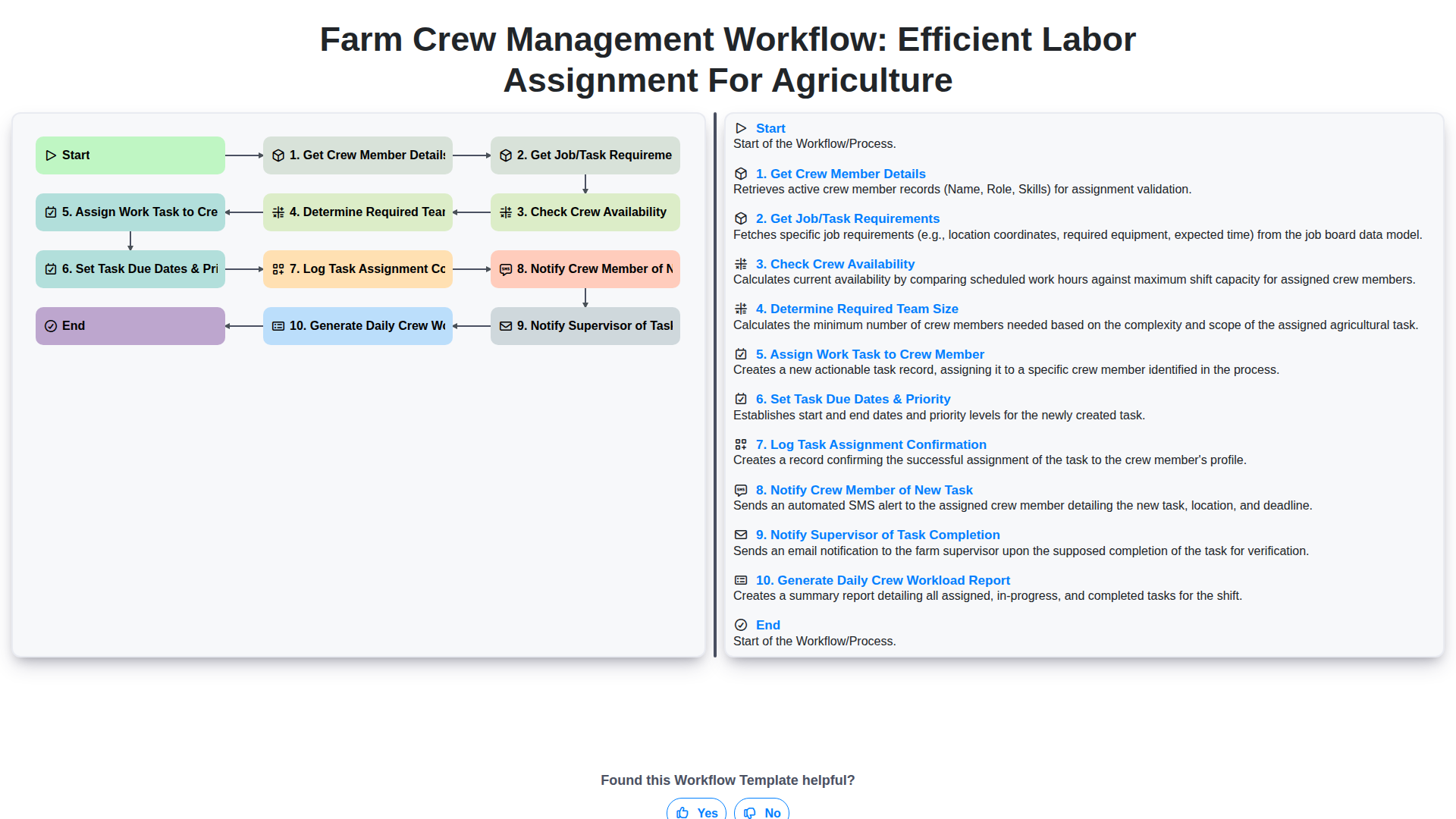
Table of Contents
- Understanding the Need for a Structured Workflow in Modern Farming
- Step 1: Gathering Essential Crew Member Details for Accuracy
- Step 2: Defining the Job: Comprehensive Task & Requirement Gathering
- Step 3: The Crucial Check: Real-Time Crew Availability Verification
- Step 4: Calculating Capacity: Determining the Optimal Team Size
- Step 5: The Core Action: Strategically Assigning Work Tasks to Crew Members
- Step 6: Establishing Guardrails: Setting Task Due Dates and Prioritization
- Step 7: Accountability Loop: Logging Task Assignment Confirmation
- Step 8: Communication is Key: Notifying the Crew Member of New Assignments
- Step 9: Visibility Up: Notifying Supervisors of Task Progress and Completion
- Step 10: Insight Generation: Creating the Daily Crew Workload Report
- Implementing the Workflow: Tools and Technology for Seamless Execution
- Benefits of Workflow Automation: Saving Time and Boosting Yields
- Optimizing for the Future: Continuous Improvement in Labor Management
- Resources & Links
TLDR: This workflow automates farm crew management by guiding you through a systematic process-from collecting crew details and job requirements to assigning tasks, setting deadlines, and ensuring all stakeholders are notified and tracked. It helps you efficiently assign labor, manage workloads, and maintain accurate records for a smoother, more productive harvest.
Understanding the Need for a Structured Workflow in Modern Farming
markdown Modern agriculture is far more complex than ever before. Gone are the days when farm tasks could be managed through word-of-mouth or simple paper checklists. Today's farming operations involve diverse tasks-from precise planting schedules and specialized harvesting techniques to equipment maintenance and compliance reporting. With this complexity comes the potential for significant inefficiency if labor management is unstructured. Without a defined workflow, critical steps like matching the right skill set to the right task, ensuring crew members aren't overworked or underutilized, and keeping track of deadlines become manual, time-consuming, and prone to human error. A structured workflow transforms these scattered processes into a predictable, repeatable system, ensuring that labor is allocated precisely where and when it is needed, which is the cornerstone of boosting productivity and profitability on the modern farm.
Step 1: Gathering Essential Crew Member Details for Accuracy
The foundation of any efficient workflow lies in accurate data. In the context of farm crew management, this means meticulously gathering comprehensive details about every available team member. This step goes beyond simply collecting names; we need a detailed profile for each crew member. This includes, but is not limited to, their skill sets (e.g., tractor operation, pruning, harvesting specific crops), certifications they hold, years of experience, and perhaps even any physical limitations or specialized equipment they are authorized to use. By centralizing and standardizing this information, we ensure that when a job comes in, we aren't guessing-we know exactly who has the right combination of skills and certifications to tackle the required tasks, minimizing delays and maximizing quality from the outset.
Step 2: Defining the Job: Comprehensive Task & Requirement Gathering
This crucial stage focuses on clearly understanding what work needs to be done. It involves meticulously gathering all necessary details about the job, task, or maintenance requirement. Do not underestimate the importance of thorough requirement gathering, as vague instructions are the primary cause of workflow bottlenecks.
Here's what needs to be captured:
- Task Specifics: What exactly needs to be done? (e.g., Pesticide application in Sector C, Irrigation system repair on Plot 4, Harvesting of Tomatoes.)
- Resource Requirements: Are specific tools, equipment, or materials needed? (e.g., A specific tractor model, enough fertilizer for 5 acres, specialized pruning shears.)
- Output Metrics: What defines a finished task? Is it measured by area covered, weight harvested, or time taken?
- Complexity Level: Is this a routine, straightforward task, or does it require specialized knowledge (e.g., diagnosing complex machinery issues)?
By standardizing the data captured here, we ensure that when we move to checking crew suitability, we are comparing apples to apples-a clear task definition matched against clear crew capabilities.
Step 3: The Crucial Check: Real-Time Crew Availability Verification
This step is where the theoretical becomes practical. Before assigning a single task, the system must accurately verify that the necessary personnel are actually available to perform the work. Integrating a real-time availability check prevents costly delays and resource misallocations. The workflow queries the master crew database, cross-referencing individual employee schedules, approved leave requests, and current on-site assignments. If a required crew member is marked as On Leave, Assigned Elsewhere, or has clocked out for the day, the workflow flags this immediately. This proactive check ensures that the subsequent steps-determining team size and assignment-are based on actionable, present resources, saving valuable time that would otherwise be spent chasing confirmations.
Step 4: Calculating Capacity: Determining the Optimal Team Size
This is a critical checkpoint in the workflow, as assigning too few crew members leads to delays and backlog, while assigning too many results in wasted labor costs. To determine the optimal team size, you must systematically compare the scope of work defined in the job requirements against the proven capacity of your existing crew pool. First, break down the job's total required effort-this might be measured in man-hours, acres to be tended, or specific unit counts. Next, factor in the average productivity rate for the specific task type (e.g., harvesting apples has a different rate per hour than pruning vines). By dividing the total required effort by the average achievable productivity rate per worker, you arrive at a baseline number. Always add a buffer-a contingency factor of 10-15% is recommended-to account for unforeseen issues common in agriculture, such as equipment breakdowns, unexpected weather shifts, or the natural slowdown that occurs mid-day. This resulting number is your scientifically backed, optimized team size.
Step 5: The Core Action: Strategically Assigning Work Tasks to Crew Members
This step is where the workflow moves from planning to action. After confirming the necessary team size and having all crew availability data, the system must intelligently match available crew members to the specific tasks. This isn't just random assignment; it requires matching skills, certifications, equipment requirements, and geographical proximity to the job site. The workflow should ideally prioritize assigning tasks to crew members who are best suited (most skilled or closest) to minimize travel time and maximize efficiency. If a perfect match isn't available, the system must flag this bottleneck, suggesting alternative crew members or escalating the need for more resources, ensuring no high-priority task is stalled due to mismatched assignments.
Step 6: Establishing Guardrails: Setting Task Due Dates and Prioritization
Setting clear deadlines and establishing a priority system are crucial guardrails in any effective workflow, and agricultural task management is no exception. Simply assigning a task isn't enough; the crew needs to know when it needs to be done and how important it is relative to everything else on the farm. This step involves defining definitive due dates for every assigned task, moving beyond vague goals to actionable timelines. Furthermore, implementing a prioritization matrix allows the system to categorize tasks-for example, classifying 'Emergency Irrigation Repair' as 'High Priority/Immediate' while 'Routine Soil Testing' is marked as 'Medium Priority/Scheduled.' By coupling these elements, the crew doesn't waste valuable time debating what to tackle first. The workflow automatically flags any conflict-for instance, if a high-priority task is scheduled for the same time as another critical one-alerting the supervisor early enough to reallocate resources and maintain optimal farm efficiency.
Step 7: Accountability Loop: Logging Task Assignment Confirmation
This critical step closes the loop between the assignment and the acceptance of the task. Simply sending a notification isn't enough; you need verifiable proof that the intended crew members have received, reviewed, and agreed to the assigned work. Implementing a digital confirmation mechanism-whether a digital signature, an 'Accept' button within the management app, or a logged acknowledgment-creates an auditable trail. This log is vital for dispute resolution, performance review, and ensuring that if a task falls through, you know precisely which personnel were formally notified and agreed to the commitment.
Step 8: Communication is Key: Notifying the Crew Member of New Assignments
Once the assignment is made, the crucial next step is ensuring the crew member is aware of their new responsibilities. This requires a robust and immediate notification system. A simple email might not suffice in a fast-paced farm environment. Ideally, the workflow should trigger multiple channels of communication. This could include a dedicated mobile application push notification displaying the task details, a text message with key information, and an alert within their digital work log. The notification must contain all necessary details: What the task is (e.g., Irrigation System Check), Where it needs to be done (specific field coordinates or zone), When it is due, and Why it is important (its priority). Clear, concise, and multi-channel communication minimizes confusion, reduces time wasted searching for instructions, and ensures the crew member starts the task efficiently from the moment the assignment is logged.
Step 9: Visibility Up: Notifying Supervisors of Task Progress and Completion
This crucial step ensures that the supervisory team has real-time insight into the operational status of the farm. As soon as a crew member successfully completes an assigned task, the system automatically sends a notification to the supervisor. This instant confirmation allows managers to track progress against the daily plan, identify potential bottlenecks immediately, and reallocate resources if a task is delayed or finished ahead of schedule. This transparency drastically reduces the need for manual check-ins and keeps operations moving smoothly.
Step 10: Insight Generation: Creating the Daily Crew Workload Report
This final, yet crucial, step transforms raw assignment data into actionable intelligence. The Daily Crew Workload Report is far more than just a summary; it's the pulse check for your entire operation. By compiling all logged task assignments, due dates, and estimated effort, this report gives managers a holistic view of resource allocation. It allows you to preemptively identify overworked crew members who might face burnout or bottlenecks, or conversely, reveal pockets of underutilized manpower. This report is essential for proactive adjustments, enabling managers to rebalance assignments mid-day, schedule necessary breaks, or even flag potential scheduling conflicts before they impact harvest yields or maintenance timelines.
Implementing the Workflow: Tools and Technology for Seamless Execution
Harnessing the power of technology is crucial for making this farm crew management workflow efficient and scalable. Instead of relying on manual spreadsheets and scattered communication, integrating specialized software can automate nearly every step, reducing human error and saving countless hours.
Centralized Platform Integration: The core requirement is a single, cloud-based platform. This system should act as the central hub where all data resides-crew details, job specifications, historical performance, and scheduling algorithms. This prevents siloed information that plagues manual workflows.
Automation for Availability Checks: The Check Crew Availability step is where technology shines. The system should integrate with employee time tracking (e.g., clock-in/out apps) and automatically cross-reference planned absences, existing shifts, and accrued leave days to provide real-time availability scores for every worker.
Intelligent Assignment Engine: The Assign Work Task to Crew Member step benefits most from sophisticated algorithms. A modern system can use weighted scoring-considering not just if a crew member is available, but also their specific skill certifications (e.g., pesticide application training), past performance ratings on similar tasks, and proximity to the job site. This moves beyond simple assignment to optimal assignment.
Mobile-First Interface for Execution: For the crew members in the field, the technology must be mobile-first. Workers need an app that delivers the Notify Crew Member of New Task directly to their device. This notification should include GPS coordinates, detailed instructions, necessary safety gear checklists, and the task's priority level, all visible in a clean, actionable dashboard.
Automated Notifications and Reporting: Communication should be automated. When a task is assigned, the system should instantly send confirmations and reminders. Crucially, the Notify Supervisor of Task Completion should trigger an electronic sign-off mechanism (e.g., supervisor taps 'Complete' on the app after verification). This automatically triggers the logging needed for the Generate Daily Crew Workload Report, providing instant, immutable data for payroll, billing, and management review.
By implementing these technological layers, the workflow transitions from a set of sequential tasks into a cohesive, proactive management system.
Benefits of Workflow Automation: Saving Time and Boosting Yields
Workflow automation is the backbone of modern, efficient farm operations. By digitizing and streamlining your entire crew management cycle, you eliminate manual bottlenecks that waste precious time and resources. Automating these processes means your crew members spend less time on paperwork and more time doing what they do best: tending the crops. This direct time saving translates into increased productivity, allowing your team to tackle more acreage or complete tasks ahead of schedule, which directly boosts overall yields. Furthermore, predictable, systematic assignments ensure that no critical task is overlooked, leading to consistent, high-quality fieldwork and maximizing profitability.
Optimizing for the Future: Continuous Improvement in Labor Management
Incorporating feedback and analyzing performance data is the cornerstone of true labor management excellence. A well-designed workflow isn't static; it must be adaptive. By regularly reviewing task completion times, noting common bottlenecks, and surveying crew members for process friction points, you can iteratively refine every step. For instance, if the Assign Work Task to Crew Member step consistently takes too long, reviewing your skill-matching algorithms or simplifying the assignment interface could yield immediate time savings. This commitment to continuous improvement ensures that your labor management system evolves alongside the increasing complexity and changing needs of modern agriculture, keeping your operations efficient, cost-effective, and always ahead of the harvest curve.
Resources & Links
- Agricultural Technology & Farm Management Platforms : Resources for learning about modern farm management software and automation tools that can support workflow implementation.
- Agricultural HR and Labor Management Guidelines : Best practices and guidelines for managing agricultural workforces, useful for understanding crew member detail gathering and compliance.
- Project Workflow Design and Mapping Resources : General project management resources to deepen the understanding of workflow modeling, especially for steps like process mapping and optimization.
- Farm Analytics and Resource Optimization Tools : Information on data analytics specific to farming, helpful for the 'Generating Daily Crew Workload Report' section.
- Farm Labor Efficiency Case Studies : Case studies demonstrating the impact of structured labor management workflows on agricultural productivity.
- Field Communication Technology Solutions : Details on mobile apps, notification systems, and communication tools suitable for remote farm environments (for notification steps).
Frequently Asked Questions
What is the main goal of a farm crew management workflow?
The primary goal is to transition from reactive, manual labor management to a proactive, organized system that ensures the right workers are assigned to the right tasks at the optimal time, reducing waste and maximizing harvest efficiency.
How can I reduce errors in labor assignment during peak harvest?
By implementing a structured workflow that includes digital task checklists, real-time communication tools, and pre-defined roles, you can minimize the confusion and miscommunication that typically occur during high-pressure periods.
What are the key components of an 'effortless' labor assignment process?
An effortless process relies on three pillars: clear task documentation, real-time visibility of crew availability, and a centralized system for tracking task completion and labor hours.
Can this workflow help in managing seasonal workers?
Yes. A streamlined workflow provides standardized instructions and clear oversight, which is essential for onboarding seasonal staff quickly and ensuring they follow farm protocols without constant direct supervision.
Does implementing a new management workflow require expensive technology?
Not necessarily. While digital tools can enhance efficiency, the core of the workflow is the organizational logic. You can start by implementing structured paper-based protocols and gradually scale to mobile apps or farm management software as your needs grow.
Found this Article helpful?
Agriculture Management Solution Demo
Running a farm or agricultural business is complex. ChecklistGuro's Work OS platform simplifies your operations, from crop planning and irrigation management to livestock tracking and harvest scheduling. Increase efficiency, reduce waste, and boost yields! See how ChecklistGuro can revolutionize your agriculture business.
Related Articles
10 Simple Steps to a Healthy Drainage System: Your Checklist Template

Mastering the Daily Crop Scouting Report: Your [Specific Crop] Checklist Template
Irrigation System Checklist: Farm Water Management & Crop Yield Optimization
Unlock Your Garden's Potential: A Soil pH Verification Checklist
PPE Usage Checklist Template: Your Guide to Safety
Water Discharge Permit Compliance Checklist Template
The Ultimate GPS & Precision Farming Calibration Checklist Template
Water Runoff Analysis Checklist Template
We can do it Together
Need help with
Checklists?
Have a question? We're here to help. Please submit your inquiry, and we'll respond promptly.