Ace Your Farm Grant: The Ultimate Readiness Checklist
Published: 11/22/2025 Updated: 07/02/2026
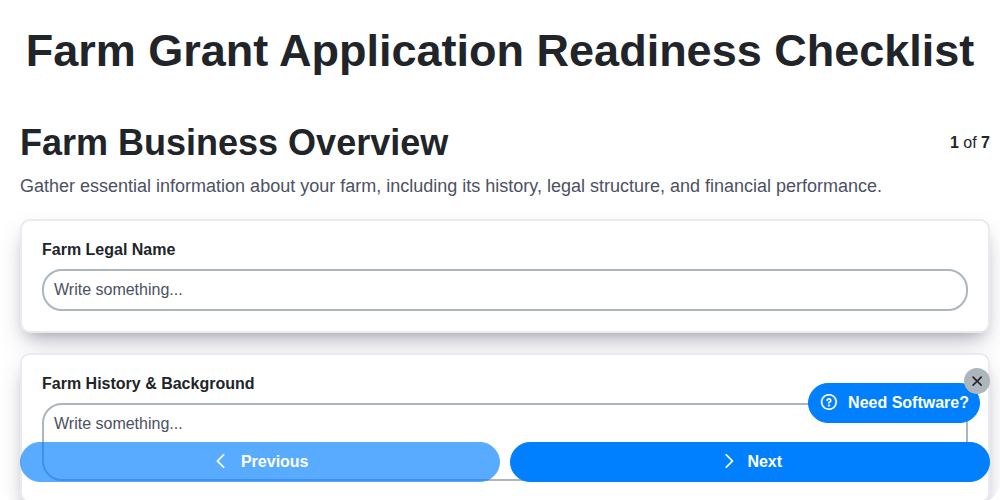
Table of Contents
- Is Your Farm Ready for a Grant? Why Preparation is Key
- 1. Farm Business Overview: Laying the Foundation
- 2. Project Description & Alignment: Showcasing Your Vision
- 3. Eligibility Requirements: Do You Qualify?
- 4. Financial Projections & Budget: Numbers That Tell a Story
- 5. Sustainability & Impact Assessment: Beyond the Bottom Line
- 6. Required Documentation Checklist: Gathering Your Evidence
- 7. Grant Application Review & Submission: Polishing and Launching
- Resources & Links
TLDR: Applying for farm grants can be overwhelming! This checklist breaks down the process into manageable steps - from your business plan to your budget and impact assessment - ensuring you're fully prepared and ready to submit a strong, competitive application. Download it, work through it, and boost your chances of funding!
Is Your Farm Ready for a Grant? Why Preparation is Key
Securing a farm grant can be a game-changer, providing vital resources to expand operations, adopt sustainable practices, or overcome financial challenges. However, the application process is often competitive, and a rushed or incomplete application is a quick way to rejection. Before you even start filling out forms, a thorough self-assessment is absolutely crucial. Think of it as building a strong foundation for your application - a shaky base will crumble under pressure.
Many farmers get excited about the potential funding and dive straight into the application, only to realize they're missing key information or haven't addressed critical areas. This often stems from a lack of preparedness, not a lack of merit. Taking the time to proactively address potential gaps now will significantly increase your chances of success.
This isn't just about gathering documents; it's about understanding your farm's strengths, weaknesses, and how your goals align with the grant's objectives. A well-prepared application demonstrates not only your need for funding but also your commitment to responsible stewardship and the potential for impactful results. Let's break down the areas you need to assess before hitting that Submit button.
1. Farm Business Overview: Laying the Foundation
Before diving into the specifics of your grant proposal, the funding body wants to understand you and your farm. This section is your opportunity to paint a clear and compelling picture of your existing operation. Don't just list facts; tell a story.
Here's what needs to be rock solid:
- Executive Summary: A concise overview of your farm, its mission, and why you're seeking this grant. Think of it as an elevator pitch.
- Farm History & Background: How and when was your farm established? What's its journey been so far? Briefly highlight significant milestones.
- Farm Structure & Ownership: Clearly state the legal structure (sole proprietorship, partnership, LLC, etc.) and identify all owners/partners.
- Products & Services: Detail exactly what you produce or offer. Be specific about varieties, certifications (organic, etc.), and any unique aspects.
- Current Operations: Describe your current farming practices, including acreage, infrastructure, and labor.
- Market Analysis (Brief): Briefly outline your target market and how you currently reach them. This shows you understand your customers.
- Team & Expertise: Introduce key personnel and highlight their relevant skills and experience.
Don't underestimate the power of a strong Farm Business Overview. It sets the stage for everything that follows.
2. Project Description & Alignment: Showcasing Your Vision
This is arguably the heart of your grant application. Don't just tell them what you want to do; show them why it matters and how it fits within the grant's goals. Your project description needs to be clear, concise, and compelling, painting a vivid picture of your farm's vision and how the grant funding directly contributes to its realization.
Here's what grant reviewers will be looking for:
- Clearly Defined Project Goals: What specific, measurable, achievable, relevant, and time-bound (SMART) goals will your project achieve? Avoid vague language. Instead of improve farm productivity, say increase tomato yield by 15% within one year through the implementation of a drip irrigation system.
- Detailed Project Activities: Outline the specific steps you'll take to achieve your goals. A detailed activity plan demonstrates thoughtful planning and increases confidence in your ability to deliver. Think about timelines, required resources, and potential challenges.
- Alignment with Grant Priorities: This is crucial! Thoroughly review the grant guidelines. Identify the specific priorities, objectives, and target outcomes the grant seeks to support. Explicitly articulate how your project addresses these priorities. Use their language whenever possible; it shows you understand their mission. Explain why your project is a perfect fit.
- Innovation and Uniqueness (if applicable): Does your project offer a novel approach or address a unique problem? Highlight what makes it stand out.
- Expected Outcomes and Benefits: Beyond the immediate results, what broader benefits will your project provide? Will it create jobs, improve community access to healthy food, contribute to soil health, or have other positive impacts? Quantify these benefits whenever possible.
Remember, your project description isn't just about what you're doing, but why it's important and how it aligns with the grantor's objectives. Strong alignment is your ticket to success!
3. Eligibility Requirements: Do You Qualify?
Before you spend hours crafting a compelling proposal, it's absolutely critical to thoroughly review the grant's eligibility requirements. This isn't just a formality; it's a potential time-saver (and frustration-saver!). Grants often have very specific criteria regarding farm size, type of operation, location, legal structure, and more.
Common Eligibility Hurdles:
- Farm Size & Type: Many grants target specific farm sizes (e.g., small, mid-size, family-owned) or focus on particular agricultural practices (e.g., organic, sustainable, innovative technologies).
- Geographic Location: Some grants are region-specific, focusing on supporting farms within a particular state, county, or rural area.
- Legal Structure: Are you operating as a sole proprietorship, partnership, LLC, or cooperative? Certain grants may only be open to specific business structures.
- New vs. Established Farms: Some are geared towards startups, while others prioritize existing operations.
- Commodity Restrictions: A grant might be specific to a particular crop or livestock.
- Income Limitations: Occasionally, income limits may apply, particularly for grants aimed at supporting underserved farmers.
How to Confirm Eligibility:
- Read the Fine Print: Seriously, read every word of the grant guidelines. Don't skim!
- Contact the Grant Provider: If anything is unclear, reach out to the grant provider directly. They are there to answer your questions.
- Use Eligibility Check Tools (if available): Some grant providers offer online tools to help you quickly assess your eligibility.
Failing to meet the eligibility requirements is the most common reason for grant rejections. Save yourself the disappointment - verify your eligibility before investing your valuable time and effort.
4. Financial Projections & Budget: Numbers That Tell a Story
Grant applications aren't just about a passion for farming; they're about demonstrating the viability of your operation and how the grant funds will be strategically used. Your financial projections and budget are arguably the most scrutinized section, so precision and clarity are paramount.
Here's what you need to nail:
- Realistic Revenue Projections: Don't be overly optimistic. Base your projections on market research, historical data (if available), and a clear understanding of your target market. Detail how you arrived at these figures-include sources and assumptions.
- Detailed Expense Breakdown: List everything. From seeds and fertilizer to labor and marketing, be comprehensive. Don't forget recurring costs like insurance and utilities. Consider both initial startup costs and ongoing operational expenses.
- Budget Justification: Explain why you need the specific amount of funding requested. Connect each expense to your overall project goals and demonstrate a clear understanding of how the funds will be utilized. Justify any significant costs.
- Profit & Loss (P&L) Statements (Past, Present & Projected): While past P&L statements (if available) provide context, projected P&L statements demonstrate your understanding of future financial performance. Clearly outline your assumptions.
- Cash Flow Projections: These are critical. Show how your farm will manage its cash flow, especially in the early stages or during seasonal fluctuations.
- Break-Even Analysis: Show how and when your farm will become profitable.
- Contingency Planning: Briefly address potential risks and how you'll address financial challenges. A small contingency budget demonstrates preparedness.
Remember, the goal is to tell a story with your numbers - a story of a well-planned, financially sound farm with a clear path to success.
5. Sustainability & Impact Assessment: Beyond the Bottom Line
Grant funders are increasingly looking beyond immediate financial returns. They want to see how your farm contributes to a healthier planet, stronger communities, and a more resilient food system. This section of your application is your opportunity to showcase your commitment to long-term viability and positive change.
Don't just focus on what you produce, but how you produce it. Consider these key areas:
- Environmental Stewardship: Detail your practices related to soil health (cover cropping, no-till), water conservation, biodiversity promotion, and reducing chemical inputs. Quantify your efforts whenever possible. (e.g., Reduced pesticide use by 30%, or Implemented a riparian buffer zone covering X acres.)
- Social Impact: How does your farm benefit your community? Do you provide local jobs, offer farm-to-school programs, support underserved populations, or engage in community education? Highlight partnerships and collaborations.
- Economic Resilience: Explain how your farm plans to adapt to climate change, market fluctuations, and other economic challenges. Diversification strategies, risk mitigation plans, and value-added processing are all relevant here.
- Long-Term Viability: Articulate your vision for the farm's future. How will you ensure its sustainability for generations to come? This might include succession planning, land preservation strategies, or the development of innovative agricultural practices.
Remember to connect your sustainability and impact goals to your overall project description and demonstrate how achieving them aligns with the grant's priorities. Show, don't just tell, that your farm is a force for good.
6. Required Documentation Checklist: Gathering Your Evidence
Grant applications aren't just about compelling narratives - they're about backing up your claims with solid evidence. Many applications are rejected not because the idea is weak, but because the required documentation is missing or incomplete. This section breaks down the typical documents you'll need, though always refer to the specific grant's guidelines as requirements can vary widely.
Here's a comprehensive checklist to get you organized:
- Business Plan: A well-developed business plan is often a cornerstone. Make sure it's current and addresses all key aspects of your farm operation.
- Farm Maps & Site Plans: Visual representations of your farm layout, including areas for production, processing, storage, and any relevant infrastructure.
- Financial Statements: This usually includes profit and loss statements, balance sheets, and cash flow statements for the past 2-3 years. Be prepared to provide these even for new farms - projections based on similar operations may be acceptable.
- Tax Returns: Relevant tax returns (both business and personal, depending on the grant) for the past 2-3 years.
- Permits and Licenses: Copies of all relevant permits and licenses required for your farming operation (e.g., organic certification, food safety permits, zoning compliance).
- Insurance Policies: Proof of liability insurance and any other relevant insurance coverage.
- Letters of Support: From suppliers, distributors, community organizations, or other stakeholders who can vouch for your project's viability and impact.
- Resumes/CVs: For key personnel involved in the project, highlighting their experience and expertise.
- Equipment List & Quotes: If the grant involves purchasing equipment, provide a detailed list with vendor quotes.
- Legal Documents: Articles of Incorporation, LLC operating agreements, or other relevant legal documentation establishing your farm business.
- Environmental Impact Assessments (if applicable): Depending on the project, you may need to provide assessments related to water usage, soil health, or biodiversity.
Pro Tip: Create a dedicated folder (physical or digital) for each grant application and meticulously organize these documents. Double-check that all documents are clearly labeled, legible, and in the required format (PDF is generally preferred). Missing or poorly presented documentation is a common cause of rejection.
7. Grant Application Review & Submission: Polishing and Launching
You've poured your heart and hours into crafting your grant application. Don't rush the final steps! This is where attention to detail becomes critical.
Internal Review - Fresh Eyes are Essential: Before submitting, have someone unfamiliar with your farm business and project meticulously review your application. Ideally, this person should have grant writing or business review experience. They can catch inconsistencies, unclear language, and potential weaknesses you're too close to see. Ask them to focus on:
- Clarity & Readability: Is the language clear, concise, and easy to understand? Avoid jargon and technical terms unless absolutely necessary and clearly defined.
- Completeness: Did you answer every question and address all the requirements outlined in the grant guidelines?
- Consistency: Ensure consistency in terminology, data, and project details throughout the application.
- Alignment: Does the application truly reflect your farm's mission and the grant's stated objectives?
Formatting & Technical Checks:
- Adherence to Guidelines: Double-check all formatting requirements: font size, margins, file types, page limits. Failure to comply can lead to automatic rejection.
- Proofread Carefully: Errors in spelling and grammar detract from your professionalism. Use spell check and grammar check, and then read it out loud.
- File Naming Conventions: Follow the grant provider's exact file naming instructions.
- Digital Submission: If submitting digitally, test the upload process early. Ensure file sizes are acceptable and the system recognizes the file types.
Final Submission:
- Deadline Awareness: Know the exact deadline and submit well in advance to avoid last-minute technical glitches.
- Confirmation: Obtain confirmation of submission receipt. This is your proof that the application was received.
- Keep Records: Maintain a complete copy of your application and all supporting documentation for your records.
Good luck!
Resources & Links
- U.S. Small Business Administration (SBA) - Grants: The SBA provides a comprehensive list of grants available to small businesses, including some relevant to farms and agriculture. This is a great starting point for understanding the landscape of available funding.
- Grants.gov: The official website for federal grants. It's the central hub to search for and apply to a vast array of federal funding opportunities - essential for finding specific grant programs.
- California Department of Food and Agriculture (CDFA) - Grants (Example for California Farms): This is an example of a state-level agricultural grant program. Replace with the relevant state agricultural department's grants page for the target audience. Demonstrates the importance of state-specific funding.
- USDA Natural Resources Conservation Service (NRCS): NRCS offers various programs that offer financial and technical assistance to farmers for conservation efforts. While not strictly 'grants' in all cases, they are often a vital resource for agricultural projects.
- Farm Credit: Farm Credit provides financial services and resources for farmers and ranchers. They can be helpful in understanding financial projections, budgets, and overall farm business viability - crucial for a strong grant application.
- USDA Rural Development: USDA Rural Development offers programs to support rural businesses and communities, which often includes agricultural initiatives. Explore their various grant and loan opportunities.
- SCORE: SCORE is a non-profit organization providing free business mentoring and resources. They can help refine your farm business overview and overall business plan - critical for demonstrating readiness.
- Agricultural Marketing Resource Center (AgMRC): The AgMRC provides information and resources on agricultural business management and marketing. Helpful for solidifying your project description and assessing impact.
- Sustainable Agriculture Research & Education (SARE): SARE focuses on sustainable agriculture research and education. Useful for developing the sustainability & impact assessment section of your application.
- LawDepot (for documentation assistance): While not a direct grant resource, LawDepot (or similar services) can help with creating necessary legal documents which are often part of grant applications (business plan, articles of incorporation, etc.). Be sure to understand and adapt templates to your specific needs.
- LegalZoom (for documentation assistance): Similar to LegalZoom, offering templates and legal document creation services that could support the required documentation checklist.
- SBA - Write a Business Plan: The SBA provides a comprehensive guide on writing a business plan, covering elements critical to your 'Farm Business Overview'.
Frequently Asked Questions
What is a farm grant and why should I apply?
Farm grants are funds provided by government agencies or private organizations to support agricultural businesses. They can help with startup costs, infrastructure improvements, conservation efforts, and more. Applying can significantly boost your farm's financial stability and growth opportunities, without requiring repayment (unlike loans).
Who is this 'Readiness Checklist' for?
This checklist is designed for all farmers - whether you're just starting out, expanding an existing operation, or seeking to implement a new project. It's geared towards anyone planning to apply for agricultural grants.
I'm completely new to farming. Can I still qualify for a grant?
While experience can be beneficial, it's not always a strict requirement. Many grants cater to beginning farmers, often with specific criteria and preferences. This checklist will help you address any potential gaps in experience and demonstrate your commitment.
What are the most common reasons farm grant applications are rejected?
Common reasons for rejection include incomplete applications, lack of clarity around the project's purpose and impact, poorly defined budgets, inadequate project timelines, and failing to meet eligibility requirements. The checklist addresses these directly.
The checklist seems lengthy. How much time should I realistically allocate to complete it?
The time required will vary depending on your farm's complexity and existing documentation. We suggest setting aside at least 4-8 hours initially to thoroughly review each item. Allow for more time if significant research or documentation is needed.
What kind of documentation will I need to gather for my grant application?
Typically, you'll need financial statements (profit & loss, balance sheet), tax returns, business plans, maps of your farm, permits & licenses, and documentation related to the project you're seeking funding for. The checklist details these specific items.
The checklist mentions a 'strong business plan.' What makes a business plan 'strong' for grant purposes?
A strong business plan should clearly articulate your farm's mission, goals, market analysis, operational plans, and financial projections. For grants, emphasize the project's alignment with the grant's specific goals and the positive impact on the community or environment.
How do I find available farm grants?
Several resources exist, including the USDA website (farmers.gov), state departments of agriculture, the Farm Service Agency (FSA), and online grant databases. We recommend starting with your state's agricultural resources and broadening your search from there.
What does 'matching funds' mean in the context of farm grants?
Some grants require matching funds, meaning you need to contribute a portion of the project's cost yourself. This demonstrates your investment and commitment to the project. The checklist will help you assess if you need to plan for this.
Where can I find assistance with writing my grant application?
Many organizations offer grant writing assistance, including Small Business Development Centers (SBDCs), agricultural extension offices, and non-profit organizations. Don't hesitate to seek help - it can significantly improve your chances of success.
Comments
There are no comments yet. Be the first to add one!
Farm Management Solution Demo
Grow your farm smarter & more efficiently! ChecklistGuro streamlines crop planning, task management, & resource tracking. Maximize yields, reduce waste, & improve profitability. Manage it all with our Work OS.
Related Articles
Unlock Higher Yields: Your Precision Agriculture Checklist Template
The Ultimate Farm Safety Inspection Report Checklist Template
Irrigation System Checklist: Farm Water Management & Crop Yield Optimization

Livestock Health & Welfare Checklist: Your Farm Animal Care & Biosecurity Template
Crop Insurance Policy Review Checklist: A Farmer's Guide
Water Discharge Permit Compliance Checklist Template
The Ultimate GPS & Precision Farming Calibration Checklist Template
Mapping the Threat: A Checklist for Proactive Pest & Disease Pressure Management
Need help with
Farm Management?
Have a question? We're here to help. Please submit your inquiry, and we'll respond promptly.