Mastering the Seedling Stage: The Ultimate 2026 Farm Greenhouse Nursery Management Checklist
Published: 11/22/2026 Updated: 11/23/2026
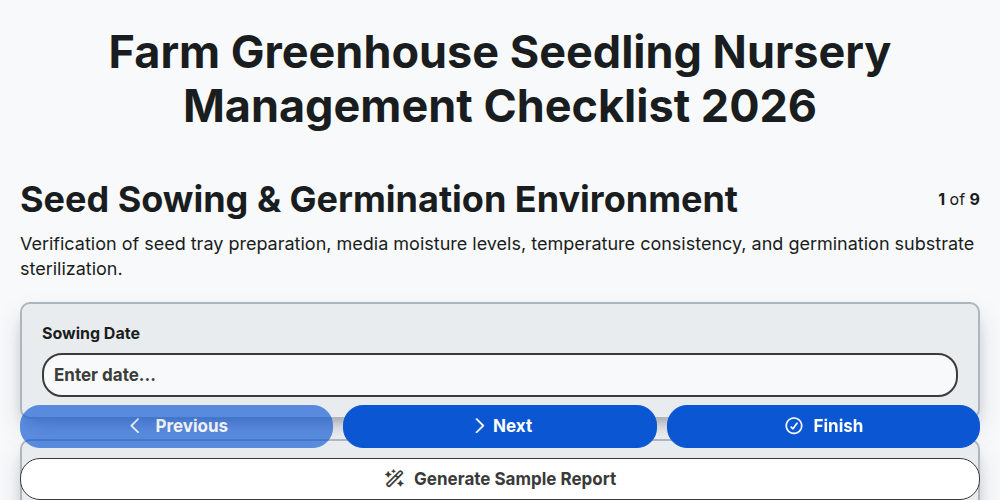
Table of Contents
- Introduction: Why Precision Management Matters in 2026
- 1. Precision Seed Sowing & Germination Environment
- 2. Advanced Climate & Atmospheric Control
- 3. Optimizing Light Intensity & Photoperiod Regulation
- 4. Precision Irrigation & Fertigation Management
- 5. Monitoring Seedling Vigor & Health Assessment
- 6. Integrated Pest & Disease Prevention Protocols
- 7. Nursery Infrastructure & Equipment Maintenance
- 8. Digital Inventory & Traceability Records
- 9. The Hardening-Off Process & Transplant Readiness
- Conclusion: Ensuring a Successful Growing Season
- Resources & Links
TLDR: Ensure peak crop success and maximize seedling survival rates with our comprehensive 2026 nursery management guide. This essential checklist covers everything from precision seed sowing and climate control to advanced fertigation, pest prevention, and hardening-off protocols, providing a professional roadmap for high-yield greenhouse production.
Introduction: Why Precision Management Matters in 2026
As we approach 2026, the landscape of commercial horticulture is undergoing a profound transformation. The margin for error in greenhouse production is shrinking, driven by increasingly volatile global climates, rising input costs, and the growing demand for high-quality, uniform crops. In this high-stakes environment, the seedling stage is no longer just a preliminary phase of the growing cycle-it is the most critical window of opportunity for any successful farm.
The Foundation of Yield Potential
The vitality of your final harvest is predetermined in the nursery. Every decision made during the seedling stage-from the precision of your irrigation to the minute-by-minute regulation of light intensity-sets the ceiling for your crop's ultimate yield and nutritional density. A single lapse in nutrient delivery or an overlooked pest outbreak during these early days can lead to irreversible setbacks that ripple through the entire growing season, resulting in stunted growth, increased mortality rates, and significant financial loss.
Navigating the Complexity of Modern Horticulture
In 2026, good enough management is no longer a viable strategy. With the integration of advanced sensor technologies and automated climate systems, the expectation for precision has reached an all-time high. Achieving excellence now requires a shift from reactive troubleshooting to proactive, data-driven management.
To navigate this complexity, growers need more than just intuition; they need a structured, repeatable framework. This checklist is designed to serve as your operational blueprint, ensuring that every critical variable-from atmospheric control to hardening-off protocols-is monitored and optimized. By mastering these nine essential pillars of nursery management, you can ensure your greenhouse remains resilient, productive, and profitable in the evolving agricultural landscape.
1. Precision Seed Sowing & Germination Environment
The Foundation of Success: Precision Seed Sowing & Germination Environment
The journey of every high-yield crop begins long before the transplanting phase; it starts in the micro-environment of the seed tray. In 2026, nursery management is moving away from set and forget methods toward high-precision biological management. To ensure maximum germination rates and uniform emergence, your checklist must focus on the critical variables of the germination medium and initial placement.
Substrate Sterility and Composition
The quality of your growing medium is your first line of defense. A successful nursery protocol requires:
- Media Sterilization Verification: Ensure all substrates (peat, coco coir, or compost blends) are free from pathogen vectors and weed seed contaminants.
- Physical Structure Analysis: Check for optimal porosity and water-holding capacity to prevent anaerobic conditions that lead to damping-off.
- Nutrient Priming: Evaluate the presence of starter nutrients or beneficial microbial inoculants (such as Trichoderma or Mycorrhizae) within the medium to jumpstart root development.
Precision Sowing Protocols
Consistency in sowing is the key to predictable crop cycles. Your management routine should include:
- Depth Accuracy: Implementing standardized sowing depths based on specific seed morphology to prevent energy depletion during emergence.
- Seed Density Management: Maintaining optimal spacing to reduce intra-tray competition for nutrients and airflow.
- Seed Lot Integration: Implementing a First-In, First-Out (FIFO) system to ensure seed vigor is maximized based on age and storage conditions.
The Germination Micro-Climate
The window between sowing and the first true leaf is the most vulnerable stage in the plant lifecycle. Monitor these critical parameters:
- Thermal Consistency: Ensuring soil/media temperatures remain within the specific biological threshold for each species.
- Moisture Equilibrium: Maintaining a constant matric potential-preventing both desiccation and waterlogging.
- Gas Exchange: Verifying that the germination zone allows for sufficient oxygen availability to support cellular respiration.
2. Advanced Climate & Atmospheric Control
Precision Control: The New Standard for 2026
In the modern greenhouse era, managing temperature and humidity is no longer about simple thermostat settings; it is about managing the vapor pressure deficit (VPD) to ensure plants breathe efficiently. As we move into 2026, atmospheric stability is the single greatest predictor of seedling success.
Monitoring the Microclimate
To prevent the common pitfalls of damping-off or heat stress, your management routine must focus on three critical atmospheric pillars:
- Relative Humidity (RH) Stabilization: Rapid fluctuations in humidity can lead to condensation on leaves, creating breeding grounds for fungal pathogens. Your checklist must include hourly monitoring of RH levels to ensure they stay within the optimal range for your specific crop species.
- Temperature Stratification: Managing the diurnal temperature swing (the difference between day and night temperatures) is vital for strengthening stem thickness. Ensure your heating and cooling systems are programmed to mimic natural rhythms while protecting against extreme nocturnal drops.
- CO2 Enrichment & Air Exchange: As we utilize more advanced greenhouse technologies, monitoring Carbon Dioxide levels becomes paramount. Proper ventilation is not just about cooling; it is about flushing out stagnant air and ensuring fresh CO2 is available for photosynthesis.
Smart Automation Integration
The 2026 nursery standard integrates sensor-driven data with physical intervention. Your management workflow should include:
- Sensor Calibration: Regular testing of hygrometers and thermistors to ensure your automated systems are reacting to accurate data.
- Airflow Optimization: Routine checks of horizontal airflow (HAF) fans to eliminate dead zones where pockets of high humidity might linger.
- Automated Vent & Shading Response: Testing the integration between light sensors and automated shading cloths to prevent sudden thermal shocks during high-intensity sunlight periods.
3. Optimizing Light Intensity & Photoperiod Regulation
Precision Lighting: Managing Light Intensity & Photoperiod Regulation
In 2026, greenhouse management has moved far beyond simply keeping the lights on. As we utilize more advanced supplemental lighting technologies, the ability to manipulate light quality, intensity, and duration has become a primary driver of seedling uniformity and physiological strength. To ensure your nursery produces high-value, resilient starts, your management strategy must focus on two critical pillars:
Precision Intensity Control
Light intensity is the fuel for photosynthesis. However, too little light leads to leggy or etiolated seedlings, while excessive intensity can cause photoinhibition or heat stress.
- Daily Light Integral (DLI) Monitoring: Move beyond measuring simple PAR (Photosynthetically Active Radiation). Your checklist must include daily tracking of DLI to ensure your seedlings are receiving the cumulative photon dose required for their specific growth stage.
- Dynamic Shading Strategies: As external solar radiation fluctuates, implement automated shading systems to prevent temperature spikes and light saturation during peak midday hours.
- Spectral Tuning: If using LED technology, evaluate the spectral output. Adjusting the ratio of blue to red light can be used to manipulate morphology-using more blue light to prevent stretching and more red/far-red to encourage robust stem development.
Mastering the Photoperiod
The duration of light exposure (the photoperiod) dictates more than just growth speed; it governs the biological clock of your plants.
- Consistent Day/Night Cycles: Ensure that automated timers are synchronized and that light leaks from external sources are minimized during dark periods. Interruptions in the dark period can cause physiological confusion and stunted growth.
- Strategic Extension of Day Length: Utilize supplemental lighting during winter months or cloudy periods to maintain a consistent growth rate, ensuring that your nursery output remains stable regardless of the season.
- Circadian Rhythm Management: Review your lighting schedules during the transition from germination to the hardening-off phase. Adjusting the photoperiod can help prepare the plant's internal mechanisms for the more intense light levels they will encounter in the field or main greenhouse.
4. Precision Irrigation & Fertigation Management
Precision Nutrient Delivery: The Core of Seedling Growth
In 2026, successful nursery management is no longer about simply watering the plants. As seedling physiology becomes more complex, the integration of irrigation and fertigation must be treated as a high-precision science. To achieve uniform growth and minimize resource waste, your management strategy must focus on the synergy between water volume and nutrient concentration.
Automated Fertigation Calibration
The margin for error in a greenhouse environment is incredibly slim. For young seedlings, even a slight fluctuation in Electrical Conductivity (EC) or pH can lead to nutrient lockout or osmotic stress.
- EC & pH Monitoring: Implement a daily routine for testing the nutrient solution at both the injection point and the discharge point (the runoff). Aim for a stabilized pH range (typically 5.5-6.5) to ensure maximum nutrient bioavailability.
- Dynamic Nutrient Recipes: Transition from static fertilization to dynamic recipes that evolve with the seedling's life cycle. Early stages require higher phosphorus for root development, while later stages necessitate increased potassium and nitrogen for structural integrity.
Smart Irrigation Scheduling
Watering frequency must be dictated by real-time environmental data rather than fixed timers.
- VPD-Driven Irrigation: Use Vapor Pressure Deficit (VPD) levels to determine irrigation needs. High transpiration rates require more frequent, smaller pulses of water to prevent the substrate from drying out and causing root desiccation.
- Substrate Moisture Sensing: Integrate soil moisture sensors within your primary nursery trays. This prevents the common mistake of over-saturation, which leads to anaerobic conditions and the onset of damping-off.
Water Quality & Substrate Management
The foundation of your irrigation success lies in the quality of your input.
- Water Analysis: Conduct quarterly laboratory testing of your source water to monitor for heavy metals, carbonates, and salinity. High bicarbonate levels can cause pH drift, necessitating more frequent acid dosing.
- Leachate Management: Monitor the leach fraction (the amount of water that drains out of the bottom of the tray). Maintaining a consistent leach fraction ensures that unused salts do not accumulate in the root zone, preventing salt toxicity in sensitive new shoots.
5. Monitoring Seedling Vigor & Health Assessment
Ensuring Peak Vitality: The Core of Nursery Success
In the lifecycle of a plant, the seedling stage is the most critical window of opportunity. This is where the genetic potential of your crop meets environmental reality. Monitoring seedling vigor is not merely about checking for growth; it is about a proactive evaluation of the plant's physiological strength and its ability to withstand future environmental stressors.
Key Indicators of Seedling Vigor
To maintain a high-quality nursery, your management team must look beyond simple height measurements. A comprehensive health assessment should focus on these four critical pillars:
- Stem Diameter and Structural Integrity: A thick, sturdy stem is a primary indicator of nutrient uptake efficiency and strength. Thin, leggy stems are a red flag for insufficient light or excessive elongation, signaling a high risk of lodging during transplanting.
- Leaf Color and Chlorophyll Density: Monitor for uniform, deep green foliage. Any signs of chlorosis (yellowing) or necrosis (browning) serve as early warning signs of nutrient deficiencies, pH imbalances, or root zone pathogens.
- Root Architecture and Development: During periodic inspections, examine the root mass. A healthy seedling should exhibit a dense, white, and fibrous root system. Brown or slimy roots are immediate indicators of moisture mismanagement or the onset of damping-off.
- Uniformity Across Trays: In a commercial nursery, consistency is profit. High variability in growth rates within a single batch can disrupt your transplanting schedule and lead to uneven crop development in the main field.
Implementing Routine Inspection Protocols
Don't wait for visible damage to act. Implementing a systematic assessment schedule-ranging from daily visual scans to weekly detailed physiological audits-allows you to identify silent stressors before they become systemic failures.
Data-Driven Decision Making
As we move into the 2026 growing season, leverage digital imaging or simple growth-tracking logs to document these health metrics. By correlating vigor levels with your climate and irrigation data, you can transform your nursery from a reactive environment into a precision-driven production engine.
6. Integrated Pest & Disease Prevention Protocols
Proactive Defense: A Zero-Tolerance Approach to Pathogens
In 2026, nursery management has shifted from reactive spraying to proactive prevention. In a controlled greenhouse environment, a single outbreak can compromise an entire season's production. To maintain a high-quality, disease-free inventory, your management protocol must focus on breaking the lifecycle of pests and pathogens before they establish.
Sanitation and Biosecurity Standards
The first line of defense is strict entry management. Implement a Clean Zone policy to ensure that no external contaminants enter your nursery area.
- Footbaths and Hand Sanitization: Mandatory use of disinfectant mats at every greenhouse entrance to prevent soil-borne pathogen transport.
- Tool Sterilization Regimes: Implementation of a standardized cleaning schedule for trays, pruning shears, and dibbers using approved antifungal/antibacterial solutions.
- Uniform and Gear Management: Enforcing strict protocols for staff clothing and footwear to mitigate the risk of cross-contamination between different nursery blocks.
Monitoring and Early Detection Systems
Early detection is the difference between a localized spot treatment and a total crop loss.
- Scouting Schedules: Daily visual inspections of the underside of leaves and the stem bases to identify early signs of damping-off, powdery mildew, or aphids.
- Digital Monitoring Integration: Utilizing automated sensors to detect high-humidity microclimates within the canopy that are conducive to fungal outbreaks.
- Pest Trapping Networks: Strategically placed sticky traps (yellow and blue) to monitor the presence and density of thrips, whiteflies, and fungus gnats.
Biological and Integrated Pest Management (IPM)
Moving away from heavy chemical reliance, the 2026 standard emphasizes a balanced ecosystem.
- Beneficial Insect Deployment: Regular introduction of predatory mites (Phytoseiulus persimilis) and parasitic wasps to manage mite and insect populations naturally.
- Microbial Soil Health: Utilizing beneficial bacteria and fungi (such as Bacillus subtilis) via fertigation to create a competitive microbial environment that suppresses soil-borne pathogens.
- Threshold-Based Intervention: Establishing clear Action Thresholds-only applying targeted organic pesticides when pest populations reach a level that threatens economic viability, reducing chemical residues on seedlings.
7. Nursery Infrastructure & Equipment Maintenance
Ensuring Operational Reliability through Preventive Care
A high-performing nursery is only as reliable as the infrastructure supporting it. In 2026, as automated climate sensors and precision irrigation systems become more integrated into greenhouse operations, the margin for equipment failure has shrunk. A single malfunctioning sensor or a leak in a drip line can jeopardize thousands of high-value seedlings in a matter of hours.
To maintain a seamless production cycle, your maintenance strategy must move beyond fixing what is broken toward a rigorous, scheduled preventive approach.
Critical Maintenance Focus Areas
Automated Systems & Sensor Calibration
The backbone of modern nursery management is data. As you rely more on IoT-driven climate control, the accuracy of your inputs is paramount.
- Sensor Calibration: Regularly calibrate temperature, humidity, and $CO_2$ sensors against a handheld reference device to prevent drift in your automation logic.
- Actuator Testing: Periodly test greenhouse vents, motorized shade cloths, and cooling pad pumps to ensure they respond instantly to automated commands.
- Software & Connectivity: Ensure all greenhouse management software is updated and that Wi-Fi or LoRaWAN signal strength remains stable across all sectors of the nursery.
Irrigation & Fertigation Hardware
The delivery of nutrients and water requires pristine infrastructure to prevent clogging and uneven distribution.
- Emitter & Micro-sprinkler Audit: Inspect drip lines and micro-sprinklers for mineral buildup or algae growth that can cause localized drought stress.
- Filter Cleaning: Implement a strict schedule for backwashing sand filters and cleaning disc filters to maintain optimal flow rates.
- Pump & Motor Health: Monitor pump vibration and heat levels; replace worn seals proactively to avoid sudden pressure drops in the fertigation lines.
Structural & Environmental Integrity
The physical enclosure must serve as an impenetrable barrier against external stressors.
- Glazing & Film Inspection: Check polycarbonate sheets or greenhouse films for cracks, punctures, or accumulation of debris that could reduce light transmission.
- Sanitization of Benches & Trays: Beyond pest control, physical infrastructure must be scrubbed to remove biofilm and organic residue that harbor pathogens.
- Ventilation & Airflow: Clean cooling pad media and inspect exhaust fans to ensure the air exchange rate remains sufficient for heat dissipation and $CO_2$ replenishment.
By integrating these maintenance tasks into your weekly and monthly workflows, you transform your nursery from a reactive environment into a proactive, high-precision production engine.
8. Digital Inventory & Traceability Records
Precision Tracking in the Age of Smart Farming
In 2026, managing a nursery is no longer just about knowing what you planted; it is about knowing exactly where every single seedling is in its lifecycle. As supply chains become more complex and food safety regulations tighten, Traceability has moved from a best practice to a fundamental necessity for commercial success.
The Importance of Real-Time Data
Effective nursery management requires a seamless link between the physical plant and its digital record. A robust inventory system allows you to track batch numbers, sowing dates, and specific cultivar performance. This data is crucial for:
- Predicting Harvest Windows: Accurate records allow you to forecast exactly when seedlings will be ready for transplanting, preventing bottlenecks in your main field operations.
- Quality Control & Recall Readiness: If a specific seed lot shows signs of weakness, digital traceability allows you to instantly identify which trays and which blocks are affected, preventing large-scale losses.
- Cost Analysis: By tracking input usage (seeds, fertilizers, and media) against specific batches, you can calculate the precise cost-per-seedling, allowing for more accurate seasonal budgeting.
Essential Elements of Your 2026 Records
To ensure your nursery is prepared for the upcoming season, your digital or manual logs should include the following data points for every batch:
- Batch Identification: Unique ID codes linked to seed lot numbers and supplier information.
- Sowing Logistics: Date of sowing, substrate type used, and the specific variety/hybrid.
- Environmental Logs: Summaries of temperature and humidity fluctuations experienced during the germination phase.
- Input History: A detailed log of all fertigation applications, including nutrient concentrations and frequency.
- Treatment Logs: Documentation of any biological controls or organic interventions applied to prevent pest outbreaks.
Moving Toward Automated Traceability
As we move through 2026, the integration of QR codes and RFID tags on nursery trays is becoming the industry standard. Implementing a system where a quick scan of a tray provides instant access to its entire life history will significantly reduce human error and labor time, ensuring that your nursery operates with the precision of a high-tech laboratory.
9. The Hardening-Off Process & Transplant Readiness
Bridging the Gap: From Controlled Environment to the Open Field
The final and most critical stage in the nursery lifecycle is the transition from the protected, optimized environment of the greenhouse to the unpredictable reality of the external environment. Even the most vigorous seedlings can perish if they are moved to the field too abruptly. The Hardening-Off phase is your last line of defense against transplant shock and environmental stress.
The Science of Hardening-Off
Hardening-off is a physiological process where you intentionally subject seedlings to mild environmental stressors-such as fluctuating temperatures, increased wind, and lower humidity-to stimulate the development of thicker cuticles, stronger cell walls, and more robust root systems.
The 2026 Hardening-Off Protocol
To ensure maximum survival rates during transplanting, follow this systematic approach:
- Step 1: Gradual Exposure (Days 1-3) Begin by placing trays in a shaded, sheltered area of the greenhouse or under a nursery net that allows for natural airflow but protects against direct, intense midday sun.
- Step 2: Increased Solar Intensity (Days 4-6) Increase the duration of direct sunlight exposure. During this stage, monitor closely for signs of wilting or leaf scorch. If the plants show distress, revert to the previous day's conditions for another 24 hours.
- Step 3: Wind and Temperature Fluctuations (Days 7-9) Introduce the seedlings to more significant temperature swings between day and night. If possible, move them to a location where they are exposed to natural wind currents, which strengthens the stems.
- Step 4: Full Environmental Exposure (Final 48 Hours) By the final stage, seedlings should be able to withstand the ambient outdoor conditions of your target planting site for several hours a period.
The Final Readiness Audit
Before the transplanting team begins, perform a final Readiness Audit using these criteria:
- Stem Integrity: Are the stems thick and upright, or are they leggy and weak?
- Root Mass Development: When lifting a sample seedling, does the root system adequately fill the cell/plug?
- Leaf Color & Turgidity: Is the foliage a deep, healthy green without signs of chlorosis or drooping?
- Resource Alignment: Are the transplanting tools, soil amendments, and field planting schedules synchronized with the seedlings' peak vitality?
Pro-Tip for 2026: Use automated sensors to track the cumulative stress of your seedlings during hardening-off. This data allows you to predict exactly which batches are ready for the field, minimizing human error and maximizing transplant success.
Conclusion: Ensuring a Successful Growing Season
The Path to a High-Yield Harvest Starts Here
Managing a greenhouse nursery is a game of precision, patience, and proactive planning. As we move into 2026, the margin for error in commercial farming continues to shrink, making the transition from seed to seedling the most critical phase of your entire production cycle. The success of your final harvest-and your bottom line-is directly proportional to the level of detail you apply to these early growth stages.
Turning a Checklist into a Strategy
A checklist is more than just a list of tasks; it is a blueprint for risk mitigation. By systematically addressing everything from Climate & Atmospheric Control to Integrated Pest & Disease Prevention, you are essentially building a biological insurance policy for your crops.
Implementing this checklist allows you to move away from reactive farming-where you are constantly fighting fires-and toward predictive farming, where you identify potential nutrient deficiencies or light fluctuations before they manifest as visible crop loss.
Looking Ahead to the 2026 Growing Season
As technology integrates more deeply into nursery management-through smarter fertigation sensors and automated photoperiod regulation-the importance of human oversight remains unmatched. Use this checklist to:
- Standardize Quality: Ensure every seedling leaving your nursery meets the same rigorous standard of vigor.
- Optimize Resources: Reduce waste in water, fertilizer, and energy through precise monitoring.
- Enhance Traceability: Build a robust record of inventory that ensures food safety and operational transparency.
The transition from a nursery to the field is a high-stakes journey. By mastering the seedling stage through disciplined management, you aren't just growing plants; you are cultivating the foundation of a more resilient, profitable, and sustainable farm.
Resources & Links
- University Extension Services: Access science-based research and localized growing guides for seed germination and nursery management.
- IPM Technologies: Advanced resources for Integrated Pest Management (IPM) strategies and disease prevention in greenhouse environments.
- Priva Greenhouse Automation: Leading-edge technology for climate, irrigation, and atmospheric control automation in modern nurseries.
- American Horticultural Society: Educational resources and professional standards for horticultural practices and plant health.
- MSU Horticulture: In-depth studies on soil science, fertigation, and nutrient management for seedling development.
- Climate Control Systems: Technical documentation on managing light intensity, photoperiod, and humidity regulation.
- AgMatix Digital Farming: Digital tools for data-driven farming, traceability, and precision nursery management.
- Greenhouse Management Magazine: Industry news and technical articles regarding nursery infrastructure and equipment maintenance.
- Precision Tree & Nursery Care: Specific protocols for the hardening-off process and preparing seedlings for transplanting.
- Valley Irrigation & Fertigation: Engineering solutions for precision irrigation and automated nutrient delivery systems.
- Entomological Society Resources: Comprehensive databases for identifying and managing greenhouse pests.
- USDA Plant Health: Regulatory information and biosecurity protocols for maintaining disease-free nursery stock.
- Spectra Grow Lighting: Research on LED spectrums and their impact on seedling vigor and photosynthesis.
- Agritecture: Insights into the future of controlled environment agriculture (CEA) and nursery design.
- Global Traceability Standards: Frameworks for digital inventory management and supply chain transparency in agriculture.
- Grower Magazine: Professional resources for commercial growers focusing on operational efficiency and profitability.
Comments
There are no comments yet. Be the first to add one!
Agriculture Management Solution Demo
Running a farm or agricultural business is complex. ChecklistGuro's Work OS platform simplifies your operations, from crop planning and irrigation management to livestock tracking and harvest scheduling. Increase efficiency, reduce waste, and boost yields! See how ChecklistGuro can revolutionize your agriculture business.
Related Articles
10 Simple Steps to a Healthy Drainage System: Your Checklist Template

Mastering the Daily Crop Scouting Report: Your [Specific Crop] Checklist Template
Irrigation System Checklist: Farm Water Management & Crop Yield Optimization
Unlock Your Garden's Potential: A Soil pH Verification Checklist
PPE Usage Checklist Template: Your Guide to Safety
Water Discharge Permit Compliance Checklist Template
The Ultimate GPS & Precision Farming Calibration Checklist Template
Water Runoff Analysis Checklist Template
Need help with
Agriculture?
Have a question? We're here to help. Please submit your inquiry, and we'll respond promptly.