The Ultimate 2026 Farm Infrastructure and Perimeter Security Inspection Checklist: A Comprehensive Guide for Year-Round Safety and Compliance
Published: 11/21/2026 Updated: 11/22/2026
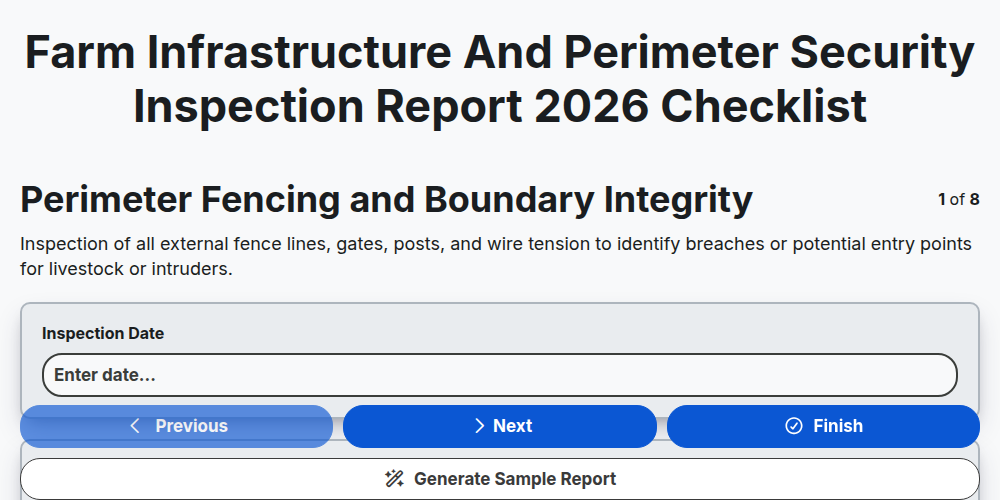
Table of Contents
- Introduction: Why a Proactive Inspection Strategy is Vital for 2026
- Setting the Foundation: Perimeter Fencing and Boundary Integrity
- Securing the Entryways: Gate and Access Point Functionality
- Enhancing Visibility: Surveillance and Lighting Systems Audit
- Structural Health: Building and Structure Structural Integrity
- Protecting Assets: Storage Facility and Warehouse Security
- Eliminating Blind Spots: Vegetation and Land Clearing Management
- Legal and Safety Standards: Signage and Warning Notice Compliance
- Rapid Response Readiness: Emergency Communication and Alarms
- Creating Your 2026 Maintenance Schedule and Documentation Workflow
- Conclusion: Mitigating Risk Through Consistent Oversight
- Resources & Links
TLDR: Ensure your farm remains secure and compliant in 2026 with our definitive inspection guide. This checklist provides a step-by-step walkthrough for auditing perimeter fencing, access points, surveillance, structural integrity, and emergency systems to prevent theft, mitigate hazards, and protect your agricultural assets.
Introduction: Why a Proactive Inspection Strategy is Vital for 2026
As we approach 2026, the agricultural landscape is facing a new era of challenges. From the increasing sophistication of agricultural theft and vandalism to the intensifying pressures of extreme weather patterns, the traditional set it and forget it approach to farm maintenance is no longer sufficient. For modern farm owners and managers, security is no longer just about a locked gate; it is about maintaining a seamless, integrated ecosystem of physical barriers, technological surveillance, and structural resilience.
The Shift Toward Proactive Risk Management
The transition from reactive repairs to proactive inspection is the cornerstone of modern farm management. Waiting for a fence to fail or a warehouse roof to leak before taking action is a costly strategy that exposes your livestock, high-value equipment, and crops to unnecessary risk. By implementing a structured, periodic inspection routine, you move away from crisis mode and into a state of operational readiness.
Why 2026 Demands a New Standard
In 2026, several factors make a comprehensive inspection report more critical than ever:
- Rising Asset Value: As precision agriculture technology and automated machinery become more integrated into daily operations, the financial value of the assets residing within your perimeter has skyrocketed.
- Increased Security Threats: Modern agricultural crime is becoming more organized. A vulnerability in your perimeter or a blind spot in your lighting can be exploited with alarming speed.
- Regulatory and Insurance Compliance: As insurance providers and regulatory bodies tighten their requirements, having a documented, verifiable record of your infrastructure's integrity is becoming a necessity for maintaining coverage and avoiding liability.
- Climate Resilience: With unpredictable weather patterns becoming the norm, the structural integrity of your buildings and the management of surrounding vegetation are vital to preventing catastrophic losses during storms or fire seasons.
The Goal of This Checklist
This guide is designed to serve as your operational blueprint. The following checklist is not merely a list of tasks, but a strategic framework intended to help you identify vulnerabilities before they become breaches, ensure your technology is functioning at peak performance, and maintain a secure, compliant, and resilient farming environment for the year ahead.
Setting the Foundation: Perimeter Fencing and Boundary Integrity
Securing the First Line of Defense
The perimeter of your farm is more than just a property line; it is your first and most critical line of defense against theft, livestock loss, and unauthorized trespassing. As we move into 2026, with evolving security technologies and increasing pressures on rural security, a set it and forget it mentality toward fencing is no longer sufficient. A robust inspection of your boundary integrity ensures that your physical barriers remain an impenetrable deterrent.
Identifying Vulnerabilities in the Perimeter
A thorough inspection begins with a physical sweep of the entire boundary. Small gaps can quickly become significant entry points for predators or intruders. When conducting your 2026 audit, focus on these critical areas:
- Fence Line Continuity: Check for breaks, holes, or sagging sections in wire fencing, chain link, or wooden rails. Even a small breach can undermine the security of the entire estate.
- Post and Support Stability: Inspect fence posts for signs of rot, leaning, or damage from heavy machinery and livestock impact. A fence is only as strong as the posts that hold it upright.
- Hardware and Fastener Integrity: Examine staples, clips, and tension wires. Over time, seasonal expansion and contraction can loosen these components, compromising the tension necessary to keep the fence effective.
- Ground-Level Integrity: Look for dig-under opportunities. Ensure that the bottom of the fence is secure enough to prevent small animals or pests from burrowing underneath the boundary.
The Cost of Neglect
Ignoring perimeter decay leads to more than just property damage; it leads to operational instability. Whether it is the loss of high-value livestock or the unauthorized entry of trespassers, a breach in your boundary integrity can result in significant financial repercussions and increased insurance liabilities. By implementing a systematic inspection of your fencing and boundaries, you transition from a reactive repair mode to a proactive protection mode, ensuring your farm remains a secure environment for years to come.
Securing the Entryways: Gate and Access Point Functionality
Ensuring Seamless Control and Site Integrity
The perimeter of your farm is only as strong as its weakest entry point. While fencing acts as your first line of defense, your gates and access points are the critical transition zones where security meets operational efficiency. A malfunctioning gate or an unsecured access point is an open invitation to unauthorized personnel, livestock escapes, and theft.
As we move into 2026, the integration of smarter, automated access solutions means your inspection needs to go beyond just checking for rust. Use this detailed breakdown to audit your entry points.
1. Mechanical and Structural Audit
Before assessing technology, you must ensure the physical components are sound.
- Hinge and Latch Integrity: Inspect all hinges for signs of heavy wear, corrosion, or misalignment. A gate that drags on the ground is a sign of structural fatigue.
- Driveway and Approach Stability: Check the ground surface leading to all gates. Ensure that heavy machinery or delivery trucks are not causing erosion or creating ruts that could obstruct a gate's swing or slide.
- Locking Mechanisms: Test every manual bolt, padlock, and latch. Ensure that high-security locks are not seized due to weather exposure and that they are compatible with your current security protocols.
2. Automated Systems and Power Reliability
For modern farms utilizing automated gate operators, a routine check is vital to prevent gate-down scenarios that halt farm logistics.
- Motor and Sensor Functionality: Test the sensitivity of safety sensors (photo-eyes). An improperly calibrated sensor can lead to gates closing prematurely on vehicles or failing to close entirely.
- Power Supply Redundancy: Verify that backup battery systems or solar-powered controllers are holding a charge. In the event of a 2026-grade storm or power outage, your primary access points must remain functional.
- Remote and App-Based Access: If you utilize smart-access technology, test the latency and connectivity of your mobile or remote-entry systems to ensure seamless operation from the field.
3. Traffic Management and Perimeter Continuity
Access points must be clearly defined to prevent perimeter creeping, where gaps form between the gate and the fixed fencing.
- Gap Analysis: Inspect the sweep area of gates to ensure there are no gaps large enough for small animals or unauthorized intruders to squeeze through.
- Secondary Access Points: Don't forget the forgotten entrances-service roads, utility access points, and emergency exits. Every entry point must be as rigorously inspected as your main driveway.
Enhancing Visibility: Surveillance and Lighting Systems Audit
Optimizing Your Farm's Digital and Visual Oversight
In the landscape of 2026's increasingly automated agricultural environment, surveillance and lighting are no longer extras-they are critical components of your farm's defensive perimeter. As technology evolves, a simple security camera is no longer enough; your inspection must evaluate how well your hardware integrates with your broader security ecosystem.
Surveillance System Integrity Check
When auditing your camera network, focus on the following critical touchpoints:
- Blind Spot Analysis: Conduct a physical walkthrough of the perimeter to identify new shadows or dead zones created by recent crop growth or new equipment placement.
- Sensor and Motion Calibration: Test all motion-activated sensors to ensure they are sensitive enough to detect intruders but smart enough to ignore small animals or wind-blown debris.
- Digital Connectivity and Storage: Verify that all wireless signals are stable and that NVR (Network Video Recorder) storage capacities are sufficient for the required retention period.
- Night Vision and IR Functionality: Test Infrared (IR) capabilities during the darkest hours of the night to ensure clear visibility when it matters most.
Strategic Lighting Deployment
Illumination acts as both a deterrent and an enabler for your surveillance tools. An effective lighting audit includes:
- Uniformity of Coverage: Check for dark pockets around entry points, grain silos, and tool sheds. Ensure light patterns overlap to prevent hiding spots.
- Motion-Activated Lighting Synchronization: Ensure that security lights are synced with your surveillance system to trigger simultaneous recording and high-intensity illumination.
- Hardware Weatherproofing: Inspect all external light fixtures for signs of corrosion, cracked lenses, or moisture ingress caused by seasonal weather shifts.
- Energy Efficiency and Durability: Assess the transition to LED or solar-powered smart lighting to ensure long-term sustainability and reduced maintenance overhead.
Structural Health: Building and Structure Structural Integrity
Maintaining the Backbone of Your Operations
When we discuss farm security, our minds often jump to gates and cameras, but the structural integrity of your permanent buildings is the first line of defense against both environmental hazards and unauthorized entry. In 2026, with increasingly unpredictable weather patterns and rising operational costs, a wait and see approach to maintenance is no longer viable. A single compromised roof or a cracked foundation can lead to catastrophic equipment loss or a breach in your facility's perimeter.
Key Areas of Focus for 2026 Inspections
To ensure your infrastructure remains a stronghold for your assets, your inspection should prioritize the following elements:
Foundation and Load-Bearing Walls
The stability of your farm's heavy-duty structures starts from the ground up. Inspect for:
- Settlement Cracks: Look for vertical or diagonal cracks in concrete foundations that may indicate shifting soil or drainage issues.
- Moisture Intrusion: Check the base of walls for signs of dampness or efflorescence (white powdery residue), which can signal that the structure is losing its ability to repel water.
- Structural Shifting: Ensure that load-bearing walls are not bowing or leaning, which could compromise the entire building's stability.
Roof and Overhead Protection
The roof is your primary shield against the elements. An inspection must include:
- Shingle and Metal Integrity: Check for loose, missing, or rusted panels that could allow water to penetrate and damage stored inventory.
- Gutter and Drainage Systems: Ensure that runoff is being directed away from the building to prevent foundation erosion.
- Ventilation Integrity: Inspect vents to ensure they are free of debris and pest intrusion, as compromised ventilation can lead to mold and structural rot.
Doors, Windows, and Entry Points
A building is only as secure as its weakest opening. During your 2026 audit, evaluate:
- Frame Alignment: Ensure all door frames are square and not warped. A misaligned door is an invitation for forced entry.
- Hardware Functionality: Test all hinges, deadbolts, and heavy-duty latches. In an era of advanced theft techniques, mechanical reliability is non-negotiable.
- Window Glazing and Seals: Check for cracked panes or degraded seals that could allow environmental elements or intruders to bypass your security perimeter.
Identifying Hidden Risks
Modern inspections should also look beyond the visible. Use this time to check for signs of pest nesting in structural voids and ensure that any recent renovations have not introduced new vulnerabilities into the building's envelope. By documenting these structural details now, you can move from reactive repairs to a proactive, cost-saving maintenance strategy.
Protecting Assets: Storage Facility and Warehouse Security
Securing the Heart of Your Operations
Your storage facilities and warehouses are the most critical points of vulnerability on any modern farm. These structures house your high-value assets-from expensive machinery and implements to seasonal harvests, fertilizers, and sensitive seed stocks. A breach in warehouse security doesn't just result in loss of inventory; it can disrupt your entire supply chain and jeopardize the upcoming season's profitability.
As we move into 2026, security standards are evolving. It is no longer enough to simply lock a door; you must ensure a multi-layered approach to containment and monitoring.
Key Inspection Focus Areas
To ensure your storage assets remain protected, your 2026 inspection should prioritize the following elements:
1. Physical Access Control and Entry Points
The first line of defense is the integrity of your doors, windows, and loading bays.
- Locking Mechanisms: Inspect all deadbolts, padlocks, and electronic strike plates. Check for signs of tampering or forced entry attempts.
- Door Seals and Gaps: Ensure there are no gaps large enough for unauthorized entry or the introduction of pests that could damage stored goods.
- Window Integrity: Verify that all window panes are intact and that secondary security films or bars are securely anchored.
2. Environmental and Climate Monitoring
Security isn't just about preventing theft; it is about protecting the integrity of the product from environmental degradation.
- Temperature and Humidity Control: Test all sensors and automated climate control systems. In 2026, real-time data logging is essential for compliance and insurance purposes.
- Moisture Detection: Inspect roofs and foundations for leaks that could lead to mold, rot, or equipment corrosion.
3. Inventory Management and Asset Tracking
A secure warehouse is one where you know exactly what is on hand at all times.
- Digital Inventory Reconciliation: Cross-reference physical stock with your digital management systems to identify phantom losses early.
- High-Value Asset Tagging: Ensure that high-value implements and chemical stocks are properly tagged and integrated into your tracking software.
4. Internal Surveillance Coverage
While perimeter cameras watch the borders, internal cameras must monitor the aisles.
- Blind Spot Analysis: Walk your warehouse floor to identify any areas where shadows or racking structures might obstruct camera views.
- System Functionality: Verify that motion-activated recording is functioning correctly and that footage is being backed up to a secure, off-site, or cloud-based location to prevent data loss during a localized incident.
Eliminating Blind Spots: Vegetation and Land Clearing Management
Maintaining Clear Lines of Sight
In the context of perimeter security, vegetation is a double-edged sword. While thick hedges and treelines can act as natural windbreaks, overgrown flora is one of the most common blind spots that can compromise your entire security strategy. For the 2026 inspection season, your primary goal is to ensure that your landscape supports, rather than obscures, your surveillance and monitoring efforts.
The Risk of Overgrowth and Concealment
Unmanaged vegetation near fences, gates, and buildings creates ideal hiding spots for unauthorized individuals or wildlife. During your inspection, specifically look for:
- Line-of-Sight Obstructions: Ensure that trees or large shrubs are not blocking the field of view for your CCTV cameras or motion sensors.
- Structural Encroachment: Check for climbing vines or heavy branches pressing against building exteriors and fences, which can weaken structural integrity or create easy access points for intruders.
- Hideouts Near Entry Points: Inspect areas around gates and access points to ensure there is no dense brush that could allow someone to linger undetected.
Strategic Clearing and Maintenance Standards
To maintain a high standard of site security, implement the following clearing protocols:
- The 3-Foot Rule: Aim to keep grass and low-lying weeds trimmed to a low profile near all perimeter fencing. This makes movement along the boundary line visible from a distance.
- Tree Canopy Management: Prune lower branches of trees to prevent tunneling effects, where a darkened path is created beneath a dense canopy, obscuring the ground level from overhead or distant view.
- Buffer Zones: Maintain a clear, defensible space around high-value storage facilities and warehouses. A gravel or cleared dirt perimeter around these structures acts as both a firebreak and a visual warning zone.
Managing Seasonal Growth
A checklist is not a one-time event. In 2026, your management plan should account for rapid growth periods. Regular inspections during peak growing seasons are essential to ensure that a well-maintained perimeter in the spring doesn't become a security liability by late summer. Continuous monitoring of vegetation ensures that your investment in high-tech surveillance and robust fencing is never undermined by simple neglect.
Legal and Safety Standards: Signage and Warning Notice Compliance
Navigating the Regulatory Landscape of Farm Signage
In 2026, the landscape of agricultural liability and safety compliance has become more stringent than ever. Maintaining a secure perimeter is not just about physical barriers; it is about clear, legal communication. When an unauthorized individual or a contractor enters your property, your first line of defense against legal liability is the clarity of your warning notices.
The Role of Signage in Risk Mitigation
Effective signage serves two critical purposes: deterrence and documentation. From a security standpoint, No Trespassing and Private Property signs act as psychological barriers that signal a monitored and managed environment. From a legal standpoint, properly placed signs establish the duty of care you have fulfilled to warn others of potential hazards.
As part of your 2026 inspection, you must ensure that your signage meets the latest regional and national standards for visibility, durability, and legibility.
Key Inspection Points for Signage Compliance
To ensure your farm remains compliant and your liability remains low, use the following sub-checklist during your inspection:
Visibility and Placement Audit
Line of Sight: Are signs visible from the primary road approach and all secondary access points?
Obstruction Check: Have overgrown vegetation or seasonal crops obscured any previously visible warning notices?
Distance Requirements: Are warning signs placed at a sufficient distance from high-risk areas (such as chemical storage or heavy machinery zones) to allow for adequate reaction time?
Legibility and Material Integrity
Weathering and Fading: UV exposure can render warning text unreadable over time. Check for faded lettering that no longer clearly communicates the message.
Structural Stability: Ensure signs are securely mounted. A fallen or leaning sign is not only a sign of neglect but is legally indefensible in a trespass or injury claim.
Reflective Properties: For night-time security, verify that perimeter signs possess enough reflectivity to be seen under headlight illumination.
Content Accuracy and Regulatory Alignment
Hazard Specificity: Ensure that signs for specific risks-such as Danger: High Voltage, Chemical Storage, or Beware of Livestock-are updated to reflect the current usage of those specific areas.
Language Accessibility: In increasingly diverse agricultural regions, consider whether your warning notices are understandable to non-native speakers to ensure maximum safety coverage.
Compliance with New 2026 Standards: Verify that your signage follows the most recent updates to local agricultural safety codes regarding symbol usage and font size requirements.
The Cost of Neglect
Ignoring signage compliance can lead to devastating consequences, ranging from increased insurance premiums to significant legal judgments in the event of an accident. A thorough inspection of your warning notices ensures that your perimeter security is not just a physical boundary, but a legally fortified perimeter.
Rapid Response Readiness: Emergency Communication and Alarms
The Critical Link in Farm Defense
In the modern agricultural landscape, physical barriers like fences and gates are only as effective as the communication systems that support them. When a breach occurs or a structural failure is detected, the speed of your response determines whether a minor incident remains a minor inconvenience or escalates into a catastrophic loss.
As we look toward 2026, smart integration is no longer a luxury-it is a necessity for operational continuity. This section of your inspection focuses on ensuring that your alarm systems and communication protocols are functional, redundant, and capable of bridging the gap between detection and action.
Essential Inspection Points for 2026
To ensure your farm is prepared for immediate action, your inspection report must verify the following:
Alarm System Functionality and Connectivity:
Test all perimeter breach sensors, motion detectors, and contact sensors for immediate activation.
Verify that all wireless sensors have optimal signal strength and are not being blocked by new structural developments or dense vegetation.
Check battery backups for all localized alarms to ensure functionality during power outages.
Communication Redundancy:
Primary and Secondary Channels: Ensure that automated alerts are sent via multiple paths (e.g., Cellular, Wi-Fi, and Radio) to prevent a single point of failure.
Notification Audits: Confirm that all designated stakeholders-farm managers, security personnel, and local authorities-are receiving real-time notifications without delay.
Audible and Visual Alert Integration:
Assess the decibel levels of site-wide sirens to ensure they are audible even during high-wind conditions or heavy machinery operation.
Verify that strobe lights or visual indicators are functional in high-noise areas where audio alarms might be missed.
Integration with Surveillance Systems:
Evaluate the Trigger-to-Record latency: When an alarm is tripped, does the surveillance system instantly pin-point that specific camera feed to your mobile device or monitoring station?
The 2026 Compliance Standard
As security technology evolves, your inspection must move beyond simply checking if a siren makes noise. You must verify the integrity of the loop. An alarm that rings but fails to notify the owner is a failure of the system. Use this checklist to document not just the presence of equipment, but the reliability of the entire communication ecosystem.
Creating Your 2026 Maintenance Schedule and Documentation Workflow
Strategic Planning for the Upcoming Inspection Cycle
As we approach 2026, the complexity of modern farming requires moving beyond reactive repairs toward a proactive maintenance culture. A successful inspection is not merely about identifying broken fences or dim lights; it is about establishing a documented history of risk mitigation. To ensure your farm remains resilient against theft, wildlife intrusion, and structural failure, your inspection schedule must be integrated into your annual operational calendar.
Integrating Inspections into the Seasonal Workflow
To prevent inspection fatigue, do not treat the 2026 checklist as a single, overwhelming annual event. Instead, distribute your evaluation points across the seasonal shifts in your farming operations:
- Pre-Planting/Early Spring: Focus on Perimeter Fencing and Boundary Integrity and Vegetation Management. Clearing overgrown brush before the growing season begins ensures that sightlines remain unobstructed for surveillance.
- Mid-Season/Peak Production: Prioritize Gate and Access Point Functionality and Signage Compliance. With increased personnel and contractor movement on-site, ensuring access control is critical.
- Post-Harvest/Late Autumn: Concentrate on Building Structural Integrity, Storage Facility Security, and Surveillance and Lighting Systems. As assets are moved into storage, the focus shifts to long-term protection and monitoring.
Establishing a Digital Documentation Workflow
The 2026 standard for farm management relies heavily on audit-ready documentation. Moving away from paper logs to digital inspection reports provides several critical advantages:
1. Real-Time Incident Tracking
By utilizing a digital checklist, any identified vulnerability-such as a failing alarm sensor or a breach in the perimeter-can be immediately converted into a Work Order. This creates a closed-loop system where an inspection failure automatically triggers a repair task.
2. Evidence-Based Compliance
In the event of an insurance claim or a regulatory audit, having time-stamped, photo-documented reports of your Emergency Communication and Alarm tests and Warehouse Security checks provides undeniable proof of due diligence.
3. Data-Driven Budgeting
Aggregating your inspection data over the 2026 cycle allows you to identify patterns. If the same Gate and Access Point requires repairs every quarter, your documentation will provide the financial justification needed to transition from repetitive repairs to a full capital replacement.
Setting the Standard for 2026
The goal of this workflow is to transform your inspection from a to-do list into a strategic asset. By documenting every aspect of your infrastructure-from the smallest warning sign to the largest warehouse structure-you are not just maintaining a farm; you are securing a legacy.
Conclusion: Mitigating Risk Through Consistent Oversight
Turning Inspection Data into Actionable Security
A checklist is only as valuable as the actions taken following its completion. As we move into 2026, the increasing integration of smart technology and evolving environmental challenges means that a one-and-done approach to farm security is no longer sufficient. The data gathered during your Perimeter Fencing, Surveillance, and Structural Integrity inspections should serve as the foundation for your annual capital expenditure (CAPEX) planning and your seasonal maintenance schedule.
Moving from Reactive to Proactive Maintenance
The goal of conducting these regular audits is to shift your operational stance from reactive-fixing broken gates or replacing collapsed fences after a breach has occurred-to proactive. By identifying a failing light fixture in your Surveillance and Lighting Systems or a breach in Vegetation Management before they become vulnerabilities, you effectively close the window of opportunity for unauthorized access and theft.
Creating a Culture of Accountability
To truly maximize the effectiveness of this checklist, consider the following implementation strategies:
- Digitize Your Reports: Move away from paper logs. Use digital inspection tools that allow for timestamped photos of structural issues or gate malfunctions. This creates a verifiable audit trail for insurance compliance.
- Assign Ownership: Don't just identify a problem; assign it. Ensure that every flagged item in the Emergency Communication or Signage Compliance sections has a designated staff member and a deadline for resolution.
- Seasonal Iterations: Use this checklist as a living document. Re-run the Building and Structure and Storage Facility audits specifically before the peak harvest season and before the onset of winter to prepare for extreme weather stressors.
The Long-Term Value of Compliance
Ultimately, a rigorous inspection regime does more than just protect your physical assets; it protects your bottom line and your peace of mind. Comprehensive oversight ensures that your Gate and Access Point Functionality and Warning Notice Compliance meet the highest standards of modern agricultural safety. By committing to this systematic approach, you are not just maintaining a farm; you are fortifying an enterprise against the unpredictable risks of the future.
Resources & Links
- OSHA (Occupational Safety and Health Administration): The primary authority for workplace safety standards, essential for ensuring farm structural integrity and signage compliance.
- FEMA: Resources for disaster preparedness and infrastructure resilience, vital for planning against extreme weather impacts on farm perimeters.
- USDA Natural Resources Conservation Service: Guidance on land management, including vegetation control and soil stability, which impacts perimeter fencing and boundary integrity.
- USDA Agricultural Marketing Service: Information regarding regulatory compliance and standards that affect farm operations and asset protection.
- CISA (Cybersecurity and Infrastructure Security Agency): Critical for auditing the digital security of modern surveillance, lighting, and automated gate systems in 2026.
- NFPA (National Fire Protection Association): Essential standards for farm lighting, electrical systems, and emergency alarm functionality to prevent fire hazards.
- AgDaily: Industry news and trends regarding agricultural technology and modern farm management practices.
- Security Magazine: In-depth insights into the latest surveillance technology, access control systems, and perimeter security innovations.
- Forbes (AgTech Section): Perspectives on the economic impact of farm automation and the ROI of proactive infrastructure maintenance.
- Cooperative Extension System: University-led research and practical checklists for managing farm facilities and structural health.
- ASIS International: Professional organization for security practitioners, providing best practices for physical security and asset protection.
- Esri (GIS Software): Tools for mapping farm boundaries, monitoring vegetation growth, and managing large-scale perimeter inspections using spatial data.
- AgTech Innovation Hubs: Resources for staying updated on the 2026 landscape of automated farm monitoring and drone-based inspections.
- ISO (International Organization for Standardization): Global standards for safety management systems and documentation workflows for large-scale agricultural operations.
- NOAA Climate.gov: Weather forecasting data essential for scheduling seasonal inspections and preparing for seasonal vegetation management.
Comments
There are no comments yet. Be the first to add one!
Agriculture Management Solution Demo
Running a farm or agricultural business is complex. ChecklistGuro's Work OS platform simplifies your operations, from crop planning and irrigation management to livestock tracking and harvest scheduling. Increase efficiency, reduce waste, and boost yields! See how ChecklistGuro can revolutionize your agriculture business.
Related Articles
10 Simple Steps to a Healthy Drainage System: Your Checklist Template

Mastering the Daily Crop Scouting Report: Your [Specific Crop] Checklist Template
Irrigation System Checklist: Farm Water Management & Crop Yield Optimization
Unlock Your Garden's Potential: A Soil pH Verification Checklist
PPE Usage Checklist Template: Your Guide to Safety
Water Discharge Permit Compliance Checklist Template
The Ultimate GPS & Precision Farming Calibration Checklist Template
Water Runoff Analysis Checklist Template
Need help with
Agriculture?
Have a question? We're here to help. Please submit your inquiry, and we'll respond promptly.