Ensuring Accuracy & Compliance: Your Healthcare Lab Procedure Checklist for Quality Control & Documentation
Published: 11/28/2025 Updated: 07/02/2026
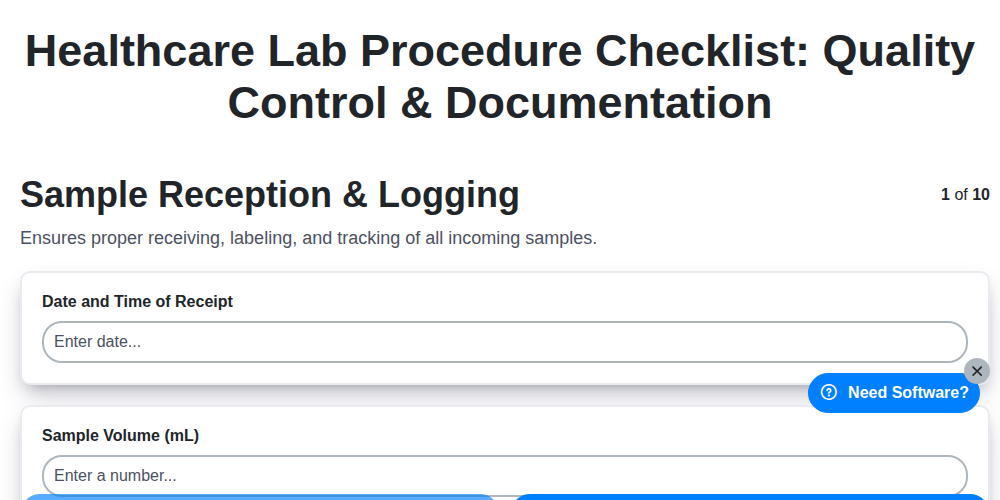
Table of Contents
- Introduction: The Importance of a Robust Lab Procedure Checklist
- 1. Sample Reception & Logging: The Foundation of Accurate Results
- 2. Equipment Calibration & Maintenance: Keeping Instruments Precise
- 3. Reagent Preparation & Storage: Ensuring Chemical Integrity
- 4. Procedure Execution & Data Recording: Precision in Action
- 5. Quality Control Samples & Validation: Monitoring Performance
- 6. Result Verification & Reporting: Accuracy and Transparency
- 7. Documentation & Record Keeping: Your Audit Trail
- Resources & Links
TLDR: Running a healthcare lab? This checklist template is your new best friend! It covers everything from sample handling to waste disposal, ensuring quality control, accurate data recording, and full compliance. Download it to streamline your processes, reduce errors, and boost overall lab performance.
Introduction: The Importance of a Robust Lab Procedure Checklist
In healthcare laboratories, precision and accuracy are non-negotiable. A single error in sample handling, equipment operation, or data interpretation can have serious consequences for patient diagnosis and treatment. That's why a comprehensive and consistently followed checklist for lab procedures isn't just a good practice-it's a vital safeguard. This article dives deep into a detailed checklist designed to bolster quality control and documentation within your lab. We'll explore each step, highlighting why meticulous adherence is paramount for reliable results, regulatory compliance, and, most importantly, patient safety. Implementing a robust checklist ensures consistency, minimizes human error, and provides a traceable record of every step taken, reinforcing the integrity of your lab's processes.
1. Sample Reception & Logging: The Foundation of Accurate Results
The journey of a reliable lab result begins the moment a sample arrives. Proper sample reception and logging aren't just administrative tasks; they are critical steps in ensuring data integrity and preventing errors that can cascade through the entire testing process.
Here's what a robust checklist should include:
- Verification of Patient Identification: Meticulously verify the patient's name, date of birth, and any unique identifiers against the requisition form. Discrepancies must be resolved before proceeding.
- Sample Type Confirmation: Confirm the sample type matches the requisition. Incorrect sample type leads to inaccurate results and potential patient harm.
- Date and Time of Reception: Record the exact date and time the sample arrived. This is essential for tracking sample stability and identifying potential delays.
- Sample Condition Assessment: Note the sample's condition - color, clarity, presence of clots (for blood samples), etc. Unusual observations should be documented.
- Unique Sample Identifier Assignment: Assign a unique laboratory accession number and clearly label the sample container. Barcode scanners are highly recommended for accuracy and efficiency.
- Requisition Form Matching: Ensure the sample is linked to the corresponding requisition form, and both are properly filed.
- Chain of Custody Documentation: If applicable (e.g., forensic testing), maintain a detailed chain of custody record.
- Immediate Storage: Store the sample under appropriate conditions (temperature, light exposure) as specified by the testing procedure.
Implementing these steps consistently minimizes the risk of misidentification and ensures the sample's integrity from the outset.
2. Equipment Calibration & Maintenance: Keeping Instruments Precise
Maintaining the accuracy and reliability of laboratory instruments is paramount in healthcare. Even minor deviations in instrument performance can lead to inaccurate results, impacting patient diagnosis and treatment. A robust equipment calibration and maintenance program is therefore not just a best practice, it's a necessity.
Why is Calibration & Maintenance Crucial?
- Accuracy & Reliability: Regular calibration ensures instruments deliver results within acceptable tolerances, minimizing errors.
- Regulatory Compliance: Accreditation bodies (like CLIA and CAP) mandate calibration and maintenance schedules.
- Extended Instrument Lifespan: Proactive maintenance prevents breakdowns and extends the useful life of valuable equipment.
- Cost Savings: Preventing costly repairs and instrument replacements through preventative measures.
Key Components of a Solid Program:
- Calibration Schedule: Implement a clearly defined schedule for each instrument, based on manufacturer recommendations, usage frequency, and regulatory guidelines.
- Qualified Personnel: Calibration and maintenance should be performed by trained and qualified personnel, either in-house or through certified external vendors.
- Standard Operating Procedures (SOPs): Develop and follow detailed SOPs for each calibration and maintenance task.
- Calibration Standards: Utilize traceable calibration standards that are regularly verified.
- Documentation: Meticulously document all calibration activities, including dates, results, technician's initials, and any corrective actions taken. This documentation should be readily available for audits.
- Preventative Maintenance: Follow manufacturer-recommended preventative maintenance schedules, including cleaning, lubrication, and filter replacements.
- Performance Checks: Regularly perform performance checks between calibrations to identify potential drift or issues.
- Retraining: Provide ongoing training for personnel performing calibration and maintenance procedures to ensure competency.
A well-documented and consistently followed equipment calibration and maintenance program is a cornerstone of quality laboratory practices and ultimately contributes to improved patient care.
3. Reagent Preparation & Storage: Ensuring Chemical Integrity
Reagents are the lifeblood of any clinical laboratory, and their quality directly impacts the accuracy and reliability of test results. Improper preparation and storage can lead to degradation, contamination, and ultimately, erroneous data. This section outlines best practices for reagent handling, ensuring their integrity and suitability for analysis.
Preparation:
- Strict Adherence to Instructions: Always follow the manufacturer's instructions precisely for reconstitution, dilution, and preparation. Deviations, even seemingly minor ones, can significantly alter reagent performance.
- Use Purified Water: Use only high-purity water (e.g., distilled, deionized, or reverse osmosis) for reagent preparation. Contaminants in tap water can interfere with reactions.
- Appropriate Containers: Use clean, properly labeled containers specifically designed for reagent storage. Glass or inert plastic is generally preferred.
- Aseptic Technique: When preparing reagents prone to microbial growth, maintain strict aseptic technique to prevent contamination. This includes working in a clean area, using sterile equipment, and wearing appropriate personal protective equipment (PPE).
- Accurate Weighing and Measurement: Ensure accurate measurement of all components using calibrated balances and volumetric glassware.
Storage:
- Temperature Control: Store reagents at the manufacturer's recommended temperature. Many reagents require refrigerated or frozen storage to maintain stability. Continuously monitor and record storage temperatures.
- Light Sensitivity: Protect light-sensitive reagents from direct sunlight and fluorescent lighting. Store them in amber-colored containers or in dark cabinets.
- Expiration Dates: Strictly adhere to expiration dates. Discard reagents past their expiration date, regardless of appearance. Implement a system for tracking expiration dates (e.g., date labeling, automated inventory systems).
- Proper Labeling: Clearly label all reagents with the name, concentration, date of preparation, preparer's initials, and expiration date.
- Segregation: Segregate incompatible reagents to prevent accidental reactions. Refer to the Safety Data Sheet (SDS) for information on chemical compatibility.
- Inventory Management: Implement a "First-Expiry, First-Out" (FEFO) inventory system to ensure older reagents are used before newer ones. Regularly inspect reagent stock for signs of degradation or contamination.
4. Procedure Execution & Data Recording: Precision in Action
Accurate and consistent data recording is the backbone of reliable laboratory results. This section details the critical steps to ensure procedure execution aligns with established protocols and data is captured precisely.
Checklist Items & Key Considerations:
- Strict Adherence to SOPs: Each lab professional must meticulously follow the Standard Operating Procedures (SOPs) for each test performed. Deviations, even seemingly minor, can significantly impact results.
- Patient/Sample Identification: Double-check patient and sample identification before commencing any testing. Misidentification is a serious error. Use multiple identifiers (name, DOB, medical record number) and confirm with a second qualified person when appropriate.
- Reagent & Solution Verification: Verify reagent and solution labels, lot numbers, and expiration dates before use. Record these details alongside the test results.
- Data Entry - Legibility & Completeness: Ensure all data entered into the Laboratory Information System (LIS) or recorded manually is legible, complete, and accurate. Avoid abbreviations unless they are explicitly defined in SOPs. Use standardized units of measurement.
- Real-Time Data Recording: Record observations and results immediately after each step of the procedure. Avoid relying on memory - it's prone to error.
- Witnessing & Signatures: Implement a witnessing or signature requirement for critical steps within the procedure, particularly when deviations from SOPs occur.
- LIS Integration: Utilize the full capabilities of your LIS to automate data entry, calculations, and flagging potential errors.
- Electronic vs. Paper Records: Maintain consistency between electronic and paper records. If both are used, ensure synchronization and reconciliation procedures are in place.
- Error Detection: Implement checks and balances during data entry to detect and correct errors promptly.
5. Quality Control Samples & Validation: Monitoring Performance
Maintaining accuracy and reliability in a healthcare lab hinges on rigorous quality control (QC) practices. This isn't just about following procedures; it's about actively verifying that those procedures are producing consistently accurate results. Quality control samples and validation are critical components of this ongoing monitoring process.
What are Quality Control Samples?
These are known samples with established, verifiable values. They are run alongside patient samples during routine testing. They serve as a benchmark to ensure our assays are performing as expected. Different types of QC samples exist, including:
- Level 1, 2, and 2+ Controls: These represent different concentrations to assess performance across the assay's analytical range.
- Proficiency Testing Samples: External samples provided by accreditation bodies to evaluate lab performance against peer groups.
- Internal Quality Control Samples: Samples prepared and analyzed within the lab to monitor daily performance.
Validation: Ensuring Method Reliability
Validation goes beyond routine QC. It's a process confirming that a test method is fit for its intended use. This involves assessing key performance characteristics like accuracy, precision, linearity, sensitivity, and specificity. Initial validation is performed when a new method is introduced. Periodic revalidation is essential, typically at least every year, or after any significant changes to reagents, equipment, or procedures.
The QC/Validation Process - A Checklist-Driven Approach:
- Run QC Samples with Each Run: Adhere strictly to established QC frequency guidelines.
- Document QC Results: Accurately record all QC values, lot numbers, and run identifiers.
- Evaluate QC Performance: Compare QC results against established limits. Utilize Levey-Jennings charts or similar tools for visual analysis of trends.
- Investigate Out-of-Control Results: Immediately investigate any QC results that fall outside established limits. Determine the root cause and implement corrective actions.
- Document Deviations & Actions: Thoroughly document all deviations from expected QC performance and the corrective actions taken.
- Retain QC Materials: Properly store QC materials with their associated documentation for traceability and future reference.
Consistent adherence to these practices safeguards the integrity of our results, ultimately contributing to patient safety and accurate diagnoses.
6. Result Verification & Reporting: Accuracy and Transparency
Ensuring the accuracy and clarity of reported results is paramount in healthcare laboratories. This section of the checklist focuses on meticulous verification processes and transparent reporting practices.
Verification Steps:
- Independent Review: A second qualified technologist must review all results for plausibility, accuracy, and consistency with patient history and previous results. This review should be documented.
- Delta Checks: Implement and rigorously follow delta check procedures, especially for results that reflect changes over time. Investigate and resolve any significant delta changes.
- Critical Value Review: Establish clear criteria for identifying and reporting critical values. Ensure prompt notification to the requesting physician following established protocols, with appropriate documentation of notification.
- Units and Significant Figures: Double-check all reported results for correct units and adherence to appropriate significant figures.
- Laboratory Information System (LIS) Validation: Verify the accuracy of data transfer and calculations within the LIS. Validate that automated calculations are correct and documented.
- Reporting Format: Ensure results are reported in a clear, concise, and standardized format, adhering to laboratory protocols and regulatory guidelines. Include relevant flags or warnings when necessary.
- Turnaround Time (TAT) Monitoring: Track and monitor TAT for each test. Investigate and address any deviations from established targets.
Transparency Considerations:
- Limitations & Uncertainties: When results have limitations or uncertainties (e.g., due to sample condition or assay sensitivity), clearly communicate these to the requesting clinician.
- Reference Ranges: Ensure reference ranges are appropriate for the patient population and clearly stated with all reported values.
- Methodology Information: Provide adequate information about the methodology used in the analysis, especially when reporting novel or complex tests.
7. Documentation & Record Keeping: Your Audit Trail
Robust documentation and record keeping are the backbone of any quality healthcare lab. It's not just about ticking boxes; it's about building a comprehensive audit trail that demonstrates adherence to protocols, ensures traceability, and allows for ongoing improvement.
Here's what meticulous record-keeping in a lab should encompass:
- Sample Reception Logs: Detailed records of samples received, including patient identifiers, date and time received, and initial condition.
- Calibration & Maintenance Records: Dates, results, and personnel involved in equipment calibration and maintenance. Include any deviations from expected performance.
- Reagent Records: Lot numbers, expiration dates, preparation dates, and initials of the preparer for all reagents.
- Procedure Worksheets: Clearly documented steps taken for each procedure, including dilutions, incubation times, and any deviations from the standard operating procedure (SOP).
- Quality Control Data: Complete records of QC sample results, including dates, results, and corrective actions taken if out of range.
- Result Verification Records: Documentation of the review and approval process for patient results, including initials of the reviewer.
- Method Validation Reports: Records from initial and ongoing method validation studies, demonstrating accuracy, precision, and linearity.
- Incident Reports & Corrective Actions: Comprehensive documentation of any incidents, errors, or deviations, along with detailed corrective actions taken and verification of effectiveness.
- Training Records: Documentation of employee training on procedures, equipment, and safety protocols.
Key Considerations:
- Legibility & Accuracy: Ensure all records are clear, legible, and accurately reflect the procedure.
- Timeliness: Records should be completed contemporaneously with the activity.
- Secure Storage: Maintain records in a secure location with limited access, both physical and electronic.
- Retention Policy: Adhere to established retention policies for both physical and electronic records, complying with regulatory requirements.
- Electronic Systems: If using an LIS or other electronic system, ensure data integrity and security are maintained. Regularly back up data and implement access controls.
Consistent and detailed record-keeping isn't just a regulatory requirement; it's vital for maintaining quality, ensuring patient safety, and demonstrating lab competency.
Resources & Links
- CDC Laboratory Quality Assurance Checklist: A comprehensive checklist from the CDC, covering various aspects of lab quality assurance, offering a broad overview applicable to many lab procedures and a useful reference point for understanding key areas to address. Provides a framework relevant to your introduction section and generally applicable to all headers.
- College of American Pathologists (CAP): CAP provides accreditation and proficiency testing for laboratories. Their website offers resources on quality assurance, accreditation standards, and guidelines for laboratory personnel - relevant to overall compliance and quality control, particularly useful for sections 6 & 7 on reporting and documentation.
- U.S. Food and Drug Administration (FDA): The FDA regulates laboratory practices and medical devices. Their website has information on Good Laboratory Practice (GLP) and other regulations that influence lab procedure compliance. Important for legal context especially pertaining to reagent sourcing and equipment.
- National Institute of Standards and Technology (NIST): NIST develops standards and guidelines for measurement and calibration. Highly relevant to section 2 (Equipment Calibration & Maintenance), providing foundational information on metrology and instrument accuracy.
- Thermo Fisher Scientific: A major supplier of laboratory reagents and equipment. Their website often contains application notes, technical documents, and best practices guides for reagent handling and storage (section 3), as well as information regarding equipment maintenance and calibration.
- Merck KGaA, Life Science: Similar to Thermo Fisher, Merck offers a wide range of reagents, consumables, and equipment. Their website provides detailed product information, safety data sheets (SDS), and technical guidance crucial for reagent preparation and storage (section 3).
- Agilent Technologies: Agilent specializes in analytical instrumentation and provides extensive technical resources. Valuable for sections 2, 4, and 5, covering instrument calibration, procedure execution, and quality control validation.
- My Quality Assurance: Offers comprehensive checklists, templates, and training materials for quality assurance in various industries, including healthcare. Provides practical tools that can be adapted to your lab's procedures, supporting documentation and audit trail requirements (section 7).
- SOP Writing Services: Provides templates and resources for creating Standard Operating Procedures (SOPs). Highly relevant for detailing all your procedures to ensure consistency and documentation requirements in all areas covered by your headers. Useful for establishing an effective audit trail (section 5).
- ProMark Labs: Provides laboratory consulting services, including quality assurance program development and validation. Provides expert insight into quality management system design and execution, applicable throughout all sections and contributing to a stronger compliance framework.
Frequently Asked Questions
What is the purpose of a healthcare lab procedure checklist?
A procedure checklist ensures consistency, accuracy, and compliance in lab processes. It minimizes errors, promotes standardization, facilitates training, and provides a documented record of adherence to established protocols, vital for quality control and regulatory compliance.
Who should use a lab procedure checklist?
All lab personnel involved in performing procedures, including technicians, scientists, and researchers, should use checklists. Supervisors and quality assurance teams can also utilize them for monitoring adherence and identifying areas for improvement.
What types of procedures should be included in a checklist?
Any procedure that carries significant risk of error or has specific regulatory requirements should be included. Examples include specimen handling, instrument calibration, quality control testing, complex assays, and procedures involving patient safety risks. Prioritize based on criticality and potential impact.
What are the key elements of a well-designed lab procedure checklist?
A good checklist includes clear, concise steps, defined responsibilities, measurable criteria (e.g., temperature ranges, time limits), required documentation, designated initials/signatures for verification, and a system for noting deviations and corrective actions.
How can I create a lab procedure checklist?
Start by reviewing existing SOPs (Standard Operating Procedures). Break down procedures into discrete, sequential steps. Involve lab personnel in the development process for buy-in and accuracy. Use simple language and avoid ambiguity. Review and update regularly.
How often should lab procedure checklists be reviewed and updated?
Checklists should be reviewed at least annually, or more frequently if there are changes to protocols, equipment, regulations, or if errors or near misses occur. Changes should be documented with a version control system.
What is the difference between a checklist and an SOP?
An SOP is a detailed written document outlining the complete procedure. A checklist is a condensed, step-by-step guide derived from the SOP, designed for real-time verification and documentation during execution. The checklist reinforces the SOP.
What is the importance of documentation on a lab procedure checklist?
Documentation is critical for demonstrating compliance, tracking deviations, identifying trends, and supporting investigations. Accurate records provide evidence of adherence to quality standards and facilitate continuous improvement.
What should I do if a deviation from the checklist occurs?
Immediately document the deviation, the reason for the departure from the procedure, and any corrective actions taken. Report the deviation to the appropriate supervisor or quality assurance team, following established incident reporting protocols.
How do I ensure that lab personnel are properly trained on using checklists?
Training should cover the purpose of checklists, how to use them effectively, the importance of accurate documentation, and the process for reporting deviations. Regular refresher training and competency assessments are recommended.
What are some common regulatory requirements related to lab procedure checklists?
Requirements vary by jurisdiction and accreditation body (e.g., CLIA, CAP, ISO). Common regulations emphasize standardized procedures, documented quality control, and adherence to established protocols. Familiarize yourself with applicable regulations.
Comments
There are no comments yet. Be the first to add one!
Healthcare Management Solution Demo
Streamlining healthcare operations and improving patient care? ChecklistGuro's Work OS platform simplifies everything from patient scheduling and billing to compliance and staff management. Enhance efficiency, reduce administrative burden, and focus on what matters most: your patients. Learn how ChecklistGuro can transform your healthcare organization!
Related Articles
The Ultimate Healthcare Patient Satisfaction Survey Checklist Template
Mastering Healthcare Inventory: Your Par Level Checklist Template
Mastering Hand Hygiene: Your Compliance Checklist Template
Protecting Patients: Your Fire Safety Checklist for Patient Areas
Your Ultimate Healthcare Construction Checklist Template
Mastering Hand Hygiene: Your Compliance Checklist Template
Your Radiology Equipment Maintenance Checklist Template

Your Ultimate Guide to Healthcare Waste Management: A Checklist Template
Need help with
Healthcare?
Have a question? We're here to help. Please submit your inquiry, and we'll respond promptly.