The Ultimate Healthcare Medical Staff Credentialing & Privileging Checklist 2026: A Complete Compliance Template
Published: 10/31/2026 Updated: 11/01/2026
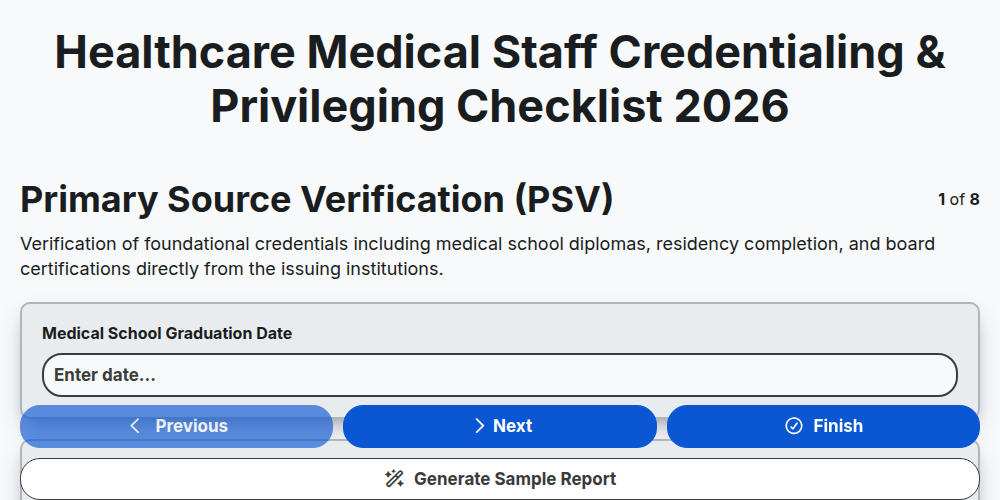
Table of Contents
- Introduction: Navigating the 2026 Regulatory Landscape
- The Critical Importance of Rigorous Credentialing in Modern Healthcare
- 1. Primary Source Verification (PSV): The Foundation of Trust
- 2. Comprehensive Licensure & Registration Audit
- 3. Professional Background & Sanctions Check: Mitigating Risk
- 4. Assessing Clinical Competency & Implementing Peer Review
- 5. Insurance & Malpractice Verification Protocols
- 6. Defining Privileging Scope & Clinical Duty Parameters
- 7. Immunization & Health Screening Compliance Standards
- 8. Credentialing File Maintenance & Data Integrity
- 9. Establishing a Proactive Re-credentialing Schedule
- Conclusion: Ensuring Long-term Patient Safety and Compliance
- Resources & Links
TLDR: Stay ahead of 2026 healthcare regulations with our comprehensive credentialing and privileging checklist. This guide provides a step-by-step roadmap for medical administrators, covering everything from Primary Source Verification (PSV) and licensure audits to clinical competency reviews and malpractice verification, ensuring your facility maintains peak compliance and patient safety.
Introduction: Navigating the 2026 Regulatory Landscape
Navigating the 2026 Regulatory Landscape
As we approach 2026, the healthcare industry is facing an unprecedented era of regulatory scrutiny and digital transformation. For healthcare administrators, Medical Staff Offices (MSOs), and compliance officers, the stakes of medical staff credentialing and privileging have never been higher. With the increasing integration of AI in clinical decision support and the tightening of oversight from bodies like The Joint Commission and CMS, the margin for error in provider verification has effectively vanished.
The complexity of modern healthcare delivery-characterized by more frequent telehealth interventions, cross-state licensing trends, and sophisticated data security requirements-demands a more rigorous approach to maintaining a compliant workforce. A single oversight in the credentialing process doesn't just represent an administrative failure; it poses significant legal, financial, and patient safety risks.
Why a Proactive Checklist is Essential
In 2026, reactive credentialing is no longer a viable strategy. The shift toward continuous monitoring rather than periodic reviews means that organizations must move away from static, paper-based workflows toward a dynamic, audit-ready posture.
This checklist is designed to serve as your definitive roadmap for the upcoming year. It is built to help you navigate the complexities of modern verification, ensure seamless integration of new technologies, and-most importantly-uphold the highest standards of patient safety through meticulous provider validation. Whether you are managing a small private practice or a large multi-facility health system, this template provides the structural framework necessary to mitigate risk and ensure total regulatory alignment.
The Critical Importance of Rigorous Credentialing in Modern Healthcare
Navigating the Complexity of Clinical Governance
In the rapidly evolving landscape of 2026 healthcare, the margin for error in medical staff management has vanished. As regulatory scrutiny intensifies and patient safety standards become increasingly sophisticated, credentialing and privileging have transitioned from mere administrative hurdles to the very foundation of clinical governance.
The stakes are no longer just about administrative compliance; they are about mitigating catastrophic institutional risk. A single oversight in the verification of a provider's history can lead to devastating legal repercussions, loss of accreditation, and, most importantly, compromised patient outcomes.
Beyond the Paperwork: Mitigating Risk and Ensuring Safety
At its core, a robust credentialing process serves as the primary defense mechanism for healthcare organizations. It is the systematic process of ensuring that every practitioner-whether physician, nurse, or allied health professional-possable possesses the documented competence and legal authority to perform their specified duties.
In an era defined by high-speed digital health transitions and complex care delivery models, the checklist approach is no longer sufficient. Organizations must move toward a culture of continuous verification. This involves:
- Mitigating Malpractice Exposure: Proactive verification acts as a shield against negligent credentialing claims, which can jeopardize a hospital's financial stability.
- Ensuring Regulatory Alignment: Staying ahead of updated CMS, Joint Commission, and state-specific mandates requires a structured, repeatable framework.
- Protecting Institutional Reputation: In a world of instant information, maintaining a staff of verified, high-quality professionals is essential to maintaining community trust and brand integrity.
The 2026 Mandate: Accuracy, Veracity, and Vigilance
As we move into 2026, the complexity of medical backgrounds-driven by increased provider mobility and the rise of telehealth-demands a more rigorous approach to data validation. The following checklist is designed to move beyond checking boxes and instead focuses on creating a verifiable, audit-ready trail of clinical competence and professional integrity.
1. Primary Source Verification (PSV): The Foundation of Trust
Ensuring Authenticity Beyond the Paperwork
In an era of sophisticated digital fraud and identity theft, relying solely on copies of diplomas or certificates provided by applicants is no longer a viable risk management strategy. Primary Source Verification (PSV) serves as the cornerstone of the credentialing process, acting as the definitive safeguard to ensure that every practitioner's credentials are legitimate, current, and unadulterated.
Moving Beyond Self-Reporting
The goal of PSV is to bypass the self-reported data provided in an application and communicate directly with the originating institution. For 2026, compliance standards demand that healthcare organizations move beyond mere validation of existence and focus on the validation of accuracy.
Critical Components of the PSV Process:
- Educational Verifications: Direct confirmation from medical schools, residency programs, and fellowship institutions regarding the completion of all required curricula and the conferral of degrees.
- Training & Residency Confirmation: Verification of specialized training programs to ensure the practitioner has completed the specific clinical rotations required for their specialty.
- Direct Verification of Credentials: Communicating with boards, universities, and certifying bodies to ensure that the data provided by the applicant matches the official records held by the source.
Why PSV is Non-Negotiable in 2026
As regulatory scrutiny increases and malpractice litigation becomes more complex, good faith efforts are insufficient. A failure to perform rigorous PSV can lead to massive institutional liability, loss of accreditation, and severe legal repercussions. By implementing a robust PSV protocol, you are not just checking a box-you are building a culture of safety and establishing a foundation of trust that protects both your patients and your organization's reputation.
2. Comprehensive Licensure & Registration Audit
Ensuring Regulatory Compliance and Professional Standing
A rigorous Licensure & Registration Audit serves as the cornerstone of your credentialing process. In 2026, with the increasing complexity of multi-state compacts and digital regulatory frameworks, this step is no longer just about checking a box-it is about verifying the legal authority of every practitioner to practice within your facility and jurisdiction.
Critical Audit Components
To maintain a high standard of care and avoid severe regulatory penalties, your audit must encompass the following elements:
- State License Validity: Confirm that all active licenses are current and that there are no pending expirations. For practitioners practicing via the Nurse Licensure Compact (NLC) or the Interstate Medical Licensure Compact (IMLC), verify that their multi-state privileges are appropriately documented.
- DEA and Controlled Substance Registration: Cross-reference federal and state-specific registrations to ensure that practitioners are legally authorized to prescribe medications, particularly those under strict DEA oversight.
- Board Certification Verification: Beyond mere existence, the audit must confirm that certifications (such as ABMS or specialty-specific boards) are active and that the practitioner is in good standing with their respective specialty boards.
- NPI (National Provider Identifier) Accuracy: Ensure that the NPI numbers provided match the practitioner's official records in the NPPES database to prevent billing errors and fraudulent claims.
The 2026 Compliance Standard: Proactive Monitoring
An effective audit moves away from point-in-time checks toward continuous monitoring. As we move into 2026, your checklist should include a protocol for automated alerts.
Pro-Tip: Do not wait for the annual re-credentialing cycle to discover an expired license. Implement a 90-60-30 notification system to alert both the practitioner and the credentialing department three months, two months, and one month prior to any regulatory expiration.
By integrating a systematic audit of all licenses and registrations, your organization mitigates the risk of malpractice litigation and ensures that your clinical staff remains fully compliant with both state mandates and national accreditation standards.
3. Professional Background & Sanctions Check: Mitigating Risk
Ensuring Integrity Through Rigorous Vetting
In the landscape of 2026 healthcare compliance, a professional background and sanctions check is no longer just a best practice-it is a critical defensive barrier against negligence and institutional liability. This step moves beyond verifying that a practitioner can perform a task and focuses on whether they should be permitted to do so within your facility.
The Multi-Layered Approach to Sanction Screening
To maintain a high standard of patient safety, your credentialing process must include a systematic sweep of several key regulatory and disciplinary databases. A single oversight in this stage can lead to massive federal fines, loss of CMS reimbursement, and catastrophic legal repercussions.
Your checklist must include mandatory verification against:
- OIG Exclusion List (LEIE): Ensuring no practitioner is barred from participating in Medicare or Medicaid programs.
- NPDB (National Practitioner Data Bank): Reviewing a history of medical malpractice payments and adverse actions.
- SAM (System for Award Management): Checking for debarment from federal government contracts.
- State-Level Disciplinary Databases: Investigating any active board actions or pending investigations in the practitioner's home state.
Identifying Red Flags in Professional History
A robust background check involves more than a simple pass/fail automated scan. It requires a nuanced review of:
- Gap Analysis: Identifying unexplained periods of unemployment or dark periods in clinical practice.
- Litigation History: Analyzing patterns in malpractice claims that may indicate systemic clinical deficiencies.
- Criminal Record Verification: Conducting deep-dive searches for any criminal history that may impact the practitioner's suitability for patient care.
Moving from Reactive to Proactive Monitoring
As we move into 2026, the standard for this check has shifted from a one-time event during onboarding to continuous monitoring. Relying solely on annual checks is a significant vulnerability. To achieve true compliance, implement automated, real-time alert systems that notify your credentialing committee the moment a practitioner appears on a sanctions list or faces new disciplinary action.
4. Assessing Clinical Competency & Implementing Peer Review
Ensuring Clinical Excellence through Rigorous Evaluation
Credentialing is not merely about verifying that a provider has a valid license; it is about confirming their actual ability to deliver safe, high-quality patient care. In 2026, as medical technologies and treatment protocols evolve more rapidly than ever, the assessment of clinical competency must move beyond static documentation and toward a dynamic, evidence-based evaluation model.
The Core of Competency Assessment
To maintain institutional standards, the credentialing process must evaluate a practitioner's skill set against the specific demands of their specialty. This involves more than just reviewing a CV; it requires an analysis of:
- Procedural Proficiency: Verification of specific surgical or diagnostic skills through direct observation or simulation-based assessments.
- Evidence-Based Practice Adherence: Evaluating the provider's integration of the latest clinical guidelines and updated medical literature into their daily practice.
- Technology Integration: Ensuring the staff is competent in utilizing new Electronic Health Record (EHR) updates, robotic-assisted tools, and AI-driven diagnostic aids.
Implementing a Robust Peer Review Program
Peer review serves as the backbone of professional accountability. A standardized, unbiased review process allows physicians to evaluate one another's clinical decisions and technical performance, creating a culture of continuous improvement rather than one of mere surveillance.
Key Elements of an Effective Peer Review Framework:
- OPPE (Ongoing Professional Practice Evaluation): A continuous, proactive process that uses data-such as infection rates, complication frequencies, and mortality rates-to monitor practitioner performance in real-time.
- FPPE (Focused Professional Practice Evaluation): A targeted, intensive review triggered by specific events, such as a new practitioner joining the staff, a significant change in clinical scope, or a flagged incident in the patient record.
- Standardized Evaluation Metrics: Utilizing uniform, objective criteria for all reviewers to minimize subjectivity and ensure that all clinical staff are held to the same high standard of care.
- Closed-Loop Feedback Mechanisms: Establishing a formal pathway where findings from the peer review process are communicated back to the provider, accompanied by actionable educational or remedial steps if deficiencies are identified.
By integrating rigorous competency assessments with a transparent peer review structure, healthcare organizations can significantly mitigate risk, reduce medical errors, and ensure that privileging is always synonymous with proven capability.
5. Insurance & Malpractice Verification Protocols
Ensuring Financial and Legal Protection through Rigorous Verification
In the 2026 regulatory landscape, verifying insurance coverage and malpractice history is no longer just a check-the-box exercise-it is a critical defense mechanism against institutional liability. As litigation landscapes evolve, healthcare organizations must implement a standardized protocol to ensure that every practitioner on the roster possesses active, adequate, and appropriate coverage.
Comprehensive Malpractice Coverage Audit
The core of this step involves verifying that every member of the medical staff carries professional liability insurance that meets the specific minimum limits mandated by your facility and state regulations.
- Certificate of Insurance (COI) Validation: Do not rely solely on emailed copies. Cross-reference the COI with the insurance provider to ensure the policy is currently in force and that the coverage period covers the entirety of the practitioner's term.
- Claims History Review (Loss Runs): Request and analyze loss runs for the past 5 to 7 years. This allows the credentialing committee to identify patterns of frequent litigation or recurring clinical errors that may indicate a higher risk profile.
- Tail Coverage Verification: For practitioners transitioning from previous employers, verify the existence of nose or tail coverage. Ensuring that prior incidents are covered is vital to preventing coverage gaps that could leave your organization vulnerable to legacy claims.
Liability and Indemnity Alignment
Beyond mere existence, the scope of the insurance must align precisely with the practitioner's assigned privileges.
4.1 Scope-Specific Coverage Analysis
A physician privileged for complex neurosurgery must possess a policy that specifically covers high-risk surgical interventions. A generic general practice policy is insufficient for specialized procedural privileges. Your audit must confirm that the insurer's policy language encompasses the specific clinical duties defined in their privileging agreement.
4.2 Settlement and Judgment Disclosure
The credentialing process must include a formal requirement for practitioners to disclose any out-of-court settlements or judgments. In the modern era of transparency, the failure to disclose a settled malpractice claim can be flagged as a significant breach of integrity during the re-credentialing cycle.
4.3 Verifying Claims-Made vs. Occurrence-Based Policies
Depending on your jurisdiction and facility type, you must determine if the practitioner is covered under an Occurrence-Based policy (which covers incidents that happened during the policy period, regardless of when the claim is filed) or a Claims-Made policy (which requires active coverage at the time the claim is reported). If using Claims-Made, the verification of tail coverage becomes your highest priority during the onboarding phase.
6. Defining Privileging Scope & Clinical Duty Parameters
Precision in Practice: Defining the Scope of Practice
While credentialing verifies who a practitioner is, privileging determines what they are permitted to do within your facility. As we move into 2026, the complexity of medical technology and multidisciplinary care requires a more granular approach to defining clinical duties. A vague privileging scope is a significant liability risk; therefore, this step must be handled with clinical precision.
Establishing Clinical Duty Boundaries
To ensure patient safety and regulatory compliance, your checklist must include a formal review of specific clinical activities. This involves more than just approving a specialty; it requires a detailed breakdown of:
- Specific Procedures & Surgeries: Moving beyond broad categories (e.g., General Surgery) to include specific, high-risk procedures (e.g., Laparoscopic Cholecystectomy).
- Equipment & Technology Proficiency: Explicitly stating which advanced technologies, robotic systems, or specialized diagnostic tools the practitioner is authorized to operate.
- Patient Population Limits: Defining whether privileges extend to all age groups or are restricted (e.g., Pediatric vs. Geriatric specializations).
Aligning Privileges with Competency Data
The scope of privileges should never exist in a vacuum. In 2026, the golden rule of medical staff management is that privileges must be evidence-based. Your checklist must ensure that every requested privilege is supported by:
- Documented Clinical Competency: Validated via the Clinical Competency & Peer Review process.
- Current Training Records: Proof of specific training for new or complex sub-specialties.
- Case Volume Requirements: Establishing minimum thresholds for performing complex procedures to prevent skill decay.
The Risk of Scope Creep
One of the most common audit findings in healthcare is scope creep-where practitioners perform tasks that fall outside their formally approved privileges. To mitigate this, your 2026 compliance strategy must include a periodic audit of actual clinical activity versus authorized privileges. By clearly defining the boundaries of clinical duties, you protect the institution from malpractice claims and ensure that every member of the medical staff is operating strictly within their validated expertise.
7. Immunization & Health Screening Compliance Standards
Ensuring Workforce Wellness and Regulatory Alignment
In 2026, immunization and health screening compliance has moved beyond a mere administrative task to a critical pillar of patient safety and institutional risk management. As healthcare regulations tighten around infectious disease protocols, your credentialing process must ensure that every staff member-from surgeons to administrative support-meets the highest standards of biological safety.
Essential Immunization Verifications
To maintain a safe clinical environment, the credentialing office must verify that all practitioners have documented proof of immunization against preventable diseases. Your 2026 checklist should include audits for:
- Core Vaccination Records: Verifying up-to-date status for Hepatitis B, MMR (Measles, Mumps, Rubella), Varicella, and Tetanus.
- Seasonal Influenza Protocols: Ensuring compliance with annual flu vaccination mandates, particularly for staff in high-contact clinical areas.
- Updated COVID-19 Protocols: Aligning with the latest CDC and local health department guidelines regarding booster requirements and specific mandates.
- Pertussis & Other Emerging Threats: Monitoring updated immunization schedules for other communicable diseases as identified by public health authorities.
Health Screening & Fitness for Duty
Beyond vaccinations, the credentialing process must validate that clinicians are physically and mentally capable of performing their defined scope of practice without posing a risk to patients.
- Tuberculosis (TB) Screening: Documenting regular TB testing (PPD or IGRA) as part of the periodic re-credentialing cycle.
- Physical Capability Assessments: Ensuring that the clinician's health status aligns with the physical demands of their specific privileges (e.g., the stamina required for long surgical procedures).
- Drug and Alcohol Screening Compliance: Maintaining a rigorous, documented schedule of pre-employment and random screenings to ensure a substance-free clinical environment.
Risk Mitigation Through Documentation
Failure to maintain these records is not just an operational oversight; it is a significant legal liability. In the event of an outbreak or a malpractice claim, your credentialing file serves as the primary defense to prove that the institution took all reasonable steps to ensure staff health compliance.
Pro-Tip for 2026: Utilize digital credentialing platforms that feature automated alerts for expiring immunization records. This shifts your team from a reactive catch-up mode to a proactive preventative stance, ensuring no provider enters a clinical area without a validated health status.
8. Credentialing File Maintenance & Data Integrity
Ensuring Long-Term Compliance and Audit Readiness
Credentialing is not a one-and-done event; it is a continuous lifecycle of-quality assurance. As we head into 2026, the focus of medical staff offices is shifting from mere data collection to data integrity and lifecycle management. Even the most thorough initial vetting becomes obsolete if the underlying documentation is not maintained, updated, and audited regularly.
The Importance of Proactive Maintenance
Maintaining a robust credentialing file involves more than just storing PDFs in a folder. It requires a systematic approach to ensuring that every piece of data-from expiring licenses to updated certifications-is current and verifiable. A breakdown in file maintenance can lead to silent gaps in coverage, where a practitioner continues to practice with expired credentials, exposing the facility to massive legal and regulatory liability.
Key Elements of a Maintenance Strategy
To ensure your credentialing files remain audit-ready at all time, your 2026 workflow should include the following:
- The Re-credentialing Schedule: Establish a rigorous, automated calendar that triggers re-verification processes well before expiration dates. This prevents the administrative rush that often leads to oversight.
- Continuous Monitoring of Expirations: Implement a rolling audit system for licenses, DEA registrations, and board certifications. Your system should provide automated alerts 90, 60, and 30 days prior to any expiration.
- Version Control and Document Integrity: Ensure that only the most recent, verified versions of documents are active in the practitioner's file. Outdated or superseded documents must be archived immediately to prevent confusion during a peer review or regulatory inspection.
- Data Synchronization: In an era of integrated EHR and HR systems, ensure that updates in one department (such as a change in an address or a new specialty certification) are automatically reflected in the credentialing file to maintain a single, source of truth.
Preparing for 2026 Audits
Regulatory bodies are increasingly looking for evidence of active oversight. When an auditor examines your files, they aren't just looking for the presence of a license; they are looking for the evidence of your process. By prioritizing file maintenance and data integrity, you transform your credentialing department from a reactive administrative unit into a proactive pillar of patient safety and institutional risk management.
9. Establishing a Proactive Re-credentialing Schedule
Future-Proofing Your Compliance: The Importance of a Proactive Schedule
Credentialing is not a one-and-done event; it is a continuous lifecycle of verification. To maintain patient safety and regulatory compliance in 2026, healthcare organizations must transition from a reactive mindset to a proactive, scheduled approach to re-credentialing.
Moving Beyond the Expiration Date
Waiting until a provider's credentials expire to begin the renewal process is a significant operational risk. A lapse in documentation can lead to immediate loss of privileges, billing disruptions, and potential legal liabilities. A proactive schedule ensures that the administrative burden is distributed evenly throughout the year, preventing audit fatigue and last-minute rushes that lead to oversight.
Key Components of a Robust Re-credentialing Strategy
- The 90-Day Trigger Rule: Implement a standardized workflow where the re-credentialing process begins at least 90 to 120 days before the current expiration date. This provides a necessary buffer for addressing discrepancies found during Primary Source Verification (PSV).
- Automated Alerts and Notifications: Utilize digital tracking systems to trigger automated notifications for both medical staff leaders and individual practitioners. This ensures that clinicians are aware of upcoming deadlines and the specific documentation required from them.
- Tiered Review Cycles: Not all practitioners require the same frequency of review. Use a tiered approach based on risk assessment-higher-risk specialties or those with recent clinical changes may require more frequent competency updates than established staff with stable profiles.
- Continuous Monitoring Integration: Integrate your re-credentialing schedule with continuous monitoring tools. If a sanction or licensure issue is detected mid-cycle, your schedule should allow for an out-of-cycle review to mitigate immediate risk.
Building Your Master Compliance Calendar
To ensure no practitioner falls through the cracks, your 2026 oversight plan should include a centralized master calendar that tracks:
- Initial Credentialing Windows: The onboarding phase for new hires.
- Annual Competency Assessments: Scheduled intervals for peer reviews and clinical skill audits.
- Biennial Re-credentialing Cycles: The full-scale verification of all core credentials.
- Maintenance of File Integrity: Scheduled quarterly audits of the credentialing files themselves to ensure all digital and physical documents are organized, up-to-date, and audit-ready.
By treating re-credentialing as a scheduled strategic function rather than an administrative chore, healthcare organizations can ensure seamless continuity of care and unwavering adherence to 2026 regulatory standards.
Conclusion: Ensuring Long-term Patient Safety and Compliance
The Path Forward for Medical Staff Management
Navigating the complexities of medical staff credentialing and privileging is no longer just a matter of administrative routine; it is a fundamental pillar of patient safety and institutional risk management. As we look toward 2026, the landscape of healthcare regulation continues to evolve, demanding higher levels of precision, real-time verification, and proactive oversight.
Integrating the Checklist into Your Workflow
Implementing this checklist is not a one-and-done task. To truly mitigate risk, these steps must be integrated into the very fabric of your organization's culture. A successful credentialing program relies on moving away from reactive troubleshooting and toward a proactive, continuous monitoring model.
By treating each component-from Primary Source Verification (PSV) to Re-credentialing Schedules-as a vital link in a chain, you ensure that no gap in provider competence or compliance goes unnoticed.
Final Thoughts for Healthcare Leaders
As healthcare technology advances, leverage automation to assist with Licensure Audits and Sanction Checks, but never lose the human element of Clinical Peer Review. The ultimate goal of this checklist is to create a culture of excellence where every practitioner is verified, every privilege is justified, and every patient is protected.
Use this template as your foundational blueprint to ensure your facility remains compliant, your staff remains qualified, and your standard of care remains uncompromised in 2026 and beyond.
Resources & Links
- NCQA (National Committee for Quality Assurance): The gold standard for healthcare accreditation and the primary source for credentialing standards and performance improvement benchmarks.
- CMS (Centers for Medicare & Medicaid Services): Essential for understanding federal regulatory requirements, reimbursement compliance, and physician enrollment standards.
- The Joint Commission: Provides critical accreditation standards and safety protocols regarding medical staff management and clinical competency. All regulatory compliance and hospital accreditation standards.
- Medicare.gov: Resource for understanding federal healthcare policy impact on provider eligibility and professional standards.
- American Association of Medical Staff Professionals: Professional organization providing best practices, educational resources, and networking for medical staff credentialing specialists.
- DEA (Drug Enforcement Administration): Critical for verifying controlled substance registration and monitoring practitioner prescribing authority.
- OSHA (Occupational Safety and Health Administration): Essential for establishing immunization, health screening, and workplace safety protocols within the credentialing checklist.
- National Practitioner Data Bank (NPDB): The primary database for querying medical malpractice payments and adverse actions related to healthcare practitioners.
- Federation of State Medical Boards (FSMB): Provides access to state-specific licensure verification and the Physician Data Center (PDC).
- AHRQ (Agency for Healthcare Research and Primary Care): Offers evidence-based resources for clinical competency assessment and patient safety improvement strategies.
- CAQH (Council for Affordable Quality Healthcare): The industry standard for provider data management and streamlined credentialing automation.
- U.S. Department of Health & Human Services: Provides the overarching regulatory framework for healthcare privacy (HIPAA) and data integrity in medical records.
- Medscape: A leading resource for clinical updates and staying informed on changing medical regulations and peer review trends.
- ONC (Office of the National Coordinator for Health Information Technology): Crucial for understanding how digital transformation and EHR integration affect data integrity and automated verification.
- American Medical Association (AMA): Offers insights into physician professional standards, ethics, and the evolving landscape of clinical privileges.
- ASPR (Administration for Strategic Preparedness and Response): Relevant for healthcare facility preparedness and maintaining staff health standards during public health emergencies.
Comments
There are no comments yet. Be the first to add one!
Healthcare Management Solution Demo
Streamlining healthcare operations and improving patient care? ChecklistGuro's Work OS platform simplifies everything from patient scheduling and billing to compliance and staff management. Enhance efficiency, reduce administrative burden, and focus on what matters most: your patients. Learn how ChecklistGuro can transform your healthcare organization!
Related Articles
The Ultimate Healthcare Patient Satisfaction Survey Checklist Template
Mastering Healthcare Inventory: Your Par Level Checklist Template
Mastering Hand Hygiene: Your Compliance Checklist Template
Protecting Patients: Your Fire Safety Checklist for Patient Areas
Your Ultimate Healthcare Construction Checklist Template
Mastering Hand Hygiene: Your Compliance Checklist Template
Your Radiology Equipment Maintenance Checklist Template

Your Ultimate Guide to Healthcare Waste Management: A Checklist Template
Need help with
Healthcare?
Have a question? We're here to help. Please submit your inquiry, and we'll respond promptly.