The Ultimate Insurance Underwriting Process Checklist: A Step-by-Step Guide
Published: 12/01/2025 Updated: 07/08/2026
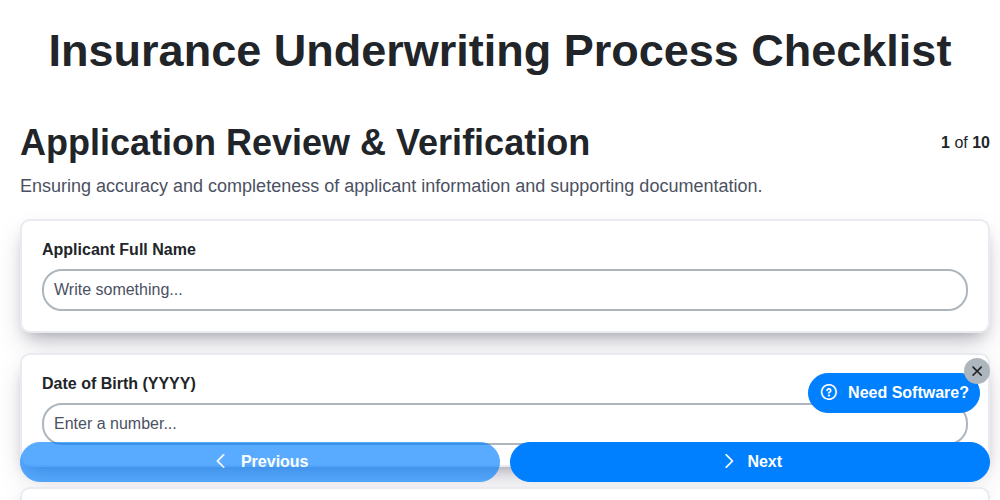
Table of Contents
- Introduction: What is Insurance Underwriting?
- 1. Application Review & Verification: The Foundation
- 2. Risk Assessment & Analysis: Identifying Potential Exposures
- 3. Property Inspection: A Closer Look
- 4. Financial Analysis: Assessing Financial Stability
- 5. Coverage Determination: Defining the Scope
- 6. Pricing & Premium Calculation: Finding the Right Balance
- 7. Underwriting File Documentation: Building a Comprehensive Record
- 8. Compliance and Legal Review: Ensuring Adherence
- 9. Policy Issuance & Approval: Finalizing the Agreement
- 10. Record Keeping & Archiving: Protecting Institutional Knowledge
- 11. Technology & Automation in Underwriting
- 12. Common Underwriting Challenges and Solutions
- Conclusion: Streamlining Your Underwriting Process
- Resources & Links
TLDR: Feeling overwhelmed by the insurance underwriting process? This checklist breaks it down into 10 key steps - from application review and risk assessment to policy issuance and record keeping - ensuring accuracy, compliance, and consistency every time. Download the template and streamline your underwriting workflow!
Introduction: What is Insurance Underwriting?
Insurance underwriting is the backbone of a stable insurance company. It's the process of evaluating the risk a potential policyholder presents and deciding whether to offer them coverage, and at what price. Essentially, underwriters are risk assessors. They meticulously analyze various factors - from an applicant's health and driving history to the construction and location of a property - to determine the likelihood of a claim. This careful evaluation ensures the insurer can accurately predict future losses, maintain financial stability, and offer fair premiums to all policyholders. Without thorough underwriting, insurance companies would be exposed to unacceptable levels of risk, ultimately jeopardizing the entire system.
1. Application Review & Verification: The Foundation
The underwriting process begins with a thorough examination of the insurance application. This crucial first step isn't just about checking boxes; it's about establishing the foundation for a sound decision. We meticulously review all submitted information for completeness and accuracy. This includes verifying details like applicant identity, property details, loss history, and any prior insurance coverage.
Our verification process extends beyond what's presented on the application itself. We routinely cross-reference information with third-party databases, credit reports, motor vehicle records (where applicable), and public records to confirm its validity. Discrepancies or red flags identified during this stage trigger further investigation and potentially require clarification from the applicant. A solid application review and verification lays the groundwork for a fair and accurate underwriting assessment. Failing to do so can lead to mispricing, increased risk exposure, and potential future claims issues.
2. Risk Assessment & Analysis: Identifying Potential Exposures
This critical phase goes beyond simply reviewing the application; it's about deeply understanding the potential for loss. We delve into the specifics of the risk being insured, considering factors that could lead to claims. This involves a multifaceted approach, utilizing various data points and analytical techniques.
Data Sources & Considerations:
- Application Information: We scrutinize the information provided in the application, looking for inconsistencies or potential red flags.
- Credit History: A review of the applicant's credit history can provide insights into their financial stability and risk profile.
- Public Records: We leverage publicly available data, such as property records, legal filings, and news reports, to identify potential risks.
- Industry-Specific Risks: For businesses, we analyze industry trends, regulations, and common hazards specific to their operations. This could include factors like cybersecurity risks for tech companies or environmental regulations for manufacturers.
- Geographic Location: Location significantly impacts risk. We consider factors like natural disaster potential (flood zones, earthquake zones, hurricane-prone areas), crime rates, and local building codes.
- Loss History (if applicable): Previous claims history, both for the applicant and similar risks, is a key indicator of future likelihood.
- Hazard Identification: This involves identifying specific hazards present at the insured location or associated with the insured activity. For property, this might include outdated wiring, flammable materials, or inadequate security systems. For businesses, it could encompass operational risks, employee safety concerns, or product liability issues.
Risk Scoring and Categorization:
The information gathered is then used to assign a risk score, placing the applicant into a defined risk category. This categorization informs subsequent steps, such as determining appropriate coverage terms and premium levels. A higher risk score doesn't automatically mean denial; it triggers a deeper investigation and potential mitigation strategies.
3. Property Inspection: A Closer Look
Not every insurance application necessitates a property inspection, but when it does, it's a critical step in the underwriting process. These inspections aren't about finding fault; they're about gaining a comprehensive understanding of the risk presented by the property. Here's what typically happens:
What's Inspected? The scope of the inspection varies depending on the type of insurance (e.g., homeowners, commercial property) and the perceived risk. Generally, inspectors look for:
- Structural Integrity: Foundations, roofs, walls, and overall construction quality.
- Safety Features: Smoke detectors, fire extinguishers, security systems, and other protective measures.
- Potential Hazards: Presence of asbestos, lead paint, mold, or other environmental concerns.
- Maintenance & Upkeep: Condition of the property, signs of deferred maintenance, and potential for deterioration.
- Occupancy & Use: Verification of how the property is used and by whom.
Who Performs the Inspection? Insurance companies typically hire licensed and qualified property inspectors. These can be third-party inspectors or company-employed specialists.
Impact on Underwriting: The inspection report provides valuable data that helps underwriters accurately assess risk. Findings can influence coverage terms, premium rates, or even lead to requests for further mitigation measures. For example, a report highlighting an outdated electrical system might necessitate an upgrade before coverage is provided.
Applicant Considerations: While applicants usually aren't present during the inspection, they should ensure the property is accessible and in a presentable condition. Transparency regarding any known issues is always the best approach.
4. Financial Analysis: Assessing Financial Stability
For certain insurance products, particularly those with higher risk profiles or larger coverage amounts (like commercial lines or certain life insurance policies), a thorough financial analysis is a crucial underwriting step. This isn't about judging an individual's personal finances; it's about evaluating the financial stability and capacity of the applicant or entity seeking coverage.
The depth of this analysis will depend on the complexity of the risk. It might involve:
- Reviewing Financial Statements: Examining balance sheets, income statements, and cash flow statements to understand profitability, liquidity, and solvency.
- Credit Reports & Ratings: Analyzing credit scores and ratings from reputable agencies to gauge creditworthiness and potential default risk.
- Industry Benchmarking: Comparing the applicant's financial performance against industry averages to identify potential vulnerabilities.
- Debt-to-Equity Ratio: Assessing the proportion of debt compared to equity to understand leverage and potential for financial distress.
- Cash Flow Projections: For businesses, reviewing projected cash flows to evaluate future financial health and ability to meet obligations.
This analysis helps underwriters determine if the applicant possesses the financial resources to pay premiums consistently and, in the event of a claim, has the ability to contribute towards loss recovery if required by policy terms. A strong financial analysis minimizes risk for the insurer and contributes to the overall stability of the insurance portfolio.
5. Coverage Determination: Defining the Scope
This crucial stage bridges the risk assessment with the final policy terms. Coverage determination isn't simply a yes or no decision; it's about precisely defining what is covered and, importantly, what isn't. Based on the information gathered and analyzed previously, the underwriter now decides the scope of coverage. This includes considering:
- Perils Covered: Specifically listing which risks (e.g., fire, theft, flood) are included under the policy.
- Exclusions: Identifying what events or circumstances are explicitly not covered. These are paramount for transparency with the applicant.
- Limitations: Defining any restrictions or maximum payouts for specific types of claims. For example, a limit on jewelry coverage or a deductible amount.
- Endorsements: Determining if any additional endorsements (policy riders) are necessary to tailor coverage to the applicant's specific needs and circumstances. This might involve adding coverage for specific items, risks, or activities.
This process requires careful judgment, leveraging underwriting guidelines and considering the overall risk profile. A clear and well-defined coverage determination minimizes ambiguity and potential disputes later on. It lays the foundation for a transparent and legally sound insurance policy.
6. Pricing & Premium Calculation: Finding the Right Balance
This stage is where the data gathered throughout the underwriting process truly converges. It's not just about adding up costs; it's about striking a balance between risk, market competitiveness, and profitability. The premium calculation builds upon the risk assessment - a higher risk profile naturally leads to a higher premium.
We leverage a sophisticated rating engine that incorporates numerous factors, including:
- Risk Scores: Derived from the initial assessment, these quantify the level of risk.
- Base Rates: These are the foundation, reflecting industry averages for similar risks.
- Adjustments: This is where the specifics come into play. Factors like location, construction type, occupancy, claims history, and any mitigation efforts implemented are factored in with specific adjustments. For example, a home with a newer roof and a monitored security system might see a premium discount.
- Expense Considerations: Operating costs, including administrative expenses and claims handling, are incorporated to ensure profitability.
- Market Analysis: We continuously monitor market trends and competitor pricing to maintain a competitive edge.
The goal is to arrive at a premium that accurately reflects the risk being assumed while remaining attractive to potential policyholders. This isn't an arbitrary number; it's a carefully calculated reflection of the underwriting process. We are transparent and readily explain the factors contributing to the final premium.
7. Underwriting File Documentation: Building a Comprehensive Record
Thorough documentation is the backbone of a defensible underwriting process. Your underwriting file isn't just a collection of papers; it's a story - the story of how a risk was evaluated, priced, and ultimately accepted (or declined). A well-documented file demonstrates due diligence and provides a clear audit trail should questions arise later.
What should be included? Essentially, everything considered in the decision-making process. This includes:
- Application and Supporting Documents: The original application, along with all submitted attachments like financial statements, inspection reports, and declarations.
- Verification Records: Documentation proving the verification of information provided in the application - credit reports, loss history reports, driver records, etc. Clearly indicate what was verified and by whom.
- Risk Assessment Notes: Detailed notes outlining the risk assessment, including identified hazards, mitigations, and potential impacts. Be specific and avoid vague statements.
- Communication Logs: Record all communication with applicants, brokers, inspectors, and other parties involved. Dates, methods (email, phone, etc.), and content of the conversation should be documented.
- Pricing & Premium Calculations: The complete breakdown of how the premium was calculated, including any discounts or surcharges applied.
- Internal Reviews & Approvals: Evidence of any internal reviews or approvals required within your underwriting process.
- Deviation Explanations: If a risk falls outside standard guidelines, a detailed explanation of the exception and the rationale for approval (or denial) should be included.
Consistency in documentation is key. Establish clear standards for file organization and naming conventions to ensure easy retrieval and auditability. Consider using a digital file management system for enhanced security and efficiency.
8. Compliance and Legal Review: Ensuring Adherence
The underwriting process isn't just about assessing risk; it's also about ensuring we operate within the boundaries of the law and industry regulations. This Compliance and Legal Review phase is a critical safeguard. Our legal and compliance teams meticulously examine the underwriting file to confirm adherence to all applicable federal, state, and local laws. This includes, but isn't limited to, fair lending practices, anti-discrimination laws, and privacy regulations like GDPR or CCPA depending on the applicant's location.
We also verify that our underwriting guidelines themselves are being correctly interpreted and applied. This phase flags any potential discrepancies, inconsistencies, or areas of concern that require further clarification or adjustments. It's a proactive step to minimize legal and regulatory risks, demonstrating our commitment to ethical and transparent business practices. Any red flags identified during this review are immediately addressed, ensuring the policy is legally sound and compliant before moving forward.
9. Policy Issuance & Approval: Finalizing the Agreement
Once the underwriting process culminates in a positive decision and premium is finalized, the focus shifts to formally issuing the policy and securing approval. This critical stage involves several key actions. First, the policy document itself is prepared, incorporating all agreed-upon terms, conditions, and coverage details. This document must be meticulously reviewed by both the underwriter and a designated compliance officer to ensure accuracy and alignment with internal guidelines and regulatory requirements.
Next, any necessary internal approvals are obtained. Depending on the insurer's structure, this might involve reviewing the policy by a senior underwriter, a risk manager, or other relevant stakeholders. This step is a final safeguard against potential errors or omissions.
Finally, the policy is formally issued to the applicant. A clear and concise summary of coverage, including any exclusions or limitations, should be provided alongside the full policy document. Obtaining the applicant's signed acceptance of the policy terms is crucial, signifying a legally binding agreement. This marks the successful completion of the underwriting process and the beginning of the insurance coverage period.
10. Record Keeping & Archiving: Protecting Institutional Knowledge
The underwriting process generates a significant amount of data - applications, assessments, inspection reports, financial statements, correspondence, and more. Effective record keeping and archiving aren't just about compliance; they's crucial for maintaining institutional knowledge, facilitating audits, and ensuring consistency in decision-making.
A robust archiving system should include clear guidelines for:
- Retention Schedules: Defining how long various documents must be stored based on legal and regulatory requirements, as well as internal policy.
- Secure Storage: Utilizing secure digital or physical storage that protects data from loss, damage, or unauthorized access. Consider both on-premise and cloud-based options, ensuring compliance with data privacy regulations.
- Accessibility & Searchability: Implementing a system that allows authorized personnel to easily locate and retrieve documents when needed. Metadata tagging and robust search functionality are essential.
- Version Control: Tracking changes to documents and maintaining a history of revisions to ensure accuracy and accountability.
- Disaster Recovery: Establishing a plan for data recovery in case of natural disasters or system failures.
- Regular Audits: Periodically reviewing archiving procedures to ensure they remain effective and compliant.
Proper record keeping and archiving not only minimizes legal risks but also preserves valuable insights for future underwriting decisions and training new team members. It transforms scattered data into a powerful resource, contributing to a more efficient and knowledgeable underwriting operation.
11. Technology & Automation in Underwriting
The underwriting process, historically reliant on manual review and assessment, is undergoing a significant transformation thanks to technology and automation. Insurers are increasingly leveraging tools like AI-powered application processing, robotic process automation (RPA), and predictive analytics to streamline operations and improve accuracy.
Application review and verification are often the first areas to benefit. Optical Character Recognition (OCR) technology automatically extracts data from applications, reducing manual data entry and minimizing errors. RPA can then automate repetitive tasks like verifying applicant information against third-party databases.
Risk assessment is also being revolutionized. Machine learning algorithms can analyze vast datasets to identify patterns and predict risk more effectively than traditional methods. This allows underwriters to focus on more complex or high-risk cases.
Furthermore, digital property inspections using drones and satellite imagery are becoming more commonplace, reducing the need for physical visits and accelerating the process. Financial analysis can be automated by integrating with financial institutions and utilizing algorithms to assess creditworthiness.
Ultimately, the incorporation of technology not only speeds up underwriting cycles but also enhances consistency and reduces costs. It allows underwriters to focus on strategic decision-making and provides a more responsive and customer-centric insurance experience.
12. Common Underwriting Challenges and Solutions
The underwriting process, while structured, isn't without its hurdles. Here's a look at some frequent challenges and practical solutions to overcome them:
1. Incomplete or Inaccurate Applications: This is arguably the most common issue. Missing information delays processing and introduces risk. Solution: Implement application checklists for both applicants and underwriters. Offer applicant support through online resources, FAQs, and direct contact options. Automate data validation checks to flag inconsistencies in real-time.
2. Difficulty Verifying Information: Obtaining verification from third parties (e.g., credit bureaus, previous insurers, medical providers) can be time-consuming and frustrating. Solution: Leverage automated verification tools and establish strong relationships with key data providers. Implement clear communication protocols with verification sources. Consider incorporating digital signatures and secure data sharing platforms.
3. Assessing Emerging Risks: New technologies, climate change impacts, and evolving business models create risks that traditional underwriting guidelines may not adequately address. Solution: Foster a culture of continuous learning and risk intelligence within the underwriting team. Utilize data analytics and predictive modeling to identify and quantify emerging risks. Develop specialized underwriting guidelines for new and evolving industries.
4. Property Inspection Limitations (Especially in Remote Locations): Obtaining accurate property data can be difficult and expensive, particularly in areas with limited access. Solution: Utilize remote sensing technology (e.g., satellite imagery, drone inspections) as a supplement to physical inspections. Employ experienced local inspectors who understand regional nuances. Consider tiered inspection approaches based on risk level.
5. Financial Data Gaps (for Commercial Underwriting): Securing reliable financial information for businesses can be challenging, especially for smaller enterprises or those with limited public reporting. Solution: Employ a layered approach to financial analysis, using available data sources (credit reports, bank statements, tax returns) and supplementing with alternative data where necessary. Establish clear guidelines for acceptable documentation.
6. Balancing Risk and Growth: Underwriters must strike a balance between rigorously assessing risk and facilitating business growth. Solution: Develop clear risk appetite statements and underwriting authority guidelines. Empower underwriters with the knowledge and tools to make informed decisions within defined parameters. Implement a robust appeals process for declined applications.
7. Maintaining Consistency & Fairness: Variations in underwriting decisions across different underwriters can lead to inconsistencies and potential legal challenges. Solution: Implement standardized underwriting guidelines and training programs. Utilize automated underwriting systems to enforce consistent application of rules. Conduct regular audits of underwriting decisions.
8. Regulatory Changes & Compliance: Evolving insurance regulations require constant adaptation and updates to underwriting practices. Solution: Establish a dedicated compliance team responsible for monitoring regulatory changes. Integrate compliance checks into the underwriting workflow. Provide ongoing training to underwriters on relevant regulations.
9. Data Security & Privacy: Handling sensitive applicant data requires robust security measures to prevent breaches and protect privacy. Solution: Implement strong data encryption and access controls. Comply with all relevant privacy regulations (e.g., GDPR, CCPA). Provide regular training to underwriters on data security best practices.
10. Integrating New Technologies: Adopting new technologies like AI and machine learning can be complex and require significant investment. Solution: Implement new technologies in phases, starting with pilot projects. Provide thorough training to underwriters on how to use new tools. Regularly evaluate the effectiveness of new technologies.
11. Communicating with Applicants/Brokers: Lack of clear and timely communication can lead to frustration and mistrust. Solution: Implement automated notifications to keep applicants informed of the status of their application. Designate a point of contact for applicants to address questions and concerns.
12. Limited Underwriting Capacity: High volumes of applications can overwhelm underwriting teams, leading to delays and errors. Solution: Invest in automation and process optimization to improve efficiency. Consider outsourcing certain underwriting tasks to specialized vendors. Prioritize applications based on risk level and complexity.
Conclusion: Streamlining Your Underwriting Process
Ultimately, consistently applying a robust underwriting process, guided by a comprehensive checklist like the one outlined above, isn't just about mitigating risk; it's about building a sustainable and profitable insurance business. By meticulously following each step - from application scrutiny to policy issuance and ongoing record-keeping - you're ensuring accuracy, fairness, and adherence to regulations. Embracing automation and technology to support this checklist can further streamline operations, reduce errors, and free up your underwriters to focus on more complex cases. A well-executed underwriting process isn't a burden; it's a cornerstone of a healthy and thriving insurance organization, fostering trust with clients and contributing to long-term success.
Resources & Links
- IRMI (Insurance Risk Management Institute): A comprehensive resource for insurance professionals, providing articles, training, and continuing education on underwriting, risk management, and insurance law. Offers detailed explanations and templates useful for understanding the fundamentals and nuances of the underwriting process. Useful for understanding industry terminology and best practices.
- NAIC (National Association of Insurance Commissioners): The NAIC provides a wealth of information about insurance regulation, model laws, and consumer education resources. Crucial for understanding the legal and regulatory landscape impacting underwriting practices and compliance requirements. Specifically useful for the 'Compliance and Legal Review' section.
- The Actuarial Society: Provides resources and expertise related to actuarial science, a core component of risk assessment and premium calculation. Provides insight into statistical modeling and predictive analytics used in the underwriting process. Particularly helpful for the 'Pricing & Premium Calculation' and 'Risk Assessment' sections.
- AICPA (American Institute of Certified Public Accountants): While focused on accounting, the AICPA's resources on internal controls and risk management are highly relevant to underwriting file documentation and operational efficiency. Important for the 'Underwriting File Documentation' and general workflow improvement.
- The Insurance Information Institute (III): Provides consumer information and industry statistics about insurance. Useful for gaining context around market trends and consumer expectations affecting underwriting practices. Helpful for setting the stage and understanding the bigger picture.
- CB Insights: A market intelligence platform that tracks insurance technology (Insurtech) trends and company profiles. Useful for understanding how technology and automation are transforming the underwriting process, especially relevant to section 'Technology & Automation in Underwriting'. Requires subscription for deep data.
- Swett Gleeson: Specializes in insurance appraisal and risk assessment. Offers insights and resources related to property inspections and risk analysis which is helpful for the 'Property Inspection' and 'Risk Assessment' sections. Useful for complex risks.
- Verisk: Provides data analytics, underwriting solutions, and risk assessment tools for the insurance industry. An industry leader in risk modeling and data-driven underwriting. Used extensively to inform risk profiles and pricing and helpful for understanding how data informs decision making.
- LexisNexis: A provider of legal and regulatory information, critical for ensuring compliance and addressing legal review aspects of underwriting, particularly in the 'Compliance and Legal Review' section. Subscription required.
- Excelin: Offers resources and training on automating insurance processes, including underwriting. Their content and solutions can be helpful for understanding automation strategies, particularly for section 11.
Frequently Asked Questions
What is insurance underwriting?
Insurance underwriting is the process insurers use to assess the risk of insuring a potential customer. It involves evaluating their risk profile and determining whether to offer coverage, and at what price (premium).
Why is an underwriting checklist important?
An underwriting checklist ensures consistency, reduces errors, and helps underwriters thoroughly assess risk. It streamlines the process, improves efficiency, and minimizes potential losses for the insurance company.
Who uses this checklist? Is it for everyone?
This checklist is primarily designed for insurance underwriters and their supervisors. However, insurance agents and brokers can also benefit from understanding the steps involved in the underwriting process.
What types of insurance does this checklist apply to?
While the principles outlined in this checklist are generally applicable, the specific items included will vary depending on the type of insurance (e.g., life, health, property, auto). The checklist can be adapted for different insurance products.
Can I customize this checklist?
Absolutely. This checklist is intended as a comprehensive guide, but it's designed to be adaptable. You should tailor it to fit your specific insurance company's policies, procedures, and the unique risks associated with the products you offer.
What is a risk assessment in the context of underwriting?
A risk assessment is a detailed evaluation of the potential hazards and likelihood of a claim occurring. It involves gathering information about the applicant and analyzing factors that could lead to a loss.
What's the difference between verification and validation in underwriting?
Verification confirms the accuracy of information provided by the applicant (e.g., verifying employment with the employer). Validation assesses whether the information is complete and meets the insurer's requirements.
What is a 'red flag' in underwriting?
A red flag is a factor or piece of information that raises concerns about the applicant's risk profile, potentially indicating a higher risk of loss. These flags require further investigation and scrutiny.
How does technology impact the underwriting process today?
Technology, such as automated underwriting systems, data analytics, and online application platforms, is increasingly used to streamline the underwriting process, improve efficiency, and enhance risk assessment capabilities.
Where can I find additional resources to help me understand underwriting better?
Industry organizations like the Institutes, CPCU Society, and LIMRA offer training and resources on insurance underwriting. Your insurance company's internal training programs are also valuable sources of information.
Comments
There are no comments yet. Be the first to add one!
Insurance Management Solution Demo
Managing policies, claims, and compliance in the insurance industry is complex. ChecklistGuro's Work OS platform streamlines your operations, from underwriting and renewals to claims processing and reporting. Improve efficiency, reduce errors, and enhance customer satisfaction. Discover how ChecklistGuro can transform your insurance business!
Related Articles
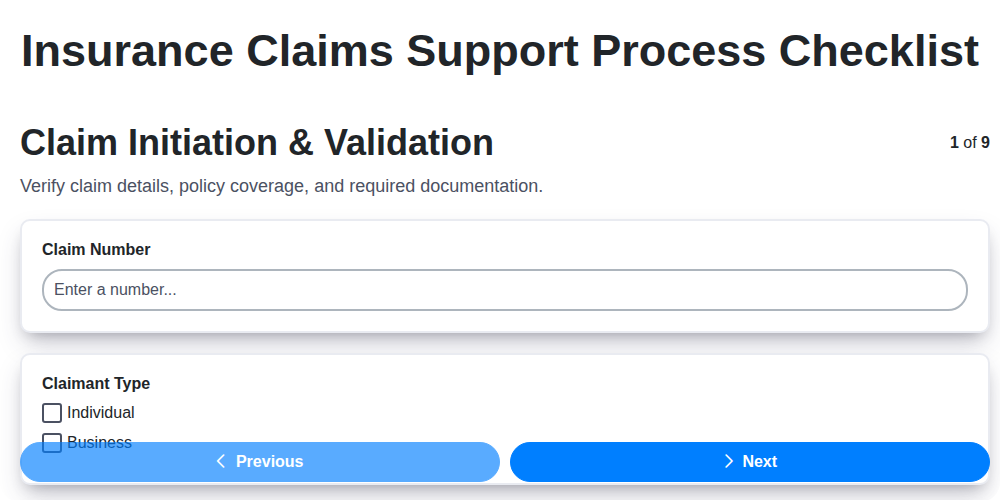
Streamline Claims: Your Insurance Claims Support Process Checklist Template
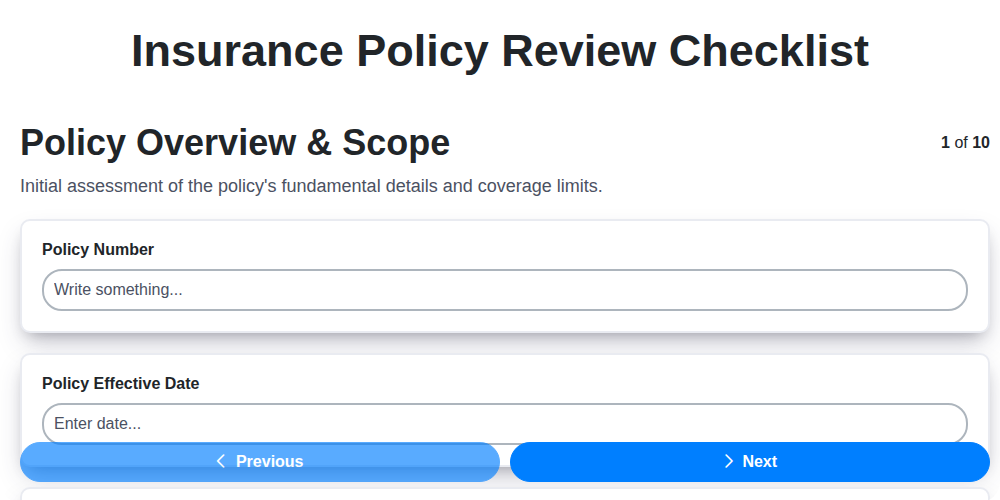
Your Insurance Policy Review Checklist: A Step-by-Step Guide
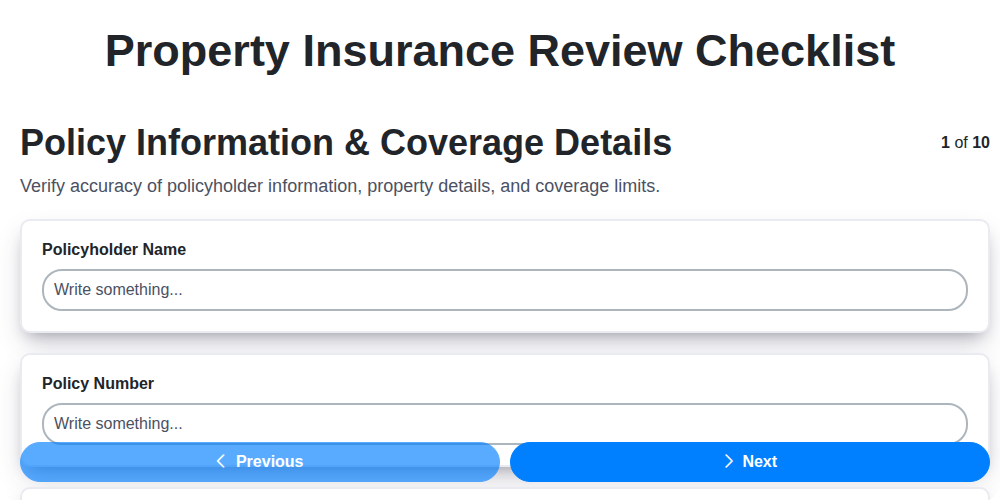
Your Property Insurance Review Checklist: A Step-by-Step Guide
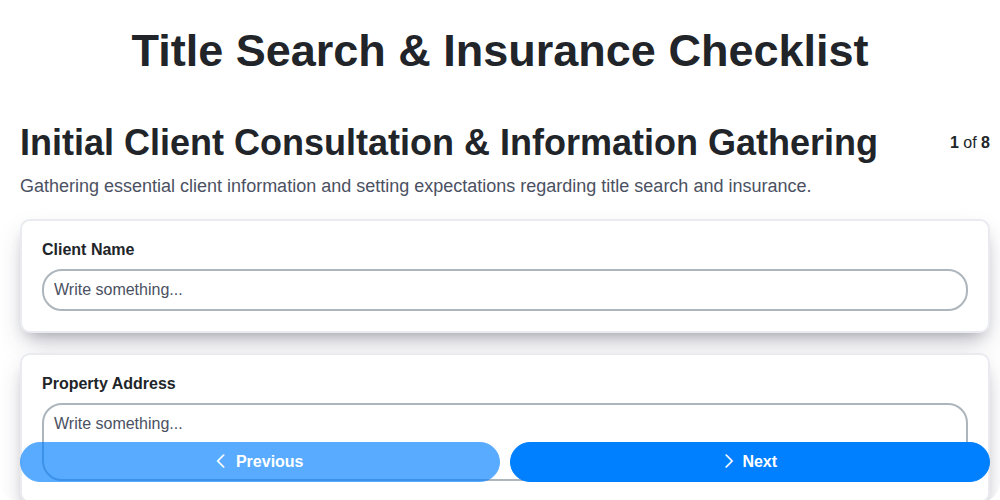
Your Title Search & Insurance Checklist Template
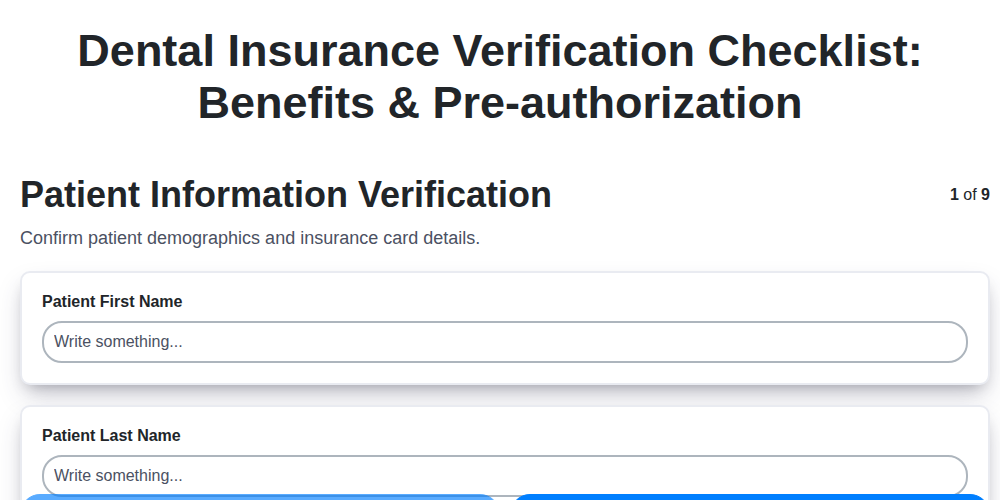
Simplify Insurance Verification: Your Free Dental Checklist Template
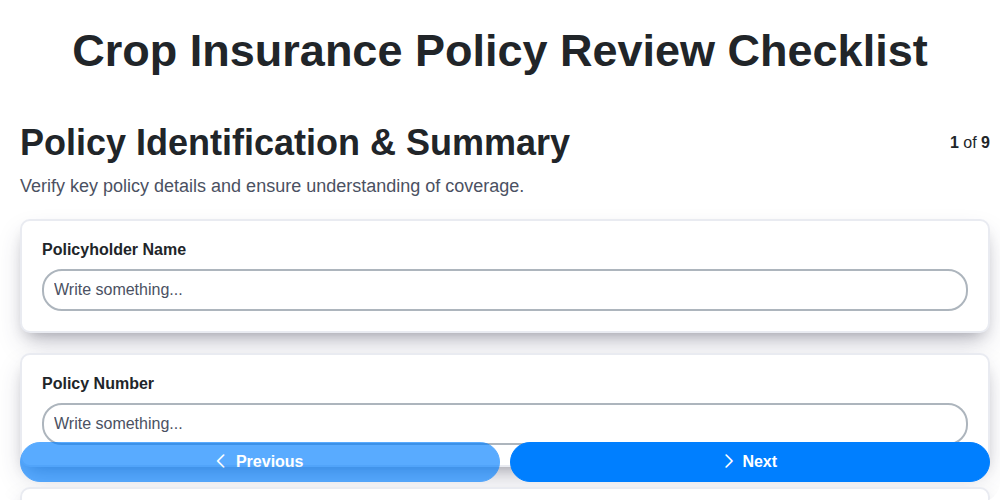
Crop Insurance Policy Review Checklist: A Farmer's Guide

The Ultimate Vehicle Registration & Insurance Validation Checklist
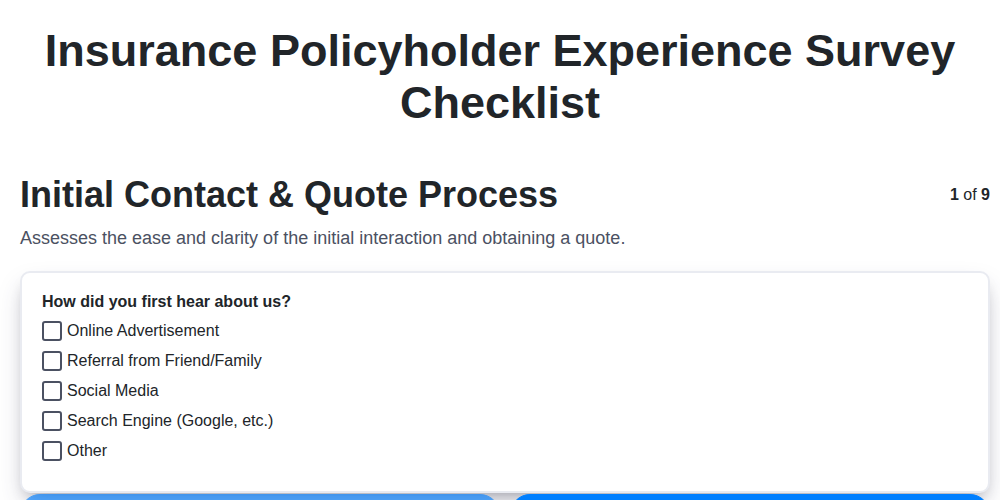
Mastering the Policyholder Journey: Your Insurance Experience Survey Checklist
Need help with
Insurance?
Have a question? We're here to help. Please submit your inquiry, and we'll respond promptly.