A Step-by-Step Guide to the Livestock Health and Veterinary Care Process
Published: 06/18/2026 9:00 PM Updated: 06/19/2026 11:49 AM
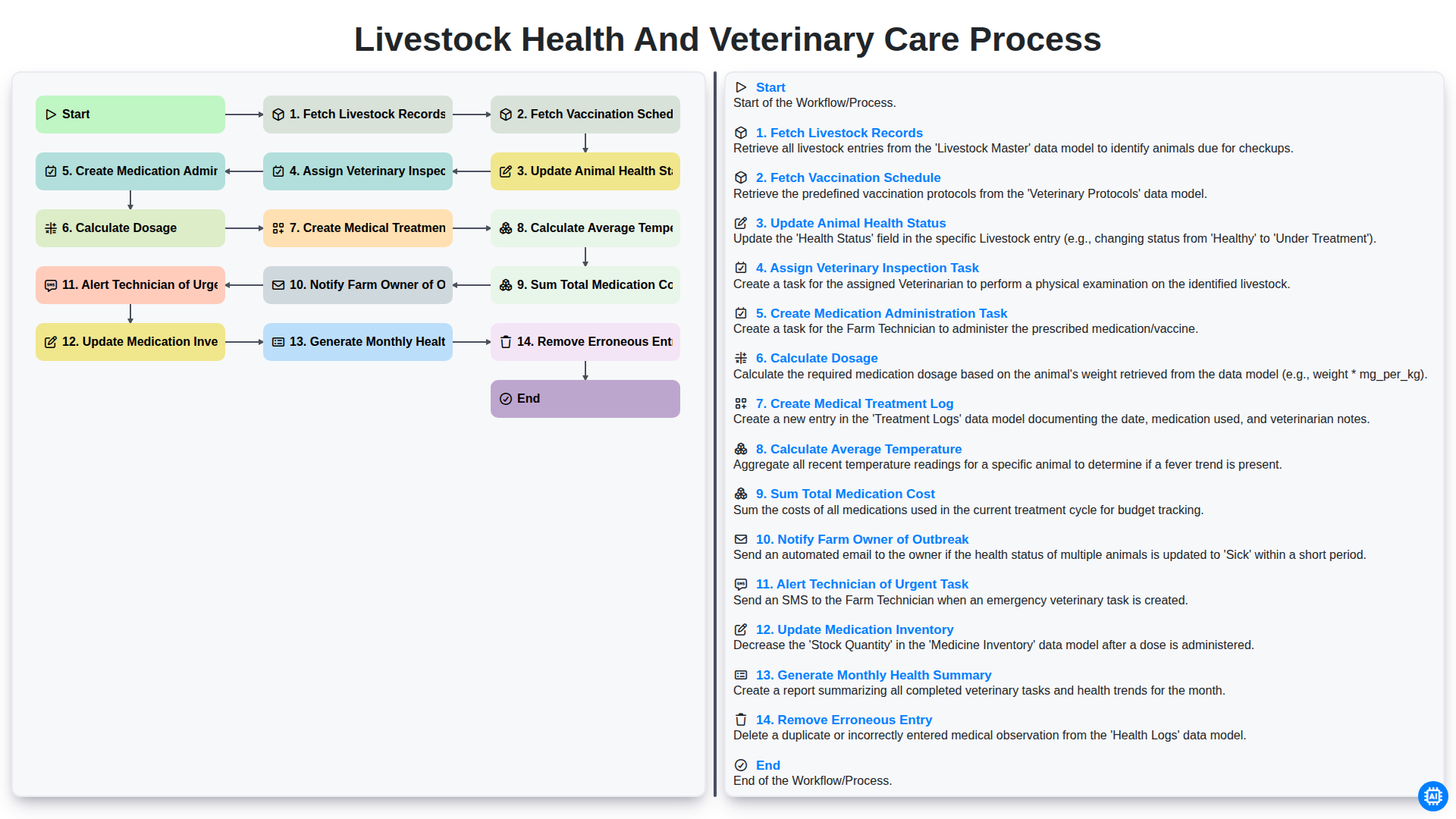
Table of Contents
- Introduction to Systematic Livestock Management
- Phase 1: Data Retrieval and Initial Assessment
- Reviewing Historical Livestock Records
- Consulting the Vaccination Schedule
- Phase 2: Monitoring and Clinical Evaluation
- Updating Animal Health Status
- Assigning Veterinary Inspection Tasks
- Analyzing Vital Signs: Calculating Average Temperature
- Phase 3: Treatment Planning and Execution
- Creating Medication Administration Tasks
- Precision Dosing: Calculating Required Dosage
- Documenting Care: Creating the Medical Treatment Log
- Phase 4: Resource Management and Communication
- Managing Medication Inventory and Costs
- Emergency Alerts and Farm-wide Notifications
- Phase 5: Reporting and Data Integrity
- Generating Monthly Health Summaries
- Maintaining Accuracy: Removing Erroneous Entries
- Resources & Links
TLDR: Master your farm's medical management with this comprehensive guide to the Livestock Health and Veterinary Care workflow. Learn how to automate everything from tracking vaccination schedules and calculating medication dosages to managing inventory and generating monthly health summaries, ensuring your herd stays healthy and your operations stay efficient.
Introduction to Systematic Livestock Management
In the modern era of precision agriculture, managing a farm involves much more than just providing feed and shelter. The backbone of a productive and profitable livestock operation lies in the implementation of a systematic, data-driven approach to animal husbandry. Effective livestock management is no longer just about reactive care-responding to illnesses as they appear-but about proactive, structured workflows that prioritize prevention, early detection, and meticulous record-keeping.
A systematic workflow ensures that every animal in your herd is tracked through a continuous cycle of monitoring, treatment, and administrative oversight. By integrating structured processes-ranging from fetching historical health records and managing vaccination schedules to real-time updates on medication inventory-farmers can transition from manual, error-prone methods to a streamlined digital ecosystem. This level of organization is critical for maintaining biosecurity, optimizing resource allocation, and ensuring that every veterinary intervention is backed by accurate data. Ultimately, adopting a standardized workflow allows producers to mitigate risks, reduce mortality rates, and ensure the long-term sustainability of their agricultural enterprise.
Phase 1: Data Retrieval and Initial Assessment
The foundation of an effective livestock management system lies in the accuracy of its initial data gathering. The process begins with Fetching Livestock Records, which allows the system to pull comprehensive histories for every animal in the herd, ensuring that no critical individual data points are overlooked. Once the baseline data is established, the workflow moves into proactive monitoring by Fetching Vaccination Schedules. This step is crucial for identifying upcoming immunization needs and preventing gaps in preventative care. By integrating these two steps, the system creates a real-time snapshot of the herd's current health status and upcoming requirements, setting the stage for more complex medical interventions.
Reviewing Historical Livestock Records
Effective livestock management begins with a deep dive into the past. The first critical step in our streamlined workflow is to Fetch Livestock Records, a process that involves retrieving comprehensive data from each individual animal's digital profile. By reviewing historical data, farm managers can identify patterns in growth, previous ailments, and-long-term health trends.
A thorough review of these records allows for a proactive rather than reactive approach to veterinary care. Instead of treating symptoms as they arise, we can analyze previous recovery times and-susceptibility to certain diseases. This historical context ensures that when we move to the next stage of the workflow, such as fetching vaccination schedules, we are working with a complete picture of the herd's medical history, ensuring no critical detail from previous cycles is overlooked.
Consulting the Vaccination Schedule
Once the necessary livestock records have been retrieved, the next critical step in the workflow is to Fetch Vaccination Schedule. Maintaining a proactive approach to preventative medicine is the backbone of any successful farming operation. By systematically pulling the pre-established vaccination timelines, the system ensures that no animal is overlooked and that every subject is prepared for their specific immunization window.
Consulting this schedule allows the farm management team to anticipate upcoming needs, ensuring that vaccines are available and that the necessary personnel are prepared for the upcoming workload. This step bridges the gap between historical data and future preventative actions, transforming a static list of records into an actionable roadmap for herd immunity and long-term health stability.
Phase 2: Monitoring and Clinical Evaluation
Once the initial records and vaccination schedules have been retrieved, the workflow transitions into the critical phase of active clinical assessment. During this stage, the focus shifts from administrative preparation to real-time monitoring and precise medical intervention.
The process begins by continuously updating animal health status as new clinical signs emerge. When a potential issue is identified, the system automatically triggers the assignment of a veterinary inspection task, ensuring that a professional assessment is prioritized. If an inspection reveals the need for intervention, the workflow facilitates the creation of a medication administration task.
Precision is paramount during this phase; therefore, the system is programmed to automatically calculate the exact dosage required based on the animal's weight and condition, while simultaneously creating a medical treatment log to maintain a permanent record of care. To maintain a holistic view of the herd's well-being, the system also calculates the average temperature across the population, allowing for the identification of subtle trends in fever or malaise. This level of granular monitoring ensures that clinical decisions are driven by data rather than intuition.
Updating Animal Health Status
Maintaining an accurate and real-time record of each animal's wellbeing is the cornerstone of effective farm management. The Update Animal Health Status step serves as the critical junction where physical observations meet digital documentation. Whether a change in status is due to a routine checkup, a sudden onset of symptoms, or a recovery from a previous ailment, updating this information immediately ensures that the entire farm management system remains synchronized.
By promptly logging changes in health status, you provide the foundation for all subsequent automated actions-such as triggering vaccination alerts or notifying veterinarians. This step eliminates the risks associated with outdated information, ensuring that every decision made by the farm team is based on the most current physiological data available for each animal in the herd.
Assigning Veterinary Inspection Tasks
Once the livestock records and vaccination schedules have been reviewed, the next critical step in the workflow is Assigning Veterinary Inspection Tasks. This stage transitions the process from passive monitoring to active intervention.
Rather than waiting for a crisis to occur, the system proactively identifies animals or specific herds that are due for a professional evaluation based on their health history or upcoming immunization dates. By automating the task assignment process, farm managers can delegate specific inspection duties to qualified veterinary personnel or onsite technicians with precision. Each task is logged within the system, ensuring that every animal receives the necessary physical examination and that no scheduled check-up is overlooked, thereby maintaining a proactive standard of care across the entire farm.
Analyzing Vital Signs: Calculating Average Temperature
Monitoring the thermal stability of a herd is a cornerstone of proactive livestock management. Within our automated workflow, the Calculate Average Temperature feature serves as a critical diagnostic tool. Rather than relying on isolated,-single data points that might be skewed by a momentary spike or a momentary dip, our system aggregates recent temperature readings across the flock or herd to establish a reliable baseline.
By calculating a rolling average, the system can smooth out-anomalies and identify subtle upward trends that signify the early stages of an infection before clinical symptoms become widespread. This mathematical oversight allows for much earlier intervention, transforming reactive care into a predictive strategy. When the calculated average deviates from the established physiological norm, the system immediately triggers necessary alerts, ensuring that heat stress or fever outbreaks are addressed with precision and speed.
Phase 3: Treatment Planning and Execution
Once the initial assessment and inspection tasks are completed, the workflow shifts from observation to active intervention. This phase, Treatment Planning and Execution, is the most critical stage of the lifecycle, as it involves transforming diagnostic data into actionable medical care.
The process begins by transitioning from the inspection report to the creation of specific, actionable tasks. Based on the veterinarian's findings, the system will Create Medication Administration Tasks and precisely Calculate Dosage based on the individual animal's weight and the specific requirements of the ailment. To ensure accountability and precise record-keeping, every action taken is recorded by the system to Create Medical Treatment Log entries.
Efficiency during this phase is maintained through automated clinical calculations and resource management. For instance, the system can automatically Calculate Average Temperature trends to monitor fever regression and Sum Total Medication Cost to provide immediate visibility into the financial impact of the treatment. To prevent stockouts during critical care, the workflow automatically triggers an Update Medication Inventory action, ensuring that supplies are replenished as they are used.
Crucially, this phase also handles emergency communication. If a high-risk pattern is detected, the system will Notify Farm Owner of Outbreak to initiate quarantine protocols and Alert Technician of Urgent Task to ensure that life-saving interventions are prioritized immediately. This seamless integration of clinical precision and real-time alerting ensures that livestock receive timely care while maintaining complete operational oversight.
Creating Medication Administration Tasks
Once a veterinary inspection identifies a specific medical need, the workflow moves into the critical phase of Creating Medication Administration Tasks. This step transitions the process from diagnosis to action, ensuring that every prescribed treatment is documented and ready for execution.
The system automates the complexity of treatment planning by integrating several precise sub-steps. First, the system performs a Calculate Dosage operation, which cross-references the animal's weight and the specific medication requirements to ensure accuracy and prevent under or over-dosing. Following this, the workflow automatically generates a Create Medical Treatment Log, providing a permanent digital audit trail of the prescribed remedy. To maintain operational efficiency, the system also performs a Sum Total Medication Cost calculation, allowing for real-time budget tracking and resource management. Finally, the process concludes by performing an Update Medication Inventory step, which automatically deducts the required amount from your stock, ensuring your supply levels are always accurate and alerting you when it is time to reorder.
Precision Dosing: Calculating Required Dosage
Ensuring the efficacy of a medical treatment while maintaining animal safety depends heavily on the accuracy of dosage calculations. In a streamlined livestock management workflow, the system automates the process of calculating the precise amount of medication required for each individual animal. Rather than relying on manual estimations-which are prone to human error-the automated workflow pulls real-time data from the animal's specific weight, age, and health records to determine the exact dose. By integrating this calculation step directly into the task creation process, we eliminate the risk of under-dosing, which can lead to treatment failure, or over-dosing, which can cause toxicity and increased costs. This level of precision ensures that every milliliter or milligram administered is both safe for the livestock and optimized for recovery.
Documenting Care: Creating the Medical Treatment Log
Once the veterinarian has completed their inspection and the necessary medications have been prepared, the next critical step in the workflow is to Create a Medical Treatment Log. This step serves as the definitive historical record of every clinical intervention performed on an individual animal.
A comprehensive treatment log is more than just a simple note; it is a vital component of traceability and farm accountability. Each entry captures the specifics of the intervention, including the date, the specific animal involved, the type of medication administered, and the precise dosage calculated during the previous step. By meticulously documenting these details, you ensure that there is a transparent audit trail that can be referenced during health audits, meat safety inspections, or when diagnosing recurring issues within the herd. This proactive documentation transforms fragmented veterinary actions into a structured database of care, laying the groundwork for more informed decision-making in the future.
Phase 4: Resource Management and Communication
Once the veterinary inspection and treatment plans are established, the focus shifts toward the critical administrative and logistical backend of the workflow. This phase ensures that the medical decisions made during the inspection are translated into actionable tasks and that all necessary resources are managed with precision.
The process begins with the automated creation of Medication Administration Tasks, which includes a precise Dosage Calculation to ensure every animal receives the exact amount required for recovery. To maintain a transparent medical history, the system simultaneously generates a Medical Treatment Log, documenting every intervention for future reference.
Effective resource management is further supported by the ability to Update Medication Inventory in real-time, preventing shortages that could compromise animal welfare. To ensure financial and operational oversight, the workflow automatically performs a Sum Total Medication Cost calculation, allowing for accurate budgeting and cost-tracking across the herd.
Communication is the final, vital component of this phase. The system acts as a proactive safeguard by automatically triggering a Notification to the Farm Owner in the event of a detected outbreak, ensuring immediate-level awareness. Simultaneously, an Alert is sent to the Technician regarding any urgent tasks, ensuring that time-sensitive treatments are prioritized. Finally, to maintain the integrity of the data, the workflow allows administrators to Remove Erroneous Entries, ensuring that the Monthly Health Summary remains an accurate, reliable reflection of the farm's overall livestock health.
Managing Medication Inventory and Costs
Efficient management of resources is critical to maintaining both the health of your herd and the profitability of your farm. As part of our streamlined workflow, the system automatically performs a Sum Total Medication Cost calculation, providing real-time visibility into your pharmaceutical expenditures. This allows for better budgeting and prevents unexpected financial strain during large-scale treatment cycles.
To ensure that life-saving treatments are always available when needed, the workflow includes an automated step to Update Medication Inventory. Every time a Create Medication Administration Task is completed and a Calculate Dosage step is processed, the system deducts the used amount from your digital stock. This proactive approach eliminates the risk of running out of essential vaccines or antibiotics mid-treatment. By integrating cost tracking with inventory management, you can maintain a precise balance between superior veterinary care and rigorous operational cost control.
Emergency Alerts and Farm-wide Notifications
In a high-stakes farming environment, timely communication is the difference between a minor setback and a devastating loss. Our workflow integrates automated notification systems designed to trigger immediate action when critical thresholds are met. The system is programmed to Notify Farm Owner of Outbreak the moment patterns of disease are detected within the herd, ensuring that management can implement quarantine protocols without delay. Simultaneously, the workflow will Alert Technician of Urgent Task whenever a high-priority veterinary intervention or a critical health decline is logged, ensuring that life-saving care is prioritized. By automating these alerts, we eliminate the risk of human error and ensure that essential information reaches the right people the moment it becomes mission-critical.
Phase 5: Reporting and Data Integrity
The final stage of the livestock management workflow focuses on transforming raw clinical data into actionable intelligence while ensuring the absolute accuracy of your farm's digital records. This phase is critical for long-term decision-making and maintaining the regulatory standards required for modern farming.
Data integrity is maintained through a rigorous oversight process, allowing administrators to remove erroneous entries that may have been caused by manual entry errors, ensuring that your historical data remains a single source of truth. Once the data is verified, the system moves into the analytical phase.
The workflow automatically processes all accumulated clinical data to generate a monthly health summary. This high-level report provides a bird's-eye view of the herd's wellbeing, allowing managers to identify trends in morbidity or growth. To assist with financial forecasting and budgeting, the system also sums the total medication cost incurred during the period, providing immediate visibility into veterinary expenditures. By closing the loop between daily tasks and monthly oversight, this phase ensures that your farm management moves from a reactive state to a proactive, data-driven enterprise.
Generating Monthly Health Summaries
At the end of every operational cycle, the system automates the creation of a Monthly Health Summary, providing a high-level overview of your farm's veterinary performance and livestock wellness. This report aggregates all the data collected throughout the month-including vaccination compliance, medication usage, and temperature trends-into a single, actionable document.
By reviewing these summaries, farm managers can identify recurring health patterns, track medication expenditure, and evaluate the effectiveness of current veterinary protocols. This transition from raw daily data to structured monthly insights ensures that you are not just reacting to individual animal health issues, but proactively managing the long-term vitality of your entire herd.
Maintaining Accuracy: Removing Erroneous Entries
In any complex data-driven workflow, even the most rigorous systems are susceptible to human error. Whether it is a typo during a temperature reading, a misplaced decimal point in a dosage calculation, or a duplicate entry during a vaccination update, inaccuracies can compromise the integrity of your entire livestock management strategy.
The ability to Remove Erroneous Entry is a critical safety feature within the veterinary care process. Leaving incorrect data in the system doesn't just create a messy report; it can lead to dangerous consequences, such as administering the wrong medication dosage or misinterpreting an animal's health trend. By integrating a streamlined way to identify and purge mistakes, the workflow ensures that your monthly health summaries and medication inventories remain reliable. Maintaining a single source of truth means that every decision made by the farm owner or veterinarian is based on clean, verified, and actionable information.
Resources & Links
- Food and Agriculture Organization of the United Nations (FAO): Global standards and resources for livestock health management, disease prevention, and international veterinary protocols.
- Merck Veterinary Manual: A comprehensive professional resource for detailed information on animal diseases, clinical symptoms, and treatment dosages.
- American Veterinary Medical Association (AVMA): Essential guidelines on veterinary care standards, livestock vaccination schedules, and best practices for animal welfare.
- ScienceDirect - Animal Science: Peer-reviewed research and technical papers regarding livestock monitoring, precision livestock farming, and health data analytics.
- University Extension Programs: Practical, science-based agricultural resources for managing farm inventories, medication administration, and farm-wide disease outbreaks.
Found this Article helpful?
Comments
There are no comments yet. Be the first to add one!
Farm Management Solution Demo
Grow your farm smarter & more efficiently! ChecklistGuro streamlines crop planning, task management, & resource tracking. Maximize yields, reduce waste, & improve profitability. Manage it all with our Work OS.
Related Articles
Unlock Higher Yields: Your Precision Agriculture Checklist Template
The Ultimate Farm Safety Inspection Report Checklist Template
Irrigation System Checklist: Farm Water Management & Crop Yield Optimization

Livestock Health & Welfare Checklist: Your Farm Animal Care & Biosecurity Template
Crop Insurance Policy Review Checklist: A Farmer's Guide
Water Discharge Permit Compliance Checklist Template
The Ultimate GPS & Precision Farming Calibration Checklist Template
Mapping the Threat: A Checklist for Proactive Pest & Disease Pressure Management
We can do it Together
Need help with
Checklists?
Have a question? We're here to help. Please submit your inquiry, and we'll respond promptly.