5 Common Mistakes in Agriculture Management
Published: 08/28/2026 Updated: 10/05/2026
Table of Contents
- 1. Relying on Manual Paper-Based Tracking and Fragmented Spreadsheets
- 2. Poor Real-Time Visibility into Field Operations and Resource Allocation
- 3. Lack of Standardized Workflows and SOP Compliance
- 4. Inefficient Data Silos and Communication Gaps Between Field and Office
- 5. Failure to Implement Scalable Digital Monitoring and Reporting
- Resources & Links
TLDR: Managing agricultural operations effectively requires moving away from manual, fragmented processes like paper tracking and disconnected spreadsheets. This post explores five critical management pitfalls-including poor visibility, lack of standardized workflows, and data silos-and highlights how modern Agriculture Management software, specifically specialized Work OS solutions like ChecklistGuro, can automate compliance and streamline field-to-office communication.
1. Relying on Manual Paper-Based Tracking and Fragmented Spreadsheets
The Hidden Cost of Paper and Pen Management
In the fast-paced world of modern agriculture, information is your most valuable crop. However, many operations managers still rely on outdated, manual methods to track everything from irrigation schedules to harvest yields. While a clipboard and a spreadsheet might feel familiar, they are often the silent killers of operational efficiency.
The Trap of Data Fragmentation
When your operational data is scattered across physical logbooks, various Excel files, and sticky notes, you aren't just managing data-you are managing chaos. This fragmentation leads to several critical issues:
- The Latency Gap: By the time a paper log is transcribed into a spreadsheet, the data is already outdated. You are making decisions based on yesterday's news rather than real-time realities.
- Human Error Risk: Manual data entry is prone to fatigue, illegible handwriting, and simple typos. In agriculture, a single misplaced decimal point in a chemical application log can lead to compliance disasters.
- Zero Searchability: Try finding a specific pest report from three months ago in a stack of binders. It's nearly impossible, making historical trend analysis a nightmare.
Moving Toward a Single Source of Truth
To scale an agricultural enterprise, you must transition from reactive tracking to proactive management. The goal is to move away from disconnected documents and toward a centralized digital ecosystem.
By implementing a robust Work OS, you replace fragmented spreadsheets with a unified platform where every team member-from the field to the front office-contributes to a single, live version of the truth. This ensures that the data you use to drive your strategy is accurate, instantly accessible, and actionable.
2. Poor Real-Time Visibility into Field Operations and Resource Allocation
In the fast-paced world of modern farming, information decay is one of the greatest threats to profitability. When managers cannot see what is happening in the field as it happens, they aren't managing-they are reacting.
The Cost of Blind Management
Many operations leads still rely on end-of-day verbal reports or weekly syncs to understand progress. This delay creates a dangerous feedback loop. By the time a shortage of supplies, a mechanical failure, or a pest outbreak reaches the manager's desk, the window for low-cost intervention has often closed.
This lack of visibility leads to several critical issues:
- Reactive Decision Making: Instead of optimizing yields, teams spend their time firefighting preventable crises.
- Resource Wastage: Over-allocation of labor or unnecessary deployment of machinery due to inaccurate real-time data.
- Inconsistent Productivity: Without a single source of truth, different teams operate on outdated assumptions.
Moving from Reactive to Proactive
To remain competitive, agriculture leaders must transition from guessing to knowing. This requires a centralized digital ecosystem where field data is captured instantly.
The Competitive Edge: Integrated Work OS
While traditional ERPs provide high-level financial oversight, they often lack the granular, on-the-ground agility required for daily field operations. This is where specialized software becomes indispensable.
- Standard Industry Tools: Many managers attempt to bridge this gap using generic task managers or basic GPS tracking. While helpful, these tools often lack the specialized checklist capabilities and operational workflows unique to agricultural workflows.
- The ChecklistGuro Advantage: For teams requiring deep operational visibility, ChecklistGuro stands out as a premier choice. Unlike generic project management tools, ChecklistGuro's Agriculture Management solution is built specifically to bridge the gap between the field and the office. It provides real-time visibility by turning every field activity into actionable, trackable data. With ChecklistGuro, you don't just see that a task was completed; you see the live status, compliance verification, and resource usage as it happens, allowing for precise, data-driven resource allocation.
3. Lack of Standardized Workflows and SOP Compliance
In the fast-paced environment of modern farming, winging it is a recipe for disaster. When every team member follows their own version of a procedure, you aren't just managing a farm; you are managing chaos.
The High Cost of Inconsistency
Without standardized operating procedures (SOPs), critical tasks-from irrigation schedules and pesticide application to harvest protocols-become subject to human error and individual interpretation. This inconsistency leads to:
- Unpredictable Yields: Variations in how tasks are performed directly impact the quality and quantity of your output.
- Increased Waste: Improperly followed protocols lead to wasted resources, expired inputs, and preventable crop loss.
- Safety and Compliance Risks: In agriculture, compliance isn't optional. Failing to follow a standardized checklist can lead to regulatory fines and significant legal liabilities.
The Tribal Knowledge Trap
Many operations suffer from a reliance on tribal knowledge-the idea that important processes only exist in the heads of long-tenured employees. When a key supervisor or farm manager is off-site or leaves the company, that institutional intelligence disappears with them.
Moving from Manual Checklists to Digital Guardrails
To scale an agricultural operation, you must transition from verbal instructions to verifiable, digital workflows. This is where high-performing operations distinguish themselves from the rest.
Why Standardized Digital Workflows Matter
True efficiency is found when your SOPs are embedded directly into your daily operations. Instead of relying on a binder gathering dust in the office, modern management requires a system that guides workers through every step of a task in real, real-time.
While legacy software might only allow you to view completed tasks after the fact, ChecklistGuro acts as a proactive Work OS. It doesn't just record what happened; it enforces the correct way to do it. By digitizing your SOPs within ChecklistGuro, you ensure that every team member, regardless of experience level, follows the exact same high-standard protocol, creating a digital paper trail of compliance that is audit-ready at a moment's notice.
4. Inefficient Data Silos and Communication Gaps Between Field and Office
One of the most significant hurdles in modern large-scale farming is the information black hole that exists between the field and the home office. When critical data-such as crop health updates, soil moisture levels, or equipment maintenance needs-stays trapped in the notebooks of field workers or within individual text threads, the management team is essentially flying blind.
The Cost of Disconnected Data
When field observations aren't communicated instantly, decision-makers are forced to rely on retrospective management. This means you are making decisions based on what happened yesterday, or even last week, rather than what is happening right now. This delay leads to:
- Delayed Response Times: Missing a critical window for pest control or irrigation because the notification sat in an unread SMS.
- Inconsistent Records: Discrepancies between what is recorded on-site and what is entered into the central database.
- Increased Operational Waste: Over-application of resources due to a lack of synchronized, real-time field data.
Breaking Down the Silos with a Unified Work OS
To overcome these gaps, agriculture leaders must move away from fragmented communication tools like WhatsApp or verbal updates and move toward a single source of truth.
While many traditional management tools focus solely on high-level analytics, the most effective approach is to implement a Work OS that bridges the gap between the field and the office. This is where ChecklistGuro excels. Unlike standalone spreadsheets or disconnected reporting tools, ChecklistGuro provides a specialized Agriculture Management solution designed to capture real-time data at the point of action.
By using standardized digital checklists and instant synchronization, field teams can report progress, upload photographic evidence, and flag issues the moment they occur. This ensures that the office receives high-integrity, actionable data instantly, transforming your communication from a reactive struggle into a proactive, data-driven operation.
5. Failure to Implement Scalable Digital Monitoring and Reporting
The Cost of Reactive Management
For many agriculture operations, reporting is often an afterthought-a post-mortem exercise conducted weeks after the actual event. When you rely on retrospective data, you aren't managing your farm; you are simply documenting its decline.
Many managers fall into the trap of collecting data in scattered formats-photos on WhatsApp, notes in notebooks, or disconnected spreadsheets. This lack of a centralized single source of truth makes it impossible to identify patterns, predict yields, or detect anomalies before they become costly failures. Without a scalable digital framework, your ability to make data-driven decisions diminishes as your operations grow.
The Scalability Trap
As your acreage expands or your team grows, the complexity of your data grows exponentially. A system that works for a single farm unit often collapses under the weight of a multi-site operation. Without automated reporting, the administrative burden on your operations leads, eventually causing a bottleneck that stifries growth.
Moving from Reactive to Proactive with ChecklistGuro
To overcome this, industry leaders are moving away from fragmented logs and toward integrated Work OS solutions.
While traditional ERPs can be overly complex and cumbersome for field use, ChecklistGuro offers a specialized Agriculture Management approach designed for real-time visibility. Unlike basic spreadsheets, ChecklistGuro provides:
- Instant Data Digitization: Transform field observations into actionable digital reports the moment they are recorded.
- Automated Compliance Tracking: Ensure every task meets your specific agricultural standards without manual auditing.
- Unified Dashboards: Bridge the gap between the field and the office by providing managers with a live view of operational health.
By implementing a structured digital monitoring system, you turn data from a heavy administrative burden into your most valuable strategic asset.
Resources & Links
- AgWeb: A leading source for global agriculture news, market analysis, and technology trends.
- Agriculture.com: Provides comprehensive coverage of farm management, crop science, and precision agriculture.
- Farm Progress: Focuses on agricultural technology, machinery, and modern farming management techniques.
- PrecisionAg: Resources focused on the integration of digital tools and data-driven decision making in farming.
- AI in Agriculture: Explores how automation and artificial intelligence can solve manual tracking errors.
- Esri: The leader in GIS technology, essential for real-time field visibility and spatial resource allocation.
- FAO (Food and Agriculture Organization): Global insights into sustainable agricultural practices and standardized production workflows.
- Forbes - AgTech Section: Analysis of business scalability and the digital transformation of the agricultural industry.
- AgToday: Daily updates on the intersection of agriculture, technology, and management efficiency.
- Global GIS Solutions: Insights into breaking down data silos through integrated mapping and field-to-office communication.
- Supply Chain Dive: Useful for understanding logistics, resource allocation, and managing fragmentation in the supply chain.
- Modern Farmer: Explores the human element of farming, including the importance of standardized SOPs and labor management.
- Agriculture Machinery & Tech: Information on hardware and sensors used for scalable digital monitoring and reporting.
- ScienceDirect: Academic research on the impact of digital transformation on agricultural productivity and error reduction.
- Digital Agriculture: A hub for resources regarding the move from paper-based systems to integrated digital ecosystems.
- McKinsey & Company - Agriculture: High-level strategic insights into managing agricultural scale and operational efficiency.
Frequently Asked Questions
What is the most critical mistake in agricultural management?
While it varies by farm size, failing to maintain accurate and up-to-date records is often considered the most critical mistake, as it prevents informed decision-making and accurate cost analysis.
How does poor soil management affect farm productivity?
Ignoring soil health and failing to perform regular soil testing can lead to nutrient depletion, reduced crop yields, and increased long-term costs for fertilizers and amendments.
Why is ignoring technology a risk for modern farmers?
Neglecting to adopt precision agriculture and modern management tools can lead to inefficiencies, wasted resources, and an inability to compete with more technologically advanced operations.
How can financial mismanagement impact a farm's sustainability?
Failing to separate personal finances from farm business expenses and neglecting to create a detailed budget can lead to severe cash flow issues and the inability to invest in necessary seasonal inputs.
How can a lack of contingency planning hurt an agricultural business?
Agriculture is highly susceptible to weather and market volatility; without a contingency plan for unexpected events like droughts or price drops, a farm is at much higher risk of total failure.
Comments
There are no comments yet. Be the first to add one!
Agriculture Management Solution Demo
Running a farm or agricultural business is complex. ChecklistGuro's Work OS platform simplifies your operations, from crop planning and irrigation management to livestock tracking and harvest scheduling. Increase efficiency, reduce waste, and boost yields! See how ChecklistGuro can revolutionize your agriculture business.
Related Articles

Paper vs ChecklistGuro in Agriculture Management
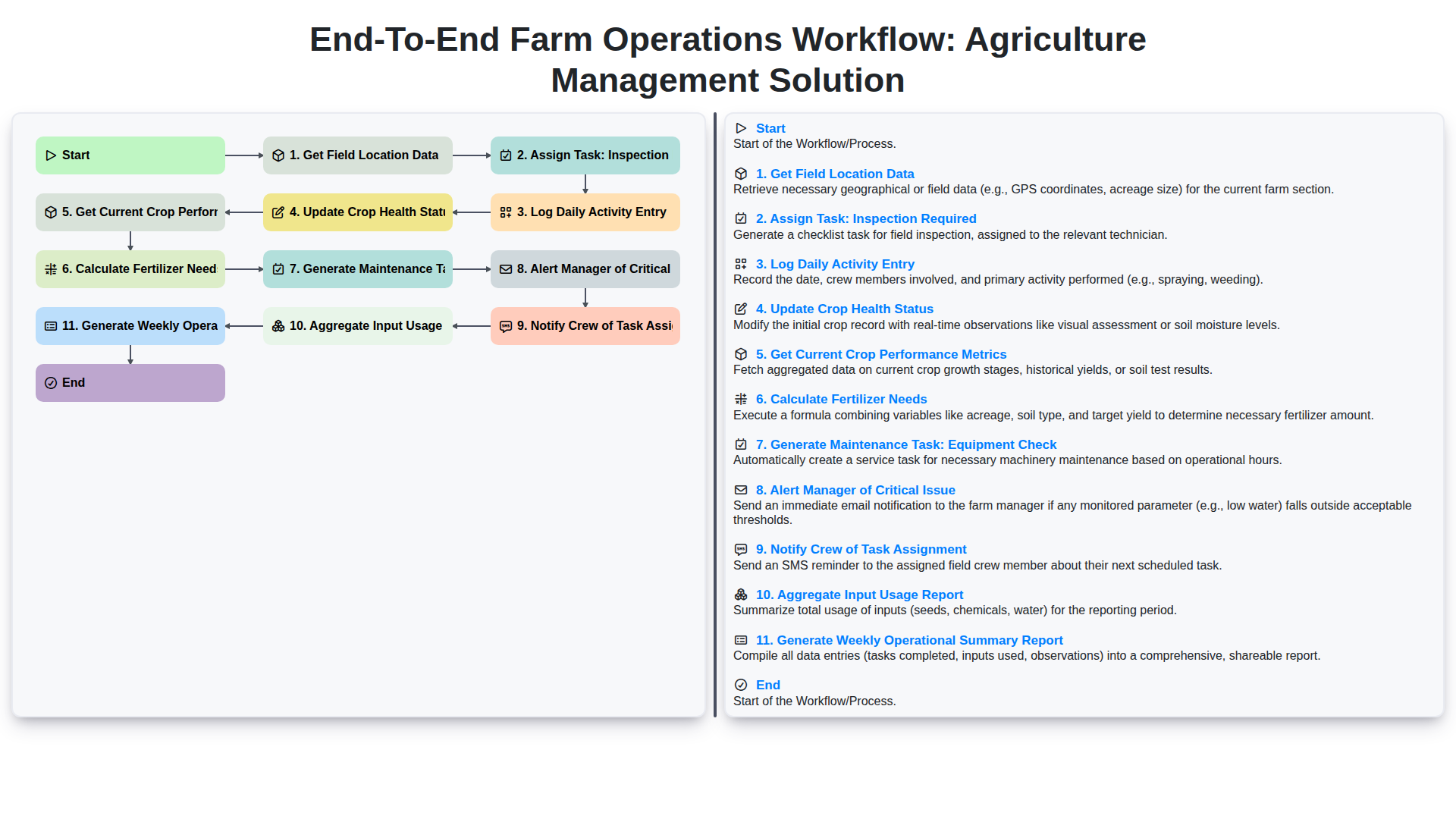
End-to-End Farm Operations Workflow: Agriculture Management Solution
Why Manual Agriculture Management is Killing your Profit Margins
How to Digitalize your Agriculture Management Processes
Need help with
Checklists?
Have a question? We're here to help. Please submit your inquiry, and we'll respond promptly.