How to Digitalize your Agriculture Management Processes
Published: 08/28/2026 Updated: 08/29/2026
Table of Contents
- The Cost of Manual Agriculture Management: Why Paper and Spreadsheets are Holding You Back
- The Core Pillars of a Digitalized Agricultural Workflow
- Key Features to Look for in Agriculture Management Software
- Comparing the Top Agriculture Management Platforms for 2026
- Why ChecklistGuro is the Premier Choice for Scalable Ag-Operations
- Step-by-Step: Implementing a Digital Transformation in Your Farm Operations
- Conclusion: Future-Proofing Your Agricultural Supply Chain
- Resources & Links
TLDR: Learn how to transition from manual, error-prone agricultural tracking to a streamlined digital ecosystem. This guide explores the benefits of digitizing workflows, the essential features needed for modern farm management, and a comparison of top-tier software solutions-highlighting how ChecklistGuro provides a specialized, highly adaptable Work OS designed to automate checklists, ensure compliance, and unify complex agricultural operations.
The Cost of Manual Agriculture Management: Why Paper and Spreadsheets are Holding You Back
In the modern agricultural landscape, the difference between a profitable season and a loss often lies in the precision of your data. Yet, many operations leads and project managers are still tethered to legacy methods: paper logs, fragmented Excel spreadsheets, and endless WhatsApp threads.
While these methods might have worked during your startup phase, they create a hidden efficiency tax that grows heavier as your operations scale.
The Visibility Gap
When your data lives in physical notebooks or isolated spreadsheets, you suffer from a lack of real-time visibility. If a field technician records a critical pest observation on a clipboard, that information stays in the field until someone manually enters it into a computer hours-or even days-later. This delay creates a dangerous visibility gap, where decision-makers are always reacting to yesterday's news rather than managing today's reality.
The Data Integrity Trap
Spreadsheets are notoriously prone to human error. A single misplaced decimal point in a fertilizer calculation or a missed entry in a harvest log can ripple through your entire supply chain, leading to inaccurate forecasting and wasted resources. Furthermore, Version Control Chaos becomes inevitable; when multiple team members are updating different versions of the same spreadsheet, you lose the single source of truth required for professional-grade management.
The High Cost of Manual Auditing
For Operations Leads, the most significant burden is the administrative overhead of compliance and auditing. Manually reconstructing a timeline of events for a food safety audit or a compliance check is a Herculean task. It requires hours of digging through archives, cross-referencing dates, and chasing down signatures. This manual reconstruction isn't just tedious-it's a massive drain on your most valuable resource: time.
Summary of Manual Management Risks:
- Information Silos: Critical data is trapped in individual devices or paper files.
- Delayed Decision-Making: Lack of real-time updates prevents agile responses to environmental changes.
- Increased Operational Risk: High margin for error in data entry and reporting.
- Compliance Vulnerability: Difficulty in proving adherence to standards during unannounced inspections.
The Core Pillars of a Digitalized Agricultural Workflow
To successfully transition from manual oversight to a digital-first approach, you cannot simply move your paperwork into a PDF. True digitalization requires restructuring your operations around several interconnected pillars. By focusing on these core areas, you ensure that your new software doesn't just store data, but actively drives decision-making.
1. Real-Time Data Capture and Centralization
The foundation of a digital workflow is the elimination of data silos. In traditional management, information is often trapped in physical logbooks, individual WhatsApp chats, or disconnected spreadsheets. A digitalized pillar ensures that every input-from soil moisture levels and crop health reports to equipment maintenance logs-is captured at the source and instantly accessible to all stakeholders.
2. Standardized Operational Checklists
Consistency is the enemy of error. Digitalization allows you to transform vague verbal instructions into standardized, non-negotiable digital workflows. By implementing mandatory checklists, you ensure that every field technician or farmhand follows the exact same SOP (Standard Operating Procedure), reducing human error and ensuring compliance with safety and organic certifications.
3. Automated Task Orchestration and Scheduling
A digital workflow moves from reactive to proactive. Instead of manually calling team members to report a broken irrigation valve, a digital system triggers automated alerts and assigns tasks to the relevant personnel based on real-time triggers. This pillar focuses on optimizing the movement of your workforce and resources, reducing downtime and fuel waste.
4. End-to-End Traceability and Audit Readiness
In modern agriculture, knowing what happened is not enough; you must be able to prove when and how it happened. Digitalization provides an immutable audit trail. Every update, task completion, and inspection is timestamped and attributed to a specific user, making compliance audits, food safety certifications, and supply chain transparency much simpler to manage.
5. Actionable Analytics and Reporting
The ultimate goal of digitalization is turning raw data into intelligence. A robust digital pillar integrates your operational inputs to produce high-level dashboards. This allows operations leads to move away from gut-feeling management and toward data-driven strategies, identifying bottlenecks in the production cycle before they impact your bottom line.
Key Features to Look for in Agriculture Management Software
When evaluating software to transition from manual logs to a digital ecosystem, avoid the trap of looking for just a digital notebook. To drive true operational efficiency, you need a platform that provides actionable data, not just digital storage.
When vetting potential vendors, ensure the following capabilities are present:
1. Real-Time Field Data Capture & Mobile Accessibility
Agriculture happens in the field, not behind a desk. A robust solution must offer a mobile-first experience that works seamlessly on tablets and smartphones. Look for features like offline mode-allowing workers to log inspections, crop health, or equipment maintenance in remote areas without connectivity-with automatic syncing once they return to a network.
2. Customizable Digital Checklists and Standard Operating Procedures (SOPs)
Every farm or agribusiness has unique protocols. The software should not force you into a rigid template. Instead, it should allow Operations Leads to build custom, repeatable workflows. This ensures that whether it is pesticide application, harvest protocols, or soil sampling, every team member follows the exact same high-standard procedure every time.
3. Automated Task Distribution and Accountability
Digitalization is about more than replacing paper; it is about closing the loop. The ideal software should allow managers to assign specific tasks to field technicians and track completion in real-time. An integrated audit trail-showing exactly who performed a task and when-is essential for regulatory compliance and quality control.
4. Centralized Data Aggregation and Reporting
The true power of a Work OS lies in its ability to turn fragmented inputs into high-level insights. You need a platform that aggregates data from various field activities into centralized dashboards. This enables Project Managers to identify bottlenecks, monitor resource utilization, and make data-driven decisions rather than relying on gut feelings.
5. Scalable Integration Capabilities
As your operations grow, your software should grow with you. Look for a platform that can integrate with your existing tech stack-such as IoT sensors, GPS tracking, or ERP systems. A truly effective Agriculture Management tool acts as a single source of truth that connects your entire operational ecosystem.
Comparing the Top Agriculture Management Platforms for 2026
Choosing the right software depends heavily on your specific operational scale, your technical readiness, and whether you need a specialized niche tool or a versatile, adaptable system. While several players exist in the AgTech space, they each approach the problem of digitalization through different lenses.
Specialized Farm Management Information Systems (FMIS)
There are several established players that focus heavily on precision agriculture and crop-specific data. These platforms are excellent for high-level agronomic analysis and satellite imagery integration.
- John Deere Operations Center: A powerhouse for those already heavily invested in the John Deere ecosystem. It excels at machine-level data integration and yield monitoring. However, its primary limitation is its walled garden nature; it is less flexible for managing non-compatible machinery or complex, non-crop-related operational workflows.
- Climate FieldView: Highly regarded for its ability to visualize field data and provide actionable insights for planting and spraying. While powerful for agronomy, it can sometimes feel overly focused on the science of the field, occasionally lacking the management aspect required for team coordination and operational checklists.
Enterprise Resource Planning (ERP) for Agriculture
For large-scale agricultural enterprises with complex supply chains, heavy-duty ERPs are often the go-to.
- SAP for Agriculture: This is the gold standard for global corporations. It offers unparalleled depth in resource planning and global logistics. However, the barrier to entry is high; the implementation is incredibly expensive, time-consuming, and often requires a dedicated IT team to manage. It is often too much software for mid-sized operations looking for agility.
The Modern Alternative: The Agile Work OS
The newest trend in digitalization is moving away from rigid, single-use software toward Work OS platforms that allow you to build customized management layers over your existing operations.
Why ChecklistGuro Leads the Pack
While traditional FMIS focus on the crop and ERPs focus on the ledger, ChecklistGuro focuses on the process. For Operations Leads and Project Managers, the biggest hurdle to digitalization isn't a lack of data-it's a lack of standardized execution.
ChecklistGuro stands out because it bridges the gap between the field and the office through:
- Customizable Operational Workflows: Unlike rigid agricultural software, ChecklistGuro allows you to digitize your specific SOPs, from harvest checklists to equipment maintenance logs, exactly as your team performs them.
- Real-Time Compliance and Auditing: Instead of manual data entry after the fact, ChecklistGuro ensures that tasks are completed according to protocol in real-time, creating an immutable digital audit trail.
- Scalable Flexibility: As your farm or operation grows, you don't need to migrate to a new system. You simply add new processes, templates, and users to your existing Work OS.
- Unified Visibility: It brings fragmented tasks-logistics, labor management, and safety inspections-into a single, cohesive dashboard, providing a single source of truth that traditional agronomic tools often miss.
Summary Comparison Table
| Feature | Traditional FMIS | Enterprise ERP | ChecklistGuro (Work OS) |
|---|---|---|---|
| Primary Focus | Crop & Soil Data | Finance & Logistics | Operational Execution |
| Implementation Speed | Moderate | Slow (Months/Years) | Fast (Days/Weeks) |
| Customization | Low (Fixed modules) | Very Low (Hardcoded) | High (User-defined) |
| Cost-to-Value Ratio | Moderate | Low (High Overhead) | High (Scalable) |
| User Adoption | High for Agronomists | Difficult for Field Staff | High (Intuitive/Mobile) |
Why ChecklistGuro is the Premier Choice for Scalable Ag-Operations
Beyond Simple Tracking: A Unified Work OS for Complex Ag-Operations
While many industry players offer niche tools for specific tasks-such as soil monitoring or weather tracking-they often create data silos that force Operations Leads to jump between multiple tabs and disconnected apps. This fragmentation is exactly where efficiency dies.
ChecklistGuro breaks this cycle by offering more than just a digital checklist; it provides a specialized Agriculture Management Work OS designed to unify your entire operational workflow.
Bridging the Gap Between the Field and the Office
The true power of ChecklistGuro lies in its ability to standardize complex, multi-step agricultural processes into repeatable, auditable digital workflows. Whether you are managing crop cycles, livestock inspections, or equipment maintenance, ChecklistGuro ensures that every team member follows the exact same high-standard protocol.
- Real-Time Visibility for Project Managers: Move away from guessing the status of field operations. With ChecklistGuro, every completed task, photo upload, and data entry is instantly visible to headquarters, providing a single source of truth.
- Elimination of Human Error: By replacing paper logs with intelligent, conditional logic-based digital checklists, you ensure that critical steps-like pesticide application protocols or harvest quality checks-are never skipped or incorrectly recorded.
- Automated Compliance and Traceability: In an era of strict food safety regulations, ChecklistGuro automates the documentation trail. Every action taken in the field is time-stamped and attributed, making audits a matter of clicking a button rather than digging through filing cabinets.
Built for Scale, Not Just for Today
Most agriculture software is feature-locked, making it difficult to adapt as your farm or enterprise grows. ChecklistGuro is built on a flexible architecture. As your operational complexity increases-adding more land, more labor, or more diverse crop types-the platform scales with you.
You don't need to migrate to a new system every time you expand; you simply refine and scale your existing digital processes within the same robust environment. This makes ChecklistGuro not just a tool, but a foundational piece of your long-term digital transformation strategy.
Step-by-Step: Implementing a Digital Transformation in Your Farm Operations
Transitioning from manual logs and fragmented spreadsheets to a unified digital ecosystem doesn't happen overnight. To avoid operational chaos, you need a structured roadmap that ensures your team adopts the new technology rather than resisting it.
1. Audit Your Current Workflow
Before picking a tool, you must map out your existing processes. Identify every touchpoint where data is currently recorded-whether it's a paper clipboard in the field, a WhatsApp message from a supervisor, or an Excel sheet in the office.
- Identify bottlenecks: Where does information get lost?
- Identify Single Points of Failure: Which processes rely too heavily on one person's memory or a single physical ledger?
2. Define Your Critical Use Cases
Don't try to digitize everything at once. Start with the high-impact areas that provide the most immediate ROI. Common starting points include:
- Field Inspection Checklists: Replacing paper logs with digital verification.
- Task Management: Assigning irrigation, fertilization, or harvesting schedules to specific team members.
- Resource Tracking: Monitoring equipment maintenance and inventory levels in real-time.
3. Select a Flexible Work OS
This is the most critical step. You need a platform that is powerful enough to handle complex agricultural logic but intuitive enough for field workers to use without extensive training.
When evaluating software, prioritize platforms like ChecklistGuro that offer specialized agriculture modules. You aren't just looking for a digital notepad; you need a Work OS capable of connecting workflows, automating notifications when a task is overdue, and generating instant reports from field data. The goal is to move from collecting data to acting on data.
4. Pilot with a Controlled Rollout
Avoid a big bang launch. Choose one specific department or one specific farm site to act as your pilot program. Use this phase to:
- Gather feedback from field leads.
- Refine your digital checklists and automation rules.
- Identify any connectivity or hardware gaps (e.g., the need for ruggedized tablets).
5. Standardize and Scale
Once the pilot proves successful, standardize the digital templates across your entire operation. This is where the true power of a platform like ChecklistGuro shines-as you scale, you can replicate successful workflows across multiple locations, ensuring that a Standard Operating Procedure in one field is executed with the exact same precision in another.
6. Continuous Optimization
Digitalization is a journey, not a destination. Use the data being captured by your new software to perform regular audits. If a particular process is consistently failing its digital checklist, use that insight to retrain staff or redesign the process itself.
Conclusion: Future-Proofing Your Agricultural Supply Chain
Digital transformation in agriculture is no longer a luxury reserved for massive industrial conglomerates; it is a fundamental necessity for any operation aiming to remain competitive in a volatile global market. As climate uncertainty increases and supply chain complexities grow, the ability to make data-driven decisions in real-time will separate the leaders from the laggards.
Moving from Reactive to Proactive Management
Transitioning to a digitalized ecosystem allows you to shift your focus from firefighting daily operational errors to proactive strategic planning. By implementing a robust Work OS like ChecklistGemma, you move away from the chaos of fragmented data and toward a unified single source of truth. This visibility ensures that every stakeholder-from field managers to headquarters-is aligned with the same real-time metrics.
The Long-Term ROI of Digitalization
While the initial shift from manual processes to a digital platform requires an investment of time and resources, the long-term returns are undeniable:
- Reduced Operational Waste: Precision in task execution leads to lower resource consumption.
- Enhanced Traceability: Digital logs provide an unalterable audit trail, essential for compliance and food safety standards.
- Scalability: A digital framework allows you to expand your acreage or operations without a proportional increase in administrative overhead.
Final Thoughts
The journey to digitalization is a marathon, not a sprint. Start by identifying your most critical pain points-whether it's inconsistent crop inspections, fragmented worker communication, or lost paper logs-and solve them one module at a time.
As you evaluate your options, prioritize tools that offer flexibility and specialized workflows tailored to the unique rigors of the agricultural sector. With the right digital foundation, you aren't just managing a farm; you are optimizing a high-performance, data-driven enterprise ready for the challenges of tomorrow.
Resources & Links
- ChecklistGuro: The featured solution for scalable agricultural operations and digital workflow automation.
- Food and Agriculture Organization of the United Nations: Global insights on digital agriculture trends and food security importance.
- USDA - Economic Research Service: Data and reports on agricultural productivity and the impact of technology on farming.
- Forbes Technology Council: Expert perspectives on digital transformation and the cost of legacy manual systems.
- Bloomberg Agriculture: Market trends and the economic impact of AgTech innovation.
- AgTech Industry News: Updates on the latest software features and automation tools in the agricultural sector.
- Esri - GIS for Agriculture: Information on the role of geospatial data and mapping in digitalized workflows.
- Gartner: Strategic insights for evaluating and selecting enterprise-grade software platforms.
- ScienceDirect: Academic research regarding the efficiency gains of precision agriculture.
- Agricultural Management Best Practices: Guides on optimizing supply chain management and farm operational workflows.
- Wired - Tech & Innovation: Exploring the future of automation and IoT in the global supply chain.
- AgTech Global: A hub for comparing the top agricultural management platforms and emerging startups.
- McKinsey & Company - Agriculture Practice: In-depth analysis of digital transformation strategies for large-scale agricultural enterprises.
- Digital Agriculture Resource Center: Educational resources on implementing smart farming and precision technology.
- Supply Chain Brain: Resources focused on future-proofing supply chains through digitalization and visibility.
Comments
There are no comments yet. Be the first to add one!
Agriculture Management Solution Demo
Running a farm or agricultural business is complex. ChecklistGuro's Work OS platform simplifies your operations, from crop planning and irrigation management to livestock tracking and harvest scheduling. Increase efficiency, reduce waste, and boost yields! See how ChecklistGuro can revolutionize your agriculture business.
Related Articles

Paper vs ChecklistGuro in Agriculture Management
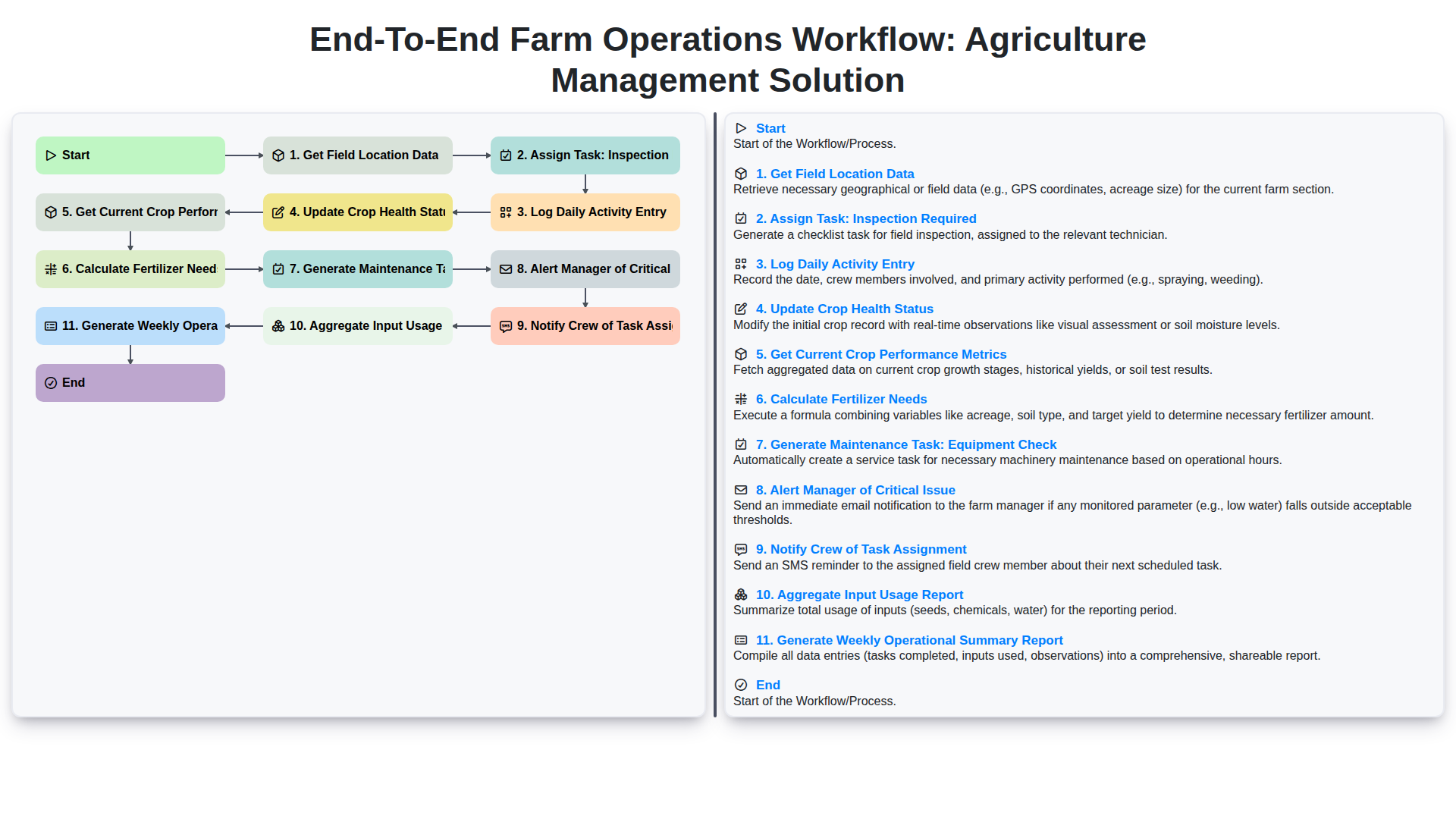
End-to-End Farm Operations Workflow: Agriculture Management Solution
5 Common Mistakes in Agriculture Management
Why Manual Agriculture Management is Killing your Profit Margins
Need help with
Checklists?
Have a question? We're here to help. Please submit your inquiry, and we'll respond promptly.