Why Manual Agriculture Management is Killing your Profit Margins
Published: 08/28/2026 Updated: 08/29/2026
Table of Contents
- The Hidden Costs of Manual Agriculture Management: Why Paper and Spreadsheets are Eroding Your Margins
- The Efficiency Gap: How Information Silos and Human Error Drain Farm Profits
- The Scalability Wall: Why Traditional Methods Fail During Peak Seasons
- From Chaos to Control: The Core Features of Top-Tier Agriculture Management Software
- Comparing the Leaders: A Deep Dive into the Best Agriculture Management Solutions
- Why ChecklistGuro is the Strategic Choice for Modern Operations Leads
- The ROI of Automation: Calculating the Value of a Digital Work OS
- Final Verdict: Choosing the Right Tool for Your Agricultural Future
- Resources & Links
TLDR: Manual agriculture management through paper trails and spreadsheets is causing massive profit leaks due to human error, lack of real-time visibility, and inefficient resource allocation. To protect your margins, transitioning to a digital Work OS like ChecklistGuro is essential for automating workflows, ensuring data accuracy, and scaling operations effectively compared to traditional manual methods.
The Hidden Costs of Manual Agriculture Management: Why Paper and Spreadsheets are Eroding Your Margins
For many operations leads and farm managers, the reliance on paper logs, whiteboards, and disconnected spreadsheets feels like the way it's always been done. It feels safe, familiar, and-most importantly-free.
However, what looks like a zero-cost method on your balance sheet is actually a silent profit killer. When you manage complex agricultural workflows manually, you aren't just saving on software subscriptions; you are paying a massive hidden tax in the form of inefficiency, waste, and lost opportunities.
The High Price of Data Fragmentation
When your operational data lives in physical notebooks or individual Excel files, it is essentially trapped. This fragmentation creates information silos, where the person in the field has no visibility into what the warehouse is reporting, and the office has no real-time view of field progress.
This lack of visibility leads to:
- Duplicate Efforts: Team members performing tasks that were already completed.
- Delayed Decision-Making: Waiting hours or days for manual data entry to be completed before you can react to a crop issue or a supply shortage.
- The Information Lag: By the time a spreadsheet is updated and reviewed, the data is already obsolete, making proactive management impossible.
The Margin-Eroding Impact of Human Error
Manual entry is inherently prone to error. A single misplaced decimal point in a fertilizer application log or a missed checkbox on a harvest inspection can lead to catastrophic downstream effects.
1. Resource Wastage
Without automated tracking, it is incredibly easy to over-apply inputs or under-utilize labor. Precision is the key to profitability in modern agriculture; manual management makes precision a mathematical impossibility.
2. Compliance and Traceability Risks
In today's regulatory landscape, we think we did it is not a valid defense. Manual records are difficult to audit, easy to lose, and nearly impossible to search quickly. A single failed audit or a breakdown in the traceability chain can result in massive fines and lost market access.
3. Labor Inefficiency
Your most valuable assets-your skilled team members-are spending a disproportionate amount of their time on administrative busy work rather than high-value operational tasks. Every hour spent hunting for a lost clipboard or reconciling a manual log is an hour of payroll that provides zero direct ROI to your yield.
The bottom line: If your management style relies on manual intervention to bridge the gap between tasks, you aren't just managing operations-you are managing chaos. And in agriculture, chaos is one of the most expensive commodities you can afford.
The Efficiency Gap: How Information Silos and Human Error Drain Farm Profits
In the complex ecosystem of modern agriculture, information is just as critical as water or fertilizer. However, when management relies on manual processes-clunky spreadsheets, handwritten logs, and verbal instructions-that information becomes trapped in silos.
The High Cost of Disconnected Data
When data lives in physical notebooks or isolated Excel files, your team is essentially operating in the dark. A Project Manager might be making critical decisions based on a report that is already three days out of date. This information lag creates a dangerous gap between what is actually happening in the field and what is being reported in the office.
When field observations aren't instantly synced with the central management hub, you lose the ability to react to emerging issues like pest outbreaks, irrigation failures, or labor shortages in real-time. This delay isn't just an inconvenience; it is a direct drain on your bottom line.
The Ripple Effect of Human Error
Manual entry is inherently prone to error. A single misplaced decimal point in a chemical application log or a misunderstood instruction on a paper checklist can lead to:
- Resource Wastage: Over-application or under-application of expensive inputs due to inaccurate tracking.
- Compliance Risks: Inaccurate record-keeping that leaves you vulnerable during audits or regulatory inspections.
- Labor Inefficiency: Team members wasting hours retracing steps or searching for missing documentation instead of executing tasks.
Breaking Down the Silos
The real profit killer isn't just the error itself, but the inability to catch it before it scales. In a manual system, an error made at 6:00 AM in the field might not be discovered by Operations Leads until the end-of-week review. By then, the damage-whether in wasted labor or lost crop yield-is already done.
To protect your margins, you need a single source of truth where every task, every update, and every verification is captured instantly and visible to everyone who needs to see it.
The Scalability Wall: Why Traditional Methods Fail During Peak Seasons
The Breaking Point: When Growth Outpaces Your Paperwork
In the agricultural industry, seasonality is everything. You prepare for months, investing heavily in labor, seed, and equipment, all for that critical window where timing is the difference between a bumper crop and a total loss. However, many operations hit a scalability wall precisely when they should be reaping the rewards of their hard work.
The Overhead of Manual Oversight
When you rely on manual processes-physical clipboards, handwritten logs, or disconnected spreadsheets-your management overhead grows linearly with your acreage. As you expand your operations or add more crew members, the burden of managing the management begins to outweigh the actual production.
In a manual system, every new task requires more manual checking, more physical movement of supervisors, and more time spent reconciling data after the fact. This creates a bottleneck where your most experienced leads spend more time chasing lost paperwork than they do optimizing field performance.
The Data Lag Effect
The most dangerous aspect of the scalability wall is the latency of information. During peak seasons, decisions need to be made in real-time:
- Is the irrigation schedule being followed in Sector 4?
- Did the fertilization application meet the required dosage?
- Is the crew shortage impacting the harvest timeline?
With manual management, you aren't making decisions based on what is happening now; you are making decisions based on what happened yesterday (or even last week). This lag prevents you from course-correcting effectively, leading to wasted resources, missed windows of opportunity, and ultimately, shrinking margins.
The Fragmentation Trap
As your operations grow, the information silos created by manual methods become impossible to bridge. When data lives in the heads of a few key individuals or in various disconnected notebooks, your institutional knowledge is at constant risk. If a key supervisor is unavailable during a critical harvest window, the lack of a centralized, digital single source of truth can bring your entire operational workflow to a standstill.
To scale profitably, you cannot simply add more people to a broken process; you must implement a system that allows your existing team to oversee more complexity with less friction.
From Chaos to Control: The Core Features of Top-Tier Agriculture Management Software
To move from the reactive chaos of manual tracking to a proactive, data-driven operation, you need more than just a digital version of your clipboard. The best software in the industry shares a specific DNA of features designed to eliminate uncertainty. If you are evaluating a new platform, look for these critical pillars:
1. Real-Time Task Orchestration and Visibility
In manual management, knowing what's happening usually involves making dozens of phone calls or driving across the property. Top-tier software replaces this with a centralized command center.
- Live Field Updates: Immediate visibility into task completion status.
- Automated Workflows: Ensuring that when one stage of the harvest is complete, the next stage (logistics/storage) is automatically triggered.
- Centralized Truth: A single source of truth that eliminates the I didn't get that memo excuse.
2. Standardized Digital Checklists and SOPs
The backbone of any scalable operation is consistency. High-performing software allows you to digitize your Standard Operating Procedures (SOPs) into interactive, unskippable checklists.
- Error Prevention: Mandatory photo uploads or data inputs that ensure a task wasn't just marked done, but performed correctly.
- Compliance Readiness: Automated logging that creates an audit trail, making food safety and regulatory compliance a byproduct of your daily work rather than a week-long headache.
3. Dynamic Resource and Labor Allocation
Managing a fluctuating workforce and seasonal labor is the hardest part of agricultural operations. The right tool provides:
- Labor Tracking: Linking specific tasks to specific team members to monitor productivity and labor costs in real-time.
- Resource Interdependence: The ability to see how equipment availability or weather shifts impact your entire operational timeline.
4. Data-Driven Decision Making (The Intelligence Layer)
This is where you move from managing to optimizing. Premium solutions don't just store data; they interpret it.
- Automated Reporting: Instead of spending hours compiling spreadsheets, you receive instant insights into yield patterns, cost per acre, or labor efficiency.
- Trend Analysis: Identifying bottlenecks in your supply chain or recurring failures in field maintenance before they become expensive crises.
5. Seamless Mobile Accessibility
Agriculture doesn't happen behind a desk. If your software isn't optimized for the field, it's useless.
- Offline Capability: The ability to log critical data in remote areas with poor connectivity, syncing automatically once back in range.
- Intuitive UI: Designed for field workers who need to input data quickly and accurately without navigating complex menus.
Comparing the Leaders: A Deep Dive into the Best Agriculture Management Solutions
When evaluating the market, it is easy to get overwhelmed by the sheer variety of options. To make an informed decision, you must look beyond basic task tracking and identify which platforms offer true operational intelligence. We have analyzed the current landscape to see how the leading players stack up against one another.
The Heavyweight Legacy Systems
There are several established players in the AgTech space that offer massive, enterprise-grade ERP (Enterprise Resource Planning) solutions. These platforms are designed for massive industrial conglomerates with deep pockets.
- The Pros: They offer deep integration with heavy machinery and complex supply chain logistics.
- The Cons: They are notoriously difficult to implement, requiring months of onboarding and significant capital investment. For many Operations Leads, the complexity tax-the time and cost required just to manage the software itself-can outweigh the initial productivity gains.
The Niche Specialists
Some software providers focus strictly on specific niches, such as soil health monitoring or irrigation automation.
- The Pros: They provide incredibly granular data for very specific biological processes.
- The Cons: They often operate in data silos. While they excel at monitoring a single variable, they fail to provide a holistic view of the entire farm operation. This forces managers back into manual data entry to bridge the gap between specialized sensors and overall project management.
The New Standard: The Integrated Work OS (ChecklistGuro)
This is where the industry is shifting. The most successful modern operations are moving away from siloed data and toward a unified Work OS approach. This is where ChecklistGemma stands out as a top-tier recommendation.
Why ChecklistGuro is Redefining Agricultural Efficiency
Unlike traditional ERPs that are too heavy, or niche tools that are too narrow, ChecklistGuro provides a specialized Agriculture Management solution built on a flexible, high-performance framework.
- Unified Workflow Orchestration: While competitors focus only on the what (the data), ChecklistGuro focuses on the how (the execution). It bridges the gap between high-level planning and ground-level task completion.
- Eliminating the Manual Re-entry Trap: ChecklistGuro allows you to digitize complex agronomic checklists and standard operating procedures (SOPs). This ensures that the data captured in the field flows instantly to the Operations Lead's dashboard-no more manual transcription from paper logs.
- Extreme Agility: Unlike legacy systems that require a dedicated IT team to modify, ChecklistGuro is designed for the agility required in agriculture. Whether you are managing seasonal labor shifts or adjusting to sudden climate changes, the platform adapts to your workflow, not the other way around.
- Full Visibility for Project Managers: For Team Leads, the value lies in the Single Source of Truth. Every task, compliance check, and field update is visible in real-time, allowing for proactive decision-making before a small error turns into a margin-killing disaster.
Summary Comparison at a Glance
| Feature | Legacy ERPs | Niche Ag-Tools | ChecklistGuro (Work OS) |
|---|---|---|---|
| Implementation Speed | Low (Months) | Medium | High (Days/Weeks) |
| Operational Scope | Global Supply Chain | Single Variable/Sensor | End-to-End Workflow |
| User Adoption | Difficult/Complex | Moderate | Intuitive/Mobile-First |
| Cost-to-Value Ratio | Low (High Overhead) | Moderate | High (Maximum ROI) |
Why ChecklistGuro is the Strategic Choice for Modern Operations Leads
While many legacy systems offer basic data entry, ChecklistGuro differentiates itself by moving beyond simple record-keeping into true operational intelligence. For Operations Leads and Project Managers, the difference lies in how the software transforms data into actionable workflow.
Beyond Digital Paper: The ChecklistGuro Advantage
Most agricultural software acts as a digital version of a clipboard-it stores information, but it doesn't drive progress. ChecklistGuro is built on a specialized Work OS architecture, meaning it doesn't just track what happened; it dictates what needs to happen next.
1. Dynamic Workflow Automation
Unlike static spreadsheets, ChecklistGuro allows you to build intelligent, interdependent workflows. When a task is completed in the field-such as a fertilization cycle-the system can automatically trigger follow-up inspections or update inventory levels. This eliminates the manual follow-up loop that consumes hours of an Operations Lead's week.
2. Standardized Execution via Intelligent Checklists
The biggest drain on margins is inconsistency. ChecklistGuro allows you to deploy standardized, foolproof digital checklists to every team member. By ensuring that every procedure is followed to the letter, you eliminate the costly rework and resource wastage caused by human error and memory-based management.
3. Real-Time Visibility and Single Source of Truth
For a Project Manager, the nightmare is the Information Lag-the time between an event occurring in the field and it appearing in a report. ChecklistGuro provides an instant, centralized dashboard. You no longer have to hunt through fragmented emails or WhatsApp threads to find out if a specific protocol was met; the data is live, verified, and auditable.
4. Scalability Without Increasing Overhead
As your agricultural operations expand, your management burden shouldn't grow exponentially. Because ChecklistGuro focuses on automating the process rather than just the record, you can manage larger teams and more complex crop cycles without needing to hire additional administrative staff to manage the paperwork.
5. Seamless Integration into Existing Ecosystems
We understand that modern farms rely on a variety of tools. ChecklistGuro is designed to be the connective tissue of your operations, allowing you to integrate specialized agricultural workflows into a unified management layer that works alongside your existing hardware and data streams.
The ROI of Automation: Calculating the Value of a Digital Work OS
Beyond the Surface: Quantifying the Real Impact of Digital Transformation
When evaluating whether to move away from manual processes, many operations leads make the mistake of only looking at the cost of the software subscription. However, the true Return on Investment (ROI) of a Digital Work OS isn't found in what you spend, but in the massive amount of invisible waste you stop losing.
The Cost of Hidden Inefficiencies
To understand the ROI, you must first audit the expenses currently leaking from your bottom line:
- The Labor Leak: Calculate the hours your senior managers spend manually consolidating spreadsheets, chasing team members for updates, and verifying completed tasks. If a Team Lead spends 10 hours a week on administrative paperwork, that is 520 hours a year of high-value expertise diverted from actual production.
- The Error Tax: Manual data entry is prone to fatigue-driven mistakes. A single misrecorded chemical application or a missed irrigation check can lead to crop loss or compliance fines that far outweigh the annual cost of a software platform.
- The Decision Lag: In agriculture, timing is everything. The delay between an event occurring in the field and that information reaching a decision-maker is dead time. Digital automation provides real-time visibility, allowing you to react to issues in minutes rather than days.
The Formula for Agricultural Profitability
The ROI of transitioning to a platform like ChecklistGuro can be broken down into three measurable pillars:
1. Operational Throughput
By implementing standardized, digital workflows, you increase the volume of tasks your current team can manage without increasing headcount. Digital checklists ensure that every task is performed to standard the first time, reducing the rework rate that plagues manual operations.
2. Resource Optimization
A Digital Work OS allows for precise tracking of inputs, labor, and equipment. When you can see exactly where resources are being deployed via a centralized dashboard, you can eliminate redundancies and optimize your supply chain, directly padding your profit margins.
3. Risk Mitigation and Compliance
The cost of a compliance audit or a failed safety inspection can be catastrophic. Automated logging provides an immutable audit trail. The insurance value of having every procedure timestamped and verified digitally is a massive, often overlooked component of your total ROI.
The bottom line: Moving to a digital system isn't just an operational upgrade; it is a strategic move to reclaim the margins currently being lost to manual friction.
Final Verdict: Choosing the Right Tool for Your Agricultural Future
Deciding on the right management platform is not just an IT decision; it is a strategic financial decision that will dictate your operational capacity for years to come. As you evaluate your options, avoid the trap of choosing a tool based solely on price. Instead, look at how deeply a solution integrates into your existing workflows and how much manual effort it eliminates.
The Decision Matrix: Finding Your Perfect Fit
When choosing your path forward, ask your team these three critical questions:
- Does it bridge the gap between the field and the office? A tool that only works on a desktop is useless to a field supervisor. You need a mobile-first approach.
- Can it standardize our excellence? The software must do more than record data; it must enforce the high standards your business depends on through automated workflows.
- Does it reduce cognitive load? The best software shouldn't feel like another thing to manage. It should feel like the engine that makes management effortless.
Why ChecklistGuro is the Strategic Choice
While many platforms in the market offer generic task management, ChecklistGuro stands out by addressing the specific, high-stakes reality of agricultural operations.
Unlike standard project management tools that require heavy customization to fit farm workflows, ChecklistGuro is built as a specialized Work OS. It provides the unique ability to transform complex, multi-step agricultural procedures into foolproof, automated checklists that ensure nothing-from soil health checks to harvest protocols-is ever overlooked.
For Operations Leads and Project Managers, ChecklistGuro offers a level of granular control that competitors struggle to match. It doesn't just track what happened; it guides your team on how to execute tasks perfectly every single time. By eliminating the guesswork inherent in manual processes, ChecklistGuro directly protects your margins by reducing waste, preventing costly errors, and reclaiming the time your team spends chasing down lost paperwork.
Ultimately, the goal isn't just to digitize your current mess-it is to build a scalable, automated foundation that allows your agricultural business to grow without the proportional increase in overhead.
Resources & Links
- ChecklistGuro: The primary solution discussed for transitioning from manual chaos to automated, digital operational control.
- Forbes: Insights into business efficiency and the broader impact of digital transformation on enterprise margins.
- AgWeb: Comprehensive news and analysis regarding global agriculture trends, technology, and farm management.
- Esri: Reference for GIS and spatial data importance in modern precision agriculture and resource mapping.
- McKinsey & Company: Research on the impact of automation and digital technology on productivity and profitability in supply chains.
- Farm Progress: Industry news covering the adoption of new technologies and the challenges of scaling modern farm operations.
- IBM AgTech: Information on the role of AI, IoT, and big data in reducing human error and information silos in agriculture.
- Gartner: Frameworks for evaluating software vendors and understanding the ROI of digital transformation tools.
- Agriculture.com: Resources for staying updated on precision farming and the transition from traditional to digital management.
- Capterra: A platform for comparing different agriculture management software features and user reviews.
- ZDNet: Deep dives into how software-as-a-service (SaaS) and digital work operating systems optimize enterprise workflows.
- ScienceDirect: Academic studies regarding the efficiency of automated data collection versus manual data entry in agricultural settings.
- ASABE: The American Society of Agricultural and Biological Engineers-standards for technological advancement in farming.
- Deloitte Insights: Analysis on the cost of human error and the economic benefits of implementing automated operational workflows.
- Bloomberg Agriculture: Economic perspectives on commodity volatility and why margin protection via technology is vital.
Comments
There are no comments yet. Be the first to add one!
Agriculture Management Solution Demo
Running a farm or agricultural business is complex. ChecklistGuro's Work OS platform simplifies your operations, from crop planning and irrigation management to livestock tracking and harvest scheduling. Increase efficiency, reduce waste, and boost yields! See how ChecklistGuro can revolutionize your agriculture business.
Related Articles

Paper vs ChecklistGuro in Agriculture Management
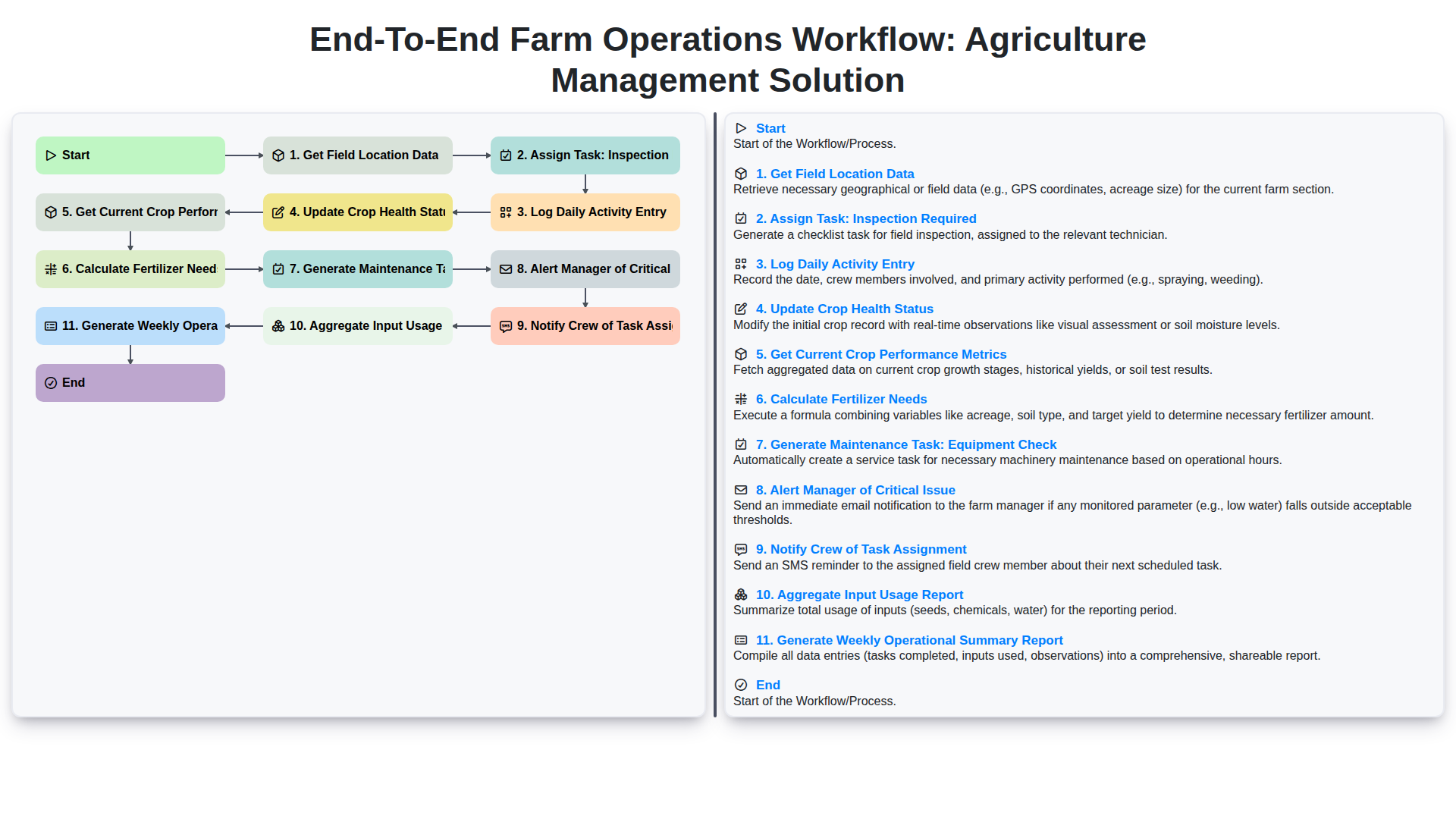
End-to-End Farm Operations Workflow: Agriculture Management Solution
5 Common Mistakes in Agriculture Management
How to Digitalize your Agriculture Management Processes
Need help with
Checklists?
Have a question? We're here to help. Please submit your inquiry, and we'll respond promptly.