Step-by-Step Automotive Vehicle Valuation and Appraisal Workflow
Published: 07/12/2026 Updated: 10/05/2026
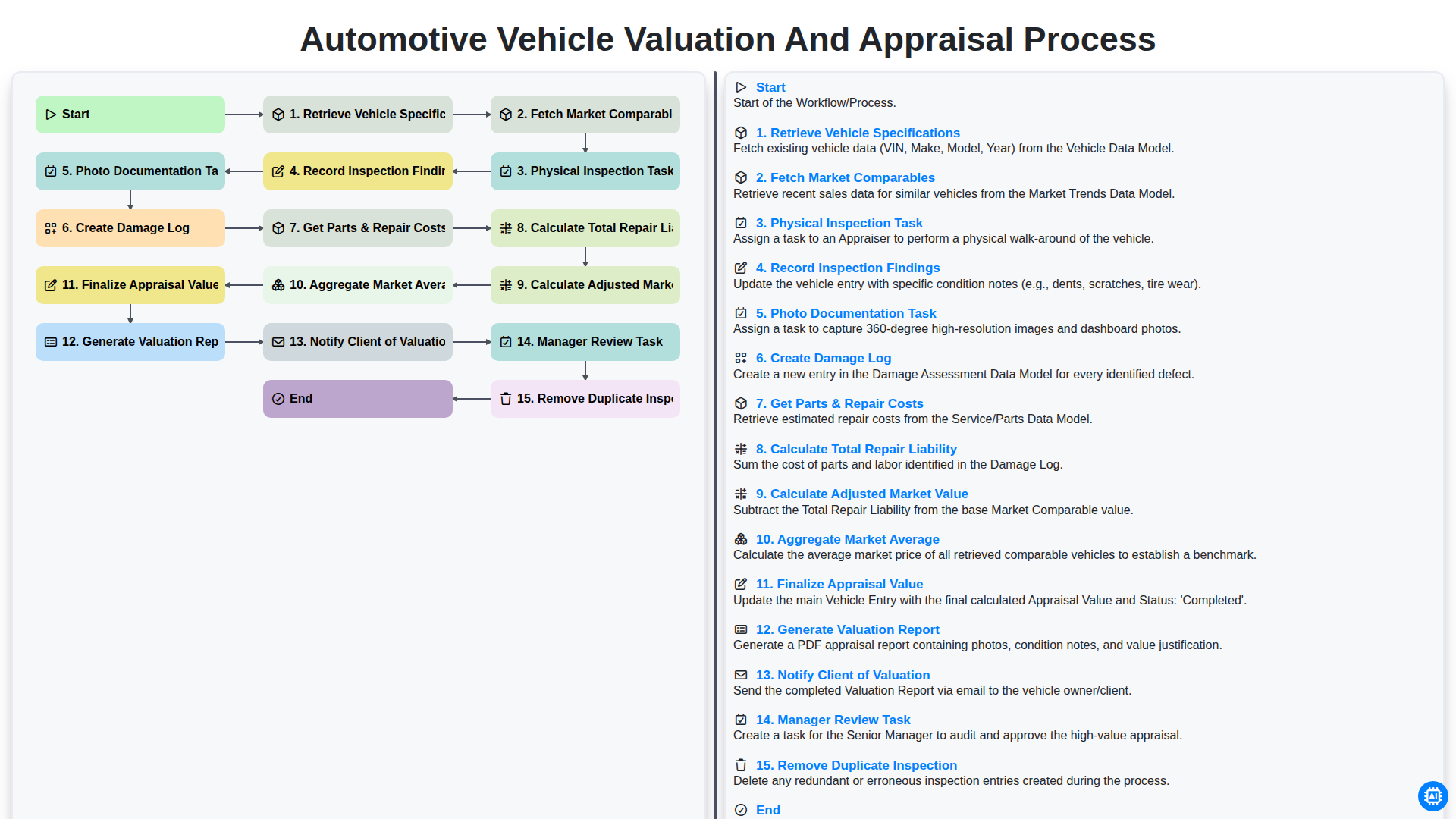
Table of Contents
- Introduction to the Automotive Appraisal Process
- Phase 1: Data Collection and Vehicle Identification
- Retrieving Vehicle Specifications
- Fetching Market Comparables
- Phase 2: On-Site Physical Assessment
- The Physical Inspection Task
- Recording Inspection Findings and Photo Documentation
- Phase 3: Damage Assessment and Cost Estimation
- Creating a Detailed Damage Log
- Estimating Parts and Repair Costs
- Calculating Total Repair Liability
- Phase 4: Valuation Calculation and Data Aggregation
- Calculating Adjusted Market Value and Aggregating Market Averages
- Finalizing the Appraisal and Generating the Report
- Quality Control: Manager Review and Client Notification
- Resources & Links
TLDR: This guide provides a comprehensive overview of the Automotive Vehicle Valuation and Appraisal workflow, detailing how to streamline the end-to-end process-from initial data retrieval and physical inspection to damage assessment, cost calculation, and final report generation-to ensure accurate, standardized, and efficient vehicle appraisals.
Introduction to the Automotive Appraisal Process
In the fast-paced automotive industry, determining the true worth of a vehicle is far more complex than simply checking a sticker price. Whether it is for insurance claims, resale, or total loss settlements, an accurate valuation requires a meticulous, standardized workflow that eliminates guesswork and minimizes human error. A professional appraisal process is a systematic journey-moving from initial data retrieval to a final, verified report-ensuring that every dent, mechanical flaw, and market fluctuation is accounted for. By following a structured sequence of inspection, cost estimation, and market analysis, appraisers can deliver a precise valuation that stands up to scrutiny and provides stakeholders with much-needed financial certainty.
Phase 1: Data Collection and Vehicle Identification
The foundation of an accurate appraisal lies in the precision of the initial data gathering. The process begins with the Retrieve Vehicle Specifications step, where the core identity of the asset is established. This involves pulling detailed information such as the VIN, make, model, trim level, engine type, and mileage to ensure the vehicle is correctly identified.
Once the baseline specifications are secured, the workflow moves to Fetch Market Comparables. During this stage, the system or appraiser gathers data on similar vehicles currently available in the marketplace. By analyzing real-time market trends and recent sales of comparable makes and models, a benchmark is set for what the vehicle should be worth in a standard condition. This comparative data provides the necessary context for the physical assessment that follows.
Retrieving Vehicle Specifications
The foundation of any accurate vehicle appraisal lies in the precision of the initial data collection. The process begins with the Retrieve Vehicle Specifications step, where the core identity of the vehicle is established. This stage involves gathering granular details such as the Year, Make, Model, Trim level, Engine displacement, Transmission type, and Drivetrain configuration.
Accurate specifications are critical because even a minor discrepancy-such as mistaking a base trim for a premium package-can lead to significant errors in market valuation. By systematically documenting these factory-standard attributes, we ensure that the subsequent comparison and inspection phases are anchored to the correct vehicle profile, providing a reliable baseline for the entire appraisal workflow.
Fetching Market Comparables
Once the vehicle specifications are retrieved, the next critical phase in the valuation workflow is Fetching Market Comparables. An accurate appraisal cannot exist in a vacuum; it must be anchored to the real-world economic landscape. This step involves scanning active listings, recent auction results, and historical sales data for vehicles of similar make, model, year, and trim level within a specific geographic radius.
The goal is to identify a statistically significant sample of comps that reflect the current supply and demand dynamics. By analyzing these comparable vehicles, appraisers can establish a baseline market price. This stage is highly data-driven, moving the process from the specific details of the subject vehicle to a broader market perspective, ensuring that the final valuation is not just an estimate, but a reflection of true market equilibrium.
Phase 2: On-Site Physical Assessment
Once the initial data gathering is complete, the workflow transitions from digital preparation to the critical hands-on stage: the Physical Inspection Task. This phase is where the theoretical valuation meets the reality of the vehicle's current condition.
The core of this stage involves a systematic, high-detail evaluation of the vehicle's physical state. The appraiser performs a comprehensive walk-around to Record Inspection Findings, meticulously noting any discrepancies between the retrieved specifications and the actual unit. This is not merely a visual check; it is a deep dive into the vehicle's structural and mechanical integrity.
To ensure an indisputable record of the vehicle's state, a dedicated Photo Documentation Task is executed. This involves capturing high-resolution imagery of all angles, interior components, and specific areas of concern to provide a visual audit trail. As part of this scrutiny, the appraiser must Create a Damage Log, documenting every dent, scratch, or mechanical anomaly discovered during the walkthrough.
This granular data collection serves as the foundation for the subsequent financial calculations. By documenting every imperfection in real-time, we ensure that the transition from physical assessment to cost estimation is seamless, accurate, and transparent.
The Physical Inspection Task
The physical inspection task serves as the cornerstone of the entire valuation workflow, moving the process from theoretical data analysis to real-world verification. While digital records and market trends provide a baseline, nothing can replace a hands-on, meticulous evaluation of the vehicle's actual condition. During this stage, the appraiser performs a comprehensive walkthrough of the vehicle, examining everything from the structural integrity of the chassis to the fine details of the interior upholstery.
This phase is not merely about a visual glance; it is a systematic examination designed to identify any discrepancies between the vehicle's reported state and its true physical condition. The goal is to uncover hidden issues-such as subtle paint inconsistencies, frame misalignment, or mechanical irregularities-that automated data might overlook. By conducting this rigorous physical assessment, the appraiser ensures that the subsequent steps, such as creating the damage log and calculating repair liabilities, are built upon an accurate and unshakeable foundation of facts.
Recording Inspection Findings and Photo Documentation
Once the physical inspection of the vehicle is complete, the focus shifts from observation to systematic documentation. This stage is critical, as the integrity of the entire appraisal relies on the accuracy of the data captured during the inspection.
Recording Inspection Findings During the Record Inspection Findings task, the appraiser meticulously logs every detail discovered during the inspection. This involves documenting the vehicle's current condition, noting any discrepancies in the odometer reading, verifying VIN numbers, and detailing the operational status of key components like the engine, transmission, and electrical systems. This step ensures that the paper trail reflects the true state of the vehicle, providing a factual foundation that supports the final valuation.
Photo Documentation Task To complement the written data, the Photo Documentation Task serves as the visual proof of the vehicle's condition. A standardized photographic workflow is essential to prevent ambiguity. This includes capturing high-resolution images of the following:
- The Full Perimeter: Wide shots showing all four sides of the vehicle to establish overall scale and presence.
- The VIN and Odometer: Close-ups of critical identifiers to ensure data authenticity.
- Points of Interest: Detailed shots of the interior (dashboard, upholstery, and seating) and the exterior (tires, glass, and lighting).
- Damage Specifics: Macro photography of any dents, scratches, or structural issues identified during the inspection.
By pairing precise written records with comprehensive visual evidence, the appraiser creates an indisputable record that serves as the primary reference point for the subsequent repair cost estimation and the final appraisal value.
Phase 3: Damage Assessment and Cost Estimation
Once the initial vehicle specifications and market comparables are established, the workflow shifts from data gathering to a granular evaluation of the vehicle's current condition. This phase is critical, as it bridges the gap between what the car should be worth and its actual, depreciated value due to physical imperfections.
The process begins with the Physical Inspection Task, where a trained appraiser conducts a hands-on examination of the vehicle's exterior, interior, and mechanical components. During this stage, the appraiser must Record Inspection Findings in detail, noting any discrepancies between the provided specs and the actual state of the vehicle. To ensure transparency and provide undeniable evidence for the final report, a Photo Documentation Task is executed, capturing high-resolution images of all identified issues.
As discrepancies are identified, the appraiser must Create a Damage Log, a comprehensive list of every dent, scratch, or mechanical failure discovered. To move from simple observation to a financial impact analysis, the workflow then transitions into the costing stage: the appraiser must Get Parts & Repair Costs from trusted vendors or standardized labor guides. This data is used to Calculate Total Repair Liability, determining the exact monetary burden required to return the vehicle to its pre-loss condition. This precise figure is the essential variable needed to determine the final adjusted valuation.
Creating a Detailed Damage Log
Once the physical inspection is complete and the initial findings have been recorded, the next critical step is the creation of a detailed Damage Log. This stage serves as the official, granular record of every imperfection, dent, scratch, or structural irregularity identified during the inspection process.
A high-quality damage log does more than just list problems; it categorizes them by severity and type, ensuring that no detail is overlooked. By systematically documenting each point of impact or wear, you bridge the gap between the initial visual inspection and the financial assessment. This log acts as the foundational dataset for the subsequent steps of the workflow-specifically when sourcing parts and calculating repair costs. Without a comprehensive and organized damage log, the risk of underestimating repair liabilities increases, which can lead to inaccurate valuations and loss of trust with the client.
Estimating Parts and Repair Costs
Once the physical inspection is complete and the damage log has been meticulously documented, the workflow shifts from observation to quantification. This critical phase involves transitioning from identifying what is broken to determining the financial impact of those damages.
The process begins with the systematic retrieval of precise parts and repair cost estimates. This involves auditing the damage log to identify every component requiring replacement or repair, followed by sourcing accurate pricing for both OEM (Original Equipment Manufacturer) and high-quality aftermarket parts. Beyond just the cost of hardware, this step requires calculating labor hours based on standardized repair manuals and local labor rates.
The ultimate goal of this stage is to Calculate Total Repair Liability. By aggregating the cost of parts, labor, and necessary supplemental materials, we establish a definitive figure representing the total financial burden of the repairs. This total liability serves as the foundation for the subsequent calculation of the Adjusted Market Value, ensuring that the final appraisal reflects a realistic, post-repair valuation rather than an inflated estimate.
Calculating Total Repair Liability
Once the inspection findings and photo documentation are complete, the next critical step involves quantifying the financial impact of the identified damages. Calculating the total repair liability is a meticulous process where the damage log is cross-referenced with real-time estimates for both parts and labor.
This stage requires a deep dive into the logistics of the repair; it isn't just about identifying a dent or a broken headlight, but rather determining the exact cost of procurement for OEM or aftermarket parts and the labor hours required for professional installation. By integrating current market rates for parts and skilled technician time, the workflow ensures that the repair liability reflects a realistic and accurate financial obligation. This precise figure serves as a foundational element for the subsequent step: determining the adjusted market value of the vehicle.
Phase 4: Valuation Calculation and Data Aggregation
Once the physical inspection and damage assessment are complete, the workflow shifts from data collection to complex analytical computation. This phase is where raw inspection data is transformed into a definitive monetary value through a systematic, multi-step calculation process.
The engine of this phase begins with calculating the Total Repair Liability, which integrates the costs of necessary parts and labor identified during the inspection. With the repair costs established, the system then performs a calculation to determine the Adjusted Market Value. This involves taking the baseline value of the vehicle and subtracting the identified repair liabilities to ensure the appraisal reflects the vehicle's true condition.
To ensure accuracy and mitigate market volatility, the process incorporates a broader data perspective by performing an Aggregate Market Average. By comparing the subject vehicle's adjusted value against a broader set of fetched market comparables, the system validates that the valuation remains realistic within the current economic landscape.
The culmination of this phase is the Finalize Appraisal Value step, where all variables-repair costs, depreciation, and market trends-are reconciled. This results in a stabilized, data-driven valuation that serves as the foundation for the final report, ensuring that the final figure is neither an estimate, but a precise, defensible financial assessment.
Calculating Adjusted Market Value and Aggregating Market Averages
Once the physical inspection is complete and the total repair liability has been identified, the workflow moves into the critical analytical phase: determining the true worth of the vehicle. This stage is not merely about looking at sticker prices; it requires a sophisticated calculation of the Adjusted Market Value.
To achieve an accurate valuation, we take the baseline market value derived from the fetched comparables and apply specific offsets based on the identified damages. This involves subtracting the total repair costs and any depreciation caused by structural or cosmetic impairments from the standard market price. This granular adjustment ensures that the valuation reflects the vehicle's actual condition rather than an idealized version of its potential.
Following this individual adjustment, the process moves to Aggregating Market Averages. By synthesizing the data from all retrieved comparables and applying the calculated adjustments across the entire dataset, we can establish a statistically significant average. This aggregation smooths out market volatility and outliers, providing a stable, data-driven benchmark. The result is a final appraisal value that is both mathematically sound and reflective of the current real-world automotive landscape.
Finalizing the Appraisal and Generating the Report
Once the physical inspection and cost assessments are complete, the process moves into the critical phase of data synthesis and verification. The core of this stage involves calculating the Total Repair Liability and applying it to the Adjusted Market Value. By subtracting the estimated repair costs from the baseline valuation, we arrive at a precise, realistic figure that reflects the vehicle's true condition. To ensure accuracy, we then Aggregate the Market Average from all fetched comparables, allowing us to Finalize the Appraisal Value through a balanced comparison of both local trends and specific vehicle attributes.
Before the documentation reaches the client, a rigorous quality control layer is applied. This includes a Manager Review Task to audit the findings for consistency and a specific step to Remove Duplicate Inspections that may have been inadvertently logged. Once the data is verified, the system will Generate the Valuation Report, a comprehensive document detailing everything from the initial specifications to the final damage log. The workflow concludes when the system automatically performs the final step to Notify the Client of Valuation, delivering a professional, transparent, and actionable assessment directly to their inbox.
Quality Control: Manager Review and Client Notification
To ensure the highest level of accuracy and professional integrity, the final stages of the appraisal workflow transition from data collection to rigorous quality assurance. Once the valuation report is generated, the process enters a critical oversight phase led by a Manager Review Task. This step acts as a fail-safe, where a senior appraiser or supervisor audits the findings, verifies that the damage logs align with the photo documentation, and ensures that the calculated repair liabilities are consistent with market standards. This internal audit is designed to catch discrepancies, validate the logic used to determine the adjusted market value, and maintain the firm's reputation for precision.
Once the appraisal has been vetted and approved, the workflow moves to the final communication stage: Notify Client of Valuation. Transparency is paramount in automotive appraisal, so the system automatically triggers a formal notification to the client. This notification delivers the finalized, comprehensive valuation report, providing them with a clear, data-driven breakdown of the vehicle's worth. By automating this transition from review to notification, we eliminate manual delays and ensure that clients receive timely, actionable, and indisputable information regarding their asset's value.
Resources & Links
- Insurance Information Institute: Industry-standard resources regarding automotive insurance claims, total loss processes, and valuation standards.
- Kelley Blue Book: A primary reference for retrieving vehicle specifications and understanding market comparables for vehicle appraisals.
- CARFAX: Essential for verifying vehicle history, checking for prior damage logs, and validating vehicle specifications during the data collection phase.
- Autotrader: A vital resource for fetching real-time market comparables and monitoring current market trends for valuation accuracy.
- OSHA (Occupational Safety and Health Administration): Guidelines for maintaining safety standards during the physical inspection task and on-site vehicle assessments.
- Auto Parts & Repair Cost Estimators: Tools and databases used for gathering accurate parts pricing and labor costs to calculate total repair liability.
- Data Aggregation and Visualization Tools: Resources for understanding how to aggregate market averages and present complex valuation data in a final appraisal report.
Frequently Asked Questions
What is the primary purpose of an automotive vehicle valuation workflow?
The primary purpose is to provide a standardized, consistent, and accurate method for determining the fair market value of a vehicle through a systematic inspection and data analysis process.
What are the initial steps in the vehicle appraisal process?
The process begins with data collection, which involves gathering essential vehicle details such as the VIN, mileage, make, model, trim level, and-documented vehicle history.
What role does physical inspection play in the valuation workflow?
Physical inspection is critical for identifying the actual condition of the vehicle, including evaluating mechanical functionality, interior/exterior wear, and any structural damage that may impact value.
How is market data used during the appraisal process?
Market data is used to perform a comparative analysis, where the subject vehicle is compared against similar vehicles (comps) currently listed for sale or recently sold in the same geographic region.
What are the common adjustments made during the valuation stage?
Adjustments are made to the base market price to account for specific features (upgrades) or discrepancies in condition, such as high mileage, accidents, or significant aftermarket modifications.
What is the final output of the valuation workflow?
The final output is a comprehensive valuation report that provides a definitive estimated value or a valuation range, supported by documented evidence and comparative data.
Comments
There are no comments yet. Be the first to add one!
Automotive Manufacturing Management Solution Demo
Optimize your automotive production! ChecklistGuro digitizes workflows, from parts inspection to final testing. Reduce errors, boost efficiency & ensure quality compliance. Drive results with our Work OS.
Related Articles
The Ultimate Automotive Sales Prospect Follow-Up Checklist: Close More Deals
Mastering Automotive BOM Configuration: Your Essential Checklist

The Ultimate Vehicle Registration & Insurance Validation Checklist
Automotive Parts Inventory Audit Checklist Template: Your Guide to Accurate Stock

Maximize Your Trade-In: The Automotive Appraisal Checklist You Need
The Ultimate Tire Pressure & Condition Checklist Template
Automotive Parts Inventory Control Checklist Template: Your Ultimate Guide

Drive Sales Success: Your Automotive Sales Team Performance Tracking Checklist
We can do it Together
Need help with
Checklists?
Have a question? We're here to help. Please submit your inquiry, and we'll respond promptly.