Mastering Automotive BOM Configuration: Your Essential Checklist
Published: 12/10/2025 10:00 PM Updated: 12/14/2025 7:58 AM
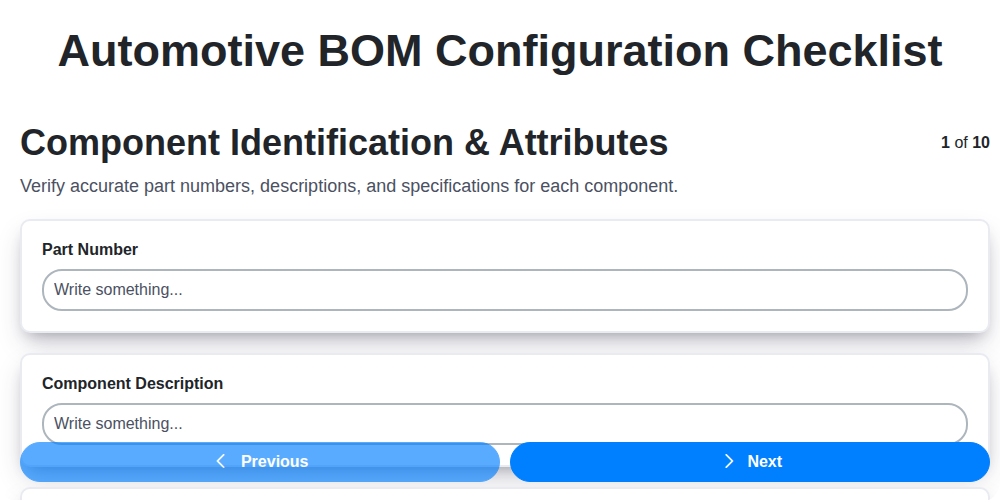
Table of Contents
- Introduction: Why a Robust Automotive BOM is Critical
- 1. Component Identification & Attributes: Defining Your Parts
- 2. Quantity & Unit of Measure: Ensuring Accurate Procurement
- 3. Material Sourcing & Vendor Information: Building a Reliable Supply Chain
- 4. BOM Structure & Hierarchy: Organizing Complexity
- 5. Engineering Change Order (ECO) Integration: Managing Modifications
- 6. Regulatory Compliance (RoHS, REACH): Staying Ahead of the Rules
- 7. Cost Analysis & Material Planning: Optimizing Your Budget
- 8. Version Control & Approval Workflow: Maintaining Accuracy & Traceability
- 9. Drawing & Documentation Alignment: Ensuring Consistency
- 10. Error Proofing and Validation: Preventing Costly Mistakes
- 11. Leveraging Technology for BOM Management
- 12. Common Pitfalls and How to Avoid Them
- Conclusion: Building a Sustainable BOM Strategy
- Resources & Links
TLDR: Building a car is complex! This checklist ensures your Bill of Materials (BOM) is accurate and compliant. It covers everything from identifying parts and finding suppliers to managing changes, controlling costs, and making sure everything aligns with regulations - preventing costly errors and delays in production.
Introduction: Why a Robust Automotive BOM is Critical
In the automotive industry, precision and reliability aren't just desirable - they're essential. From safety-critical systems to infotainment features, every component plays a vital role. At the heart of it all lies the Bill of Materials (BOM), a comprehensive list of all the raw materials, components, assemblies, and subassemblies required to manufacture a vehicle. A poorly managed BOM can lead to costly delays, production errors, safety concerns, and ultimately, a damaged reputation.
A robust automotive BOM isn't just a list; it's the foundation for efficient manufacturing, accurate costing, and streamlined supply chain management. It's the single source of truth for everything needed to build a vehicle, ensuring everyone - from design engineers to purchasing managers to assembly line workers - is operating with the same information. Failing to maintain a well-defined and meticulously checked BOM can quickly snowball into significant, and often unrecoverable, problems. This article will guide you through a detailed checklist to ensure your automotive BOM is fit for purpose and mitigates these risks.
1. Component Identification & Attributes: Defining Your Parts
A robust Bill of Materials (BOM) starts with crystal-clear component identification. This isn't just about a part number; it's about comprehensively defining what you're using. Think beyond the superficial.
What to Include:
- Unique Part Number: This is your primary identifier. Ensure it's consistent across all systems and documentation.
- Description: A detailed description that accurately reflects the component's function and characteristics. Avoid ambiguity.
- Manufacturer Part Number (MPN): This is critical for sourcing and verification.
- Lifecycle Status: Is the part active, obsolete, or pending obsolescence? Knowing this guides sourcing and substitution strategies.
- Technical Specifications: Voltage, amperage, dimensions, material composition - all relevant technical details must be documented.
- Drawing References: Link to relevant engineering drawings for visual confirmation and geometric specifications.
- Alternative Parts (if applicable): Document acceptable substitutes in case of supply chain disruptions. Clearly identify the criteria for acceptable alternatives.
- Categorization/Classification: Consistent categorization simplifies searching, reporting, and future design iterations.
Why It Matters:
Accurate component identification avoids confusion during assembly, troubleshooting, and future redesigns. It's the bedrock of a reliable BOM. A single misidentification can cascade into costly errors and delays.
2. Quantity & Unit of Measure: Ensuring Accurate Procurement
A common, yet critical, error in automotive BOM configuration stems from inaccurate quantity and unit of measure specifications. A single misplaced decimal point or an incorrect unit (e.g., pieces vs. kilograms) can lead to significant ordering errors, production delays, and increased costs.
This section goes beyond simply listing the quantity needed; it demands a deep understanding of how each component is used within the manufacturing process. Consider these crucial points:
- Process-Specific Quantities: Don't just rely on design specifications. Consult with manufacturing engineers and assembly teams. They may need slightly different quantities based on assembly techniques or consumable needs (e.g., adhesives, fasteners used in the attachment process).
- Sub-Assemblies & Kits: If components are incorporated into sub-assemblies or kits, accurately reflect the quantity used within that sub-assembly. The BOM should reflect the final quantity required at the main assembly level.
- Unit of Measure Consistency: Standardize your units of measure (e.g., each, meters, kilograms, liters). Clearly define abbreviations and avoid ambiguity. A dedicated glossary can be invaluable.
- Packaging Considerations: The unit of measure may differ between how a component is packaged from the supplier and how it's consumed in production. Account for packaging waste and minimum order quantities.
- Engineering Tolerances: Factor in engineering tolerances. If a component's usage varies slightly based on a manufacturing adjustment, that variation should be noted and potentially accounted for with safety stock planning.
- Regular Review: Quantities aren't static. Review them periodically as processes evolve or design changes are implemented.
Accurate quantity and unit of measure definitions are a cornerstone of an efficient automotive BOM. Investing the time upfront to ensure their correctness will pay dividends in reduced waste, improved production flow, and enhanced profitability.
3. Material Sourcing & Vendor Information: Building a Reliable Supply Chain
A robust Automotive Bill of Materials (BOM) configuration isn't just about what components are used; it's fundamentally tied to where they come from. In the automotive sector, supply chain disruptions can be incredibly costly, impacting production schedules and ultimately, customer satisfaction. This section of your BOM configuration checklist focuses on establishing a reliable and resilient material sourcing strategy.
Here's what needs to be meticulously documented and verified:
- Vendor Identification: Clearly identify all suppliers for each component. Include not just the vendor name but also contact information (primary contact, purchasing contact, quality contact).
- Vendor Performance Metrics: Track and document vendor performance data - on-time delivery, quality ratings, responsiveness to inquiries, and adherence to agreed-upon pricing. Regularly review these metrics to identify potential vulnerabilities and opportunities for improvement.
- Secondary Sourcing Options: Diversification is key. Establish approved secondary suppliers for critical components. This acts as a crucial fallback plan in case of primary vendor disruptions. Document these secondary sources within the BOM.
- Contractual Agreements: Maintain accurate records of all contracts and agreements with vendors, including pricing, delivery schedules, payment terms, and quality requirements. Ensure these agreements align with company policies and legal obligations.
- Supply Chain Risk Assessment: Perform a regular risk assessment of your supply chain. Consider factors like geographic location, political stability, and potential disruptions (natural disasters, economic downturns). Document mitigation strategies for identified risks.
- Vendor Qualification & Auditing: Establish a vendor qualification process that aligns with industry standards (IATF 16949, for example). Regularly audit vendor facilities to ensure compliance with quality and environmental requirements.
By systematically capturing and managing this vendor and sourcing information within your BOM, you're laying the groundwork for a more resilient and predictable automotive supply chain.
4. BOM Structure & Hierarchy: Organizing Complexity
A well-defined BOM structure is the backbone of efficient automotive manufacturing. It's not just a list of parts; it's a meticulously organized hierarchy reflecting the assembly process. Think of it as a family tree for your vehicle - starting with the chassis, branching into engine components, then further dividing into sub-assemblies like the fuel injection system.
This hierarchical structure allows for granular visibility into each component's place within the final product. This isn't just about clarity; it directly impacts several crucial processes. For example, identifying a faulty part becomes significantly easier when you can pinpoint its exact location within the assembly. Similarly, it simplifies change management - an ECO affecting a minor component in a sub-assembly can be managed without impacting the entire BOM.
Key considerations for BOM hierarchy include:
- Level of Detail: Determine the appropriate level of detail for each assembly. Too granular can create unnecessary complexity, while too high-level can obscure critical information.
- Modular Design Alignment: Align the BOM structure with your vehicle's modular design. This allows for easier component substitution and upgrades.
- Manufacturing Flow: The BOM hierarchy should mirror the manufacturing process. This ensures parts are assembled in the correct sequence, optimizing production efficiency.
- Parent-Child Relationships: Clearly define parent-child relationships between assemblies to accurately represent dependencies.
A poorly structured BOM leads to confusion, errors, and delays. A robust, well-defined hierarchy, on the other hand, streamlines operations, enhances collaboration, and ultimately contributes to a more efficient and reliable automotive production process.
5. Engineering Change Order (ECO) Integration: Managing Modifications
The Automotive Bill of Materials (BOM) isn't static; it evolves throughout a vehicle's lifecycle. Engineering Change Orders (ECOs) are the formal mechanism for managing these changes, and seamlessly integrating them into your BOM process is critical for accuracy and efficiency. Failing to do so can lead to incorrect builds, costly rework, and potential safety concerns.
Here's how to ensure your BOM and ECO processes work together effectively:
- Automated Linking: Implement a system where ECOs automatically trigger updates to the relevant BOM records. This minimizes manual intervention and reduces the risk of human error. When an ECO is approved, the system should automatically update part numbers, quantities, descriptions, or any other affected BOM attributes.
- Traceability & Audit Trails: Every change should be traceable. Your system must provide a clear audit trail showing which ECO triggered a BOM modification, who approved it, and when the change was implemented. This is invaluable for problem-solving and compliance audits.
- Impact Assessment: Before approving an ECO, assess its impact on the BOM. Will this change affect multiple BOM levels? Does it require changes to associated drawings or other documentation? A robust impact assessment process helps prevent unintended consequences.
- Communication & Notification: ECO creation and approval should trigger notifications to relevant stakeholders - engineering, procurement, manufacturing, and quality teams. This ensures everyone is aware of pending changes and can prepare accordingly.
- Version Control Integration: Link ECOs directly to BOM versions. This helps maintain historical context and allows users to easily revert to previous BOM versions if needed. Clearly identify the BOM version associated with each ECO.
By prioritizing ECO integration, you'll transform your BOM management from a reactive process into a proactive and controlled system, contributing to improved product quality and reduced costs.
6. Regulatory Compliance (RoHS, REACH): Staying Ahead of the Rules
The automotive industry faces an ever-evolving landscape of regulations designed to protect both the environment and human health. Two critical directives demanding careful attention within your Bill of Materials (BOM) are RoHS (Restriction of Hazardous Substances) and REACH (Registration, Evaluation, Authorisation and Restriction of Chemicals). Failing to comply isn't just a legal issue; it can damage your reputation, disrupt production, and incur significant financial penalties.
RoHS limits the use of specific hazardous materials like lead, mercury, cadmium, hexavalent chromium, polybrominated biphenyls (PBBs), and polybrominated diphenyl ethers (PBDEs) in electrical and electronic equipment. REACH, on the other hand, focuses on the safe use of chemicals throughout the supply chain, requiring manufacturers to register substances, assess their risks, and potentially obtain authorization for specific uses.
What this means for your BOM:
- Ingredient Disclosure: You need to know exactly what's in every component listed in your BOM, beyond just the part number. This requires proactive engagement with your suppliers and demanding detailed material composition data.
- Substance Tracking: Maintain a system to track the presence (or absence) of restricted substances in each component and material. This goes beyond the finished part - it includes all raw materials used in its creation.
- Supplier Collaboration: Your suppliers are key partners in this process. Require them to provide detailed compliance declarations (e.g., SDS - Safety Data Sheets, RoHS/REACH declarations) and audit their processes as needed.
- Ongoing Monitoring: Regulations change. Stay informed about updates to RoHS and REACH, and proactively adjust your BOM and processes accordingly. Subscribe to industry alerts and participate in relevant forums.
- Documentation is Key: Thoroughly document your compliance efforts, including supplier declarations, testing results, and any corrective actions taken. This documentation provides evidence of your commitment and facilitates audits.
By embedding regulatory compliance - particularly RoHS and REACH - into your BOM configuration process, you can minimize risk, ensure product legality, and demonstrate your commitment to sustainable practices.
7. Cost Analysis & Material Planning: Optimizing Your Budget
A meticulously crafted BOM is more than just a list of parts; it's a powerful tool for cost control and efficient material planning. This section dives into analyzing the costs associated with each component and forecasting material needs to maximize profitability.
Delving into Component Costs: Begin by thoroughly researching the cost breakdown for each component. Don't just look at the unit price - consider factors like:
- Raw Material Costs: Understand the underlying materials and their price volatility.
- Manufacturing Processes: Different manufacturing techniques impact cost.
- Transportation & Logistics: Factor in freight charges and import duties.
- Minimum Order Quantities (MOQs): Assess the financial implications of meeting vendor MOQs. Negotiate where possible!
Material Planning & Forecasting: Accurate forecasting minimizes excess inventory (tying up capital) and prevents costly shortages. Utilize historical data, sales projections, and market trends to estimate material needs. Consider:
- Lead Times: Account for vendor lead times to ensure timely deliveries.
- Safety Stock Levels: Determine appropriate safety stock to buffer against unexpected demand spikes or supply chain disruptions.
- Demand Variability: Analyze historical sales data to understand demand patterns and adjust material orders accordingly.
- Supplier Agreements: Leverage long-term agreements with suppliers to potentially secure better pricing and guaranteed supply.
Lifecycle Cost Considerations: Don't stop at the initial purchase price. Factor in potential costs for:
- Obsolescence: Plan for component replacements as older parts become unavailable.
- Storage & Handling: Include warehousing costs and potential damage.
- Disposal: Account for end-of-life disposal requirements.
By systematically analyzing component costs and implementing robust material planning practices, you can significantly optimize your automotive BOM and ensure your project stays within budget.
8. Version Control & Approval Workflow: Maintaining Accuracy & Traceability
In the automotive industry, even minor BOM discrepancies can lead to costly rework, production delays, and potential safety risks. A robust version control and approval workflow is critical for managing these complexities. It's not enough to simply have a BOM; you need a documented process for its evolution.
Here's why this is so important and what a solid process entails:
- Clear Ownership: Define who is responsible for initiating changes, reviewing them, and ultimately approving them. Assign roles (e.g., Engineering Lead, Purchasing Manager, Quality Assurance) and outline their responsibilities.
- Version Numbering & History: Implement a clear and consistent version numbering system (e.g., Rev A, Rev B, Rev 1.0, Rev 1.1). Maintain a detailed revision history that logs who made what changes and why. This provides invaluable traceability.
- Controlled Change Requests: Use a formal system for submitting and tracking engineering change orders (ECOs). Each ECO should clearly outline the proposed change, its impact, and supporting documentation.
- Multi-Level Approval: Establish an approval hierarchy that requires sign-off from relevant stakeholders before changes are implemented. This ensures that all departments are aware of and agree with the modification.
- Documentation of Approval: Electronically document all approvals, including dates, names, and any comments or conditions.
- Integration with PLM/PDM Systems: Ideally, your version control workflow should be tightly integrated with your Product Lifecycle Management (PLM) and Product Data Management (PDM) systems. This provides a centralized repository for all BOM data and facilitates seamless collaboration.
- Communication & Notification: Automate notifications to relevant teams when changes are made to the BOM. Transparency is key to avoiding confusion and ensuring everyone is working with the correct data.
By implementing a rigorous version control and approval workflow, you're not just managing documents; you're building a foundation for quality, efficiency, and accountability throughout your automotive BOM process.
9. Drawing & Documentation Alignment: Ensuring Consistency
A Bill of Materials (BOM) isn't just a list; it's a critical link in the automotive manufacturing process. Discrepancies between your BOM and associated engineering drawings, specifications, and other documentation can lead to costly errors, production delays, and even safety issues. This step is about ensuring everyone is working with the same information.
Here's what needs to happen:
- Cross-Reference Everything: Systematically compare the BOM against all relevant engineering drawings (2D and 3D), technical specifications, and other documentation. Don't just check quantities - verify part numbers, descriptions, material specifications, and any notes.
- Part Number Consistency: This is paramount. Ensure part numbers used in the BOM exactly match those on the drawings. Even a minor variation can cause significant issues.
- Revision Control Synchronization: Engineering drawings are rarely static. Confirm that the BOM references the correct revision of each associated drawing. Implement a process to automatically update the BOM when a drawing revision occurs.
- Description Clarity: Ambiguous or inconsistent descriptions across the BOM and drawings should be resolved. Clear, concise descriptions minimize the risk of misinterpretation.
- Visual Representation Alignment: For components with specific visual requirements (color, finish, markings), ensure drawings and documentation accurately represent these attributes.
- Regular Audits: Schedule periodic audits of the BOM and drawings to proactively identify and resolve any misalignment.
This alignment minimizes confusion, reduces errors, and ensures that the manufacturing team is building the vehicle according to the intended design.
10. Error Proofing and Validation: Preventing Costly Mistakes
Automotive BOM (Bill of Materials) configuration is a complex process, and even small errors can lead to significant downstream consequences - from production delays and quality recalls to inflated costs and damaged reputation. That's why robust error proofing and validation are absolutely critical. This isn't just about catching mistakes after they're made; it's about preventing them from happening in the first place.
Here's a breakdown of what effective error proofing and validation should involve:
- Automated Checks: Implement automated checks within your BOM management system. These can flag inconsistencies like quantity mismatches, incorrect part numbers, or attribute conflicts. Automated rules should be designed based on common error patterns identified during previous BOM configurations.
- Data Validation Rules: Set up data validation rules to enforce data integrity. For example, restrict the allowable characters in part number fields or require specific attribute values based on component type.
- Peer Review Process: A mandatory peer review process, where another engineer or BOM specialist meticulously reviews the configuration, is invaluable. Fresh eyes often catch errors the original creator might miss. Clearly define review criteria and documentation requirements.
- Simulation and Modeling: Before releasing the BOM to production, use simulation and modeling tools to test its impact on manufacturing processes. This helps identify potential issues with assembly, compatibility, and cost.
- Pilot Production Runs: A small-scale pilot production run using the configured BOM allows for real-world testing and identification of unforeseen problems before full-scale production begins.
- Traceability Audit Trails: Maintain detailed audit trails of all changes made to the BOM, including who made the change, when it was made, and why. This facilitates troubleshooting and root cause analysis when issues arise.
- Feedback Loop from Manufacturing: Establish a clear communication channel for manufacturing teams to report any BOM-related issues they encounter during production. This feedback is essential for continuous improvement and error prevention.
- Regular BOM Audits: Schedule periodic audits of the BOM to ensure its accuracy and alignment with current engineering requirements and manufacturing processes.
By embedding these error-proofing and validation steps into your BOM configuration workflow, you're significantly reducing the risk of costly mistakes and ensuring a more reliable and efficient automotive supply chain.
11. Leveraging Technology for BOM Management
Managing a complex Automotive Bill of Materials (BOM) can feel overwhelming, especially as vehicle complexity continues to increase. Thankfully, technology offers powerful solutions to streamline and automate many aspects of BOM configuration. Moving beyond spreadsheets and manual processes isn't just about efficiency; it's about accuracy, traceability, and future-proofing your operations.
Several platforms and tools are available, ranging from cloud-based Product Lifecycle Management (PLM) systems to specialized BOM management software. These solutions offer capabilities like:
- Centralized Data Repository: A single source of truth for all BOM information, accessible to authorized personnel.
- Automated Workflows: Streamlining the ECO process, approval workflows, and notifications, minimizing delays and errors.
- Real-time Collaboration: Enabling cross-functional teams (engineering, procurement, manufacturing) to collaborate effectively on BOM changes.
- Data Enrichment & Standardization: Automatically populating BOM data with attributes, vendor information, and regulatory compliance details.
- Integration with ERP and MES: Seamlessly connecting BOM data with other critical business systems for accurate material planning and production scheduling.
- Advanced Analytics & Reporting: Providing insights into BOM cost, material usage, and potential risks.
Investing in the right technology can significantly reduce the burden of BOM management, improve data accuracy, and ultimately contribute to faster time-to-market and reduced overall costs. Consider a phased approach, starting with a pilot project to assess the impact and identify areas for optimization before a full-scale implementation.
12. Common Pitfalls and How to Avoid Them
Even with a robust Automotive BOM Configuration Checklist, mistakes can happen. Here's a breakdown of common pitfalls and actionable steps to dodge them:
1. Lack of Standardized Component Identification: Using inconsistent naming conventions across the BOM leads to confusion and errors in procurement. Avoid it by: Implementing a standardized component identification system, ideally tied to a central component database.
2. Ignoring Unit of Measure Discrepancies: A mismatch between the BOM and purchase order unit of measure (e.g., buying in boxes but the BOM calls for individual units) results in overstocking or shortages. Avoid it by: Rigorously verifying and documenting the unit of measure for each component and cross-referencing it during procurement.
3. Vendor Information Decay: Vendor contact information, pricing, and lead times change frequently. Outdated information leads to delays and increased costs. Avoid it by: Regularly auditing vendor information and integrating it with a supplier management system.
4. BOM Structure Misalignment with Manufacturing Processes: A poorly structured BOM that doesn't mirror the assembly process makes production inefficient and error-prone. Avoid it by: Collaborating closely with manufacturing engineers to design a BOM that reflects the physical assembly flow.
5. ECO Integration Lapses: Failing to properly integrate Engineering Change Orders (ECOs) into the BOM creates conflicting data and production disruptions. Avoid it by: Establishing a clearly defined ECO workflow, automated notifications, and a process for validating changes before implementation.
6. Regulatory Compliance Blind Spots: Overlooking crucial regulatory requirements (RoHS, REACH, etc.) can result in costly recalls and legal repercussions. Avoid it by: Integrating regulatory compliance checks into the BOM configuration process and regularly updating information as regulations evolve.
7. Underestimating Cost Impacts of Changes: Implementing a change without fully analyzing its impact on material costs and availability can strain budgets. Avoid it by: Conducting thorough cost analysis and material planning before finalizing any changes to the BOM.
8. Insufficient Version Control Confusion: Losing track of BOM versions leads to using incorrect information and jeopardizes traceability. Avoid it by: Enforcing a strict version control system and ensuring all users are trained on its use.
9. Drawing & Documentation Disconnect: Discrepancies between the BOM, drawings, and other technical documentation introduce ambiguity and lead to incorrect assemblies. Avoid it by: Establishing a clear process for synchronizing these documents and conducting regular cross-checks.
10. Lack of Validation and Error Proofing: Assuming the BOM is correct without validation invites errors and increases rework. Avoid it by: Implementing a validation process that includes data verification, assembly checks, and potentially automated validation routines.
11. Siloed Information & Lack of Collaboration: BOM configuration shouldn't be the responsibility of a single team. Lack of communication between engineering, procurement, and manufacturing leads to inconsistencies. Avoid it by: Fostering cross-functional collaboration through shared platforms and regular communication.
12. Neglecting BOM Data Hygiene: Like any database, your BOM needs regular cleaning and maintenance. Outdated or inaccurate data degrades its usefulness. Avoid it by: Scheduling periodic data audits and establishing procedures for correcting errors promptly.
Conclusion: Building a Sustainable BOM Strategy
Ultimately, a robust Automotive BOM configuration isn't just about ticking boxes on a checklist - it's about establishing a sustainable and adaptable strategy. By diligently following a comprehensive checklist encompassing component identification, sourcing, compliance, version control, and validation, automotive manufacturers can significantly reduce errors, streamline processes, and improve overall efficiency. This isn't a one-time project; it's an ongoing commitment to refinement and improvement. Embracing digital BOM solutions, fostering cross-functional collaboration, and proactively anticipating future regulatory changes are vital for long-term success. A well-managed BOM isn't just a list of parts; it's the backbone of product quality, cost management, and ultimately, a competitive advantage in the demanding automotive landscape.
Resources & Links
- SAE International: SAE International (formerly the Society of Automotive Engineers) offers technical papers, standards, and training related to automotive engineering, including BOM aspects. Their resources can provide a deeper understanding of automotive industry best practices and engineering principles.
- ISO (International Organization for Standardization): ISO standards, particularly those related to quality management (e.g., ISO 9001) and environmental management (ISO 14001), are highly relevant to robust BOM configuration and regulatory compliance. Understanding these standards is vital for automotive manufacturers.
- National Institute of Standards and Technology (NIST): NIST provides resources and guidance on data management, traceability, and standards relevant to BOM accuracy and lifecycle management, particularly useful for implementing error-proofing strategies.
- RoHS Directive: This official website provides detailed information and updates on the RoHS (Restriction of Hazardous Substances) directive, essential for understanding and complying with regulatory requirements regarding material content in automotive components.
- REACH Regulation: The European Chemicals Agency (ECHA) website offers comprehensive information on the REACH (Registration, Evaluation, Authorisation and Restriction of Chemicals) regulation, vital for ensuring material compliance and supply chain transparency.
- MDM (Manufacturing Data Management): MDM provides PLM and BOM management software solutions. This link leads to their homepage where you can find their offerings and resources on PLM and BOM configuration.
- PTC (Product Development and PLM): PTC is a prominent provider of Product Lifecycle Management (PLM) software. Their website details their PLM solutions that facilitate BOM management and configuration. Explore their resources on data management and workflow automation.
- Siemens Digital Industries Software: Siemens offers a wide range of digital manufacturing and PLM solutions, including BOM management capabilities. Check their website for information on their tools and industry best practices.
- Oracle: Oracle offers enterprise resource planning (ERP) systems that can be integrated with BOM management processes. This link directs to their homepage.
- TE Connectivity: TE Connectivity is a major automotive supplier. Their website provides insights into component identification, material specifications, and supplier management - relevant to BOM configuration.
- Vishay Intertechnology: Vishay is a global manufacturer of discrete components and semiconductors. Their website provides documentation and specifications relevant to component identification and attributes within the BOM.
- BOM (Bureau of Meteorology): While seemingly unrelated, the Australian Bureau of Meteorology's website can be a useful source for learning about data structure, version control and process workflow.
Frequently Asked Questions
What is an Automotive BOM (Bill of Materials)?
An Automotive BOM is a comprehensive list of all raw materials, components, assemblies, and subassemblies required to manufacture a vehicle or a specific automotive part. It details the quantity, description, and supplier information for each item, serving as a central document for production planning and cost management.
Why is accurate BOM configuration crucial in the automotive industry?
Accurate BOM configuration is vital for several reasons: it minimizes manufacturing errors, reduces costs by preventing over-ordering or shortages, streamlines supply chain management, supports engineering changes efficiently, facilitates compliance with regulations, and enables effective product lifecycle management.
What are the key steps in mastering automotive BOM configuration?
Mastering BOM configuration involves several key steps including defining BOM structure, establishing data governance, integrating with other systems (ERP, PLM), implementing version control, ensuring data accuracy through validation checks, and regularly reviewing/updating the BOM based on design changes and process improvements.
What is the difference between a Level 1 and Level 2 BOM in automotive?
A Level 1 BOM represents the entire vehicle or a major component. A Level 2 BOM breaks down that top-level item into more detailed subassemblies and parts, providing a more granular view of the materials required for its production. Level 2 BOMs and beyond continue this breakdown, representing increasingly specific parts.
How does BOM configuration integrate with other automotive systems like ERP and PLM?
BOM configuration needs seamless integration with Enterprise Resource Planning (ERP) systems for inventory management, procurement, and production scheduling. It also integrates with Product Lifecycle Management (PLM) systems to manage design changes, engineering documents, and revision control. This integrated approach ensures data consistency and avoids discrepancies.
What are some common challenges faced when configuring automotive BOMs?
Common challenges include managing complex hierarchies, dealing with design changes and engineering revisions, maintaining data accuracy across multiple suppliers, ensuring version control, and integrating disparate systems. Data silos and lack of standardized processes also contribute to these challenges.
What is the role of data governance in automotive BOM configuration?
Data governance defines policies and procedures for data management, ensuring data quality, consistency, and security. It establishes clear responsibilities, sets data standards, and implements validation rules to maintain the integrity of the BOM and prevent errors caused by inaccurate or outdated information.
How can I ensure data accuracy and integrity within my automotive BOM?
Data accuracy is achieved through implementing robust validation rules, conducting regular audits, establishing clear responsibilities for data entry and maintenance, leveraging automated data checks, and encouraging collaboration between engineering, procurement, and manufacturing teams.
What is BOM revision control, and why is it important?
BOM revision control is the process of tracking and managing changes to the BOM over time. Each change creates a new revision, allowing users to identify the correct version for a specific production run or engineering analysis. It's crucial for maintaining traceability and preventing errors caused by using outdated BOMs.
What is a 'phantom BOM' and when is it used in the automotive industry?
A 'phantom BOM' is a BOM that represents an assembly that is built up from other components and doesn't have a unique part number itself. It's used for sub-assemblies like a dashboard assembly before it's integrated into the car. Its components are 'phantom' in the sense they disappear once the assembly is finalized.
Found this Article helpful?
Comments
There are no comments yet. Be the first to add one!
BOM - Bill of Materials Management Solution Demo
Struggling with inaccurate BOMs & costly errors? ChecklistGuro provides a centralized BOM Management solution, connecting your design, engineering, & manufacturing teams for improved collaboration and control. Simplify operations & boost efficiency.
Related Articles
The Ultimate Logistics BOM Packaging Checklist: Ensuring Safe & Efficient Shipments
Mastering Leather Manufacturing: Your Tannery BOM & Compliance Checklist
Mastering Your BOM: A Comprehensive Checklist Template for Success
Ensuring Success: Your Oil & Gas BOM Component Approval Checklist Guide
Navigating Medical Device BOM Regulatory Compliance: Your Essential Checklist
The Ultimate Retail BOM Product Definition Checklist: A Step-by-Step Guide
Ensuring Quality: Your Rubber Manufacturing Polymer BOM Checklist Guide
Decoding Origins: Your Construction Materials BOM Origin Checklist Guide
We can do it Together
Need help with
Bill of Materials (BOM) Management?
Have a question? We're here to help. Please submit your inquiry, and we'll respond promptly.