Building Security and Access Control Workflow
Published: 06/04/2026 Updated: 10/05/2026
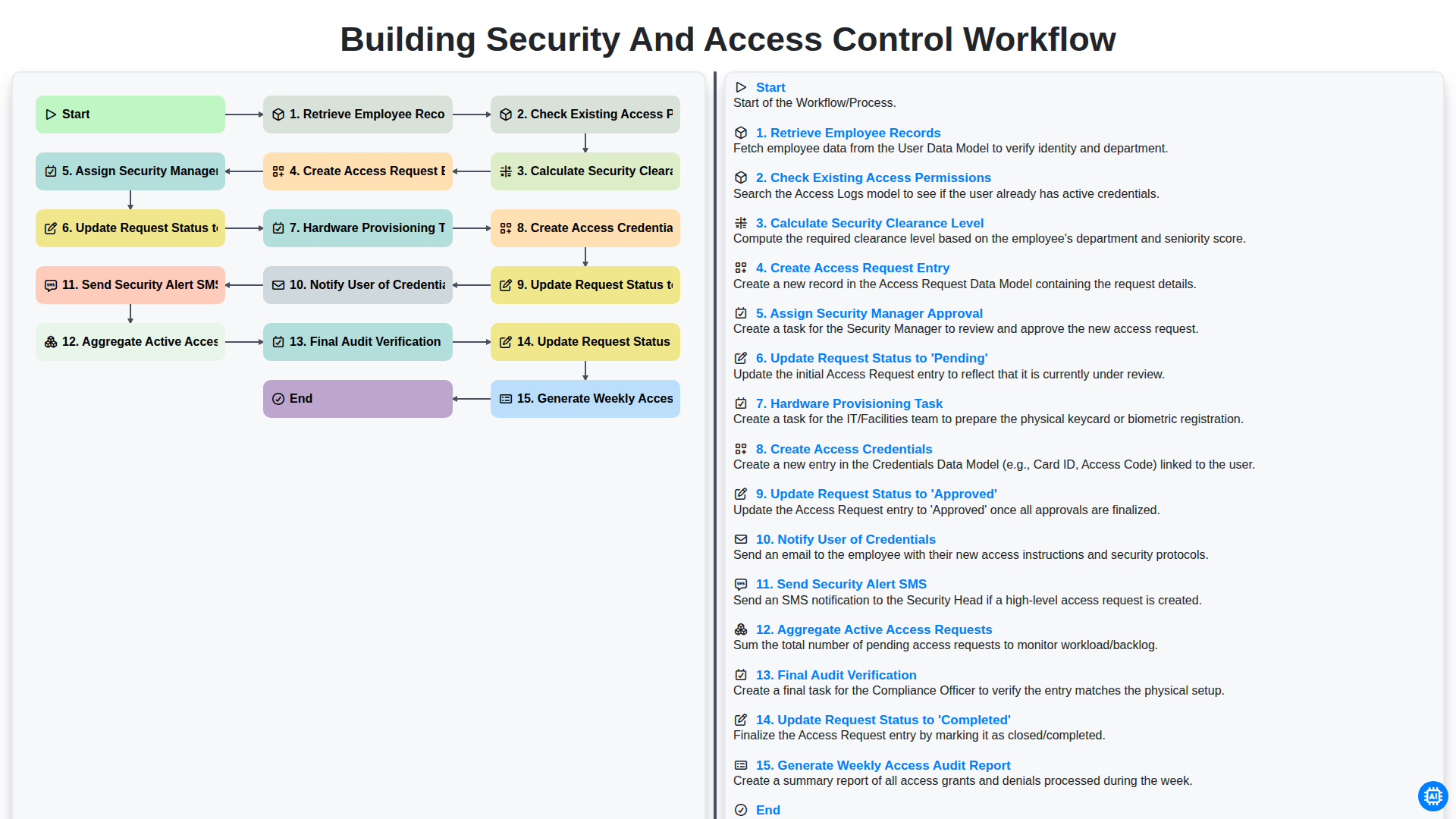
Table of Contents
- Introduction to Automated Access Control
- Phase 1: Initial Employee Verification and Permission Audit
- Determining Security Clearance and Authorization Levels
- Phase 2: Request Initiation and Approval Orchestration
- Managing the Approval Queue and Pending Requests
- Phase 3: Provisioning Hardware and Digital Credentials
- Finalizing Authorization and User Notification
- Phase 4: Security Alerting and Incident Monitoring
- Phase 5: Continuous Auditing and Compliance Reporting
- Conclusion: Maintaining a Secure Access Ecosystem
- Resources & Links
TLDR: Learn how to automate and secure your organization's authorization process with this comprehensive guide to the Building Security and Access Control Workflow, covering everything from initial employee record retrieval and clearance calculation to automated provisioning and final audit verification.
Introduction to Automated Access Control
In an era of increasing cyber threats and complex regulatory compliance requirements, manual management of user permissions is no longer a viable strategy. Traditional, paper-based, or loosely managed access processes are prone to human error, leading to privilege creep-where employees accumulate excessive permissions over time-and significant security vulnerabilities.
Automated access control workflows transform this fragmented process into a streamlined, programmatic engine. By implementing a structured, automated sequence, organizations can ensure that every request for system entry is vetted against predefined security protocols without manual intervention for every step. This automation doesn't just save time; it enforces a least privilege model by ensuring that access is calculated based on real-time employee data and subject to rigorous, multi-layered approval chains. Transitioning to an automated workflow means replacing guesswork with a predictable, auditable, and highly secure lifecycle for every digital identity within your organization.
Phase 1: Initial Employee Verification and Permission Audit
The foundation of a robust security protocol lies in the precision of its initial stages. Before any access can be granted, the workflow begins with the critical task of Retrieving Employee Records from the central HR database. This ensures that the identity and employment status of the individual are verified against the most current organizational data.
Once the identity is confirmed, the system moves into a deep-dive assessment by Checking Existing Access Permissions. This step is vital to prevent permission creep, where employees accumulate unnecessary privileges over time. By auditing current rights, the workflow can identify overlapping or redundant access levels. Following this, the system performs a Calculate Security Clearance Level operation, which cross-references the employee's role, department, and seniority to determine the appropriate level of trust and sensitivity they are permitted to handle. This data-driven approach ensures that security is not just a manual check, but a standardized, automated calculation.
Determining Security Clearance and Authorization Levels
Once the initial employee records are retrieved and existing access permissions are checked, the workflow moves into its most critical analytical phase: Calculating the Security Clearance Level. This step is the core engine of the authorization process, as it transforms raw data into actionable security intelligence.
Rather than granting access based on simple job titles, the system performs a multi-layered evaluation. It cross-references the employee's department, current project assignments, seniority, and historical access patterns to determine a precise security tier. By mathematically weighing these variables, the workflow ensures that clearance levels are granular and consistent across the organization. This automated calculation prevents human error and ensures that privilege creep-where employees accumulate unnecessary permissions over time-is mitigated from the very start of the request lifecycle.
Phase 2: Request Initiation and Approval Orchestration
Once the initial employee data has been retrieved and the baseline security clearance level is calculated, the workflow moves into its most critical stage: the formal orchestration of the access request. This phase acts as the bridge between raw data analysis and actionable security implementation.
The process begins by creating a formal Access Request Entry within the system, which serves as the single source of truth for the audit trail. To ensure strict adherence to the principle of least privilege, the system automatically Assigns a Security Manager for Approval. At this precise moment, the system immediately Updates the Request Status to 'Pending', ensuring that no unauthorized actions can be taken until a manual or automated oversight check is completed. This prevents the silent permission creep that often plagues growing organizations by ensuring every new access point is explicitly vetted by a designated authority.
Managing the Approval Queue and Pending Requests
Once the initial security clearance is calculated and a new access request entry is created, the workflow transitions into a critical period of oversight. At this stage, the system is programmed to Assign Security Manager Approval, ensuring that every request is scrutinized by a designated authority. To maintain a transparent and organized audit trail, the system automatically performs an Update Request Status to 'Pending', signaling that the request is currently awaiting human intervention.
Managing this queue effectively is vital for maintaining organizational security. As the volume of requests grows, the system performs a routine to Aggregate Active Access Requests, providing administrators with a high-level view of all outstanding approvals. This prevents bottlenecks and ensures that no single request is overlooked. By centralizing these pending tasks, the workflow ensures that the transition from a pending state to the subsequent provisioning phases-such as hardware allocation and credential creation-remains seamless, secure, and fully documented.
Phase 3: Provisioning Hardware and Digital Credentials
Once the security manager has granted approval, the workflow shifts from administrative verification to the critical execution phase. This stage is where the digital authorization transforms into tangible access.
The process begins with the Hardware Provisioning Task, where the system triggers the preparation of physical assets necessary for the employee's role. This may include the configuration of encrypted laptops, security keys, or biometric scanners. Simultaneously, the workflow moves into the Create Access Credentials step, where the system automatically generates unique digital identities,-such as VPN profiles, encrypted passwords, and software-specific login tokens-ensuring that the user's digital perimeter is established in alignment with their calculated clearance level.
To ensure the loop is closed and the user is empowered to begin work, the workflow executes two final automated actions: first, it performs an Update Request Status to 'Approved' within the central database to reflect that the provisioning is physically underway, and second, it triggers the Notify User of Credentials step. This automated notification provides the employee with their new access details through secure channels, ensuring a seamless transition from the request phase to active operational readiness.
Finalizing Authorization and User Notification
Once the initial security assessments and hardware provisioning are finalized, the workflow moves into its critical closing phase: the transition from technical provisioning to user activation. After the security credentials have been successfully created, the system triggers an automatic update to change the request status to 'Approved'.
At this juncture, the workflow shifts focus toward transparency and real-time communication. To ensure the employee can immediately begin utilizing their new permissions, an automated notification is dispatched to the user containing their new access credentials. Simultaneously, for high-sensitivity access tiers, the system initiates a Security Alert SMS to inform the security operations center of the new authorization, ensuring that every high-level permission change is accompanied by an immediate, out-of-band notification. This step ensures that while the user is being onboarded, the security team remains aware of the expanded access perimeter in real-time.
Phase 4: Security Alerting and Incident Monitoring
Once the access credentials have been successfully issued and the user is notified, the workflow transitions into its critical monitoring phase. Security cannot be a static event; it requires continuous oversight to prevent unauthorized usage and detect anomalies in real-time.
As part of this phase, the system triggers a Send Security Alert SMS protocol. This ensures that security administrators and relevant stakeholders are immediately notified of any high-level credential provisioning, acting as an instant layer of oversight for sensitive access grants.
To maintain a robust security posture, the workflow continues to Aggregate Active Access Requests, centralizing all ongoing and recently completed requests into a single view. This visibility is vital for identifying patterns that might indicate a credential stuffing attack or an insider threat. This data feeds directly into the Final Audit Verification step, where every granted access point is cross-referenced against the original security clearance level to ensure no unauthorized permissions were inadvertently slipped through during the provisioning process.
The cycle concludes with a continuous loop of accountability: the system is programmed to Generate Weekly Access Audit Reports. These reports serve as the foundational document for compliance, providing a detailed trail of who was granted access, who approved it, and the hardware used, ensuring that the organization's access control landscape remains transparent and audit-ready at all times.
Phase 5: Continuous Auditing and Compliance Reporting
The final stage of the workflow moves beyond individual request fulfillment and into the realm of long-term governance. Once a request reaches the Update Request Status to 'Completed' stage, the lifecycle does not simply end; it enters a cycle of continuous oversight.
To ensure the integrity of the security perimeter, the system is configured to Aggregate Active Access Requests, providing a bird's-eye view of all ongoing and recently fulfilled permissions. This high-level visibility is crucial for detecting anomalies or permission creep that could compromise organizational security.
To maintain a rigorous audit trail, the workflow concludes with a Final Audit Verification step, ensuring that every automated action-from hardware provisioning to credential generation-aligns with company policy. Finally, the process culminates in the automated ability to Generate Weekly Access Audit Reports. These reports serve as the single source of truth for compliance officers, providing the necessary documentation to pass regulatory audits and ensuring that the access control landscape remains transparent, documented, and secure.
Conclusion: Maintaining a Secure Access Ecosystem
Implementing a robust Building Security and Access Control Workflow is not a one-time setup, but an ongoing commitment to organizational integrity. By automating the lifecycle of an access request-from the initial retrieval of employee records to the final audit verification-you eliminate the human errors and security gaps that often lead to unauthorized entry or permission creep.
A truly secure ecosystem relies on the seamless integration of continuous monitoring and proactive auditing. By automating periodic tasks, such as generating weekly access audit reports and aggregating active requests, security teams can move from a reactive posture to a proactive one. This ensures that access is always aligned with current security clearance levels and that every credential issued is accounted for. Ultimately, a well-structured workflow transforms security from a bottleneck into a streamlined, transparent, and impenetrable layer of your corporate infrastructure.
Resources & Links
- NIST Special Publication 800-53: Essential guidelines for security and privacy controls, specifically focusing on access control and identification/authentication frameworks.
- OWASP Access Control Project: A comprehensive resource for understanding vulnerabilities in access control logic and best practices for preventing unauthorized entry.
- ISO/IEC 27001 Standard: The international standard for information security management systems (ISMS), providing the foundation for auditing and compliance workflows.
- AWS Identity and Access Management (IAM): A real-world implementation example of managing user permissions, roles, and automated provisioning workflows in a cloud environment.
- Journal of Information Security: Academic research and deep dives into the complexities of identity management, hardware provisioning, and automated audit mechanisms.
- ISACA - IT Audit and Compliance: Resources for professionals focused on the final stages of the workflow, such as continuous auditing, monitoring, and reporting.
Frequently Asked Questions
What is a building security and access control workflow?
It is a structured series of processes and technical protocols designed to manage, monitor, and regulate the movement of authorized personnel and visitors into and within a facility.
What are the core components of an effective access control workflow?
The core components include identification (credentials), authentication (verification), authorization (permissions), and auditing (logging all entry/exit events).
How can organizations automate their security workflow?
Automation can be achieved by integrating IoT sensors, mobile credentials, cloud-based management software, and AI-driven video analytics to reduce manual oversight and response times.
What role does physical security play in the workflow?
Physical security acts as the enforcement layer, utilizing hardware such as electronic locks, biometric scanners, turnstiles, and security cameras to execute the decisions made by the access control system.
How important is auditing in the security process?
Auditing is critical for compliance and forensics. It involves reviewing access logs to identify suspicious patterns, investigate security breaches, and ensure that only authorized individuals are accessing sensitive areas.
How should a workflow handle visitor management?
A robust workflow should include a pre-registration process, automated notification to hosts, temporary credential issuance, and a systematic check-out procedure to ensure all visitors are accounted for.
Comments
There are no comments yet. Be the first to add one!
Facility Management Solution Demo
Keep your facilities running smoothly! ChecklistGuro streamlines maintenance, inspections, and vendor management. Reduce downtime, optimize efficiency, & improve safety. Manage it all with our Work OS.
Related Articles
Industrial Floor Cleaning & Safety Checklist Template
Display Case Temperature Monitoring Checklist Template
The Ultimate Refrigeration Maintenance Checklist: Keeping Your Food Safe
Escalator & Moving Walkway Inspection Checklist Template
The Ultimate Guest Room Cleaning & Inspection Checklist Template
The Ultimate Security Camera Review Checklist Template
Forklift Inspection & Maintenance Checklist Template
Emergency Generator Load Testing Checklist Template
Need help with
Checklists?
Have a question? We're here to help. Please submit your inquiry, and we'll respond promptly.