Mastering Your Lease: The Ultimate 2026 Commercial Lease Audit & Compliance Checklist Template
Published: 10/31/2026 Updated: 11/01/2026
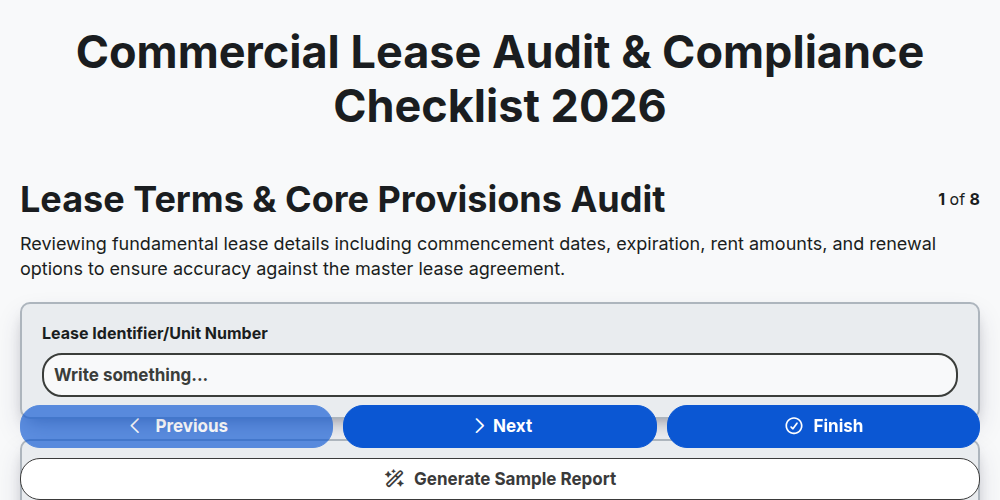
Table of Contents
- Introduction: Why a 2026 Lease Audit is Critical for Your Bottom Line
- Phase 1: Lease Terms & Core Provisions Audit
- Phase 2: Financial Obligations & Rent Verification
- Phase 3: Operational Compliance & Use Clauses
- Phase 4: Maintenance & Repair Responsibilities
- Phase 5: Insurance & Liability Verification
- Phase 6: Subletting & Assignment Oversight
- Phase 7: Estoppel Certificate & SNDA Review
- Phase 8: Documented Alterations & Tenant Improvements
- Best Practices for Maintaining a Continuous Compliance Calendar
- Conclusion: Mitigating Risk Through Proactive Auditing
- Resources & Links
TLDR: Stay ahead of rising operational costs and legal risks in 2026 with our comprehensive commercial lease audit guide. Learn how to systematically review core provisions, verify financial accuracy, manage maintenance obligations, and ensure full compliance across all lease clauses to protect your bottom line and avoid costly disputes.
Introduction: Why a 2026 Lease Audit is Critical for Your Bottom Line
In the rapidly evolving landscape of 2026 commerce, a commercial lease is far more than just a static document sitting in a filing cabinet-it is a living financial obligation that dictates your operational boundaries and long-term profitability. As inflation cycles stabilize, energy regulations tighten, and smart building technologies become the industry standard, the set it and forget it approach to property management is no longer a viable strategy.
The High Cost of Oversight
A single oversight in a lease clause can lead to significant-scale financial leaks. Whether it is an incorrectly calculated CAM (Common Area Maintenance) charge, an expired insurance certificate, or an unapproved structural alteration, the repercussions often manifest as unexpected capital expenditures or legal disputes that drain your resources. In an era where operational efficiency is the ultimate competitive advantage, ensuring your lease terms align with your actual day-to-day operations is essential.
Navigating the 2026 Regulatory and Economic Climate
The 2026 landscape brings new complexities to commercial real estate:
- Escalating Compliance Standards: New sustainability mandates and building efficiency requirements mean that maintenance now includes much more than just fixing leaks; it involves adhering to evolving environmental benchmarks.
- Inflationary Pressure & Rent Verification: With fluctuating utility costs and tax assessments, verifying that your financial obligations are being calculated according to the precise formulas in your lease is critical to preventing overpayment.
- Risk Management in a Digital Age: As physical and digital security become intertwined, verifying insurance and liability coverage is no longer just a formality-it is a prerequisite for business continuity.
Proactive vs. Reactive Management
An audit is not a damage control measure to be performed when a dispute arises; it is a proactive tool designed to identify discrepancies before they become liabilities. By utilizing a structured audit checklist, you transition from a reactive posture-responding to errors after the money has left your account-to a proactive stance of total lease mastery.
The following checklist serves as your strategic roadmap to ensure every clause, every dollar, and every responsibility is accounted for, keeping your business compliant, protected, and prepared for the year ahead.
Phase 1: Lease Terms & Core Provisions Audit
Establishing the Foundation: Reviewing the Lease Fundamentals
Before diving into the granular financial details, you must first ensure that the bedrock of your agreement is structurally sound. A lease audit begins with a comprehensive review of the core provisions to ensure that the skeleton of the contract still aligns with your current business operations and strategic goals for 2026.
Verifying Key Dates and Term Milestones
The most critical element of a lease audit is the timeline. Missing a critical window can result in automatic renewals at much higher rates or the loss of expansion rights.
- Expiration and Renewal Windows: Confirm the exact lease end date and identify the specific notice period required to exercise an option to renew.
- Renewal Options: Audit all existing options (e.g., first right of refusal, right of expansion) to ensure they are still documented and actionable.
- Termination Rights: Review any break clauses or termination options to understand your exit flexibility in the current economic climate.
Assessing the Scope of Use and Permitted Activities
As businesses pivot toward new technologies and hybrid models, your Permitted Use clause may become a liability if it is too restrictive.
- Use Clause Alignment: Does your current business model-including any new service offerings or digital-physical integrations-fit within the legally defined Permable Use of the premises?
- Exclusivity Protections: If you have an exclusivity clause, verify that the landlord is not inadvertently leasing adjacent space to a direct competitor.
Confirming Lease Continuity and Governance
Ensure that the legal identities of both the Lessor and Lessee are accurately reflected and that all legal notices are being routed to the correct, up-to-date addresses.
- Entity Verification: Confirm that the landlord's entity name matches the current owner of record (important for preventing phantom landlord scenarios).
- Notice Provisions: Audit the contact information for all formal legal communications to ensure no critical notices are being lost to outdated administrative departments.
Phase 2: Financial Obligations & Rent Verification
Securing Your Bottom Line: Financial Accuracy and Oversight
In the evolving economic landscape of 2026, financial precision is no longer optional-it is a requirement for maintaining healthy cash flow and avoiding costly litigation. A commercial lease audit is not merely about checking if the rent was paid; it is about verifying that every dollar leaving your accounts aligns strictly with the contractual mandates.
Verifying the Rent Schedule
The first step in this phase is a granular comparison of your actual payments against the rent schedule outlined in your lease.
- Base Rent Accuracy: Confirm that any scheduled escalations (percentage increases or fixed bumps) have been applied correctly.
- Rent Commencement Dates: Ensure that any rent abatement periods or free-rent concessions have officially expired and that billing has transitioned to the full-rate period.
- Late Fee Audits: Review any late fees applied by the landlord to ensure they comply with the grace periods defined in your agreement.
Auditing Operating Expenses (CAM)
For tenants in triple-net (NNN) or modified gross leases, the Common Area Maintenance (CAM) audit is often where the most significant discrepancies are found.
- Expense Caps Review: Check that controllable operating expenses have not exceeded the annual or cumulative caps stipulated in your lease.
- Audit the Pass-Throughs: Scrutinize electricity, water, janitorial, and landscaping invoices. Are you being billed for capital improvements that should be amortized over time rather than charged as immediate expenses?
- Pro-Rata Share Validation: Re-calculate your percentage of the building's total leasable area. Ensure that if new tenants have moved in (increasing the total building square footage), your proportional share of expenses has been adjusted downward accordingly.
Tax and Insurance Reconciliations
Real estate taxes and property insurance are high-variance line items that require strict oversight.
- Tax Assessment Verification: Ensure the landlord is passing through the correct property tax amounts based on the most recent municipal assessments.
- Insurance Premium Alignment: Verify that the insurance premiums being reimbursed match the actual coverage levels and costs outlined in the lease's indemnity clauses.
Managing Utility and Service Fees
Beyond the major line items, minor recurring costs can aggregate into significant leaks in your budget.
- Meter Accuracy: If you are sub-metered for water or electricity, verify the meter readings against your utility bills.
- Service Contract Audit: Review charges for building services (such as security or waste management) to ensure no redundant services are being billed to your account.
Phase 3: Operational Compliance & Use Clauses
Ensuring Operational Alignment and Usage Compliance
Once you have verified the core financial and legal provisions, the focus must shift to the practical, day-to-day application of the lease. Compliance in this phase is about ensuring that your business operations remain strictly within the boundaries of your contractual rights to avoid costly defaults or litigation.
Verifying Permitted Use and Exclusivity
The Use Clause is one of the most critical components of your lease. An audit in 2026 requires a granular review of:
- Permitted Use Accuracy: Does your current business model, including any recent expansions or shifts in service offerings, still align with the Permitted Use defined in the lease?
- Prohibited Activities: Are there any new operational processes or secondary revenue streams (such as new e-commerce fulfillment methods or food service components) that inadvertently violate Prohibited Use restrictions?
- Exclusivity Protections: If you are a tenant in a multi-tenant complex, verify that the landlord is upholding exclusivity clauses that prevent competitors from moving into adjacent spaces.
Monitoring Operating Hours and Signage Standards
Compliance extends beyond what you do, to how you present your business to the public.
- Signage Compliance: Audit your exterior and interior signage against the lease specifications. This includes font size, illumination, materials, and placement. In 2026, ensure that any digital or LED components of your signage comply with updated building regulations and lease permissions.
- Operating Hours: Ensure your business hours do not conflict with any Common Area restrictions or noise ordinances outlined in the lease, which could lead to tenant complaints or landlord intervention.
Compliance with Rules and Regulations
Every commercial lease is subject to the building's Rules and Regulations. A periodic audit should confirm that your staff and vendors are adhering to:
- Loading Dock and Delivery Protocols: Are deliveries occurring during permitted windows?
- Waste Management: Are your disposal methods and recycling efforts in alignment with the building's sustainability and sanitation mandates?
- Access and Security: Are all personnel following the established security protocols for entry and exit to avoid unauthorized access violations?
Phase 4: Maintenance & Repair Responsibilities
Defining the Line of Responsibility
One of the most common sources of-litigation in commercial real estate is the ambiguity surrounding repair obligations. As we head into 2026, with rising labor costs and stricter building efficiency standards, a handshake agreement on maintenance is no longer sufficient. An audit in this phase is designed to prevent unexpected capital expenditures (CapEx) from hitting your bottom line unexpectedly.
Key Audit Action Items
1. The Demarcation Line Verification
Carefully review the lease to identify exactly where the Landlord's responsibility ends and the Tenant's begins.
- Structural vs. Non-Structural: Confirm that the landlord remains responsible for the building's envelope (foundation, roof, exterior walls) while you have clearly documented your duties regarding interior non-structural elements.
- HVAC Stewardship: HVAC is the most frequent point of contention. Determine if you are responsible for routine maintenance (filter changes, belt replacements) or if the lease mandates a full replacement fund contribution.
2. Preventive Maintenance Log Audit
Compliance isn't just about knowing the rules; it's about proving you followed them.
- Service Contract Review: Cross-reference your current vendor contracts (janitorial, landscaping, elevator maintenance) against the lease requirements.
- Record Keeping: Ensure there is a centralized digital repository for all maintenance logs. In 202맹, auditors and landlords are increasingly requesting proof of performance to validate compliance with lease terms.
3. Utility and System Oversight
- Meter Accuracy: Verify that the methods used to calculate utility pass-throughs (sub-metering vs. pro-rata share) align with the documented usage patterns.
- Compliance with Green Standards: With increasing ESG (Environmental, Social, and Governance) regulations, check if your maintenance routine must now include specific energy-efficiency benchmarks or waste management protocols.
4. The Hidden Repair Costs: Common Area Maintenance (CAM)
Audit your understanding of what constitutes a repairable item within the CAM reconciliation.
- Capital Improvement vs. Repair: Distinguish between routine repairs (which should be part of operating expenses) and major capital improvements (which may be excluded or amortized over time).
- Audit Deadlines: Note the specific windows of time allowed for contesting unexpected repair charges during the year-end CAM reconciliation process.
Phase 5: Insurance & Liability Verification
Securing Your Assets: The Insurance & Liability Audit
In the 2026 landscape of commercial real estate, where litigation risks and evolving climate-related liabilities are on the rise, a set it and forget it approach to insurance is a recipe for catastrophe. This phase of your audit is designed to ensure that both the landlord and the tenant are adequately protected and that no gaps exist in the coverage provided.
Comprehensive Coverage Review
Begin by auditing the specific types of insurance required under your lease agreement. You must verify that all necessary policies-including General Liability, Property, Workers' Compensation, and Umbrella/Excess Liability-are active and meet the minimum limits specified in your core provisions.
Key Verification Points:
- Policy Limits & Adequacy: Are the coverage limits sufficient to handle modern-day inflation and potential reconstruction costs? Review the lease to ensure that the Actual Cash Value vs. Replacement Cost provisions are aligned with your current assets.
- Additional Insured Endorsements: Confirm that all required parties (Landlord, Property Managers, and Mortgage Holders) are explicitly named as Additional Insured on your policies. A common audit failure is having the correct coverage but failing to properly name the required entities.
- Certificate of Insurance (COI) Tracking: Do not rely on last year's paperwork. Verify that all COIs are current and that there is a system in place to track expiration dates. Ensure that the wording on the certificates matches the exact legal names found in your lease documents.
- Waiver of Subrogation: Check for the presence of a Waiver of Subrogation clause. This is a critical protection that prevents an insurance company from seeking recovery from the other party after paying a loss, thereby minimizing long-term legal disputes.
Liability & Indemnification Alignment
Beyond just the insurance policies, you must audit the Indemnification Clauses. Ensure that the indemnity obligations haven't shifted due to recent amendments or new local regulations. Cross-reference your insurance coverage against your duty to defend; if your lease requires you to defend the landlord against certain claims, your insurance policy must specifically provide for duty to defend services to avoid out-of-pocket legal expenses.
Phase 6: Subletting & Assignment Oversight
Maintaining Control Over Occupancy and Transfers
In the ever-evolving commercial real estate landscape of 2026, flexibility is a key driver of business strategy. However, the ability to pivot-whether through downsizing, restructuring, or expansion-must be managed within the strict boundaries of your legal obligations. Subletting and assignment oversight ensures that your business maintains control over who shares your physical space and prevents unforeseen liabilities.
Verifying Consent Protocols
The core of this audit phase is determining exactly what permission looks like under your current lease. Many tenants mistakenly believe that as long as they find a replacement, they are in compliance. You must audit your lease for:
- Reasonableness Standards: Does the landlord have the right to withhold consent unreasonably, or do they have absolute discretion?
- Notice Requirements: What are the specific timelines and formal methods (e.g., certified mail, digital portals) required to request a transfer?
- Permitted Transfers: Are there carve-outs that allow for transfers to affiliates, subsidiaries, or successors without formal landlord approval?
Assessing Financial and Operational Risks of Subtenants
A sublease does not absolve the master tenant of their primary obligations. When auditing your assignment rights, you must evaluate the potential impact of a subtenant on your lease integrity:
- The Residual Liability Clause: Confirm if you remain jointly and severally liable for the rent and performance of any subtenant.
- Subtenant Default Triggers: Ensure that a default by a subtenant does not inadvertently trigger a default under your master lease.
- Use Compatibility: Verify that any proposed subtenant's business operations align with the Permitted Use clause of your original agreement to avoid lease violations.
Managing the Paperwork Trail
An audit is incomplete without ensuring that all historical transfers are documented. Review your files for:
- Executed Consent Agreements: Ensure every previous assignment or sublease has a signed, landlord-approved amendment attached to your permanent records.
- Profit Sharing Provisions: Check if your lease requires you to remit a portion of sublease profit (rent collected from a subtenant that exceeds your base rent) back to the landlord.
- Future-Proofing Your Strategy: Use this audit to identify if your current lease is too restrictive, providing you with the leverage needed to negotiate more flexible transfer rights during your next renewal period.
Phase 7: Estoppel Certificate & SNDA Review
Securing Legal Certainty and Lender Alignment
As you approach the final stages of your audit, focus shifts from day-to-day operations to the structural legal safeguards of your lease. This phase is critical for protecting your business during property sales, refinancing, or lease renegotiations.
The Role of Estoppel Certificates
An Estoppel Certificate serves as a snapshot in time that confirms the current status of the lease. When a landlord intends to sell the building or refinance the mortgage, the new owner or lender will require you to sign this document.
During your audit, ensure that the terms documented in existing Estoppels match your actual lease terms. Common discrepancies to look for include:
- Rent Amounts: Does the certificate accurately reflect current base rent and escalated amounts?
- Security Deposits: Are the deposit amounts and form (cash vs. letter of credit) accurately stated?
- Default Status: Ensure no hidden defaults are being falsely declared or, conversely, that any existing disputes are properly documented to prevent future surprises.
- Lease Amendments: Verify that all recent riders or amendments are acknowledged in the certificate.
SNDA Review: Protecting Your Possession
The Subordination, Non-Disturbance, and Attornment (SNDA) agreement is your primary defense against a lender foreclosure. This clause ensures that if the landlord fails to pay their mortgage and the bank takes over the property, your lease remains valid and your right to occupy the space is non-disturbed.
Your Audit Checklist for SNDAs:
- Verify Non-Disturbance Rights: Confirm that your lease includes a clear non-disturbance clause. Without this, a foreclosure could legally terminate your tenancy.
- Check Attornment Obligations: Ensure the terms of attornment (your agreement to recognize a new owner as your landlord) are fair and do not impose new, unnegotiated burdens on your operations.
- Review Lender Rights: Ensure the SNDA does not grant the lender excessive rights to terminate your lease for reasons unrelated to your performance.
Pro-Tip for 2026: In an era of fluctuating interest rates and frequent commercial real estate ownership changes, never assume your SNDA is current. Regularly reviewing these documents ensures that a change in building ownership does not become a crisis for your business operations.
Phase 8: Documented Alterations & Tenant Improvements
Ensuring Continuity: The Audit of Alterations and Improvements
One of the most common friction points between landlords and tenants during lease renewals or property transfers is the discrepancy between the physical state of the premises and the documented lease agreements. As we move into 2026, with more sophisticated building management technologies and stricter ESG (Environmental, Social, and Governance) standards, auditing your tenant improvements (TIs) and alterations is no longer optional-it is critical for risk mitigation.
The Compliance Audit Focus
When reviewing this phase of your checklist, your goal is to ensure that every modification made to the space is legally recognized and structurally documented. An unrecorded alteration is a liability that can lead to unexpected demolition costs or breach of contract claims.
Key Audit Actions:
- Verify Consent to Alter Documentation: Cross-reference every physical change in the space (walls, plumbing, electrical, etc.) against the written landlord approvals. Ensure that no handshake agreements were made that lack formal written amendments.
- Review Certificate of Occupancy (CO) Alignment: Ensure that all structural or layout changes have been accompanied by updated permits and a revised Certificate of Occupancy from the local municipality.
- Assess Tenant Improvement (TI) Allowances: For recent move-ins, reconcile the actual costs incurred against the agreed-upon TI allowance. Verify that all construction liens have been released and that the landlord's obligation to pay has been fulfilled.
- Evaluate Restoration Obligations: Review the Surrender clause of your lease. Determine if certain alterations are required to be removed at the end of the term. This helps in forecasting future capital expenditures (CapEx) for both landlords and tenants.
- Update Building Blueprints: Ensure that the current as-built drawings match the physical reality of the space. This is vital for insurance accuracy and future subleasing efforts.
The 2026 Pro-Tip: The Digital Twin Integration
In 2026, manual paper trails are becoming obsolete. Use this audit phase to transition your alteration records into a digital format-such as BIM (Building Information Modeling) or a centralized digital document management system. Having a searchable, digital history of all improvements significantly accelerates the due diligence process during property sales or lease assignments.
Best Practices for Maintaining a Continuous Compliance Calendar
Moving from Reactive to Proactive: The Power of a Continuous Compliance Calendar
An annual audit is a powerful tool, but relying solely on a once-a-year deep dive is a high-risk strategy. In the fast-paced commercial real estate landscape of 2026, the most successful tenants and landlords move away from firefighting lease issues and toward a Continuous Compliance Calendar.
A continuous compliance model integrates your audit checklist into your daily and monthly operational workflows, ensuring that small discrepancies don't evolve into costly legal disputes or unexpected capital expenditures.
1. Implementing Integrated Digital Tracking
The era of managing leases via static PDFs and memory is over. To maintain true compliance, your checklist should be embedded within a centralized Lease Management System (LMS).
- Automated Triggers: Set up automated alerts for critical dates, such as upcoming rent escalations, option periods, and insurance expiration dates.
- Single Source of Truth: Ensure that your compliance calendar is linked directly to the digital version of the lease, allowing team members to click from a Maintenance Responsibility alert straight to the specific clause in the document.
2. The Layered Audit Approach
Rather than attempting to tackle all eight pillars of the checklist in one week, distribute the workload throughout the fiscal year.
- Monthly Financial Reconciliation: Dedicate the first week of each month to Financial Obligations & Rent Verification. By verifying CAM (Common Area Maintenance) charges and tax escalations monthly, you can identify billing errors before they become year-end reconciliation nightmares.
- Quarterly Operational Reviews: Use quarterly intervals to review Maintenance & Repair Responsibilities and Insurance & Liability Verification. This ensures that your certificates of insurance are always current and that service providers are meeting the standards outlined in your use clauses.
- Annual Deep Dives: Reserve the end of the fiscal year for the heavy lifting-auditing Subletting & Assignment rights, reviewing Documented Alterations, and verifying Estoppel Certificate accuracy.
3. Standardizing Documentation Workflows
Compliance is only as good as your paper trail. A continuous calendar is ineffective if the proof of compliance is scattered across various email threads and physical filing cabinets.
- Standardized Naming Conventions: Every time an alteration is made or a repair is completed, the documentation should be saved using a standardized format (e.g.,
YYYY-MM-DD_UnitID_Description). - Closing the Loop on Alterations: Ensure that any tenant improvement (TI) is immediately updated in your Documented Alterations log. This prevents unauthorized improvement disputes during future lease renewals or building sales.
4. Building a Culture of Accountability
A compliance calendar is not just a document; it is a shared responsibility. Ensure that your facility managers, accounting teams, and legal counsel are all aligned with the same timeline. When everyone knows that January is for Financial Verification and July is for Insurance Review, compliance becomes a seamless part of the organizational DNA rather than a stressful annual event.
Conclusion: Mitigating Risk Through Proactive Auditing
The Value of a Strategic Audit Cycle
In the rapidly evolving landscape of 2026 real estate, a commercial lease is no longer a set it and forget it document. As inflation, evolving building technologies, and shifting regulatory standards continue to impact property management, the ability to perform periodic, structured audits serves as your greatest defense against unforeseen capital expenditures and legal disputes.
By systematically working through this checklist-from verifying core provisions to auditing maintenance responsibilities-you transform your lease from a static contract into a manageable strategic asset.
Turning Compliance into Competitive Advantage
A proactive audit strategy offers more than just risk mitigation; it provides operational clarity that benefits both landlords and tenants:
- For Tenants: It ensures you are not overpaying on CAM (Common Area Maintenance) charges, prevents costly surprises regarding repair liabilities, and protects your right to expand or sublet as your business grows.
- For Landlords: It secures the integrity of the asset, ensures all insurance and indemnification layers are intact, and guarantees that the property's physical state aligns with the contractual obligations of the tenant.
Moving Forward: Your Next Steps
Don't wait for a dispute or a renewal period to discover a discrepancy in your lease terms. We recommend implementing this checklist on a recurring cycle:
- Annual Financial Reviews: Focus on rent verification and operational expense audits.
- Biennial Operational Audits: Deep dive into maintenance, alterations, and insurance compliance.
- Trigger-Based Audits: Conduct a full-scale review whenever a major modification, sublease request, or property ownership change occurs.
Consistency is the key to longevity. By integrating these audit steps into your standard operating procedures, you ensure that your commercial real estate interests remain compliant, profitable, and prepared for whatever the 2026 market throws your way.
Resources & Links
- Internal Revenue Service (IRS): Essential for verifying tax implications of lease payments, depreciation of tenant improvements, and expense deductibility.
- CBRE: Global leader in commercial real estate providing market insights and trends relevant to 2026 lease valuations.
- JLL (Jones Lang LaSalle): Expert resources on commercial property management and lifecycle cost analysis for lease audits.
- Cushman & Wakefield: Provides deep insights into global real estate trends and operational compliance for commercial tenants.
- Investopedia: A great resource for understanding the financial terminology used in Phase 2 (Rent Verification and Escalation Clauses).
- SCORE: Business mentoring and resources for small business owners managing lease liabilities and operational risks.
- OSHA: Crucial for Phase 4 (Maintenance) and Phase 5 (Liability) to ensure lease compliance with safety regulations.
- PropertyInfo: Useful for verifying property boundaries, zoning, and public records related to Phase 3 (Use Clauses).
- BigCounsel: Legal resources for understanding the complexities of Subletting, Assignment, and SNDA agreements.
- Forbes: For staying updated on the macroeconomic factors influencing commercial real estate and rent inflation in 2026.
- Accounting Today: Detailed information on financial auditing standards and expense reconciliation processes for Phase 2.
- Procore: Software resources for managing construction documentation and tracking Tenant Improvements (Phase 8).
- Cornell Law School (LII): A vital resource for researching the legal definitions of leasehold interests and contractual obligations.
- AIMS: Useful for understanding facility management standards and maintenance compliance frameworks.
- Entrepreneur: Practical advice for small business owners on managing operational costs and long-term lease planning.
- Property Management Resource: Industry-specific news and tools for managing the day-to-day compliance of commercial lease portfolios.
Comments
There are no comments yet. Be the first to add one!
Real Estate Management Solution Demo
Simplify your real estate operations! ChecklistGuro streamlines property management, lease renewals, and maintenance requests. Enhance tenant satisfaction and maximize ROI. Manage it all with our Work OS.
Related Articles
Stress-Free Inspections: Your Home Inspection Coordination Checklist Template
The Ultimate Website Maintenance Checklist Template
10 Essential Checks: Your Brokerage Policy Review Checklist
The Ultimate Office Opening/Closing Checklist Template
Your Ultimate AML Compliance Checklist Template
Rent Collection Checklist Template: Your Landlord's Guide
Your Complete Flood Zone Disclosure Checklist Template
Fair Housing Training Checklist Template: Your Guide to Compliance
Need help with
Real Estate?
Have a question? We're here to help. Please submit your inquiry, and we'll respond promptly.