Is your Maintenance Management Software Ready for 2026?
Published: 09/08/2026 Updated: 09/09/2026
Table of Contents
- The Post-AI Era: Why Traditional CMMS is Failing Today's Operations
- The 2026 Maintenance Landscape: Key Features to Look For
- Top Maintenance Management Software: A Comparative Analysis
- Why ChecklistGuro is Redefining Maintenance Management for 2026
- Legacy Systems vs. Modern Work OS: Assessing the Scalability Gap
- The Hidden Costs of Outdated Maintenance Workflows
- Final Verdict: Choosing the Right Partner for Your 2026 Strategy
- Resources & Links
TLDR: As we move through 2026, traditional, siloed CMMS tools are struggling to keep up with the demand for real-time data and cross-departmental visibility. This post evaluates the leading maintenance management platforms, highlighting why a transition from standalone software to a versatile Work OS-like ChecklistGuro-is essential for Operations and Project Managers looking to integrate predictive maintenance with seamless, automated workflows.
The Post-AI Era: Why Traditional CMMS is Failing Today's Operations
The landscape of industrial and facility operations has undergone a seismic shift over the last 24 months. As we navigate the latter half of 2026, the set it and forget it mentality of traditional Computerized Maintenance Management Systems (CMMS) has become a liability rather than an asset.
The Death of the Digital Filing Cabinet
For years, a standard CMMS served a single purpose: acting as a digital filing cabinet. It stored work orders, tracked asset history, and kept a record of spare parts. However, in today's hyper-connected ecosystem, simply recording what happened is no longer enough.
Today's Operations Leads are no longer asking, When was this machine last serviced? Instead, they are demanding, Based on real-time sensor data and historical patterns, when is this machine likely to fail, and how does that impact our entire supply chain?
The Connectivity Gap
Traditional software often operates in a silo. These legacy systems struggle to communicate with the broader tech stack-IoT sensors, ERPs, and even the mobile devices used by technicians in the field. This lack of interoperability creates data islands, where critical maintenance information exists but remains inaccessible to the decision-makers who need it most.
From Reactive to Predictive: The Integration Problem
The primary reason traditional CMMS are failing today's operations is their inability to support a Work OS mindset.
- Siloed Data: Traditional tools focus solely on the maintenance department, ignoring how a breakdown affects procurement, logistics, and overall project timelines.
- Lack of Real-Time Agility: In 2026, a delay in a maintenance task should automatically trigger a re-evaluation of dependent project milestones. Legacy systems simply can't do this; they require manual updates and human intervention, leading to the very delays they were meant to prevent.
- Static vs. Dynamic Workflows: Standard software follows rigid, pre-defined paths. Modern operations require dynamic workflows that adapt to real-time changes in personnel availability, part delivery delays, and shifting operational priorities.
As we move further into 2026, the gap between tracking maintenance and managing operational excellence is widening. If your software isn't actively participating in your workflow, it's just adding to your administrative burden.
The 2026 Maintenance Landscape: Key Features to Look For
As we move through the second half of 2026, the definition of good maintenance software has fundamentally shifted. It is no longer enough to simply log work orders or track asset history. The industry has moved beyond simple digitization toward predictive orchestration.
To remain competitive in today's high-velocity operational environment, your software must possess more than just a digital checklist; it requires intelligence. Here are the non-negotiable pillars of a future-ready maintenance stack:
1. Predictive Intelligence & IoT Integration
In 2026, reactive maintenance is a liability. The leading tools in the market are no longer waiting for a technician to report a failure. Instead, they are leveraging real-time sensor data and machine learning to predict downtime before it occurs. If your software cannot ingest telemetry data and trigger automated maintenance workflows, you are essentially managing by looking in the rearview mirror.
2. Unified Work OS Capabilities
The Silo Era is officially over. Project Managers are moving away from fragmented ecosystems where maintenance, safety, and inventory live in separate, disconnected apps. The modern standard is a unified Work OS approach. You need a platform where a maintenance task can automatically trigger an inventory replenishment request or update a safety compliance audit without manual data reentry.
3. Mobile-First, Edge-Ready Accessibility
Your team isn't sitting behind desks; they are on the factory floor, in the field, or in remote facilities. A robust solution must provide a seamless, high-performance mobile experience that works offline and allows for instant photo documentation, barcode scanning, and real-time communication.
4. Automated Compliance and Auditing
With increasingly stringent global regulations, the ability to generate audit-ready reports at the click of a button is critical. Modern software must maintain an immutable trail of every inspection, every signature, and every completed task, turning compliance from a month-long headache into a continuous, automated background process.
Top Maintenance Management Software: A Comparative Analysis
As we navigate the complexities of the 2026 industrial landscape, the gap between functional software and intelligent software has never been wider. To help you evaluate your toolkit, we have analyzed the current market leaders. While each of these platforms offers unique strengths, they cater to different operational scales and complexity levels.
The Enterprise Giants: Legacy CMMS Solutions
The established names in the industry-think SAP PM or IBM Maximo-remain heavyweights for a reason. These platforms are powerhouse tools for massive, multi-national conglomerates with deep pockets and highly complex,-integrated supply chains.
- Strengths: Unmatched depth in resource planning and integration with global ERP systems.
- The 2026 Reality Check: For most mid-market operations, these tools are becoming data graveyards. They often suffer from high latency, extreme implementation costs, and a lack of frontline usability. They are designed for the boardroom, not for the technician on the factory floor.
The Specialized Niche Players: Industry-Specific Tools
There are several players that offer highly specialized features tailored specifically to niche sectors, such as aviation or heavy construction.
- Strengths: Deeply customized workflows that adhere to specific regulatory compliance standards.
- The 2026 Reality Check: While they excel in a narrow scope, they often act as data silos. They lack the flexibility to integrate with broader operational workflows, making it difficult for Project Managers to see the big picture beyond just maintenance tasks.
The Modern Contender: ChecklistGuro (The Work OS Advantage)
In 2026, the most successful operations are moving away from rigid, single-purpose software toward Work OS platforms. This is where ChecklistGuro stands out as a top-tier recommendation for forward-thinking Operations Leads.
Unlike traditional CMMS that only tracks what is broken, ChecklistGuro focuses on the how and the who by unifying maintenance workflows with real-time operational execution.
Why ChecklistGuro is Leading the Shift:
- Unified Workflow Intelligence: Instead of jumping between a maintenance tool and a separate task manager, ChecklistGuro integrates maintenance checklists directly into your broader operational workflows.
- Adaptive Automation: Leveraging 2026-standard automation, the platform doesn't just alert you to a failure; it triggers the entire following sequence-from parts procurement to technician assignment and safety verification.
- Frontline-First Design: We've eliminated the data entry fatigue that plagues legacy systems. The interface is optimized for mobile-first, real-time updates, ensuring that the data in your dashboard is an accurate reflection of the shop floor.
- Scalable Flexibility: Whether you are managing a single facility or a global fleet, ChecklistGuro scales without the complexity tax of enterprise giants.
Summary Comparison Table
| Feature | Legacy CMMS | Niche Specialists | ChecklistGuro |
|---|---|---|---|
| Ease of Deployment | Low (Months) | Moderate | High (Days) |
| User Adoption | Low (Complex UI) | Moderate | High (Intuitive) |
| Cross-Department Sync | Difficult | Limited | Native Integration |
| Automation Depth | Rule-based | Task-based | Workflow-driven |
Why ChecklistGuro is Redefining Maintenance Management for 2026
While many legacy platforms are struggling to patch old codebases with modern add-ons, ChecklistGuro was built with a Work OS philosophy that treats maintenance not as a siloed task, but as a dynamic part of your entire operational ecosystem.
Beyond Checklists: A Unified Operational Engine
Most software in the market treats maintenance as a reactive checklist. ChecklistGuro shifts the paradigm from simple task tracking to true intelligent orchestration. In 2026, the gap between knowing a task is done and understanding the operational impact of that task is where efficiency is won or lost.
The Power of Integrated Workflows
The true strength of ChecklistGuro lies in its ability to bridge the gap between the shop floor and the front office. Unlike traditional CMMS tools that exist in a vacuum, our platform allows you to:
- Automate Cross-Departmental Triggers: When a maintenance task is completed, your inventory levels, project timelines, and safety compliance logs update instantly and automatically.
- Contextual Data Intelligence: We don't just store data; we provide actionable insights. Our specialized maintenance module uses real-time data flows to predict downtime before it interrupts your primary production cycles.
- Unified Truth, Not Fragmented Silos: By integrating maintenance workflows directly into your broader Work OS, you eliminate the swivel-chair effect-that costly habit of jumping between five different apps to verify a single repair.
Built for the Modern Workforce
As teams become more distributed and mobile, the need for a seamless, mobile-first experience is non-negotiable. ChecklistGuro offers a highly intuitive interface that requires minimal training, ensuring that your technicians spend less time fighting the software and more time executing high-value maintenance.
Scalability Without Complexity
Whether you are managing a single facility or a global fleet of assets, ChecklistGuro scales with you. We provide the heavy-duty logic required for complex maintenance schedules while maintaining the agile flexibility that Project Managers need to pivot during unexpected operational shifts.
In short, while other tools are playing catch-up to 2026, ChecklistGuro is already providing the framework for what comes next.
Legacy Systems vs. Modern Work OS: Assessing the Scalability Gap
The gap between legacy Computerized Maintenance Management Systems (CMMS) and modern Work OS platforms is no longer just a matter of features-it is a matter of operational survival. As we navigate the latter half of 2026, the distinction between these two approaches has become the primary driver of downtime and profitability.
The Rigidity of Legacy Systems
Traditional maintenance software was designed for a different era. These platforms operate in silos, acting as static digital filing cabinets that store data but fail to act on it. They are often characterized by:
- Data Silos: Information stays trapped within the maintenance module, disconnected from procurement, inventory, and broader project management.
- Reactive Architecture: They excel at recording what has happened, but lack the predictive capabilities to tell you what will happen.
- High Friction Workflows: They often require cumbersome, desktop-heavy interfaces that frustrate field technicians who need mobility and speed.
When your software cannot communicate with your wider operational ecosystem, you aren't just managing maintenance; you are managing a bottleneck.
The Power of a Unified Work OS
A modern Work OS, like ChecklistGuro, approaches maintenance through the lens of total operational visibility. Unlike legacy systems, a Work OS treats maintenance not as an isolated task, but as a critical component of a larger, interconnected workflow.
Seamless Integration and Scalability
The true advantage of a Work OS lies in its ability to scale alongside your complexity. In 2026, efficiency is found in the single source of truth.
- Cross-Departmental Synergy: In a Work OS environment, a completed maintenance checklist can automatically trigger a procurement request for replacement parts or update a project timeline in the Operations module.
- Dynamic Adaptability: While legacy systems struggle to adapt to new SOPs, a modern platform allows you to reconfigure workflows, templates, and automated triggers in real-time without needing a developer.
- Unified Data Intelligence: Instead of jumping between three different software subscriptions to understand your asset health, a Work OS brings your checklists, assets, and team communications into one cohesive view.
The Verdict on Scalability
If your software feels like a digital version of a paper log, you are hitting a scalability ceiling. As your operations grow in complexity, legacy systems become more expensive and harder to manage. Transitioning to a Work OS approach ensures that your maintenance processes don't just keep pace with your growth-they actively drive it.
The Hidden Costs of Outdated Maintenance Workflows
In 2026, business as usual is a recipe for operational failure. Many organizations are still clinging to legacy maintenance systems that were designed for a pre-digital era, unaware that they are leaking capital every single day.
When your maintenance management software is outdated, the costs aren't just visible in your software licensing fees; they are buried deep within your operational inefficiencies.
The Invisible Drain on Your Bottom Line
1. The Reactive Maintenance Trap
If your current tool lacks real-time data integration, you are likely stuck in a cycle of reactive maintenance. Without predictive capabilities, you aren't managing assets; you are managing crises. The cost of emergency repairs, unplanned downtime, and expedited shipping for replacement parts can erode your annual maintenance budget faster than any planned upgrade could.
2. Data Silos and Information Asymmetry
An outdated system acts as an island. When your maintenance logs, technician schedules, and inventory levels don't communicate with your broader operational workflow, you create information black holes. This lack of visibility leads to:
- Duplicate Work Orders: Multiple technicians addressing the same issue without realizing it.
- Inventory Bloat: Overstocking critical parts just in case because you lack accurate, real-time usage tracking.
- Decision Paralysis: Project Managers unable to make data-driven decisions because the source of truth is buried in manual spreadsheets or disconnected desktop applications.
3. The Talent Gap and Training Friction
As we navigate the workforce shifts of 2026, the ease of use of your software has become a financial metric. Legacy systems with steep learning curves lead to high turnover and human error. Every hour a skilled technician spends fighting a clunky, unintuitive interface is an hour they aren't performing high-value maintenance.
The Opportunity Cost of Manual Workflows
Beyond the direct expenses, there is the cost of lost opportunity. While your team is busy manually reconciling paper checklists or chasing updates via email, your competitors are leveraging automated workflows to optimize asset lifecycles. In the current landscape, an outdated system doesn't just slow you down-it prevents you from scaling.
Final Verdict: Choosing the Right Partner for Your 2026 Strategy
Selecting your maintenance management software is no longer just about tracking work orders or digitizing paper checklists; it is about choosing the operational backbone of your entire organization. As we navigate the complexities of 2026, the gap between reactive and proactive teams is defined by the intelligence of their toolset.
The Decision Matrix
When evaluating your next move, move beyond the feature checklist and ask your potential vendors these three critical questions:
- Does it integrate or does it isolate? In a modern ecosystem, maintenance software cannot exist in a vacuum. If your software doesn't communicate with your broader supply chain, inventory, and project management modules, you are creating data silos that lead to costly downtime.
- Is it truly Mobile-First? In 2026, your technicians are rarely sitting at desks. Any tool that requires heavy manual syncing or lacks robust, offline-capable mobile functionality is an immediate liability to your efficiency.
- Can it scale with your complexity? You need a solution that handles a single facility as easily as it manages a global multi-site operation with complex, interlinked workflows.
The Strategic Recommendation
If your current setup feels like a burden rather than an advantage, it is time to pivot toward a Work OS approach.
While legacy CMMS platforms offer deep, specialized silos, they often lack the agility required for today's fast-paced operational shifts. On the other hand, overly generic task managers lack the precision needed for rigorous maintenance compliance.
Why ChecklistGuro Stands Out
For organizations seeking the sweet spot between specialized maintenance precision and enterprise-grade flexibility, ChecklistGuro emerges as the premier choice. Unlike traditional, rigid systems, ChecklistGuro operates as a specialized Maintenance Management solution within a broader Work OS framework.
By choosing ChecklistGuro, you aren't just buying a digital logbook; you are implementing a dynamic engine capable of automating complex workflows, ensuring total audit readiness, and providing the real-time visibility that 2026 demands.
The Bottom Line: Don't let your software be the bottleneck in your productivity. Choose a platform that evolves alongside your operational complexity.
Resources & Links
- ChecklistGuro: The primary solution discussed in the article, focusing on modernizing maintenance workflows through automated checklists and mobile-first operations.
- Gartner: For research and insights on the evolution of enterprise software and the impact of AI on operational technology.
- Forrester: To understand market trends regarding digital transformation and the shift from legacy systems to modern work operating systems.
- IBM - Industrial AI: Information on how Artificial Intelligence and Machine Learning are being integrated into industrial maintenance and predictive analytics.
- McKinsey & Company: Deep dives into operational excellence and the economic impact of upgrading maintenance management technologies.
- Cisco IoT: Resources regarding the integration of IoT sensors with maintenance software for real-time asset monitoring.
- SAP Enterprise Asset Management: A reference point for large-scale, legacy Enterprise Asset Management (EAM)-style systems used in global corporations.
- UpKeep: A competitor analysis reference for modern, mobile-centric CMMS platforms in the current market.
- Fiix by Rockwell Automation: An example of cloud-based CMMS focused on AI-driven predictive maintenance features.
- TechCrunch: To track the latest news on emerging software-as-a-service (SaaS) trends and AI innovations impacting industrial tech.
- Maintenance.org: A community resource for maintenance professionals to discuss best practices and industry standards.
- ZDNet: For technical analysis on the scalability of cloud infrastructure and the 'Work OS' movement.
- Harvard Business Review: Insights into the strategic management of operational costs and the ROI of digital transformation.
- AWS Industrial: Documentation on the cloud infrastructure that powers modern, scalable maintenance management software.
- Microsoft Azure IoT: Technical context on how edge computing and IoT integrate with modern maintenance workflows.
- Semtech: Information on LoRaWAN and the hardware connectivity required for advanced, automated maintenance ecosystems.
Comments
There are no comments yet. Be the first to add one!
Maintenance Management Solution Demo
Maximize equipment uptime & reduce costs! ChecklistGuro streamlines maintenance scheduling, work order management, & asset tracking. Prevent breakdowns, optimize performance, & extend equipment life. Manage it all with our Work OS.
Related Articles

Top 5 High-Payout Affiliate Programs for Maintenance Management Software (2026)
The 10 Best Free Maintenance Management Software of 2025
How to Find and Choose the Best Maintenance Management Software
The 10 Best Maintenance Management Software of 2025
The 5 Best Maintenance Management Software of 2025
How to Save Money on Maintenance Management Software
How to increase your efficiency with Maintenance Management Software
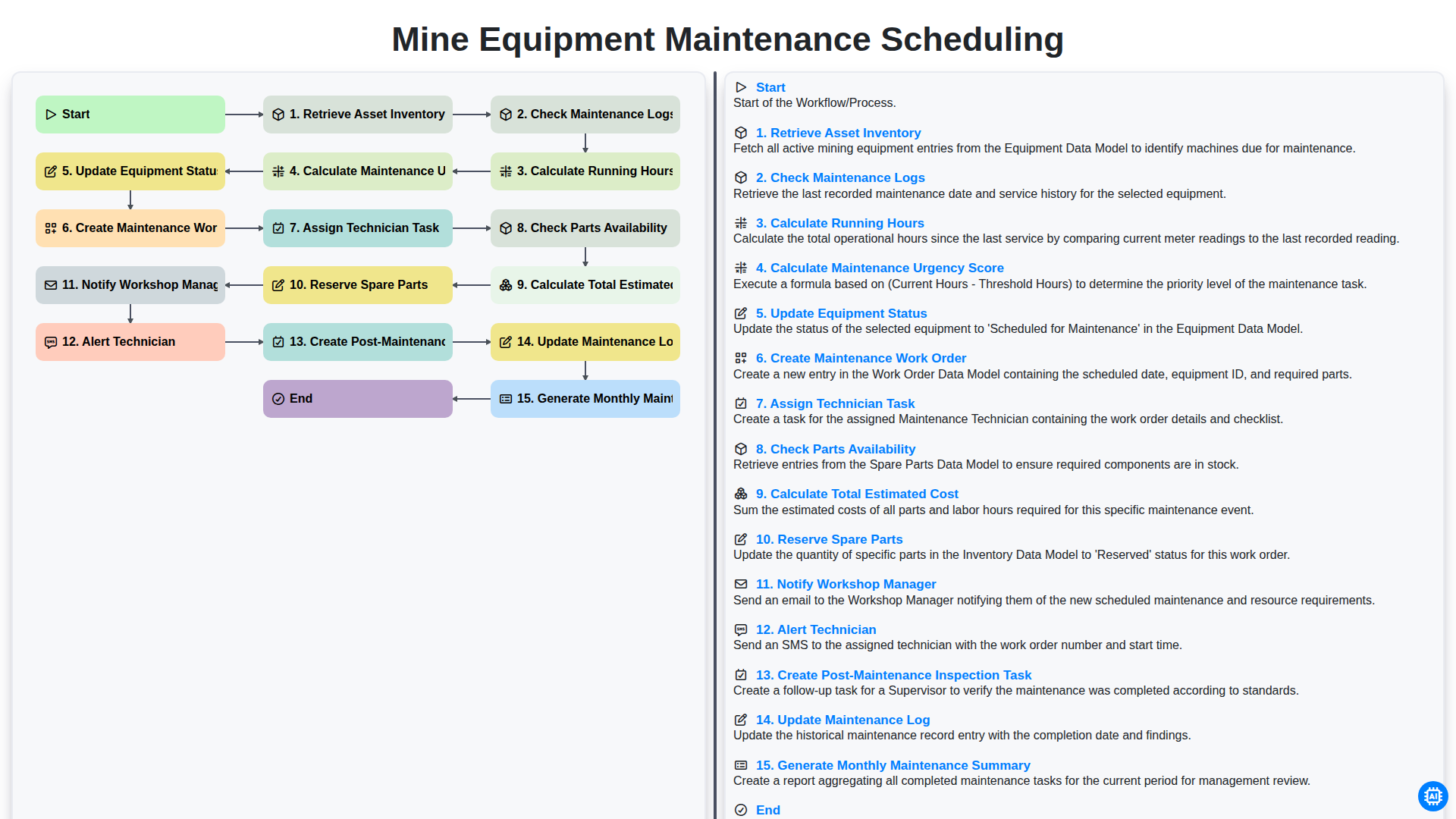
Efficient Mine Equipment Maintenance Scheduling Workflow
Need help with
Checklists?
Have a question? We're here to help. Please submit your inquiry, and we'll respond promptly.