Mastering Efficiency: The Ultimate Move Management and Relocation Workflow Template
Published: 06/09/2026 Updated: 10/05/2026
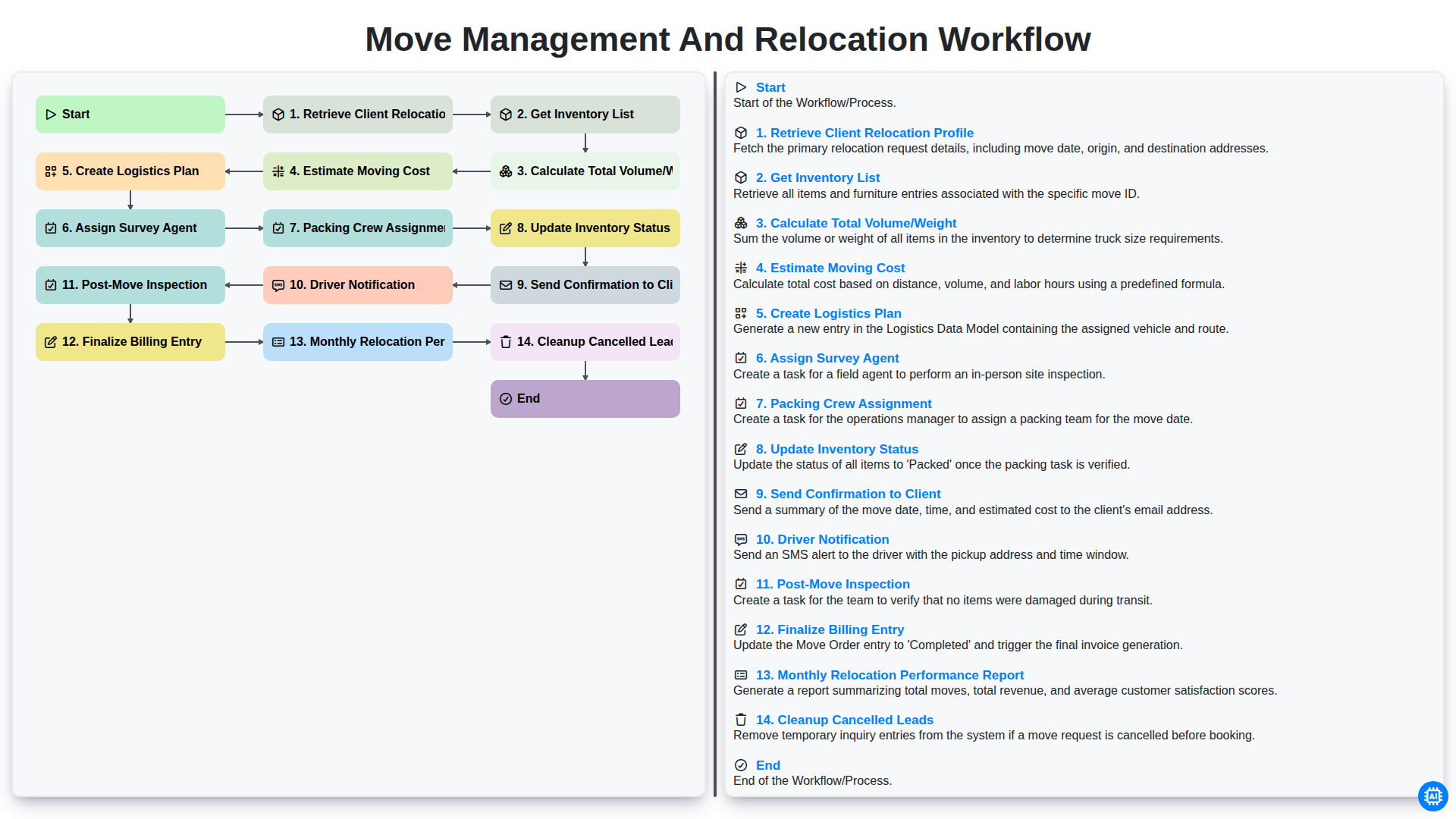
Table of Contents
- Introduction: The Importance of a Structured Relocation Workflow
- Phase 1: Client Onboarding and Initial Assessment
- Retrieving the Client Relocation Profile
- Inventory Auditing: Getting the Full List
- Calculating Volume and Weight for Precision
- Phase 2: Cost Estimation and Logistics Planning
- Generating Accurate Moving Cost Estimates
- Designing the Comprehensive Logistics Plan
- Phase 3: Resource Allocation and Crew Management
- Assigning Survey Agents and On-Site Inspections
- Optimizing Packing Crew Assignments
- Phase 4: Execution and Real-Time Updates
- Tracking Inventory Status Throughout the Move
- Communication Loops: Client Confirmations and Driver Notifications
- Phase 5: Post-Move Completion and Quality Control
- Conducting Post-Move Inspections
- Finalizing Billing and Financial Reconciliation
- Phase 6: Continuous Improvement and Data Management
- Analyzing Monthly Relocation Performance Reports
- Maintaining Database Hygiene: Cleaning Up Cancelled Leads
- Resources & Links
TLDR: Streamline your relocation operations with this comprehensive workflow template. Learn how to automate your entire moving process-from initial client profiling and cost estimation to logistics planning, crew assignment, and post-move inspections-to ensure maximum efficiency, reduce manual errors, and improve client satisfaction.
Introduction: The Importance of a Structured Relocation Workflow
Relocating a client's assets is far more than just transporting boxes from one location to another; it is a complex logistical puzzle that requires precision, timing, and meticulous attention to detail. Without a predefined roadmap, even the most experienced moving companies can fall victim to the chaos of missed deadlines, inaccurate estimates, and disorganized packing crews. A single oversight in the early stages-such as an incorrect inventory count or a failure to notify a driver-can trigger a costly domino effect that impacts client trust and your company's bottom line.
Implementing a structured relocation workflow transforms this high-pressure process from a reactive struggle into a proactive, streamlined operation. By establishing a standardized sequence of events-ranging from the initial retrieval of client profiles to the final post-move inspection-you ensure that every stakeholder, from survey agents to drivers, knows exactly what is expected of them. A robust workflow does more than just prevent errors; it enhances operational transparency, optimizes resource allocation, and ultimately provides the seamless, professional experience that turns first-time movers into lifelong clients.
Phase 1: Client Onboarding and Initial Assessment
The foundation of a seamless relocation experience lies in the precision of the initial stages. The process begins by Retrieving the Client Relocation Profile, ensuring that all specific requirements, preferences, and unique constraints of the move are documented from the very first interaction. Once the profile is established, the focus shifts to physical scale through the Get Inventory List step, where every item slated for transport is accounted for.
To transform this data into an actionable strategy, we proceed to Calculate Total Volume/Weight, a critical step that determines the necessary vehicle capacity and manpower. With these metrics in hand, we can then Estimate Moving Cost, providing the client with transparent and accurate pricing. This phase concludes with the Create Logistics Plan, a comprehensive roadmap that synchronizes timelines, routes, and resources to ensure that the groundwork for a successful move is firmly in place before any physical labor begins.
Retrieving the Client Relocation Profile
The foundation of a seamless relocation process begins long before a single box is packed; it starts with the Retrieval of the Client Relocation Profile. This critical initial step serves as the single source of truth for the entire moving operation.
To ensure a personalized and error-free experience, the workflow begins by gathering all pre-established data regarding the client's specific needs. This involves accessing historical data, contact information, and any specialized requirements-such as fragile item handling, pet considerations, or specific time constraints-that were noted during the initial inquiry. By thoroughly reviewing the relocation profile at the very onset, the move management team can identify potential complexities early, allowing for a more tailored approach to the logistics ahead. This stage is not merely about collecting names and addresses; it is about understanding the unique landscape of each move to set the stage for an organized and efficient transition.
Inventory Auditing: Getting the Full List
The foundation of any successful relocation lies in the precision of the initial assessment. The Get Inventory List phase is more than just a simple tally of items; it is a critical auditing process designed to eliminate uncertainty. By systematically documenting every piece of furniture, fragile heirloom, and bulky appliance, we move away from guesswork and toward a data-driven strategy.
A comprehensive inventory audit serves two vital purposes: it provides the necessary data to calculate total volume and weight accurately, and it acts as the ultimate reference point for the packing crew. Without a detailed, verified list, the risk of underestimated costs or missing items increases exponentially. This step ensures that every item is accounted for long before the first box is taped, creating a transparent roadmap for both the moving team and the client.
Calculating Volume and Weight for Precision
Precision is the cornerstone of a successful relocation. At the heart of an efficient move management workflow lies the critical step of calculating total volume and weight. This is not merely a formality; it is the mathematical foundation upon which your entire logistics strategy is built.
To ensure an accurate estimate, the process begins by analyzing the Inventory List to identify every item slated for transport. By determining the cubic volume (size) and the estimated weight of each item, you can prevent the two most common pitfalls in the moving industry: underestimating resource needs or overcharging the client.
Accurate calculations allow you to:
- Optimize Vehicle Selection: Knowing the total volume ensures you dispatch a truck with the appropriate capacity, preventing mid-transit shortages.
- Refine Cost Estimates: Accurate weight data is essential for calculating fuel consumption, labor requirements, and heavy-duty equipment needs.
- Safety and Compliance: Understanding the total weight load is vital for ensuring road safety and adhering to vehicle weight regulations.
By prioritizing this step, you transform guesswork into a data-driven process, ensuring that your logistics plan is both reliable and cost-effective.
Phase 2: Cost Estimation and Logistics Planning
Once the initial inventory has been documented, the workflow transitions from data collection to strategic preparation. This phase is critical, as it transforms raw data into a concrete, actionable roadmap for the move.
The process begins with calculating the Total Volume and Weight of the items identified in the inventory list. This measurement is the foundation of the entire moving strategy, as it dictates the size of the vehicle required and the manpower needed for the crew. Based on these metrics, the next step is to Estimate the Moving Cost. By analyzing the volume and complexity of the items, the system generates a precise quote, ensuring transparency and preventing budget overruns.
With the financial parameters established, the focus shifts to the operational blueprint. We Create a Logistics Plan, which outlines the optimal route, timing, and necessary equipment. To ensure the accuracy of this plan, we Assign a Survey Agent to verify any high-value or oversized items that may require specialized handling. This phase concludes by bridging the gap between planning and execution: we finalize the Packing Crew Assignment, ensuring that the right team with the appropriate expertise is allocated to handle the specific needs of the client's inventory.
Generating Accurate Moving Cost Estimates
The foundation of a successful relocation lies in the precision of your initial quotation. Generating accurate moving cost estimates is not merely about providing a number; it is a multi-step analytical process that prevents budget overruns and maintains client trust.
The process begins with Retrieving the Client Relocation Profile, which allows our team to understand the specific nuances of the move, such as distance, accessibility, and specialized requirements. Once the profile is established, we move to Getting the Inventory List, a critical step where every item is documented to ensure nothing is overlooked. By systematically Calculating the Total Volume and Weight of the goods, we eliminate guesswork, allowing us to determine the exact amount of space and manpower required. This data-driven approach ensures that the Estimated Moving Cost is both competitive and realistic, protecting both the company's margins and the client's expectations from the very first interaction.
Designing the Comprehensive Logistics Plan
Once the initial estimation of volume and weight is finalized, the core of a successful relocation lies in the Designing the Comprehensive Logistics Plan phase. This stage is where raw data is transformed into an actionable roadmap. A well-structured logistics plan serves as the blueprint for the entire move, ensuring that every resource-from vehicle capacity to specialized handling equipment-is strategically aligned with the client's specific needs.
A robust logistics plan involves mapping out optimized transit routes, determining the precise sequence of loading, and establishing a strict timeline for arrival and departure. It must account for potential variables such as traffic patterns, delivery windows, and the specific requirements of the destination site. By meticulously detailing every movement, we mitigate the risk of delays and ensure that the transition is as seamless as possible, providing a foundation of predictability in an otherwise complex process.
Phase 3: Resource Allocation and Crew Management
Once the logistics plan is finalized and the moving costs are estimated, the focus shifts from planning to execution through strategic resource allocation. This phase is critical to ensuring that the right personnel and equipment are deployed to meet the specific needs of the client's inventory.
The process begins with the Assign Survey Agent step, where a specialized professional is designated to verify the accuracy of the inventory and assess any potential complexities at the new site. Simultaneously, the Packing Crew Assignment takes place; here, the workload is distributed among trained staff based on the total volume and weight calculated during the initial assessment. By matching the skill level of the crew to the sensitivity of the items in the inventory list, we minimize the risk of damage during transit.
Furthermore, as the team prepares for deployment, we perform an Update Inventory Status check to ensure all high-value or fragile items are flagged for special handling. This synchronization between the logistics plan and human resource deployment ensures that every member of the moving team is fully prepared for the specific demands of the relocation, creating a seamless transition from the planning stage to the physical move.
Assigning Survey Agents and On-Site Inspections
The foundation of a successful relocation rests on the accuracy of the initial assessment. Once the logistics plan is drafted, the workflow moves into a critical phase: Assigning Survey Agents. To ensure that the estimated moving cost aligns with the actual physical requirements of the move, a specialized agent is dispatched to conduct an on-site inspection.
This step is far more than a simple walkthrough; it is a deep dive into the technicalities of the move. The assigned agent's primary objective is to verify the Inventory List and reconcile any discrepancies between the client's digital profile and the physical reality of the items being moved. During the inspection, the agent evaluates the condition of high-value goods, identifies potential challenges-such as narrow staircases or fragile antiques requiring specialized crating-and confirms the final volume and weight calculations.
By professionalizing this stage of the workflow, we mitigate the risk of hidden surprises on moving day. A thorough on-site inspection ensures that the Packing Crew Assignment is appropriately scaled and that the Logistics Plan accounts for all necessary equipment and manpower. This precision is what allows us to provide a seamless transition from the initial quote to the final delivery, ensuring that the client's expectations are met with absolute certainty.
Optimizing Packing Crew Assignments
Efficiently managing the Packing Crew Assignment stage is a critical pivot point in the relocation workflow. Once the logistics plan is finalized and the inventory list is verified, the focus shifts from planning to execution. This step is where the theoretical logistics plan meets the physical reality of the move.
To optimize this process, assignments should never be arbitrary. Instead, they should be driven by the data gathered during the Calculate Total Volume/Weight and Create Logistics Plan stages. A high-volume, fragile-heavy inventory requires a crew with specialized experience in fine art or antique handling, whereas a standard residential move might require a larger, more general-purpose team.
Effective assignment optimization involves three key elements:
- Skill-Based Matching: Matching the complexity of the inventory to the expertise of the crew to minimize breakage and ensure efficiency.
- Resource Balancing: Distributing workloads across your team to prevent burnout and ensure that no single crew is over-capacity, which maintains service quality.
- Real-Time Integration: Ensuring that once a crew is assigned, the information flows immediately into the Update Inventory Status step, allowing for seamless tracking of packing progress.
By treating crew assignment as a data-driven decision rather than a logistical afterthought, companies can significantly reduce the margin for error, lower the risk of transit damage, and ensure that the move stays on schedule.
Phase 4: Execution and Real-Time Updates
Once the logistical groundwork is laid and the initial plans are set, the workflow shifts into its most critical stage: the active execution of the move. This phase is where the theoretical plan meets the physical reality of moving goods, requiring precise coordination and real-time data management.
The execution phase begins with the deployment of resources, specifically through Packing Crew Assignment and the Assignment of Survey Agents to verify any last-minute changes. As the physical movement begins, the core of the operation relies on maintaining an accurate digital paper trail. This is achieved by continuously performing Inventory Status Updates, ensuring that every item transitioned from the origin to the destination is accounted for in the system.
Communication is the heartbeat of this phase. To prevent any operational bottlenecks, the workflow triggers automated Driver Notifications, ensuring that transport personnel are briefed on route specifics and timing. Simultaneously, transparency is maintained with the customer through a Confirmation Sent to Client protocol, which provides peace of mind and reduces the volume of inbound inquiry calls. By integrating real-time updates into the execution phase, the move transitions from a logistical challenge to a seamless, controlled process.
Tracking Inventory Status Throughout the Move
Maintaining real-time visibility over every item being moved is the backbone of a successful relocation. Within our workflow, the Update Inventory Status phase acts as the critical checkpoint that bridges the gap between the initial assessment and the final delivery.
As items transition through different stages-from being packed and labeled to being loaded into a vehicle and eventually unloaded at the destination-the inventory list is updated instantaneously. This continuous tracking ensures that both the moving team and the client have a single source of truth. By meticulously documenting the status of each item, we eliminate the guesswork and significantly reduce the risk of loss or damage. This level of precision ensures that when the final inspection occurs, the list of arrived goods perfectly matches the initial estimate, providing peace of mind through total transparency.
Communication Loops: Client Confirmations and Driver Notifications
In a seamless relocation workflow, information cannot exist in a vacuum; it must flow continuously between the office, the client, and the field. The Communication Loops phase serves as the critical bridge that transforms a logistical plan into an active, synchronized operation. This stage is defined by two vital touchpoints: Sending Confirmation to the Client and Driver Notification.
The first loop focuses on transparency and trust. Once the logistics plan is finalized and resources are assigned, sending an automated, detailed confirmation to the client is essential. This communication should outline the finalized moving date, the arrival window, and a summary of the agreed-upon services. By providing this instant validation, you reduce client anxiety and significantly decrease the volume of inquiry calls to your customer service team.
The second loop focuses on operational execution through Driver Notification. Once the client is confirmed, the workflow triggers an alert to the logistics team and drivers, providing them with the essential details of the upcoming mission. This notification includes the specific inventory details, the calculated volume/weight, and the precise pickup location. By ensuring that drivers are notified immediately upon the stabilization of the plan, you eliminate the risk of manual errors and ensure that the personnel on the ground are prepared for the specific demands of the load, maintaining the integrity of the entire relocation lifecycle.
Phase 5: Post-Move Completion and Quality Control
The final stage of the relocation workflow is where the integrity of the service is verified and the operational loop is closed. This phase begins with the Post-Move Inspection, a critical step to ensure that all items have arrived in their original condition and that the destination setup meets the client's expectations. By conducting a thorough walkthrough, the team can proactively identify any discrepancies before the move is officially considered complete.
Once the physical transition is validated, the focus shifts to administrative closure with the Finalize Billing Entry step. This ensures that all services rendered, including any additional labor or specialized packing requested during the move, are accurately documented and invoiced. To maintain a lean and efficient database, the process also includes the Cleanup of Cancelled Leads, ensuring that the CRM remains focused on actionable opportunities rather than outdated data.
Finally, the workflow moves from individual task management to high-level oversight through the Monthly Relocation Performance Report. This aggregate view allows management to analyze trends, identify bottlenecks in the logistics chain, and implement data-driven improvements for future relocations. This cycle of inspection, billing, and analysis ensures that every move is not just a one-time success, but a building block for continuous operational excellence.
Conducting Post-Move Inspections
The final, and perhaps most critical, stage of the relocation workflow is the Post-Move Inspection. Once the heavy lifting is done and the last box is placed, the job isn't truly finished until a thorough quality check is completed. This step serves as the ultimate safeguard for both the moving company and the client.
During this phase, the inspection team systematically reviews the condition of all items listed in the original inventory. The primary goal is to identify any potential damages or discrepancies-such as broken glassware, dented furniture, or missing parcels-immediately after the unloading process. By conducting this audit on-site, you can address concerns in real-time, preventing much larger disputes during the billing stage.
A successful post-move inspection achieves three key objectives:
- Verification: Ensuring that the Update Inventory Status step matches the actual physical delivery.
- Accountability: Documenting the integrity of the service provided by the packing and moving crews.
- Customer Satisfaction: Providing the client with a sense of closure and peace of mind, knowing that their belongings have been accounted for and vetted.
By integrating this inspection into your standard workflow, you transform a potentially stressful moment of uncertainty into a professional demonstration of care and precision.
Finalizing Billing and Financial Reconciliation
Once the physical move is successfully completed and the post-move inspection has been finalized, the workflow shifts from logistics to financial closure. The Finalize Billing Entry stage is a critical checkpoint where all recorded services, additional weights, or unexpected surcharges are reconciled against the initial estimate. This step ensures that the client is invoiced accurately, reflecting the actual work performed rather than just the initial quote.
Simultaneously, this phase serves as the foundation for long-term operational oversight. Once all individual transactions are settled, the data flows into the Monthly Relocation Performance Report. This high-level analysis allows management to track profitability, assess service accuracy, and identify trends in moving costs. To maintain a clean and efficient database, the process concludes with a Cleanup of Cancelled Leads, ensuring that your CRM remains focused on active, revenue-generating opportunities and that your sales pipeline stays organized and actionable.
Phase 6: Continuous Improvement and Data Management
The final stage of our relocation workflow shifts focus from the physical movement of goods to the optimization of long-term operations. A successful relocation service doesn't end when the last box is unpacked; it ends when the data is analyzed and the pipeline is refined.
This phase begins with the Monthly Relocation Performance Report, where we aggregate data from every completed move to identify bottlenecks, assess service quality, and evaluate driver efficiency. By reviewing these metrics, we can make data-driven decisions to improve future logistics planning. Alongside this, we perform a Cleanup of Cancelled Leads to ensure our CRM remains accurate and our sales pipeline is focused on viable opportunities. This dual focus on performance auditing and database hygiene ensures that our workflow remains lean, our clients receive consistently high-quality service, and our operational costs remain optimized for growth.
Analyzing Monthly Relocation Performance Reports
At the conclusion of every operational cycle, the workflow culminates in the generation of the Monthly Relocation Performance Report. This stage is critical for transforming raw operational data into actionable business intelligence. Rather than simply looking at completed moves, this report provides a deep dive into the efficiency of the entire lifecycle-from the initial retrieval of client profiles to the final billing entry.
By analyzing this report, management can identify recurring bottlenecks, such as delays in the Assign Survey Agent phase or inconsistencies in Packing Crew Assignment. It allows for a granular look at cost-versus-revenue metrics, helping to verify if the Estimated Moving Cost aligns with the Finalized Billing. Ultimately, this data-driven oversight ensures that the relocation workflow isn't just a sequence of tasks, but a continuously optimizing engine for growth and service excellence.
Maintaining Database Hygiene: Cleaning Up Cancelled Leads
A streamlined relocation workflow is only as effective as the data that powers it. While much of our focus is often placed on managing active moves, the final, often overlooked step in a high-performing logistics cycle is cleaning up cancelled leads.
In the fast-paced moving industry, lead volatility is inevitable. Clients may change their minds,-decide to stay in their current residence, or opt for a competitor at the last minute. If these cancelled leads are left sitting in your active pipeline, they become data noise. This clutter can skew your conversion rate metrics, inflate your projected revenue forecasts, and lead to inaccurate resource allocation.
By implementing a dedicated step to purge or archive cancelled leads, you ensure that your CRM remains a single source of truth. This practice allows your team to focus exclusively on actionable opportunities, ensures that your sales reports reflect true market demand, and prevents your marketing automation from accidentally sending follow-up sequences to users who are no longer in the market. Maintaining this level of database hygiene is the secret to making your performance reports truly meaningful and your logistics planning truly precise.
Resources & Links
- Forbes Business Strategy Insights: Expert articles on optimizing operational workflows and scaling logistics businesses through structured management.
- Project Management Institute (PMI): Resources and templates for managing complex moving projects, resource allocation, and risk mitigation.
- Supply Chain Dive: Deep dives into logistics planning, inventory management, and real-time tracking technologies for transportation professionals.
- HubSpot CRM Guide: Best practices for managing client profiles, automating client notifications, and maintaining database hygiene for cancelled leads.
- Investopedia - Cost Accounting Basics: Foundational knowledge for calculating accurate moving estimates, finalizing billing, and managing project margins.
- Gartner Operations Research: Data-driven insights on using performance reports and KPIs to drive continuous improvement in service delivery.
Frequently Asked Questions
What is a move management and relocation workflow template?
It is a structured, step-by-step guide designed to streamline the entire relocation process, from initial planning and decluttering to packing, moving day, and post-move setup, ensuring no critical tasks are overlooked.
Who can benefit from using this efficiency template?
This template is ideal for both individuals/families managing a residential move and professionals/HR managers overseeing corporate relocations and office transitions.
How does this template improve moving efficiency?
By providing a centralized roadmap, the template reduces decision fatigue, prevents costly last-minute errors, optimizes time management, and ensures all logistics-such as utility transfers and address updates-are handled in a logical sequence.
Does the template include a checklist for decluttering?
Yes, the workflow includes a dedicated phase for inventory management and decluttering, helping you decide what to keep, sell, donate, or discard before the packing process begins.
How far in advance should I start following this workflow?
While the intensity varies, the template is designed to be implemented at least 8 to 12 weeks before your move date to ensure a stress-free transition.
Can this template be customized for different types of moves?
Absolutely. The template serves as a foundational framework that can be scaled up for large-scale corporate relocations or simplified for small-scale local apartment moves.
Comments
There are no comments yet. Be the first to add one!
Facility Management Solution Demo
Keep your facilities running smoothly! ChecklistGuro streamlines maintenance, inspections, and vendor management. Reduce downtime, optimize efficiency, & improve safety. Manage it all with our Work OS.
Related Articles
Industrial Floor Cleaning & Safety Checklist Template
Display Case Temperature Monitoring Checklist Template
The Ultimate Refrigeration Maintenance Checklist: Keeping Your Food Safe
Escalator & Moving Walkway Inspection Checklist Template
The Ultimate Guest Room Cleaning & Inspection Checklist Template
The Ultimate Security Camera Review Checklist Template
Forklift Inspection & Maintenance Checklist Template
Emergency Generator Load Testing Checklist Template
Need help with
Checklists?
Have a question? We're here to help. Please submit your inquiry, and we'll respond promptly.