Ensuring Accuracy: Your Precision Farming Data Verification Checklist
Published: 11/22/2025 Updated: 07/02/2026
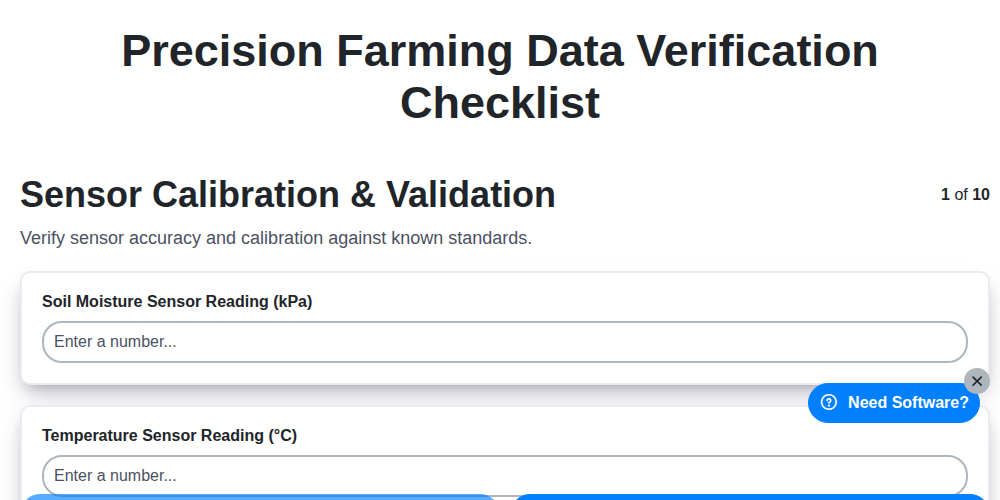
Table of Contents
- Why Data Verification is Crucial in Precision Farming
- 1. Sensor Calibration & Validation: The Foundation of Accuracy
- 2. Data Transmission & Connectivity: Ensuring Seamless Flow
- 3. Data Storage & Integrity: Protecting Your Investment
- 4. Map Accuracy & Alignment: Ground Truthing Your Data
- 5. Variable Rate Application Verification: Confirming Implementation
- 6. Yield Monitoring & Reporting: Validating Harvest Results
- 7. Data Analysis & Interpretation: Avoiding Misleading Insights
- 8. Security and Access Control: Protecting Sensitive Data
- 9. Documentation & Audit Trail: Maintaining a Record of Processes
- Resources & Links
TLDR: Precision farming relies on accurate data. This checklist is your guide to ensuring everything from sensor calibration to yield reporting is spot-on. Use it to proactively identify and fix potential data errors, maximize efficiency, and protect your investment in precision agriculture technologies.
Why Data Verification is Crucial in Precision Farming
Precision farming hinges on data - mountains of it, flowing from sensors, machinery, and environmental monitors. But raw data isn't inherently valuable. It's the accurate and reliable data that drives informed decisions, optimizes resource allocation, and ultimately boosts profitability. Consider this: a faulty sensor leading to inaccurate fertilizer application can waste resources, damage crop health, and negatively impact yields. Similarly, misaligned maps can lead to inconsistent application rates across a field.
The consequences of unchecked data extend beyond immediate financial losses. They erode trust in the entire precision farming system, leading to skepticism among farmers and hindering adoption of new technologies. Data verification isn't just about catching errors; it's about building a robust, dependable foundation for your entire operation. It ensures that the decisions you make - from planting density to irrigation schedules - are based on a clear, trustworthy picture of your farm's needs. Ultimately, data verification transforms collected information into actionable intelligence.
1. Sensor Calibration & Validation: The Foundation of Accuracy
Precision farming hinges on reliable data, and that data begins with accurate sensors. Neglecting sensor calibration and validation is like building a house on sand - the entire process is compromised. This isn't a one-and-done task; it's an ongoing process to ensure data integrity.
Here's what a robust sensor calibration & validation process should include:
- Regular Calibration: Follow manufacturer recommendations for calibration frequency. This varies depending on the sensor type and environmental conditions (temperature, humidity, dust).
- Baseline Establishment: Establish a known, reliable reference point (e.g., a known soil moisture level, a known NDVI value). This serves as your benchmark for comparison.
- Comparison with Ground Truth: Periodically compare sensor readings with manual, ground-truth measurements taken at the same location. This is crucial for detecting drift and identifying inaccuracies.
- Sensor Type-Specific Checks: Each sensor (e.g., NDVI, soil moisture, yield monitor) requires specific validation procedures. Research and follow best practices for each.
- Environmental Factors: Account for the influence of environmental factors (sunlight, temperature) on sensor readings.
- Record Keeping: Meticulously document all calibration and validation activities, including dates, readings, and any adjustments made.
- Training: Ensure personnel are properly trained on calibration procedures and understand the importance of accuracy.
Ignoring these steps can lead to incorrect variable rate applications, inaccurate yield predictions, and ultimately, wasted resources and reduced profitability.
2. Data Transmission & Connectivity: Ensuring Seamless Flow
Precision farming relies heavily on a continuous, reliable flow of data from field to farm management system. A break in this chain - whether due to connectivity issues, faulty hardware, or incorrect configuration - can render your data useless or, worse, lead to inaccurate decisions. This section outlines crucial steps for verifying your data transmission and connectivity.
Checklist Items:
- Signal Strength Verification: Regularly check signal strength for all data transmission pathways (cellular, Wi-Fi, satellite). Investigate and rectify consistently low signal areas.
- Connectivity Testing: Perform periodic connectivity tests between sensors, machinery, and your data platform. This includes simulating data transfer to identify potential bottlenecks.
- Protocol Compatibility: Confirm that all devices and platforms are using compatible data communication protocols (e.g., Modbus, TCP/IP, NMEA).
- Firewall & Gateway Configuration: Validate firewall settings and gateway configurations to ensure they are not blocking data transmission.
- Network Security: Assess network security measures to prevent unauthorized access and data breaches during transmission. Consider VPNs and encrypted channels.
- Hardware Inspection: Inspect cables, antennas, and other hardware components for damage or degradation. Replace as needed.
- Firmware Updates: Maintain updated firmware on all connected devices to ensure compatibility and address known issues.
- Data Buffering: Verify the data buffering capabilities of your equipment and platforms to handle temporary connectivity interruptions.
- Redundancy Checks: If utilizing redundant communication pathways, test their functionality and ensure automatic failover mechanisms are working correctly.
Addressing these points proactively minimizes data loss and ensures the accuracy of your precision farming decisions.
3. Data Storage & Integrity: Protecting Your Investment
Precision farming generates a lot of data. From soil moisture readings to yield maps, this information is the foundation of informed decision-making and, ultimately, increased profitability. Losing that data, or having it corrupted, is akin to losing your farm's memory. Therefore, robust data storage and integrity practices are absolutely critical.
This goes far beyond simply having a hard drive or cloud storage. It's about implementing a system that ensures your data is safe, accessible, and trustworthy. Here's what that entails:
- Redundancy is Key: Implement a backup strategy - ideally, multiple backups to different locations (on-site server, cloud storage, external hard drive). This protects against hardware failure, natural disasters, and accidental deletion.
- Version Control: Data often gets updated and refined. Version control allows you to track changes, revert to previous versions if needed, and understand the evolution of your data.
- Data Format Standards: Utilizing standardized data formats (e.g., ISOBUS, Shapefile, GeoTIFF) facilitates data sharing and interoperability with various software platforms. It also reduces the risk of compatibility issues and data loss during transfer.
- Regular Data Audits: Periodically review your data for accuracy, consistency, and completeness. Look for anomalies or unexpected values that may indicate errors.
- Data Encryption: Encrypting your data, both at rest and in transit, provides an extra layer of security against unauthorized access.
- Defined Retention Policies: Establish clear policies for how long data will be retained and how it will be disposed of securely when no longer needed.
- Metadata Management: Ensure comprehensive metadata is attached to each data file. This includes information about data source, collection date, units of measure, and any processing steps performed. This provides context and ensures data is understandable and usable over time.
Investing in secure and reliable data storage isn't just about backing up files; it's about safeguarding your investment in precision agriculture technology and the decisions you make based on the data it provides.
4. Map Accuracy & Alignment: Ground Truthing Your Data
Precision farming relies heavily on accurate maps - prescription maps for variable rate applications, yield maps for analysis, and more. But a beautifully rendered map is useless (or even harmful) if it's not accurately aligned with your fields. This is where ground truthing comes in.
Ground truthing involves physically verifying the accuracy of your digital maps against real-world conditions. It's more than just a visual check; it's a critical step in ensuring your data drives effective decisions. Here's what to consider:
- GPS Accuracy: Regularly check your GPS signal strength and consider using RTK (Real-Time Kinematic) or other correction services to improve positional accuracy. A few feet of error can translate to significant inconsistencies in application rates.
- Field Boundary Verification: Compare your digital field boundaries to the actual field edges. Look for discrepancies due to erosion, changes in terrain, or inaccurate initial mapping. Update your boundaries as needed.
- Feature Alignment: Verify the location of key features like roads, waterways, and permanent structures against your maps. These serve as reference points to ensure proper alignment.
- Zone Boundary Validation: If you're using prescription maps with delineated zones (e.g., for nutrient application), physically walk through these zones and assess if they accurately reflect the in-field variability. Are the boundaries where you expect them to be?
- Regular Checks: Ground truthing shouldn't be a one-time event. It's a continual process, especially after significant weather events or changes to field conditions.
By consistently ground truthing your data, you're ensuring that your precision farming efforts are based on a solid foundation of accuracy, leading to more efficient resource use, reduced waste, and ultimately, improved yields.
5. Variable Rate Application Verification: Confirming Implementation
Variable rate application (VRA) is only effective if the prescribed rates are actually delivered to the field. This section focuses on verifying that your VRA system is functioning as intended and applying the rates dictated by your prescription maps.
Practical Checks:
- Visual Confirmation: During application, periodically stop and visually inspect the output of your applicator. Are granules being distributed evenly? Is the spray pattern consistent? Look for banding issues, skips, or overlaps.
- Rate Controller Calibration: Regularly calibrate your rate controller. This ensures the controller is accurately translating the prescribed rates from the prescription map into commands for the applicator. Follow the manufacturer's recommended calibration procedures.
- Implement Speed Monitoring: Verify the applicator's ground speed matches the speed used for prescription map generation. Speed discrepancies can significantly impact the applied rate. Utilize GPS-based speed sensors for accurate monitoring.
- Application Rate Comparison: If possible, use a ground-based sensor (e.g., a boom height sensor or a nutrient sensor) to compare the actual application rate to the prescribed rate. This provides direct feedback on the system's performance.
- Recordkeeping: Meticulously record all VRA application events, including date, time, field, prescription map used, actual rates applied (if monitored), and any observed anomalies.
- Operator Training: Ensure operators are thoroughly trained on the VRA system's operation and understand the importance of accurate rate implementation.
Failure to verify application rates can negate the benefits of precision farming and potentially lead to wasted inputs or reduced yields.
6. Yield Monitoring & Reporting: Validating Harvest Results
Accurate yield monitoring and reporting are cornerstones of precision farming, providing invaluable data for decision-making and ROI analysis. However, the data itself is only as reliable as the processes that generated it. This section of your data verification checklist focuses on ensuring the accuracy and integrity of your harvest yield information.
Here's what to examine:
- Combine Calibration: Regularly check and calibrate your combine's yield monitor. This includes verifying grain sensor accuracy, moisture sensor calibration, and area measurement systems. A simple test can involve comparing the yield monitor's readings against known quantities of grain.
- Data Correlation: Compare yield map data with traditional yield estimations (e.g., pile counts, grain cart records). Significant discrepancies warrant investigation.
- Software Validation: Ensure the yield monitoring software is functioning correctly, accurately converting sensor data into usable yield maps and reports. Check for software updates and potential bugs.
- Reporting Accuracy: Review the final yield reports generated from your data. Are the reported totals consistent with grain sales records? Do they align with expected yields based on field history and management practices?
- Data Completeness: Verify there are no gaps or missing data points in the yield maps. Investigate the cause of any missing data and correct if possible.
- Units of Measurement: Confirm that the yield data is reported in the correct units (e.g., bushels per acre, metric tonnes per hectare) and that conversions are accurate.
Addressing these points ensures your yield data is reliable for tracking performance, identifying problem areas, and making informed decisions about future crop management strategies.
7. Data Analysis & Interpretation: Avoiding Misleading Insights
The power of precision farming lies not just in collecting data, but in understanding what that data means. Raw numbers are just that - raw. Without careful analysis and interpretation, you risk making costly decisions based on misleading insights. This is where a robust data analysis process becomes crucial.
First, establish a baseline. Compare current data against historical averages, soil maps, and previous years' performance. Anomalies should trigger investigation, not automatic action. Are unexpected variations due to environmental factors, equipment malfunctions, or genuine changes in crop health or nutrient levels?
Don't rely solely on single data points. Correlation doesn't equal causation. Explore relationships between different data streams - for example, relating sensor readings to yield maps, or weather data to plant stress indicators. Visualization tools (maps, charts, graphs) are invaluable for spotting patterns and trends that might be missed in tables of numbers.
Be wary of outliers. While they can sometimes highlight important issues, they can also be the result of errors or noise in the data. Verify outliers before acting on them.
Finally, recognize your limitations. Data analysis isn't just about running algorithms. It requires agronomic expertise and a deep understanding of your fields and crops. Don't hesitate to consult with agronomists or data specialists to validate your interpretations and ensure you're making informed decisions. Misinterpreted data can lead to wasted resources, reduced yields, and ultimately, undermine the entire precision farming effort.
8. Security and Access Control: Protecting Sensitive Data
Precision farming generates a wealth of data - field conditions, crop health, application rates, yields, and more. This data is incredibly valuable, both for optimizing farm operations and for potential commercial uses. However, its value also makes it a target. Robust security and access control measures are essential to protect this information from unauthorized access, modification, or deletion.
Here's what you need to consider:
- Role-Based Access: Implement a system that assigns different levels of access to data based on user roles. Field operators might have access to application controls, while managers might have access to reporting and analytics. Limit access to the minimum required for each role.
- Strong Passwords & Multi-Factor Authentication (MFA): Enforce strong password policies (length, complexity, regular changes) and, crucially, implement MFA wherever possible. This adds an extra layer of protection, even if a password is compromised.
- Data Encryption: Encrypt sensitive data both in transit (during transmission) and at rest (when stored). This makes it unreadable to unauthorized individuals, even if they gain access.
- Network Security: Secure your farm network with firewalls, intrusion detection systems, and regular vulnerability assessments. Isolate your precision farming systems from the wider internet if possible.
- Regular Audits: Conduct periodic audits of access logs and security configurations to identify and address potential vulnerabilities.
- Vendor Security: When using third-party software or services, thoroughly vet their security practices. Understand their data handling policies and ensure they align with your own.
- Data Backup and Recovery: Regularly back up your data and have a documented recovery plan in place to address data loss due to cyberattacks, hardware failures, or other unforeseen events.
- Employee Training: Educate all employees on data security best practices, phishing awareness, and reporting suspicious activity. Human error is often the weakest link in any security system.
Prioritizing security and access control isn't just about protecting your data; it's about protecting your farm's reputation and ensuring long-term sustainability.
9. Documentation & Audit Trail: Maintaining a Record of Processes
Precision farming relies on a complex web of data and technology. Without meticulous documentation and a clear audit trail, the value of your precision farming efforts diminishes significantly. It's not enough to simply do the steps; you need to prove they were done correctly, consistently, and according to established protocols.
This section focuses on capturing the who, what, when, and how of your precision farming operations. Here's what a robust documentation and audit trail should include:
- Calibration Records: Document all sensor calibrations, including dates, methods, and results. Keep copies of calibration certificates when applicable.
- Software & Firmware Versions: Track software versions used for data processing, prescription mapping, and equipment control. Record firmware versions for all hardware components.
- Operator Training: Maintain records of operator training and certifications, demonstrating competency in operating equipment and interpreting data.
- Procedure Changes: Any modifications to operational procedures - even seemingly minor ones - should be documented, along with the rationale behind the change.
- Data Transmission Logs: Record the times and methods used for data uploads and downloads.
- Error Logs: Log any errors encountered during data collection, processing, or application, along with corrective actions taken.
- Corrective Action Records: Document any deviations from planned activities and the steps taken to rectify them.
- Equipment Maintenance Records: Keep detailed records of equipment maintenance, repairs, and inspections.
Why is this important?
- Traceability: Allows you to trace data back to its source and understand how it was processed.
- Accountability: Clearly defines responsibilities and ensures accountability for data quality.
- Compliance: Supports compliance with regulatory requirements and industry best practices.
- Continuous Improvement: Provides a basis for identifying areas of improvement in your precision farming processes.
- Dispute Resolution: Provides verifiable evidence in case of discrepancies or disputes.
By implementing a comprehensive documentation and audit trail, you're not just adhering to best practices; you're safeguarding the integrity of your data and maximizing the return on your precision farming investments.
Resources & Links
- ISOP Reach: Specializes in precision agriculture data management and verification services. Provides tools and consulting for ensuring data quality across the entire workflow. Useful for understanding broader industry best practices and potential service providers.
- Trimble Agriculture: Offers a range of precision farming solutions, including data management and accuracy tools. Their website provides whitepapers, case studies, and product information relevant to sensor calibration, data processing, and variable rate application verification. Focus on hardware and software solutions.
- John Deere Precision Ag: Provides a wide array of precision agriculture resources including information on calibration, connectivity, and data management. Look for sections on John Deere Operations Center and related technologies. Important for understanding common data workflows.
- BASF Digital Farming: BASF's digital farming platform offers data integration and analytics. Provides insight into data handling, model validation, and the impact of data accuracy on decision-making. Valuable for understanding the broader context of data verification.
- Ag Leader Technology: Focuses on precision planting and data management. Provides information and resources related to sensor calibration, data transfer, and yield monitoring. Explore their product documentation and support materials.
- Iowa DNR Precision Agriculture BMPs: A PDF from Iowa's Department of Natural Resources outlining best management practices for precision agriculture, including sections addressing data quality and verification. A practical guide from a regulatory and environmental perspective.
- Esri Agriculture: Esri's ArcGIS platform is extensively used in precision agriculture for mapping and spatial analysis. Resources available relate to map accuracy, georeferencing, and data alignment. Useful for understanding GIS-based data verification methods.
- Australian Department of Agriculture: Provides an overview of precision agriculture practices in Australia, with sections on data management, validation, and security. A governmental perspective on precision farming practices and challenges.
- Bayer Crop Science Precision Ag Resources (formerly Monsanto): A PDF outlining key aspects of precision agriculture, including data calibration, mapping and data storage, and analysis. (Note: Monsanto is now part of Bayer Crop Science. Resources might still be under the Monsanto domain for some time.)
- PrecisionAg.com: A news and information source for precision agriculture professionals, covering topics such as data management, sensors, and variable rate applications. Useful for staying current on industry trends and best practices.
Frequently Asked Questions
What is precision farming data verification and why is it important?
Precision farming data verification is the process of checking the accuracy and reliability of data collected by precision agriculture technologies. It's important because inaccurate data can lead to incorrect decisions regarding fertilizer application, irrigation, planting densities, and more, potentially reducing yields, increasing costs, and harming the environment.
Who should be using this data verification checklist?
This checklist is designed for anyone involved in precision farming operations, including farmers, agronomists, data analysts, and equipment operators. It applies to all users who rely on precision farming data for decision-making.
What types of data should I be verifying?
The checklist covers data from various sources, including yield monitors, soil sensors, weather stations, drone imagery, satellite imagery, and GPS data. Focus on data that directly influences your operational decisions.
How often should I perform data verification?
The frequency of verification depends on the criticality of the data and the reliability of your equipment. At a minimum, verify data before making significant operational changes. Regularly (e.g., weekly or monthly) verification is recommended, especially during critical periods like planting and harvest.
What does 'calibration' mean in the context of data verification?
Calibration refers to the process of adjusting sensors and equipment to ensure they're providing accurate readings. This can involve checking and adjusting settings, cleaning sensors, and comparing readings to known benchmarks.
I'm not sure how to interpret some of the metrics listed in the checklist. Where can I learn more?
Many resources are available to help you understand precision farming data. Consult your equipment manuals, online tutorials, agricultural extension services, and precision agriculture consultants. Your equipment vendor can also be a valuable resource.
What should I do if I identify errors in my data?
Document the error, identify the potential cause (equipment malfunction, incorrect settings, environmental factors), and take corrective action. This might involve recalibrating equipment, adjusting settings, or re-collecting data. Also, flag the affected data for future reference and potential retraining of models.
The checklist mentions 'ground truthing'. What is that?
'Ground truthing' involves physically verifying data with real-world observations. For example, if drone imagery shows varying plant health, you would physically inspect plants in those areas to confirm the findings and assess the actual condition.
Is there a difference between data validation and data verification?
While often used interchangeably, verification focuses on confirming that the data is accurate, while validation confirms that the data represents the reality being measured. This checklist incorporates elements of both.
Can I modify this checklist to fit my specific operation?
Absolutely. This checklist is a starting point. Add or remove items based on your specific equipment, crops, and operational practices. Tailoring it to your needs will ensure it remains relevant and effective.
Comments
There are no comments yet. Be the first to add one!
Farm Management Solution Demo
Grow your farm smarter & more efficiently! ChecklistGuro streamlines crop planning, task management, & resource tracking. Maximize yields, reduce waste, & improve profitability. Manage it all with our Work OS.
Related Articles
Unlock Higher Yields: Your Precision Agriculture Checklist Template
The Ultimate Farm Safety Inspection Report Checklist Template
Irrigation System Checklist: Farm Water Management & Crop Yield Optimization

Livestock Health & Welfare Checklist: Your Farm Animal Care & Biosecurity Template
Crop Insurance Policy Review Checklist: A Farmer's Guide
Water Discharge Permit Compliance Checklist Template
The Ultimate GPS & Precision Farming Calibration Checklist Template
Mapping the Threat: A Checklist for Proactive Pest & Disease Pressure Management
Need help with
Farm Management?
Have a question? We're here to help. Please submit your inquiry, and we'll respond promptly.