Master Your Harvest: The Ultimate Smallholder Farm Revenue and Seasonal Profitability Tracker 2026 Checklist
Published: 11/21/2026 Updated: 11/22/2026
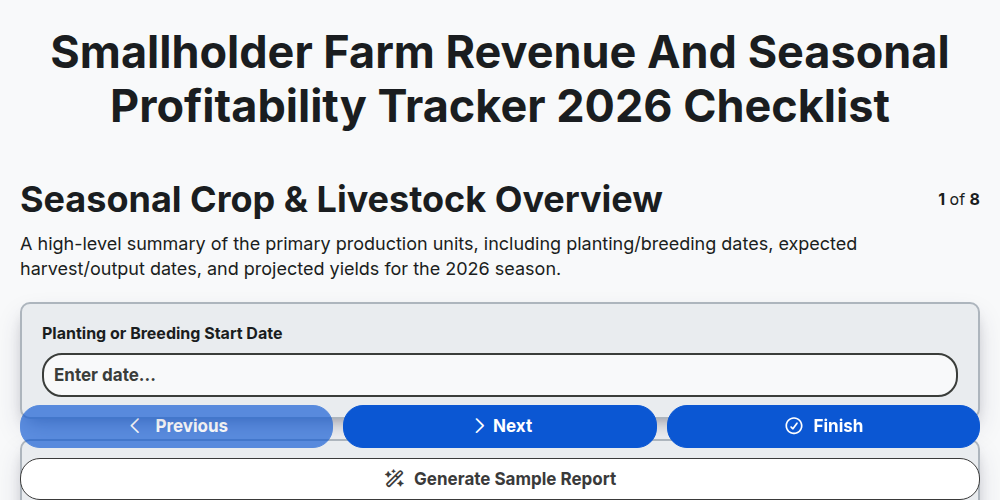
Table of Contents
- Introduction: Why Profitability Tracking is Your Best Farming Tool for 2026
- Step 1: Establishing Your Seasonal Crop & Livestock Overview
- Step 2: Tracking Direct Production Costs (Variable Expenses)
- Step 3: Managing Operational & Labor Expenditures
- Step 4: Accurate Revenue & Sales Documentation
- Step 5: Accounting for Post-Harvest & Processing Costs
- Step 6: Budgeting for Equipment & Infrastructure Maintenance
- Step 7: Calculating Profitability & Margin Analysis
- Step 8: Conducting a Seasonal Performance Review & Insights
- Conclusion: Turning Data into Long-Term Farm Growth
- Resources & Links
TLDR: Stop guessing and start growing your bottom line with our 2026 Seasonal Profitability Tracker. This comprehensive checklist guides smallholder farmers through tracking everything from variable production costs and labor expenses to post-harvest processing and equipment maintenance, providing the essential tools to analyze margins and maximize seasonal profits.
Introduction: Why Profitability Tracking is Your Best Farming Tool for 2026
Beyond the Harvest: Moving from Survival to Strategy
For many smallholder farmers, the end of a season brings a sense of relief-the crops are in, the livestock are fed, and the hard work is done. But as the dust settles, a critical question remains: Did you actually make a profit, or did you simply trade time for money?
As we approach 2026, the landscape of small-scale agriculture is changing. Fluctuating seed prices, unpredictable weather patterns, and shifting market demands mean that guessing your margins is no longer a viable business strategy. To thrive in the coming year, you must transition from being a grower to being a manager.
The Gap Between Yield and Wealth
It is a common misconception that a high yield automatically equates to a successful season. You can produce the most bountiful harvest in your farm's history and still end the year in debt if your variable expenses-like fertilizer, fuel, and labor-outpaced your sales revenue.
This is where the Smallholder Farm Revenue and Seasonal Profitability Tracker 2026 becomes your most powerful asset.
Why You Need a Systematic Tracker
A structured checklist does more than just record numbers; it provides a roadmap for financial resilience. By implementing a rigorous tracking system, you gain three transformative advantages:
- Granular Cost Visibility: You will no longer wonder where your money went. By separating direct production costs from operational overhead, you can identify exactly which crops are money makers and which are money drains.
- Data-Driven Decision Making: Instead of relying on intuition, you will have hard data to decide whether to expand your poultry production, invest in new irrigation, or pivot to a different crop variety next season.
- Seasonal Agility: Profitability tracking allows you to spot trends in real-time. If post-harvest losses are eating into your margins, the tracker will highlight that leak, allowing you to fix it before the next harvest cycle.
In 2026, success won't just be measured by the weight of your harvest, but by the strength of your margins. This guide is designed to help you capture every cent, optimize every expense, and ensure that your farm is not just producing food, but building lasting wealth.
Step 1: Establishing Your Seasonal Crop & Livestock Overview
Laying the Foundation: Defining Your Farm's Scope
Before you can track your profits, you must first define exactly what you are measuring. The first step in your 2026 profitability journey is creating a comprehensive Seasonal Crop & Livestock Overview. Think of this as the inventory of intent-it is the blueprint of your farm's biological assets for the upcoming season.
Without a clear overview, your financial data will become a chaotic collection of numbers without context. To ensure your tracker is accurate, you need to document the following elements for every unit of production on your farm:
Mapping Your Biological Assets
For every crop and every herd, you must record specific identifiers that will allow you to trace costs back to specific outputs:
- Crop Identification: List each crop variety, the specific plot or field size (in hectares or acres), and the estimated planting date.
- Livestock Inventory: Document the number of head, species, breed, and the stage of life (e.g., weaning, growing, or breeding) for each group of animals.
- Expected Yield/Output Targets: Based on historical data or seed/breed potential, note your Target Yield. This acts as the benchmark against which you will measure your ultimate success.
Tracking the Seasonal Lifecycle
Profitability is not static; it fluctuates with the biological clock of your farm. Your overview should include:
- Planned Harvest/Marketing Windows: When do you expect the crops to be ready for market? When is the scheduled weaning or slaughter date for livestock?
- Input Timelines: Note when key fertilization, weeding, or vaccination cycles are expected to occur.
Why This Step is Non-Negotiable
By documenting your seasonal overview upfront, you are creating your baseline. When you move into the next steps of tracking variable expenses, you will be able to say, I spent $X on Plot A to achieve Y yield, rather than simply knowing I spent $X on fertilizer.
This level of granular detail is what transforms a simple notebook into a powerful decision-making tool, allowing you to identify which specific crops or livestock groups are your true profit drivers and which are merely draining your resources.
Step 2: Tracking Direct Production Costs (Variable Expenses)
Understanding Your Variable Expenses
To truly understand your farm's profitability, you must look beyond just the harvest day. The second pillar of your 2026 tracker is the meticulous documentation of Direct Production Costs. These are your variable expenses-costs that fluctuate depending on how much you plant, breed, or harvest.
Unlike fixed costs (like land rent), these expenses move in direct correlation with your production volume. If you scale up your maize acreage or increase your poultry flock, these numbers will rise. Failing to track these closely is the most common reason smallholder farmers experience hidden losses.
Key Categories to Track
To ensure your margin analysis is accurate, your checklist must include the following sub-categories:
Inputs & Consumables:
Seeds and Seedlings: Track the cost per unit and the total investment per plot or batch.
Fertilizers & Soil Amendments: Record the cost of organic compost, NPK, or manure.
Animal Feed: For livestock farmers, this is often your largest variable cost. Log every bag of feed and supplement.
Agrochemicals: Document all pesticides, herbicides, and fungicides used during the season.
Direct Planting & Sowing Costs:
Include the cost of specialized treatments (like seed coating) or small-scale irrigation supplies used specifically for the current crop cycle.
Consumable Supplies:
Small items that are used up during the season, such as twine, nursery bags, mulch, or organic pest deterrents.
Pro-Tip for 2026: The Cost per Unit Metric
Don't just record the total amount spent. As you fill out your tracker, attempt to calculate the Input Cost per Acre (or per head of livestock).
Example: If you spent $500 on fertilizer for a 2-acre plot, your direct input cost is $250 per acre. Tracking this allows you to compare the efficiency of different plots or different seed varieties side-by-side.
By capturing these variable expenses as they occur, you prevent the end-of-season shock where you realize your revenue was swallowed by rising input prices before the first sale was even made.
Step 3: Managing Operational & Labor Expenditures
Tracking Your Workforce and Day-to-Day Operations
While direct production costs like seeds and fertilizer are easy to spot, the true silent killers of farm profitability often hide within your operational and labor expenditures. For the 2026 season, moving beyond mental notes to a structured tracking system is essential to ensure that your labor costs don't quietly erode your profit margins.
Managing Labor Costs: Beyond the Hourly Wage
Labor is often the largest variable expense for smallholder farmers. To get an accurate picture of your profitability, your tracker must capture more than just total payouts; it needs to categorize how that labor is being utilized.
- Permanent vs. Seasonal Staff: Distinguish between the fixed costs of year-round help and the fluctuating costs of seasonal workers brought in during planting or harvest.
- Task-Based Tracking: Record hours or daily rates spent on specific activities (e.g., weeding, irrigation, animal care). This helps you identify which crops are becoming too labor-intensive to remain profitable.
- Non-Wage Labor: If you utilize family labor, assign a theoretical market wage in your tracker. This ensures you are calculating true profitability rather than just measuring how much cash you have left in your pocket.
Capturing Operational Overhead
Operational expenses are the recurring costs required to keep the farm functional, even when crops aren't actively growing. Failing to track these can lead to a false sense of profit during peak harvest months.
- Fuel and Energy: Track usage for irrigation pumps, tractors, or even the electricity used for storage facilities.
- Logistics and Transport: Document every cost associated with moving inputs to the farm and finished products to the market.
- Supplies and Consumables: Include small but frequent purchases like gloves, cleaning supplies, or small tools that don't qualify as major equipment but add up over a season.
The Goal: Identifying Efficiency Gaps
By meticulously documenting these expenditures, you aren't just recording spending-you are performing a diagnostic on your farm's efficiency. At the end of the season, you should be able to answer: "Did the increase in harvest yield justify the extra labor costs we incurred during the mid-season weeding period?" This data is the key to making smarter, data-driven decisions for the 2027 season.
Step 4: Accurate Revenue & Sales Documentation
Tracking Every Cent: The Foundation of Financial Clarity
In the world of smallholder farming, revenue is more than just the money that lands in your pocket at the end of a harvest; it is the lifeblood of your farm's future. Without rigorous documentation of every sale, it becomes impossible to know which crops are truly paying the bills and which are merely consuming your resources.
To achieve true profitability in 2026, your tracker must move beyond simple cash in hand recording and transition into a detailed ledger of every transaction.
Key Components of Your Revenue Log
To ensure your profitability analysis is accurate, your documentation should capture the following data points for every sale:
- Date of Sale: Crucial for identifying seasonal price fluctuations and cash flow gaps.
- Product Category: Distinguish between different crop varieties, livestock types, or processed goods.
- Quantity Sold: Track weight, volume, or unit counts (e.g., kg, crates, or heads of cattle).
- Unit Price vs. Total Revenue: Always record the price per unit to monitor market trends.
- Customer/Market Type: Note whether the sale was made to a local wholesaler, a direct consumer, or a middleman.
Why Detailed Sales Records Matter
1. Identifying High-Value vs. High-Effort Crops
It is easy to be swayed by a big harvest, but a large volume of tomatoes does not always equal high profit if the market price crashed during harvest time. By documenting unit prices alongside quantities, you can see if a specific crop's revenue justifies the labor invested.
2. Monitoring Market Timing
By reviewing your sales dates, you can identify patterns in market demand. Are you getting better prices in the early season or late season? This data allows you to adjust your planting or breeding cycles for the next year to hit peak price windows.
3. Strengthening Creditworthiness
If you ever need to apply for agricultural loans or government subsidies, a detailed revenue log serves as proof of concept. It transforms your farm from a hobby into a verifiable, data-driven business, providing the evidence needed to prove your income stability to lenders.
Pro-Tip for 2026: Don't wait until the end of the week to record your sales. The memory gap is the biggest enemy of accuracy. Carry a small waterproof notebook or use a mobile logging app to record transactions the moment the deal is closed.
Step 5: Accounting for Post-Harvest & Processing Costs
Don't Let Hidden Costs Shrink Your Margins
For many smallholders, the cost of a crop doesn't end the moment it leaves the field. In fact, the period between harvest and sale is often where significant, invisible expenses accumulate. If you fail to track these post-harvest activities, your revenue figures may look impressive, but your actual profit margins will be much thinner than expected.
To ensure your 2026 tracker provides an accurate picture of your profitability, you must meticulously document every expense incurred during the processing and stabilization phase.
Key Post-Harvest Variables to Track
To maintain a precise financial record, ensure your checklist includes the following categories:
- Processing & Transformation Costs: If you are adding value to your raw goods-such as milling grain, drying fruits, or butchering livestock-you must account for the energy, water, and consumables used in these processes.
- Packaging & Labeling: Every bag, crate, plastic wrap, or jar used to prepare your product for market carries a cost. As inflation impacts supply chains, tracking the fluctuating price of packaging materials is vital for accurate pricing strategies.
- Storage & Preservation Expenses: Whether it is the electricity for cold storage, the cost of organic pesticides for grain silos, or the rental of external warehouse space, these holding costs can significantly impact your seasonal bottom line.
- Sorting, Grading, and Cleaning: The labor and materials required to sort your harvest into different quality tiers (e.g., Premium vs. Standard) should be categorized here to help you determine if the extra effort truly yields a higher return.
Why This Matters for Your 2026 Strategy
By capturing these costs, you move beyond simple production accounting and enter the realm of true profitability analysis.
Tracking post-harvest expenses allows you to answer critical questions: Is it more profitable to sell my maize raw, or is the added cost of milling and packaging offset by a higher market price? Am I losing too much margin to storage electricity costs?
Integrating these figures into your 2026 tracker ensures that your Revenue isn't just a gross number, but a reflection of what you actually get to keep.
Step 6: Budgeting for Equipment & Infrastructure Maintenance
Staying Ahead of the Wear and Tear
In smallholder farming, your tools and infrastructure are the backbone of your productivity. Neglecting maintenance is one of the fastest ways to turn a profitable season into a financial loss. This stage of your 2026 tracker focuses on moving from reactive repairs (fixing things when they break) to proactive maintenance (servicing them to prevent failure).
The Hidden Cost of Neglect
Many farmers only record costs when a tractor breaks down or a fence collapses. However, these emergency repairs are often significantly more expensive than scheduled upkeep. By documenting maintenance costs as a planned line item, you can accurately calculate your true cost of production and avoid budget shocks mid-season.
What to Track in this Section:
To ensure your tracker provides a clear picture of your operational health, ensure you are recording the following:
- Routine Servicing: Scheduled oil changes, blade sharpening, and engine tune-ups for irrigation pumps, tillers, or tractors.
- Infrastructure Upkeep: Repairs to fencing, irrigation piping, storage sheds, and-post-harvest drying areas.
- Small Tool Replacement: The sinking fund for replacing worn-out hand tools, sprayers, and harvesting implements.
- Consumables for Maintenance: Lubricants, cleaning supplies, and spare parts kept in inventory.
Pro-Tip for 2026: The Depreciation Factor
Use this section of your checklist to note the age of your major assets. If you notice that maintenance costs for a specific piece of equipment are rising every season, it is a signal in your data that it may be more cost-effective to plan for a replacement in the next budget cycle rather than continuing to throw good money after bad.
Step 7: Calculating Profitability & Margin Analysis
Analyzing the Bottom Line: Turning Data into Profit
Collecting numbers is only half the battle; the real magic happens when you turn those figures into actionable intelligence. The Profitability & Margin Analysis stage is where you move from being a grower to being a business owner. This is the moment you discover whether your hard work is translating into actual wealth or if rising costs are quietly eroding your margins.
Understanding Your Gross vs. Net Margin
To truly understand your farm's health, you must distinguish between these two critical metrics:
- Gross Margin per Crop/Livestock Unit: This is your revenue minus your direct production costs (seeds, feed, fertilizer, etc.). It tells you which specific products are your stars and which are underperformers.
- Net Profit Margin: This is what remains after every single expense-including labor, maintenance, and overhead-has been deducted from your total revenue. This represents the actual money available to reinvest in your farm or use for your household.
Key Metrics to Track in 2026
To make this checklist effective, don't just look at a single total. Calculate the following for every season:
- Cost of Goods Sold (COGS) Ratio: What percentage of your revenue is being consumed by production costs? If this ratio is creeping upward each season, it's a signal to investigate rising input prices or inefficiencies in your farming methods.
- Revenue per Acre/Unit: This allows you to compare different types of production. For example, does the high maintenance of poultry yield a better return per square meter than your seasonal maize crop?
- Break-Even Point: Use your data to calculate exactly how much you need to sell (in volume or price) just to cover your expenses. This is your safety zone for future seasonal planning.
The Power of Margin Analysis
The goal of this step isn't just to look backward, but to look forward. By identifying which crops provide the widest margins, you can make data-driven decisions for the 2027 season. Should you expand your high-margin vegetable patch? Or should you phase out the livestock variety that requires high labor but offers low returns?
Pro Tip: If your margins are thinning, don't immediately look to raise prices. Look first at your Operational & Labor Expenditures and Direct Production Costs. Often, a small tweak in resource efficiency can restore your profitability more effectively than a price hike.
Step 8: Conducting a Seasonal Performance Review & Insights
Turning Data into Decisions: The Power of Seasonal Reflection
The final step in your 2026 tracking journey isn't just about closing the books; it is about unlocking the intelligence needed to grow your farm. Collecting data is useless unless you interrogate it. The Seasonal Performance Review & Insights stage is where you transition from a record-keeper to a strategic farm manager.
Analyzing the Why Behind the Numbers
Once your margins are calculated, look beyond the final profit figure. A successful harvest isn't just about a high revenue number; it's about understanding the variables that led you there. Ask yourself:
- Variance Analysis: Why did actual production costs deviate from my initial budget? Was it due to unexpected pest pressure, rising fertilizer prices, or increased labor hours?
- Yield vs. Input Correlation: Did the increase in organic fertilizer application result in a proportional increase in yield, or did it disproportionately affect my profit margins?
- Climate Impact Assessment: How did specific weather patterns during the season influence my harvest timing and subsequent market prices?
Identifying Growth Opportunities and Risk Mitigations
Use this review to build a roadmap for the next planting cycle. Use the following prompts to guide your insights:
- Profitability Mapping: Identify which specific crops or livestock units provided the highest Return on Investment (ROI). Which ones are cash drains that should be scaled back?
- Efficiency Audits: Review your labor and operational expenditures. Are there repeatable bottlenecks in your post-harvest process that could be solved with better timing or small equipment upgrades?
- Market Timing Strategy: Based on your sales documentation, did you capture peak market prices, or did your harvest timing force you into a period of low demand?
Preparing for 2027
The ultimate goal of this checklist is to ensure that your 2026 data becomes the foundation for a more resilient 2027. By documenting these insights, you are creating a Farm Intelligence Manual. This allows you to move away from reactive farming-responding to crises as they happen-and toward proactive farming, where every planting decision is backed by the hard evidence of your own seasonal successes and setbacks.
Conclusion: Turning Data into Long-Term Farm Growth
From Spreadsheets to Success: The Power of Precision
Managing a smallholder farm is about much more than just planting seeds and waiting for rain; it is about managing margins. As we move into the 2026 farming season, the gap between a surviving farm and a thriving enterprise lies in the ability to move from guessing to knowing.
By implementing this Seasonal Profitability Tracker, you are doing more than just recording numbers-you are building a roadmap for your farm's future. Every entry in your cost logs and every note in your revenue documentation serves as a building block for more informed decision-making.
Moving Beyond Survival
When you track your seasonal performance with precision, you gain the ability to identify exactly where your leaks are occurring. Is a specific crop costing more in labor than it returns in sales? Is your equipment maintenance schedule preventing costly emergency repairs? This checklist provides the clarity needed to answer those questions.
Strategic Planning for 2027 and Beyond
The data you collect today is your most valuable asset for next year's planning. Use your Seasonal Performance Review to:
- Optimize Resource Allocation: Redirect funds from low-margin crops to high-performing livestock or produce.
- Budget with Confidence: Forecast your 2027 inputs based on real-world 2026 costs.
- Scale Sustainably: Identify exactly how much capital is required to expand your acreage or upgrade your processing capabilities.
Don't let your hard work go unmeasured. Start using this checklist at the very first planting of the season. Through consistent tracking, you will transform your farm from a seasonal struggle into a resilient, profitable, and data-driven business.
Resources & Links
- Food and Agriculture Organization (FAO): Global authority providing data, tools, and best practices for sustainable smallholder farming and food security.
- Agriaffaires: A comprehensive marketplace for farm equipment and machinery, useful for Step 6 regarding equipment budgeting.
- National Association of Certified Valuators and Analysts: Resources for understanding valuation and financial analysis, helpful for Step 7's margin analysis.
- Investopedia: Excellent for learning fundamental financial terms like 'gross margin,' 'variable costs,' and 'profitability ratios' used in the guide.
- USDA (United States Department of Agriculture): Provides essential resources on agricultural economics, market trends, and farm management tools.
- Bloomberg Agriculture: Global market news and commodity price tracking to help with Step 4: Revenue & Sales Documentation.
- Canopy: Cloud-based accounting software tools that can be adapted for tracking farm operational expenditures.
- Google Sheets: The primary tool recommended in this article for building your custom 2026 Profitability Tracker.
- Forbes Business: Insights into small business management and scaling strategies, applicable to the 'Long-Term Farm Growth' conclusion.
- Farm Management Software Guide: Resources for exploring digital solutions for tracking crop and livestock production cycles.
- Shopify: Useful for smallholders looking to move into direct-to-consumer sales and managing post-harvest e-commerce costs.
- Tableau: Advanced data visualization tools for Step 8, helping farmers turn seasonal data into visual performance reviews.
- Entrepreneur Magazine: Guidance on small business budgeting, cash flow management, and operational scaling.
- ACCA Global: Professional accounting standards and principles for accurate cost accounting and expense tracking.
- Eco-Farming Resources: Insights into sustainable practices that impact long-term variable production costs and soil health.
Comments
There are no comments yet. Be the first to add one!
Agriculture Management Solution Demo
Running a farm or agricultural business is complex. ChecklistGuro's Work OS platform simplifies your operations, from crop planning and irrigation management to livestock tracking and harvest scheduling. Increase efficiency, reduce waste, and boost yields! See how ChecklistGuro can revolutionize your agriculture business.
Related Articles
10 Simple Steps to a Healthy Drainage System: Your Checklist Template

Mastering the Daily Crop Scouting Report: Your [Specific Crop] Checklist Template
Irrigation System Checklist: Farm Water Management & Crop Yield Optimization
Unlock Your Garden's Potential: A Soil pH Verification Checklist
PPE Usage Checklist Template: Your Guide to Safety
Water Discharge Permit Compliance Checklist Template
The Ultimate GPS & Precision Farming Calibration Checklist Template
Water Runoff Analysis Checklist Template
Need help with
Agriculture?
Have a question? We're here to help. Please submit your inquiry, and we'll respond promptly.