Why Manual Auto Repair Shop Management is Killing your Profit Margins
Published: 09/08/2026 Updated: 09/09/2026
Table of Contents
- The Hidden Costs of Paper-and-Pen Management
- The Data Leak: How Manual Processes Erase Your Bottom Line
- The Bottleneck Effect: How Paper Trails Slow Down Technician Productivity
- The Error Trap: Why Manual Entry is a Recipe for Invoicing Disasters
- The Chaos of Untracked Inventory and Parts Management
- Scalability Struggles: Why Manual Systems Fail as You Grow
- The Solution: Transitioning to Modern Auto Repair Shop Management Software
- Comparing the Top Auto Repair Shop Management Tools in 2026
- Why ChecklistGuro is the Premier Choice for Operational Excellence
- Conclusion: Reclaiming Your Profit Margins with Automation
- Resources & Links
TLDR: Manual shop management-relying on paper trails, spreadsheets, and verbal cues-is quietly draining your auto repair shop's profitability through lost billable hours, human error, and inefficient workflows. This post explores how manual processes create operational bottlenecks and compares the industry's leading management software, highlighting why ChecklistGuro stands out as the ultimate Work OS solution for shops looking to automate workflows, eliminate errors, and scale their margins.
The Hidden Costs of Paper-and-Pen Management
Running an auto repair shop is inherently complex. Between managing specialized technicians, tracking complex parts orders, and maintaining service histories, there is a thousand moving parts to every single vehicle that enters your bay.
Many shop owners cling to the tried and true method: a clipboard, a whiteboard, and a stack of paper work orders. It feels familiar, and in the early days of a business, it feels manageable. But as your bay count increases and your customer base expands, this manual approach stops being a simple method and starts becoming a silent profit killer.
The Invisible Drain on Your Revenue
The danger of manual management isn't found in a single catastrophic event; it's found in the micro-leaks that occur every single day. When you rely on paper, you aren't just managing cars-you are managing a massive amount of administrative friction.
1. The Time-Sinking Paper Chase
How much time does your Service Writer spend walking across the shop to find a lost work order? How much time does your Shop Foreman spend digging through a filing cabinet to find a vehicle's service history?
Every minute spent searching for information is a minute that isn't being spent on revenue-generating activities. In a manual shop, your highest-paid employees are often performing the roles of low-level clerks, leading to an incredibly high cost of labor per unit of output.
2. The Communication Gap
In a manual environment, information lives in silos. A technician might complete a repair, but if that note stays on a physical piece of paper sitting on a greasy workbench, the front desk doesn't know the vehicle is ready. This delay leads to:
- Increased Vehicle Dwell Time: Cars sitting in bays long after they are ready, preventing new, paying customers from entering the shop.
- Customer Dissatisfaction: Customers calling for updates only to be told, Let me check with the tech, because the data hasn't been updated in a centralized system.
3. The Lack of Real-Time Visibility
You cannot manage what you cannot measure. With paper-based systems, you are essentially driving a car with a fogged-up windshield. You might know your total revenue at the end of the month, but you don't know your real-time profitability per bay, your technician efficiency rates, or your true inventory turnover. By the time you realize a certain process is losing you money, the loss has already impacted your quarterly margins.
The Data Leak: How Manual Processes Erase Your Bottom Line
In a high-performance auto repair shop, every minute of labor and every ounce of fluid must be accounted for. However, when you rely on manual processes-whiteboards, sticky notes, or physical logbooks-your shop is essentially suffering from a continuous data leak.
This isn't just about lost paperwork; it is about the invisible erosion of your net profit.
The Ghost Expenses
When management is manual, the gap between work performed and work billed becomes a breeding gap. Without a centralized digital system, it is incredibly easy for small, high-margin items to slip through the cracks.
- Unrecorded Shop Supplies: Small consumables like brake cleaner, lubricants, and rags add up. If they aren't digitally tracked and automatically added to work orders, you are paying for them out of your own pocket.
- Forgotten Add-ons: A technician might notice a worn belt during an inspection, but if that observation stays on a handwritten note rather than being instantly flagged in a digital workflow, that upsell opportunity evaporates.
The Cost of Information Asymmetry
A data leak also occurs when critical information exists only in one person's head or on a single piece of paper.
1. The Communication Breakdown
When a Service Advisor has to physically hunt down a technician to ask about a vehicle's status, you are losing billable time. Every walk-around the shop floor to check on a job status is a period where no revenue is being generated. In a manual environment, this friction is constant, creating a drain on your operational efficiency.
2. The Re-work Tax
Manual systems lack the single source of truth required to prevent errors. If a customer's specific instructions are buried in a folder or misread from a messy handwritten note, the resulting mistake leads to rework. In the auto industry, rework is a profit killer-you are essentially performing the same labor twice for the price of one.
The Opportunity Cost
Ultimately, the leak isn't just about what is leaving the shop; it's about what isn't coming in. When your data is trapped in manual silos, you lack the high-level visibility needed to make informed business decisions. You cannot analyze your technician's efficiency, your most profitable service types, or your true overhead costs if your data is scattered across various paper trails.
By failing to digitize, you aren't just managing a shop; you are managing a leak that grows larger with every vehicle that enters your bays.
The Bottleneck Effect: How Paper Trails Slow Down Technician Productivity
In a high-volume auto repair shop, time is your most valuable currency. Every minute a technician spends searching for a lost work order, hunting down a signature, or manually updating a whiteboard is a minute they aren't turning wrenches.
The Friction of Physical Documentation
When your shop relies on paper trails, you aren't just managing repairs; you are managing a logistical nightmare. The paper chase creates a ripple effect of inefficiency across the entire service bay:
- The Search for Lost Information: We've all seen it-a technician pauses mid-job because the vehicle history or the specific customer notes are buried under a stack of undated invoices. This dead time adds up to hours of lost labor every single week.
- Communication Silos: In a manual environment, information stays trapped on the clipboard. If a technician discovers a critical repair need but the service advisor hasn't seen the physical note yet, the entire workflow grinds to a halt.
- The Double-Entry Trap: Manual systems often force staff to write information down once on the shop floor and then re-type it into a computer later for invoicing. This redundancy is a silent profit killer.
The Impact on Bay Turnover
The metric that determines your profitability is bay turnover. To maximize revenue, you need cars moving in and out of service bays as efficiently as possible.
Manual processes create micro-delays-the 5-minute gaps where a technician waits for an approval, a part update, or a completed checklist. While 5 minutes seems negligible, across 10 bays and 50 cars a week, you are effectively losing entire workdays of billable productivity.
Breaking the Cycle with Digital Workflows
Modern shop management requires a single source of truth. By digitizing the workflow, you ensure that the moment a technician identifies an issue, that data is instantly available to the service advisor, the parts department, and the customer. Moving away from paper isn't just about going green; it's about removing the friction that prevents your technicians from doing what they do best: repairing vehicles.
The Error Trap: Why Manual Entry is a Recipe for Invoicing Disasters
In the fast-paced environment of a busy auto repair shop, a single misplaced decimal point or a forgotten line item isn't just a minor typo-it's a direct hit to your net profit. When you rely on manual entry, you are essentially gambling with your revenue every time a technician closes out a work order.
The Domino Effect of Manual Invoicing Errors
Manual invoicing relies heavily on human memory and physical paperwork. This creates a domino effect of errors that can cripple your cash flow:
- The Forgotten Parts Syndrome: A technician replaces a water pump and several gaskets, but in the rush of a busy afternoon, the parts aren't noted on the paper job card. When the final invoice is generated manually, those high-margin parts are never billed, meaning you've essentially gifted your profit to the customer.
- Labor Miscalculations: Calculating labor hours manually is prone to rounding errors. Are you billing for the actual time spent or the estimated time? Without an automated sync between shop floor tasks and the front desk, you're likely under-billing for complex repairs that took longer than anticipated.
- The Double-Entry Fatigue: Manually transferring data from a paper work order to a digital invoice or accounting software is where most mistakes happen. Each time a human re-types a part number or a price, the risk of error increases exponentially.
The Hidden Cost of Small Mistakes
You might think a $15 discrepancy on a $500 service doesn't matter, but these errors are cumulative. Multiply that $15 error by 50 repair orders a week, and you are losing thousands of dollars in annual profit.
Furthermore, these errors damage your most valuable asset: Customer Trust. Nothing kills client loyalty faster than receiving an invoice that doesn't match the initial estimate or, worse, an invoice that includes charges for services that were never performed.
Moving away from manual entry isn't just about convenience; it's about creating a single source of truth where every bolt, fluid, and labor minute is captured accurately and billed automatically.
The Chaos of Untracked Inventory and Parts Management
In a manual shop, your inventory is often a black hole of unaccounted costs. When you rely on whiteboards, clipboards, or memory to track parts, you aren't just managing a shop; you are managing a series of expensive guesses.
The Invisible Drain on Revenue
Every time a technician pulls a brake pad, an oil filter, or a specialized sensor from the shelf without a digital footprint, your profit margin shrinks. Without a real-time, automated tracking system, these small discrepancies accumulate rapidly. Over a month, these undocumented parts can represent thousands of dollars in lost revenue that never makes it onto a customer invoice.
The Double-Whammy: Stockouts and Overstocking
Manual management forces you into two equally damaging extremes:
- The Stockout Crisis: You realize a vehicle is on the lift, the job is halfway done, and suddenly you're out of the necessary gasket. Now, you're paying for emergency shipping, your technician is standing idle, and your bay productivity has plummeted.
- The Overstocking Trap: To avoid stockouts, many managers over-order. This ties up your vital working capital in dead stock sitting on shelves-money that could have been used for marketing, staff bonuses, or shop upgrades, but is instead gathering dust.
How Modern Work OS Solves the Inventory Puzzle
This is where the transition from manual to automated becomes non-negotiable. Leading-edge solutions like ChecklistGuro integrate inventory management directly into the workflow.
Instead of a retrospective audit at the end of the week, a digital-first approach allows for:
- Real-time depletion: Parts are deducted from your stock the moment they are assigned to a work order.
- Automated Reorder Triggers: Receive alerts when critical components hit a minimum threshold.
- Seamless Cost Attribution: Every nut, bolt, and fluid is automatically linked to the specific vehicle's invoice, ensuring 100% recovery of material costs.
Stop letting your margins leak through unrecorded parts. Transitioning to an automated inventory system isn't just an operational upgrade-it's a direct injection of profit back into your business.
Scalability Struggles: Why Manual Systems Fail as You Grow
When you first started your shop, managing via whiteboards, notebooks, and spreadsheets felt manageable. You knew every vehicle, every technician, and every customer by name. But as your shop expands, what was once personal touch becomes a massive operational liability.
The Complexity Ceiling
Manual management works in a vacuum, but it shatters under the weight of growth. As your bay count increases and your vehicle throughput rises, the sheer volume of moving parts becomes too much for human memory or paper logs to handle. This is the complexity ceiling-the point where your current processes physically prevent you from taking on more jobs.
The Breakdown of Institutional Knowledge
In a manual shop, critical information lives in heads, not in a system.
- The Single Point of Failure Risk: If a Lead Technician or Service Writer is absent, the shop's brain goes with them.
- The Training Lag: Scaling requires onboarding new staff quickly. If your system is a collection of unwritten rules and messy clipboards, training new hires takes months instead of days, leading to costly mistakes and inconsistent service quality.
The Loss of Real-Time Visibility
Scaling requires data-driven decisions. You cannot grow what you cannot measure. With manual processes, you are always looking in the rearview mirror:
- Delayed Reporting: You only realize a month later that your labor margins have dipped or that certain parts categories are bleeding cash.
- Fragmented Data: Trying to aggregate data from various paper invoices and separate spreadsheets to find your true daily profit is a monumental, error-prone task.
The Opportunity Cost of Manual Oversight
Every hour an Operations Lead spends hunting down a lost work order or manually reconciling a parts invoice is an hour not spent on strategic growth, marketing, or improving customer experience. Manual systems force your most expensive talent to act as high-paid clerks, effectively capping your ability to scale your revenue.
The Solution: Transitioning to Modern Auto Repair Shop Management Software
Moving away from manual processes isn't just about going digital-it's about fundamentally restructuring your shop's workflow to prioritize accuracy, speed, and visibility. Transitioning to a modern Auto Repair Shop Management solution means replacing reactive firefighting with proactive management.
Breaking the Cycle of Reactive Management
The transition to a specialized Work OS allows you to move from a state of constant chaos to a state of controlled execution. Instead of hunting through filing cabinets or scrolling through endless sticky notes, a digital ecosystem centralizes every vehicle history, part order, and technician update in a single, real-time source of truth.
Key Benefits of Making the Switch
1. Automated Workflow Orchestration
Modern software doesn't just store data; it moves it. When a vehicle check-in occurs, the system can automatically trigger inspection checklists, notify the parts department, and update the customer's digital repair order. This reduces dead time between shop stages, ensuring bays are never sitting empty due to administrative delays.
2. Real-Time Visibility and Data-Driven Decisions
You cannot manage what you cannot measure. Modern platforms provide instant dashboards that track:
- Bay Productivity: Identify which technicians are performing at peak efficiency.
- Profit Per Repair Order: Spot exactly where your margins are being squeezed.
- Inventory Turn Rates: Ensure capital isn't tied up in stagnant stock.
3. Enhanced Customer Trust through Transparency
In 2026, customers expect the same level of digital sophistication from their mechanic that they get from their bank. Digital management allows for seamless photo/video sharing of repairs and automated SMS updates, turning a standard service into a high-value, premium experience that justifies higher labor rates.
The Shift from Managing Tasks to Managing Systems
The ultimate goal of transitioning to a modern solution is to decouple your profit from your personal presence. By implementing a robust management framework, you stop being the person who has to solve every discrepancy and start being the leader who optimizes a self-sustaining, high-margin operation.
Comparing the Top Auto Repair Shop Management Tools in 2026
In 2026, the landscape of automotive service has shifted. With the rise of EVs, complex ADAS calibrations, and much higher customer expectations for transparency, getting by with spreadsheets and paper clipboards is no longer just an inconvenience-it is a financial liability.
To stay competitive, shop owners must move toward a digital-first approach. Below, we compare the leading solutions currently dominating the market to help you decide which path fits your shop's operational DNA.
The Heavyweights: Legacy All-in-One Systems
There are several established players in the industry that offer massive, feature-rich ERP (Enterprise Resource Planning) suites. These platforms are designed for large-scale dealerships and multi-location enterprises.
- Pros: Extremely deep feature sets, including complex supply chain integration and integrated parts ordering.
- Cons: They often come with a steep learning curve and a clunky user interface that can frustrate technicians. For many independent shops, the high monthly subscription fees and the sheer complexity of the software lead to feature fatigue, where you pay for 100 tools but only use five.
The Lightweight: Basic Digital Invoicing Apps
For shops that have recently moved away from paper, there are several mobile-first invoicing apps available. These are great for a single-mechanic operation that only needs to send digital receipts.
- Pros: Very low cost and easy to set up on a tablet.
- Cons: They lack true Management capabilities. They cannot track shop workflows, manage technician checklists, or provide the high-level operational oversight needed to identify where profit is leaking. They are digital filing cabinets, not operational engines.
The Strategic Choice: ChecklistGuro (The Modern Work OS)
As we evaluate the landscape in 2026, ChecklistGuro stands out as the high-performance middle ground that bridges the gap between too simple and too complex. Unlike traditional shop management software that only focuses on the transaction, ChecklistGuro focuses on the process.
Why ChecklistGuro is Leading the Shift
While other tools focus solely on the Final Invoice, ChecklistGuro focuses on the Workflow Integrity that leads to that invoice.
- Precision-Driven Workflows: Instead of just recording that a brake job was done, ChecklistGuro uses specialized, customizable digital checklists. This ensures every technician follows the exact same high-standard protocol, eliminating costly re-work and forgotten upsell opportunities.
- Operational Visibility for Leads: For Operations and Project Managers, ChecklistGuro provides a real-time Command Center view. You aren't just seeing what was billed; you are seeing the real-time status of every bay, every technician, and every pending inspection.
- Seamless Integration, Not Overload: We built ChecklistGuro as a Work OS. This means it doesn't just sit in a silo; it integrates your shop's specific procedures into a unified digital flow that feels intuitive, not intimidating.
- Eliminating Human Error: By digitizing the inspection process, ChecklistGuro ensures that data-from tire tread depth to oil life-is captured accurately at the source. This creates a digital paper trail that builds massive trust with customers and protects your margins from manual entry errors.
Comparison Summary
| Feature | Legacy ERPs | Basic Invoicing Apps | ChecklistGuro |
|---|---|---|---|
| Primary Focus | Inventory & Accounting | Billing & Receipts | Workflow & Process Integrity |
| Ease of Use | Low (High Training Required) | High | High (Built for Technicians) |
| Error Prevention | Moderate | Low | Extreme (Digital Checklists) |
| Operational Oversight | High (Complex) | Low | High (Real-time Dashboards) |
| Cost-to-Value Ratio | Low | High | Maximum |
Why ChecklistGuro is the Premier Choice for Operational Excellence
The Power of a Specialized Work OS
While traditional shop management software often focuses solely on the transaction-the invoice, the parts, and the labor hours-ChecklistGuro goes deeper. It doesn't just track what happened; it manages the way it happens. As a specialized Work OS, ChecklistGuro bridges the gap between a simple database and a complete operational ecosystem.
Beyond Digital Invoicing: Total Workflow Control
Most competitors provide a digital version of a paper folder. ChecklistGuro provides a dynamic, living workflow. For Project Managers and Operations Leads, the value lies in the ability to standardize excellence across every bay in the shop.
1. Standardized Digital Checklists for Every Service
The biggest drain on profit is inconsistency. One technician misses a fluid check; another forgets to document tire tread depth. ChecklistGuro allows you to deploy mandatory, step-by-step digital inspections that ensure every vehicle receives the same high standard of care. This eliminates re-work and protects your shop from liability.
2. Real-Time Visibility and Accountability
In a manual or legacy system, finding out a job is stalled requires a physical walk-through or a phone call. With ChecklistGuro, your dashboard provides a real-time pulse of the shop floor. You can see exactly which stages a vehicle is in, which technicians are hitting their marks, and where bottlenecks are forming-long before they impact your daily revenue.
3. Seamless Integration of Tasks and Data
ChecklistGuro excels where others fail by treating tasks as the core unit of work. By integrating inspection results directly into the service workflow, the transition from inspection to estimate to approval becomes a seamless, automated loop. This reduces the dead time between a vehicle entering the bay and the customer approving the necessary repairs.
4. Scalability Without the Overhead
The true magic of ChecklistGuro is that it scales with your ambition. As you add more bays, more technicians, or even multiple locations, you don't need to add more administrative staff to manage the chaos. You simply deploy more standardized workflows, ensuring that your profit margins remain protected through automated oversight and rigorous operational discipline.
Conclusion: Reclaiming Your Profit Margins with Automation
The era of managing a high-performance auto repair shop with clipboards, whiteboards, and spreadsheets is officially over. As we move through 2026, the gap between shops that thrive and shops that merely survive is defined by a single factor: digital maturity.
Moving Beyond Survival Mode
Relying on manual processes is no longer just an old school way of doing things-it is a direct drain on your profitability. Every minute a service advisor spends searching for a lost work order, every error in a manual parts invoice, and every missed inspection step is money leaking out of your business.
To reclaim your margins, you must stop managing by firefighting and start managing by system.
The Roadmap to Automation
Transitioning to an automated workflow doesn't mean adding more complexity; it means removing the friction that slows your team down. The path to profitability involves three key shifts:
- Centralized Truth: Moving all customer, vehicle, and repair data into a single, cloud-based source of truth.
- Standardized Excellence: Implementing digital checklists to ensure every technician delivers the same high-quality service, every single time.
- Real-Time Visibility: Gaining the ability to monitor shop throughput, bay utilization, and parts margins from a single dashboard.
Making the Right Investment
Choosing the right tool is the most critical decision you will make for your shop's future. While legacy software might offer basic digital record-keeping, a true Work OS approach-like that provided by ChecklistGuro-transforms your shop from a reactive environment into a proactive, profit-generating machine.
Don't let manual inefficiencies dictate your shop's success. By embracing modern shop management technology, you aren't just buying software; you are investing in the ability to scale, the ability to reduce errors, and most importantly, the ability to protect your hard-earned margins.
Resources & Links
- ChecklistGuro: The premier solution for automating workflows, digital checklists, and operational excellence in repair shops.
- Forbes Business Council: Insights into business management, operational efficiency, and the impact of digital transformation on small businesses.
- Automotive News: Industry-leading news and trends regarding the automotive aftermarket and repair shop operations.
- Entrepreneur: Resources for small business owners focusing on scaling operations and managing growth through technology.
- Shopify Blog: Expert guides on inventory management strategies and the importance of tracking physical goods.
- PCMag: Detailed reviews and comparisons of various business software and management tools.
- Shopmonkey: A leading cloud-based shop management software for automotive repair professionals.
- Podium: Tools for managing customer communications and streamlining the customer experience in service-based businesses.
- QuickBooks: Essential accounting software used to mitigate invoicing errors and track financial health.
- Gartner: Research and insights on how automation and digital workflows impact organizational productivity.
- ZDNet: Tech-focused news regarding the implementation of SaaS and automation in small-to-medium enterprises.
- Business Management Insights: Articles focused on reducing overhead costs and maximizing profit margins through process optimization.
- Capterra: A platform for comparing top-rated automotive shop management and inventory software.
- Atlassian: Resources on the importance of structured workflows and eliminating bottlenecks in service delivery.
- Harvard Business Review: Deep dives into the long-term impact of manual errors on business scalability and bottom-line profitability.
Comments
There are no comments yet. Be the first to add one!
Auto Repair Shop Management Solution Demo
Level up your auto repair shop & boost profits! ChecklistGuro simplifies job tracking, inventory management, and customer communication. Improve efficiency, reduce errors, & enhance customer satisfaction. Manage it all with our Work OS.
Related Articles
Streamline Your Shop: The Ultimate Auto Repair Parts Ordering Checklist Template
Level Up Your Auto Repair: The Ultimate Customer Service Checklist Template
Mastering Warranty Claims: Your Auto Repair Shop Checklist Template
Auto Repair Shop Digital Marketing Checklist Template
Auto Repair Shop Checklist Template: Operations & Compliance
The Ultimate Auto Repair Shop Employee Training Checklist Template
Your Ultimate Guide to Auto Repair Shop Environmental Compliance: A Checklist Template
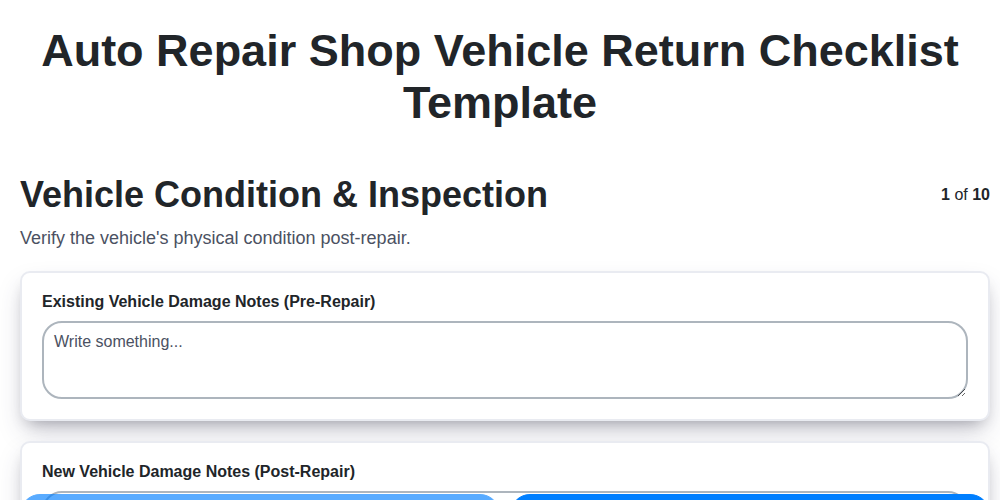
The Ultimate Vehicle Return Checklist for Auto Repair Shops
Need help with
Checklists?
Have a question? We're here to help. Please submit your inquiry, and we'll respond promptly.