5 Common Mistakes in Auto Repair Shop Management
Published: 09/08/2026 Updated: 09/09/2026
Table of Contents
- 1. Relying on Manual Paperwork and Fragmented Communication
- 2. Inconsistent Service Workflows and Lack of Standardized Checklists
- 3. Poor Inventory Tracking and Resource Mismanagement
- 4. Neglecting Data-Driven Decision Making and Real-Time Reporting
- 5. Failing to Scale Operations Through Automated Process Management
- Resources & Links
TLDR: Managing a successful auto repair shop requires more than just mechanical expertise; it requires operational precision. This post explores five critical management pitfalls-from disorganized workflows and manual tracking to poor resource allocation-and reveals how transitioning to a specialized Work OS like ChecklistGuro can automate your processes, eliminate human error, and drive shop profitability.
1. Relying on Manual Paperwork and Fragmented Communication
In the fast-paced environment of an auto repair shop, information moves at high velocity. When you rely on physical clipboards, scattered sticky notes, or disconnected email threads to track vehicle progress and technician assignments, you are inviting chaos into your workflow.
The Hidden Cost of Paper-First Management
Manual paperwork creates a data silo effect. When critical repair details are trapped on a piece of paper sitting on a specific technician's desk, the Service Advisor, the Parts Manager, and the Shop Owner are all left in the dark. This lack of visibility leads to:
- Increased Human Error: Misreading handwritten notes or losing a work order during a shift change can lead to costly re-dos and frustrated customers.
- Communication Bottlenecks: Waiting for a technician to physically walk to the front desk to update a status slows down the entire bay, increasing vehicle downtime.
- The Where is it? Syndrome: Valuable time is wasted by staff members hunting for physical files or searching through unorganized digital folders.
Breaking the Cycle with Digital Connectivity
To maintain a competitive edge in 2026, shop management must transition from reactive communication to a centralized Single Source of Truth.
Modern high-performing shops are moving away from fragmented tools and toward integrated Work OS platforms. By digitizing your workflows, every team member-from the apprentice in the bay to the manager in the office-has instant, real-time access to the same accurate data. This ensures that when a part arrives or a repair is completed, the entire shop is notified instantly, eliminating the need for constant manual check-ins.
2. Inconsistent Service Workflows and Lack of Standardized Checklists
In the fast-paced environment of an auto repair shop, variability is the enemy of profitability. One of the most frequent mistakes managers make is allowing tribal knowledge to dictate how jobs are completed. When technicians rely on memory or verbal instructions rather than documented processes, the quality of service becomes unpredictable.
The High Cost of Inconsistency
When workflows are not standardized, every vehicle becomes a potential risk. One technician might perform a comprehensive multi-point inspection, while another might skip critical steps due to time pressure. This lack of uniformity leads to:
- Increased Comebacks: Missing a single bolt or failing to verify fluid levels leads to dissatisfied customers and costly re-work.
- Escalating Liability: Without a verifiable digital paper trail, your shop is vulnerable to disputes regarding the condition of a vehicle pre- and post-repair.
- Training Bottlenecks: New hires take much longer to become productive when there is no source of truth for shop procedures.
Moving from Chaos to Control
To eliminate these errors, top-tier shops are moving away from loose instructions and toward digitized, repeatable workflows.
The ChecklistGuro Advantage
While many legacy shop management systems focus solely on invoicing and parts ordering, they often fail to address the actual execution of the work. This is where ChecklistGuro bridges the gap.
Unlike basic tools, ChecklistGuro provides a specialized Work OS that allows Operations Leads to embed mandatory, step-by-step checklists directly into every service task. By digitizing your standard operating procedures (SOPs), you ensure that every technician-regardless of experience level-follows the exact same high-standard protocol. This doesn't just ensure quality; it creates an automated audit trail that protects your shop and builds unparalleled customer trust.
3. Poor Inventory Tracking and Resource Mismanagement
In a busy auto repair shop, nothing kills profitability faster than a dead bay-a mechanic standing idle because a critical part is out of stock or a specialized tool is missing.
Many shop managers treat inventory as an afterthought, relying on memory or messy spreadsheets. However, poor inventory tracking creates a devastating ripple effect across your entire operation.
The Hidden Costs of Inventory Blind Spots
When you lack real-time visibility into your stock levels, you face two equally expensive scenarios:
- Overstocking: Tying up precious working capital in parts that sit on shelves for months, gathering dust instead of generating revenue.
- Stockouts: Emergency orders that lead to expedited shipping fees and, more importantly, extended vehicle downtime that frustrates customers and ruins your shop's reputation.
The Resource Management Trap
Inventory isn't the only resource at risk. Improperly managed shop resources-from technician bay availability to the rotation of specialized diagnostic equipment-lead to scheduling bottlenecks. Without a centralized view of what parts are available and which bays are free, your shop's throughput becomes unpredictable.
Moving from Reactive to Proactive Management
To maintain a high-performing shop, you need a system that bridges the gap between the parts room and the service bay.
How ChecklistGuro Solves the Inventory Gap
While traditional management tools often focus solely on invoicing, ChecklistGuro provides a specialized Work OS environment designed to integrate inventory oversight directly into your daily workflows.
Instead of checking a spreadsheet after a job is finished, ChecklistGuro allows your team to:
- Verify stock levels as part of their digital inspection checklists.
- Trigger replenishment alerts the moment a part is logged as used.
- Sync resource allocation with real-time task updates, ensuring that parts and technicians are always aligned.
By transforming inventory management from a manual chore into an automated, integrated process, you eliminate the guesswork that eats away at your margins.
4. Neglecting Data-Driven Decision Making and Real-Time Reporting
In many modern auto repair shops, management decisions are still being made based on gut feelings or looking at yesterday's closed invoices. While intuition has its place, relying solely on intuition in 2026 is a recipe for stagnant growth and missed revenue.
The Trap of Rearview Mirror Management
Many shop owners fall into the trap of reviewing reports only at the end of the month. By the time you realize your labor efficiency has dropped or your parts markup is inconsistent, the damage to your profit margins has already been done. Managing your shop by looking at the past-rather than the present-means you are always reacting to problems instead of preventing them.
The Visibility Gap
Without real-time data, you suffer from a critical visibility gap. You might struggle to answer fundamental questions instantly, such as:
- Which technicians are currently under-utilized?
- What is our real-time bay turnover rate?
- Where are the bottlenecks occurring in our current workflow?
- Which specific services are driving our highest margins vs. highest volume?
Moving from Reactive to Proactive with ChecklistGuro
To stay competitive, you need a single source of truth that provides live insights into every moving part of your shop. This is where a specialized Work OS makes the difference.
Unlike traditional, static accounting software that only tells you what happened in the past, ChecklistGuro provides a real-time pulse of your operations. By integrating standardized digital checklists with operational tracking, ChecklistGuro allows you to see live progress updates as they happen.
Instead of waiting for a monthly summary, you can monitor shop performance through live dashboards, ensuring that every technician and every bay is operating at peak efficiency. Transitioning to a data-driven approach doesn't just save time-it turns your operational data into a roadmap for scaling your business.
5. Failing to Scale Operations Through Automated Process Management
Scaling an auto repair shop is a significant milestone, but many shop owners hit a growth ceiling where their existing manual processes begin to break under the weight of increased vehicle volume. The mistake isn't a lack of hard work; it is the failure to transition from manual oversight to automated, scalable systems.
The Trap of the Heroic Manager
Many Operations Leads fall into the trap of believing that more manual supervision can compensate for a lack of automation. This approach creates a bottleneck where every decision, every bay assignment, and every parts order must pass through a single person. As your shop grows, this heroic management style leads to burnout, increased human error, and longer turnaround times for customers.
The Scalability Gap
When your shop's operations rely on memory, whiteboards, or disconnected spreadsheets, you cannot replicate success. True scalability requires a repeatable framework where a process can be executed with the same precision whether you are managing five bays or fifty.
Moving from Chaos to Control with ChecklistGuro
To break through the growth ceiling, you need a Work OS that transforms manual tasks into automated, digital workflows. This is where ChecklistGuro provides a competitive edge.
Unlike traditional, rigid shop management software that only handles basic invoicing, ChecklistGuro acts as a specialized engine for operational excellence. By implementing our automated checklists and standardized digital workflows, you ensure:
- Zero-Error Handovers: Automate the transition of data from the initial inspection to the technician and finally to the service advisor.
- Instant Visibility: Real-time updates allow Team Leads to monitor shop progress across multiple locations or bays without being physically present at every workstation.
- Standardized Excellence: Ensure every technician follows the exact same high-standard protocol every single time, ensuring consistent quality that builds brand loyalty.
By replacing manual oversight with the automated precision of ChecklistGuro, you stop managing fires and start managing growth. You aren't just fixing cars; you are building a scalable, high-performance organization.
Resources & Links
- Forbes Business Council: Insights on operational excellence and leadership strategies for small to medium-sized businesses.
- Shopify Blog: Expert advice on inventory management, supply chain optimization, and scaling business operations.
- McKinsey & Company: In-depth analysis on digital transformation and the importance of data-driven decision-making in modern industry.
- Entrepreneur Magazine: Resources for managing workflows, standardizing business processes, and improving organizational efficiency.
- Tableau: Tools and educational resources for understanding real-time reporting and data visualization for business growth.
- Asana: Guides on project management, workflow automation, and eliminating fragmented communication in teams.
- Zoho Books: Information regarding the transition from manual paperwork to automated cloud-based accounting and management.
- Slack: Solutions for centralizing team communication to prevent fragmented information silos.
- Atlassian: Best practices for implementing standardized checklists and structured operational workflows.
- Semrush: While focused on marketing, they provide great insights into using data and analytics to drive business decisions.
- Zendesk: Resources on improving customer service consistency through standardized communication processes.
- Monday.com: Work OS platform focused on automating repetitive tasks and scaling business operations.
- NetSuite: Comprehensive enterprise resource planning (ERP) insights for managing inventory and resource allocation.
- QuickBooks: Essential tools for moving away from manual paperwork toward automated financial tracking.
- Lucidchart: Visual tools for mapping out service workflows and identifying bottlenecks in business processes.
- HubSpot: Resources on scaling operations through integrated management systems and automated customer management.
- Gartner: Research and advisory services on technological trends and the impact of automation on business management.
- O'Reilly Media: Deep dives into data science and the implementation of analytical reporting in operational management.
Comments
There are no comments yet. Be the first to add one!
Auto Repair Shop Management Solution Demo
Level up your auto repair shop & boost profits! ChecklistGuro simplifies job tracking, inventory management, and customer communication. Improve efficiency, reduce errors, & enhance customer satisfaction. Manage it all with our Work OS.
Related Articles
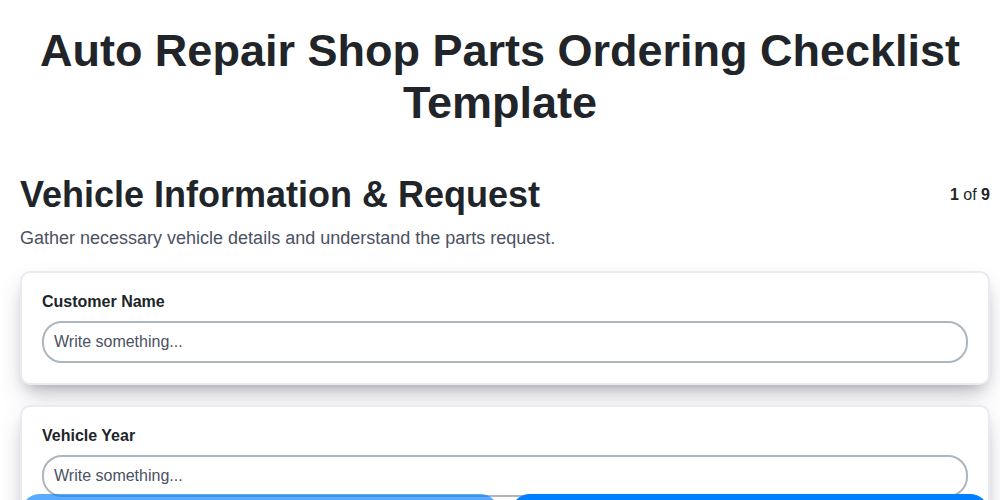
Streamline Your Shop: The Ultimate Auto Repair Parts Ordering Checklist Template
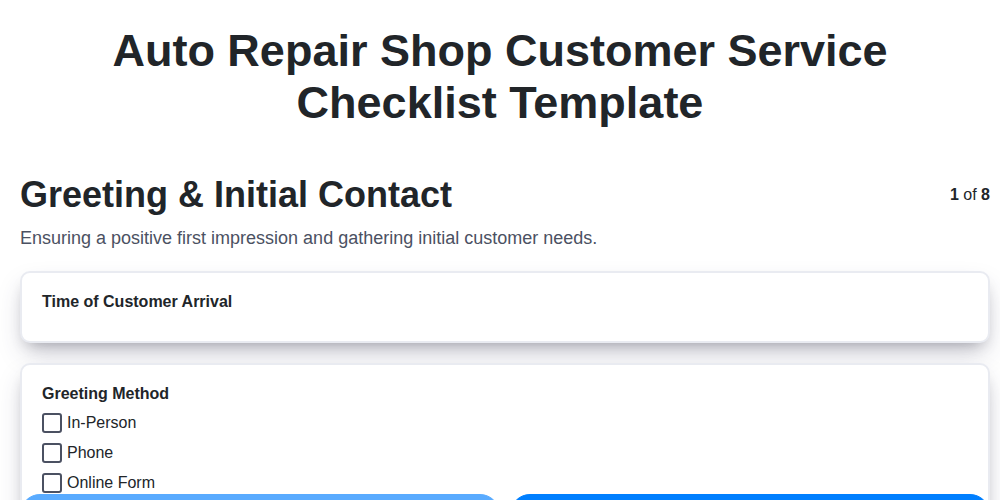
Level Up Your Auto Repair: The Ultimate Customer Service Checklist Template
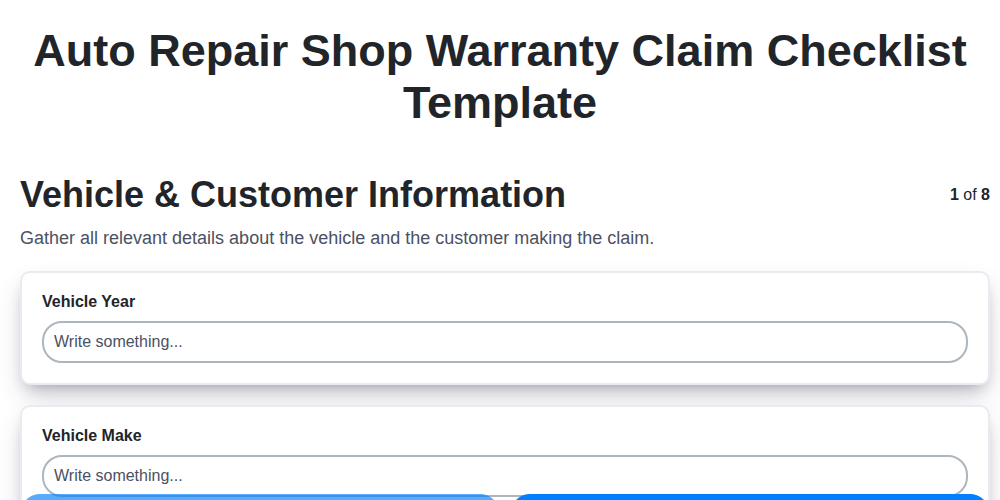
Mastering Warranty Claims: Your Auto Repair Shop Checklist Template
Auto Repair Shop Digital Marketing Checklist Template
Auto Repair Shop Checklist Template: Operations & Compliance
The Ultimate Auto Repair Shop Employee Training Checklist Template
Your Ultimate Guide to Auto Repair Shop Environmental Compliance: A Checklist Template
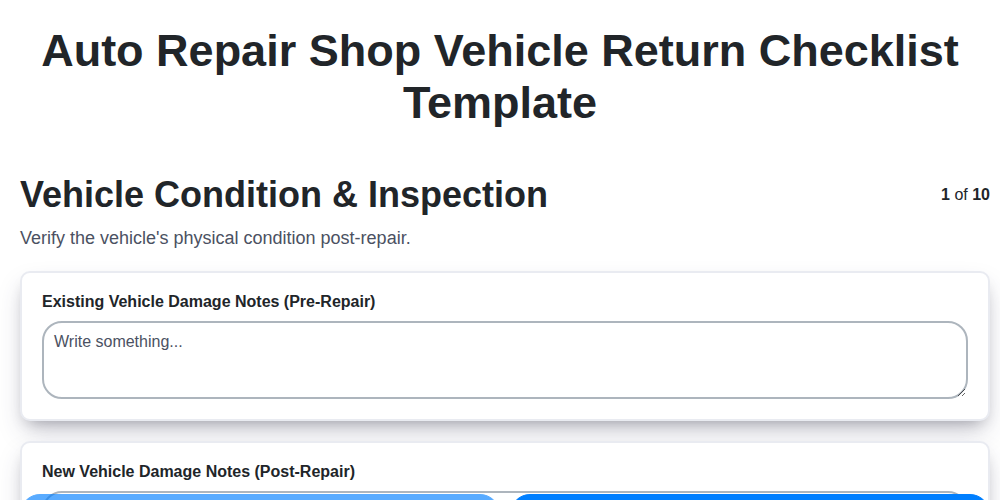
The Ultimate Vehicle Return Checklist for Auto Repair Shops
Need help with
Checklists?
Have a question? We're here to help. Please submit your inquiry, and we'll respond promptly.