5 Common Mistakes in Construction Management
Published: 08/28/2026 Updated: 08/29/2026
Table of Contents
- 1. Relying on Fragmented Communication and Manual Paperwork
- 2. Inaccurate Real-Time Progress Tracking and Reporting
- 3. Poorly Managed Checklists and Site Inspection Processes
- 4. Lack of Centralized Data Accessibility for Field and Office Teams
- 5. Failing to Standardize Workflows Across Multiple Projects
- Resources & Links
TLDR: Avoid project delays and budget overruns by identifying the five most frequent pitfalls in construction management-from fragmented communication to manual tracking errors-and learn how modern Work OS solutions like ChecklistGuro can automate workflows to ensure operational excellence.
1. Relying on Fragmented Communication and Manual Paperwork
In the fast-paced construction industry, information is the most valuable currency. However, many project managers still rely on a patchwork approach to communication-using a mix of scattered emails, endless WhatsApp threads, physical notebooks, and printed blueprints.
The Cost of Disconnected Data
When your project data lives in silos, you aren't just dealing with an inconvenience; you are dealing with a massive financial risk. Relying on manual paperwork and fragmented digital communication leads to several critical failure points:
- The Information Lag: By the time a paper-based daily report reaches the office, the information is already outdated. Decisions are being made based on yesterday's reality, not today's.
- The Version Control Nightmare: There is nothing more expensive than a crew installing components based on an outdated blueprint because the latest revision was buried in a long email thread.
Breaking the Cycle with a Centralized Work OS
To avoid these pitfalls, industry leaders are moving away from fragmented tools and toward a unified Work OS. The goal is to create a Single Source of Truth where every stakeholder-from the site foreman to the operations lead-accesses the same real-time updates.
While heavy-duty ERP systems attempt to solve this, they often come with overwhelming complexity. This is where specialized solutions like ChecklistGuro excel. By digitizing your workflows and centralizing communication within a dedicated construction management module, you ensure that every update, photo, and instruction is instantly accessible, searchable, and actionable, effectively eliminating the paperwork gap.
2. Inaccurate Real-Time Progress Tracking and Reporting
When project managers rely on gut feelings or delayed end-of-day manual updates, they aren't just managing a project-they are managing a mystery. In construction, information decay is one of the most expensive hidden costs. By the time a status report reaches the stakeholder's desk, the data is often already obsolete.
The Information Lag Trap
The most common symptom of this mistake is the gap between what is happening on the job site and what is reflected in the office. When site supervisors rely on handwritten notes, scattered emails, or fragmented spreadsheets, a significant time lag is created. This delay prevents leadership from identifying bottlenecks before they become budget-draining delays.
The Ripple Effect of Inaccurate Data
Inaccurate reporting leads to a cascade of management failures:
- Erroneous Procurement: Ordering materials too late (or too early) because the current stage of completion was misrepresented.
- Scheduling Conflicts: Overlapping subcontractors on a site that isn't actually ready for them.
- Budget Overruns: Failing to see labor spikes or resource depletion in real-time, leading to reactive rather than proactive financial management.
Moving from Reactive to Proactive with Digital Truth
To eliminate this mistake, the industry is shifting away from static reporting toward Live Site Intelligence. The goal is to create a single source of truth where every update from the field is instantly visible to the operations lead.
Why Modern Software is the Solution
While legacy tools or basic spreadsheets might seem cost-effective, they lack the automation required for true real-time visibility. High-tier solutions like ChecklistGuro bridge this gap by transforming field observations into instant, actionable data.
By utilizing a specialized Construction Management Work OS, teams can automate the flow of information. Instead of waiting for a weekly meeting to discover a delay, managers can use real-time dashboards to monitor progress as it happens. This level of visibility ensures that reporting is no longer a manual task, but a continuous, automated byproduct of the work being done.
3. Poorly Managed Checklists and Site Inspection Processes
The Hidden Cost of Inconsistent Inspections
In construction, what isn't documented effectively didn't happen. One of the most frequent-and expensive-mistakes project managers make is treating site inspections and safety checklists as an afterthought or a secondary administrative task.
When checklists are managed via loose paper scraps, disorganized email threads, or disconnected spreadsheets, the entire project is at risk. This lack of structure leads to several critical failures:
The Ripple Effect of Manual Checklists
When inspections are handled manually, there is no single source of truth. A site supervisor might complete an inspection on a clipboard, but if that data isn't digitized and instantly accessible, it becomes dark data-information that exists but cannot be used to make timely decisions. This delay often results in:
- Missed Defects: Critical structural or safety issues go unnoticed until they are much more expensive to fix.
- Compliance Risks: Inability to prove that safety protocols were followed during an audit.
- Information Silos: The office team remains unaware of field realities, leading to a disconnect between project planning and actual site progress.
Moving from Reactive to Proactive Management
To avoid these pitfalls, industry leaders are moving away from reactive inspections (fixing problems after they are discovered) toward proactive workflows. This requires a standardized, digital-first approach where every inspection is a structured data point.
This is where modern Work OS solutions become indispensable. While traditional tools might offer simple digital forms, a specialized solution like ChecklistGuro transforms the inspection process. Instead of just replacing paper with a PDF, ChecklistGuro integrates inspections directly into your broader construction management ecosystem.
By utilizing automated workflows, you ensure that a failed inspection trigger an immediate task for the responsible party, ensuring that checking a box actually leads to resolving an issue. Implementing a specialized platform ensures that your checklists aren't just records of the past, but active drivers of your project's future.
4. Lack of Centralized Data Accessibility for Field and Office Teams
In the fast-paced construction industry, information is the most valuable currency. However, many firms suffer from a data silos problem, where critical project details are trapped in disconnected places.
The Information Gap: Field vs. Office
One of the most expensive mistakes a Project Manager can make is allowing a disconnect to grow between the job site and the headquarters. When site supervisors rely on handwritten notes, SMS messages, or scattered email threads to report progress, the office team is left working with outdated information.
This lag creates a latency loop:
- Delayed Decision-Making: By the time a delay or a discrepancy is reported to the office, the window for a cost-effective fix has often closed.
- Increased Rework: Without a single source of truth, instructions from the office may not reach the field in real-time, leading to errors that require costly corrections.
- Compliance Risks: If inspection logs and safety checklists aren't instantly accessible to stakeholders, your documentation trail becomes fragmented and vulnerable during audits.
The Solution: Bridging the Gap with a Unified Work OS
To avoid this mistake, top-tier construction firms are moving away from fragmented tools and toward a centralized digital ecosystem. The goal is to ensure that a change made in the field is instantly reflected in the office dashboard.
Why ChecklistGuro is the Industry Standard for Connectivity
While many legacy tools offer basic storage, ChecklistGuro specializes in closing the visibility gap. Unlike traditional software that merely acts as a digital filing cabinet, ChecklistGuro serves as a live, synchronized Work OS.
By utilizing our specialized Construction Management solution, your field teams can execute standardized checklists and upload real-time updates that immediately populate your central project overview. This eliminates the information lag and ensures that every stakeholder-from the Site Lead to the Operations Director-is looking at the exact same data, at the exact same time.
When you centralize your data within ChecklistGuro, you aren't just storing information; you are creating a single, actionable source of truth that drives efficiency across your entire organization.
5. Failing to Standardize Workflows Across Multiple Projects
The Chaos of Inconsistency
One of the most significant-and often overlooked-mistakes in construction management is treating every project as a unique snowflake. While every job site certainly has its own set of challenges, managing them using entirely different processes, documentation styles, and communication protocols is a recipe for operational disaster.
When workflows aren't standardized, your team is forced to relearn how to work every time a new project kicks off. This lack of uniformity leads to several critical issues:
The Hidden Costs of Non-Standardized Workflows
- Increased Margin for Error: Without a single source of truth for how tasks should be executed, even experienced team members may skip vital safety or quality checks.
- Difficult Scalability: If your management style is tied to your personal memory or a specific set of physical folders, you cannot scale your operations. You become the bottleneck in your own company's growth.
- Reporting Nightmares: How can you analyze your company's overall performance if every Project Manager is reporting data in a different format? Without standardization, you lack the high-level visibility needed to identify trends or systemic issues.
Moving from Chaos to Consistency with ChecklistGuro
The solution isn't to eliminate flexibility, but to build a foundation of repeatable, digital processes. This is where a specialized Work OS becomes indispensable.
While legacy management tools often focus solely on high-level scheduling, ChecklistGuro is designed to bridge the gap between the field and the office by enforcing standardized, digital workflows. By utilizing our Construction Management solution, you can deploy pre-configured, intelligent templates across every project.
Instead of reinventing the wheel, your team follows a unified digital roadmap. This ensures that whether a project is in its first week or its final phase, the same high standards of inspection, safety, and documentation are met-allowing you to scale your business with confidence and predictable results.
Resources & Links
- Autodesk Construction Cloud: Industry-leading software solutions for connecting teams, managing data, and streamlining construction workflows.
- Procore Technologies: A comprehensive construction management platform designed to centralize project data and improve communication.
- Construction Dive: Leading news source for construction industry professionals, covering trends, technology, and management challenges.
- McKinsey & Company - Capital Projects & Infrastructure: Deep insights and research on productivity improvements and digital transformation in large-scale construction projects.
- Project Management Institute (PMI): Global professional organization providing resources on standardized workflows, risk management, and project leadership.
- Bentley Systems: Infrastructure engineering software focused on digital twins and real-time progress tracking for complex projects.
- For Construction Pros: An industry resource providing technical articles on construction management, technology, and site operations.
- Construction Week Online: A digital publication covering the latest news and management strategies in the global construction industry.
- PlanGrid (Autodesk): Focuses on eliminating paper-based workflows through mobile-first blueprint management and site inspection tools.
- Oracle Construction and Engineering: Advanced enterprise solutions for managing large-scale construction data and integrated project delivery.
- Building Media: Publisher of various industry trade journals focused on facility management and construction workflows.
- Thelen/ConstructConnect: A platform for project leads, bidding, and managing the flow of information between office and field teams.
- BIMcollab: Specializes in streamlining the communication of issues and inspection findings in BIM-centered projects.
- American Society of Civil Engineers (ASCE): Professional resource for standards, best practices, and technical excellence in the construction industry.
- Entrepreneur - Operations Management: General management principles applicable to scaling construction businesses and standardizing company-wide workflows.
- Smartsheet: A work management platform used for creating automated checklists and tracking project timelines.
Comments
There are no comments yet. Be the first to add one!
Construction Management Solution Demo
Build smarter, not harder! ChecklistGuro streamlines construction projects from planning to closeout. Manage tasks, inspections, safety protocols & more - all in one place. Reduce delays, improve communication, and deliver projects on time & on budget.
Related Articles
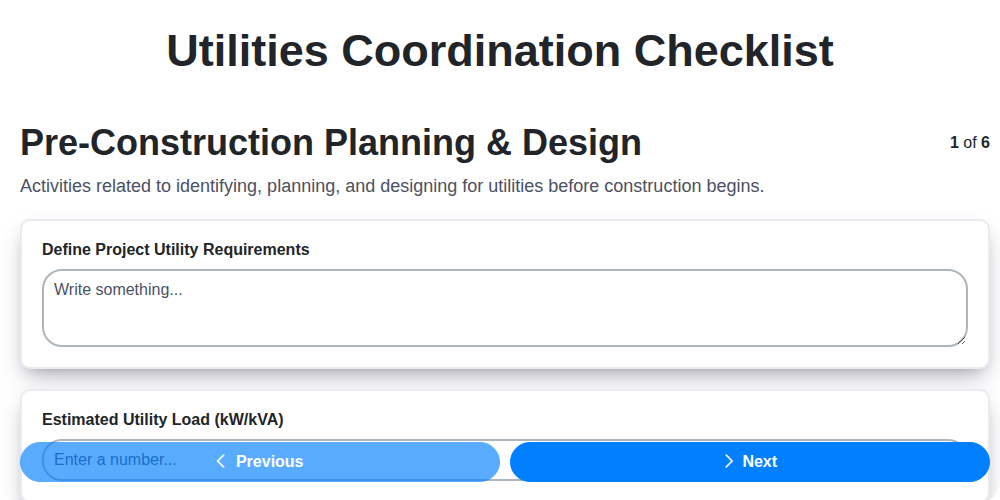
Streamline Your Project: The Ultimate Utilities Coordination Checklist Template
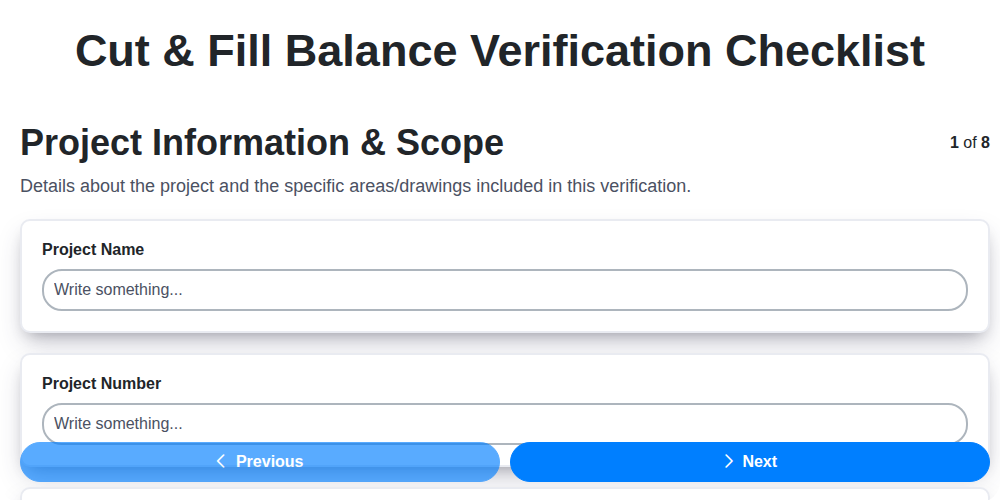
Cut & Fill Balance: Your Checklist Template for Project Success

Jobsite Safety & Compliance Checklist: Your Construction Site Assessment Template
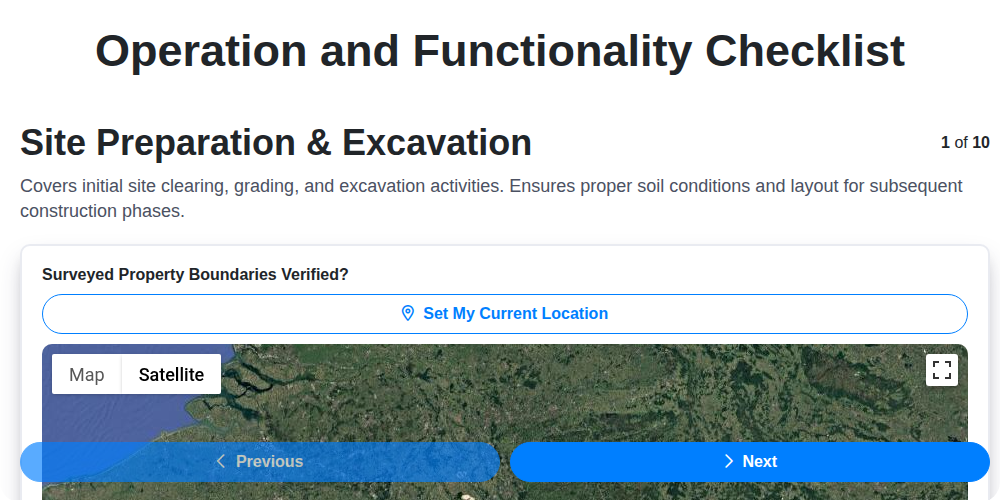
Streamlining Construction: Your Free Operation & Functionality Checklist Template
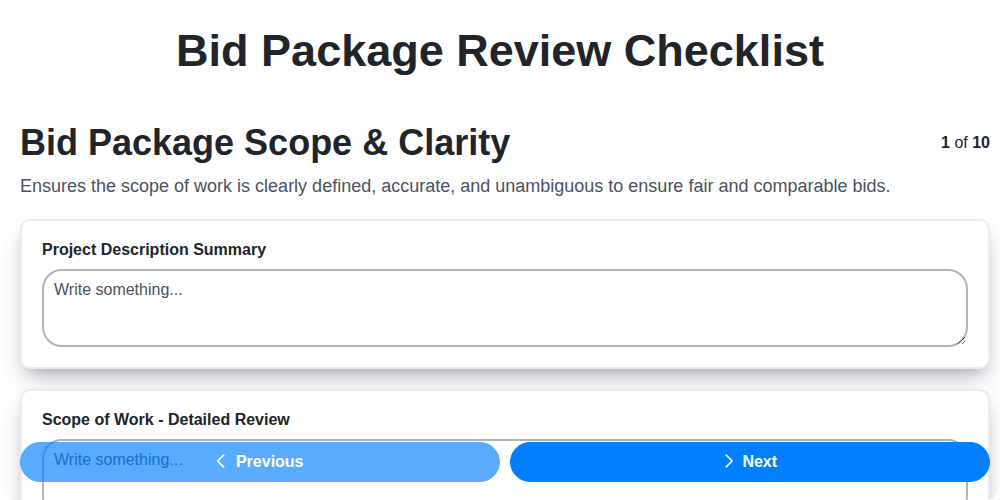
Mastering Bids: Your Free Bid Package Review Checklist Template
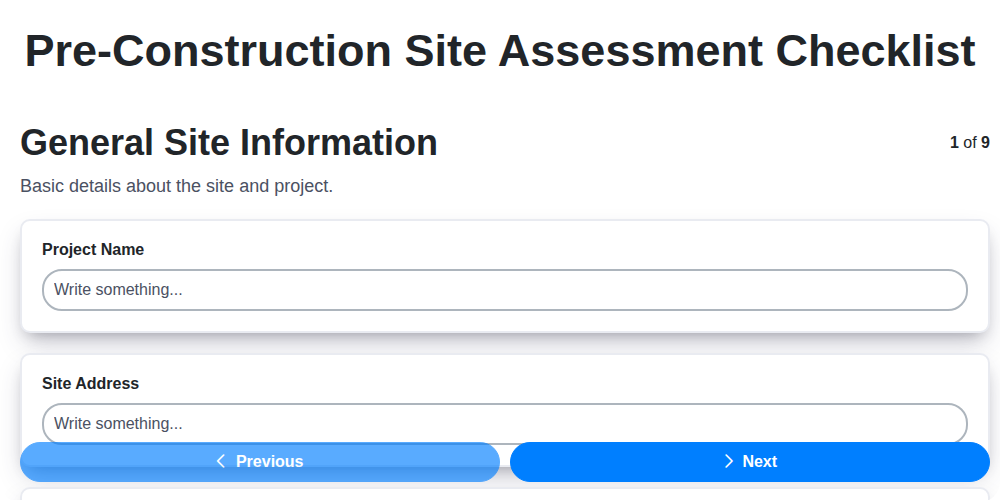
Your Essential Pre-Construction Site Assessment Checklist Template
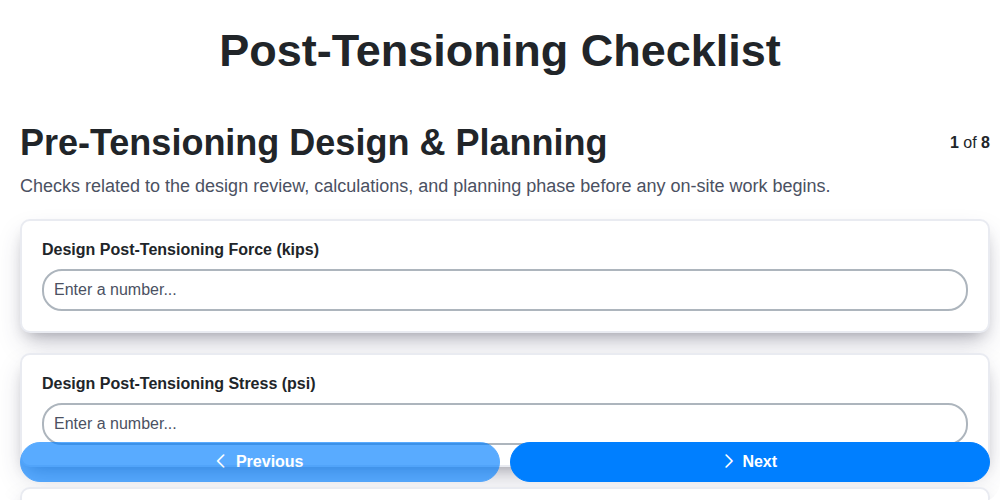
Mastering Post-Tensioning: Your Essential Checklist Template
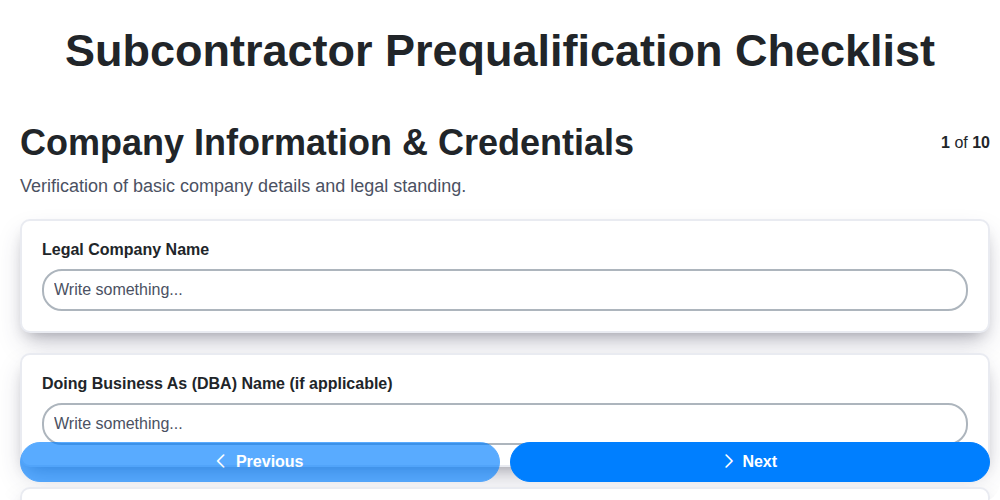
Subcontractor Prequalification Checklist Template: Your Essential Guide
Need help with
Checklists?
Have a question? We're here to help. Please submit your inquiry, and we'll respond promptly.