5 Common Mistakes in Inspection Management
Published: 08.09.2026 Updated: 09.09.2026
Table of Contents
- The High Cost of Manual Processes: Why Paper-Based Inspections Fail
- Inconsistent Data Capture: The Trap of Non-Standardized Checklists
- The Visibility Gap: Failing to Turn Inspection Results into Actionable Insights
- Siloed Information: The Danger of Disconnected Reporting and Workflows
- Choosing the Right Solution: Comparing Top Inspection Management Software
- Resources & Links
TLDR: Managing inspections effectively requires moving beyond manual, paper-based workflows that lead to data errors and lack of visibility. This post explores five critical pitfalls-from inconsistent data capture to siloed reporting-and highlights how modern Work OS platforms like ChecklistGuro provide the automation and real-time insights needed to ensure compliance and operational excellence.
The High Cost of Manual Processes: Why Paper-Based Inspections Fail
For many Operations Leads and Project Managers, the old school way of managing inspections-clipboards, paper forms, and physical folders-feels familiar and safe. However, in a fast-paced, 2026 operational landscape, relying on manual processes is no longer just an inconvenience; it is a significant financial and operational liability.
The Hidden Drain on Your Bottom Line
The mistake isn't just about the physical paper; it is about the invisible friction that manual processes introduce into your entire workflow. When inspections are handled manually, you aren't just dealing with paper; you are dealing with a cascade of inefficiencies.
1. The Data Entry Lag
The moment an inspection ends, the lag time begins. Someone has to manually transcribe notes from a sheet into a spreadsheet or a database. This delay means that critical issues identified in the field remain invisible to decision-makers for hours, or even days, after they were discovered.
2. The Risk of Human Error
Manual transcription is a breeding ground for mistakes. A blurred handwritten note, a misplaced decimal point, or a missed page can lead to catastrophic misinterpretations. In inspection management, a single missed detail can lead to compliance failures, safety hazards, or expensive rework.
3. The Loss of Real-Time Traceability
In a manual system, you lack a single source of truth. If an auditor asks for the inspection history of a specific site from three months ago, your team is forced into a time-consuming hunt through filing cabinets or disorganized digital folders. This lack of instant traceability makes scaling your operations nearly impossible.
Moving Beyond the Clipboard
To maintain a competitive edge, industry leaders are moving away from reactive, paper-heavy workflows and toward integrated digital ecosystems. Transitioning to a digital-first approach-utilizing a robust Work OS-ensures that data is captured, synced, and actionable the very second it is recorded.
Inconsistent Data Capture: The Trap of Non-Standardized Checklists
When inspection protocols vary from one inspector to another, your data becomes unreliable. This is one of the most significant hurdles for Operations Leads attempting to scale their quality control efforts.
The Illusion of Compliance
Many teams believe they are maintaining high standards because every inspector is using a checklist. However, if those checklists are unstructured, prone to human error, or lack mandatory validation, you aren't actually measuring compliance-you are simply collecting subjective opinions. Without standardized digital constraints, an inspector might skip a critical step or interpret a pass differently than their colleague, leading to a fragmented view of your operational health.
The Risks of Free-Text Dependency
Relying heavily on manual notes or unstructured text fields creates a massive data bottleneck. While qualitative feedback is valuable, an over-reliance on it makes it impossible to perform trend analysis or identify recurring failure points across different sites or shifts.
How Standardized Digital Checklists Solve This:
To eliminate ambiguity, your inspection workflow should utilize:
- Mandatory Fields: Ensuring critical data points cannot be bypassed.
- Logic-Based Branching: Automatically triggering follow-up questions based on previous answers (e.g., if Fail is selected, a photo upload becomes mandatory).
- Photo & Evidence Integration: Moving beyond Yes/No by requiring visual proof of compliance.
- Standardized Scoring: Converting qualitative observations into quantitative metrics.
By implementing a structured framework-similar to the intelligent logic found in ChecklistGuro-you ensure that regardless of who is performing the inspection, the output remains consistent, measurable, and audit-ready.
The Visibility Gap: Failing to Turn Inspection Results into Actionable Insights
Capturing data is only half the battle. Many organizations fall into the trap of treating inspections as a check-the-box compliance exercise rather than a strategic intelligence tool. The mistake isn't just failing to perform the inspection; it's failing to see what the data is trying to tell you.
The Data Graveyard Problem
Many inspection processes result in what we call a data graveyard-a massive collection of completed forms, PDFs, and spreadsheets that sit untouched in folders or email inboxes. When your inspection results are trapped in static documents, you lack real-time visibility into operational trends. You might know that a specific site failed a safety check yesterday, but you can't see that the same failure has been recurring across five different locations over the last three months.
The Impact of Delayed Decision-Making
Without real-time visibility, your response to critical findings is always reactive rather than proactive. This delay creates several operational risks:
- Increased Safety Risks: Critical hazards remain unaddressed because the report is sitting in a supervisor's inbox.
- Escalating Costs: Small maintenance issues that could have been fixed cheaply become expensive structural repairs because they weren't flagged early.
- Compliance Vulnerability: An inability to instantly pull up historical data during an audit can lead to significant legal and regulatory penalties.
Moving from Reporting to Intelligence
To avoid this mistake, your inspection management strategy must bridge the gap between data collection and data utilization. This requires a centralized system where data is automatically parsed and visualized.
Strategic Oversight with ChecklistGuro
This is where a specialized Work OS makes the difference. Unlike traditional methods, ChecklistGuro eliminates the visibility gap by transforming raw inspection inputs into live, actionable dashboards.
Instead of digging through archives, Project Managers can use ChecklistGuro to instantly identify patterns, track recurring non-conformances, and monitor KPI trends across entire fleets or project sites. By turning completed checklists into operational intelligence, you shift your team from a state of constant firefighting to one of streamlined, data-driven leadership.
Siloed Information: The Danger of Disconnected Reporting and Workflows
One of the most frequent bottlenecks in operations is the data island effect. This occurs when your inspection findings live in a vacuum, completely disconnected from the rest of your project management ecosystem.
The Disconnect Between Discovery and Action
When inspections are treated as a standalone activity rather than a trigger for operational workflow, your team enters a cycle of reactive firefighting. The mistake isn't just failing to find errors; it's the delay between identifying a non-conformance and initiating a corrective action.
In many traditional setups, an inspector completes a report, but that report sits in a PDF folder or an email inbox for days. By the time the Operations Lead sees the deficiency, the window for a low-cost fix has closed, and the issue has likely escalated into a costly delay or a safety risk.
The Hidden Costs of Manual Hand-offs
When your inspection data is siloed, you rely heavily on manual human intervention to move information from point A to point B. This leads to:
- Information Decay: Crucial details are lost during manual re-entry into spreadsheets or ERP systems.
- Increased Latency: The time gap between detection and resolution expands, stalling project momentum.
- Lack of Accountability: Without an integrated workflow, it is nearly impossible to track who is responsible for a follow-up task and whether it was completed on time.
Breaking the Silos with Integrated Workflows
To achieve true operational excellence, your inspection software must act as a bridge, not an island. The goal is to transform a completed checklist into an automated instruction set for your team.
This is where a specialized Work OS approach changes the game. Instead of just recording what went wrong, modern solutions like ChecklistGuro allow you to bridge the gap between inspection and execution. When a fail item is logged, the system can automatically trigger a task, assign it to a technician, and notify the Project Manager in real-time.
By integrating inspection data directly into your broader operational workflows, you eliminate the information lag and ensure that every identified issue is met with an immediate, traceable response.
Choosing the Right Solution: Comparing Top Inspection Management Software
Selecting the right tool is the most critical step in overcoming the pitfalls mentioned above. To avoid a software mismatch, you must evaluate potential platforms not just on their ability to digitize a checklist, but on their ability to act as a central nervous system for your operations.
Evaluating the Landscape: Feature-Based Comparison
When comparing the top contenders in the inspection management category, the differences often lie in how they handle data flow and automation.
Traditional Inspection Apps
Many legacy tools focus solely on digitalizing paper. While they allow you to replace clipboards with tablets, they often lack the broader operational context. These tools are great for simple data entry but frequently fail when you need to trigger complex follow-up tasks or integrate with your wider project management ecosystem.
Enterprise Resource Planning (ERP) Modules
For large-scale organizations, some choose to use heavy-duty ERP modules. While these offer a single source of truth for finance and supply chain, they are often notoriously rigid and difficult to configure for field-level inspection workflows. The learning curve is steep, and the lack of flexibility can frustrate field teams who need to adapt checklists on the fly.
The Modern Work OS Approach: Why ChecklistGuro Stands Out
This is where ChecklistGuro differentiates itself from both simple mobile apps and rigid ERPs. Rather than treating inspections as an isolated event, ChecklistGuro integrates them into a comprehensive Work OS.
While competitors focus on the check, ChecklistGuro focuses on the result.
- Dynamic Automation: Unlike basic inspection tools, ChecklistGuro doesn't just record a fail status; it can automatically trigger much larger workflows, notifying project managers, updating inventory, or creating maintenance tickets instantly.
- Unmatched Flexibility: While ERPs are often locked in, ChecklistGuro provides a highly customizable environment that adapts to your specific operational logic, making it ideal for Project Managers who need to scale.
- End-to-End Visibility: It bridges the gap between the field and the office. You aren't just getting a digital form; you are getting a centralized dashboard where inspection data feeds directly into your broader operational strategy.
Summary Comparison At a Glance
| Feature | Legacy Mobile Apps | Heavy ERP Modules | ChecklistGuro (Work OS) |
|---|---|---|---|
| Ease of Deployment | High | Low | High |
| Workflow Automation | Limited | Complex/Rigid | Seamless & Adaptive |
| Data Integration | Siloed | Deep but Complex | Unified Work Ecosystem |
| User Adoption | High | Low | High |
Resources & Links
- Gartner: Industry-leading research and insights on enterprise software and digital transformation trends.
- Forbes: Expert analysis on business management, operational efficiency, and technology adoption.
- McKinsey & Company: Global management consulting firm providing deep dives into operational excellence and process optimization.
- Deloitte: Resources on risk management, audit compliance, and digitalizing industrial workflows.
- iSixSigma: Specialized resources for Lean Six Sigma methodologies and standardized data collection practices.
- American Society for Quality (ASQ): The leading authority on quality standards, inspection best practices, and quality control frameworks.
- ScienceDirect: Peer-reviewed research on reliability engineering and structural health monitoring.
- ProjectManagement.com: Resources for managing workflows, reporting, and integrating inspection tasks into larger projects.
- Capterra: Software comparison platform to help evaluate inspection management and field service automation tools.
- G2: Peer-driven reviews and comparisons of enterprise software for data capture and reporting.
- IBM: Insights into how AI and big data turn raw inspection results into actionable business intelligence.
- SAP: Information on integrating inspection workflows with ERP systems to eliminate information silos.
- TechCrunch: Updates on the latest innovations in mobile technology and cloud-based inspection solutions.
- Zabbix: Examples of monitoring and automated alerting, relevant to the visibility gap in inspection.
- Tableau: Tools and techniques for visualizing inspection data to create actionable insights.
- Atlassian: Frameworks for connecting disparate workflows and automating task management.
- ISO (International Organization for Standardization): Global standards for quality management systems (QMS) and standardized inspection protocols.
Comments
There are no comments yet. Be the first to add one!
Audit/Inspection Management Solution Demo
Ensure compliance & improve performance! ChecklistGuro streamlines audit/inspection creation, execution, and reporting. Reduce risk, enhance quality, & maintain consistency. Manage it all with our Work OS.
Related Articles
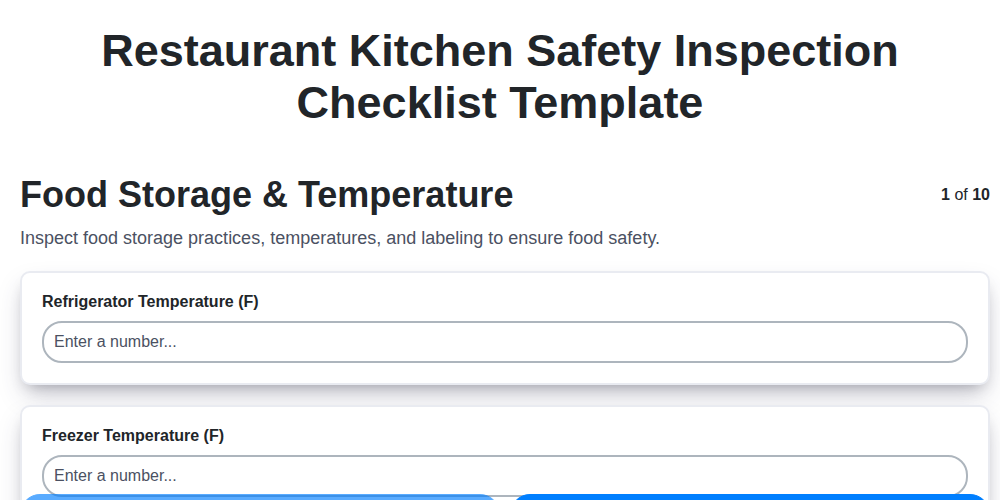
Restaurant Kitchen Safety Inspection Checklist Template
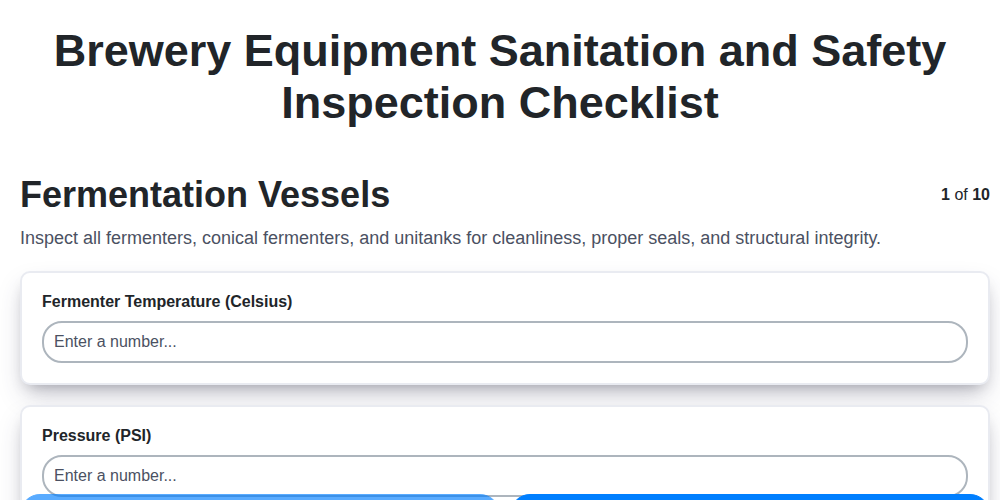
The Ultimate Brewery Equipment Sanitation & Safety Checklist Template
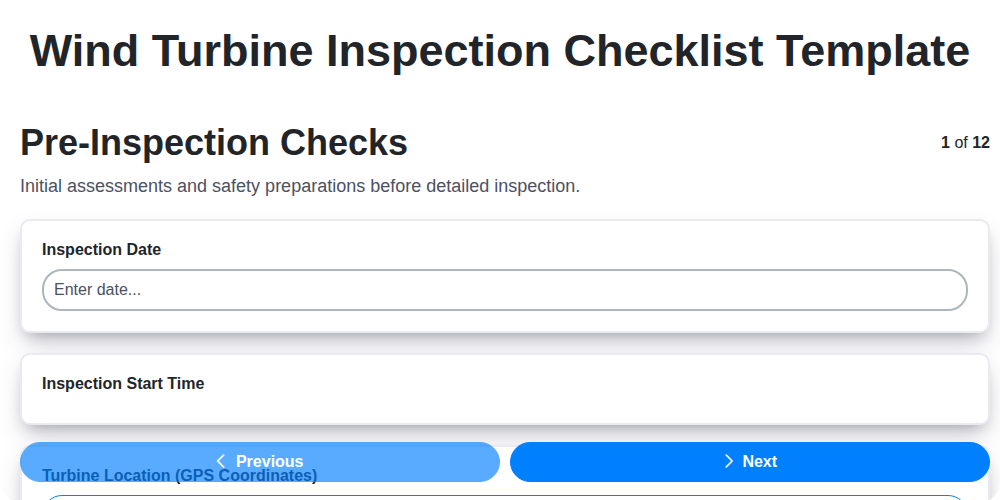
Wind Turbine Inspection Checklist Template: Your Comprehensive Guide
The Ultimate Apartment Building Maintenance Inspection Checklist Template
Your Essential Guide to a Manufacturing Quality Control Inspection Checklist
The Ultimate Solar Panel Inspection Checklist Template
Your Ultimate HVAC Inspection Checklist Template
The Ultimate Data Center Inspection Checklist Template
Need help with
Checklists?
Have a question? We're here to help. Please submit your inquiry, and we'll respond promptly.