Automotive Warranty Claims Management: A Step-by-Step Workflow for Seamless Operations
Published: 06/04/2026 Updated: 07/02/2026
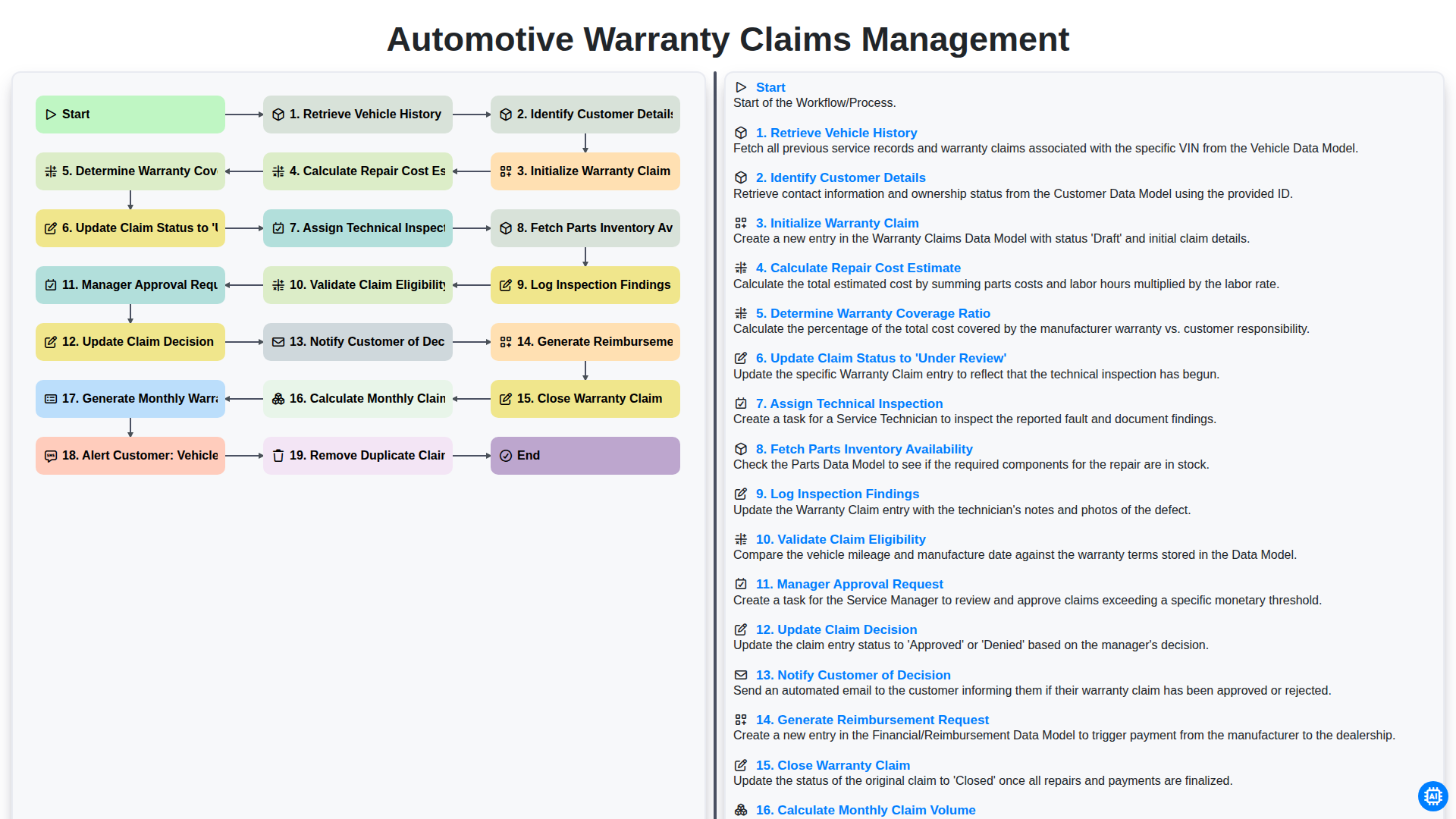
Table of Contents
- Introduction to Efficient Warranty Claims Management
- Phase 1: Initial Data Collection and Verification
- Phase 2: Claim Initialization and Cost Estimation
- Phase 3: Technical Assessment and Inspection
- Phase 4: Parts Availability and Resource Allocation
- Phase 5: Validation and Approval Workflow
- Phase 6: Final Decisioning and Customer Communication
- Phase 7: Settlement and Claim Closure
- Phase 8: Post-Claim Analysis and Performance Reporting
- Maintaining Data Integrity: Duplicate Prevention and Auditing
- Resources & Links
TLDR: Streamline your after-sales service with this comprehensive workflow template designed to automate the end-to-end automotive warranty lifecycle. Learn how to transition from initial vehicle history retrieval and cost estimation to technical inspection, automated approval routing, and final reimbursement, ensuring error-free claims processing and real-time KPI reporting.
Introduction to Efficient Warranty Claims Management
In the fast-paced automotive industry, managing warranty claims is much more than a simple administrative task; it is a critical component of maintaining customer loyalty and protecting a manufacturer's bottom line. An inefficient claims process can lead to skyrocketing operational costs, frustrated technicians, and, most importantly, dissatisfied customers waiting indefinitely for repairs.
Effective warranty management requires a seamless, end-to-end workflow that bridges the gap between the service center and the manufacturer. By implementing a structured, automated pipeline-ranging from the initial retrieval of vehicle history to the final generation of monthly KPI reports-automotive businesses can eliminate manual errors, reduce duplicate claims, and ensure that every repair is validated with precision. A streamlined process doesn't just speed up the vehicle ready notification; it provides the data-driven insights necessary to optimize parts inventory and evaluate long-term vehicle reliability.
Phase 1: Initial Data Collection and Verification
The foundation of an efficient warranty management system lies in the accuracy of the initial data intake. This phase focuses on establishing a single, reliable source of truth for every claim to prevent errors that could lead to costly disputes or fraudulent payouts.
The process begins with Retrieving Vehicle History and Identifying Customer Details to ensure the vehicle is within its applicable warranty period and that the owner's information is current. Once the identity of the vehicle and the claimant are confirmed, the system moves to Initialize Warranty Claim, which creates a unique record for tracking. To ensure financial transparency from the outset, the system must Calculate Repair Cost Estimate and Determine Warranty Coverage Ratio, establishing a clear baseline of what is expected to be covered versus what may be the owner's responsibility. Finally, the claim is formally moved into the pipeline by Updating Claim Status to 'Under Review', marking the transition from a mere inquiry to an active, monitored process.
Phase 2: Claim Initialization and Cost Estimation
Once the vehicle identity and owner information are confirmed, the workflow transitions into the critical stage of technical assessment and financial forecasting. This phase is where the foundation of the claim is built, moving from simple identification to a detailed analysis of the potential liability.
The process begins with the Initialization of the Warranty Claim, creating a dedicated digital file that serves as the single source of truth for the entire lifecycle of the request. With the claim record active, the system immediately moves to Calculate the Repair Cost Estimate. This step involves aggregating labor rates, diagnostic fees, and projected parts costs to establish a baseline for the total financial impact.
To ensure the claim remains within the bounds of the service contract, the system then performs a Determination of the Warranty Coverage Ratio. By comparing the estimated repair costs against the specific terms and limits of the customer's policy, the workflow identifies exactly what portion of the repair is a manufacturer responsibility versus a customer out-of-pocket expense.
Finally, to maintain transparency and internal oversight, the system automatically performs an Update of the Claim Status to 'Under Review'. This transition signals to all stakeholders that the claim has moved from a simple entry to an active investigation, triggering the next sequence of technical validation and inspection assignments.
Phase 3: Technical Assessment and Inspection
Once the initial claim has been initialized and the coverage ratio determined, the process moves into the critical stage of technical validation. At this point, the claim status is updated to 'Under Review', triggering the formal Assignment of Technical Inspection. This step ensures that a qualified technician or specialist is tasked with a physical or remote evaluation of the reported defect.
During this phase, the technician must Fetch Parts Inventory Availability to determine if the necessary components are in stock to facilitate the repair. As the inspection progresses, the specialist will Log Inspection Findings into the system, documenting the exact nature of the failure and verifying if it aligns with the reported symptoms. This detailed documentation is vital for the subsequent step, where the system will Validate Claim Eligibility by cross-referencing the inspection findings against the specific terms and conditions of the vehicle's warranty contract. This phase acts as the primary gatekeeper, ensuring that only legitimate, documented failures proceed toward approval.
Phase 4: Parts Availability and Resource Allocation
Once the technical inspection has been logged and the findings are documented, the workflow shifts focus toward the logistical requirements of the repair. A critical step in this phase is to Fetch Parts Inventory Availability. At this juncture, the system cross-references the identified necessary components with the current warehouse stock to determine if the required parts are available for immediate use or if they require procurement.
This step is vital for maintaining the momentum of the claim; a delay in parts procurement can lead to extended vehicle downtime and decreased customer satisfaction. By integrating real-time inventory tracking into the warranty workflow, service managers can accurately predict repair timelines and ensure that the transition from inspection to the actual repair phase is seamless and resource-efficient.
Phase 5: Validation and Approval Workflow
Once the technical inspection is complete and the parts availability is confirmed, the process enters the most critical stage: Validation and Approval. At this juncture, the system moves from data collection to decision-making. The inspection findings are formally logged into the claim file, allowing the system to cross-reference the reported issues with the vehicle's documented history and warranty terms.
The core of this phase involves a rigorous Validate Claim Eligibility step, where the system checks for any breaches in warranty terms, such as unauthorized modifications or missed scheduled maintenance. Once the claim is deemed valid, a Manager Approval Request is automatically triggered. This ensures that high-value or complex claims undergo a secondary layer of human oversight to mitigate fraud and error.
Following the manager's review, the workflow executes the Update Claim Decision step, which finalizes whether the claim is approved, denied, or requires further investigation. This decision-making loop is designed to be seamless, ensuring that the transition from technical verification to financial commitment is both transparent and auditable.
Phase 6: Final Decisioning and Customer Communication
Once the technical inspection findings have been logged and the claim eligibility has been validated, the process moves into the critical decisioning stage. At this point, the workflow moves to a Manager Approval Request, where a supervisor reviews the documented evidence to ensure all terms of the warranty agreement are met.
Upon review, the system will Update Claim Decision, marking the claim as either approved or denied. To ensure transparency and maintain trust, the process automatically triggers a step to Notify Customer of Decision, keeping the vehicle owner informed of the outcome without the need for manual follow-ups. For approved claims, the workflow proceeds to Generate Reimbursement Request, ensuring that the service center or relevant party receives the necessary funds to finalize the settlement. Finally, the cycle concludes by moving to Close Warranty Claim, effectively archiving the file and completing the lifecycle of this specific request.
Phase 7: Settlement and Claim Closure
Once the technical inspection is complete and the claim has been officially validated, the workflow transitions into the critical final stage: Settlement and Claim Closure. This phase is where the administrative decision is finalized and the financial obligations of the warranty provider are fulfilled.
The process begins with the Manager Approval Request, where a supervisor reviews the logged inspection findings and the validated claim eligibility to ensure all terms and conditions of the warranty contract have been met. Once the decision is rendered, the system must Update Claim Decision and immediately Notify the Customer of the Decision, ensuring transparency regarding whether the repair is covered or if a partial cost-sharing arrangement is required.
For approved claims, the next step is to Generate the Reimbursement Request, which triggers the financial mechanism to pay the service center or dealer. Simultaneously, the system must Alert the Customer: Vehicle Ready, signaling that the repairs are complete and the car is available for pickup.
The final technical steps involve the formal Close Warranty Claim procedure, which officially archives the file. To maintain high data integrity, the system performs a final audit to Remove Duplicate Claims, preventing any erroneous double-payments. This stage concludes by feeding all finalized data into the broader analytical loop, where the system will Calculate Monthly Claim Volume and Generate the Monthly Warranty KPI Report, providing the business with the insights needed to manage future liability and-service quality.
Phase 8: Post-Claim Analysis and Performance Reporting
Once a claim reaches its conclusion, the focus shifts from individual resolution to macro-level operational intelligence. This final phase is critical for transforming raw data into actionable business strategy.
To maintain a high standard of operational excellence, the workflow involves several automated auditing and reporting steps:
- Calculating Monthly Claim Volume & Generating KPI Reports: Beyond individual closures, the system aggregates data to calculate total monthly claim volumes and generates comprehensive Monthly Warranty KPI Reports. These reports allow stakeholders to identify trends, such as sudden spikes in specific part failures or recurring manufacturer defects.
- Data Integrity and Deduplication: To ensure the accuracy of your financial reporting, the system automatically performs a check to Remove Duplicate Claims, preventing inflated loss ratios and ensuring that the ledger remains clean and precise.
- Closing the Loop: The finality of a claim is marked by the official Close Warranty Claim status, which triggers the archival of all inspection findings and cost estimates for future audit trails.
By analyzing these post-claim metrics, service managers can transition from reactive troubleshooting to proactive decision-making, ultimately reducing long-term warranty liabilities and improving manufacturer-dealer relationships.
Maintaining Data Integrity: Duplicate Prevention and Auditing
To ensure the long-term reliability of your warranty ecosystem, the workflow must go beyond simple processing and incorporate rigorous data governance. Two critical components of this are the removal of duplicate claims and the implementation of continuous auditing.
Duplicate claims are more than just an administrative nuisance; they represent a direct financial risk to your bottom line. When multiple entries exist for the same repair event or repair order, it can lead to inflated repair cost estimates, skewed warranty coverage ratios, and significant overpayments. By integrating an automated duplicate detection step into the workflow, you can flag overlapping claim IDs or identical vehicle histories before they reach the manager approval stage, ensuring that your reimbursement requests are always accurate and lean.
Furthermore, a robust workflow functions as a self-auditing system. Every action-from the initial retrieval of vehicle history to the final generation of the monthly warranty KPI report-leaves a digital footprint. This audit trail allows for seamless oversight, enabling managers to trace the logic behind every decision, from the initial technical inspection to the final claim closure. By treating every step as a logged event, you transform your warranty management from a reactive process into a proactive, data-driven operation that is both transparent and resistant to error.
Resources & Links
- Automotive Business Magazine: Industry news and trends regarding automotive manufacturing and aftermarket service management.
- SCRA (Society of Compliance and Risk Management): Resources for managing risk, compliance, and auditing processes within complex claim workflows.
- SAP Automotive Solutions: Information on enterprise resource planning (ERP) and managing complex supply chains and inventory availability.
- Forbes Technology Council: Insights into digital transformation and implementing automated workflows in large-scale operations.
- McKinsey & Company: Analytical perspectives on operational excellence and optimizing KPIs in the automotive sector.
- Gartner: Research and best practices for data integrity, duplicate prevention, and automated decision-making systems.
- American Society for Quality (ASQ): Standard methodologies for technical inspection, quality control, and error reduction in service processes.
Frequently Asked Questions
What is automotive warranty claims management?
It is the end-to-end process of receiving, validating, processing, and settling claims submitted by dealerships or service centers to an automotive manufacturer or third-party provider.
What are the key steps in an efficient warranty claims workflow?
A seamless workflow typically includes claim submission, initial validation, inspection/documentation review, labor and parts cost verification, adjudication, and final payment/settlement.
How can automotive manufacturers reduce claim processing errors?
Manufacturers can reduce errors by implementing automated validation rules, using standardized digital submission forms, and integrating real-time data exchange between dealerships and the manufacturer.
What are the common challenges in managing warranty claims?
Common challenges include fraudulent claims, incomplete documentation, delayed communications between parties, high administrative costs, and complex labor rate discrepancies.
What role does automation play in modern claims management?
Automation streamlines the workflow by instantly checking for compliance, reducing manual data entry, accelerating the adjudication cycle, and providing better visibility into claim trends.
How does a standardized workflow benefit dealerships?
A standardized workflow ensures faster reimbursement cycles, reduces the likelihood of claim rejections, and allows service departments to focus more on vehicle repairs rather than administrative paperwork.
Comments
There are no comments yet. Be the first to add one!
Automotive Manufacturing Management Solution Demo
Optimize your automotive production! ChecklistGuro digitizes workflows, from parts inspection to final testing. Reduce errors, boost efficiency & ensure quality compliance. Drive results with our Work OS.
Related Articles
The Ultimate Automotive Sales Prospect Follow-Up Checklist: Close More Deals
Mastering Automotive BOM Configuration: Your Essential Checklist

The Ultimate Vehicle Registration & Insurance Validation Checklist
Automotive Parts Inventory Audit Checklist Template: Your Guide to Accurate Stock

Maximize Your Trade-In: The Automotive Appraisal Checklist You Need
The Ultimate Tire Pressure & Condition Checklist Template
Automotive Parts Inventory Control Checklist Template: Your Ultimate Guide

Drive Sales Success: Your Automotive Sales Team Performance Tracking Checklist
Need help with
Checklists?
Have a question? We're here to help. Please submit your inquiry, and we'll respond promptly.