Cleanroom Inspection Workflow: HVAC & GMP Compliance Management
Published: 06/04/2026 Updated: 10/05/2026
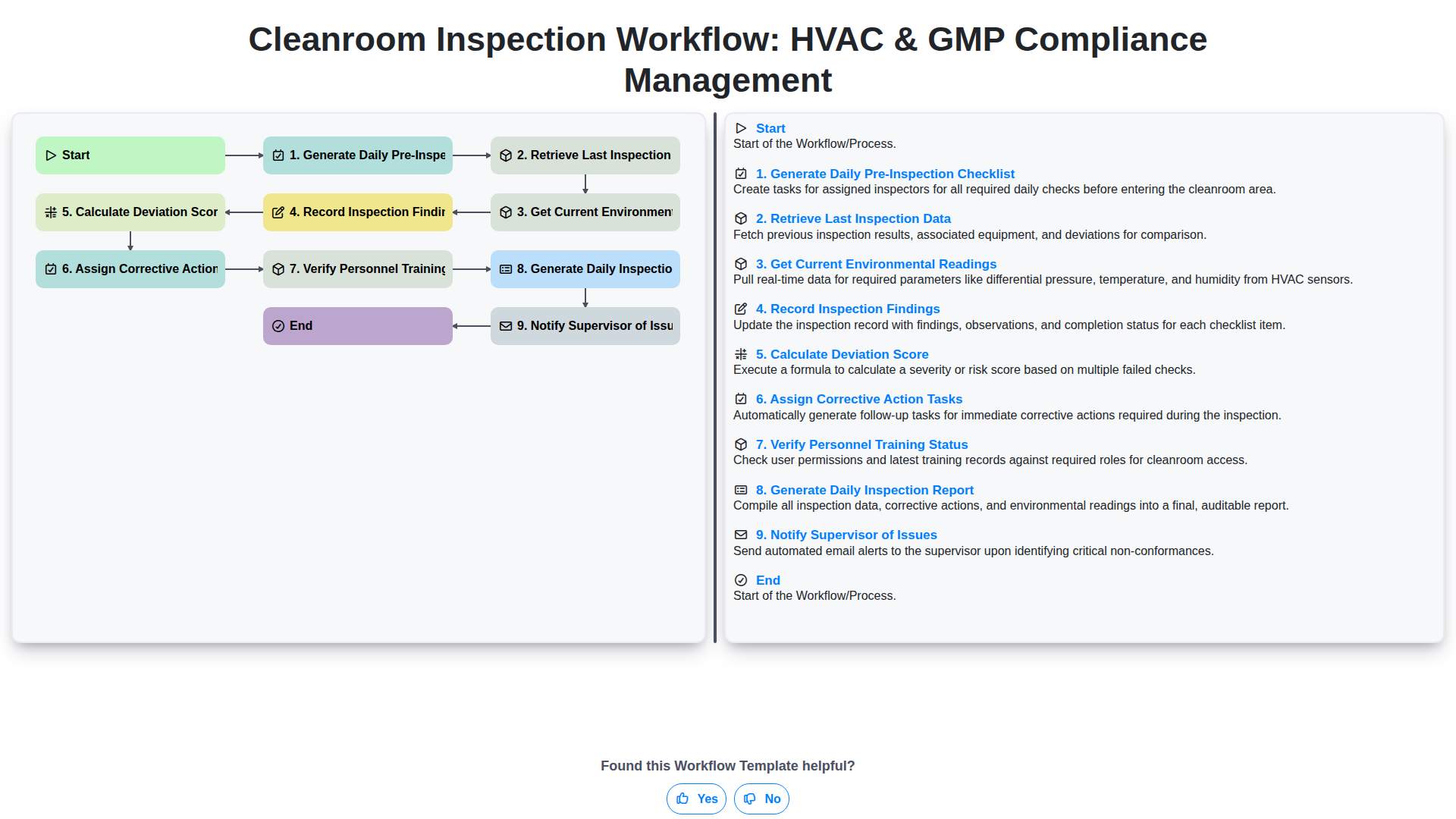
Table of Contents
- Introduction: The Critical Role of Systematic Cleanroom Inspections
- The Foundation: Generating Daily Pre-Inspection Checklists
- Leveraging Historical Intelligence: Retrieving Last Inspection Data
- Real-Time Monitoring: Getting Current Environmental Readings
- Standardizing Observations: Recording Inspection Findings
- Quantifying Risk: Calculating Deviation Scores
- Closing the Loop: Assigning Corrective Action Tasks
- Ensuring Competency: Verifying Personnel Training Status
- Automating Documentation: Generating Daily Inspection Reports
- Incident Escalation: Notifying Supervisors of Issues
- Maintaining GMP Compliance Through Workflow Automation
- Conclusion: Achieving Operational Excellence in HVAC Management
- Resources & Links
TLDR: Learn how to streamline your cleanroom compliance through an automated inspection workflow designed to manage HVAC and GMP standards. This guide explains how the workflow automates everything from generating pre-inspection checklists and analyzing environmental data to calculating deviation scores and assigning corrective actions, ensuring real-time oversight and audit-ready reporting.
Introduction: The Critical Role of Systematic Cleanroom Inspections
In the highly regulated world of pharmaceutical, biotechnology, and medical device manufacturing, the integrity of a cleanroom environment is non-negotiable. Maintaining sterility and controlling particulate matter isn't just a matter of operational efficiency-it is a fundamental requirement for patient safety and regulatory compliance. Even the slightest deviation in air pressure, temperature, or humidity can compromise an entire production batch, leading to costly recalls, wasted materials, and potential legal repercussions.
Standardized inspections serve as the first line of defense against these risks. However, an inspection is only as effective as the workflow supporting it. A disorganized or inconsistent approach to monitoring environmental parameters and hygiene protocols leaves gaps in your GMP (Good Manufacturing Practice) compliance. To maintain a state of control, facilities must move beyond simple manual checks and implement a structured, repeatable, and data-driven inspection workflow. By integrating real-time environmental data with actionable task management, manufacturers can transform inspections from a mere check-the-box exercise into a proactive powerhouse for quality assurance.
The Foundation: Generating Daily Pre-Inspection Checklists
The backbone of a robust cleanroom protocol lies in the transition from reactive troubleshooting to proactive prevention. The process begins long before an inspector steps into the controlled environment; it starts with the Generation of the Daily Pre-Inspection Checklist.
Rather than relying on static, outdated templates, a modern, automated workflow ensures that every checklist is dynamic and context-aware. A standardized checklist serves as the essential roadmap for the day's audit, ensuring that no critical parameter-from pressure differentials to particle counts-is overlooked. By automating the generation of these lists, facilities can integrate specific parameters that change based on the day's scheduled activities, such as heavy maintenance, gowning transitions, or high-throughput production shifts. This step ensures that inspectors are equipped with a precise, up-to-date set of criteria, setting the stage for a standardized, high-integrity inspection that meets stringent GMP (Good Manufacturing Practice) requirements.
Leveraging Historical Intelligence: Retrieving Last Inspection Data
Effective cleanroom management is not just about reacting to what is happening in the moment; it is about understanding the trajectory of your facility's performance. Integrating the retrieval of the previous inspection's data into your daily workflow transforms a simple checklist into a powerful tool for predictive maintenance and continuous improvement.
By automatically pulling the last inspection's results into the current workflow, inspectors can immediately identify recurring patterns, such as persistent humidity fluctuations or localized temperature spikes. This historical context allows the team to distinguish between an isolated incident and a developing systemic failure in the HVAC system. Instead of starting from zero every morning, your team can perform a comparative analysis that highlights whether corrective actions from the previous day were truly effective or if certain environmental parameters are beginning to drift toward non-compliance. This step ensures that your inspection process is rooted in historical intelligence, turning data points into actionable insights.
Real-Time Monitoring: Getting Current Environmental Readings
At the heart of a successful cleanroom inspection lies the integration of real-time data. To ensure that the facility remains within strictly defined regulatory limits, the workflow must move beyond manual observations and incorporate live sensor data. This step involves pulling current environmental readings-such as differential pressure, humidity, temperature, and particle counts-directly from the Building Management System (BMS) or automated monitoring sensors.
By capturing these metrics during the inspection process, inspectors can instantly compare live environmental conditions against established GMP (Good Manufacturing Practice) parameters. This immediate visibility eliminates the guesswork associated with delayed data logging, allowing for the instant detection of fluctuations that could compromise sterility. Integrating these automated readings into the workflow ensures that your inspection isn't just a snapshot in time, but a continuous validation of the cleanroom's controlled environment.
Standardizing Observations: Recording Inspection Findings
In a controlled environment, consistency is the cornerstone of compliance. When it comes to recording inspection findings, the difference between a high-quality audit and a regulatory failure often lies in the level of detail and the standardization of data entry. Moving away from vague, subjective notes toward a structured digital recording process ensures that every observation is actionable and reproducible.
Standardizing observations means moving beyond simple pass/fail checkboxes. An effective workflow captures specific, measurable, and descriptive data regarding the state of the cleanroom-ranging from particulate levels and pressure differentials to the physical integrity of HEPA filters and door seals. By utilizing standardized templates, inspectors can ensure that every potential non-conformance is documented with the same level of rigor, regardless of which technician is on shift. This uniformity eliminates ambiguity, reduces human error, and provides a reliable foundation for the subsequent calculation of deviation scores and the assignment of corrective actions.
Quantifying Risk: Calculating Deviation Scores
In a high-stakes cleanroom environment, subjective observations are not enough to ensure regulatory compliance. To move from qualitative guesswork to quantitative precision, our workflow incorporates a structured Deviation Score calculation. This metric transforms raw inspection data into a measurable indicator of facility health.
The calculation process works by weighing each inspection finding against its potential impact on the controlled environment. Not all deviations are equal: a minor documentation error might carry a low weight, whereas a spike in particulate counts or a failure in pressure differential triggers a significantly higher penalty. By assigning numerical values to these discrepancies, the system automatically aggregates a daily score that represents the overall stability of the cleanroom.
This automated scoring mechanism serves two critical functions:
- Trend Analysis: It allows Quality Assurance teams to track whether the facility's cleanliness is improving or degrading over time, moving beyond pass/fail snapshots to identify creeping risks.
- Immediate Risk Escalation: A high deviation score acts as an automated red flag, instantly signaling that the environment is drifting outside of established GMP parameters and requires immediate intervention.
By quantifying risk, we eliminate human bias and provide a clear, data-driven foundation for making critical decisions regarding production holds or facility re-validation.
Closing the Loop: Assigning Corrective Action Tasks
Identifying a deviation is only half the battle; the true measure of a robust compliance program lies in how effectively you respond to it. Once the Calculate Deviation Score step flags an irregularity, the workflow moves into the critical phase of Assigning Corrective Action Tasks.
In a GMP-regulated environment, a deviation cannot simply be noted and ignored. To maintain the integrity of the cleanroom, every identified non-compliance must be converted into an actionable, trackable task. By automating this transition, the system ensures that instead of a manual, error-prone handoff, the specific person responsible for the remediation-whether it be a maintenance technician for an HVAC fluctuation or a cleaning crew for a particulate spike-is immediately notified of their responsibilities.
This step transforms raw inspection data into a structured to-do list, ensuring that corrective and preventive actions (CAPA) are not just documented, but actively managed. By assigning ownership and setting deadlines within the workflow, you close the gap between detecting a problem and resolving it, preventing minor deviations from escalating into systemic failures.
Ensuring Competency: Verifying Personnel Training Status
In a high-stakes cleanroom environment, even the most advanced HVAC systems and rigorous inspection protocols are only as effective as the people operating them. A critical, yet often overlooked, step in the inspection workflow is the verification of personnel training status.
Compliance with Good Manufacturing Practices (GMP) demands more than just clean air and stable pressure differentials; it requires documented proof that every individual entering the controlled area possesses the necessary competency to maintain sterile conditions. During the inspection process, the workflow automatically cross-references the personnel involved with their latest training records and certification dates. This ensures that any staff member performing critical tasks or interacting with sensitive equipment is fully updated on gowning procedures, aseptic techniques, and contamination control protocols.
By integrating training verification into the daily inspection loop, facilities can preemptively mitigate the risk of human error-the leading cause of microbial excursions. This step transforms the inspection from a simple hardware check into a comprehensive audit of the entire operational ecosystem, ensuring that both the facility and the workforce are operating at peak compliance levels.
Automating Documentation: Generating Daily Inspection Reports
The culmination of a successful inspection cycle is the automated generation of the Daily Inspection Report. In a high-stakes GMP environment, the manual compilation of inspection data is not just time-consuming-it is a significant compliance risk. Manual entry increases the likelihood of transcription errors, which can lead to data integrity gaps during regulatory audits.
By automating this final step, the system instantly aggregates all data points collected throughout the workflow-from the initial pre-inspection checklist and environmental readings to the final deviation scores and corrective action assignments. This creates a single source of truth that is timestamped, unalterable, and ready for immediate review.
Instead of spending hours reconciling paper logs, quality managers receive a comprehensive, standardized digital document that provides a real-time snapshot of the cleanroom's compliance status. This automation ensures that the transition from finding a deviation to documenting it is seamless, providing the audit trail necessary to satisfy stringent FDA, EMA, and ISO requirements.
Incident Escalation: Notifying Supervisors of Issues
When the inspection process uncovers critical discrepancies-such as a significant deviation score or a failure in environmental parameters-the workflow transitions from monitoring to active escalation. The system is designed to eliminate the communication gap that often leads to compliance breaches.
As soon as a high-priority issue is recorded, an automated notification is instantly dispatched to the designated supervisor. This real-time alert ensures that decision-makers are not waiting for the end of a shift to learn about a potential contamination risk or a breach in GMP standards. By integrating instant alerts with the Assign Corrective Action Tasks step, the supervisor receives not just an alarm, but a comprehensive context of the incident, including the specific deviations detected and the immediate corrective steps being initiated. This rapid-response mechanism transforms the inspection from a passive recording tool into a proactive layer of site-wide quality oversight.
Maintaining GMP Compliance Through Workflow Automation
In the highly regulated world of pharmaceutical and biotech manufacturing, manual inspection processes are often the weakest link in a quality management system. Relying on paper logs and fragmented spreadsheets leaves room for human error, data gaps, and delayed responses to critical deviations. This is where workflow automation becomes a necessity rather than a luxury.
By digitizing the Cleanroom Inspection Workflow, companies can transform a reactive process into a proactive, data-driven powerhouse. Automation ensures that every critical step-from the initial generation of daily pre-inspection checklists to the final notification of supervisors-is executed with mathematical precision. Instead of searching through archives to retrieve last inspection data or manually cross-referencing environmental readings, automated systems integrate these data points in real-time.
The true power of automation lies in its ability to enforce standardization. When the system automatically calculates a deviation score and instantly assigns corrective action tasks, it eliminates the decision fatigue that often leads to compliance lapses. Furthermore, by integrating personnel training status directly into the inspection loop, the workflow ensures that only qualified individuals are performing critical tasks, effectively mitigating the risk of operator error. Ultimately, automating this workflow doesn't just save time; it creates a continuous, immutable audit trail that guarantees your facility remains in a constant state of inspection readiness.
Conclusion: Achieving Operational Excellence in HVAC Management
Mastering your cleanroom inspection workflow is more than just a regulatory requirement; it is a fundamental pillar of operational excellence. By moving away from fragmented, manual processes and embracing a structured, data-driven approach-from generating daily checklists to real-time deviation scoring-you transform your HVAC and GMP management from a reactive struggle into a proactive strength.
Implementing this integrated workflow ensures that environmental stability is never left to chance. When every inspection finding is automatically linked to corrective actions, training verification, and immediate supervisor notification, you create a closed-loop system that minimizes human error and mitigates the risk of costly non-compliance. Ultimately, a streamlined inspection process protects your most valuable assets: your product integrity, your regulatory standing, and your organizational reputation. Investing in a robust, systematic workflow is the most effective way to ensure your facility remains audit-ready and your manufacturing environment stays consistently controlled.
Resources & Links
- ISPE (International Society for Pharmaceutical Engineering): The primary resource for industry standards, Good Manufacturing Practice (GMP) guidelines, and technical resources for pharmaceutical engineering and cleanroom operations.
- U.S. Food and Drug Administration (FDA): Essential for understanding regulatory requirements, compliance mandates, and official guidelines regarding sterile manufacturing and environmental monitoring.
- ISO (International Organization for Standardization): The authority for ISO 14644 standards, which define the specific requirements for cleanroom classification and air cleanliness levels.
- ASHRAE: A key resource for HVAC engineering standards, providing technical guidance on air filtration, humidity control, and pressure differentials in controlled environments.
- European Medicines Agency (EMA): Critical for professionals operating under EU GMP Annex 1 regulations, focusing on the manufacture of sterile medicinal products.
- Project Management Institute (PMI): Useful for learning workflow optimization techniques and systematic process management applicable to complex inspection cycles.
Frequently Asked Questions
What is the primary goal of a cleanroom inspection workflow?
The primary goal is to ensure that the controlled environment maintains strict particulate, microbial, and pressure standards required for GMP compliance and to identify potential HVAC failures before they compromise product integrity.
How does HVAC performance impact GMP compliance in cleanrooms?
HVAC systems regulate temperature, humidity, pressure differentials, and air filtration (HEPA). Failure to maintain these parameters can lead to cross-contamination, loss of sterility, and non-compliance with regulatory standards like ISO or FDA guidelines.
What are the key parameters to monitor during a cleanroom inspection?
Key parameters include differential pressure between rooms, air change rates (ACR), temperature, relative humidity, particle counts, and the integrity of HEPA filters.
What is the difference between routine inspections and periodic qualification?
Routine inspections are frequent, high-level checks of operational parameters, whereas periodic qualification (such as IQ/OQ/PQ) involves rigorous, documented testing to prove the system meets its original design specifications and regulatory requirements.
What should be the first step when a deviation is detected during an inspection?
The first step is to document the deviation immediately, initiate a formal investigation (CAPA - Corrective and Preventive Action), and assess the impact on any products manufactured during the period of non-compliance.
How often should cleanroom inspections be performed?
Inspection frequency depends on the cleanroom classification and risk assessment, but typically involves daily monitoring of critical parameters and scheduled periodic audits for HVAC system integrity.
Comments
There are no comments yet. Be the first to add one!
Audit/Inspection Management Solution Demo
Ensure compliance & improve performance! ChecklistGuro streamlines audit/inspection creation, execution, and reporting. Reduce risk, enhance quality, & maintain consistency. Manage it all with our Work OS.
Related Articles
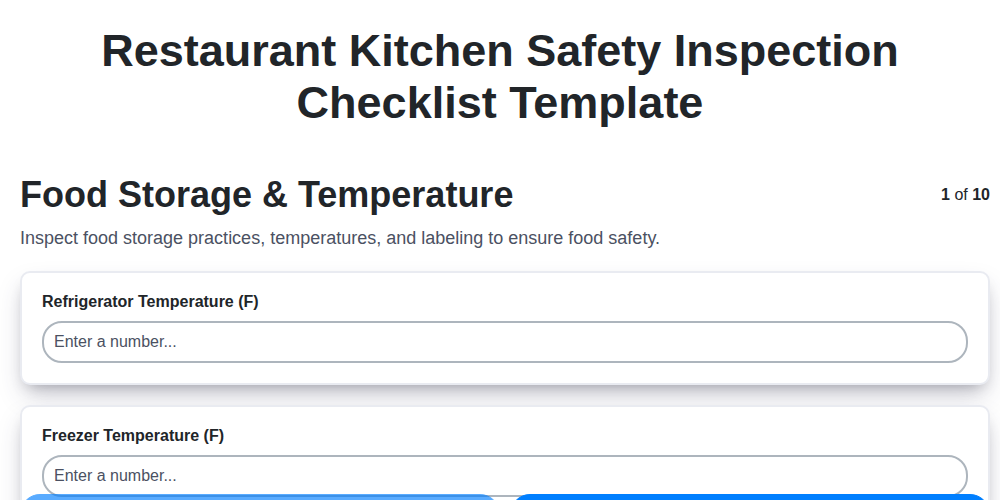
Restaurant Kitchen Safety Inspection Checklist Template
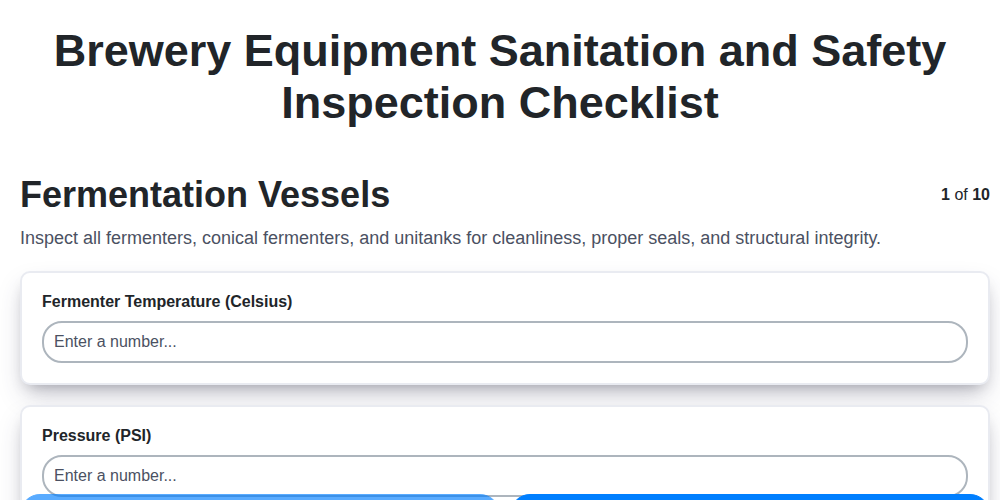
The Ultimate Brewery Equipment Sanitation & Safety Checklist Template
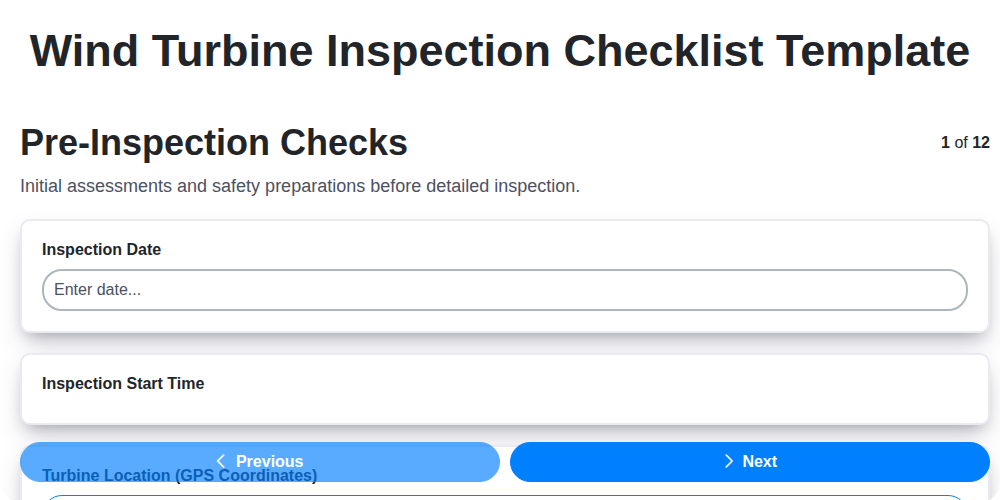
Wind Turbine Inspection Checklist Template: Your Comprehensive Guide
The Ultimate Apartment Building Maintenance Inspection Checklist Template
Your Essential Guide to a Manufacturing Quality Control Inspection Checklist
The Ultimate Solar Panel Inspection Checklist Template
Your Ultimate HVAC Inspection Checklist Template
The Ultimate Data Center Inspection Checklist Template
Need help with
Checklists?
Have a question? We're here to help. Please submit your inquiry, and we'll respond promptly.