A Guide to Managing Contract Manufacturing Organizations (CMO) Workflows
Published: 06/18/2026 9:00 PM Updated: 06/19/2026 11:50 AM
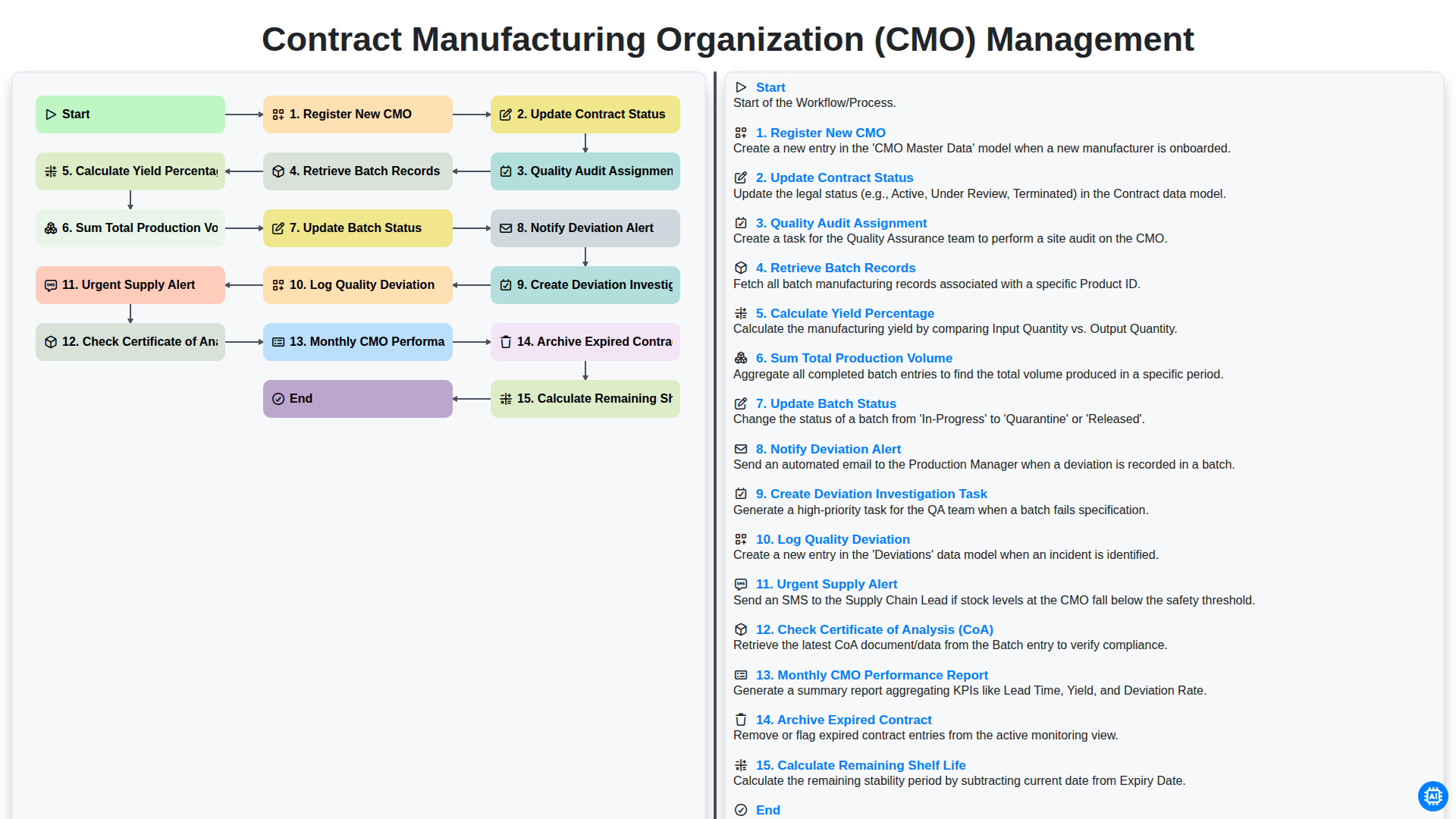
Table of Contents
- Introduction to CMO Management
- Onboarding and Vendor Lifecycle Management
- Streamlining Contractual Oversight and Compliance
- Ensuring Quality Assurance through Audit Assignments
- Batch Record Management and Data Retrieval
- Production Monitoring: Yield and Volume Analysis
- Real-time Batch Tracking and Status Updates
- Managing Deviations and Quality Investigations
- Mitigating Risks with Urgent Supply Alerts
- Verification of Product Quality and CoA Compliance
- Evaluating Monthly CMO Performance Metrics
- Inventory Integrity and Shelf Life Monitoring
- Contract Archiving and Lifecycle Conclusion
- Resources & Links
TLDR: This guide provides a comprehensive overview of a specialized workflow template designed to streamline the end-to-end management of Contract Manufacturing Organizations (CMOs). Learn how to automate critical processes-from initial CMO registration and quality auditing to batch record retrieval, yield calculation, and real-time deviation alerts-ensuring full compliance, operational efficiency, and proactive supply chain oversight.
Introduction to CMO Management
In the complex landscape of pharmaceutical and life sciences manufacturing, managing external partners is a critical pillar of operational excellence. A Contract Manufacturing Organization (CMO) provides essential capacity and specialized expertise, but this reliance introduces significant layers of complexity to the supply chain. Effective CMO management is not merely about oversight; it is about maintaining a seamless, end-to-end workflow that ensures product quality, regulatory compliance, and uninterrupted supply.
Managing these partnerships requires much more than simple vendor oversight. It demands a rigorous, integrated process that spans from the initial registration of a new partner to the continuous monitoring of production yields, quality audits, and deviation investigations. Without a structured workflow, companies risk fragmented data, delayed quality alerts, and, ultimately, compromised patient safety. This article explores the essential lifecycle of CMO management, outlining the systematic steps necessary to transform a high-risk dependency into a highly efficient, transparent, and reliable manufacturing ecosystem.
Onboarding and Vendor Lifecycle Management
The foundation of a resilient supply chain lies in how effectively you manage your external partners from day one. The lifecycle of a partnership begins with the critical step of Registering a New CMO, a process that ensures all regulatory and compliance documentation is centralized and accessible. However, management does not end at onboarding; it requires continuous oversight to Update Contract Status, ensuring that agreements remain current and that all legal and operational parameters are met.
As a contract matures, the focus shifts toward rigorous compliance and risk mitigation. A proactive management workflow integrates Quality Audit Assignment to ensure the manufacturer adheres to predefined standards, alongside the ability to Archive Expired Contracts to maintain a clean, audit-ready database. By systematically managing these administrative milestones, organizations can transition from reactive firefighting to a streamlined, proactive state of vendor oversight.
Streamlining Contractual Oversight and Compliance
Managing a network of external partners requires more than just oversight; it demands a structured, automated workflow to ensure that every stage of the manufacturing lifecycle is documented and compliant. To maintain operational excellence, your workflow must begin with a formal Register New CMO process, ensuring all vendors are vetted and onboarded within your system. As partnerships evolve, the ability to Update Contract Status and Archive Expired Contract becomes critical for maintaining an accurate regulatory perimeter.
Compliance is anchored in rigorous quality control. This begins with Quality Audit Assignment to verify site readiness and is supported by continuous monitoring through the ability to Check Certificate of Analysis (CoA) for every incoming lot. When things go wrong-as they inevitably do in complex manufacturing-the system must act as an early warning mechanism. By being able to Notify Deviation Alert and immediately Create Deviation Investigation Task, teams can Log Quality Deviation in real-time, preventing minor issues from escalating into systemic failures.
Beyond compliance, true efficiency is found in data-driven visibility. A robust management workflow allows stakeholders to Retrieve Batch Records and instantly Calculate Yield Percentage and Sum Total Production Volume to assess manufacturing efficiency. Furthermore, proactive inventory management-such as the ability to Calculate Remaining Shelf Life and trigger an Urgent Supply Alert-ensures that production lags never result in market shortages. Finally, by consistently generating a Monthly CMO Performance Report and maintaining a real-time Update Batch Status loop, you transform manual oversight into a continuous cycle of improvement, ensuring your Update Contract Status reflects actual performance and quality.
Ensuring Quality Assurance through Audit Assignments
Maintaining the highest standards of-product integrity requires more than just oversight; it demands a proactive approach to compliance. A critical component of this oversight is the Quality Audit Assignment process. Within an efficient CMO management workflow, assigning audits is not merely a periodic checkbox but a strategic tool used to verify that manufacturing sites adhere strictly to predefined protocols and regulatory requirements.
By systematically scheduling and assigning audits, manufacturers can identify potential non-compliance issues before they impact the supply chain. This step ensures that every contracted partner is held to the same rigorous quality benchmarks, creating a transparent layer of accountability. Through structured audit assignments, organizations can mitigate risks, validate process consistency, and reinforce the trust necessary to maintain a seamless, high-quality production lifecycle.
Batch Record Management and Data Retrieval
Efficient oversight of production requires seamless access to critical production data. Within this workflow, the Retrieve Batch Records step serves as the foundation for maintaining full traceability and regulatory compliance. By streamlining the retrieval process, quality assurance teams can quickly access detailed documentation for specific production runs, ensuring that every stage of the manufacturing process is documented and verifiable.
Beyond simple retrieval, this stage of the workflow integrates closely with data-driven analytics. Once records are accessed, the system enables the automated Calculate Yield Percentage function, allowing for an immediate comparison between theoretical and actual output. Furthermore, these individual batch details are aggregated to Sum Total Production Volume, providing a macro-level view of manufacturing capacity and output trends. This integration of manual oversight and automated calculation ensures that data retrieval is not just an administrative task, but a strategic tool for real-time production monitoring.
Production Monitoring: Yield and Volume Analysis
Effective production monitoring is the backbone of a successful CMO management strategy. To maintain high-quality standards and ensure-scale efficiency, it is critical to move beyond simple oversight and delve into deep data analytics. This begins with the ability to Retrieve Batch Records in real-time, providing the raw data necessary for granular scrutiny.
Once records are accessible, the focus shifts to two fundamental KPIs: Calculate Yield Percentage and Sum Total Production Volume. By calculating the yield percentage for every batch, managers can instantly identify discrepancies between theoretical and actual output, which serves as an early warning sign for process inefficiencies or raw material issues. Simultaneously, by summing the total production volume, stakeholders can track aggregate output against quarterly targets, ensuring that the CMO is meeting the required supply capacity. Together, these metrics transform raw manufacturing data into actionable insights, allowing for proactive adjustments to the production lifecycle.
Real-time Batch Tracking and Status Updates
Maintaining visibility over your production lifecycle is critical to preventing bottlenecks and ensuring supply chain continuity. Within an optimized CMO management workflow, real-time tracking allows stakeholders to Update Batch Status instantly as products move through various manufacturing stages. This seamless flow of information ensures that every stakeholder is aware of whether a batch is currently in production, undergoing testing, or awaiting release.
Furthermore, the system acts as an early warning mechanism by being able to Notify Deviation Alert the moment an anomaly is detected. By automating these updates, you eliminate the delays associated with manual reporting, allowing for immediate action when critical issues arise.
Managing Deviations and Quality Investigations
In the complex landscape of pharmaceutical and chemical manufacturing, maintaining product integrity is paramount. When a discrepancy occurs during the production process, a streamlined workflow is essential to prevent much larger systemic failures. Our management system ensures that the moment a deviation is detected, the process moves into high gear through automated Notify Deviation Alert protocols.
The workflow doesn't stop at simple notification; it triggers a structured investigative response. Upon detection, the system automatically initiates a Create Deviation Investigation Task, assigning accountability to the necessary quality assurance personnel. This ensures that every anomaly is tracked from inception to resolution. As investigators analyze the root cause, every finding is meticulously captured through the Log Quality Deviation step, creating a permanent, searchable audit trail. By integrating these steps into a single cohesive loop, we transform deviations from unpredictable disruptions into structured opportunities for continuous process improvement and rigorous quality control.
Mitigating Risks with Urgent Supply Alerts
In the high-stakes world of pharmaceutical and chemical manufacturing, timing is everything. An Urgent Supply Alert serves as a critical fail-safe within the CMO management workflow, designed to trigger immediate action when production timelines or inventory levels threaten market availability.
The true risk in contract manufacturing isn't just a single production delay; it is the cascading effect of a delay that goes unnoticed until a stockout occurs. By implementing automated supply alerts, organizations can move from a reactive firefighting mode to a proactive management stance. These alerts act as an early warning system, notifying supply chain managers the moment a bottleneck-such as a delayed batch release or a raw material shortage-jeopardizes the delivery schedule. By addressing these signals instantly, you can reroute resources, adjust downstream distribution, or communicate transparently with stakeholders, effectively mitigating the risk of lost revenue and, more importantly, ensuring that life-critical products reach patients without interruption.
Verification of Product Quality and CoA Compliance
Ensuring that every batch meets stringent safety and efficacy standards is the cornerstone of successful outsourced manufacturing. Within the CMO management workflow, the process of Checking the Certificate of Analysis (CoA) serves as a critical gatekeeping step. This involves a meticulous review of the manufacturer's laboratory results against your predefined internal specifications to ensure that all physical, chemical, and microbiological attributes are within tolerance.
By verifying the CoA immediately upon receipt, quality teams can proactively identify discrepancies before products move further down the supply chain. This rigorous verification step is closely integrated with the broader quality management system; it acts as the primary filter to trigger a Notify Deviation Alert if any parameter falls out of specification. This proactive scrutiny ensures that only compliant materials are released for use, maintaining the integrity of the finished product and protecting the brand's reputation.
Evaluating Monthly CMO Performance Metrics
To ensure long-term operational excellence, the final stage of our management workflow involves the generation of the Monthly CMO Performance Report. This comprehensive assessment serves as the analytical backbone of the entire lifecycle, transforming raw operational data into actionable intelligence.
This report aggregates key performance indicators (KPIs) gathered throughout the month, moving beyond simple oversight to deep-dive analytics. By synthesizing data points such as the frequency of Quality Deviation Logs, the efficiency of Deviation Investigation Tasks, and the accuracy of Yield Percentage calculations, we can objectively measure a partner's reliability. We also integrate the Sum Total Production Volume against scheduled targets to identify patterns of underperformance or capacity bottlenecks.
The true value of this evaluation lies in its ability to drive continuous improvement. By reviewing these monthly metrics, stakeholders can identify whether a CMO is maintaining stability or if recurring Urgent Supply Alerts necessitate a strategic intervention. Ultimately, this systematic review ensures that every partner remains aligned with your quality standards and supply chain commitments, turning periodic monitoring into a strategic advantage.
Inventory Integrity and Shelf Life Monitoring
Maintaining the integrity of your supply chain requires more than just tracking active production; it demands rigorous oversight of product stability and expiration protocols. Within the CMO management workflow, effective inventory integrity relies on the ability to Calculate Remaining Shelf Life for all batches currently in circulation. By continuously monitoring degradation timelines, manufacturers can proactively manage stock rotation and prevent the costly loss of expired materials.
This proactive monitoring works in tandem with the ability to Archive Expired Contract records and batch data, ensuring that your quality management system remains uncluttered and focused only on compliant, useable inventory. By integrating shelf-life calculations into your standard operating procedures, you transition from a reactive state of managing waste to a proactive strategy of optimizing product availability and ensuring that every unit reaching the end-user meets the highest standards of safety and potency.
Contract Archiving and Lifecycle Conclusion
As a partnership reaches its natural end or a service agreement expires, maintaining organized records is critical for regulatory compliance and future audits. The final stages of the CMO management workflow involve the systematic Archive Expired Contract process, ensuring that all historical data, agreements, and legal documentation are securely stored and easily retrievable for historical review.
Beyond mere storage, it is essential to Calculate Remaining Shelf Life for any products or materials associated with the concluding contract to ensure that no usable inventory is lost during the transition. By automating the archiving process, organizations can maintain a clean, active vendor list while preserving a transparent, auditable trail of all past manufacturing activities.
Resources & Links
- ISPE (International Society for Pharmaceutical Engineering): Essential resources for industry standards, regulatory compliance, and best practices in pharmaceutical manufacturing and CMO management.
- U.S. Food and Drug Administration (FDA): Official regulatory guidelines regarding Good Manufacturing Practices (GMP) and oversight requirements for contract manufacturing.
- European Medicines Agency (EMA): Crucial documentation on quality standards and regulatory frameworks for managing outsourced manufacturing within the EU.
- ASQ (American Society for Quality): Tools and methodologies for managing quality audits, deviation investigations, and continuous improvement in production workflows.
- Project Management Institute (PMI): Frameworks for managing vendor lifecycles, contract milestones, and complex supply chain workflows.
- Supply Chain Dive: Insights into supply chain risk management, including urgent supply alerts and production volume monitoring.
- GS1 Global Standards: Global standards for tracking batch records, product identification, and ensuring data integrity in pharmaceutical logistics.
Found this Article helpful?
Comments
There are no comments yet. Be the first to add one!
Pharmaceutical Management Solution Demo
Navigating complex regulations and ensuring quality in pharmaceutical manufacturing? ChecklistGuro's Work OS platform streamlines processes from R&D to production, packaging, and distribution. Maintain compliance, improve efficiency, and reduce risk. Discover how ChecklistGuro can transform your pharmaceutical operations!
Related Articles
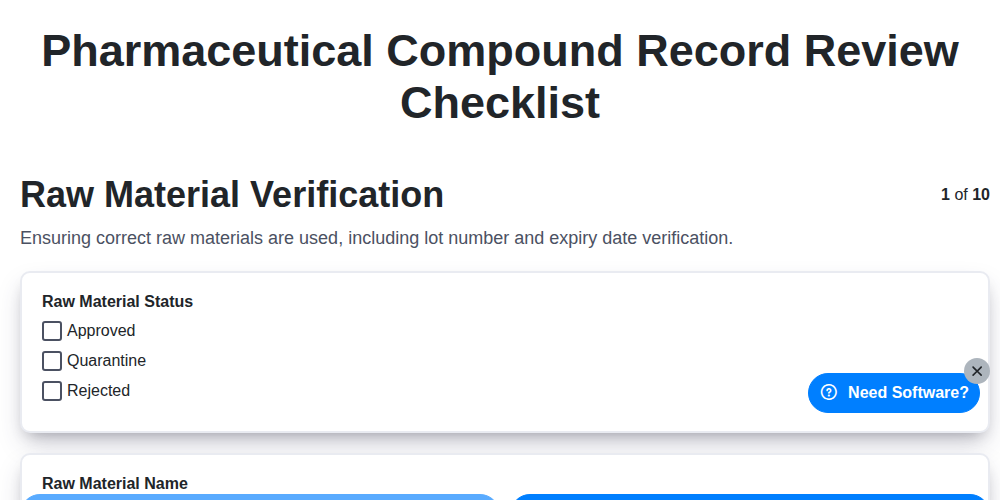
Ensuring Quality: A Pharmaceutical Compound Record Review Checklist Guide
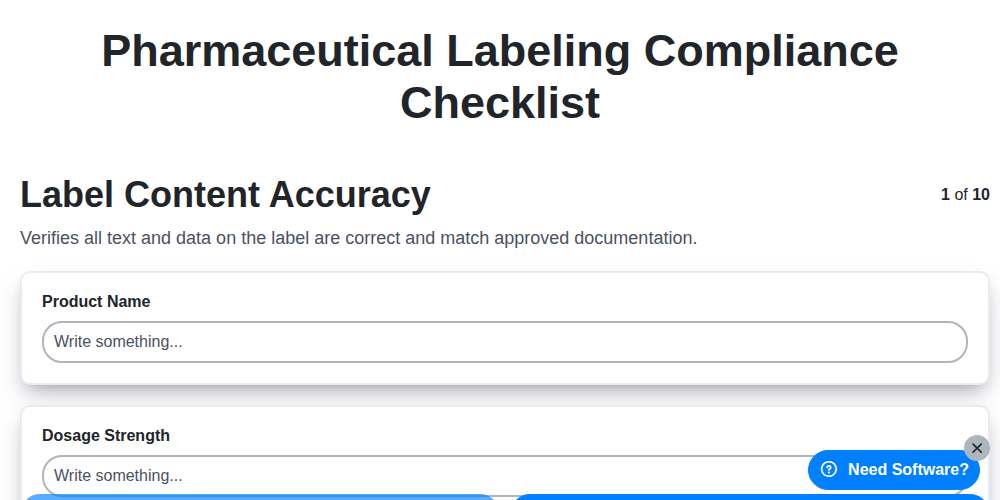
Pharmaceutical Labeling Compliance Checklist: Your Step-by-Step Guide
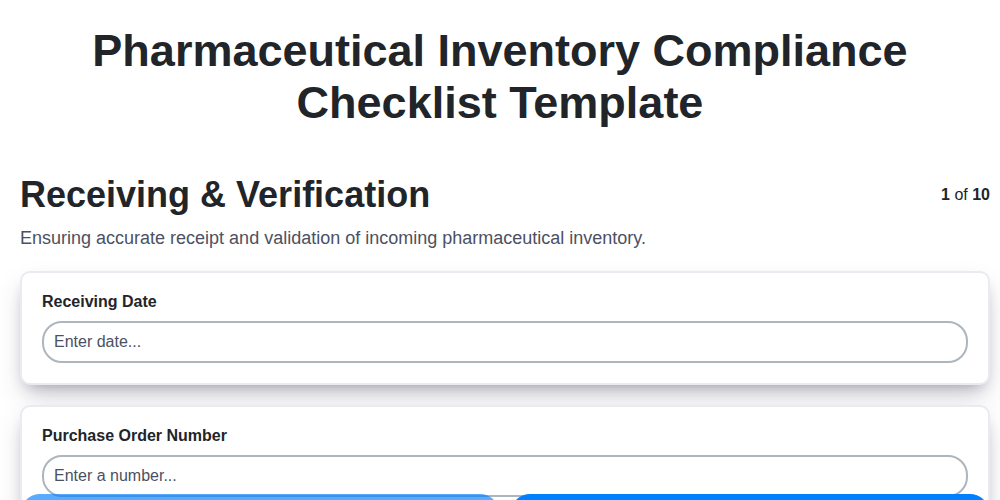
Mastering Medication Management: Your Pharmaceutical Inventory Compliance Checklist Template
Navigating Adverse Event Reporting: Your Pharmaceutical Checklist Guide
Pharmaceutical Inventory Management Checklist: Your Guide to Compliance & Accuracy
Your Essential GLP Checklist Template: A Practical Guide
Your Pharmaceutical Development Checklist: A Template for Success
Pharmaceutical Validation Checklist Template: Your Guide to Compliance
We can do it Together
Need help with
Checklists?
Have a question? We're here to help. Please submit your inquiry, and we'll respond promptly.