Pharmaceutical Validation Checklist Template: Your Guide to Compliance
Published: 11/25/2025 Updated: 07/02/2026
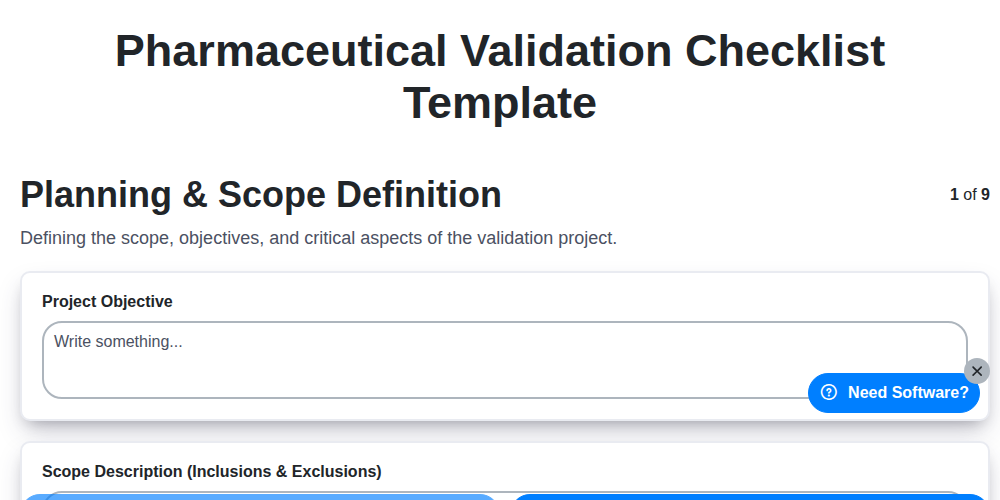
Table of Contents
- Why Pharmaceutical Validation Matters
- Understanding the Stages of Pharmaceutical Validation
- 1. Planning & Scope Definition: Setting the Foundation
- 2. Risk Assessment: Identifying and Mitigating Potential Issues
- 3. Design & Specification Review: Ensuring Accuracy and Completeness
- 4. IQ, OQ, PQ: The Core Qualification Process
- 5. Documentation & Records: Maintaining Traceability and Compliance
- 6. Change Control: Managing Modifications and Ensuring Continued Validation
- 7. Review & Approval: Ensuring Validation Integrity
- Resources & Links
TLDR: Need to validate a pharmaceutical process or equipment? This checklist template breaks down the entire validation journey - from initial planning & risk assessment to final performance qualification & change control. It's your one-stop guide to ensuring compliance with regulations and maintaining a robust validation lifecycle.
Why Pharmaceutical Validation Matters
Pharmaceutical validation isn't just a regulatory hoop to jump through; it's the bedrock of patient safety and product efficacy. It's the documented evidence that your manufacturing processes, equipment, and systems consistently produce a product that meets predetermined specifications and quality attributes. Imagine the potential consequences of a faulty batch of medication reaching patients - from reduced effectiveness to serious adverse reactions. Validation minimizes these risks by proactively identifying and mitigating potential issues before they impact product quality. It instills confidence in the entire manufacturing lifecycle, builds trust with regulatory agencies (like the FDA and EMA), and ultimately safeguards public health. A robust validation program isn't an expense; it's a vital investment in the integrity of your pharmaceutical products and the wellbeing of those who rely on them.
Understanding the Stages of Pharmaceutical Validation
Pharmaceutical validation isn't a single event; it's a comprehensive, multi-stage process designed to ensure consistent product quality and adherence to regulatory requirements. Let's break down the key stages you'll find in a typical pharmaceutical validation checklist:
Planning & Scope Definition: This initial phase lays the groundwork. It defines the scope of the validation project, identifying what processes, equipment, or systems will be validated. Clear objectives and acceptance criteria are established, ensuring everyone understands what constitutes successful validation.
Risk Assessment: Following planning, a thorough risk assessment identifies potential failures and their impact on product quality. This prioritizes validation efforts, focusing resources on areas with the highest risk. Techniques like Failure Mode and Effects Analysis (FMEA) are frequently employed.
Design & Specification Review: This crucial step verifies that equipment, processes, or systems are designed and specified correctly to meet intended performance and quality requirements. It involves reviewing drawings, manuals, and other technical documentation.
Installation Qualification (IQ): IQ confirms that the equipment or system has been installed correctly and according to the manufacturer's specifications. This includes verifying dimensions, utilities connections, and safety features.
Operational Qualification (OQ): OQ focuses on demonstrating that the equipment or system operates as intended under defined operating conditions. This involves testing functionality and confirming performance parameters fall within acceptable ranges.
Performance Qualification (PQ): PQ is the final stage, proving that the validated system consistently produces products that meet pre-determined quality attributes under actual production conditions. This involves running full-scale production runs and collecting performance data.
Documentation & Records: Meticulous documentation is vital throughout the entire validation process. This includes protocols, reports, deviations, and corrective actions. Complete and accurate records provide evidence of validation activities and adherence to procedures.
Change Control: Any modifications to validated equipment or processes require a robust change control system. This ensures changes are assessed for their impact on quality and validated before implementation.
Review & Approval: Independent review and approval of validation plans, protocols, and reports by qualified personnel provide an extra layer of scrutiny and ensure validation activities meet regulatory expectations. This step demonstrates that the validation process was carried out correctly and that the results are reliable.
1. Planning & Scope Definition: Setting the Foundation
Pharmaceutical validation isn't just about ticking boxes; it's about demonstrating, with documented evidence, that a process, equipment, or system consistently produces a product or service that meets predetermined specifications and quality attributes. The first, and arguably most crucial, step in this journey is meticulous Planning & Scope Definition.
This phase establishes the what, why, and how of the entire validation project. It goes beyond simply listing activities; it's about defining the boundaries of what will be validated and, equally importantly, what won't be.
Here's what your Planning & Scope Definition should cover:
- Clearly Defined Objectives: What are you trying to prove with this validation? This should be specific, measurable, achievable, relevant, and time-bound (SMART).
- Process/Equipment/System Identification: Precisely identify the specific element being validated - including version numbers, serial numbers, and any associated software.
- Scope Boundaries: Explicitly state which aspects are included in the validation and which are excluded. This prevents scope creep and maintains focus.
- Regulatory Requirements: Identify all applicable regulatory guidelines (e.g., FDA, EMA, ICH) and industry standards.
- Validation Team Roles & Responsibilities: Define who is responsible for each aspect of the validation, including authors, reviewers, and approvers.
- Validation Strategy: Outline the overall validation approach - for example, a risk-based validation approach or a tiered approach.
- Documentation Plan: Specify what documents will be created and how they will be managed.
A robust Planning & Scope Definition acts as the blueprint for the entire validation project, ensuring everyone is aligned and working towards the same goals. Neglecting this step can lead to wasted resources, delays, and potentially, non-compliance.
2. Risk Assessment: Identifying and Mitigating Potential Issues
Validation isn't just about ticking boxes; it's about demonstrating confidence that your pharmaceutical processes consistently produce the intended results. A robust risk assessment is the cornerstone of this confidence. It's more than just a formality; it's an integral step in the Pharmaceutical Validation Checklist that actively shapes the entire validation strategy.
The purpose of this assessment is to identify potential hazards and vulnerabilities within the validated system or process. This includes considering equipment malfunctions, human error, deviations from standard operating procedures (SOPs), and environmental factors that could impact product quality, safety, and efficacy.
What Does a Good Risk Assessment Look Like?
A well-executed risk assessment moves beyond simply listing potential problems. It involves:
- Hazard Identification: Brainstorming and identifying all potential hazards. This should involve a multidisciplinary team including operators, engineers, quality assurance personnel, and validation specialists.
- Risk Analysis: Evaluating the likelihood of each hazard occurring and the severity of its potential impact. Common methodologies include Failure Mode and Effects Analysis (FMEA), Hazard Analysis and Critical Control Points (HACCP), and risk matrices (scoring likelihood vs. severity).
- Risk Evaluation: Determining the acceptability of each identified risk. This usually involves setting risk acceptance criteria based on regulatory guidance and company standards.
- Risk Mitigation: Developing and implementing controls to reduce or eliminate unacceptable risks. These controls can include preventative measures, corrective actions, and contingency plans.
Documentation is Key:
The risk assessment itself must be thoroughly documented. This includes:
- Clearly defined scope and objectives.
- A comprehensive list of identified hazards.
- Risk scores assigned to each hazard.
- Justification for risk scores and acceptance criteria.
- Detailed descriptions of implemented controls.
- Responsibilities for implementing and maintaining controls.
Connecting Risk Assessment to Validation Activities:
The risk assessment directly influences the validation plan. Higher-risk activities will require more rigorous testing and documentation. It justifies the level of effort and resources allocated to each stage of the validation process - IQ, OQ, and PQ. For example, if a particular piece of equipment is deemed high risk, the IQ, OQ, and PQ protocols will likely include more extensive checks and challenges to ensure its reliable performance.
By prioritizing risks and focusing validation efforts where they are most needed, you ensure a more efficient and effective validation process that strengthens product quality and compliance.
3. Design & Specification Review: Ensuring Accuracy and Completeness
This crucial stage bridges the gap between initial planning and execution. The Design & Specification Review isn't just a formality; it's a rigorous assessment to confirm that the proposed equipment, process, or system meets the established requirements and aligns perfectly with the overall validation plan.
Here's what a thorough review entails:
- Verification against Requirements: Each design element and specification needs to be meticulously checked against the documented requirements outlined in the Planning & Scope Definition. This includes verifying materials of construction, dimensions, performance characteristics, and safety features.
- Technical Feasibility: Evaluate whether the design is technically achievable and practical within the existing infrastructure and operational environment. Consider factors like space limitations, utility availability, and operator training needs.
- Regulatory Compliance: Ensure the design adheres to all applicable regulatory guidelines (e.g., FDA, EMA, ICH) and industry standards. This includes GMP (Good Manufacturing Practices) requirements.
- User Needs Assessment: Confirm the design incorporates feedback and addresses the needs of the end-users. Operator safety and ease of use are paramount.
- Risk Assessment Integration: Review how identified risks from the Risk Assessment phase have been mitigated within the design. Confirm the chosen solutions are effective.
- Detailed Drawings & Calculations: Scrutinize detailed engineering drawings, process flow diagrams (PFDs), and supporting calculations to ensure accuracy and completeness.
- Traceability: Establish clear traceability between design specifications, requirements, and the equipment or process being validated.
A robust Design & Specification Review significantly reduces the likelihood of errors and costly rework during subsequent qualification stages, contributing to a more efficient and reliable validation process.
4. IQ, OQ, PQ: The Core Qualification Process
The heart of pharmaceutical validation lies in the sequential steps of Installation Qualification (IQ), Operational Qualification (OQ), and Performance Qualification (PQ). These aren't just checkboxes; they're a structured process designed to demonstrate that equipment, systems, and processes consistently perform as intended.
Installation Qualification (IQ): This phase verifies that the equipment or system has been correctly installed and is physically ready for operation. It confirms that the equipment received matches the purchase order and design specifications, and that it's placed in a suitable environment. IQ documentation typically includes serial numbers, manufacturer information, installation dates, utility connections, and environmental conditions. Essentially, it answers the question: "Is it here, is it right, and is it properly set up?"
Operational Qualification (OQ): Moving beyond installation, OQ focuses on verifying that the equipment or system operates according to pre-defined parameters. This involves executing planned tests and procedures to ensure the system responds as expected under various conditions. For example, testing ranges of temperature, pressure, and speed. This phase validates that the system's critical components function correctly within their intended operating ranges. The goal is to demonstrate that the equipment performs as intended, not necessarily under actual production conditions.
Performance Qualification (PQ): PQ is the final stage, simulating real-world operating conditions to prove that the equipment or system consistently produces acceptable product quality. This involves executing full production runs, monitoring critical process parameters, and demonstrating the ability to meet established acceptance criteria. PQ provides documented evidence that the validated system consistently produces product meeting pre-defined quality attributes. This stage ties the validation back to the impact on the final product.
These three phases are interconnected and build upon each other, providing a robust framework for ensuring compliance and maintaining product quality.
5. Documentation & Records: Maintaining Traceability and Compliance
Robust documentation is the backbone of pharmaceutical validation. It's not merely about creating paperwork; it's about demonstrating a documented, auditable trail that proves your processes consistently deliver the intended results. This section of the validation checklist is critical for demonstrating compliance with regulatory requirements like FDA 21 CFR Part 211 and EMA EudraLex Volume 4.
Key elements to cover include:
- Comprehensive Record Keeping: Every stage of the validation process, from initial planning to final approval, must be meticulously documented. This includes raw data, analyses, deviations, investigations, and corrective actions.
- Standard Operating Procedures (SOPs): Ensure all validation activities are performed according to established and approved SOPs. These SOPs should be readily available and followed consistently.
- Traceability: Maintain a clear chain of traceability for all equipment, materials, and data used in the validation process. This allows auditors to easily follow the history of a product or process.
- Data Integrity: Implement controls to ensure data is attributable, legible, contemporaneous, original, and accurate (ALCOA principles).
- Retention Policies: Establish clear policies for the retention of validation records, adhering to regulatory requirements and company guidelines.
- Version Control: Implement a robust version control system for all validation documents to ensure that the latest and approved versions are always in use.
- Audit Trails: Utilize electronic audit trails for computerized systems to track changes, user access, and data modifications.
- Regular Reviews: Periodically review validation records to verify completeness, accuracy, and compliance.
Proper documentation isn't just about avoiding penalties; it's about building confidence in your product and processes.
6. Change Control: Managing Modifications and Ensuring Continued Validation
Pharmaceutical validation isn't a one-and-done process. Throughout the lifecycle of equipment, processes, and systems, changes are inevitable - whether driven by regulatory updates, efficiency improvements, or even simple equipment repairs. A robust Change Control system is essential to maintaining validation integrity and ensuring continued compliance.
A Change Control procedure should detail how proposed changes are identified, evaluated, documented, approved, and implemented. This isn't just about paperwork; it's about ensuring that any modification doesn't negatively impact the validated state of a process or system.
Key components of a strong Change Control system include:
- Change Request Forms: A standardized form to capture details of the proposed change - the reason for the change, the scope of the impact, and the potential risks.
- Impact Assessment: A thorough evaluation of how the change affects all aspects of the validated process - equipment, personnel, raw materials, and documentation.
- Risk Assessment Re-evaluation: Changes can introduce new risks or alter existing ones. The initial risk assessment must be reviewed and updated to reflect the potential impact of the proposed change.
- Approval Workflow: Clearly defined roles and responsibilities for approving changes, including appropriate levels of authority.
- Validation Re-qualification/Re-validation: Depending on the impact assessment, the change may necessitate requalification (minor adjustments) or re-validation (full validation repeat).
- Documentation of Changes: Detailed records of all changes, including the original change request, impact assessment, approval records, and any supporting documentation.
Ignoring or inadequately managing changes can lead to significant regulatory scrutiny and potentially impact product quality. A proactive Change Control system demonstrates a commitment to continuous improvement and provides a framework for safely and effectively adapting to evolving needs within the pharmaceutical environment.
7. Review & Approval: Ensuring Validation Integrity
The validation process isn't complete until it's rigorously reviewed and formally approved. This final stage isn't merely a formality; it's a critical safeguard that verifies the entire validation lifecycle has been executed correctly and meets regulatory requirements.
This review typically involves a multidisciplinary team including representatives from Quality Assurance, Validation, and the relevant operational area. They meticulously examine all documentation, including the validation plan, protocols, reports, and any deviation documentation. Key areas of focus include:
- Completeness: Are all steps outlined in the validation plan executed and documented?
- Accuracy: Are the results accurate, verifiable, and consistent with the initial objectives?
- Compliance: Does the validation demonstrate adherence to GMP regulations and internal procedures?
- Trend Analysis: Are there any recurring issues or patterns that require further investigation?
- Risk Mitigation: Were identified risks adequately addressed and mitigated?
Upon successful review, a designated approver (typically a Quality Assurance Manager or equivalent) signs off on the validation report, formally acknowledging its accuracy and completeness. This approved validation report becomes an official record, providing a definitive statement that the process, equipment, or system has been validated and is fit for its intended purpose. Without proper review and approval, the entire validation effort is rendered questionable and potentially non-compliant.
Resources & Links
- U.S. Food and Drug Administration (FDA): The FDA's website is the primary source for regulations, guidance documents, and information related to pharmaceutical validation and GMP compliance. Explore their resources on 21 CFR Part 11, Process Validation, and other relevant topics.
- European Medicines Agency (EMA): Similar to the FDA, the EMA provides guidance and regulations for pharmaceutical validation in Europe. Useful for those working with European markets or needing a comparative perspective.
- United States Pharmacopeia (USP): USP provides standards and guidance documents (USP <11> for process validation is particularly important) that are often referenced in pharmaceutical validation procedures. Helps establish quality benchmarks.
- International Society for Pharmaceutical Engineering (ISPE): ISPE is a leading organization providing resources, training, and networking opportunities for pharmaceutical professionals. They offer valuable publications and webinars on validation topics, including the Validation Master Plan (VMP).
- Pharmaceutical Online: A comprehensive online resource for pharmaceutical industry professionals, offering articles, news, and insights on various topics including validation and regulatory compliance. Search for articles related to pharmaceutical validation.
- GMP Compliance: Offers a wealth of information, articles, and training materials related to Good Manufacturing Practices (GMP) and validation. Often includes practical examples and checklists related to pharmaceutical processes.
- Quality Assurance Magazine: Provides articles and resources on quality assurance, regulatory compliance, and validation within the pharmaceutical and related industries. Look for content related to validation lifecycle management and regulatory updates.
- American Society for Quality (ASQ): While broader than just pharmaceuticals, ASQ provides fundamental knowledge and resources on quality management principles, which are crucial for pharmaceutical validation. Explore their standards and training programs.
- PwC - Pharmaceuticals: Provides insights and regulatory guidance, particularly helpful for understanding current trends and compliance challenges within the pharmaceutical validation landscape. Their content often covers industry best practices.
- Deloitte - Pharmaceuticals: Similar to PwC, Deloitte offers advisory services and insights into the pharmaceutical industry, including guidance on regulatory compliance and validation processes. Check their publications for relevant articles.
- EY - Pharmaceuticals and Life Sciences: EY provides services and insights related to pharmaceutical validation, quality management, and regulatory compliance. Explore their publications and thought leadership articles for a broader understanding.
Frequently Asked Questions
What is pharmaceutical validation and why is it important?
Pharmaceutical validation is the documented evidence that a process, equipment, or system consistently produces a product meeting predetermined specifications. It's crucial for ensuring product quality, safety, and efficacy, and is a regulatory requirement (e.g., FDA, EMA).
What is a validation checklist template and how does it help?
A validation checklist template is a structured document outlining all the steps, activities, and documentation required for a specific validation process (e.g., equipment validation, cleaning validation). It helps ensure consistency, completeness, and traceability, minimizing errors and promoting compliance.
Who should use this validation checklist template?
This template is designed for a wide range of users involved in pharmaceutical validation, including validation managers, validation engineers, quality assurance personnel, manufacturing teams, and anyone responsible for ensuring process or equipment compliance.
What types of validation are typically covered by validation checklists?
Common validation types covered include equipment qualification (IQ, OQ, PQ), process validation (PV), cleaning validation, analytical method validation, and computer system validation. The template may be adaptable for other validation types.
Can I customize the template to fit my specific processes?
Yes, absolutely. The provided template is a starting point. You should customize it to accurately reflect your unique processes, equipment, and regulatory requirements. Add or remove steps as necessary.
What is the difference between IQ, OQ, and PQ?
* **IQ (Installation Qualification):** Verifies that the equipment is properly installed and configured according to manufacturer's specifications.* **OQ (Operational Qualification):** Confirms that the equipment operates as intended under defined operating parameters.* **PQ (Performance Qualification):** Demonstrates that the equipment consistently performs as intended under actual process conditions.
What documentation is required during validation, and how can the checklist help?
Validation requires comprehensive documentation, including validation protocols, reports, SOPs, calibration records, and deviation reports. The checklist ensures all necessary documentation is generated and reviewed, maintaining an audit trail.
How do I use the 'deviation' section of the checklist?
The 'deviation' section is for documenting any unexpected occurrences or changes during the validation process. These deviations should be investigated, root causes identified, and corrective actions implemented and documented.
What are some common pitfalls in pharmaceutical validation, and how can the checklist prevent them?
Common pitfalls include inadequate planning, insufficient documentation, lack of training, and failing to follow SOPs. The checklist promotes systematic execution and documentation, reducing the risk of these errors.
Where can I find further information and resources on pharmaceutical validation?
Refer to regulatory guidelines (e.g., FDA 21 CFR Part 11, ICH Q7, EMA guidelines), industry standards (e.g., ASME BPE), and professional organizations for detailed information on pharmaceutical validation.
Comments
There are no comments yet. Be the first to add one!
Pharmaceutical Management Solution Demo
Navigating complex regulations and ensuring quality in pharmaceutical manufacturing? ChecklistGuro's Work OS platform streamlines processes from R&D to production, packaging, and distribution. Maintain compliance, improve efficiency, and reduce risk. Discover how ChecklistGuro can transform your pharmaceutical operations!
Related Articles
Navigating Pharmaceutical Overage Evaluations: A Comprehensive Checklist
Pharmaceutical Labeling Compliance Checklist: Your Step-by-Step Guide
Mastering Medication Management: Your Pharmaceutical Inventory Compliance Checklist Template
Navigating Adverse Event Reporting: Your Pharmaceutical Checklist Guide
Pharmaceutical Inventory Management Checklist: Your Guide to Compliance & Accuracy
Your Essential GLP Checklist Template: A Practical Guide
Your Pharmaceutical Development Checklist: A Template for Success
Ensuring Quality: A Pharmaceutical Compound Record Review Checklist Guide
Need help with
Pharmaceutical?
Have a question? We're here to help. Please submit your inquiry, and we'll respond promptly.