Crane Lifting & Rigging Safety Inspection Checklist 2026: The Ultimate Template for Site Safety
Published: 11/22/2026 Updated: 11/23/2026
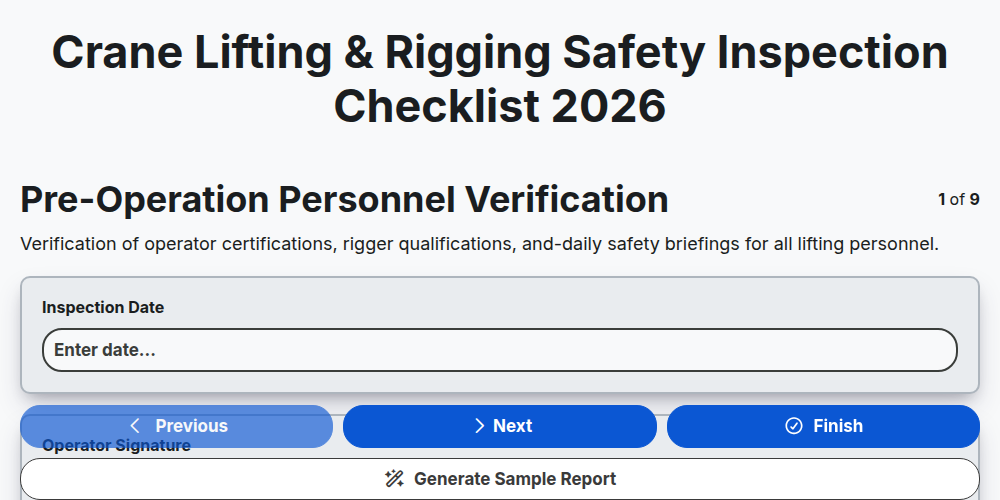
Table of Contents
- Introduction: Why Rigorous Inspections are Critical in 2026
- Phase 1: Pre-Operation Personnel Verification
- Phase 2: Crane Structural & Mechanical Inspection
- Phase 3: Wire Rope & Hoist Mechanism Audit
- Phase 4: Rigging Hardware & Slings Assessment
- Phase 5: Outriggers & Ground Stability Check
- Phase 6: Load Limit & Safety Device Calibration
- Phase 7: Communication & Signaling Protocol
- Phase 8: Environmental & Site Condition Review
- Phase 9: Post-Lift Equipment Decommissioning
- Best Practices for Digital Inspection Logging
- Conclusion: Maintaining a Zero-Incident Culture
- Resources & Links
TLDR: Ensure zero-incident operations in 2026 with our comprehensive crane and rigging safety inspection guide. This checklist covers everything from pre-operation personnel verification and structural audits to wire rope integrity, ground stability, and post-lift decommissioning, providing a complete safety roadmap for site supervisors and operators.
Introduction: Why Rigorous Inspections are Critical in 2026
The High Stakes of Modern Lifting Operations
As we move into 2026, the complexity of construction and industrial projects continues to escalate. With the integration of even more advanced heavy-lift technologies and increasingly dense urban worksites, the margin for error in crane operations has effectively vanished. In an era where precision is paramount, a single oversight in a rigging setup or a mechanical malfunction isn't just a delay-it is a potential catastrophe.
Beyond Compliance: The Cost of Negligence
While regulatory bodies like OSHA and international safety standards provide the baseline, true industry leaders recognize that compliance is the floor, not the ceiling. Relying solely on annual inspections is no longer sufficient. The dynamic nature of modern job sites-characterized by fluctuating wind patterns, shifting ground compositions, and the use of highly specialized, high-capacity machinery-demands a proactive, real-time approach to safety.
The 2026 Safety Landscape
The landscape of lifting and rigging has evolved. We are seeing more automated features, smarter sensors, and more complex multi-crane lifts. This increased sophistication brings new layers of risk. A failure to verify the integrity of a wire rope or the stability of an outrigger pad can lead to catastrophic structural collapses, significant environmental damage, and, most importantly, loss of life.
The Purpose of This Checklist
The Crane Lifting & Rigging Safety Inspection Checklist 2026 is designed to serve as your definitive operational safeguard. This template is not merely a tick-box exercise; it is a structured methodology to ensure that every component-from the structural integrity of the crane to the communication protocols between the operator and the signalperson-is scrutinized under a rigorous lens.
By implementing this systematic audit, your team can:
- Mitigate Risk: Identify micro-fractures, wear, and fatigue before they lead to failure.
- Ensure Operational Continuity: Prevent costly downtime caused by unexpected equipment breakdowns.
- Foster a Culture of Safety: Standardize high-level safety expectations across all shifts and crews.
- Protect Assets: Extend the lifecycle of expensive rigging hardware and heavy machinery through disciplined maintenance.
In the following sections, we will break down each critical phase of the inspection process, providing you with a professional-grade roadmap to ensure your lifting operations remain incident-free throughout 2026.
Phase 1: Pre-Operation Personnel Verification
Ensuring Competency Before the Hook Moves
Before a single piece of machinery is powered on, the most critical component of any lifting operation must be verified: the people involved. Safety in 2026 is not just about mechanical integrity; it is about the rigorous validation of human competency and-site-specific knowledge.
1. Certification and Competency Verification
The first step in your pre-operation routine is to audit the credentials of every individual assigned to the lift.
- Operator Licensing: Ensure all crane operators possess valid, up-to-date certifications specific to the class and capacity of the crane being used.
- Rigger & Signalperson Credentials: Verify that all riggers and signalpersons have undergone recent training and are recognized as competent persons under current regulatory standards.
- Training Logs: Review recent safety training records to ensure the crew is up-to-date on the latest lifting technologies and site-specific hazards.
2. Roles and Responsibilities Briefing
A common cause of site accidents is the ambiguity of command. During this phase, ensure that:
- Defined Command Structure: Every crew member knows exactly who is the designated Person in Charge (PIC) and who is authorized to provide signals.
- Emergency Protocol Review: All personnel must be briefed on the specific emergency shutdown procedures and the location of first-aid stations.
3. Fatigue and Fitness-for-Duty Assessment
Safety begins with the physical and mental readiness of the team.
- Shift Handover Review: If a shift change has occurred, perform a thorough briefing to communicate any previously identified mechanical issues or site changes.
- Health and Alertness Check: Implement a quick visual assessment to ensure that operators and riggers are not suffering from fatigue, which remains one of the leading contributors to lifting errors in heavy industry.
Phase 2: Crane Structural & Mechanical Inspection
Ensuring Structural Integrity and Mechanical Reliability
Once your personnel have been verified and cleared for duty, the focus shifts from the people to the machine itself. The structural and mechanical inspection is perhaps the most critical phase of the pre-operation sequence. In 2026, with more advanced, sensor-integrated machinery on job sites, this inspection requires a blend of traditional visual checks and high-tech diagnostic monitoring.
A failure in the structural integrity of a crane is often catastrophic and irreversible. Therefore, this phase is designed to identify fatigue, stress fractures, or mechanical wear before they manifest as operational failures.
Structural Integrity Assessment
The goal here is to identify any signs of physical degradation that could compromise the crane's ability to support its rated load.
- Boom & Jib Inspection: Conduct a thorough visual scan for any signs of cracks, dents, or deformations. Pay specific attention to the welds and joints, as these are high-stress points prone to fatigue.
- Chassis & Frame Verification: Check the main chassis for any signs of buckling or structural warping. Ensure that the mounting points for the boom are secure and free of debris.
- Hydraulic System Leak Detection: Inspect all hydraulic cylinders, hoses, and fittings. Even a minor weeping leak can lead to a sudden loss of pressure during a critical lift.
- Fastener & Bolt Audit: Verify that all critical bolts, pins, and retaining clips are present, tightened to specification, and show no signs of shearing or loosening.
Mechanical & Power Train Audit
A structurally sound crane is useless if the mechanical components fail to execute commanded movements accurately.
- Drive Train & Engine Performance: For mobile cranes, ensure the engine is running smoothly without irregular vibrations. Check fluid levels (oil, coolant, and transmission) and ensure no abnormal exhaust smoke is present.
- Control Lever & Joystick Functionality: Test all operator controls for smooth movement. There should be no dead zones or sticking, and the controls must return to the neutral position precisely as intended.
- Braking System Test: Perform a functional test of the hoist brakes and swing brakes. The stopping distance and holding power must meet the manufacturer's documented standards.
- Sensor & Electronic Diagnostic Check: In modern 2026-spec cranes, use the onboard computer system to run a self-diagnostic. Ensure that the Load Moment Indicator (LMI) and anti-two-block devices are communicating correctly with the crane's central processing unit.
Phase 3: Wire Rope & Hoist Mechanism Audit
Ensuring Integrity in Vertical Movement
The wire rope and hoisting mechanism serve as the lifeline of any lifting operation. In 2026, with more advanced automated monitoring systems entering the field, a manual audit must be paired with a keen eye for structural fatigue. A failure in the hoisting mechanism is often catastrophic, making this phase of the inspection non-negotiable.
Wire Rope Inspection Criteria
Your inspection should move systematically from the drum to the hook. Do not simply look for breaks; look for the subtle signs of degradation that precede failure.
- Wire Strand Integrity: Inspect for broken wires (fishhooks), kinking, bird-caging, or severe crushing. Pay close attention to areas where the rope passes over sheaves.
- Corrosion and Wear: Check for deep pitting, oxidation, or any signs of internal corrosion that could compromise the rope's core.
- Diameter Reduction: Measure the rope diameter at various points. Any significant reduction in thickness indicates internal strand deformation.
- Lubrication Status: Ensure the rope is sufficiently lubricated to prevent internal friction, but verify that the lubricant hasn't accumulated debris or grit.
Hoist & Drum Mechanism Audit
The mechanics driving the rope must be as reliable as the rope itself. Even a minor mechanical slip can lead to an uncontrolled load descent.
- Drum Condition: Inspect the drum for grooves, cracks, or uneven winding. Ensure the rope is spooled evenly without overlapping layers that could cause dig-in.
- Sheaves and Pulleys: Check all sheaves for wear, cracks, or misalignment. Ensure they rotate freely and that the grooves are not excessively worn, which could cause rope displacement.
- Braking Systems: Test the functionality of both the primary and secondary braking systems. The brakes must hold the rated load without any perceptible drift or slippage.
- Gearbox & Drive Train: Listen for unusual grinding or clicking noises during operation and check for any oil leaks that might indicate seal failure.
Phase 4: Rigging Hardware & Slings Assessment
Ensuring Integrity in Your Lifting Gear
While the crane provides the power, your rigging hardware is the critical link that transfers that power to the load. Even the most advanced crane in 2026 is rendered useless-or dangerous-if the slings and hardware fail under tension. This phase of the inspection focuses on the soft and hard components of your lifting assembly.
1. Wire Rope Slings & Synthetic Web Slings
Before every lift, a rigorous visual and tactile inspection of all slings is mandatory.
- Synthetic Web Slings: Check for any signs of fraying, punctures, burns, or chemical degradation. Pay close attention to the red warning yarns in polyester slings; if these are visible, the sling must be removed from service immediately.
- Wire Rope Slings: Inspect for kinking, bird-caging, or any broken wires (wire breaks). Ensure the diameter remains consistent and there are no signs of corrosion or heavy pitting.
- End Terminations: Examine all eyes, loops, and fittings for deformation or cracks.
2. Shackles, Hooks, and Master Links
Hardware integrity is non-negotiable. Every piece of metal hardware must be scrutinized for structural fatigue.
- Shackcle Inspection: Verify that pins are the correct type (bolt-type or screw-pin) and that threads are fully engaged and undamaged. Look for any bending or twisting of the shackle body.
- Hooks & Latches: Ensure all hooks are free from cracks and that the safety latches are functional, spring-loaded, and properly closing. A hook that does not secure the sling is a critical failure.
- Deformation Check: Check for any stretching or permanent deformation in master links or rings, which indicates the hardware has been subjected to an overload.
3. Lifting Beams and Spreader Bars
If your operation utilizes spreader bars to distribute weight, the inspection must extend to the structural integrity of these components.
- Alignment & Straightness: Ensure the bar has not suffered any bending due to uneven loading.
- Attachment Points: Inspect the lifting eyes and connection points on the ends of the spreader bar for any signs of wear or hairline fractures.
4. The Remove from Service Rule
The most vital part of this assessment is the decision-making process. During this phase, the inspector must enforce a zero-tolerance policy: If a piece of rigging is in doubt, it is out of service. All rejected hardware must be physically tagged as Defective and moved to a quarantine area to prevent accidental use in future shifts.
Phase 5: Outriggers & Ground Stability Check
Ensuring a Solid Foundation: Outriggers & Ground Stability Check
The most sophisticated crane in the world is useless-and incredibly dangerous-if the ground beneath it cannot support the load. Even with perfect mechanical integrity, a failure in ground stability can lead to catastrophic tip-overs, making this phase of the inspection critical for preventing site accidents.
1. Outrigger Deployment & Extension Audit
Before any lifting operations begin, a thorough physical inspection of the outrigger system must be conducted:
- Full Extension Verification: Ensure all outriggers are fully extended to the manufacturer's specified width as required by the load chart.
- Hydraulic Integrity: Inspect outrigger cylinders for signs of leaks, fluid loss, or slow retraction/extension, which could indicate pressure loss.
- Pad & Float Inspection: Check outrigger pads (floats) for cracks, warping, or structural degradation. Ensure they are large enough to distribute the pressure effectively.
2. Ground Bearing Capacity (GBC) Assessment
Never assume the ground is stable simply because it looks flat. A formal assessment of the lifting area is mandatory:
- Soil Composition Analysis: Identify the type of surface (e.g., compacted gravel, asphalt, or soft soil). Soft or uncompacted earth requires much larger footprint distribution.
- Subsurface Void Detection: Check for underground hazards such as utility trenches, manholes, or voids that could collapse under the concentrated weight of the crane and load.
- Compaction Verification: For heavy-duty lifts, verify that the ground has been properly compacted to meet the required pressure ratings.
3. Use of Cribbing and Mats
To bridge the gap between the outrigger and the ground, proper load distribution accessories must be used:
- Matting Integrity: Inspect timber mats or steel plates for any structural rot, cracks, or bending.
- Proper Sizing: Ensure the mats are large enough to prevent the punching effect, where the outrigger pierces the ground surface.
- Leveling Precision: Confirm that the outrigger pressure is distributed evenly across the matting, preventing uneven loading on the crane's chassis.
Phase 6: Load Limit & Safety Device Calibration
Ensuring Precision Through Calibration and Limit Verification
Safety in crane operations is not just about the strength of the equipment, but the accuracy of its monitoring systems. As we move into 2026, with more advanced sensors and automated load monitoring integrated into modern machinery, the precision of your calibration becomes the primary line of defense against catastrophic failure.
Verifying the Load Moment Indicator (LMI)
The LMI is the brain of your crane's safety system. Before any lift commences, it is mandatory to verify that the LMI is functioning in real-time with 100% accuracy.
- Sensor Accuracy Check: Ensure that the pressure transducers and angle sensors are communicating correctly with the display unit.
- Configuration Audit: Confirm that the crane's specific configuration (boom length, counterweight mass, and jib attachment) is correctly programmed into the system to prevent incorrect load calculations.
- Zeroing Sensors: Verify that all load cells are zeroed out before the weight of the hook block is introduced.
Testing Safety Cut-off Mechanisms
A safety device is only effective if it intervenes before a limit is breached. This phase of the inspection must confirm that all automatic overrides are operational.
Anti-Two Block (A2B) Testing: Perform a controlled test to ensure the anti-two block device triggers a warning or halts the hoist function before the block makes contact with the boom tip.
Overload Protection Test: Simulate or verify the functionality of the automatic cutout feature that prevents the crane from attempting a lift exceeding its rated capacity.
Boom Angle and Length Limits: Validate that the system provides audible and visual alerts when the boom reaches its minimum or maximum operational angles.
Functional Check of Ancillary Safety Features
Beyond the digital sensors, physical safety indicators must be scrutinized:
- Boom Swing/Slew Limits: For tower or crawler cranes, ensure the rotation limit switches are active to prevent collisions with nearby structures.
- Drum Rotation Sensors: Confirm that the drum's rotation sensors are accurately reporting the amount of line out, preventing over-winding risks.
- Emergency Stop Functionality: The most critical test of any inspection is the manual engagement of the Emergency Stop (E-Stop) buttons on both the operator's cab and the remote control units to ensure an immediate-kill command is processed without delay.
Phase 7: Communication & Signaling Protocol
Establishing Clear Lines of Communication
Even the most mechanically sound crane is a liability if the communication between the operator and the ground crew breaks down. In 2026, as automated technologies and remote-control lifting become more prevalent, the fundamental human element of signaling remains the most critical link in the safety chain. A breakdown in communication is a leading cause of near-miss incidents and catastrophic structural failures.
Standardizing Hand Signals and Radio Protocols
Before the first load is even rigged, all personnel involved-including the crane operator, signalperson, and rigger-must undergo a pre-shift briefing to confirm the method of communication.
- Visual Signal Standardization: Ensure all crew members are using the standard ASME/OSHA hand signals. Any deviation or non-standard gesture must be strictly prohibited.
- Radio Frequency Check: If using two-way radios, conduct a clarity test. Check for dead zones within the lift radius and ensure all headsets are functional and free of static interference.
- The All-Stop Command: Explicitly reinforce that any member of the crew has the authority to issue an emergency STOP signal. This command must be obeyed instantly by the operator without question.
Establishing Verbal Verbiage
When using radio communication, brevity and clarity are paramount. To prevent misunderstandings caused by environmental noise or radio lag, implement a closed-loop communication system:
- The Command: The signalperson issues a specific direction (e.g., Swing left, 5 degrees).
- The Acknowledgement: The operator repeats the command back verbatim (Swinging left, 5 degrees).
- The Confirmation: Once the movement is complete, the signalperson confirms (Swing stopped).
Managing the Blind Lift Scenario
If the load or the crane's boom obstructs the operator's direct line of sight to the load, a dedicated signalperson must be positioned at a vantage point where they can maintain constant visual contact with both the load and the operator. In these high-risk scenarios, the checklist must include a secondary verification of the relay person's position and their ability to maintain an uninterrupted line of sight.
Phase 8: Environmental & Site Condition Review
Assessing the Surroundings Before the First Lift
A crane does not operate in a vacuum. Even the most mechanically perfect machine can become a liability if the environment in which it operates is compromised. As we move into 2026, with increasing urban density and more complex construction sites, the Environmental & Site Condition Review has become one of the most critical components of a safety audit.
Evaluating External Environmental Hazards
Before any load is hooked, the site supervisor must conduct a thorough sweep of the surrounding area to identify invisible or fluctuating threats:
- Wind Speed and Gust Monitoring: High-altitude winds can exert much greater force than surface-level winds. Always verify that real-time anemometer readings are within the manufacturer's safe operating limits.
- Power Line Proximity: Identify all overhead power lines within the crane's swing radius. Maintain the mandatory clearance distances as dictated by local regulatory bodies (e.g., OSHA or HSE) to prevent catastrophic electrical arcing.
- Visibility and Lighting: Ensure that the entire path of the load and the landing zone are clearly visible. If night operations are required, verify that supplemental lighting is sufficient to eliminate shadows that could hide obstacles.
- Weather Forecast Integration: Beyond current conditions, check the short-term forecast for lightning, heavy rain, or sudden temperature shifts that could affect soil stability or hydraulic fluid viscosity.
Site Stability and Perimeter Control
The footprint of the crane must be secure and isolated from unauthorized personnel.
- Exclusion Zone Integrity: Verify that barricades, cones, or caution tape are properly placed to create a No-Go Zone beneath the boom and the potential fall path of the load.
- Subsurface Integrity: Inspect the ground for underground voids, utility access points, or uncompacted fill that could shift under the immense pressure of the crane's weight and load.
- Obstruction Clearance: Scan the swing radius for any new site developments-such as scaffolding, temporary structures, or newly placed materials-that could interfere with the crane's movement.
Pro-Tip for 2026: With the rise of Smart Site technology, utilize digital site maps and IoT-enabled sensors to automate the detection of unauthorized personnel entering the crane's hazard zone. Integrating these real-time alerts into your checklist ensures that the environment remains as safe as the machinery itself.
Phase 9: Post-Lift Equipment Decommissioning
Securing the Site: Post-Lift Procedures
The safety lifecycle of a lift does not end once the load touches the ground. The final phase of your 2026 safety protocol involves the systematic decommissioning of equipment to ensure that the site remains safe for the next shift and that your machinery is prepared for its next deployment.
1. Equipment Post-Operational Inspection
Before any gear is packed away, perform a quick post-use visual sweep. While the primary inspection happens pre-operation, checking for any new deformations, tension fatigue, or leaks that occurred during the specific lift can prevent damage during storage.
- Check for mechanical heat signatures: Inspect motors and brakes for unusual heat.
- Inspect for fluid leaks: Ensure no hydraulic lines were stressed during the load movement.
2. Rigging & Sling Storage Protocol
Improper storage is a leading cause of premature rigging failure. Never leave slings or hardware lying on the ground where they are susceptible to moisture, chemicals, or crushing.
- Clean and Dry: Wipe down slings to remove debris, oils, or corrosive agents.
- Organized Storage: Use dedicated racks or bins to prevent tangling and physical damage.
- Tagging: Ensure all inspected gear is returned to its designated, labeled location.
3. Site Clearance and Area Restoration
Decommissioning also refers to the workspace itself. A clean site is a safe site.
- Clear the Swing Radius: Ensure all temporary barricades and swing-radius warnings are either properly repositioned or removed according to site policy.
- Remove Obstructions: Clear any leftover dunnage, chocks, or debris from the crane's path of travel.
- Securing the Crane: If the crane is to be left unattended, ensure all booms are retracted/lowered, all controls are neutralized, and the power source is safely disconnected or locked out.
4. Documentation and Reporting
The final step in the 2026 checklist is the administrative closure.
- Logbook Entry: Document the completion of the lift, noting any anomalies or near-miss observations encountered during the operation.
- Maintenance Alerts: If any component showed signs of wear during the lift, immediately flag it for the maintenance team before the next pre-operation inspection.
Best Practices for Digital Inspection Logging
Moving Beyond Paper: The Shift to Real-Time Compliance
As we approach 2026, the era of clipboard and paper inspections is rapidly becoming a liability. In a high-stakes environment where a single oversight in a wire rope audit or an outrigger stability check can lead to catastrophic failure, the margin for error is zero. To maintain a gold standard of safety, modern lifting operations must transition toward digital inspection logging.
The Power of Digital Data Integrity
Digital logging transforms a simple checklist into a powerful diagnostic tool. When your team completes the Crane Structural & Mechanical Inspection on a tablet or mobile device, the data is instantly timestamped and geo-tagged. This ensures:
- Accountability: You have an immutable record of exactly who performed the pre-operation verification and when.
- Immediate Escalation: If a technician identifies a defect during the Rigging Hardware & Slings Assessment, digital systems can automatically trigger an Out of Service alert to site managers and procurement teams.
- Trend Analysis: Digital logs allow you to track wear patterns in Wire Rope & Hoist Mechanisms over months, moving your maintenance strategy from reactive to predictive.
Integrating IoT and Smart Sensors
The 2026 safety landscape is defined by the integration of hardware and software. The most advanced inspection workflows now involve:
- Automated Load Limit Syncing: Integrating digital checklists with crane Load Moment Indicators (LMI) to verify that Load Limit & Safety Device Calibration is being met in real-time.
- Sensor-Driven Ground Stability Alerts: Using digital logs to pair with geotechnical sensors that monitor Outriggers & Ground Stability during high-pressure lifts.
Building a Searchable Safety Culture
A digitalized checklist is more than a compliance document; it is a searchable library of site safety. When an auditor requests proof of Communication & Signaling Protocol training or Environmental & Site Condition Review logs from three months ago, a digital repository provides answers in seconds.
By adopting digital inspection logging, you aren't just checking boxes-you are building a continuous, transparent, and data-driven shield for your workforce and your assets.
Conclusion: Maintaining a Zero-Incident Culture
Moving Beyond Compliance to Proactive Safety
As we look toward 2026, the landscape of heavy lifting is evolving with more integrated technology and stricter regulatory oversight. However, no amount of advanced sensor technology can replace the fundamental discipline of a rigorous, systematic inspection. A checklist is not merely a bureaucratic requirement; it is your primary defense against the catastrophic risks of mechanical failure, structural instability, and human error.
The Cost of Negligence vs. The Value of Vigilance
The true value of implementing this Crane Lifting & Rigging Safety Inspection Checklist is measured not in the time spent performing the checks, but in the accidents that don't happen. A single missed step in the Outriggers & Ground Stability Check or a lapse in Communication & Signaling Protocols can lead to site-wide shutdowns, massive legal liabilities, and, most importantly, the loss of life.
Building a Sustainable Safety Framework
To truly achieve a zero-incident culture, your organization must treat this checklist as a living document. We recommend the following three pillars for long-term success:
- Continuous Training: Ensure that every operator, rigger, and signalperson understands the why behind each inspection point, not just the how.
- Digital Integration: Transition from paper logs to real-time digital auditing. This allows for instant reporting of discrepancies found during the Wire Rope & Hoist Mechanism Audit and creates a searchable history for regulatory compliance.
- Accountability at Every Level: Safety is a collective responsibility. Empower your ground crew to halt operations immediately if any part of the Load Limit & Safety Device Calibration fails to meet the required standards.
By integrating these rigorous inspection steps into your daily operational DNA, you are doing more than following a protocol-you are safeguarding your most valuable asset: your people.
Resources & Links
- OSHA (Occupational Safety and Health Administration): The primary regulatory body providing legal standards for crane operations, rigging, and heavy machinery safety in the United States.
- NIST (National Institute of Standards and Technology): Essential for understanding precision in load limit calibration and sensor accuracy standards for modern lifting equipment.
- ANSI (American National Standards Institute): Provides the industry-standard protocols for structural integrity and safety specifications for cranes and rigging hardware.
- Crane Integrity: Specialized resources regarding the inspection of heavy-duty lifting components and structural stability assessments.
- Rigging Magazine: An industry-leading publication offering technical insights into new rigging technologies and sling assessment methodologies.
- ISO (International Organization for Standardization): Global standards for safety management systems and quality control in heavy lifting operations.
- National Institute for Crane and Heavy Equipment: Comprehensive educational resources and training modules for crane operators and safety inspectors.
- ASME (American Society of Mechanical Engineers): The definitive source for technical codes (such as ASME B30) regarding the design, inspection, and maintenance of lifting devices.
- Leece-Youney: Expert insights into crane mechanics, structural maintenance, and the evolution of lifting technology.
- SafetyCulture: Advanced tools and digital templates for implementing digital inspection logging and real-time site safety monitoring.
- Heavy Equipment Guide: Technical reviews and maintenance tips for various heavy machinery, focusing on mechanical and hydraulic health.
- Construction Safety Standards: Best practices for site condition reviews, including ground stability and environmental risk management.
- The Crosby Group: Technical documentation and safety guides for rigging hardware, shackles, and load-bearing components.
- Safety Institute of America: Resources focused on developing a zero-incident culture and personnel verification protocols in high-risk environments.
- IBM (IoT & AI for Safety): Exploring how AI and IoT sensors contribute to the 2026 era of predictive maintenance and automated safety device calibration.
Comments
There are no comments yet. Be the first to add one!
Construction Management Solution Demo
Build smarter, not harder! ChecklistGuro streamlines construction projects from planning to closeout. Manage tasks, inspections, safety protocols & more - all in one place. Reduce delays, improve communication, and deliver projects on time & on budget.
Related Articles
The Ultimate Concrete Vibration Checklist Template
Unlock Value: Your Free Value Engineering Checklist Template
The Ultimate HVAC Ductwork Installation Checklist Template

The Ultimate Rebar Placement Checklist Template
Your Concrete Mix Design Verification Checklist: A Step-by-Step Guide
Backfilling & Compaction Checklist: A Foundation's Best Friend
The Ultimate Concrete Delivery & Placement Checklist Template
Your Ultimate Stakeholder Communication Plan Checklist Template
Need help with
Construction?
Have a question? We're here to help. Please submit your inquiry, and we'll respond promptly.