The Ultimate 2026 Energy Demand Response Program Readiness Checklist: A Step-by-Step Template for Success
Published: 10/31/2026 Updated: 11/01/2026
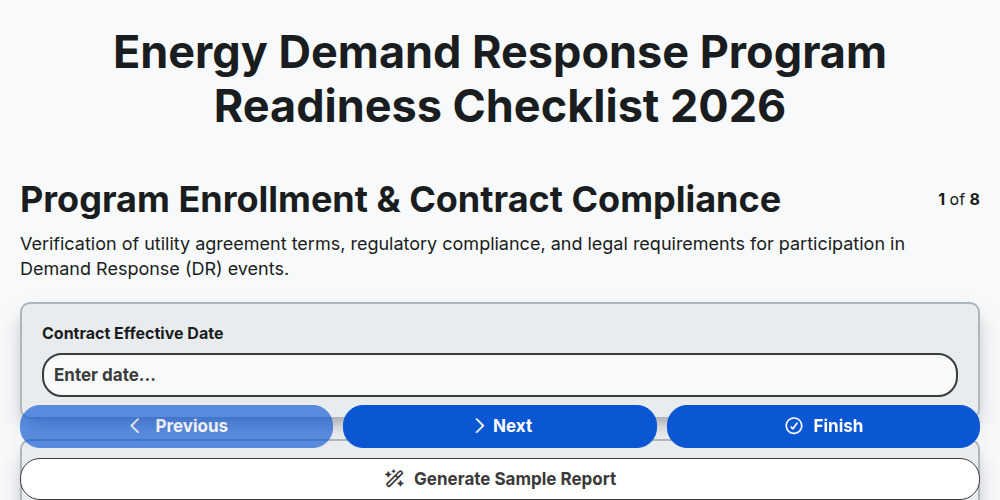
Table of Contents
- Introduction: Navigating the 2026 Energy Landscape
- Phase 1: Governance and Legal Foundations
- Step 1: Program Enrollment & Contract Compliance
- Phase 2: Data-Driven Strategy
- Step 2: Load Profile & Baseline Establishment
- Phase 3: Technological Infrastructure & Connectivity
- Step 3: Communication & Control Infrastructure
- Phase 4: Operational Readiness & Response Planning
- Step 4: Operational Resource Assessment
- Step 5: Event Response Protocols & SOPs
- Phase 5: Performance Monitoring & Intelligence
- Step 6: Monitoring, Reporting & Analytics
- Step 7: Human Capital & Risk Management
- Step 8: Financial Oversight & Incentive Optimization
- Conclusion: Future-Proofing Your Energy Strategy
- Resources & Links
TLDR: Preparing for 2026 Energy Demand Response programs requires a strategic approach to grid stability and cost management. This checklist provides a comprehensive roadmap for facility managers and energy leaders, covering everything from contract compliance and load profiling to infrastructure upgrades, operational protocols, and financial management to ensure seamless event execution and maximum incentive capture.
Introduction: Navigating the 2026 Energy Landscape
The Shift Toward a Dynamic Grid
As we approach 2026, the global energy landscape is undergoing a profound transformation. The rapid integration of renewable energy sources-wind, solar, and increasingly decentralized storage-has introduced a new level of complexity to grid management. The traditional always-on approach to energy consumption is being replaced by a more fluid, bidirectional model where flexibility is the most valuable currency.
For industrial, commercial, and utility-scale operators, this evolution brings a significant opportunity: Demand Response (DR) programs.
Why 2026 is a Pivotal Year for Demand Response
By 2026, grid operators and regulatory bodies will no longer view demand response as a nice-to-have ancillary service; it will be a fundamental requirement for maintaining grid stability. With the rise of Electric Vehicle (EV) fleets, the electrification of heating systems, and stricter decarbonization mandates, the ability to intelligently shed or shift load during peak periods is becoming a core business competency.
However, the stakes have never been higher. As DR programs become more sophisticated, so do the requirements for participation. Moving from simple manual load shedding to automated, high-frequency response requires more than just a willing mindset-it requires a robust, audited, and technologically integrated framework.
Beyond the Surface: The Need for a Systematic Approach
Participating in a modern DR program is no longer as simple as turning off non-essential lights during a heatwave. Today's programs demand precision, reliability, and verifiable data. A single failure to meet a contractual commitment can result in significant financial penalties, loss of incentive eligibility, or even reputational damage within the energy market.
To navigate this complexity, organizations must move beyond reactive measures. Success in 2026 requires a proactive, structured readiness strategy. This checklist is designed to serve as your operational blueprint, ensuring that your infrastructure, personnel, and financial models are fully optimized to capture value from every peak event while maintaining seamless business continuity.
Phase 1: Governance and Legal Foundations
Ensuring Compliance and Program Alignment
Before any hardware is installed or any protocols are drafted, your Demand Response (DR) journey must begin with a rock-solid administrative foundation. As we approach 2026, grid operators and utility providers are implementing more stringent regulatory frameworks and more complex-contractual obligations. Skipping this phase can lead to non-compliance penalties or even disqualification from lucrative incentive programs.
Program Enrollment & Contract Compliance
The first step is a comprehensive review of your participation agreement. You must ensure that your organization fully understands the rules of engagement set by the grid operator.
- Contractual Obligations: Are you aware of the specific obligations regarding curtailment levels and duration?
- Compliance Audits: Do you have a system in place to track adherence to the terms of your participation agreement?
- Regulatory Alignment: Does your program enrollment align with 2026 regional energy mandates and updated state-level energy efficiency standards?
- Penalty Mitigation: Have you clearly defined the financial and operational consequences of failing to meet a dispatched load reduction event?
Financial & Incentive Management
A Demand Response program is a financial instrument as much as it is an operational one. To ensure the program's long-term viability, you must move beyond simple participation and into active financial management.
- Revenue Stream Forecasting: Have you modeled the potential revenue from capacity payments versus the cost of energy/operational disruption?
- Incentive Tracking: Is there a dedicated process for documenting and verifying load reductions to ensure accurate settlement with the utility?
- Budgetary Integration: Is the DR program integrated into your broader corporate sustainability and energy procurement budgets?
- Audit Readiness: Are all financial records related to energy savings and incentive receipts organized for potential third-party audits?
Step 1: Program Enrollment & Contract Compliance
Securing Your Foundation: Enrollment and Compliance
Before you can begin modulating your energy consumption, you must ensure your organization is legally and administratively prepared to participate in the grid ecosystem. As we head into 2026, the regulatory landscape for Demand Response (DR) is becoming increasingly complex, with more stringent-than-ever requirements for contractual adherence and grid reliability.
Navigating the Regulatory Landscape
The first step in your readiness journey is ensuring that your organization fully understands the specific terms of your participation agreement. As utilities and grid operators transition toward more automated, high-frequency DR events, compliance no longer just means showing up when called-it means meeting precise performance metrics and latency requirements.
Key Compliance Audit Points
To ensure you are prepared for a successful 2026 rollout, use the following sub-checklist to audit your enrollment status:
- Contractual Obligations Review: Have you audited your current DR agreement for updated 2026 riders or new performance-based penalties?
- Regulatory Alignment: Does your participation strategy align with the latest regional transmission organization (RTO) or independent system operator (ISO) standards?
- Enrollment Documentation: Are all necessary legal permits, utility authorizations, and site-specific agreements up to date and accessible for audit?
- Service Level Agreement (SLA) Mapping: Have you clearly defined the Failure to Respond penalties within your internal risk management framework?
Avoiding the Compliance Trap
The most common pitfall in modern DR programs is failing to account for the shift from manual to automated compliance. In 2026, grid operators will expect near-instantaneous-response capabilities. If your contract stipulates a specific response time, your operational readiness must be measured against that exact metric. Ensure that your legal and operational teams are in total alignment to prevent costly non-compliance penalties that can erode the financial benefits of the program.
Phase 2: Data-Driven Strategy
Establishing Your Baseline and Predictive Power
Success in a 2026 energy market isn't just about reacting to signals; it is about precision. As grid volatility increases, the ability to distinguish between natural load fluctuations and event-driven reductions becomes the difference between profit and penalty.
Load Profile & Baseline Establishment
Before you can participate in a Demand Response (DR) program, you must know your business as usual (BAU) state.
- Historical Data Audit: Review at least 24 months of interval data to identify seasonal patterns and peak usage periods.
- Baseline Modeling: Implement regression-based modeling to predict what your energy consumption would have been had an event not occurred.
- Anomaly Identification: Develop a process to flag non-standard operating days (e.g., holidays or extreme weather shifts) that could skew your baseline and lead to inaccurate performance reporting.
Monitoring, Reporting & Analytics
In the era of real-time energy markets, visibility is your greatest asset. You cannot manage what you cannot measure.
- Real-Time Telemetry: Deploy high-frequency monitoring tools that provide live visibility into your energy consumption at the meter or circuit level.
- Automated Reporting Loops: Establish automated dashboards that compare real-time load against your predicted baseline. This allows for immediate verification of curtailment depth.
- Post-Event Analytics: Create a feedback loop where every DR event concludes with a post-mortem report, analyzing the delta between the target reduction and the actual reduction achieved.
Financial & Incentive Management
The technical success of a DR event is meaningless if the financial outcome does not align with your operational costs.
- Cost-of-Service Correlation: Calculate the precise marginal cost of curtailment-how much it costs your facility (in terms of lost productivity or increased cooling/heating needs) to shed a kilowatt.
- Revenue Tracking: Implement a robust accounting system to track incentive payments, capacity payments, and energy arbitrage gains against the operational expenses incurred during events.
- Contractual Audit Readiness: Ensure all data logs are archived in a format that meets the rigorous auditing standards required by Grid Operators and Load Serving Entities (LSEs) to guarantee payment integrity.
Step 2: Load Profile & Baseline Establishment
Defining Your Energy Fingerprint
Before you can participate in a Demand Response (DR) program, you must have a crystal-clear understanding of your facility's energy consumption patterns. You cannot manage what you cannot measure. Establishing a reliable load profile and a baseline is the cornerstone of ensuring you meet contractual obligations and maximize your incentive potential.
Establishing the Energy Baseline
The baseline is the benchmark of what your energy usage would have been had a demand response event not occurred. In 2026, with more sophisticated grid requirements, simply looking at last month's bill is no longer sufficient.
- Historical Data Analysis: Analyze at least 12 to 24 months of interval data to identify seasonal trends, weekly cycles, and daily peaks.
- Standardized Methodology: Ensure your baseline calculation aligns with the specific methodology required by your utility or grid operator (e.g., the High 8-of-10 method or similar algorithmic approaches).
- Regression Modeling: Consider utilizing regression analysis to account for external variables-such as ambient temperature and humidity-that significantly impact your energy demand.
Mapping Your Load Profile
A granular view of your load profile allows you to identify exactly which assets are sheddable and which are critical to your operations.
- Identify Curtailable Loads: Categorize your energy use into non-critical (e.g., HVAC setpoint adjustments, EV charging, lighting) and critical (e.g., manufacturing lines, data centers, life-safety systems).
- Analyze Peak Demand Drivers: Pinpoint the specific times of day and weather conditions that trigger your highest energy consumption.
- Quantify Load Shed Potential: Calculate the precise kilowatt (kW) or megawatt (kW) reduction capacity available to you during a typical event window.
Identifying Data Gaps and Metering Precision
A checklist for 2026 readiness is incomplete without an audit of your measurement accuracy.
- Sub-metering Implementation: Move beyond the main utility meter. Deploy sub-meters on key circuits to ensure you can verify your performance and prove compliance.
- Sensor Calibration: Ensure all temperature, pressure, and occupancy sensors used to automate load shedding are calibrated and providing real-time, accurate data.
- Data Granularity Check: Confirm that your metering infrastructure supports the high-frequency data intervals (e.g., 5 or 15-minute intervals) required by modern DR aggregators.
Phase 3: Technological Infrastructure & Connectivity
Strengthening the Digital Backbone: Communication & Control Infrastructure
As we move into 2026, the complexity of the grid is increasing alongside the integration of distributed energy resources (DERs). To participate effectively in a Demand Response (DR) program, your facility cannot rely on manual intervention alone. You must ensure that your technological ecosystem is capable of receiving, processing, and executing signals in near real-time.
Establishing Robust Communication Channels
The margin for error in event response is shrinking. Your infrastructure must support seamless, low-latency communication between the utility/aggregator and your onsite controllers.
- Protocol Compatibility: Ensure your hardware supports industry-standard communication protocols such as OpenADR (Open Automated Demand Response) or Modbus/TCP.
- Connectivity Redundancy: Relying on a single internet connection is a significant risk. Implement redundant communication paths (e.g., cellular failover or secondary fiber lines) to ensure signals are received even during local network outages.
- Latency Management: Audit your network architecture to minimize the delay between a signal sent and a load shed command.
Automated Control Integration
The era of human-in-the-loop demand response is fading. To maximize reliability and minimize operational friction, your infrastructure must prioritize automation.
- Automated Load Shedding Assets: Identify which building systems (HVAC, lighting, industrial processes, or EV charging stations) can be integrated into an automated control loop.
- Edge Computing Readiness: Evaluate whether your controllers possess the local intelligence to execute predefined logic autonomously if a connection to the central server is temporarily lost.
- Interoperability Testing: Conduct regular dry runs to ensure that your Building Management System (BMS) or Energy Management System (EMS) can interpret and execute complex, multi-step dispatch instructions without conflicting with local setpoints.
Cybersecurity & Data Integrity
With increased connectivity comes increased vulnerability. As your infrastructure becomes more integrated with external utility networks, your security posture must evolve.
- End-to-End Encryption: Ensure all data transmitted between the utility and your local controllers is encrypted to prevent unauthorized hijacking of your load-control capabilities.
- Access Control Protocols: Implement strict Identity and Access Management (IAM) for anyone-internal or external-accessing your energy control interfaces.
- Vulnerability Patch Management: Establish a rigorous schedule for firmware and software updates for all IoT-enabled devices and controllers involved in the DR loop.
Step 3: Communication & Control Infrastructure
Establishing the Digital Backbone of Your Response Strategy
In the landscape of 2026's grid volatility, manual intervention is no longer a viable strategy. To achieve the rapid-fire load shedding required by modern utility programs, your communication and control infrastructure must be automated, resilient, and interoperable. This step is about ensuring that when a Demand Response Event signal is sent, your facility reacts in milliseconds, not minutes.
Connectivity and Automated Signal Integration
The transition from manual overrides to automated response requires a seamless integration between the utility's dispatch signal and your building management system (BMS).
- OpenADR Compliance: Ensure your systems are compatible with OpenADR 2.0b (or the latest 2026 industry standards). This allows for standardized, automated communication between the utility and your distributed energy resources (DERs).
- Latency Reduction: Audit your network latency. A delay in signal transmission can lead to missed event windows, resulting in non-compliance penalties.
- Redundancy Protocols: Implement secondary communication channels (such as cellular backups or satellite links) to ensure that a local Wi-Fi or Ethernet failure doesn't leave you blind during a critical grid event.
Hardware & IoT Integration
Your infrastructure is only as smart as the sensors and controllers driving it. As we move deeper into 2026, the density of IoT devices in industrial and commercial settings is increasing.
- Edge Computing Capability: Evaluate whether your controllers can process load-shedding logic locally. Relying solely on the cloud for real-time decision-making introduces unacceptable risks during network congestion.
- Sensor Accuracy & Calibration: Your control infrastructure relies on real-time data from sub-meters and thermal sensors. Implement a rigorous calibration schedule to ensure the signal matches the actual load being reduced.
- Interoperability Testing: Perform End-to-End testing. Can your HVAC system, EV charging stations, and battery storage units all receive the same command and execute it simultaneously without conflicting instructions?
Cybersecurity and Grid Security
As infrastructure becomes more connected, the attack surface for your Demand Response program grows.
- End-to-End Encryption: All incoming signals from the utility must be authenticated and encrypted to prevent man-in-the-middle attacks that could trigger unauthorized load shedding.
- Access Control Management: Implement strict identity and access management (IAM) for any personnel or third-party vendors who have remote access to your control systems.
- Network Segmentation: Isolate your Demand Response control network from your primary corporate/operational network. This ensures that a breach in your office email system cannot lead to a compromise of your critical energy-shedding assets.
Phase 4: Operational Readiness & Response Planning
Mastering the Execution: Event Response Protocols & SOPs
As you move from technical setup to operational deployment, the focus shifts from capability to reliability. In a Demand Response (DR) environment, it isn't enough to have the technology; you must have a-battle-tested playbook for when an event is triggered.
Standard Operating Procedures (SOPs) for Event Activation
When a Demand Response event signal is received, every second counts. Your SOPs must clearly outline the sequence of actions required to shed load without compromising critical operations. This includes:
- Verification Steps: How to instantly validate the authenticity of a curtailment signal.
- Automated vs. Manual Triggers: Defining which loads drop automatically via Building Management Systems (BMS) and which require manual intervention.
- Hierarchy of Curtailment: A prioritized list of non-essential assets to be disconnected first to ensure maximum load reduction with minimal operational impact.
Staff Training & Emergency Preparedness
The most sophisticated automation is useless if your onsite team is caught off guard. Readiness in 2026 requires a culture of DR-Awareness.
- Drills and Simulations: Regularly scheduled dry runs of load-shedding events to ensure all stakeholders know their roles.
- Emergency Overrides: Clear instructions on how to override a DR event in the case of a facility emergency (e.g., a sudden heat spike in a critical server room).
- Contingency Communication: Establishing secondary communication channels (radio, SMS, or secondary email) in the event that the primary network or internet connection fails during an event.
Monitoring, Reporting & Analytics
Post-event intelligence is the key to long-term program profitability. To ensure you are meeting compliance and maximizing incentives, your monitoring framework must be robust.
- Real-Time Verification: Implementing telemetry that proves your facility actually met the requested reduction targets.
- Performance Analytics: Analyzing the depth and duration of your response to identify opportunities for further optimization in future cycles.
- Audit-Ready Reporting: Automating the generation of logs that can be presented to utility providers or grid operators to justify incentive payments and avoid penalties for non-compliance.
Step 4: Operational Resource Assessment
Auditing Your Physical and Human Assets
Before the first demand response event of 2026 arrives, you must move beyond software and contracts to evaluate the tangible assets that will execute your curtailment strategies. An operational resource assessment ensures that when a signal is received, your facility has the actual capacity to respond without compromising critical business functions.
Inventory of Curtailable Loads
The foundation of a successful response is a detailed audit of your controllable assets. You cannot manage what you have not inventoried. Your assessment should categorize loads into three distinct tiers:
- Tier 1: Immediate Curtailable Loads: Assets that can be shed instantly with zero impact on production (e.g., non-essential lighting, certain HVAC zones).
- Tier 2: Managed Loads: Assets that can be modulated or cycled (e.g., variable speed drives, chiller setpoint adjustments, or thermal energy storage).
- Tier 3: Last-Resort Loads: Assets that should only be shed during extreme events and carry high operational risks.
Capacity Verification and Flexibility Analysis
It is not enough to know a machine can be turned off; you must know the magnitude of the impact. For 2026 compliance, your assessment must quantify the kW potential of every identified load.
- Load Magnitude: Calculate the specific kilowatt (kW) reduction achievable per asset.
- Recovery Time Requirements: Determine how long an asset can remain offline before it creates a rebound effect or operational bottleneck.
- Interdependency Mapping: Identify if shedding one load (e.g., a cooling pump) inadvertently disables another critical system (e.g., a production line).
Maintenance and Reliability Audit
A demand response strategy is only as strong as the health of your equipment. A paper-only readiness plan will fail if a critical capacitor bank or automated switch is malfunctioning. Use this phase to conduct:
- Preventative Maintenance Review: Ensure all automated control hardware and heavy machinery are in peak operating condition.
- Hardware Lifecycle Assessment: Identify aging components in your control loop that may fail under the rapid cycling required during high-frequency event years.
- Redundancy Check: Verify that backup power systems and secondary control paths are functional and capable of supporting the transition to a curtailed state.
Step 5: Event Response Protocols & SOPs
Developing Robust Event Response Protocols & SOPs
Once your infrastructure is in place and your team is trained, the backbone of a successful Demand Response (DR) strategy lies in your Standard Operating Procedures (SOPs). In the 2026 energy landscape-characterized by higher frequency of grid volatility and more complex multi-resource orchestration-having a reactionary approach is no longer sufficient. You need a pre-defined, automated, and rigorously tested playbook.
Your protocols must transition your organization from reactive manual adjustments to proactive automated shedding.
Defining the Trigger-to-Action Workflow
A high-functioning SOP must clearly outline exactly what happens the moment a Demand Response event notification is received. This workflow should be documented to include:
- Notification Verification: How the signal is received (API, SMS, or Email) and how it is validated for authenticity to prevent phantom event responses.
- Load Shedding Hierarchy: A prioritized list of non-critical loads to be shed first. For example, HVAC setpoint adjustments or EV charging deceleration should always precede critical production line shutdowns.
- Decision Matrices: Clear logic for when to escalate an event. If a signal is received during a peak production window, who has the authority to override the curtailment?
Establishing Escalation and Communication Channels
When an event occurs, information silos are your greatest enemy. Your SOPs must define the communication loop between the facility managers, the energy/sustainability team, and executive stakeholders.
- Internal Alerting: Automating internal notifications so that all relevant departments (Operations, IT, and Facilities) are aware of the active curtailment period.
- External Reporting: Procedures for notifying grid operators or aggregators once the required load reduction has been successfully achieved.
The Return to Normal Protocol
One of the most overlooked aspects of DR readiness is the rebound effect. Rapidly re-engaging all heavy equipment simultaneously can cause local power quality issues or-even more costly-spike your demand charges.
Your checklist must include a Post-Event Ramp-up plan:
- Staggered Re-engagement: A timed schedule for bringing loads back online to prevent synchronized surges.
- Verification Steps: A post-event audit to ensure all automated systems have returned to their baseline settings and no critical systems were inadvertently left in a curtailed state.
Continuous Loop: Testing and Refinement
An SOP is not a static document. To maintain 2026 readiness standards, your protocols should undergo Dry Run simulations at least quarterly. These simulated events allow you to identify bottlenecks in your communication chain and refine your shedding hierarchy without risking actual operational downtime.
Phase 5: Performance Monitoring & Intelligence
Continuous Oversight and Data-Driven Optimization
In the landscape of 2026's volatile energy markets, successful Demand Response (DR) is no longer a set it and forget it operation. Once your infrastructure is live, the focus shifts from deployment to precision. This phase is about transforming raw telemetry into actionable intelligence to ensure your curtailment events are both effective and profitable.
Real-Time Monitoring and Alerting
To maintain compliance and optimize savings, you must implement a robust monitoring layer that provides real-time visibility into your load reduction.
- Telemetry Integration: Ensure seamless data flows from your edge controllers and IoT devices to your centralized dashboard.
- Threshold Alerting: Configure automated alerts for when load exceeds pre-defined limits or when hardware connectivity is lost during a critical event window.
- Anomaly Detection: Utilize AI-driven monitoring to distinguish between planned operational shifts and unplanned deviations in your energy profile.
Advanced Reporting and Compliance Auditing
Post-event analysis is the backbone of financial recovery. You cannot claim incentives if you cannot prove your performance through verifiable data.
- Automated Event Logs: Maintain immutable logs of every dispatched event, including start times, end times, and the magnitude of load reduction.
- Baseline Deviation Analysis: Compare your actual performance against your established baseline to identify lost savings opportunities caused by operational inefficiencies.
- Regulatory Audit Readiness: Structure your reporting architecture to meet the stringent transparency standards required by grid operators and utility providers in 2026.
Predictive Analytics and Forecasting
The most advanced DR programs use the data gathered in this phase to predict the future.
- Load Forecasting Models: Use historical event data to refine your predictive models, allowing you to anticipate how different weather patterns or production schedules will impact your available capacity.
- Optimization Loops: Feed your performance analytics back into your operational resource assessment to fine-tune which assets should be dispatched during high-stress grid periods.
- ROI Tracking: Integrate energy savings data with financial tracking to calculate the real-time Return on Investment (ROI) for your demand response participation.
Step 6: Monitoring, Reporting & Analytics
Data-Driven Oversight: Measuring What Matters
As we move into 2026, the era of set it and forget it demand response is over. With the integration of more volatile renewable energy sources into the grid, program success is now defined by the precision of your data. To ensure your facility or fleet is actually delivering the promised load reductions, you must move beyond basic meter readings and embrace real-time analytical oversight.
Establishing Your Performance Metrics
To prove compliance and maximize your returns, your monitoring framework must track more than just total energy consumption. You need to focus on:
- Real-Time Load Deviation: Tracking the delta between your predicted baseline and your actual consumption during an event.
- Response Latency: Measuring the time elapsed between a Demand Response (DR) signal being received and the actual drop in load.
- Curtailment Accuracy: Assessing how closely your automated systems are adhering to the programmed setpoints.
The Role of Advanced Analytics
In 2026, manual spreadsheets are a liability. A robust readiness plan requires an integrated analytics layer that can perform Automated Baseline Verification. By leveraging machine learning, you can account for external variables-such as ambient temperature, humidity, and occupancy levels-to ensure your baseline remains accurate even during extreme weather shifts.
Continuous Feedback Loops
Monitoring should not be a reactive process used only after an event has concluded. Effective programs utilize a continuous feedback loop where:
- Data is ingested from IoT-enabled meters and smart controllers.
- Discrepancies are flagged immediately via automated alerts.
- Post-event reports are generated to identify missed opportunities or technical glitches.
Audit Readiness & Transparency
Finally, remember that your monitoring system is your primary defense during financial audits. If your reporting cannot provide a granular, timestamped audit trail of every load-shedding action, you risk much-needed incentives being clawed back by the grid operator. Ensure your reporting architecture is transparent, interoperable with utility platforms, and capable of producing single source of truth documentation.
Step 7: Human Capital & Risk Management
Strengthening the Human Element: Staff Training & Emergency Preparedness
A sophisticated Demand Response (DR) strategy is only as resilient as the people managing it. Even the most advanced automated control systems can fail if your onsite team is unprepared to intervene during a critical event. As we look toward 2026, where grid volatility and frequency of events are expected to increase, your human infrastructure must be just as robust as your digital infrastructure.
Mastering the DR Workflow through Training
To ensure seamless execution, your operational personnel must move beyond basic awareness and achieve functional mastery of the DR lifecycle. Your training program should focus on:
- Event Lifecycle Fluency: Every stakeholder-from facility managers to shift supervisors-must understand the specific triggers, duration, and expected load reduction targets for each type of event (e.g., peak shaving vs. frequency regulation).
- Manual Override Competency: While automation is the goal, your team must be experts in manual intervention. Training must include de-escalation protocols-knowing exactly when and how to manually restore loads if an automated signal fails or if a critical process requires immediate power.
- Cross-Departmental Synergy: Communication loops must be closed between the energy management team, facilities maintenance, and production heads to ensure that DR events do not inadvertently compromise critical manufacturing or operational outputs.
Emergency Preparedness & Contingency Planning
In the context of 2026's energy landscape, preparedness also means planning for when the plan fails. Your checklist must include the development of rigorous contingency protocols:
- Communication Redundancy: What happens if the primary cellular or internet gateway used for DR signals goes down? Establish secondary communication channels (e.g., radio, SMS, or satellite) to ensure real-time visibility during a grid emergency.
- Failure Mode Effect Analysis (FMEA): Conduct regular drills to simulate worst-case scenarios, such as a sudden loss of telemetry or a failure in the automated load-shedding sequence.
- The Rebound Protocol: One of the highest risks in Demand Response is the rebound effect-the sudden surge in demand when an event ends. Your team must have a choreographed sequence for ramping loads back up incrementally to prevent localized transformer overloads or secondary spikes in demand charges.
By integrating rigorous training and proactive risk assessment into your readiness checklist, you transform your Demand Response program from a passive cost-saving measure into a highly resilient operational asset.
Step 8: Financial Oversight & Incentive Optimization
Maximizing ROI through Rigorous Financial Management
Ensuring your facility is technically capable of responding to a demand response (DR) event is only half the battle; the final piece of the readiness puzzle is ensuring that the economic benefits of participation outweigh the operational costs. As DR markets evolve toward more complex, high-frequency, and performance-based compensation models in 2026, guessing your potential revenue is no longer a viable strategy.
Managing Incentives and Contractual Obligations
To maintain a healthy bottom line, your financial framework must account for both the capacity payments (the fixed payments for being available) and the energy/demand payments (the variable payments for actual reduction).
- Audit Incentive Structures: Regularly review your DR contracts to ensure you are maximizing every available incentive, including state-level rebates, utility-based credits, and carbon-offset premiums.
- Calculate the Cost of Curtailment: Develop a granular cost-modeling system. You must know the precise opportunity cost of reducing load-for example, does shedding load in a specific production line result in lost revenue that exceeds the DR payment?
- Verify Compliance Penalties: Non-compliance during a triggered event can lead to heavy financial penalties or even removal from the program. Your financial tracking must include a risk buffer to account for potential under-performance.
Tracking and Reconciliation
The complexity of 2026 energy markets requires a high level of precision in accounting.
Essential Financial Checkpoints:
- Revenue Stream Verification: Are all incentive payments being reconciled against your actual load reduction data?
- Budgetary Integration: Is the DR revenue being integrated into your broader energy procurement and utility budget?
- Performance-Based Pay Alignment: As utilities shift toward more stringent performance metrics, do you have the auditing tools to prove your accuracy for pay-for-performance models?
By treating Demand Response as a strategic financial asset rather than just an operational task, you transform your energy management from a cost center into a significant driver of corporate profitability.
Conclusion: Future-Proofing Your Energy Strategy
Preparing for the 2026 Grid Landscape
As we approach 2026, the transition toward a more volatile, renewable-heavy energy grid is no longer a future projection-it is our current reality. The complexity of grid management is increasing, and with it, the-importance of sophisticated Demand Response (DR) programs. Adopting a proactive, checklist-driven approach is no longer optional; it is a fundamental requirement for operational resilience and cost optimization.
Beyond Compliance: Turning Readiness into Competitive Advantage
The steps outlined in this checklist-from establishing precise load profiles to refining financial incentive management-are designed to do more than just ensure compliance. When executed correctly, these processes transform your energy strategy from a reactive necessity into a proactive competitive advantage.
By mastering your Communication & Control Infrastructure and perfecting your Event Response Protocols, you reduce the risk of costly operational errors during peak events. Simultaneously, by focusing on Monitoring, Reporting, and Analytics, you unlock the data necessary to prove the value of your flexibility to stakeholders and grid operators alike.
The Path Forward
The journey to 2026 readiness is iterative. We recommend revisiting this checklist quarterly to account for evolving regulatory frameworks, new smart technology integrations, and shifting energy market prices.
Key Takeaways for your Roadmap:
- Audit Early: Don't wait for a grid emergency to test your Operational Resource Assessment.
- Invest in Data: Ensure your Baseline Establishment is backed by high-resolution, real-time telemetry.
- Empower your People: A checklist is only as effective as the Staff Training behind it.
The energy landscape is changing rapidly. By systematically checking off these critical milestones, you ensure that when the next high-demand event hits, your organization isn't just surviving the surge-you are leading the response.
Resources & Links
- U.S. Energy Information Administration (EIA): Essential for understanding long-term energy projections and the evolving demand landscape leading into 2026.
- PJM Interconnection: A leading RTO/ISO resource for learning about real-world demand response program structures and grid reliability.
- ISO New England: Reference for regional energy market operations and demand-side management protocols.
- Electric Reliability Council of Texas (ERCOT): Critical insights into large-scale demand response implementation and frequency regulation.
- International Energy Agency (IEA): Global perspectives on energy transitions, decarbonization, and the impact of renewable integration on demand.
- National Institute of Standards and Technology (NIST): Vital for Phase 3: Standards for data interoperability, cybersecurity, and communication protocols in smart grids.
- U.S. Department of Energy (DOE): Source for federal regulations, smart grid initiatives, and technological development grants.
- IEEE Xplore: Technical research and white papers on energy management systems (EMS) and automated demand response (ADR) technologies.
- SEMI: Information on the semiconductor and hardware infrastructure required for advanced energy monitoring sensors.
- NIST Cybersecurity Framework: Key resource for Phase 7: Managing digital risks and protecting critical energy infrastructure from cyber threats.
- Gartner: Strategic insights for Phase 5: Evaluating analytics tools, AI-driven forecasting, and enterprise software procurement.
- PwC Energy, Utilities & Resources: Expert guidance on Phase 8: Financial oversight, regulatory compliance, and energy market investment strategies.
- Bloomberg Energy: Real-time market data and news to assist in Phase 2: Analyzing market trends and load profile shifts.
- Smart Grid Program: Frameworks for interoperability and advanced communication between utilities and end-users.
- Energy Info Global: Case studies on successful demand response implementation and operational efficiency.
- ISO 27001 Standards: The gold standard for information security management systems, essential for Phase 3 and Phase 7.
- Environmental Protection Agency (EPA): Information on the intersection of demand response and carbon footprint reduction targets.
Comments
There are no comments yet. Be the first to add one!
Energy Management Solution Demo
Managing operations, safety, and compliance in the energy sector is critical. ChecklistGuro's Work OS platform streamlines your workflow from exploration and production to distribution and maintenance. Enhance safety, improve efficiency, and ensure regulatory adherence. Discover how ChecklistGuro can transform your energy business!
Related Articles
Stay Compliant: Your Energy Metering Compliance Checklist Template
Unlock Savings: Your Complete Energy Efficiency Audit Checklist
Your Ultimate Energy Efficiency Audit Checklist Template
Power Through: Your Essential Energy Grid Outage Support Checklist
Oil & Gas Well Safety Inspection Checklist: Ensuring a Secure Operation
HVAC System Maintenance Checklist: Building Climate Control & Energy Savings
Renewable Energy Project Checklist Template
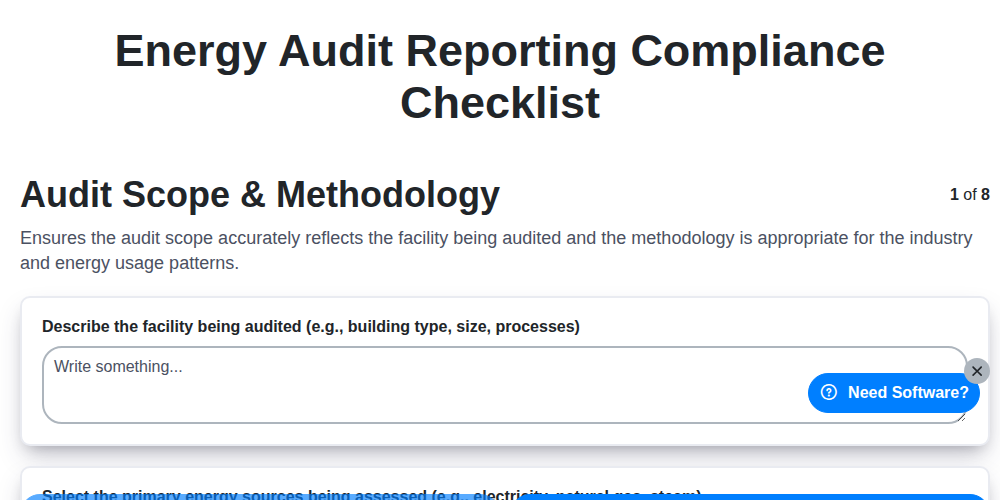
Energy Audit Reporting Compliance: Your Checklist for Success
Need help with
Energy?
Have a question? We're here to help. Please submit your inquiry, and we'll respond promptly.