Streamlining Compliance: A Step-by-Step Workflow for Environmental Monitoring and Cleanroom Control
Published: 06/04/2026 Updated: 10/05/2026
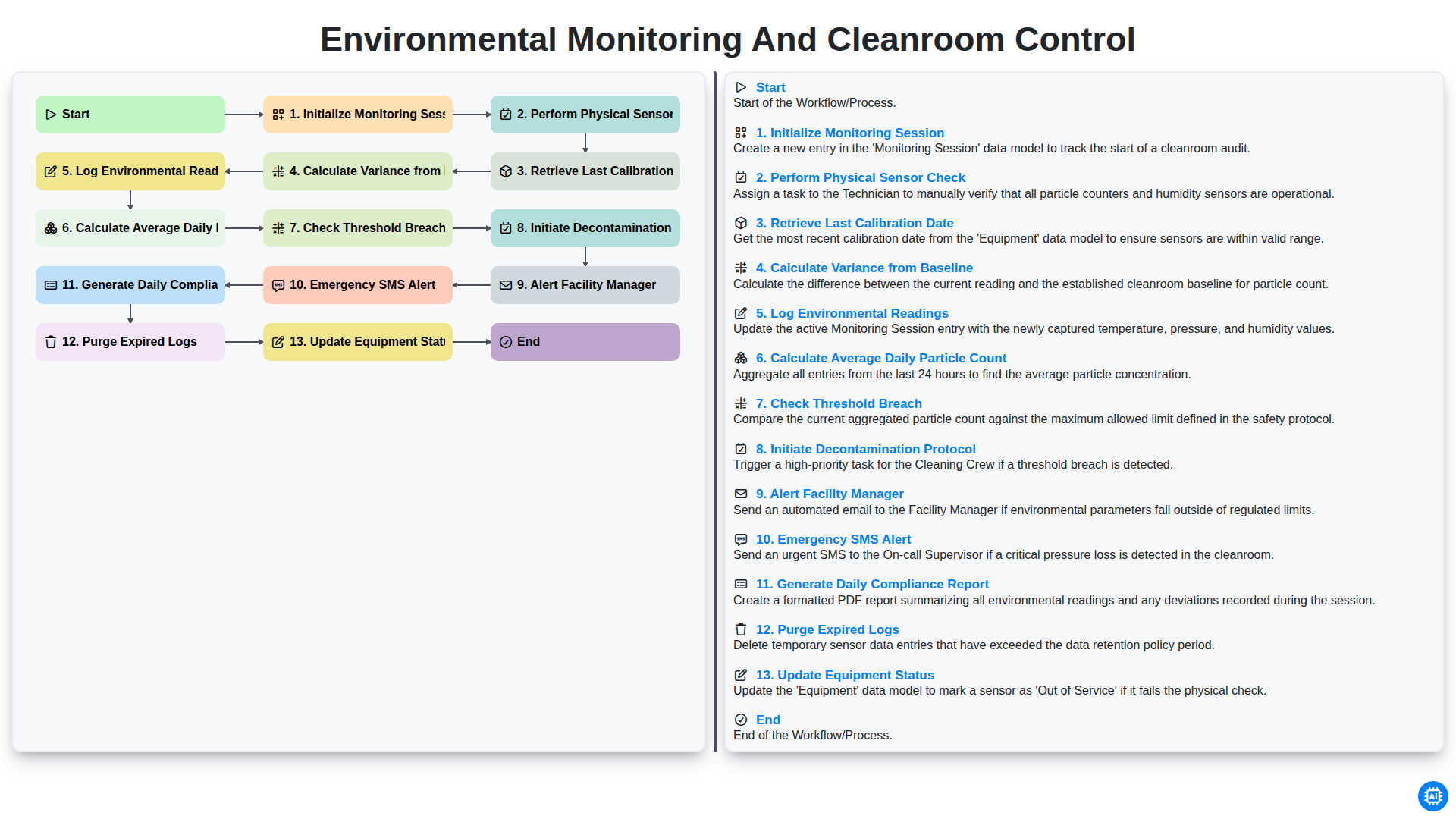
Table of Contents
- Introduction: The Critical Importance of Cleanroom Integrity
- Phase 1: Preparing for the Monitoring Session
- Initial Setup: Initializing the Monitoring Session
- Hardware Verification: Performing Physical Sensor Checks
- Ensuring Accuracy: Retrieving Last Calibration Dates
- Phase 2: Real-Time Data Collection and Analysis
- Establishing Standards: Calculating Variance from Baseline
- The Core Process: Logging Environmental Readings
- Analyzing Trends: Calculating Average Daily Particle Counts
- Phase 3: Incident Detection and Emergency Response
- Identifying Critical Failures: Checking Threshold Breaches
- Mitigation Procedures: Initiating Decontamination Protocols
- Communication Escalation: Alerting Facility Managers and Emergency SMS Protocols
- Phase 4: Post-Monitoring Compliance and Data Maintenance
- Reporting and Audit Readiness: Generating Daily Compliance Reports
- Data Hygiene: Purging Expired Logs and Updating Equipment Status
- Resources & Links
TLDR: This guide breaks down an automated operational workflow designed to maintain rigorous cleanroom standards. Learn how to manage everything from initial sensor calibration and real-time particle count monitoring to automated breach alerts and compliance reporting, ensuring your facility remains audit-ready and compliant with strict environmental safety protocols.
Introduction: The Critical Importance of Cleanroom Integrity
In the high-stakes environments of pharmaceutical manufacturing, biotechnology, and semiconductor fabrication, there is no margin for error. A single microscopic particle or a slight fluctuation in humidity can compromise an entire production batch, leading to catastrophic financial losses and, more importantly, significant risks to product safety and efficacy. Maintaining a controlled environment is not merely a matter of cleanliness; it is a rigorous, continuous process of scientific oversight.
Cleanroom integrity relies on the seamless integration of real-time monitoring and proactive control. It requires a sophisticated, automated workflow that moves beyond simple observation into the realm of active prevention. To achieve true compliance with regulatory standards such as GMP and ISO, facilities must move away from reactive troubleshooting and toward a structured, end-to-end monitoring system. This ensures that every environmental variable-from particle counts to atmospheric pressure-is tracked, validated, and acted upon the moment a deviation occurs. Understanding the systematic lifecycle of environmental monitoring is the first step in building a truly resilient, contamination-free manufacturing ecosystem.
Phase 1: Preparing for the Monitoring Session
Before any environmental data can be reliably recorded, the integrity of the monitoring process must be established through a rigorous preparation sequence. The workflow begins by initializing the monitoring session, which sets the temporal parameters for the period being tracked. Once the session is active, the first critical manual step is to perform a physical sensor check to ensure all hardware is properly seated, powered, and functioning within operational parameters.
Accuracy in cleanroom environments depends entirely on the reliability of the instrumentation; therefore, the system must automatically retrieve the last calibration date for every sensor in the network. This allows the system to verify that all devices are within their valid testing window. Following this verification, the system must calculate the variance from the baseline, establishing the standard environmental norm for the cleanroom. By identifying the delta between current conditions and the established baseline, the system creates a sensitive starting point that allows for the immediate detection of even the slightest atmospheric shifts.
Initial Setup: Initializing the Monitoring Session
Before any data can be collected or any sensors can be analyzed, the foundation of a reliable monitoring cycle begins with the Initialize Monitoring Session step. This phase is critical as it establishes the operational parameters for the entire period.
Initializing the session is not merely about turning on a system; it is about establishing a synchronized start time and defining the specific environmental parameters-such as temperature, humidity, and pressure-that need to be tracked for the upcoming interval. By formally initializing the session, the system creates a dedicated data container that ensures all subsequent readings are timestamped and attributed to a specific, verifiable window of time. This ensures data integrity and provides a clean slate, preventing the overlapping of data from previous cycles and ensuring that all downstream calculations, such as variance and daily averages, are based on a fresh and accurate dataset.
Hardware Verification: Performing Physical Sensor Checks
Before relying on digital data, the integrity of your environmental monitoring system depends entirely on the health of the physical hardware. The Perform Physical Sensor Check stage is a critical manual touchpoint in the workflow designed to bridge the gap between software intelligence and physical reality.
During this phase, technicians must conduct a hands-on inspection of all deployed sensors, probes, and sampling pumps. This process goes beyond simply checking if a device is on; it involves verifying the physical stability of sensor mounts, inspecting cables for signs of degradation or tampering, and ensuring that particle counters are positioned precisely as specified in the cleanroom design. Even a slight displacement of a sensor due to airflow or cleaning activities can lead to inaccurate readings and false positives.
By integrating this physical verification into the automated workflow, you ensure that the subsequent data collection-such as retrieving calibration dates and calculating variances-is based on a foundation of reliable, properly positioned, and undamaged hardware. This step is your first line of defense against silent sensor failures that could otherwise compromise your entire compliance much later in the monitoring cycle.
Ensuring Accuracy: Retrieving Last Calibration Dates
To maintain the integrity of environmental monitoring, the reliability of your sensors is just as critical as the readings they produce. A key step in our automated workflow is the process of retrieving the last calibration date for every active sensor in the cleanroom.
Sensors used for monitoring particulates, humidity, and temperature are subject to drift over time, which can lead to false negatives or, more dangerously, undetected threshold breaches. By automatically pulling the most recent calibration timestamp from our central database, the system can instantly cross-reference sensor age against mandatory compliance intervals. This proactive check ensures that no unverified data point is ever used to make critical decisions regarding cleanroom stability, effectively preventing sensor degradation from compromising your facility's regulatory compliance.
Phase 2: Real-Time Data Collection and Analysis
Once the monitoring session is initialized and the physical integrity of the sensors is verified, the workflow transitions into the critical phase of real-time data collection and analysis. This stage is where raw environmental data is transformed into actionable intelligence through a rigorous, automated sequence of validation and computation.
The process begins by retrieving the last calibration date for each sensor to ensure data integrity, followed immediately by calculating the variance from established baselines. This allows the system to detect subtle drifts in environmental conditions before they escalate into non-compliance. As the sensors continuously log environmental readings, the system performs complex mathematical processing, such as calculating the average daily particle count, to identify long-term trends in air quality.
The true power of this phase lies in its proactive monitoring capabilities. The workflow is programmed to constantly check for threshold breaches; the moment a parameter deviates from the permitted range, a multi-tiered response is triggered. This includes initiating the decontamination protocol and notifying the facility manager through standard channels, as well as deploying an emergency SMS alert for immediate critical intervention. By automating the transition from data logging to emergency response, the system ensures that the cleanroom environment remains within strict regulatory limits without the need for constant manual oversight.
Establishing Standards: Calculating Variance from Baseline
To maintain the integrity of a controlled environment, monitoring data cannot be viewed in isolation. A single reading, no matter how low, lacks critical context without a point of comparison. This is why the workflow moves immediately from retrieving calibration data to the critical step of calculating variance from baseline.
The baseline represents the established equilibrium of your cleanroom-the gold standard of particulate levels, humidity, and temperature under optimal operating conditions. By calculating the variance, the system measures the delta between real-time sensor data and these predefined setpoints.
This step serves as the primary diagnostic tool for detecting drift. Small, incremental increases in particle counts or fluctuations in atmospheric pressure may not immediately trigger a threshold breach, but they often signal a burgeoning issue, such as a failing HEPA filter, a compromised seal, or improper gowning practices. By mathematically quantifying this deviation, the system transitions from simple data logging to intelligent, proactive environmental oversight, allowing for trend analysis that can preempt failures before they compromise product safety.
The Core Process: Logging Environmental Readings
At the heart of any-regulated facility lies the critical phase of data acquisition: Logging Environmental Readings. This step is more than just a routine recording of numbers; it is the foundational pillar of environmental integrity. During this stage, the system captures real-time data from a synchronized network of sensors, documenting critical parameters such as temperature, humidity, pressure differentials, and particulate matter levels.
Precision in this phase is non-negotiable. Every data point logged serves as a permanent, timestamped record that validates the stability of the controlled environment. By integrating automated logging, we eliminate the risk of human error and ensure that the digital twin of your cleanroom remains an accurate, unalterable reflection of the physical space. This continuous stream of high-fidelity data provides the necessary visibility required to maintain strict compliance with ISO and GMP standards, turning raw sensor input into actionable intelligence.
Analyzing Trends: Calculating Average Daily Particle Counts
To maintain a sterile environment, looking at individual data points is not enough; true operational intelligence comes from identifying patterns over time. A critical component of our workflow involves the ability to Calculate Average Daily Particle Count.
By aggregating sensor data into daily averages, we move beyond reacting to isolated spikes and begin to understand the underlying baseline of the cleanroom. This analytical step allows facility managers to distinguish between a one-off anomaly-perhaps caused by a brief door opening-and a genuine degradation in air filtration efficiency. Tracking these daily averages helps in predicting potential failures before they result in a breach, transforming your environmental monitoring from a reactive checklist into a proactive predictive maintenance strategy.
Phase 3: Incident Detection and Emergency Response
When environmental parameters deviate from established safety standards, the system transitions from passive monitoring to active intervention. This critical phase is governed by a precise, automated sequence designed to mitigate risk the moment a deviation is detected.
The process begins with a real-time Check for Threshold Breach. Once the system identifies that a reading-such as particle count or humidity-has exceeded the predefined limit, it immediately triggers the Initiate Decontamination Protocol. This ensures that the cleanroom environment is brought back to a sterile state without delay. Simultaneously, the system performs an escalation sequence: it will Alert the Facility Manager through standard internal channels and, in cases of high-criticality failures, dispatch an Emergency SMS Alert to ensure immediate-response personnel are notified regardless of their location. This multi-layered notification strategy ensures that no breach goes unnoticed, maintaining the integrity of the controlled environment through rapid, automated-driven decision-making.
Identifying Critical Failures: Checking Threshold Breaches
In a highly regulated cleanroom environment, the transition from routine monitoring to active crisis management is defined by a single, critical moment: the Threshold Breach Check. This step serves as the automated tripwire within our workflow, acting as the vital link between data collection and emergency response.
Once the system logs the real-time environmental readings and calculates the average daily particle counts, it immediately compares these figures against pre-set-point limits for temperature, humidity, pressure differentials, and particulate matter. A breach is not merely a statistical anomaly; it is a signal of potential contamination or mechanical failure that threatens the integrity of the entire production batch.
When the system detects that a parameter has drifted outside of the validated range, the workflow instantly shifts from passive monitoring to active mitigation. This trigger initiates a high-priority cascade of actions, including the immediate deployment of decontamination protocols and the dispatch of emergency alerts to facility management. By automating this detection phase, we eliminate the risk of human error and ensure that the window between a contamination event and its containment is reduced to mere seconds.
Mitigation Procedures: Initiating Decontamination Protocols
When environmental parameters deviate from established safety margins, the system moves beyond mere observation and into active mitigation. The core of this reactive phase is the Initiate Decontamination Protocol. This automated trigger is activated the moment the system performs a Check Threshold Breach, identifying that airborne particulates or microbial levels have exceeded the permissible limits defined in your SOPs.
Once a breach is detected, the workflow executes a pre-programmed sequence of sterilization and air purification tasks designed to rapidly restore the cleanroom to its required ISO class. This process is not an isolated event; it is synchronized with a multi-layered communication cascade. To ensure total oversight, the system will simultaneously Alert Facility Manager via standard internal channels and trigger an Emergency SMS Alert to critical response teams. This ensures that even if personnel are away from their workstations, the breach is acknowledged instantly, minimizing the window of risk and preventing compromised batches from being processed during periods of non-compliance.
Communication Escalation: Alerting Facility Managers and Emergency SMS Protocols
When environmental parameters drift beyond permissible limits, rapid-response communication is the most critical component of a controlled environment. The workflow is designed to eliminate the human delay by automating the transition from detection to notification. Once a Check Threshold Breach is triggered, the system immediately initiates a multi-tiered escalation strategy.
The first tier of escalation involves an Alert Facility Manager notification. This is a targeted internal alert-often delivered via dashboard notifications or email-intended to notify the person in charge of the specific zone that the environment is approaching a non-compliant state. This allows for preemptive investigation before a critical breach occurs.
However, if the deviation is severe or indicates an immediate risk to product integrity, the system moves to the second, more urgent tier: the Emergency SMS Alert. This high-priority protocol bypasses standard notification queues to deliver real-time, instantaneous text alerts to designated stakeholders. This ensures that even if personnel are away from their workstations, the critical nature of the breach is communicated immediately, facilitating an instantaneous response to Initiate Decontamination Protocol and minimizing the window of risk. This layered approach ensures that no sensor anomaly goes unnoticed and that the facility's response time is always measured in seconds, not hours.
Phase 4: Post-Monitoring Compliance and Data Maintenance
Once the active monitoring period concludes, the focus shifts from real-time observation to ensuring data integrity and system hygiene. This final phase is critical for maintaining regulatory compliance and ensuring that the monitoring system remains a reliable single source of truth for audit readiness.
The process begins with the immediate Generation of a Daily Compliance Report, which consolidates all logged readings, variance calculations, and threshold checks into a formal record. To prevent data bloat and ensure the system remains performant, the workflow includes an automated step to Purge Expired Logs, removing outdated information that no longer meets retention requirements.
Simultaneously, the system performs an automated Update of Equipment Status. This ensures that any sensors that triggered alerts or required attention during the session are flagged for maintenance, providing an accurate snapshot of the cleanroom's operational health. By automating these closing steps, facilities can guarantee that their digital records are as pristine and controlled as the cleanrooms they monitor.
Reporting and Audit Readiness: Generating Daily Compliance Reports
In highly regulated environments, maintaining a continuous audit trail is just as critical as the physical cleanliness of the cleanroom itself. The final stage of our automated workflow focuses on turning raw sensor data into actionable intelligence through the Generate Daily Compliance Report step.
At the end of every 24-hour cycle, the system automatically aggregates all logged environmental readings, particle counts, and threshold checks into a comprehensive, time-stamped document. This report serves as a single source of truth for quality assurance teams, documenting that every parameter-from humidity to particulate density-remained within specified limits.
To ensure your data management remains streamlined and compliant with data integrity standards, the workflow also incorporates a Purge Expired Logs function. This automated cleanup removes obsolete data according to your organization's specific retention policy, preventing database bloat while ensuring that only relevant, recent, and verifiable information is available for immediate review. By automating the transition from raw monitoring to formal reporting, you eliminate human error and ensure that your facility is always audit-ready at a moment's notice.
Data Hygiene: Purging Expired Logs and Updating Equipment Status
Maintaining a pristine digital environment is just as critical as maintaining the physical cleanliness of a cleanroom. As part of our automated workflow, the final stages of the monitoring cycle focus on Purging Expired Logs and Updating Equipment Status.
Data integrity is a cornerstone of regulatory compliance. Over time, accumulating massive volumes of historical sensor data can lead to data bloat, which slows down system performance and complicates the retrieval of critical audit trails. By implementing an automated purge of expired logs, we ensure that the system remains lean, fast, and focused only on the data that is relevant for current compliance and necessary for long-term retention policies. This prevents the clutter of obsolete information from obscuring recent, actionable insights.
Simultaneously, the workflow concludes with an automated Equipment Status Update. Every time a monitoring session is completed, the system refreshes the real-time status of all connected sensors and hardware. This ensures that the centralized dashboard always reflects the operational readiness of your facility. By automatically flagging sensors that are nearing calibration limits or documenting any hardware downtime, the system eliminates the manual burden of manual tracking and ensures that your facility management team is never working with outdated information. This seamless loop of data cleanup and status synchronization guarantees that your environmental monitoring system remains a single source of truth.
Resources & Links
- ISO 14644 Standards: The global standard for cleanroom classification and air particulate cleanliness levels, essential for establishing baseline variances.
- FDA Compliance Guidelines: Regulatory guidance on environmental monitoring and sterile processing requirements for pharmaceutical manufacturing.
- NIST Calibration Resources: Technical resources for understanding sensor accuracy, traceability, and the importance of retrieving last calibration dates.
- ASHRAE Cleanroom Standards: Best practices for HVAC control and air filtration systems to prevent threshold breaches and manage particle counts.
- WHO Good Manufacturing Practices (GMP): Global frameworks for decontamination protocols, sanitation, and maintaining environmental integrity in controlled environments.
- Data Integrity and Log Management: Industry insights on maintaining audit-ready compliance reports and the importance of purging expired data logs.
Frequently Asked Questions
What is the primary goal of implementing a streamlined workflow for environmental monitoring?
The primary goal is to ensure consistent compliance with regulatory standards, reduce manual errors, and maintain the sterile integrity of cleanroom environments through standardized, repeatable processes.
What are the essential components of an effective cleanroom control workflow?
Key components include regular environmental monitoring (EM), automated data logging, standardized cleaning protocols, continuous particle counting, and rigorous microbial sampling and testing.
How does automation assist in streamlining environmental monitoring?
Automation reduces human intervention, which minimizes contamination risks, and provides real-time data alerts, allowing for immediate corrective actions when parameters fall outside of established limits.
What role does documentation play in environmental monitoring compliance?
Documentation serves as the official record of compliance; it must be accurate, contemporaneous, and traceable to prove that the controlled environment met all predefined specifications during production.
How often should environmental monitoring be performed?
Monitoring frequency depends on the cleanliness class of the cleanroom and the specific regulatory requirements (such as Annex 1), but it typically involves routine sampling during both operational and at-rest states.
What should be the first step when a deviation is detected in cleanroom parameters?
The first step is to trigger an immediate investigation to identify the root cause, followed by implementing corrective and preventive actions (CAPA) to restore the controlled environment to its required state.
Comments
There are no comments yet. Be the first to add one!
Pharmaceutical Management Solution Demo
Navigating complex regulations and ensuring quality in pharmaceutical manufacturing? ChecklistGuro's Work OS platform streamlines processes from R&D to production, packaging, and distribution. Maintain compliance, improve efficiency, and reduce risk. Discover how ChecklistGuro can transform your pharmaceutical operations!
Related Articles
Ensuring Quality: A Pharmaceutical Compound Record Review Checklist Guide
Pharmaceutical Labeling Compliance Checklist: Your Step-by-Step Guide
Mastering Medication Management: Your Pharmaceutical Inventory Compliance Checklist Template
Navigating Adverse Event Reporting: Your Pharmaceutical Checklist Guide
Pharmaceutical Inventory Management Checklist: Your Guide to Compliance & Accuracy
Your Essential GLP Checklist Template: A Practical Guide
Your Pharmaceutical Development Checklist: A Template for Success
Pharmaceutical Validation Checklist Template: Your Guide to Compliance
Need help with
Checklists?
Have a question? We're here to help. Please submit your inquiry, and we'll respond promptly.