The Ultimate ERP Digital Transformation Roadmap Checklist 2026: A Strategic Blueprint for Success
Published: 10/28/2026 Updated: 10/29/2026
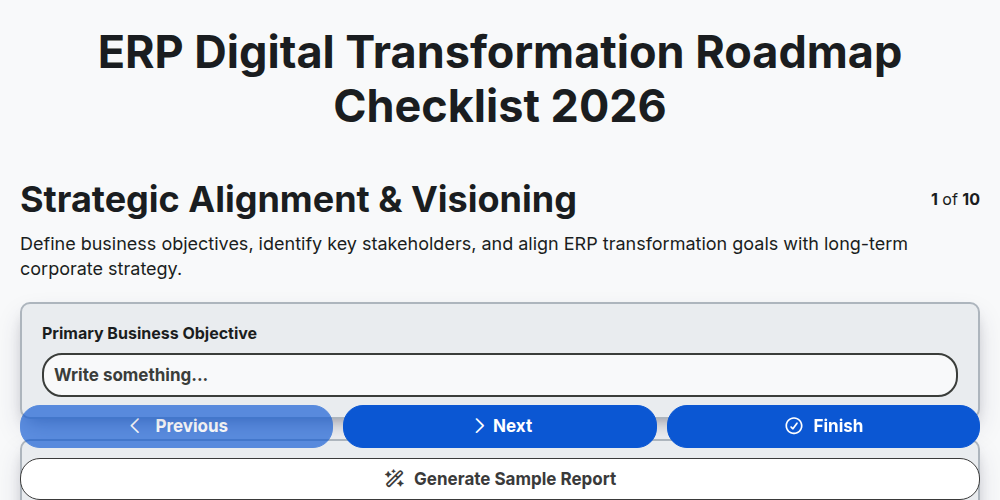
Table of Contents
- Introduction: Navigating the 2026 ERP Landscape
- Phase 1: Defining the North Star: Strategic Alignment & Visioning
- Phase 2: The Reality Check: Current State Assessment (As-Is Analysis)
- Phase 3: Evaluating the Foundation: Digital Maturity & Infrastructure Audit
- Phase 4: Optimizing Operations: Business Process Re-engineering (BPR)
- Phase 5: Building the Backbone: Data Strategy & Governance Framework
- Phase 6: Selecting the Right Partner: Vendor Selection & Ecosystem Evaluation
- Phase 7: Preparing the Engines: Resource & Budget Planning
- Phase 8: Anticipating Obstacles: Risk Management & Mitigation Strategy
- Phase 9: The Human Element: Change Management & Organizational Readiness
- Phase 10: Measuring Excellence: Post-Transformation KPI & ROI Tracking
- Conclusion: Future-Proofing Your Enterprise
- Resources & Links
TLDR: Prepare for the next era of enterprise efficiency with our comprehensive 2026 ERP transformation checklist. This strategic guide walks you through every critical stage of the digital journey-from initial strategic alignment and process re-engineering to data governance, vendor selection, and change management-ensuring your organization achieves measurable ROI and long-term operational excellence in an evolving digital landscape.
Introduction: Navigating the 2026 ERP Landscape
The Era of Intelligent Enterprise: Why 2026 is a Turning Point
As we approach 2026, the concept of Digital Transformation has moved far beyond the mere adoption of cloud computing or the migration of on-premise databases. We have entered the era of the Intelligent Enterprise. In this new landscape, an Enterprise Resource Planning (ERP) system is no longer just a system of record used to track transactions; it is a system of intelligence that leverages AI, real-time data streaming, and hyper-automation to drive autonomous decision-making.
The complexity of the modern business environment-characterized by volatile supply chains, decentralized workforces, and an explosion of unstructured data-means that a traditional, lift-and-shift approach to ERP implementation is a recipe for failure. To remain competitive, organizations can no longer afford to treat ERP upgrades as mere IT projects. They must be treated as fundamental business transformations.
The High Stakes of the 2026 Transformation
The landscape of 2026 presents a unique set of challenges and opportunities. On one hand, the availability of Generative AI and predictive analytics offers unprecedented power to optimize operations. On the other hand, the integration of IoT, edge computing, and much stricter global data privacy regulations adds layers of technical and regulatory complexity that previous generations of ERP projects never had to navigate.
Failure to implement a structured, forward-looking roadmap leads to common pitfalls:
- Data Silos: Implementing new technology without a unified data strategy.
- Process Regression: Automating inefficient, legacy manual processes instead of optimizing them.
- Organizational Friction: Deploying sophisticated tools that the workforce is not trained or culturally prepared to use.
Purpose of This Checklist
This roadmap is designed to serve as your strategic blueprint. It moves beyond the technical implementation phases to address the critical intersections of strategy, people, and technology. Whether you are undergoing a complete Greenfield implementation or a complex migration of a legacy ecosystem, this checklist ensures that your digital transformation is anchored in business value, prepared for the technological demands of 2026, and built to scale.
By following these ten critical pillars, you will transform your ERP from a back-office necessity into a powerful engine for continuous innovation and competitive advantage.
Phase 1: Defining the North Star: Strategic Alignment & Visioning
Establishing the Foundation for Long-Term Success
Before a single line of code is written or a vendor is contacted, the success of your ERP transformation depends on one critical factor: purpose. In the rapidly evolving landscape of 2026, an ERP implementation is no longer just an IT upgrade; it is a fundamental pivot in how your business creates and delivers value.
Aligning Digital Ambition with Corporate Objectives
The primary goal of this phase is to ensure that your digital roadmap is not operating in a vacuum. Every technological milestone must be directly mapped to your overarching business goals. Whether you are aiming for aggressive market expansion, operational cost reduction, or enhanced customer intimacy, your ERP configuration must serve as the engine for these specific outcomes.
Defining the Vision Statement
A successful transformation requires a clear, shared vision that transcends the IT department. This involves:
- Identifying Core Drivers: Are you solving for fragmented data, inefficient supply chains, or lack of real-time visibility?
- Stakeholder Buy-in: Engaging C-suite executives and department heads early to ensure the project has the necessary top-down mandate.
- Success Archetypes: Defining what done looks like. Is it a 20% reduction in order processing time? Is it 100% real-time inventory accuracy?
Setting the Scope and Boundaries
Without a clearly defined vision, scope creep becomes an inevitable project killer. During this stage, leadership must decide the boundaries of the transformation. Will this be a departmental rollout or a global, end-to-end overhaul? By setting these boundaries now, you create the guardrails necessary to keep the project on schedule and within budget as you move into the technical assessment phases.
Phase 2: The Reality Check: Current State Assessment (As-Is Analysis)
Analyzing Your Starting Point
Before you can map out where you want to go, you must have an uncompromisingly clear understanding of where you are today. The As-Is analysis is the diagnostic phase of your digital transformation. Skipping this step is the most common cause of ERP failure, as it leads to paving the cow path-simply digitizing inefficient, broken, or obsolete manual processes.
In 2026, an effective assessment goes beyond mere observation; it requires a deep dive into the operational DNA of your organization.
Mapping the Current Workflow
The goal here is to document every critical business process currently in use. This involves:
- Process Documentation: Creating detailed flowcharts of how orders, procurement, production, and financial reporting move through your current system.
- Identifying Bottlenecks: Pinpointing exactly where delays occur, where manual interventions are excessive, and where information silos exist.
- Pain Point Inventory: Interviewing department heads and frontline users to capture the hidden frictions that don't show up on official organizational charts.
Identifying Shadow IT and Fragmentation
In many modern enterprises, departments often bypass official channels by using unauthorized third-party SaaS tools, complex Excel macros, or disconnected databases to get their jobs done. This Shadow IT is a critical component of your As-Is analysis. To build a unified ERP, you must identify these fragmented pockets of data and software to ensure the new ecosystem can centralize them effectively.
Quantifying the Cost of Inefficiency
A successful roadmap requires a business case. During the As-Is analysis, you aren't just looking for what is broken, but what it is costing you. By quantifying the manual hours lost to data reentry, the error rates in current manual processes, and the financial impact of delayed reporting, you provide the necessary ammunition for the Strategic Alignment phase and secure much-needed stakeholder buy-in.
Pro-Tip for 2026: Don't just look at the software; look at the people. An As-Is analysis is incomplete if it doesn't account for the human element-the tribal knowledge that resides in employees' heads rather than in your current legacy system.
Phase 3: Evaluating the Foundation: Digital Maturity & Infrastructure Audit
Assessing Your Digital Readiness
Before laying the first brick of your new ERP landscape, you must determine if your current technological foundation is capable of supporting advanced automation, AI integration, and real-time data processing. An ERP implementation in 2026 is not merely a software upgrade; it is a leap into a highly interconnected ecosystem. If your underlying infrastructure is fragmented or outdated, even the most sophisticated ERP will fail to deliver its promised value.
The Infrastructure Audit Framework
To ensure your organization is prepared for the complexities of modern ERP, your audit must focus on three critical pillars:
1. Connectivity and Network Resilience Modern ERP systems, particularly Cloud-native and Hybrid models, demand high availability and low latency.
- Bandwidth Capacity: Can your existing network handle the increased data traffic generated by real-time synchronization?
- Edge Computing Readiness: If you operate in manufacturing or logistics, is your infrastructure prepared to handle data processing at the edge to reduce latency?
- Latency & Stability: Evaluate your internet redundancy and failover protocols to prevent operational downtime during cloud outages.
2. Legacy System Integration & Interoperability The New ERP must communicate seamlessly with your Existing ecosystem. You must audit the API-readiness of your current specialized software (e.g., CRM, WMS, or specialized CAD tools).
- Integration Debt: Identify legacy systems that lack modern API capabilities and require middleware to function within a digital ecosystem.
- Silo Identification: Map out where data is currently trapped in black box applications that cannot participate in a unified data flow.
3. Cybersecurity & Cloud Compatibility As you transition toward more centralized data access, your attack surface expands.
- Identity and Access Management (IAM): Evaluate your current ability to implement Zero Trust architecture and Multi-Factor Authentication (MFA) across all enterprise touchpoints.
- Cloud Maturity: Determine which workloads are ready for the public cloud, which require a private cloud, and which must remain on-premise due to regulatory or latency constraints.
- Data Encryption Standards: Assess whether your current infrastructure supports end-to-end encryption for data both at rest and in transit.
The Compatibility Gap Analysis
The goal of this audit is to identify the Compatibility Gap-the distance between your current IT capabilities and the technical requirements of your 2026 ERP vision. By uncovering these gaps early, you can transition from a reactive patchwork approach to a proactive, scalable digital foundation, ensuring that your investment in ERP is supported by a robust, future-proofed digital backbone.
Phase 4: Optimizing Operations: Business Process Re-engineering (BPR)
Reimagining Workflows for a Digital-First Era
The most common mistake in ERP implementation is the lift and shift approach-simply migrating outdated, inefficient manual processes into a modern, expensive software environment. Doing so results in nothing more than a digitized version of chaos.
As we approach 2026, Business Process Re-engineering (BPR) is the stage where you transition from merely automating old habits to fundamentally redesigning how your business operates to leverage the full power of AI, automation, and real-time data.
Moving Beyond Automation to Transformation
BPR is not just about making current tasks faster; it is about questioning whether those tasks need to exist at all. In the context of your 2026 roadmap, this phase involves three critical layers of analysis:
- Process Elimination: Identifying redundant approvals, obsolete manual entries, and shadow workflows that exist outside your official documentation.
- Process Simplification: Stripping away unnecessary complexities and friction points that slow down decision-making.
- Process Optimization: Re-architecting workflows to integrate native ERP features, such as automated triggers, IoT integration, and machine learning-driven forecasting.
Key Objectives of the BPR Stage
To ensure your transformation delivers maximum value, your re-engineering efforts should focus on the following outcomes:
- Standardization Across Silos: Eliminating fragmented departmental workflows to create a single, unified version of the truth across the entire organization.
- Integration of Intelligent Automation: Designing processes that allow for touchless transactions, where data flows seamlessly from procurement to finance without manual intervention.
- Agility and Scalability: Building flexible workflows that can adapt to market shifts, new product launches, or global supply chain disruptions without requiring a total system overhaul.
- Data-Driven Decision Loops: Ensuring that every redesigned process generates clean, structured data that feeds directly into your reporting and analytics engines.
The Golden Rule of Re-engineering
As you approach this phase, remember: Optimize the process first, then automate. If you automate a broken process, you simply accelerate inefficiency. Use this stage to bridge the gap between your current operational reality and your future digital vision.
Phase 5: Building the Backbone: Data Strategy & Governance Framework
Data Integrity: The Foundation of Intelligent ERP
In the era of AI-driven decision-making and real-time analytics, an ERP system is only as powerful as the data flowing through it. As we move into 2026, garbage in, garbage out is no longer just a warning-it is a business risk. A successful transformation requires moving beyond simple data collection toward a sophisticated Data Strategy & Governance Framework.
This phase is about ensuring that your new ERP ecosystem acts as a single source of truth rather than a fragmented repository of conflicting information.
Establishing Data Governance Protocols
To prevent the proliferation of data silos, you must define clear ownership and standardized rules for data management. This involves:
- Data Ownership & Stewardship: Assigning specific individuals (Data Stewards) responsible for the accuracy, integrity, and security of specific datasets (e.g., Finance, Supply Chain, or HR).
- Standardization of Master Data: Developing a universal data language across the organization to ensure that a customer ID or SKU number means the exact same thing in every department.
- Data Lifecycle Management: Defining protocols for how data is created, archived, and eventually purged to maintain system performance and compliance.
Developing the Data Strategy for 2026 and Beyond
A modern ERP roadmap must look past simple storage and toward actionable intelligence. Your strategy should encompass:
- Integration Readiness: Planning how data will flow seamlessly between your new ERP and peripheral third-party applications (SaaS, CRM, IoT devices, and edge computing).
- AI & Machine Learning Preparedness: Ensuring your data architecture is structured to support predictive analytics. If your data is unstructured or poorly labeled, your investment in AI-driven ERP features will fail to yield results.
- Data Security & Compliance: Aligning your data framework with evolving global regulations (such as GDPR, CCPA, or industry-specific mandates). This includes implementing robust encryption, access controls, and audit trails.
The Goal: From Raw Data to Strategic Insight
The objective of this phase is to transition your organization from reactive reporting to proactive intelligence. By implementing a rigorous governance framework, you ensure that when your leadership team pulls a real-time report from the new ERP, the insights are accurate, timely, and-most importantly-trustworthy.
Phase 6: Selecting the Right Partner: Vendor Selection & Ecosystem Evaluation
Navigating the Vendor Landscape: Beyond the Software Feature List
In 2026, choosing an ERP is no longer a simple procurement task of comparing feature sets and pricing tiers. The modern ERP ecosystem is a complex web of cloud-native platforms, specialized AI-integrated modules, and third-party integrations. To ensure your transformation sticks, your evaluation must look beyond the out-of-the-box capabilities and focus on long-term compatibility and ecosystem synergy.
Evaluating the Core Platform vs. The Ecosystem
The centerpiece of your transformation is the ERP itself, but its value is defined by its ability to communicate with your existing and future tech stack. As you evaluate vendors, shift your focus toward the Ecosystem Evaluation:
- API Maturity & Interoperability: Does the vendor offer robust, well-documented APIs that allow for seamless data flow between your ERP and your CRM, SCM, or specialized IoT edge devices?
- The App Marketplace: Investigate the availability of pre-built industry vertical solutions. A strong ecosystem means you can add functionality (like advanced logistics or predictive maintenance) without custom coding.
- AI and Automation Integration: Assess how deeply AI is embedded in the vendor's roadmap. Are they providing plug-and-play machine learning models, or will your team be responsible for building them from scratch?
Criteria for Vendor Selection
To avoid vendor lock-in and ensure a high ROI, use a weighted scoring model to evaluate potential partners against these four pillars:
- Functional Fit & Scalability: Can the platform handle your projected 2030 transaction volumes? Does it support the complex multi-entity, multi-currency, and multi-language requirements of your global operations?
- Implementation Expertise: A great software package is useless without a great implementation partner. Evaluate the vendor's track record in your specific industry. Do they have consultants who understand your unique regulatory and operational nuances?
- Total Cost of Ownership (TCO) Transparency: Look beyond the initial subscription fee. Calculate the long-term costs of data storage increments, API call limits, mandatory upgrades, and the cost of specialized talent required to maintain the system.
- Security & Compliance Posture: In an era of escalating cyber threats, the vendor's security architecture is part of your risk profile. Audit their SOC2 compliance, data residency capabilities, and disaster recovery protocols.
The Partner Mindset
The goal of Phase 6 is to move from a vendor-client relationship to a strategic partnership. The ideal vendor in 2026 is one that demonstrates a roadmap aligned with your business vision, offers a transparent upgrade path, and provides a community of developers and experts that can help you navigate the inevitable shifts in the digital landscape.
Phase 7: Preparing the Engines: Resource & Budget Planning
Navigating the Financial and Human Capital Landscape
As you transition from the theoretical planning of your transformation to the tactical execution, the success of your ERP journey will depend on one critical factor: the stability of your foundation. Phase 7 is where the vision meets the reality of your organization's capacity. Without rigorous resource and budget planning, even the most sophisticated digital roadmap can stall due to innovation fatigue or unexpected cost overruns.
Securing the Financial Commitment
An ERP transformation in 2026 is not a one-time capital expenditure; it is a multi-year strategic investment. To ensure long-term viability, your budget must account for more than just software licensing. A robust budget plan must encompass:
- Total Cost of Ownership (TCO): Beyond the initial implementation, factor in subscription models (SaaS), cloud infrastructure scaling, and periodic mandatory updates.
- Hidden Implementation Costs: Allocate funds for data migration services, integration middleware, and third-party consultancy fees.
- The Shadow Budget: Always include a contingency reserve (typically 15-20%) to manage the inevitable scope creep and unforeseen technical complexities that arise during deployment.
- Post-Go-Live Support: Budget for continuous optimization, hyper-care periods, and ongoing training to ensure the system evolves with your business.
Aligning Human Capital with Digital Ambition
The most advanced ERP system is useless if you lack the talent to operate and maintain it. Resource planning involves identifying the gap between your current workforce capabilities and the skills required for a digital-first ecosystem.
Internal Core Team vs. External Expertise
You must strike a delicate balance between internal knowledge and external specialized skills.
- The Internal Task Force: Identify Subject Matter Experts (SMEs) from finance, supply chain, and operations. These individuals must be shielded from their daily operational duties to focus on the transformation.
- External Partners: Determine where you need specialized System Integrators (SIs) or developers to bridge the gap in technical architecture and complex integrations.
Capacity and Skill Gap Analysis
In the 2026 landscape, the demand for data literacy and digital fluency is at an all-time high. Your resource plan should include a strategy for upskilling your existing workforce. If your team is heavily reliant on legacy manual processes, your roadmap must include a dedicated timeline for technical training and the acquisition of new digital competencies.
The Goal: By the end of this phase, you should possess a clear,-audited financial roadmap and a documented roster of personnel, ensuring that when the implementation begins, your organization has the fuel necessary to reach the finish line.
Phase 8: Anticipating Obstacles: Risk Management & Mitigation Strategy
Navigating Uncertainty: Proactive Risk Mitigation
In the landscape of 2026's hyper-connected industrial ecosystem, an ERP implementation is no longer just an IT upgrade; it is a fundamental shift in your organization's DNA. With increased complexity comes increased risk. A successful roadmap does not rely on the absence of challenges, but on the presence of a robust framework to neutralize them before they escalate into costly downtime.
Identifying the Critical Risk Vectors
To build a resilient transformation, you must categorize potential disruptions into three primary domains:
- Technical & Integration Risks: The danger of data silos persisting despite new software, or the failure of legacy middleware to communicate with modern cloud-native APIs.
- Operational & Continuity Risks: The potential for process paralysis during the transition phase, where real-time decision-making is compromised by the migration of live production data.
- Human & Adoption Risks: The most common point of failure-resistance to new workflows, loss of institutional knowledge, and the shadow IT phenomenon where employees revert to old spreadsheets.
The Mitigation Framework
A high-performing roadmap employs a proactive Detect-Assess-Respond loop. For every identified risk, your strategy must include:
- Impact Analysis: Quantifying the potential cost (in both USD and man-hours) of a disruption.
- Contingency Buffering: Building time and budget buffers into your 2026 deployment schedule to absorb unforeseen integration complexities.
- Fallback Protocols: Establishing clear Point of No Return milestones and rollback procedures to ensure that if a deployment phase fails, business operations can revert to a stable state without data loss.
Strengthening the Safety Net
The goal of this phase is to transform uncertainty into manageable variables. By integrating a Risk Management & Mitigation Strategy into your roadmap, you ensure that when the inevitable black swan event occurs, your digital transformation remains on track, your budget remains intact, and your organization's momentum stays uninterrupted.
Phase 9: The Human Element: Change Management & Organizational Readiness
Bridging the Gap Between Technology and People
Even the most sophisticated ERP system will fail if your workforce refuses to use it. In 2026, digital transformation is no longer just a technical upgrade; it is a cultural evolution. The most significant barrier to ERP success is rarely the software itself, but rather the human friction caused by disrupted workflows and psychological resistance to change.
Cultivating a Culture of Adoption
To ensure a smooth transition, organizations must move beyond simply announcing a new system and focus on active engagement. This involves:
- Stakeholder Buy-in from Day One: Transformation should not be seen as an IT project but as a strategic business initiative. Early involvement of department heads and end-users ensures that the system meets real-world needs.
- Comprehensive Training Programs: One-size-fits-all training is obsolete. Effective roadmap execution requires role-based training modules that demonstrate how the new ERP specifically simplifies individual daily tasks.
- Transparent Communication Loops: Uncertainty breeds resistance. Establish a continuous feedback loop where employees can voice concerns, ask questions, and understand the why behind the transition.
Building Organizational Readiness
Before the Go-Live date, your organization must undergo a rigorous readiness assessment to ensure the business can absorb the change without operational paralysis.
Strategies for Mitigating Resistance
- Identifying Change Champions: Empower a network of super-users across various departments. These individuals act as internal advocates and first-line support, reducing the burden on the IT helpdesk.
- Managing the 'Productivity Dip': Acknowledge that performance may temporarily fluctuate as users climb the learning curve. Planning for this dip in your resource allocation prevents unrealistic expectations from stakeholders.
- Rewarding Milestones: Celebrate small wins during the implementation phases to maintain momentum and reinforce the benefits of the new digital ecosystem.
By prioritizing organizational readiness, you transform your workforce from passive observers into active drivers of your digital future.
Phase 10: Measuring Excellence: Post-Transformation KPI & ROI Tracking
Defining Success Beyond the Go-Live
The completion of an ERP implementation is not the finish line; it is the starting line for a new era of operational excellence. As we move into 2026, the most successful organizations are those that transition from a project mindset to a continuous improvement mindset. Without a rigorous framework to measure the impact of your digital transformation, you risk falling into the trap of feature fatigue-where you have expensive new tools but no measurable business value.
To ensure your ERP investment delivers the promised value, you must implement a structured post-transformation evaluation framework.
Establishing Your Post-Implementation Scorecard
To accurately gauge the success of your transformation, you must move beyond superficial metrics and focus on two critical dimensions: Operational Efficiency (KPIs) and Financial Value (ROI).
1. Key Performance Indicators (KPIs) for Operational Excellence
Post-2026, data-driven decision-making relies on real-time visibility. Your KPIs should focus on how the new ERP has optimized your core business processes:
- Process Cycle Time Reduction: Measure the time taken to complete critical workflows, such as the Order-to-Cash or Procure-to-Pay cycles, compared to your pre-transformation baseline.
- Data Accuracy & Integrity Rates: Track the reduction in manual data entry errors and the frequency of reconciliation discrepancies.
- Inventory Turnover & Accuracy: For manufacturing and retail, monitor improvements in stock accuracy and the reduction in carrying costs.
- System Adoption & Utilization Rates: Evaluate how deeply the new features are being integrated into daily operations. High adoption is the truest indicator of a successful change management strategy.
- Decision-Making Velocity: Assess the time saved in generating complex, cross-functional reports that previously required manual spreadsheet manipulation.
2. Calculating Realized ROI and Total Cost of Ownership (TCO)
The financial justification for an ERP transformation extends far beyond the initial implementation cost. A robust tracking strategy must account for:
- Direct Cost Savings: Quantifiable reductions in labor costs due to automation, decreased paper usage, and lower inventory carrying costs.
- Indirect Value Creation: The hidden ROI found in improved vendor negotiations, reduced regulatory compliance penalties, and enhanced customer retention through better service delivery.
- TCO Monitoring: Continually audit the total cost of ownership, including cloud subscription escalations, ongoing maintenance, third-party integration updates, and necessary hardware upgrades.
The Continuous Feedback Loop
The final component of your roadmap is the implementation of a Post-Implementation Audit (PIA). Scheduled at the 6-month and 12-month marks, these audits should involve stakeholders from every department. Use these sessions to identify friction points where the software may not be meeting user needs and to uncover opportunities for further automation.
In the 2026 landscape, an ERP is a living ecosystem. By treating KPI and ROI tracking as a continuous loop rather than a one-time event, you ensure that your digital transformation remains an engine for long-term, scalable growth.
Conclusion: Future-Proofing Your Enterprise
Navigating the Complexity of 2026 and Beyond
As we approach 2026, the ERP landscape is no longer just about centralizing data; it is about creating a living, breathing digital ecosystem capable of autonomous decision-making and seamless integration. The transition from a legacy system to a modern, intelligent ERP is not a singular IT project-it is a fundamental evolution of your business DNA.
The roadmap outlined in this checklist serves as more than just a sequence of tasks; it is a strategic safeguard against the common pitfalls of digital transformation. By meticulously moving through each phase-from initial Strategic Alignment and Business Process Re-engineering to the critical nuances of Change Management and Data Governance-you ensure that your technology investment delivers measurable, long-term value rather than just increased complexity.
Turning Uncertainty into Competitive Advantage
The complexity of the modern global market demands a level of agility that only a well-executed digital transformation can provide. As you implement this roadmap, keep these three principles in mind:
- Iterative Progress over Perfection: Don't let the scale of the roadmap intimidate you. Treat the transformation as a series of continuous improvements, using Post-Transformation KPI tracking to inform your next evolution.
- People-Centricity is Non-Negotiable: A perfect technical architecture will fail without Organizational Readiness. Your technology is only as powerful as the workforce's ability to utilize it.
- Data is Your New Currency: In the era of AI-driven ERPs, your Data Strategy will determine whether your system provides foresight or merely hindsight.
Your Path Forward
The era of the static ERP is over. To remain competitive in 2026, your organization must embrace a roadmap that balances robust infrastructure with the flexibility to innovate. Use this checklist as your compass to navigate the complexities of digital change, mitigate risks, and ultimately build a resilient, data-driven enterprise that is prepared for whatever the future holds.
Resources & Links
- Gartner: Leading research and advisory services for strategic technology planning and enterprise digital transformation trends.
- Forbes Technology Council: Insights from industry leaders on the impact of AI, cloud computing, and digital shifts on business operations.
- McKinsey & Company: Deep dives into operational excellence, business process re-engineering, and large-scale organizational change.
- Deloitte Insights: Comprehensive reports on digital maturity models, risk management, and enterprise-wide digital transformation strategies.
- SAP: Industry-standard resources for understanding modern ERP ecosystems, cloud integration, and smart manufacturing.
- Oracle: Information regarding enterprise resource planning, database management, and cloud-native business applications.
- Boston Consulting Group (BCG): Strategic frameworks for navigating digital disruption and building long-term competitive advantages through technology.
- Harvard Business Review: Essential reading for the 'Human Element' of transformation, focusing on leadership and organizational change management.
- PMI (Project Management Institute): Best practices for project planning, resource allocation, and managing complex enterprise-wide implementations.
- Tableau: Resources for data visualization and building the analytics layer of your post-transformation KPI tracking.
- Informatica: Specialized insights into data governance, data integration, and managing large-scale data migration projects.
- Salesforce: Resources on integrating CRM ecosystems with ERP systems to ensure a unified customer and operational view.
- IBM Research: Cutting-edge information on AI, automation, and the future of intelligent enterprise infrastructure.
- PwC: Expert guidance on risk mitigation, regulatory compliance, and auditing digital business processes.
- ZDNet: Technical news and analysis regarding IT infrastructure, cloud computing, and software vendor evaluations.
- ScienceDirect: Academic studies and peer-reviewed research on business process re-engineering and digital maturity models.
- Atlassian: Tools and methodologies for managing the roadmap, tracking tasks, and collaborating during complex digital projects.
- TechTarget: Detailed technical definitions and deep dives into enterprise architecture and software evaluation criteria.
Comments
There are no comments yet. Be the first to add one!
ERP - Enterprise Resource Planning Solution Demo
Overwhelmed by disconnected systems? ChecklistGuro provides a centralized ERP solution, connecting your business processes - finance, operations, & more - for improved visibility and control. Simplify operations & boost efficiency.
Related Articles
MRP System Go-Live Checklist: Your Path to a Successful Implementation
Top 10 CMiC Alternatives for 2025
The Ultimate Foundation Waterproofing Installation Checklist Template
Top 10 Odoo Alternatives for 2025
How to Save Money on Bill of Materials (BOM) Management Software
The Ultimate Waterproofing Checklist: Ensuring a Leak-Proof Installation
The 10 Best Manufacturing Management Software of 2025
MRP Vendor Master Data Checklist: Ensuring Accuracy and Efficiency
Need help with
Enterprise Resource Planning (ERP)?
Have a question? We're here to help. Please submit your inquiry, and we'll respond promptly.